NCERT Solutions for Class 10 Science Chapter 1 (Chemical Reactions and Equations) solve every question the textbook prints — all 20 end-of-chapter exercise questions and all 8 intext questions — with concept-first reasoning, balanced equations, and a common-error warning on each.
Use this page as your homework answer sheet and your revision companion: attempt each question yourself first, then compare your working against the solution, and finish with the six-step balancing recap and the activity observation table.
These solutions follow the NCERT Class 10 Science textbook for the 2026-27 session, and every fact below traces to its pages — the official NCERT Chapter 1 PDF (jesc1) is the authoritative source you can check page-by-page. For the broader picture, pair this page with the Class 10 Science revision notes and the full Class 10 study material hub.
Reference: NCERT Class 10 Science textbook, chapter Chemical Reactions and Equations.
Reaction-type and redox statement questions (Exercise Q1-Q3)
Before solving, fix one mental table — the entire chapter is built on these five classifications. You will reuse it on every “identify the type” question below (NCERT, p. 6-12):
| Reaction type | Reactants → Products | Example from this chapter |
|---|---|---|
| Combination | Two or more → one single product | \(\text{CaO} + \text{H}_2\text{O} \rightarrow \text{Ca(OH)}_2\) |
| Decomposition | One reactant → two or more products | \(\text{CaCO}_3 \xrightarrow{\text{Heat}} \text{CaO} + \text{CO}_2\) |
| Displacement | Element + compound → new element + new compound | \(\text{Fe} + \text{CuSO}_4 \rightarrow \text{FeSO}_4 + \text{Cu}\) |
| Double displacement | Two compounds exchange ions | \(\text{Na}_2\text{SO}_4 + \text{BaCl}_2 \rightarrow \text{BaSO}_4 + 2\text{NaCl}\) |
| Redox | One gains oxygen/loses hydrogen; the other loses oxygen/gains hydrogen | \(\text{CuO} + \text{H}_2 \rightarrow \text{Cu} + \text{H}_2\text{O}\) |
Knowing where the marks sit helps you revise. The 20 exercise questions break into five skill groups:
- Choice and reasoning (Q1-Q3): redox terms, spotting a reaction type, metal + acid behaviour.
- Balancing skill (Q4-Q7): definitions, translating word statements, balancing skeletons.
- Naming the type (Q8): balanced equation plus its classification.
- Energy and decomposition (Q9-Q12): exothermic/endothermic, energy sources.
- Displacement to daily life (Q13-Q20): precipitation, redox terms, corrosion, rancidity.
Question 1: Which statements about \(2\text{PbO(s)} + \text{C(s)} \rightarrow 2\text{Pb(s)} + \text{CO}_2\text{(g)}\) are incorrect?
Which of the statements about the reaction below are incorrect?
\(2\text{PbO(s)} + \text{C(s)} \rightarrow 2\text{Pb(s)} + \text{CO}_2\text{(g)}\)
- (a) Lead is getting reduced.
- (b) Carbon dioxide is getting oxidised.
- (c) Carbon is getting oxidised.
- (d) Lead oxide is getting reduced.
- (i) (a) and (b)
- (ii) (a) and (c)
- (iii) (a), (b) and (c)
- (iv) all
This question checks the chapter’s oxygen-based definitions: a substance that gains oxygen is oxidised, and one that loses oxygen is reduced (NCERT, p. 12). In \(2\text{PbO} + \text{C} \rightarrow 2\text{Pb} + \text{CO}_2\), lead oxide (PbO, the compound) loses its oxygen to become lead, so PbO is reduced — that makes statement (d) correct.
Carbon (C) gains oxygen to form CO₂, so carbon is oxidised. Carbon dioxide is a product of that oxidation; it cannot itself be “getting oxidised”, so statement (b) is incorrect. Statement (a) is the trap: it says the element lead is reduced, but the substance undergoing reduction is the compound lead oxide, not the free element lead.
The accepted answer is (iii) — (a), (b) and (c). Note honestly: statement (c) reads as chemically true (carbon does gain oxygen), which is exactly why this MCQ is discussed so often — the official key groups (a), (b) and (c) as incorrect.
Correct answer: (iii) (a), (b) and (c).
Question 2: What type of reaction is \(\text{Fe}_2\text{O}_3 + 2\text{Al} \rightarrow \text{Al}_2\text{O}_3 + 2\text{Fe}\)?
\(\text{Fe}_2\text{O}_3 + 2\text{Al} \rightarrow \text{Al}_2\text{O}_3 + 2\text{Fe}\)
The above reaction is an example of a
- (a) combination reaction.
- (b) double displacement reaction.
- (c) decomposition reaction.
- (d) displacement reaction.
Watch what moves: aluminium (an element) replaces iron from its compound iron(III) oxide. An element taking the place of a less reactive element inside a compound is the signature of a displacement reaction (NCERT, p. 10-11).
It is not a combination (two reactants give one product), not a decomposition (one reactant splits), and not a double displacement (two compounds exchanging ions). The reaction is also redox — aluminium gains oxygen, iron(III) oxide loses it — but displacement is the classification the options permit.
Correct answer: (d) displacement reaction.
Question 3: What happens when dilute hydrochloric acid is added to iron fillings?
What happens when dilute hydrochloric acid is added to iron fillings? Tick the correct answer.
- (a) Hydrogen gas and iron chloride are produced.
- (b) Chlorine gas and iron hydroxide are produced.
- (c) No reaction takes place.
- (d) Iron salt and water are produced.
The general rule that decides this: a metal plus a dilute acid gives a salt plus hydrogen gas. Iron is more reactive than hydrogen, so iron displaces hydrogen from hydrochloric acid — the same gas-forming chemistry you saw with zinc and dilute sulphuric acid in Activity 1.3 and Figure 1.2 (NCERT, p. 2).
The salt is iron chloride: \(\text{Fe} + 2\text{HCl} \rightarrow \text{FeCl}_2 + \text{H}_2\). Bubbles of hydrogen form and the acid slowly turns pale green as iron dissolves.
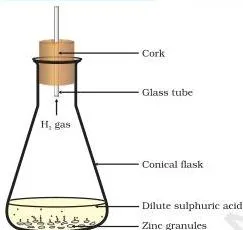
Common error: option (d) — “iron salt and water” — describes neutralisation (acid + base gives salt + water).
Metal + acid is a different reaction: it produces hydrogen gas, not water.
The correct answer is (a).
Correct answer: (a) Hydrogen gas and iron chloride are produced.
Balancing equations: definition, translation and practice (Exercise Q4-Q6)
Question 4: What is a balanced chemical equation? Why should chemical equations be balanced?
A balanced chemical equation has the same number of atoms of every element on the reactant (LHS) and product (RHS) sides.
Balancing is not a convention — it follows the law of conservation of mass (NCERT, p. 3): atoms are neither created nor destroyed in a chemical reaction, so the total mass of the reactants must equal the total mass of the products. If an equation is unbalanced, it implies mass has appeared or vanished, which is impossible.
We balance by putting coefficients (whole numbers) before formulae — never by changing subscripts, because a subscript change alters the substance itself.
Common error: students “fix” an imbalance by editing the formula, writing \(\text{H}_2\text{O}_4\) instead of \(4\text{H}_2\text{O}\).
The textbook warns against exactly this (NCERT, p. 4): a coefficient multiplies the whole formula; a subscript change makes a new compound.
Question 5: Translate these statements into chemical equations and then balance them
(a) Hydrogen gas combines with nitrogen to form ammonia.
(b) Hydrogen sulphide gas burns in air to give water and sulphur dioxide.
(c) Barium chloride reacts with aluminium sulphate to give aluminium chloride and a precipitate of barium sulphate.
(d) Potassium metal reacts with water to give potassium hydroxide and hydrogen gas.
Part (a): Hydrogen and nitrogen are both diatomic gases, so each starts as \(\text{H}_2\) and \(\text{N}_2\), and ammonia is \(\text{NH}_3\). Two nitrogens on the left need two \(\text{NH}_3\) on the right, which introduces six hydrogens — so three \(\text{H}_2\) are needed:
\[ \text{N}_2(\text{g}) + 3\text{H}_2(\text{g}) \rightarrow 2\text{NH}_3(\text{g}) \]
Part (b): Hydrogen sulphide is \(\text{H}_2\text{S}\).
“Burns in air” means it reacts with oxygen, \(\text{O}_2\).
Two \(\text{H}_2\text{S}\) give four hydrogens — enough for two waters — and the sulphur of two \(\text{H}_2\text{S}\) gives two \(\text{SO}_2\).
Oxygen must then supply \(2 + 4 = 6\) atoms, i.e.
three \(\text{O}_2\):
\[ 2\text{H}_2\text{S}(\text{g}) + 3\text{O}_2(\text{g}) \rightarrow 2\text{H}_2\text{O}(\text{g}) + 2\text{SO}_2(\text{g}) \]
Part (c): Barium is \(\text{Ba}^{2+}\) and sulphate is \(\text{SO}_4^{2-}\), so barium sulphate is \(\text{BaSO}_4\) with a 1:1 formula; aluminium is \(\text{Al}^{3+}\) and chloride is \(\text{Cl}^-\), giving \(\text{AlCl}_3\).
Three sulphates on the left need three \(\text{BaSO}_4\), which uses three \(\text{BaCl}_2\) and supplies six chlorides — exactly enough for two \(\text{AlCl}_3\):
\[ 3\text{BaCl}_2 + \text{Al}_2(\text{SO}_4)_3 \rightarrow 2\text{AlCl}_3 + 3\text{BaSO}_4 \]
Part (d): Potassium and water give potassium hydroxide \(\text{KOH}\) and hydrogen.
Hydrogen must leave as the diatomic \(\text{H}_2\), so two waters are needed to supply two hydrogens for it, and those two waters also supply the two oxygens that fix two KOH:
\[ 2\text{K} + 2\text{H}_2\text{O} \rightarrow 2\text{KOH} + \text{H}_2 \]
Common error: in part (d), students write \(\text{Na} + \text{H}_2\text{O} \rightarrow \text{NaOH} + \text{H}_2\) unbalanced, forgetting hydrogen leaves as \(\text{H}_2\) and that every atom on the right must be matched on the left.
Question 6: Balance the following chemical equations
(a) \(\text{HNO}_3 + \text{Ca(OH)}_2 \rightarrow \text{Ca(NO}_3)_2 + \text{H}_2\text{O}\)
(b) \(\text{NaOH} + \text{H}_2\text{SO}_4 \rightarrow \text{Na}_2\text{SO}_4 + \text{H}_2\text{O}\)
(c) \(\text{NaCl} + \text{AgNO}_3 \rightarrow \text{AgCl} + \text{NaNO}_3\)
(d) \(\text{BaCl}_2 + \text{H}_2\text{SO}_4 \rightarrow \text{BaSO}_4 + \text{HCl}\)
Apply the hit-and-trial routine from pages 3-5: box every formula, count atoms, then adjust with coefficients only.
Part (a): Calcium nitrate already holds two nitrate groups, so two \(\text{HNO}_3\) supply them. That gives two extra hydrogens plus the two already on calcium hydroxide = four, needing two waters:
\[ 2\text{HNO}_3 + \text{Ca(OH)}_2 \rightarrow \text{Ca(NO}_3)_2 + 2\text{H}_2\text{O} \]
Part (b): Sodium sulphate fixes two sodiums, so two \(\text{NaOH}\) are needed.
Two waters form from the two OH groups and the two hydrogens of sulphuric acid:
\[ 2\text{NaOH} + \text{H}_2\text{SO}_4 \rightarrow \text{Na}_2\text{SO}_4 + 2\text{H}_2\text{O} \]
Part (c): Check the counts before touching anything — each element already matches on both sides (Na 1 = 1, Cl 1 = 1, Ag 1 = 1, N 1 = 1, O 3 = 3).
This equation is already balanced; the mark is earned by saying so and proving it with the count:
\[ \text{NaCl} + \text{AgNO}_3 \rightarrow \text{AgCl} + \text{NaNO}_3 \]
Part (d): Barium sulphate takes the only barium and the only sulphate, leaving two chlorides and two hydrogens free to pair as \(\text{HCl}\):
\[ \text{BaCl}_2 + \text{H}_2\text{SO}_4 \rightarrow \text{BaSO}_4 + 2\text{HCl} \]
For part (a), the final atom check looks like this — the same table the textbook builds for \(\text{Zn} + \text{H}_2\text{SO}_4\) (NCERT, p. 3):
| Element | Reactants (LHS) | Products (RHS) |
|---|---|---|
| H | 2 + 2 = 4 | 2 × 2 = 4 |
| N | 2 | 2 |
| O | 6 + 2 = 8 | 6 + 2 = 8 |
| Ca | 1 | 1 |
Common error: skipping the final count.
Part (c) shows why the check matters — an equation can look unfinished when it is actually balanced, and the count is the evidence.
From word statements to balanced equations with reaction types (Exercise Q7-Q8)
Question 7: Write the balanced chemical equations for these reactions
(a) Calcium hydroxide + Carbon dioxide → Calcium carbonate + Water
(b) Zinc + Silver nitrate → Zinc nitrate + Silver
(c) Aluminium + Copper chloride → Aluminium chloride + Copper
(d) Barium chloride + Potassium sulphate → Barium sulphate + Potassium chloride
Part (a): Calcium is \(\text{Ca}^{2+}\) and hydroxide is \(\text{OH}^-\), so calcium hydroxide is \(\text{Ca(OH)}_2\); carbonate is \(\text{CO}_3^{2-}\), so calcium carbonate is \(\text{CaCO}_3\). One carbon dioxide and one water complete the balance:
\[ \text{Ca(OH)}_2 + \text{CO}_2 \rightarrow \text{CaCO}_3 + \text{H}_2\text{O} \]
This is the whitewashing finish reaction (NCERT, p. 7) — the slow formation of the shiny calcium carbonate layer on walls.
Part (b): Zinc is more reactive than silver, so it displaces silver from silver nitrate. Each silver nitrate supplies one silver, but zinc nitrate \(\text{Zn(NO}_3)_2\) needs two nitrate groups, so two \(\text{AgNO}_3\) are needed:
\[ \text{Zn} + 2\text{AgNO}_3 \rightarrow \text{Zn(NO}_3)_2 + 2\text{Ag} \]
Part (c): Aluminium forms \(\text{Al}^{3+}\) and copper chloride is \(\text{CuCl}_2\), so aluminium chloride is \(\text{AlCl}_3\).
Two aluminiums give six chlorides, matching three \(\text{CuCl}_2\):
\[ 2\text{Al} + 3\text{CuCl}_2 \rightarrow 2\text{AlCl}_3 + 3\text{Cu} \]
Part (d): This is the ion-exchange pattern of Activity 1.10 (NCERT, p. 11): barium and sulphate form the insoluble \(\text{BaSO}_4\), while potassium and chloride pair as \(\text{KCl}\).
Two potassium chlorides are needed to use both chlorides of barium chloride:
\[ \text{BaCl}_2 + \text{K}_2\text{SO}_4 \rightarrow \text{BaSO}_4 + 2\text{KCl} \]
Common error: forgetting the brackets in \(\text{Ca(OH)}_2\) and \(\text{Zn(NO}_3)_2\).
The subscript outside the bracket multiplies the whole group — write \(2\text{AgNO}_3\), never \(\text{Ag}_2\text{NO}_3\).
Question 8: Write the balanced equation and identify the type of reaction in each case
(a) Potassium bromide(aq) + Barium iodide(aq) → Potassium iodide(aq) + Barium bromide(s)
(b) Zinc carbonate(s) → Zinc oxide(s) + Carbon dioxide(g)
(c) Hydrogen(g) + Chlorine(g) → Hydrogen chloride(g)
(d) Magnesium(s) + Hydrochloric acid(aq) → Magnesium chloride(aq) + Hydrogen(g)
Part (a): Potassium is \(\text{K}^+\) and bromide is \(\text{Br}^-\), so potassium bromide is \(\text{KBr}\); barium iodide is \(\text{BaI}_2\) (Ba²⁺ with two I⁻). Barium bromide is written \(\text{BaBr}_2\), and the (s) tells you it precipitates.
Exchange the ions — two \(\text{KBr}\) supply the two bromides \(\text{BaBr}_2\) needs, and \(\text{BaI}_2\) supplies two iodides for two KI:
\[ 2\text{KBr(aq)} + \text{BaI}_2\text{(aq)} \rightarrow 2\text{KI(aq)} + \text{BaBr}_2\text{(s)} \]
Two compounds exchange ions, so this is a double displacement reaction. The (s) makes it also a precipitation reaction, but the question asks for the type, and the ion exchange is the defining feature.
Part (b): One reactant (\(\text{ZnCO}_3\)) splits into two simpler products on heating:
\[ \text{ZnCO}_3\text{(s)} \xrightarrow{\text{Heat}} \text{ZnO(s)} + \text{CO}_2\text{(g)} \]
Type: decomposition (thermal, since heat drives it).
Part (c): Two elements combine into a single product. Both are diatomic gases, and one molecule of each makes two molecules of hydrogen chloride:
\[ \text{H}_2\text{(g)} + \text{Cl}_2\text{(g)} \rightarrow 2\text{HCl(g)} \]
Type: combination.
Part (d): Magnesium displaces hydrogen from the acid because magnesium is more reactive than hydrogen. One magnesium gives one \(\text{MgCl}_2\), needing two chlorides — hence two \(\text{HCl}\) — and the freed hydrogens pair as \(\text{H}_2\):
\[ \text{Mg(s)} + 2\text{HCl(aq)} \rightarrow \text{MgCl}_2\text{(aq)} + \text{H}_2\text{(g)} \]
Type: displacement.
Common error in (a): answering “precipitation” instead of “double displacement”.
Precipitation describes what happens (a solid falls out); the reaction type is the ion exchange.
Exothermic, endothermic and decomposition reactions (Exercise Q9-Q12)
Question 9: What does one mean by exothermic and endothermic reactions? Give examples.
The dividing question is simple: does the reaction release heat to its surroundings or absorb it? Exothermic reactions release heat along with the products (NCERT, p. 7) — the mixture warms up. Examples: burning of natural gas (\(\text{CH}_4 + 2\text{O}_2 \rightarrow \text{CO}_2 + 2\text{H}_2\text{O} + \text{heat}\)), respiration, and the decomposition of vegetable matter into compost.
Endothermic reactions absorb energy (NCERT, p. 9-10) — the mixture cools. Examples: thermal decomposition of limestone (\(\text{CaCO}_3 \xrightarrow{\text{Heat}} \text{CaO} + \text{CO}_2\)), electrolysis of water, and the barium hydroxide + ammonium chloride group activity on page 10, where the test tube turns cold in your palm.
Common error: labelling electrolysis exothermic because “energy is involved”.
Energy supplied to break the reactant apart is the sign of an endothermic reaction.
Question 10: Why is respiration considered an exothermic reaction? Explain.
Respiration releases energy, and releasing energy is exactly what makes a reaction exothermic. Follow the food chain: carbohydrates from rice, potatoes and bread are digested down to glucose (\(\text{C}_6\text{H}_{12}\text{O}_6\)); glucose then combines with oxygen in the body’s cells (NCERT, p. 7). The equation on page 7 shows the product list ends in energy:
\[ \text{C}_6\text{H}_{12}\text{O}_6\text{(aq)} + 6\text{O}_2\text{(aq)} \rightarrow 6\text{CO}_2\text{(aq)} + 6\text{H}_2\text{O(l)} + \text{energy} \]
That energy keeps us alive — it powers movement, growth and repair. Because the reaction supplies energy out, not in, it is exothermic, not endothermic.
Common error: quoting the equation without saying what “exothermic” means here — state that energy is a product of the reaction.
Question 11: Why are decomposition reactions called the opposite of combination reactions? Write equations for these reactions.
The two definitions are mirror images. A combination reaction builds one product from two or more reactants; a decomposition reaction breaks one reactant into two or more simpler products (NCERT, p. 6-8). What combination does forward, decomposition undoes — which is why the textbook calls them opposite. One pair that shows this clearly:
\[ \text{Combination:}\quad \text{CaO} + \text{H}_2\text{O} \rightarrow \text{Ca(OH)}_2 \]
\[ \text{Decomposition:}\quad \text{CaCO}_3 \xrightarrow{\text{Heat}} \text{CaO} + \text{CO}_2 \]
Common error: writing a definition without any equation.
The question explicitly demands equations for both types, and each equation must show the direction: two substances collapsing into one, and one substance splitting into two.
Question 12: Write one equation each for decomposition reactions where energy is supplied as heat, light or electricity
Decomposition needs an energy input, and the source gives the name: heat → thermal decomposition, light → photolytic, electricity → electrolysis (NCERT, p. 8-9). Pick one reaction per energy source and write the source above the arrow — the question scores that detail.
Heat: green ferrous sulphate crystals turn brown, giving ferric oxide, sulphur dioxide and sulphur trioxide:
\[ 2\text{FeSO}_4\text{(s)} \xrightarrow{\text{Heat}} \text{Fe}_2\text{O}_3\text{(s)} + \text{SO}_2\text{(g)} + \text{SO}_3\text{(g)} \]
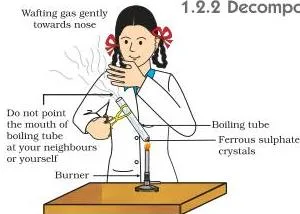
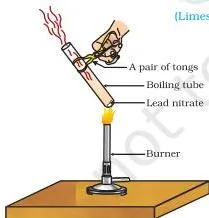
Heat (second option): lead nitrate gives brown fumes of nitrogen dioxide:
\[ 2\text{Pb(NO}_3)_2\text{(s)} \xrightarrow{\text{Heat}} 2\text{PbO(s)} + 4\text{NO}_2\text{(g)} + \text{O}_2\text{(g)} \]
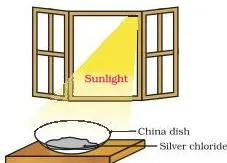
Light: white silver chloride turns grey in sunlight, splitting into silver and chlorine — the reaction behind black and white photography:
\[ 2\text{AgCl(s)} \xrightarrow{\text{Sunlight}} 2\text{Ag(s)} + \text{Cl}_2\text{(g)} \]
Electricity: electrolysis of water splits it into hydrogen and oxygen (see Figure 1.6 in the intext section below):
\[ 2\text{H}_2\text{O(l)} \xrightarrow{\text{Electricity}} 2\text{H}_2\text{(g)} + \text{O}_2\text{(g)} \]
Common error: forgetting the energy source above the arrow — Q12 explicitly tests the three labels heat, light and electricity, and the source is part of the answer.
Displacement, double displacement and precipitation (Exercise Q13-Q15)
Question 13: What is the difference between displacement and double displacement reactions? Write equations for these reactions.
Count the actors. In a displacement reaction, one element pushes a less reactive element out of its compound — so the pattern is element + compound → new element + new compound (NCERT, p. 10-11). Zinc displaces copper from copper sulphate:
\[ \text{Zn(s)} + \text{CuSO}_4\text{(aq)} \rightarrow \text{ZnSO}_4\text{(aq)} + \text{Cu(s)} \]
In a double displacement reaction, two compounds exchange ions — the positive ion of one pairs with the negative ion of the other (NCERT, p. 11). Sodium sulphate and barium chloride swap partners:
\[ \text{Na}_2\text{SO}_4\text{(aq)} + \text{BaCl}_2\text{(aq)} \rightarrow \text{BaSO}_4\text{(s)} + 2\text{NaCl(aq)} \]
Common error: answering definitions only.
The question says “write equations” — each contrast must pair its definition with a balanced equation, or marks are lost.
Question 14: Recovery of silver from silver nitrate solution using copper
In the refining of silver, the recovery of silver from silver nitrate solution involved displacement by copper metal. Write down the reaction involved.
Copper is more reactive than silver, so copper atoms displace silver from its nitrate solution — silver drops out of solution as the metal while copper goes in as copper(II) nitrate (NCERT, p. 10-11 displacement pattern). Each \(\text{Cu}^{2+}\) ion needs two nitrate groups, so two \(\text{AgNO}_3\) are consumed:
\[ \text{Cu(s)} + 2\text{AgNO}_3\text{(aq)} \rightarrow \text{Cu(NO}_3)_2\text{(aq)} + 2\text{Ag(s)} \]
This is also a redox reaction — copper gains oxygen (from nitrate) and silver(I) loses it — but the question names the driving idea: displacement of a less reactive metal by a more reactive one.
Common error: writing \(\text{Cu} + \text{AgNO}_3 \rightarrow \text{CuNO}_3 + \text{Ag}\).
Copper(II) nitrate is \(\text{Cu(NO}_3)_2\), which forces the coefficient 2 on \(\text{AgNO}_3\) and balances the nitrates.
Question 15: What do you mean by a precipitation reaction? Explain by giving examples.
A precipitation reaction is one in which two solutions react to form an insoluble solid, called a precipitate (NCERT, p. 11). The solid does not stay dissolved — it falls out of the mixture, which is why the reaction is visible. The chapter’s own example is sodium sulphate mixed with barium chloride, where the white \(\text{BaSO}_4\) settles out (Activity 1.10):
\[ \text{Na}_2\text{SO}_4\text{(aq)} + \text{BaCl}_2\text{(aq)} \rightarrow \text{BaSO}_4\text{(s)} + 2\text{NaCl(aq)} \]
A second example from Activity 1.2: lead(II) nitrate and potassium iodide give a yellow precipitate of lead(II) iodide:
\[ \text{Pb(NO}_3)_2\text{(aq)} + 2\text{KI(aq)} \rightarrow \text{PbI}_2\text{(s)} + 2\text{KNO}_3\text{(aq)} \]
Common error: calling every double displacement reaction a precipitation reaction.
Precipitation is the outcome (an insoluble salt forms); double displacement is the mechanism.
Both examples above happen to be both — but the label must match what the question asks.
Oxidation, reduction, corrosion and rancidity (Exercise Q16-Q20)
Question 16: Explain oxidation and reduction in terms of gain or loss of oxygen, with two examples each
(a) Oxidation
(b) Reduction
The chapter defines these purely by oxygen (and hydrogen) movement: oxidation is the gain of oxygen or loss of hydrogen; reduction is the loss of oxygen or gain of hydrogen (NCERT, p. 12). The gain/loss always happens to a substance in the reaction — name the substance, not just the process.
Part (a) Oxidation (gain of oxygen): copper gains oxygen to become copper(II) oxide on heating (Activity 1.11):
\[ 2\text{Cu} + \text{O}_2 \xrightarrow{\text{Heat}} 2\text{CuO} \]
\[ 4\text{Na} + \text{O}_2 \rightarrow 2\text{Na}_2\text{O} \]
Part (b) Reduction (loss of oxygen): copper(II) oxide loses oxygen when hydrogen is passed over it, giving back copper and water (reaction 1.29):
\[ \text{CuO} + \text{H}_2 \xrightarrow{\text{Heat}} \text{Cu} + \text{H}_2\text{O} \]
\[ \text{ZnO} + \text{C} \rightarrow \text{Zn} + \text{CO} \]
Common error: saying “copper is reduced” in the first equation.
The precise answer is that copper(II) oxide is reduced — the compound loses oxygen; the free element copper is its product.
Question 17: The shiny brown element X that turns black on heating
A shiny brown coloured element ‘X’ on heating in air becomes black in colour. Name the element ‘X’ and the black coloured compound formed.
Shiny brown and metallic is the giveaway: the element is copper. On heating in air, copper combines with oxygen to form a black coating of copper(II) oxide, CuO (NCERT, p. 12, Activity 1.11):
\[ 2\text{Cu} + \text{O}_2 \xrightarrow{\text{Heat}} 2\text{CuO} \]
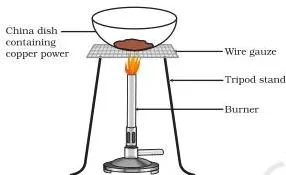
Notice the reverse is possible too: passing hydrogen over the hot black oxide turns it brown again as CuO loses oxygen back to copper — reaction 1.29 on page 12. Common error: naming the compound “copper oxide” without saying copper(II) oxide or giving the formula CuO.
Question 18: Why do we apply paint on iron articles?
Iron rusts because air and moisture reach its surface and oxidise it. Paint is a physical barrier: it seals the iron away from contact with oxygen and water, so the oxidation that causes rusting cannot start (NCERT, p. 13).
The chapter stresses how serious this is — corrosion damages car bodies, bridges, iron railings and ships, and replacing the damaged iron costs enormous sums every year. The same logic explains why you see paint, oil, grease or galvanising on iron objects exposed to weather.
Common error: saying paint “stops oxidation” without naming the barrier idea — full marks needs the mechanism: paint keeps air and moisture away from the iron surface.
Question 19: Why are oil and fat containing foods flushed with nitrogen?
Oil and fat containing food items are flushed with nitrogen. Why?
Fats and oils react with oxygen from the air and turn rancid — their smell and taste change (NCERT, p. 13). Flushing the packet with nitrogen pushes the oxygen out and fills the space with an unreactive gas, so the oil cannot be oxidised.
This is why chips manufacturers fill bags with nitrogen before sealing; the same idea sits behind airtight containers and added antioxidants, which slow oxidation.
Common error: saying nitrogen “protects” without stating why nitrogen is chosen.
The exam point is that nitrogen is unreactive — it occupies the space oxygen would otherwise fill.
Question 20: Explain corrosion and rancidity with one example each
(a) Corrosion
(b) Rancidity
Part (a) Corrosion: when a metal is attacked by substances around it — moisture, air, acids — it corrodes (NCERT, p. 13). Rusting of iron is the classic example: iron reacts with oxygen and moisture to form a reddish-brown layer of rust. The same process appears as the black coating on silver and the green coating on copper.
It is a serious economic problem because it damages car bodies, bridges, railings and ships.
Part (b) Rancidity: the oxidation of fats and oils, which changes their smell and taste (NCERT, p. 13). Food left too long tastes stale because the fat has oxidised. It is prevented by adding antioxidants, keeping food in airtight containers, and flushing packets with nitrogen — the reason chips bags are filled with nitrogen.
Common error: defining both terms with no example.
The question says “with one example each” — a definition alone loses the example mark.
Also, link both back to oxidation: corrosion is oxidation of a metal, rancidity is oxidation of a fat.
Intext questions: cleaning magnesium and writing first equations (p. 6, Q1-Q3)
Question 1: Why should a magnesium ribbon be cleaned before burning in air?
Magnesium is reactive enough to combine with oxygen in ordinary air, so a ribbon left on a shelf is already coated with a layer of magnesium oxide. That oxide is stable and does not burn — it sits between the flame and the metal underneath.
Rubbing with sandpaper scrapes the coating off and exposes fresh magnesium, so the metal can actually burn with the dazzling white flame of Activity 1.1 (NCERT, p. 1). Cleaning is not tidiness; it removes the barrier that would stop the reaction you want to observe.
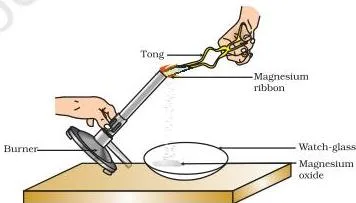
Common error: answering “to make it pure”.
The ribbon is not impure — it is already oxidised on the surface, and sandpaper removes that oxide layer to expose fresh metal.
Question 2: Write the balanced equation for the following chemical reactions
(i) Hydrogen + Chlorine → Hydrogen chloride
(ii) Barium chloride + Aluminium sulphate → Barium sulphate + Aluminium chloride
(iii) Sodium + Water → Sodium hydroxide + Hydrogen
Part (i): Hydrogen and chlorine are both diatomic gases, so each starts as \(\text{H}_2\) and \(\text{Cl}_2\). They combine in a 1:1 ratio to give two molecules of hydrogen chloride:
\[ \text{H}_2 + \text{Cl}_2 \rightarrow 2\text{HCl} \]
Part (ii): Barium is \(\text{Ba}^{2+}\) and sulphate is \(\text{SO}_4^{2-}\), so barium sulphate is \(\text{BaSO}_4\); aluminium is \(\text{Al}^{3+}\) and chloride is \(\text{Cl}^-\), so aluminium chloride is \(\text{AlCl}_3\) — the valency swap gives these formulae.
Three sulphates on the left need three \(\text{BaSO}_4\), which takes three \(\text{BaCl}_2\) and supplies six chlorides — enough for two \(\text{AlCl}_3\):
\[ 3\text{BaCl}_2 + \text{Al}_2(\text{SO}_4)_3 \rightarrow 3\text{BaSO}_4 + 2\text{AlCl}_3 \]
Part (iii): Sodium and water give sodium hydroxide, but hydrogen leaves as the diatomic \(\text{H}_2\).
Two waters supply the two oxygens for two NaOH and the two hydrogens for one \(\text{H}_2\):
\[ 2\text{Na} + 2\text{H}_2\text{O} \rightarrow 2\text{NaOH} + \text{H}_2 \]
Common error: in part (iii), leaving \(\text{Na} + \text{H}_2\text{O} \rightarrow \text{NaOH} + \text{H}_2\) unbalanced — hydrogen cannot appear as a single atom; it must be \(\text{H}_2\), and that forces the 2:2 coefficients.
Question 3: Write a balanced chemical equation with state symbols for these reactions
(i) Solutions of barium chloride and sodium sulphate in water react to give insoluble barium sulphate and the solution of sodium chloride.
(ii) Sodium hydroxide solution (in water) reacts with hydrochloric acid solution (in water) to produce sodium chloride solution and water.
Part (i): “Solutions in water” is the signal for (aq). Barium sulphate is called insoluble, so it is (s), the precipitate of Activity 1.10. Sodium chloride stays dissolved as (aq):
\[ \text{BaCl}_2\text{(aq)} + \text{Na}_2\text{SO}_4\text{(aq)} \rightarrow \text{BaSO}_4\text{(s)} + 2\text{NaCl(aq)} \]
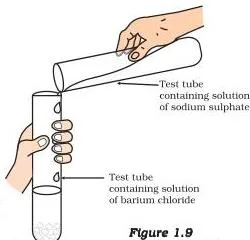
Part (ii): Sodium hydroxide solution and hydrochloric acid solution are both (aq); the products are sodium chloride solution, still (aq), and water, (l). This is a neutralisation reaction:
\[ \text{NaOH(aq)} + \text{HCl(aq)} \rightarrow \text{NaCl(aq)} + \text{H}_2\text{O(l)} \]
Common error: leaving state symbols off.
The question explicitly demands them — (aq) on everything dissolved, (s) on the precipitate, (l) on water.
Intext questions: whitewashing and electrolysis of water (p. 10, Q1-Q2)
Question 1: The substance X used for whitewashing
A solution of a substance ‘X’ is used for whitewashing.
(i) Name the substance ‘X’ and write its formula.
(ii) Write the reaction of the substance ‘X’ named in (i) above with water.
Part (i): X is calcium hydroxide, commonly called slaked lime, with formula \(\text{Ca(OH)}_2\). The “Do You Know?” box on page 7 states that a solution of slaked lime is used for whitewashing walls.
Part (ii): Here is a wording quirk you must not fall for. The question says “reaction of X with water”, but X (slaked lime) is itself the product of that reaction. The accepted answer gives the slaking equation — quick lime (calcium oxide) reacting with water to form the slaked lime solution, releasing heat (reaction 1.13, p. 6):
\[ \text{CaO(s)} + \text{H}_2\text{O(l)} \rightarrow \text{Ca(OH)}_2\text{(aq)} + \text{Heat} \]
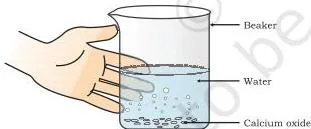
Common error: answering part (ii) with \(\text{Ca(OH)}_2 + \text{CO}_2 \rightarrow \text{CaCO}_3 + \text{H}_2\text{O}\).
That is the whitewashing finish reaction (page 7), not the reaction of X with water — it belongs in the FAQ about why fresh whitewash shines.
Question 2: Why is the gas double in one test tube of Activity 1.7, and which gas is it?
Why is the amount of gas collected in one of the test tubes in Activity 1.7 double of the amount collected in the other? Name this gas.
Work from the formula, not from memory. Electrolysis of water is the decomposition of water by electricity (NCERT, p. 9):
\[ 2\text{H}_2\text{O(l)} \xrightarrow{\text{Electricity}} 2\text{H}_2\text{(g)} + \text{O}_2\text{(g)} \]
Each water molecule has two hydrogen atoms and one oxygen atom. So two molecules of water yield two molecules of \(\text{H}_2\) (four hydrogen atoms) but only one molecule of \(\text{O}_2\) (two oxygen atoms).
At the same pressure, gas volume is proportional to the number of molecules — so twice as many hydrogen molecules means twice the volume.
The doubled gas is hydrogen, collected at the cathode (the negative electrode).
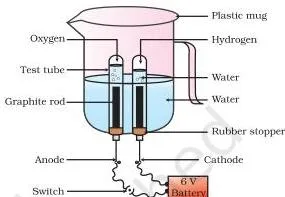
Common error: naming oxygen as the doubled gas by misreading \(2\text{H}_2 + \text{O}_2\).
Hydrogen carries the coefficient 2 — that coefficient is exactly why its volume is double.
Intext questions: displacement, double displacement and redox (p. 13, Q1-Q3)
Question 1: Why does the colour of copper sulphate solution change when an iron nail is dipped in it?
Iron is more reactive than copper, so iron displaces copper from copper sulphate solution (NCERT, p. 10-11, Activity 1.9). The blue copper sulphate solution fades because the \(\text{Cu}^{2+}\) ions leave the solution as copper metal, depositing a brownish coat on the nail. What replaces them is iron(II) sulphate, whose solution is pale green:
\[ \text{Fe(s)} + \text{CuSO}_4\text{(aq)} \rightarrow \text{FeSO}_4\text{(aq)} + \text{Cu(s)} \]
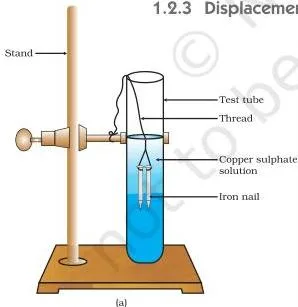
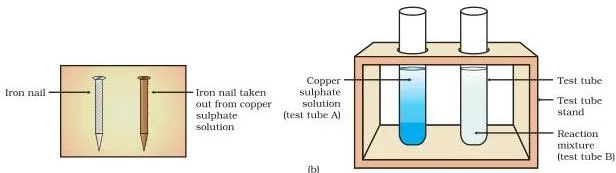
Common error: saying the solution “loses its colour” without naming the new colour.
Full answer: blue fades to pale green (iron sulphate) and the nail gains a brownish deposit of copper.
Question 2: Give an example of a double displacement reaction other than the one given in Activity 1.10
In a double displacement reaction, two compounds exchange their ions — the positive ion of one pairs with the negative ion of the other (NCERT, p. 11). Silver nitrate and sodium chloride are a clean example: silver (\(\text{Ag}^+\)) pairs with chloride (\(\text{Cl}^-\)) to give insoluble silver chloride, while sodium (\(\text{Na}^+\)) pairs with nitrate (\(\text{NO}_3^-\)) to give sodium nitrate:
\[ \text{AgNO}_3\text{(aq)} + \text{NaCl(aq)} \rightarrow \text{AgCl(s)} + \text{NaNO}_3\text{(aq)} \]
Common error: giving Activity 1.10’s own reaction (\(\text{Na}_2\text{SO}_4 + \text{BaCl}_2\)) — the question explicitly rules that one out.
Offer a different ion exchange, like the lead nitrate + potassium iodide example from Activity 1.2.
Question 3: Identify the substances oxidised and reduced in these reactions
(i) \(4\text{Na(s)} + \text{O}_2\text{(g)} \rightarrow 2\text{Na}_2\text{O(s)}\)
(ii) \(\text{CuO(s)} + \text{H}_2\text{(g)} \rightarrow \text{Cu(s)} + \text{H}_2\text{O(l)}\)
Apply the oxygen-based rule from page 12: gain of oxygen = oxidised; loss of oxygen = reduced.
Part (i): Sodium gains oxygen (it becomes \(\text{Na}_2\text{O}\)), so sodium is oxidised. The oxygen gas that provides the oxygen is the substance that gets reduced — \(\text{O}_2\) is reduced.
Part (ii): Copper(II) oxide loses oxygen (it becomes copper metal), so \(\text{CuO}\) is reduced. Hydrogen gains oxygen (it becomes water), so \(\text{H}_2\) is oxidised. This is reaction 1.29, the reverse of copper oxidation.
Common error: in part (i), students say “nothing is reduced” because oxygen is a reactant.
But oxidation and reduction always happen together — the substance that supplies the oxygen is the one reduced.
And in part (ii), write “copper(II) oxide is reduced”, not “copper is reduced” — copper metal is the product, not the substance losing oxygen.
Activity observations at a glance: Activities 1.1 to 1.11
Observation questions are common in exams, so memorise the pair — what you see and which reaction drives it (NCERT, p. 1-12):
| Activity | What you observe | Reaction or type |
|---|---|---|
| 1.1 Magnesium ribbon burns | Dazzling white flame; white powder (MgO) collected | \(2\text{Mg} + \text{O}_2 \rightarrow 2\text{MgO}\) — combination, exothermic |
| 1.2 Lead nitrate + potassium iodide | Yellow precipitate of lead(II) iodide | \(\text{Pb(NO}_3)_2 + 2\text{KI} \rightarrow \text{PbI}_2 + 2\text{KNO}_3\) — double displacement |
| 1.3 Zinc + dilute acid | Gas bubbles; flask warms up | \(\text{Zn} + \text{H}_2\text{SO}_4 \rightarrow \text{ZnSO}_4 + \text{H}_2\) (Figure 1.2) |
| 1.4 Quick lime + water | Beaker becomes hot | \(\text{CaO} + \text{H}_2\text{O} \rightarrow \text{Ca(OH)}_2 + \text{heat}\) — combination, exothermic (Figure 1.3) |
| 1.5 Heating ferrous sulphate | Green crystals turn brown; smell of burning sulphur | \(2\text{FeSO}_4 \xrightarrow{\text{Heat}} \text{Fe}_2\text{O}_3 + \text{SO}_2 + \text{SO}_3\) — thermal decomposition (Figure 1.4) |
| 1.6 Heating lead nitrate | Brown fumes of nitrogen dioxide | \(2\text{Pb(NO}_3)_2 \xrightarrow{\text{Heat}} 2\text{PbO} + 4\text{NO}_2 + \text{O}_2\) — thermal decomposition (Figure 1.5) |
| 1.7 Electrolysis of water | Gas bubbles at both electrodes; hydrogen volume doubles oxygen | \(2\text{H}_2\text{O} \xrightarrow{\text{Electricity}} 2\text{H}_2 + \text{O}_2\) — decomposition by electricity (Figure 1.6) |
| 1.8 Silver chloride in sunlight | White solid turns grey | \(2\text{AgCl} \xrightarrow{\text{Sunlight}} 2\text{Ag} + \text{Cl}_2\) — photolytic decomposition (Figure 1.7) |
| 1.9 Iron nail in copper sulphate | Blue solution fades to pale green; brown deposit on nail | \(\text{Fe} + \text{CuSO}_4 \rightarrow \text{FeSO}_4 + \text{Cu}\) — displacement (Figure 1.8) |
| 1.10 Sodium sulphate + barium chloride | White precipitate of barium sulphate | \(\text{Na}_2\text{SO}_4 + \text{BaCl}_2 \rightarrow \text{BaSO}_4 + 2\text{NaCl}\) — double displacement (Figure 1.9) |
| 1.11 Heating copper powder | Shiny brown powder turns black | \(2\text{Cu} + \text{O}_2 \xrightarrow{\text{Heat}} 2\text{CuO}\) — oxidation (Figure 1.10) |
Two group activities complete the energy picture. Barium hydroxide + ammonium chloride feels cold when you touch the tube — an endothermic reaction, the hands-on proof on page 10.
The four-beaker activity on page 16 asks you to measure temperature changes: ammonium nitrate cools the water (endothermic), anhydrous copper sulphate warms as it hydrates (exothermic), and iron filings in copper sulphate give the exothermic displacement. The textbook prints the instruction but not the potassium sulphate answer, so do not invent a figure for it — record what your class observes.
One colour-change memory aid covers most of the chapter (NCERT, p. 8-12):
- Green to brown — ferrous sulphate decomposes (thermal decomposition).
- White to grey — silver chloride decomposes in sunlight (photolysis).
- Blue fading to pale green — copper sulphate loses copper to iron (displacement).
- Brown to black — copper gains oxygen (oxidation).
Safety note for Activity 1.5: smell by wafting the fumes toward your nose, never by putting your face directly over the tube (Figure 1.4).
Balancing equations in six steps: the hit and trial method
The textbook balances the equation \(3\text{Fe} + 4\text{H}_2\text{O} \rightarrow \text{Fe}_3\text{O}_4 + 4\text{H}_2\) on pages 3-5; the routine generalises to any equation you will meet (NCERT, p. 3-5):
- Box every formula. Draw boxes around each formula and never change anything inside a box while balancing.
- Count atoms. List the number of atoms of each element on the LHS and RHS.
- Start with the densest compound. Pick the compound holding the most atoms, then its most numerous element, and balance that element with coefficients.
- Equalise with coefficients only. Write \(4\text{H}_2\text{O}\), never \(\text{H}_2\text{O}_4\) or \((\text{H}_2\text{O})_4\) — a coefficient multiplies the whole formula; a subscript change makes a new compound.
- Continue element by element until only one element remains unbalanced, then fix it.
- Final check. Count every element on both sides again; equal numbers mean the equation is balanced.
Apply it to an equation the textbook never solves — burning propane, \(\text{C}_3\text{H}_8 + \text{O}_2 \rightarrow \text{CO}_2 + \text{H}_2\text{O}\):
Step 2 (counts):
| Element | Reactants | Products |
|---|---|---|
| C | 3 | 1 |
| H | 8 | 2 |
| O | 2 | 3 |
Step 3: \(\text{C}_3\text{H}_8\) holds the most atoms; balance carbon first — one C₃H₈ gives three carbons, so put 3 before CO₂:
\[ \text{C}_3\text{H}_8 + \text{O}_2 \rightarrow 3\text{CO}_2 + \text{H}_2\text{O} \]
Step 4: Balance hydrogen — eight hydrogens on the left need four waters on the right:
\[ \text{C}_3\text{H}_8 + \text{O}_2 \rightarrow 3\text{CO}_2 + 4\text{H}_2\text{O} \]
Step 5: Now oxygen — the right side holds \(3\times2 + 4\times1 = 10\) oxygens, so the left needs five \(\text{O}_2\):
\[ \text{C}_3\text{H}_8 + 5\text{O}_2 \rightarrow 3\text{CO}_2 + 4\text{H}_2\text{O} \]
Step 6 (final check):
| Element | Reactants | Products |
|---|---|---|
| C | 3 | 3 |
| H | 8 | 4 × 2 = 8 |
| O | 5 × 2 = 10 | 6 + 4 = 10 |
Balanced. With state symbols: \(\text{C}_3\text{H}_8\text{(g)} + 5\text{O}_2\text{(g)} \rightarrow 3\text{CO}_2\text{(g)} + 4\text{H}_2\text{O(g)}\). The (g) on \(\text{H}_2\text{O}\) means steam, the textbook’s own note on page 5.
Two conventions finish a final answer. State symbols — (s) solid, (l) liquid, (g) gas, (aq) aqueous — are added only when needed to specify a state (NCERT, p. 5). Reaction conditions such as heat, sunlight, catalyst or pressure sit above or below the arrow, as in equations 1.11 and 1.12 on page 5.
The three balancing slips that cost most students marks, with their corrections:
| Mistake | Correct rule | How to check your answer |
|---|---|---|
| Changing a subscript to force a balance (\(\text{H}_2\text{O}_4\) for \(4\text{H}_2\text{O}\)) | Coefficients only; never edit a formula | Re-read each boxed formula after balancing — subscripts must be untouched |
| Forgetting diatomic gases (\(\text{H}_2\), \(\text{O}_2\), \(\text{N}_2\), \(\text{Cl}_2\)) | Elemental gases start as diatomic molecules | Check every free element: is it written as the pair it really is? |
| Skipping the final atom count | Always finish with a full LHS-vs-RHS count for every element | Draw the count table (as above) and confirm each column matches |
Try these: two extra equations to balance on your own
Test the six-step routine on two original problems built from this chapter’s own substances. Cover the answers, attempt each with pen and paper, then check.
Problem 1: Aluminium + oxygen → aluminium oxide Problem 2: Iron + chlorine → iron(III) chloride
Show answers
Problem 1: \(4\text{Al} + 3\text{O}_2 \rightarrow 2\text{Al}_2\text{O}_3\). Oxygen is diatomic, so start by balancing it: three \(\text{O}_2\) give six oxygens, which need two \(\text{Al}_2\text{O}_3\). That puts four aluminums on the right, so balance aluminium with 4 on the left.
Problem 2: \(2\text{Fe} + 3\text{Cl}_2 \rightarrow 2\text{FeCl}_3\). Chlorine is diatomic, so three \(\text{Cl}_2\) give six chlorines, which need two \(\text{FeCl}_3\) — then balance the two irons.
Common error: fixing the imbalance with a subscript (\(\text{Al}_2\text{O}_4\) or \(\text{FeCl}_6\)) instead of a coefficient.
Apply the six steps and end with the atom-count check every time.
Frequently asked questions on NCERT Solutions for Class 10 Science Chapter 1
What is the difference between a skeletal chemical equation and a balanced chemical equation?
A skeletal equation writes the correct formulae of reactants and products but the atom counts on both sides are unequal — equation (1.2), \(\text{Mg} + \text{O}_2 \rightarrow \text{MgO}\), is skeletal because oxygen shows 2 atoms on the left and 1 on the right (NCERT, p. 3).
A balanced equation has equal numbers of every atom on both sides, achieved by placing coefficients before formulae — \(2\text{Mg} + \text{O}_2 \rightarrow 2\text{MgO}\). Balance by the law of conservation of mass: atoms are neither created nor destroyed in a reaction.
Why does the electrolysis of water give twice as much hydrogen gas as oxygen gas?
The equation \(2\text{H}_2\text{O} \xrightarrow{\text{Electricity}} 2\text{H}_2 + \text{O}_2\) shows it directly. Every water molecule has two hydrogen atoms and one oxygen atom, so two molecules of water produce two molecules of hydrogen gas but only one molecule of oxygen gas (NCERT, p. 9).
Gas volume is proportional to the number of molecules, so hydrogen collects at double the volume — the relation comes from the formula \(\text{H}_2\text{O}\), not from memory.
Are all decomposition reactions endothermic?
In this chapter, yes. Decomposition requires energy in the form of heat, light or electricity to break the reactant apart, and the chapter defines endothermic reactions as those in which energy is absorbed (NCERT, p. 9-10).
The cold test tube from the barium hydroxide + ammonium chloride mixture on page 10 is the hands-on proof — the mixture absorbs heat from your palm, so the tube feels cold.
Is rusting of iron an oxidation reaction or a redox reaction?
Both, depending on how the chapter defines the terms. Rusting is oxidation of iron: iron gains oxygen from air and moisture, so by the page-12 definition it is oxidised. Because oxidation and reduction always occur together — whichever substance supplies the oxygen is reduced — rusting is also a redox reaction in the chapter’s sense.
In exams, name the oxidation (iron gains oxygen) and you earn the core mark.
How do I identify the type of reaction from a given chemical equation?
Count the substances. Two or more reactants forming one product → combination. One reactant splitting into two or more products → decomposition (and the energy source tells you if it is thermal, photolytic or electrolytic). An element plus a compound giving a new element and new compound → displacement.
Two compounds exchanging ions → double displacement (call it precipitation only if an insoluble solid is produced). If one substance gains oxygen or loses hydrogen while another loses oxygen or gains hydrogen → redox. The decision table at the top of this page runs the same logic.
Why does a fresh whitewash shine after two to three days?
Fresh whitewash is calcium hydroxide, and it shines only after it reacts. Calcium hydroxide reacts slowly with carbon dioxide in the air to form a thin layer of calcium carbonate, \(\text{CaCO}_3\), on the wall — and that layer forms only after two to three days, giving the shiny finish (NCERT, p. 7).
The reaction is \(\text{Ca(OH)}_2\text{(aq)} + \text{CO}_2\text{(g)} \rightarrow \text{CaCO}_3\text{(s)} + \text{H}_2\text{O(l)}\). Marble has the same chemical formula, \(\text{CaCO}_3\).
Reference: NCERT Class 10 Science textbook, chapter Chemical Reactions and Equations.
Explore Class 10 Science NCERT Solutions
More for this chapter:
- Chemical Reactions and Equations Notes
- Chemical Reactions and Equations Formulas
- Chemical Reactions and Equations Important Questions
- Chemical Reactions and Equations MCQ Questions
- Chemical Reactions and Equations Previous Year Questions
Class 10 Science on LearnCBSE:
Related chapters: