
Here are the complete NCERT solutions for Class 10 Science Chapter 13 — Our Environment. All 7 intext questions from pages 5, 7 and 9, and all 9 exercise questions from page 9, are solved in the order the textbook prints them, with the concept explained before every answer. This page follows the 2026-27 edition, so the questions and page numbers match your current textbook.
Read the key-concepts block first if trophic levels or biodegradable waste feel shaky, then work question by question. Every answer ends with a common-error warning, because the slips that lose marks in the board exam are remarkably predictable.
What These NCERT Solutions for Class 10 Science Chapter 13 Cover
This page solves every question the chapter asks, in sequence. The first intext block (p. 5) tests ecosystem structure — trophic levels and the role of decomposers. The second block (p. 7) tests waste: biodegradable versus non-biodegradable substances. The third block (p. 9) tests the ozone layer and how you can reduce waste disposal.
Then come the nine exercise questions. Questions 1-3 are multiple choice on biodegradable items, food chains and environment-friendly habits. Questions 4-6 test what happens when a trophic level disappears and how biological magnification builds up. Questions 7-9 close the chapter on waste problems and ozone damage.
Work through them in order, or jump to the question you need. If a question depends on a diagram, the figure is printed inside its answer. For the previous chapter, see the Chapter 12 Magnetic Effects of Electric Current solutions; for the rest, browse our Class 10 Science notes.
Key Concepts Before the Solutions
Every question in this chapter leans on the same small set of ideas. These are the ones to fix in your head before you start.
- Ecosystem: all living organisms in an area plus the non-living factors they interact with — temperature, rainfall, wind, soil and minerals. Living parts are biotic, non-living parts are abiotic. (NCERT, p. 209)
- Producers: green plants and certain bacteria that make food by photosynthesis. They sit at the first trophic level.
- Consumers: organisms that eat producers or other consumers — herbivores, carnivores, omnivores and parasites.
- Decomposers: bacteria and fungi that break dead remains and waste into simple inorganic substances and return them to the soil.
- Trophic level: each step of a food chain. (NCERT, p. 210)
- The 10% law: on average, only 10% of the food eaten becomes body mass available to the next level. So little usable energy remains after 3-4 steps that food chains rarely go further. (NCERT, p. 210)
- Unidirectional energy flow: energy moves one way, from producers upward, and never returns to the level that gave it. It diminishes at every step. (NCERT, p. 211)
- Biological magnification: non-degradable chemicals accumulate progressively at each trophic level, peaking in humans at the top. (NCERT, p. 211)
- Biodegradable / non-biodegradable: substances broken down by biological processes are biodegradable; those not broken down this way persist and are non-biodegradable. (NCERT, p. 213)
- Ozone: \( O_3 \), a shield high in the atmosphere that absorbs ultraviolet radiation from the Sun. (NCERT, p. 212)
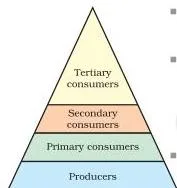
A food chain works only because energy is passed up step by step. The diagram below shows the order: producers at the base, then primary, secondary and tertiary consumers above them.
Intext Solutions: Trophic Levels and the Role of Decomposers (p. 5)
Question 1: What are trophic levels? Give an example of a food chain and state the different trophic levels in it.
A trophic level is each step of a food chain — the textbook puts it plainly: “each step or level of the food chain forms a trophic level” (NCERT, p. 210). The producers are the first trophic level, and each consumer above them forms the next.
An example chain, built fresh rather than copied from the book: grass → grasshopper → frog → snake.
- Grass — producer, first trophic level
- Grasshopper — primary consumer (herbivore), second trophic level
- Frog — secondary consumer (carnivore), third trophic level
- Snake — tertiary consumer, fourth trophic level
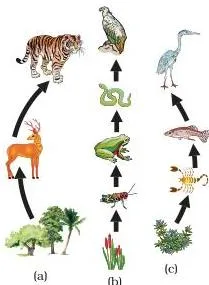
Figure 13.1 below shows real chains from a forest, a grassland and a pond; the trophic-level diagram in the key-concepts section above stacks the same levels in order.
Question 2: What is the role of decomposers in the ecosystem?
Decomposers — bacteria and fungi — break down the dead remains and waste products of organisms into simple inorganic substances (NCERT, p. 209). These substances return to the soil and are taken up once more by producers. That is what makes an ecosystem self-sustaining: producers make food, consumers eat it, and decomposers recycle the leftovers so producers can start again.
In their absence, dead animals, dead plants and garbage would simply pile up, and the natural replenishment of the soil would stop. The nutrients locked in dead matter would never come back to the producers.
Intext Solutions: Biodegradable and Non-Biodegradable Substances (p. 7)
Question 1: Why are some substances biodegradable and some non-biodegradable?
Biodegradability depends on whether the enzymes of bacteria and fungi can break a substance down. Enzymes are specific in their action — a particular enzyme acts on a particular substance, which is exactly why we cannot digest coal (NCERT, p. 213). Many human-made materials like plastics have no matching enzyme, so no microorganism can decompose them.
Physical processes such as heat and pressure may wear these materials down, but under ordinary environmental conditions they persist for a long time. So the dividing line is simple: substances broken down by biological processes are biodegradable; those that are not are non-biodegradable.
Question 2: Give any two ways in which biodegradable substances would affect the environment.
Biodegradable substances return to nature through decay, but in excess they still disturb it. Two distinct effects the board expects:
- When large amounts decay together, they release foul gases and breed harmful organisms such as flies and disease-causing microbes.
- Dumped in one place, they add so many nutrients that they pollute water bodies — overloading the water instead of enriching it.
Decay is natural, but the volume and location of the waste decide how damaging it becomes.
Question 3: Give any two ways in which non-biodegradable substances would affect the environment.
Non-biodegradable substances do not decay, so they accumulate. Two distinct effects follow:
- They persist in the environment for a long time, occupying land as they pile up in dumps, and choking drains and water bodies.
- Animals may ingest them and be harmed; being inert and persistent, they keep harming members of the ecosystem over long periods (NCERT, p. 213).
The damage is long-lasting precisely because nothing biological can remove these materials.
Intext Solutions: Ozone Layer and Reducing Waste Disposal (p. 9)
Question 1: What is ozone and how does it affect any ecosystem?
Ozone is a molecule made of three oxygen atoms (\( O_3 \)), formed high in the atmosphere (NCERT, p. 212). There it performs a vital function: it shields the Earth’s surface from ultraviolet (UV) radiation from the Sun, which is highly damaging to organisms and causes skin cancer in human beings.
Ozone forms when high-energy UV radiation splits molecular oxygen into free oxygen atoms, which then combine with oxygen molecules:
\[ O_2 \xrightarrow{\text{UV}} O + O \] \[ O + O_2 \rightarrow O_3 \]
(NCERT, p. 213). If CFCs deplete this shield, more UV reaches the ground. That harms the producers at the base of every food chain, so the damage travels upward through the whole ecosystem — a drop in plant life starves every consumer above it.
Question 2: How can you help in reducing the problem of waste disposal? Give any two methods.
Waste disposal is a problem of volume and mix. Two methods a Class-10 student can actually use:
- Segregate waste at home — separate biodegradable matter from non-biodegradable. This lets the biodegradable part be composted and treated, and stops non-biodegradable materials from contaminating the whole lot.
- Compost kitchen refuse — vegetable peels and spoilt food break down in a compost pit, returning nutrients to the soil instead of adding to landfill.
Each method works because it reduces the amount of waste that reaches the dump and keeps the biodegradable part cycling back to nature.
Exercise Solutions: Biodegradable Items, Food Chains and Environment-Friendly Habits (Q1-Q3)
Question 1: Which of the following groups contain only biodegradable items? (a) Grass, flowers and leather (b) Grass, wood and plastic (c) Fruit-peels, cake and lime-juice (d) Cake, wood and grass
- (a) Grass, flowers and leather
- (b) Grass, wood and plastic
- (c) Fruit-peels, cake and lime-juice
- (d) Cake, wood and grass
Correct answer: (a). Run every item against the definition: biodegradable means broken down by biological processes of microorganisms (NCERT, p. 213). Grass, flowers and leather all decay, so (a) is the group the textbook accepts.
Option (b) clearly fails because plastic is non-biodegradable — no enzyme of any microorganism acts on it, so it persists. Options (c) and (d) also contain biodegradable materials such as fruit-peels and wood, and are close calls; the cleanest group whose members all clearly rot away naturally is (a), which is why it is the intended answer.
Question 2: Which of the following constitute a food-chain? (a) Grass, wheat and mango (b) Grass, goat and human (c) Goat, cow and elephant (d) Grass, fish and goat
- (a) Grass, wheat and mango
- (b) Grass, goat and human
- (c) Goat, cow and elephant
- (d) Grass, fish and goat
Correct answer: (b). A food chain must run from producer to consumer, with each organism eaten by the next (NCERT, p. 210). In (b), grass is the producer, the goat is a primary consumer that eats the grass, and the human eats the goat — a genuine chain.
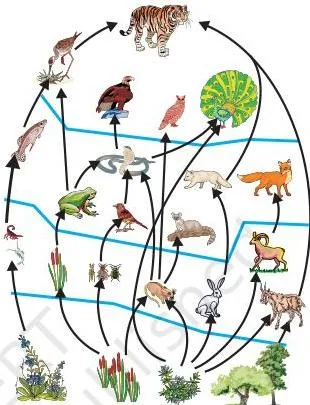
The others fail: in (a) wheat and mango are also producers, not eaters of grass; in (c) all three are consumers with no producer, so no one feeds anyone; in (d) fish do not eat grass directly, so no real feeding link exists. Figure 13.3 shows how real chains interlock into a food web.
Question 3: Which of the following are environment-friendly practices? (a) Carrying cloth-bags to put purchases in while shopping (b) Switching off unnecessary lights and fans (c) Walking to school instead of getting your mother to drop you on her scooter (d) All of the above
- (a) Carrying cloth-bags to put purchases in while shopping
- (b) Switching off unnecessary lights and fans
- (c) Walking to school instead of getting your mother to drop you on her scooter
- (d) All of the above
Correct answer: (d) All of the above. Each habit reduces waste or energy use. Cloth bags replace single-use plastic bags, so less non-biodegradable waste is generated. Switching off lights and fans saves electricity. Walking to school cuts fuel use and emissions. All three are environment-friendly.
Exercise Solutions: Removing a Trophic Level and Biological Magnification (Q4-Q6)
Question 4: What will happen if we kill all the organisms in one trophic level?
Every trophic level depends on the one below it for food, and the level above depends on it.
Remove one level and the chain breaks in both directions (NCERT, p. 210): the organisms of the level above lose their food source and may starve, while the organisms of the level below, no longer hunted or eaten, multiply excessively and overuse their own food.
The result is a collapse of the whole chain, because the 10% law means each level’s energy supply depends entirely on the level beneath it. The trophic-level diagram in the key-concepts section shows this dependence in order.
Question 5: Will the impact of removing all the organisms in a trophic level be different for different trophic levels? Can the organisms of any trophic level be removed without causing any damage to the ecosystem?
Yes, the impact differs by level. If the producers go, every consumer above them loses its food instantly and the whole ecosystem collapses. If a top predator goes, its prey may overgrow and then over-eat the level below — serious, but slower to reach every level.
No level can be removed without damage. Energy flow is unidirectional: energy captured by producers never returns to them, and once it moves on it is no longer available to the previous level (NCERT, p. 211). Every step depends entirely on the one below, so removing any step starves what sits above it.
Question 6: What is biological magnification? Will the levels of this magnification be different at different levels of the ecosystem?
Biological magnification is the progressive accumulation of non-degradable chemicals as they pass up a food chain (NCERT, p. 211). Pesticides wash into soil and water, plants absorb them, herbivores eat the plants, and carnivores eat the herbivores. Because the chemicals are not degradable, each consumer stores the doses from all the prey it ate, so the concentration builds at every step.
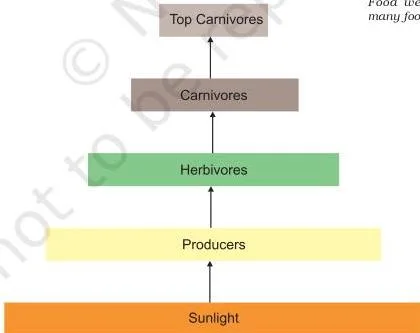
The levels of magnification are different at different trophic levels — they rise as you go up the chain. Plants hold the smallest amount, the top carnivore the largest, and human beings, at the top, accumulate the maximum concentration. Figure 13.4 shows why: energy flowing up the chain is one-way, and the non-degradable chemicals ride along with it, concentrating as they go.
Exercise Solutions: Waste Disposal, Biodegradable Waste and Ozone Damage (Q7-Q9)
Question 7: What are the problems caused by the non-biodegradable wastes that we generate?
Non-biodegradable waste does not decay, so it accumulates, and the problems follow from that persistence (NCERT, p. 213). It occupies land as it piles up in dumps, chokes drains and water bodies, and stays in the soil for long periods. Animals may ingest pieces of it and be harmed.
Because nothing biological can break it down, the damage it causes is long-lasting rather than temporary.
Question 8: If all the waste we generate is biodegradable, will this have no impact on the environment?
No — biodegradable does not mean harmless. The impact lessens but never disappears. If huge volumes of biodegradable waste are dumped in one place, it still decays, and that decay releases foul gases and breeds harmful organisms. Dumped in large amounts into water, it adds enough nutrients to pollute the water body.
So even fully biodegradable waste causes problems when the quantity overwhelms the natural decay process.
Question 9: Why is damage to the ozone layer a cause for concern? What steps are being taken to limit this damage?
Ozone (\( O_3 \)) shields the Earth from ultraviolet (UV) radiation from the Sun, which is highly damaging to organisms and causes skin cancer in humans (NCERT, p. 212). Damage to this shield lets more UV through, harming producers at the base of every food chain and, through them, the whole ecosystem.
Ozone is depleted by synthetic chemicals called chlorofluorocarbons (CFCs), used as refrigerants and in fire extinguishers. To limit the damage, the United Nations Environment Programme (UNEP) forged a 1987 agreement to freeze CFC production at 1986 levels. It is now mandatory for manufacturing companies worldwide to make CFC-free refrigerators (NCERT, p. 213).
Ozone itself forms when UV splits oxygen molecules into free atoms, which join oxygen molecules:
\[ O_2 \xrightarrow{\text{UV}} O + O \] \[ O + O_2 \rightarrow O_3 \]
How to Frame These Answers in the Board Exam
The chapter’s own summary gives the marking core: ecosystem components are interdependent; producers make sunlight energy available; energy loss between levels limits chain length; human activities affect the environment; CFCs endanger ozone; waste is biodegradable or non-biodegradable; and waste disposal causes serious problems (NCERT, p. 217). Shape your answers around those points, in point form wherever a question lists effects.
Every question on this page is reproduced word for word from the official NCERT Class 10 Science textbook, so you can verify any answer against the source PDF, which is freely available on the official NCERT portal at ncert.nic.in.
Template for a 2-mark answer (define + support):
- Define the term in one line — this earns the first mark.
- Add an example or a stated rule: the 10% law, unidirectional flow, or the UV shield — this earns the second.
Template for a 3-mark answer (e.g., biological magnification):
- Define biological magnification and name the chemicals involved (pesticides).
- Trace one path: pesticide → soil/water → plant → herbivore → carnivore.
- State the result: maximum concentration in humans at the top of the chain.
| Mistake | Correct rule | How to check your answer |
|---|---|---|
| Listing decomposers as a trophic level | A food chain is feeding order from producer upward; decomposers recycle waste from all levels | Read each level back: does that level feed on the one below it? |
| Giving a chain without naming levels | Name producer, primary, secondary and tertiary consumers | Label every organism in your chain before you write the answer |
| Mixing biodegradable and non-biodegradable effects | List two distinct effects for each, separately | Count: exactly two effects for biodegradable, two for non-biodegradable |
| Forgetting the 10% figure | About 10% of food eaten becomes body mass for the next level, so chains stop at 3-4 steps | State the number and the consequence (chain length) |
The same habits cost marks every year: writing effects without separating biodegradable from non-biodegradable waste, giving a chain without trophic levels, and dropping the 10% figure where it applies. For revision notes of this and every other Class 10 subject, visit our CBSE Class 10 notes hub, or start from the main CBSE notes page.
Frequently Asked Questions
Why are food chains usually limited to three or four trophic levels?
At each level only about 10% of the food eaten becomes the body mass available to the next level; the rest is lost as heat, digestion and work. After three or four steps, so little usable energy remains that a higher level cannot be supported (NCERT, p. 210).
What is the difference between a food chain and a food web?
A food chain is a single straight feeding line, like grass → goat → human. A food web is a network of many interlocking chains, because each organism is usually eaten by two or more other kinds of organisms (NCERT, pp. 210-211).
Why is biological magnification highest in human beings?
Humans occupy the top level of any food chain. Non-degradable pesticides accumulate progressively at every level, and because we eat from many chains, the maximum concentration builds up in our bodies (NCERT, p. 211).
Is plastic biodegradable or non-biodegradable, and why does it not break down?
Plastic is non-biodegradable. No enzyme produced by bacteria or fungi can act on it, so biological processes cannot decompose it. Physical forces like heat and pressure may wear it down, but under ordinary conditions it persists for a long time (NCERT, p. 213).
How do CFCs reach the ozone layer and cause damage?
CFCs are synthetic chemicals used as refrigerants and in fire extinguishers. Released into the air, they rise to the stratosphere, where they break down ozone molecules. This is why the 1987 UNEP agreement froze CFC production and why CFC-free refrigerators are now mandatory (NCERT, p. 213).
Reference: NCERT Class 10 Science textbook, chapter Our Environment.
Explore Class 10 Science NCERT Solutions
Class 10 Science on LearnCBSE:
Related chapters: