These NCERT Solutions for Class 10 Science Chapter 10 cover every intext and exercise question from The Human Eye and the Colourful World, with each lens-power numerical worked step by step and carried to the correct unit.
The chapter takes the refraction ideas you studied in the previous chapter on light and applies them to the human eye and to natural phenomena like twinkling stars and the blue sky.
For the 2026-27 session, these solutions follow the latest NCERT Science textbook. You can read the source text alongside these answers in the official NCERT Class 10 Science textbook PDF, so you can check any answer against the source page by page.
Students looking for broader revision material can also refer to our Class 10 Science notes or the full Class 10 notes hub on the site.
Intext Questions Solutions
The four intext questions test whether you understand how the eye adjusts its own lens and how the three common defects of vision arise.
You need two ideas before you start: accommodation — the ciliary muscles change the curvature of the eye lens, which changes its focal length so the eye can focus on near and distant objects (NCERT, p. 162; p. 164) — and the distinction between myopia (image forms in front of the retina, corrected by a concave lens) and hypermetropia (image forms behind the retina, corrected by a convex lens) (NCERT, p. 163).
The normal near point is about 25 cm for a young adult and the normal far point is at infinity. The power of a corrective lens is given by \( P = \frac{1}{f} \), where \( f \) is in metres and \( P \) is in dioptres (D) — the exercise numericals use this formula repeatedly.
Question 1: What is meant by power of accommodation of the eye?
The eye lens is made of a fibrous, jelly-like material whose curvature the ciliary muscles can modify. When the muscles relax, the lens thins, its focal length increases, and distant objects come to focus on the retina. When the muscles contract, the lens thickens, its focal length decreases, and nearby objects come to focus on the retina.
This ability of the eye lens to adjust its focal length is called the power of accommodation (NCERT, p. 162).
Common error: Students confuse accommodation with presbyopia. Accommodation is the normal, healthy ability of the eye to change focal length. Presbyopia is the loss of that ability with age as the ciliary muscles weaken and the lens loses flexibility.
Question 2: A person with a myopic eye cannot see objects beyond 1.2 m distinctly. What should be the type of the corrective lens used to restore proper vision?
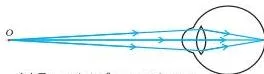
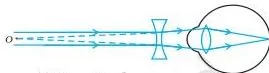
In myopia the far point is closer than infinity; the image of a distant object forms in front of the retina. To push that image back onto the retina, you need a lens that diverges incoming light before it enters the eye — a concave lens of suitable power beings that image back onto the retina.
The diagrams below shows the far point of a myopic eye and the correction using a concave lens.
Common error: Reading \”cannot see beyond 1.2 m\” and assuming the person is long-sighted. They are short-sighted — myopia. \”Cannot see far\” always points to a concave (diverging) lens.
Question 3: What is the far point and near point of the human eye with normal vision?
The far point of the eye is the farthest distance up to which the eye can see objects clearly. For a normal eye it is at infinity. The near point (or least distance of distinct vision) is the minimum distance at which objects can be seen most distinctly without strain.
For a young adult with normal vision, it is about 25 cm (NCERT, p. 162).
Common error: Writing the near point as 25 m instead of 25 cm — a unit slip that changes the answer completely. Always write the unit, not just the number.
Question 4: A student has difficulty reading the blackboard while sitting in the last row. What could be the defect the child is suffering from? How can it be corrected?
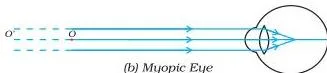
The blackboard is a distant object for a student sitting in the last row. Difficulty seeing distant objects while nearby objects remain clear is the signature of myopia (near-sightedness). In this defect the image of a distant object forms in front of the retina.
It can be corrected by using a concave lens of suitable power, which diverges the incoming light so the image falls back on the retina (NCERT, p. 163). The diagram below shows the myopic eye forming the image in front of the retina.
Common error: Jumping to hypermetropia because the word \”reading\” appears in the question. The child is looking at a distant blackboard from the back row — not a book held close — so the defect is myopia.
Exercise Solutions
The twelve exercise questions cover four broad areas: the structure and accommodation of the eye (Q1-Q4), lens-power numericals for myopia and hypermetropia correction (Q5-Q7), the limits of accommodation and image-distance reasoning (Q8-Q9), and atmospheric phenomena — refraction and scattering (Q10-Q12). The grounded diagrams for atmospheric refraction are shown alongside their questions.
The two tools these numericals need are the power formula \( P = \frac{1}{f} \) (with \( f \) in metres giving \( P \) in dioptres) and the lens formula \( \frac{1}{f} = \frac{1}{v} – \frac{1}{u} \). The sign convention matters: a concave lens (myopia correction) has negative power and negative focal length; a convex lens (hypermetropia correction) has positive power and positive focal length.
Detailed sign rules appear in the Method Recap at the end.
Question 1: The human eye can focus on objects at different distances by adjusting the focal length of the eye lens. This is due to (a) presbyopia. (b) accommodation. (c) near-sightedness. (d) far-sightedness.
- (a) presbyopia.
- (b) accommodation.
- (c) near-sightedness.
- (d) far-sightedness.
Correct answer: (b) accommodation. The eye adjusts its focal length so objects at different distances focus on the retina — this ability is accommodation (NCERT, p. 162).
- (a) presbyopia is the loss of accommodation with age — the opposite of the ability described.
- (c) near-sightedness (myopia) is a refractive defect, not a focussing ability.
- (d) far-sightedness (hypermetropia) is also a defect, not an adjustment.
Question 2: The human eye forms the image of an object at its (a) cornea. (b) iris. (c) pupil. (d) retina.
- (a) cornea.
- (b) iris.
- (c) pupil.
- (d) retina.
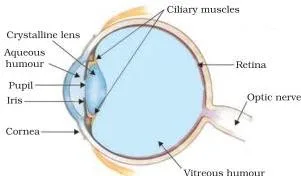
Correct answer: (d) retina. The retina is the light-sensitive screen on which the eye lens forms an inverted real image (NCERT, p. 161/162). The light-sensitive cells then send signals to the brain.
- (a) cornea is where most refraction occurs, but it does not itself form the image.
- (b) iris is the muscular diaphragm that controls pupil size — it regulates light entry, not image formation.
- (c) pupil is simply the hole that controls the amount of light entering.
Common error: Choosing cornea because \”most refraction occurs there.\” Refraction and image formation are different steps — the cornea bends the light, but the image is formed on the retina.
Question 3: The least distance of distinct vision for a young adult with normal vision is about (a) 25 m. (b) 2.5 cm. (c) 25 cm. (d) 2.5 m.
- (a) 25 m.
- (b) 2.5 cm.
- (c) 25 cm.
- (d) 2.5 m.
Correct answer: (c) 25 cm. The least distance of distinct vision (near point) for a young adult with normal vision is about 25 cm (NCERT, p. 162). The other three options are unit/order-of-magnitude traps: 25 m and 2.5 m are too far, 2.5 cm is too close.
Common error: Picking 25 m because the number 25 is \”right,\” forgetting to check the unit. \”25\” is right but \”m\” is wrong — it must be centimetres.
Question 4: The change in focal length of an eye lens is caused by the action of the (a) pupil. (b) retina. (c) ciliary muscles. (d) iris.
- (a) pupil.
- (b) retina.
- (c) ciliary muscles.
- (d) iris.
Correct answer: (c) ciliary muscles. The ciliary muscles change the curvature of the eye lens, which changes its focal length. When they contract the lens thickens and the focal length decreases; when they relax the lens thins and the focal length increases (NCERT, p. 162).
Common error: Choosing iris because it is also a muscular structure. The iris controls the pupil size (light entry), not the focal length of the lens.
Question 5: A person needs a lens of power –5.5 dioptres for correcting his distant vision. For correcting his near vision he needs a lens of power +1.5 dioptre. What is the focal length of the lens required for correcting (i) distant vision, and (ii) near vision?
The link between power and focal length is \( P = \frac{1}{f} \), so \( f = \frac{1}{P} \). With \( f \) in metres, \( P \) comes out in dioptres. The sign of power tells you the lens type: negative power means a concave (diverging) lens, positive power means a convex (converging) lens.
Part (i): Distant vision, \( P = -5.5\ \text{D} \).
\[ f = \frac{1}{P} = \frac{1}{-5.5} = -0.1818\ \text{m} \approx -0.18\ \text{m} \]
The negative sign shows the lens is concave — it corrects myopia (defective distant vision).
Part (ii): Near vision, \( P = +1.5\ \text{D} \).
\[ f = \frac{1}{P} = \frac{1}{+1.5} = +0.6667\ \text{m} \approx +0.67\ \text{m} \]
The positive sign shows the lens is convex — it corrects hypermetropia/presbyopia (defective near vision).
Final answers: (i) \( f \approx -0.18\ \text{m} \) (concave lens); (ii) \( f \approx +0.67\ \text{m} \) (convex lens).
Common error: Forgetting the sign. The negative power gives a negative focal length — dropping the sign loses the information that the distant-vision lens is concave.
Question 6: The far point of a myopic person is 80 cm in front of the eye. What is the nature and power of the lens required to correct the problem?
The corrective concave lens must make a distant object appear to sit at the person’s far point, so the eye can then focus it. The object is at infinity, so \( u = \infty \); the virtual image must form at the far point, 80 cm in front of the lens, so \( v = -80\ \text{cm} = -0.80\ \text{m} \) (negative, same side as the object).
Using the lens formula \( \frac{1}{f} = \frac{1}{v} – \frac{1}{u} \):
\[ \frac{1}{f} = \frac{1}{-0.80} – \frac{1}{\infty} = -1.25 – 0 \]
\[ f = -0.80\ \text{m} \quad \Rightarrow \quad P = \frac{1}{f} = \frac{1}{-0.80} = -1.25\ \text{D} \]
Final answer: A concave lens of power \( -1.25\ \text{D} \).
Common error: Substituting 80 (in cm) directly into \( P = 1/f \) — that gives \( -125\ \text{D} \), a nonsense value. Always convert the focal length to metres before computing power in dioptres.
Question 7: Make a diagram to show how hypermetropia is corrected. The near point of a hypermetropic eye is 1 m. What is the power of the lens required to correct this defect? Assume that the near point of the normal eye is 25 cm.
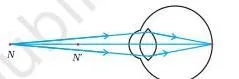
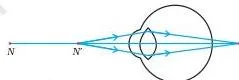
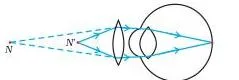
The convex lens must take an object at the normal near point (25 cm) and form a virtual image at this person’s near point (1 m = 100 cm), so the defective eye can then focus it. So \( u = -25\ \text{cm} \) and \( v = -100\ \text{cm} \) (both negative — virtual image on the same side as the object). Using the lens formula:
\[ \frac{1}{f} = \frac{1}{v} – \frac{1}{u} = \frac{1}{-100} – \frac{1}{-25} = -\frac{1}{100} + \frac{1}{25} = \frac{-1 + 4}{100} = \frac{3}{100} \]
\[ f = \frac{100}{3}\ \text{cm} = 33.3\ \text{cm} = 0.333\ \text{m} \quad \Rightarrow \quad P = \frac{1}{f} = \frac{1}{0.333} = +3.0\ \text{D} \]
Final answer: A convex lens of power \( +3.0\ \text{D} \).
How to draw the diagram (three steps):
- Draw the uncorrected, defective eye (as in Fig. 10.3(b)): rays from a nearby object converge to a point behind the retina — the blurred case.
- Place a convex lens in front of the eye and show the corrected rays (as in Fig. 10.3(c)): the lens adds converging power, so the rays now meet on the retina.
- Label the object distance (25 cm, the normal near point) and mark \( N \) (the hypermetropic near point of 1 m) and \( N’ \) (the normal near point).
Common error: Sign errors in the lens formula. Both \( u \) and \( v \) are negative here because the virtual image forms on the same side as the object. If you plug in positive values you get a wrong (and often negative) power.
Question 8: Why is a normal eye not able to see clearly the objects placed closer than 25 cm?
Accommodation has a physical limit. The ciliary muscles cannot contract enough to thicken the lens beyond a certain curvature, so there is a minimum focal length the eye lens can achieve (NCERT, p. 162).
For an object closer than 25 cm, the required focal length is shorter than this minimum, so the image forms behind the retina and appears blurred, and the eye feels strain.
Common error: Saying \”the eye cannot adjust.\” It can adjust — but only within a range. The 25 cm limit is the physical minimum of that range.
Question 9: What happens to the image distance in the eye when we increase the distance of an object from the eye?
The image distance — from the eye lens to the retina — is fixed by the anatomy of the eyeball and does not change. Instead, the eye lens adjusts its focal length through accommodation: as the object moves farther away, the ciliary muscles relax, the lens thins, and the focal length increases, so the image still forms on the retina (NCERT, p. 161-162).
Common error: Answering \”image distance increases\” by analogy with a fixed-focal-length camera lens. The eye is not a fixed lens — accommodation keeps the image distance constant by changing the focal length.
Question 10: Why do stars twinkle?
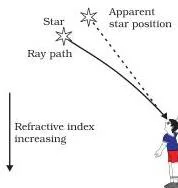
Starlight passes through layers of the earth’s atmosphere with different densities and temperatures, so the refractive index changes continuously. The path of the light ray keeps shifting slightly, and the apparent position of the star fluctuates — the amount of light entering the eye flickers, so the star appears brighter at one moment and fainter the next. This is twinkling.
Because stars are very distant, they act as point-sized sources, so this variation is noticeable (NCERT, p. 168). As the figure above shows, the apparent position is slightly higher than the actual position near the horizon.
Common error: Attributing twinkling to the star itself (pulsation, burning). It is entirely an atmospheric effect — the star’s light output is steady.
Question 11: Explain why the planets do not twinkle.
Planets are much closer to the earth than stars, so they appear as extended sources (small discs) rather than point sources. If we think of a planet as a collection of many point-sized sources, each point twinkles, but the variations from the many points average out to zero, so the total brightness appears steady (NCERT, p. 168).
Common error: Saying \”planets are brighter.\” Brightness is not the reason — planets do not twinkle because they are extended sources, not point sources.
Question 12: Why does the sky appear dark instead of blue to an astronaut?
The blue colour of the sky is due to scattering of shorter (blue) wavelengths by air molecules and fine particles in the atmosphere (NCERT, p. 169). At the very high altitude where astronauts orbit, there is almost no atmosphere — no particles, so no scattering of sunlight occurs. The sky therefore appears dark to them, even though sunlight is present.
Common error: Saying \”there is no light in space.\” Sunlight is present; it just has nothing to scatter off.
Method Recap: Lens-Power Calculations and Sign Rules
For quick board-prep revision, here is the compact toolkit you need for Q5-Q7. The power formula is \( P = \frac{1}{f} \), with \( f \) in metres and \( P \) in dioptres.
The lens formula is \( \frac{1}{f} = \frac{1}{v} – \frac{1}{u} \): object distance \( u \) is negative for real objects, image distance \( v \) is positive for real images (opposite side) and negative for virtual images (same side as the object).
| Lens type | Defect corrected | Sign of \( f \) | Sign of \( P \) | Typical use |
|---|---|---|---|---|
| Concave (diverging) | Myopia | Negative | Negative | Far point closer than infinity |
| Convex (converging) | Hypermetropia / Presbyopia | Positive | Positive | Near point farther than 25 cm |
Worked example for revision (original numbers, for extra practice): Suppose a myopic eye has a far point of 150 cm. What lens is needed? Object at infinity, image at \( v = -150\ \text{cm} = -1.50\ \text{m} \):
\[ f = -1.50\ \text{m} \quad \Rightarrow \quad P = \frac{1}{f} = \frac{1}{-1.50} = -0.67\ \text{D} \]
So a concave lens of power \( -0.67\ \text{D} \) is needed. This is the same method as Q6 — only the number changes.
| Mistake | Correct rule | How to check your answer |
|---|---|---|
| Putting cm into \( P = 1/f \) | Always convert \( f \) to metres first | If you get a power in the hundreds of dioptres, you forgot to convert. |
| Dropping the negative sign for a concave lens | Concave \( \Rightarrow \) negative \( f \) and \( P \) | Check that myopia corrections always have negative power. |
| Confusing accommodation with presbyopia | Accommodation = healthy ability; presbyopia = loss with age | If the question describes an old person who cannot see nearby objects clearly, that is presbyopia. |
| Saying the star itself twinkle | Twinkling is atmospheric refraction, not a property of the star | If there were no atmosphere, stars would not twinkle. |
Frequently Asked Questions
A short section on queries that fall out of this chapter but are not asked directly in the exercise. More revision resources are available in the CBSE notes hub, including the linked chapter on Light Reflection and Refraction and the next chapter on Electricity.
How do I quickly tell whether a vision defect is myopia or hypermetropia from the question?
If the person cannot see distant objects clearly (blackboard from the last row, far point closer than infinity), it is myopia — use a concave lens. If the person cannot see nearby objects clearly (must hold a book far away, near point beyond 25 cm), it is hypermetropia — use a convex lens.
Why is a concave lens used for myopia and a convex lens for hypermetropia?
In myopia the image of a distant object forms in front of the retina, so a concave lens diverges the rays to push the image back onto the retina. In hypermetropia the image of a nearby object forms behind the retina, so a convex lens adds converging power to bring the image forward onto the retina.
What is the difference between presbyopia and hypermetropia?
Hypermetropia is a refractive defect that can occur at any age — the eyeball is too short or the focal length too long. Presbyopia is the age-related loss of accommodation due to weakening ciliary muscles and a stiffening lens; near objects become hard to see.
A person can have both, in which case bifocal lenses (upper concave for distance, lower convex for near) are used (NCERT, p. 163).
Why does the Sun appear reddish during sunrise and sunset?
At sunrise and sunset sunlight passes through a much thicker layer of the atmosphere. Shorter wavelengths (blue, violet) are scattered away, and the longer wavelengths (red) reach our eye — so the Sun appears reddish. Students revising scattering will find this covered in the Class 10 Science notes alongside the chapter on light.
What is Tyndall effect and how is it related to the blue colour of the sky?
The Tyndall effect is the scattering of a beam of light by colloidal or fine particles in a medium, which makes the path of the beam visible (NCERT, p. 169).
The blue colour of the sky is a related scattering effect: air molecules, being smaller than the wavelength of visible light, scatter the shorter blue wavelengths more strongly than red, so we see a blue sky.
Reference: NCERT Class 10 Science textbook, chapter The Human Eye and the Colourful World.
Explore Class 10 Science NCERT Solutions
Class 10 Science on LearnCBSE:
Related chapters: