This page gives the NCERT solutions for Class 10 Science Chapter 2 (Acids, Bases and Salts) for the 2026-27 session — every intext question and every exercise question from the textbook, reproduced word for word, with concept-first answers you can follow without the book open.
All 19 intext questions (pages 18–33) and all 15 exercise questions (page 34) are solved step by step, including the balancing, the pH reasoning and the common slips students make.
Use it while doing homework or the night before a test: read the question, try your answer, then check the worked solution. The first line of each answer teaches the idea the question tests, so a similar question in the exam will not catch you out.
NCERT Solutions for Class 10 Science Chapter 2: identifying acids, bases and neutral water with red litmus (Page 18, Question 1)
This first intext question tests the most basic indicator skill of the chapter: a single piece of red litmus paper is enough to sort three unknown liquids because of the way litmus behaves. Recall from the chapter opening — acids turn blue litmus red, while bases turn red litmus blue (NCERT, p. 17).
Litmus is a natural indicator extracted from lichen (NCERT, p. 17).
Intext Question 1: You have been provided with three test tubes. One of them contains distilled water and the other two contain an acidic solution and a basic solution, respectively. If you are given only red litmus paper, how will you identify the contents of each test tube?
Concept: Red litmus changes colour only in a base — it turns blue. It stays red in both an acid and in neutral distilled water, so you must first use the one tube that gives a colour change to “manufacture” a blue strip, then use that strip to separate the acid from the water.
Step 1: Dip a piece of red litmus paper into each of the three test tubes.
The tube in which the red litmus turns blue contains the basic solution, because a base is the only thing that turns red litmus blue.
Step 2: Take the now-blue litmus paper and dip it into the remaining two liquids one at a time.
It turns red in the acid — acids turn blue litmus red.
It stays blue in distilled water, which is neither acidic nor basic.
Final answer: The tube that turns red litmus blue holds the basic solution. The tube that turns that blue paper red holds the acidic solution. The tube where the blue paper shows no change holds distilled water.
Intext solutions: acids reacting with metals and metal carbonates (Page 22, Questions 1–3)
These three questions test two reaction patterns that appear again in the exercises: an acid reacting with a metal gives a salt plus hydrogen gas (Activity 2.3, NCERT, p. 19), and an acid reacting with a metal carbonate or hydrogencarbonate gives a salt, carbon dioxide and water (Activity 2.5, NCERT, p. 20).
The gas tests are the exam’s favourite: hydrogen burns with a pop; carbon dioxide extinguishes a burning candle and turns lime water milky.
Intext Question 1: Why should curd and sour substances not be kept in brass and copper vessels?
Concept: Sour substances contain acids — Table 2.3 lists curd as a source of lactic acid (NCERT, p. 28) — and acids react with metals. Brass and copper are metals, so they are not safe containers for acidic food.
An acid reacts with a metal to produce a salt and hydrogen gas (NCERT, p. 19). The lactic acid in curd would react with the brass or copper of the vessel, forming salts that contaminate the food and can be harmful to health. The food also picks up an unpleasant taste.
Final answer: Curd and sour substances contain acids that react with the metal of brass and copper vessels to form salts, which can be poisonous and spoil the food. They should be stored in neutral containers such as glass or earthenware.
Intext Question 2: Which gas is usually liberated when an acid reacts with a metal? Illustrate with an example. How will you test for the presence of this gas?
Concept: In every acid–metal reaction the metal displaces hydrogen from the acid, so hydrogen gas is the common gas liberated (NCERT, p. 19).
Example: Zinc granules are added to dilute sulphuric acid.
Zinc sulphate forms and hydrogen gas bubbles off:
\[ \text{Zn(s)} + \text{H}_2\text{SO}_4\text{(aq)} \rightarrow \text{ZnSO}_4\text{(aq)} + \text{H}_2\text{(g)} \]
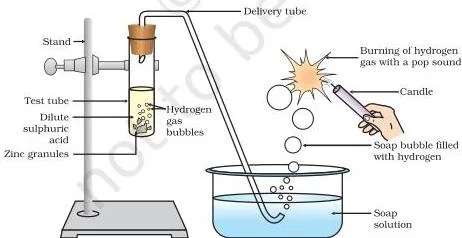
Test: Pass the gas into soap solution so bubbles form, then bring a burning candle near a bubble.
Hydrogen burns with a popping sound (NCERT, p. 19).
Final answer: Hydrogen gas is liberated. Example: zinc + dilute sulphuric acid gives zinc sulphate and hydrogen. Test: a burning candle held near a gas-filled soap bubble makes the hydrogen burn with a pop.
Intext Question 3: Metal compound A reacts with dilute hydrochloric acid to produce effervescence. The gas evolved extinguishes a burning candle. Write a balanced chemical equation for the reaction if one of the compounds formed is calcium chloride.
Concept: Effervescence means a gas is being given off. A gas that extinguishes a burning candle is carbon dioxide — hydrogen would have burned (compare with Question 2 above). Carbon dioxide is released when an acid reacts with a metal carbonate or hydrogencarbonate (NCERT, p. 20).
Decide compound A: The products include calcium chloride, so the salt carries calcium.
The carbonate that forms calcium chloride with HCl is calcium carbonate, \( \text{CaCO}_3 \).
\[ \text{CaCO}_3\text{(s)} + 2\text{HCl(aq)} \rightarrow \text{CaCl}_2\text{(aq)} + \text{H}_2\text{O(l)} + \text{CO}_2\text{(g)} \]
Check the gas: The CO₂ given off extinguishes a burning candle, and passed through lime water it turns the lime water milky, exactly as Figure 2.2 shows for Activity 2.5 (NCERT, p. 20).
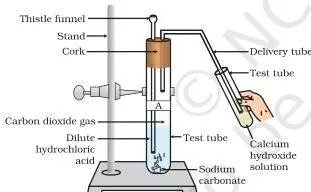
Final answer: Compound A is calcium carbonate:
\[ \text{CaCO}_3 + 2\text{HCl} \rightarrow \text{CaCl}_2 + \text{H}_2\text{O} + \text{CO}_2 \]
Intext solutions: why acids need water — ions and electrical conductivity (Page 25, Questions 1–3)
These three questions all rest on one idea from Activities 2.8 and 2.9 (NCERT, pp. 22–23): an acid is acidic because it produces hydrogen ions \( \text{H}^+\text{(aq)} \) in water, and those free ions are also what carry electric current.
Intext Question 1: Why do HCl, HNO₃, etc., show acidic characters in aqueous solutions while solutions of compounds like alcohol and glucose do not show acidic character?
Concept: Acidic character comes from \( \text{H}^+\text{(aq)} \) ions in solution, not from the mere presence of hydrogen in the formula (NCERT, p. 22).
HCl and HNO₃ dissociate in water to release hydrogen ions, which are responsible for acidic properties (NCERT, p. 22). Glucose and alcohol dissolve in water but do not ionise, so they release no \( \text{H}^+\text{(aq)} \) ions and show no acidic character at all.
Final answer: HCl and HNO₃ ionise in aqueous solution to produce \( \text{H}^+\text{(aq)} \) ions, while glucose and alcohol dissolve but never ionise, so they cannot release hydrogen ions and are not acidic.
Intext Question 2: Why does an aqueous solution of an acid conduct electricity?
Concept: Electric current in a solution is carried by free ions. An acid solution contains plenty of them.
When an acid dissolves in water it produces hydrogen ions \( \text{H}^+\text{(aq)} \) and anions such as \( \text{Cl}^- \), \( \text{NO}_3^- \) and \( \text{SO}_4^{2-} \) (NCERT, p. 22). These free ions move through the solution and carry the current — which is exactly why the bulb glows in the circuit of Activity 2.8 while glucose and alcohol solutions leave it dark.
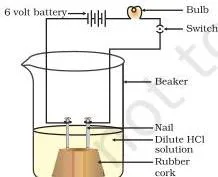
Final answer: The aqueous acid solution contains free ions (\( \text{H}^+ \) and the acid’s anions); these ions carry the electric current, so the bulb glows.
Intext Question 3: Why does dry HCl gas not change the colour of the dry litmus paper?
Concept: Hydrogen ions in HCl are produced only in the presence of water (NCERT, p. 23). Dry HCl gas cannot ionise, so it releases no \( \text{H}^+\text{(aq)} \) and shows no acidic behaviour.
In Activity 2.9, HCl gas prepared from sodium chloride and concentrated sulphuric acid is tested with dry and wet blue litmus (NCERT, p. 23). The dry litmus does not change colour; the wet litmus turns red. Water is needed to convert HCl into hydronium ions:
\[ \text{HCl} + \text{H}_2\text{O} \rightarrow \text{H}_3\text{O}^+ + \text{Cl}^- \]
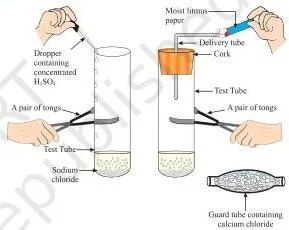
Final answer: Dry HCl gas has no hydrogen ions because water is needed to form hydronium ions \( \text{H}_3\text{O}^+ \); without them the gas shows no acidic character and dry litmus is unchanged.
Intext solutions: diluting acids and bases — safety and ion concentration (Page 25, Questions 4–6)
Dilution questions test two linked ideas from Activity 2.10 (NCERT, p. 24): mixing an acid or base with water is highly exothermic, and dilution lowers the concentration of ions per unit volume.
Intext Question 4: While diluting an acid, why is it recommended that the acid should be added to water and not water to the acid?
Concept: Dissolving an acid or base in water is a highly exothermic process — it releases a lot of heat (NCERT, p. 24).
Adding the acid slowly to water, with constant stirring, lets the heat spread through a large volume of water. If water is poured into concentrated acid instead, the heat generated is concentrated and can make the mixture splash out violently, causing burns; the local heating can even crack the glass container (NCERT, p. 24).
Final answer: Acid must always be added slowly to water with constant stirring. Adding water to the acid can make the hot mixture splash out and burn you, and may break the container.
Intext Question 5: How is the concentration of hydronium ions (H₂O⁺) affected when a solution of an acid is diluted?
Concept: Dilution adds water but no more acid, so the same number of \( \text{H}_3\text{O}^+ \) ions is spread through a larger volume.
Mixing an acid with water decreases the concentration of hydronium ions per unit volume (NCERT, p. 24). The ions are not destroyed or removed — there are just fewer of them in every millilitre of the diluted solution. (The textbook writes H₂O⁺ for the hydronium ion, \( \text{H}_3\text{O}^+ \).)
Final answer: On dilution the concentration of hydronium ions \( \text{H}_3\text{O}^+ \) per unit volume decreases, so the solution becomes less acidic.
Intext Question 6: How is the concentration of hydroxide ions (OH⁻) affected when excess base is dissolved in a solution of sodium hydroxide?
Concept: A base produces hydroxide ions in water (NCERT, p. 23), so adding more base adds more \( \text{OH}^- \) ions.
Dissolving excess base in a sodium hydroxide solution increases the number of \( \text{OH}^- \) ions and therefore the concentration of hydroxide ions per unit volume. The solution becomes more strongly basic.
Final answer: The concentration of \( \text{OH}^- \) ions per unit volume increases when excess base is dissolved in a solution of sodium hydroxide.
Intext solutions: reading the pH scale and hydrogen ion concentration (Page 28, Questions 1–4)
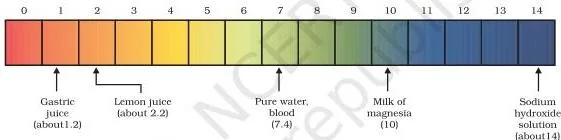
The pH scale measures the hydrogen ion concentration in a solution, from 0 (very acidic) to 14 (very alkaline), with pH 7 neutral (NCERT, p. 25). The one rule that answers every pH question: higher the hydronium ion concentration, lower is the pH (NCERT, p. 25). The figure below shows the whole scale at a glance.

Read Figure 2.6 from left to right: at very low pH the solution holds the most \( \text{H}^+\text{(aq)} \) ions and is strongly acidic; at pH 7 the \( \text{H}^+ \) and \( \text{OH}^- \) concentrations balance; past 7 the \( \text{OH}^- \) ions take over and the solution is basic.
Figure 2.7 places common household substances on the same scale — lemon juice and vinegar are acidic, tap water is close to neutral, and soap solutions are basic (NCERT, p. 26). So whenever two pH values are compared, the smaller number belongs to the solution with more hydrogen ions — and that is exactly what Question 1 below asks.
Intext Question 1: You have two solutions, A and B. The pH of solution A is 6 and pH of solution B is 8. Which solution has more hydrogen ion concentration? Which of this is acidic and which one is basic?
Concept: pH and \( \text{H}^+ \) concentration move in opposite directions — lower pH means more \( \text{H}^+ \) (NCERT, p. 25). A pH below 7 is acidic, above 7 is basic, exactly 7 is neutral.
Step 1: Solution A has pH 6, solution B has pH 8.
Since 6 is the lower pH, A has the higher hydrogen ion concentration.
Step 2: pH 6 is below 7, so A is acidic.
pH 8 is above 7, so B is basic.
Final answer: Solution A has more hydrogen ions. A (pH 6) is acidic and B (pH 8) is basic.
Intext Question 2: What effect does the concentration of H+(aq) ions have on the nature of the solution?
Concept: The \( \text{H}^+\text{(aq)} \) ion concentration decides how acidic a solution is (NCERT, p. 25).
Step: The higher the concentration of \( \text{H}^+\text{(aq)} \) ions, the more acidic the solution and the lower its pH.
As the \( \text{H}^+ \) concentration falls, the solution becomes less acidic and eventually basic.
Final answer: A higher \( \text{H}^+\text{(aq)} \) ion concentration makes the solution more acidic and lowers its pH; a lower concentration makes it less acidic.
Intext Question 3: Do basic solutions also have H+(aq) ions? If yes, then why are these basic?
Concept: No water solution is entirely free of \( \text{H}^+ \) ions; what decides the nature is which ion is present in greater amount.
Yes, a basic solution contains a few \( \text{H}^+\text{(aq)} \) ions.
It is basic because the number of \( \text{OH}^- \) ions in it is greater than the number of \( \text{H}^+ \) ions, so the hydroxide ions dominate and the solution behaves as a base — just as past pH 7 on Figure 2.6 the \( \text{OH}^- \) ion concentration rises above the \( \text{H}^+ \) concentration (NCERT, p. 25).
Final answer: Basic solutions do contain \( \text{H}^+ \) ions, but their \( \text{OH}^- \) ions outnumber the \( \text{H}^+ \) ions, which is why the solution is basic.
Intext Question 4: Under what soil condition do you think a farmer would treat the soil of his fields with quick lime (calcium oxide) or slaked lime (calcium hydroxide) or chalk (calcium carbonate)?
Concept: Plants need a specific pH range for healthy growth, so a farmer adjusts soil that is outside that range (NCERT, p. 27).
Step: Quick lime, slaked lime and chalk are all basic substances.
If the soil is too acidic, these bases neutralise the excess acid and bring the soil pH back into the favourable range for the crop (NCERT, p. 27).
Final answer: A farmer would treat acidic soil — soil whose pH is too low — with these basic substances to neutralise the excess acid and make the soil suitable for plant growth.
Intext solutions: chemicals from common salt and Plaster of Paris (Page 33, Questions 1–5)
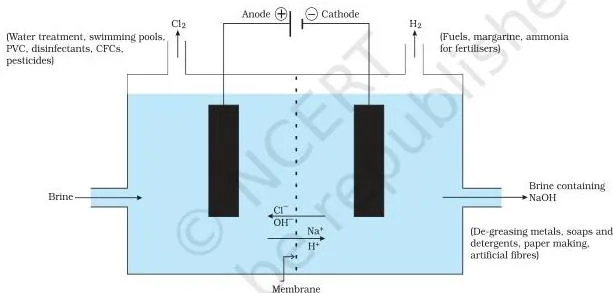
The last five intext questions test the salt products of industrial chemistry: what comes out of the chlor-alkali process, and how sodium and calcium salts are named and converted. Figure 2.8 shows the three products of the chlor-alkali process and their uses (NCERT, p. 30) — chlorine feeds into bleaching powder, and the alkali (sodium hydroxide) is used in soap and paper making.
Hydrogen from the same process is used as a fuel.
Intext Question 1: What is the common name of the compound Ca(ClO)₂?
Concept: This is the compound made when chlorine acts on dry slaked lime (NCERT, p. 30).
Final answer: The common name of \( \text{Ca(ClO)}_2 \) is bleaching powder.
Intext Question 2: Name the substance which on treatment with chlorine yields bleaching powder.
Concept: Chlorine from the chlor-alkali process is used to manufacture bleaching powder (NCERT, p. 30).
Final answer: Dry slaked lime, \( \text{Ca(OH)}_2 \), on treatment with chlorine yields bleaching powder:
\[ 2\text{Ca(OH)}_2 + 2\text{Cl}_2 \rightarrow \text{Ca(ClO)}_2 + \text{CaCl}_2 + 2\text{H}_2\text{O} \]
Intext Question 3: Name the sodium compound which is used for softening hard water.
Concept: Washing soda is the sodium compound obtained by recrystallisation of sodium carbonate and is used for removing permanent hardness of water (NCERT, p. 31).
Final answer: Sodium carbonate decahydrate, \( \text{Na}_2\text{CO}_3 \cdot 10\text{H}_2\text{O} \), commonly called washing soda, is used for softening hard water.
Intext Question 4: What will happen if a solution of sodium hydrocarbonate is heated? Give the equation of the reaction involved.
Concept: Sodium hydrogencarbonate (baking soda) decomposes on heating (NCERT, p. 31).
Step: On heating, \( 2\text{NaHCO}_3 \) breaks down into sodium carbonate, water and carbon dioxide gas:
\[ 2\text{NaHCO}_3 \xrightarrow{\text{Heat}} \text{Na}_2\text{CO}_3 + \text{H}_2\text{O} + \text{CO}_2 \]
Final answer: Sodium carbonate is formed along with water and carbon dioxide gas, with the balanced equation above.
Intext Question 5: Write an equation to show the reaction between Plaster of Paris and water.
Concept: Plaster of Paris is calcium sulphate hemihydrate \( \text{CaSO}_4 \cdot \tfrac{1}{2}\text{H}_2\text{O} \); on mixing with water it changes back to gypsum, a hard solid (NCERT, p. 33).
\[ \text{CaSO}_4 \cdot \tfrac{1}{2}\text{H}_2\text{O} + 1\tfrac{1}{2}\text{H}_2\text{O} \rightarrow \text{CaSO}_4 \cdot 2\text{H}_2\text{O} \]
Final answer: Plaster of Paris reacts with 1½ molecules of water to form gypsum, \( \text{CaSO}_4 \cdot 2\text{H}_2\text{O} \), which sets into a hard mass.
Exercise solutions: reading pH and classifying solutions (Questions 1, 9, 11, 12)
The exercise opens with pH questions that reuse the scale from page 25: red litmus turning blue proves a base, pH below 7 is acidic, above 7 is basic, and the higher the \( \text{H}^+ \) concentration the lower the pH.
Exercise Question 1: A solution turns red litmus blue, its pH is likely to be
- (a) 1
- (b) 4
- (c) 5
- (d) 10
Concept: Red litmus turns blue only in a basic solution, and a basic solution has a pH above 7 (NCERT, p. 25).
Of the options, only 10 is above 7. Values 1, 4 and 5 are all below 7, so they belong to acidic solutions, which would turn blue litmus red, not red litmus blue.
Correct answer: (d) 10. A solution that turns red litmus blue is basic, so its pH must be greater than 7.
Exercise Question 9: Five solutions A,B,C,D and E when tested with universal indicator showed pH as 4,1,11,7 and 9, respectively. Which solution is
- (a) neutral?
- (b) strongly alkaline?
- (c) strongly acidic?
- (d) weakly acidic?
- (e) weakly alkaline? Arrange the pH in increasing order of hydrogen-ion concentration.
Concept: pH 7 is neutral; far below 7 is strongly acidic, just below 7 weakly acidic; far above 7 strongly alkaline, just above 7 weakly alkaline. Hydrogen ion concentration rises as pH falls (NCERT, p. 25).
Fixed labels: A = 4, B = 1, C = 11, D = 7, E = 9.
- (a) neutral — D, pH 7.
- (b) strongly alkaline — C, pH 11 (highest value).
- (c) strongly acidic — B, pH 1 (lowest value).
- (d) weakly acidic — A, pH 4 (just below 7).
- (e) weakly alkaline — E, pH 9 (just above 7).
Hydrogen ion concentration: It increases as pH decreases, so the increasing order of \( \text{H}^+ \) concentration is the reverse of the pH order: C(11), E(9), D(7), A(4), B(1).
Final answer: (a) D, (b) C, (c) B, (d) A, (e) E. Increasing hydrogen ion concentration: C, E, D, A, B.
Exercise Question 11: Fresh milk has a pH of 6. How do you think the pH will change as it turns into curd? Explain your answer.
Concept: Curd is formed by bacteria acting on milk, and Table 2.3 lists sour milk (curd) as a source of lactic acid (NCERT, p. 28).
As milk turns into curd, the bacteria produce lactic acid. The acid adds \( \text{H}^+ \) ions to the mixture, so the pH falls below 6 — the curd is more acidic than the fresh milk. This same lactic acid is why curd should not be stored in metal vessels, as in the first intext question above.
Final answer: The pH decreases below 6 because lactic acid produced by bacteria in the curdling milk makes the mixture more acidic.
Exercise Question 12: A milkman adds a very small amount of baking soda to fresh milk.
- (a) Why does he shift the pH of the fresh milk from 6 to slightly alkaline?
- (b) Why does this milk take a long time to set as curd?
Concept: Baking soda, sodium hydrogencarbonate, is a mild non-corrosive basic salt (NCERT, p. 31).
Part (a): Adding the basic salt raises the pH of the milk from 6 (slightly acidic) to just above 7, making it slightly alkaline.
Part (b): The curd bacteria work best in a mildly acidic medium.
In the slightly alkaline milk the lactic-acid bacteria grow and act more slowly, so the milk takes longer to set as curd.
Final answer: (a) The basic baking soda lifts the pH from 6 to slightly above 7. (b) The alkaline condition slows the lactic-acid bacteria, so the milk sets slowly.
Exercise solutions: acids reacting with metals and carbonates (Questions 2, 5, 10)
These three questions return to the reaction patterns of Activities 2.3 and 2.5: acid + metal gives salt and hydrogen (NCERT, p. 19), acid + carbonate gives salt, carbon dioxide and water (NCERT, p. 20), and a strong acid gives more \( \text{H}^+ \) ions than a weak acid at the same concentration (NCERT, p. 26).
Exercise Question 2: A solution reacts with crushed egg-shells to give a gas that turns lime-water milky. The solution contains
- (a) NaCl
- (b) HCl
- (c) LiCl
- (d) KCl
Concept: Egg shells are calcium carbonate. A carbonate reacts with an acid to give carbon dioxide, and CO₂ turns lime water milky (NCERT, p. 20).
The gas that turns lime water milky is carbon dioxide. Carbon dioxide is given off when an acid reacts with a carbonate, so the solution must be an acid. Among the options only HCl is an acid — the chlorides NaCl, LiCl and KCl are salts and would not react with the shell.
Correct answer: (b) HCl. The HCl reacts with the calcium carbonate in the egg shells to release CO₂, which turns lime water milky.
Exercise Question 5: Write word equations and then balanced equations for the reaction taking place when –
- (a) dilute sulphuric acid reacts with zinc granules.
- (b) dilute hydrochloric acid reacts with magnesium ribbon.
- (c) dilute sulphuric acid reacts with aluminium powder.
- (d) dilute hydrochloric acid reacts with iron filings.
Concept: Every acid–metal reaction follows the pattern Acid + Metal → Salt + Hydrogen gas (NCERT, p. 19). Write the word equation first, then balance it using the valency of each metal ion and acid group.
Part (a): Zinc is divalent (Zn²⁺) and the sulphate group is divalent (SO₄²⁻), so they combine as ZnSO₄ — one of each, no coefficient needed.
Word equation: Zinc + Sulphuric acid → Zinc sulphate + Hydrogen \[ \text{Zn(s)} + \text{H}_2\text{SO}_4\text{(aq)} \rightarrow \text{ZnSO}_4\text{(aq)} + \text{H}_2\text{(g)} \]
Part (b): Magnesium is divalent (Mg²⁺), chloride is monovalent (Cl⁻), so the salt is MgCl₂ — two chlorides are needed.
Word equation: Magnesium + Hydrochloric acid → Magnesium chloride + Hydrogen \[ \text{Mg(s)} + 2\text{HCl(aq)} \rightarrow \text{MgCl}_2\text{(aq)} + \text{H}_2\text{(g)} \]
Part (c): Aluminium is trivalent (Al³⁺) and sulphate is divalent (SO₄²⁻); the lowest common multiple of 3 and 2 is 6, so we need 2 Al³⁺ and 3 SO₄²⁻ — Al₂(SO₄)₃.
Word equation: Aluminium + Sulphuric acid → Aluminium sulphate + Hydrogen \[ 2\text{Al(s)} + 3\text{H}_2\text{SO}_4\text{(aq)} \rightarrow \text{Al}_2\text{(SO}_4\text{)}_3\text{(aq)} + 3\text{H}_2\text{(g)} \]
Part (d): With dilute hydrochloric acid, iron forms the divalent ion Fe²⁺, so the salt is iron(II) chloride, FeCl₂.
Word equation: Iron + Hydrochloric acid → Iron(II) chloride + Hydrogen \[ \text{Fe(s)} + 2\text{HCl(aq)} \rightarrow \text{FeCl}_2\text{(aq)} + \text{H}_2\text{(g)} \]
Final answer: The four balanced equations appear under their word equations above, each giving a salt and hydrogen gas.
Exercise Question 10: Equal lengths of magnesium ribbons are taken in test tubes A and B. Hydrochloric acid (HCl) is added to test tube A, while acetic acid (CH₃COOH) is added to test tube B. Amount and concentration taken for both the acids are same. In which test tube will the fizzing occur more vigorously and why?
Concept: At the same concentration, a strong acid produces more \( \text{H}^+ \) ions than a weak acid (NCERT, p. 26).
HCl is a strong acid and acetic acid is a weak acid. At equal concentration HCl ionises almost completely and supplies more \( \text{H}^+ \) ions, which react faster with the magnesium to release hydrogen — so fizzing is more vigorous in test tube A.
Final answer: Fizzing is more vigorous in test tube A because HCl, a strong acid, produces more \( \text{H}^+ \) ions than acetic acid at the same concentration, so the reaction with magnesium is faster.
Exercise solutions: ions, conductivity and the role of water (Questions 6, 7, 8)
These three questions consolidate the Activities 2.8 and 2.9 idea: acidic and basic solutions conduct because they produce free ions, and those ions exist only in water.
Exercise Question 6: Compounds such as alcohols and glucose also contain hydrogen but are not categorised as acids. Describe an Activity to prove it.
Concept: Hydrogen in the formula is not enough — a substance is acidic only if it releases \( \text{H}^+\text{(aq)} \) ions in solution (NCERT, p. 22). Activity 2.8 proves this by showing that glucose and alcohol solutions do not conduct, while acid solutions do.
The activity (NCERT, p. 22): Fix two nails into a cork and put the cork in a beaker; connect the nails to a 6 V battery through a bulb and a switch.
Pour dilute HCl into the beaker and switch on — the bulb glows, because the acid solution carries current through its ions.
Repeat with dilute sulphuric acid, again the bulb glows.
Now repeat separately with glucose and alcohol solutions: the bulb does not glow.
Conclusion: Glucose and alcohol dissolve in water but do not ionise, so they produce no \( \text{H}^+ \) ions and show no acidic character despite containing hydrogen.
Final answer: The nail-and-bulb activity of Activity 2.8 shows that HCl and H₂SO₄ solutions make the bulb glow but glucose and alcohol solutions do not, proving that hydrogen alone does not make a compound acidic — \( \text{H}^+ \) ions in solution do.
Exercise Question 7: Why does distilled water not conduct electricity, whereas rain water does?
Concept: Water conducts only when it contains dissolved ions to carry the current.
Distilled water is pure and contains no dissolved ions, so it cannot carry electric current. Rain water, however, picks up gases from the air as it falls — the chapter links rain water to dissolved gases on page 26 — and these dissolved substances form ions in the water. Those ions carry the current, so rain water conducts.
Final answer: Distilled water has no dissolved ions and does not conduct; rain water dissolves gases such as CO₂ from the atmosphere to form ions, so it conducts electricity.
Exercise Question 8: Why does dry HCL gas not show acidic behaviour in the absence of water?
Concept: Water is needed to pull \( \text{H}^+ \) out of the HCl molecule as hydronium ions (NCERT, p. 23).
In dry HCl gas the molecules are intact and cannot separate. Only in the presence of water does HCl form hydronium and chloride ions — \( \text{HCl} + \text{H}_2\text{O} \rightarrow \text{H}_3\text{O}^+ + \text{Cl}^- \) — and it is these \( \text{H}_3\text{O}^+ \) ions that give the acidic behaviour tested by litmus.
Final answer: Dry HCl gas cannot ionise without water, so no \( \text{H}^+\text{(aq)} \) or \( \text{H}_3\text{O}^+ \) ions are formed and the gas shows no acidic behaviour.
Exercise solutions: neutralisation and everyday salts (Questions 3, 4, 13, 14, 15)
The last group ties neutralisation (Activity 2.6, NCERT, p. 21), the antacid use of pH (NCERT, p. 27) and the everyday salts from pages 30–33 together.
Exercise Question 3: 10 mL of a solution of NaOH is found to be completely neutralised by 8 mL of a given solution of HCl. If we take 20 mL of the same solution of NaOH, the amount HCl solution (the same solution as before) required to neutralise it will be
- (a) 4 mL
- (b) 8 mL
- (c) 12 mL
- (d) 16 mL
Concept: Neutralisation needs a fixed amount of acid for each unit of base, so the volumes are in direct proportion: double the base, double the acid (NCERT, p. 21).
- Step 1: 10 mL of NaOH needs 8 mL of HCl.
- Step 2: 20 mL of NaOH is exactly double, so the acid needed is double too: \( 2 \times 8\ \text{mL} = 16\ \text{mL} \).
Correct answer: (d) 16 mL. Doubling the base doubles the acid required because neutralisation is a 1 : 1 proportion.
Exercise Question 4: Which one of the following types of medicines is used for treating indigestion?
- (a) Antibiotic
- (b) Analgesic
- (c) Antacid
- (d) Antiseptic
Concept: Indigestion is caused by excess acid in the stomach; the remedy is a base that neutralises it (NCERT, p. 27).
During indigestion the stomach produces too much acid, causing pain. Antacids are bases that neutralise the excess acid (NCERT, p. 27); magnesium hydroxide, milk of magnesia, is one example. Antibiotics fight infection, analgesics relieve pain and antiseptics kill microbes.
Correct answer: (c) Antacid. Antacids neutralise the excess hydrochloric acid produced during indigestion.
Exercise Question 13: Plaster of Paris should be stored in a moisture-proof container. Explain why?
Concept: Plaster of Paris reacts with water and sets into gypsum, a hard solid (NCERT, p. 33).
Plaster of Paris is calcium sulphate hemihydrate, \( \text{CaSO}_4 \cdot \tfrac{1}{2}\text{H}_2\text{O} \). On contact with water or moisture it converts into gypsum, \( \text{CaSO}_4 \cdot 2\text{H}_2\text{O} \), and hardens. If stored in an open container, atmospheric moisture would set the powder into a hard, useless lump. A moisture-proof container keeps it dry and free-flowing.
Final answer: Plaster of Paris reacts with moisture from the air to form hard gypsum, so it must be stored in a moisture-proof container to keep the powder dry and usable.
Exercise Question 14: What is a neutralisation reaction? Give two examples.
Concept: A neutralisation reaction is the reaction between an acid and a base to give a salt and water (NCERT, p. 21). The \( \text{H}^+ \) ions of the acid combine with the \( \text{OH}^- \) ions of the base to form water.
Example 1: Potassium hydroxide with hydrochloric acid:
\[ \text{KOH(aq)} + \text{HCl(aq)} \rightarrow \text{KCl(aq)} + \text{H}_2\text{O(l)} \]
Example 2: Calcium hydroxide with sulphuric acid:
\[ \text{Ca(OH)}_2\text{(aq)} + \text{H}_2\text{SO}_4\text{(aq)} \rightarrow \text{CaSO}_4\text{(aq)} + 2\text{H}_2\text{O(l)} \]
Final answer: A neutralisation reaction is the reaction of an acid with a base in which the acidic and basic effects cancel each other, forming a salt and water. Examples: KOH + HCl → KCl + H₂O and Ca(OH)₂ + H₂SO₄ → CaSO₄ + 2H₂O.
Exercise Question 15: Give two important uses of washing soda and baking soda.
Concept: Both are sodium salts with distinct household and industrial jobs: washing soda works on water hardness, baking soda works by releasing carbon dioxide (NCERT, pp. 31–32).
Washing soda (\( \text{Na}_2\text{CO}_3 \cdot 10\text{H}_2\text{O} \)):
- It removes permanent hardness of water.
- It is used as a cleaning agent and in the glass, soap and paper industries (NCERT, pp. 31–32).
Baking soda (\( \text{NaHCO}_3 \)):
- It is an ingredient of baking powder — the CO₂ it releases makes cakes and bread soft and spongy.
- It is an ingredient in antacids, neutralising excess acid in the stomach (NCERT, p. 31).
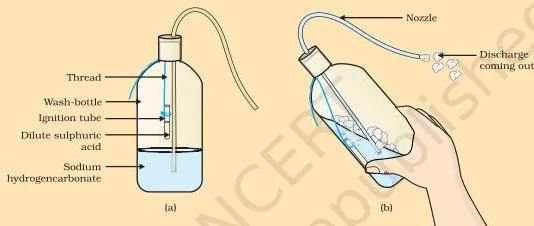
The figure also shows a third, exam-worthy use of baking soda: in a soda-acid fire extinguisher, dilute sulphuric acid reacts with sodium hydrogencarbonate to produce carbon dioxide, which is discharged onto the fire (NCERT, p. 36).
Final answer: Washing soda: removes permanent hardness of water, and is used as a cleaning agent or in glass, soap and paper industries. Baking soda: a raising agent in baking powder (soft, spongy cakes) and an antacid ingredient.
Method recap: equations, pH values and common mistakes to avoid
Before the exam, run through this crib. It gathers the indicator colours, the six reaction patterns, the salt families rule, and the mistakes that cost students marks on this chapter.
Indicator colours in acids and bases
These colours come from Activity 2.1 (NCERT, p. 18) — the table is the fastest way to recall any indicator.
| Indicator | In an acid | In a base |
|---|---|---|
| Red litmus | Stays red | Turns blue |
| Blue litmus | Turns red | Stays blue |
| Phenolphthalein | Colourless | Pink |
| Methyl orange | Red | Yellow |
The six reaction patterns of the chapter
Every reaction in the chapter fits one of these patterns, so identifying the pattern first gives you the products before you balance.
| Reaction | General pattern | One example |
|---|---|---|
| Acid + metal | Salt + Hydrogen | \( \text{Zn} + \text{H}_2\text{SO}_4 \rightarrow \text{ZnSO}_4 + \text{H}_2 \) (p. 19) |
| Base + metal | Salt + Hydrogen | \( 2\text{NaOH} + \text{Zn} \rightarrow \text{Na}_2\text{ZnO}_2 + \text{H}_2 \) (p. 20) |
| Acid + carbonate/hydrogencarbonate | Salt + CO₂ + Water | \( \text{Na}_2\text{CO}_3 + 2\text{HCl} \rightarrow 2\text{NaCl} + \text{H}_2\text{O} + \text{CO}_2 \) (p. 20) |
| Acid + base (neutralisation) | Salt + Water | \( \text{NaOH} + \text{HCl} \rightarrow \text{NaCl} + \text{H}_2\text{O} \) (p. 21) |
| Metal oxide + acid | Salt + Water | \( \text{CuO} + 2\text{HCl} \rightarrow \text{CuCl}_2 + \text{H}_2\text{O} \) (p. 21) |
| Non-metal oxide + base | Salt + Water | \( \text{Ca(OH)}_2 + \text{CO}_2 \rightarrow \text{CaCO}_3 + \text{H}_2\text{O} \) (p. 20) |
Chlor-alkali process and its products
The electrolysis of brine (aqueous sodium chloride) gives three useful products (NCERT, p. 30):
\[ 2\text{NaCl(aq)} + 2\text{H}_2\text{O(l)} \rightarrow 2\text{NaOH(aq)} + \text{Cl}_2\text{(g)} + \text{H}_2\text{(g)} \]
Mnemonic: the name chlor-alkali itself lists the first two products — chlorine gas and the alkali (sodium hydroxide) — and hydrogen comes from the water split in the process. So the three are CHLORine, ALKALI and HYDROGEN.
- Chlorine → bleaching powder, PVC, disinfecting drinking water.
- Sodium hydroxide → soap, paper, textiles.
- Hydrogen → fuel, margarine, ammonia (and used in HCl production).
The salt families rule
From Activity 2.14 (NCERT, p. 29), the pH of a salt is set by how strong its parent acid and base were — this is the rule that tells you whether any salt is acidic, basic or neutral.
| Salt from | pH of salt | Example |
|---|---|---|
| Strong acid + strong base | = 7 (neutral) | NaCl from HCl + NaOH |
| Strong acid + weak base | < 7 (acidic) | NH₄Cl from HCl + NH₄OH |
| Strong base + weak acid | > 7 (basic) | Na₂CO₃ from a strong base + weak acid |
Water of crystallisation — reading Figure 2.9
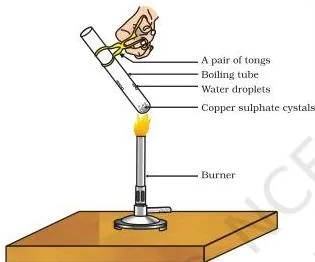
Water of crystallisation is the fixed number of water molecules in one formula unit of a salt (NCERT, p. 32).
The figure shows copper sulphate doing this: blue crystals of \( \text{CuSO}_4 \cdot 5\text{H}_2\text{O} \) turn white when heated as the five waters are driven off, and a few drops of water restore the blue colour because the salt takes the water back.
This same idea explains the formula \( \text{Na}_2\text{CO}_3 \cdot 10\text{H}_2\text{O} \) and why gypsum \( \text{CaSO}_4 \cdot 2\text{H}_2\text{O} \) loses water at 373 K to become Plaster of Paris (NCERT, p. 32).
Common mistakes to avoid
| Mistake | Correct rule | How to check your answer |
|---|---|---|
| Writing H⁺ without (aq) or H₃O⁺ | Hydrogen ions always exist as H⁺(aq) or hydronium H₃O⁺ in water (p. 23) | Any equation showing bare H⁺ needs a water molecule added to make H₃O⁺ |
| Adding water to concentrated acid | Add acid slowly to water with constant stirring (p. 24) | Recall the exothermic splash hazard — “acid into water” |
| Forgetting state symbols | H₂ is (g), salts are (aq) or (s), water is (l) | Every gas-evolving equation should show (g) on the gas |
| Writing Al(SO₄)₃ or Al₂(SO₄)₂ | Al³⁺ with SO₄²⁻ gives Al₂(SO₄)₃ (Exercise Q5c) | Cross-multiply valencies: 2 × 3 = 3 × 2 = 6 |
| Writing FeCl₃ for dilute HCl | Dilute HCl gives Fe²⁺, so FeCl₂ (Exercise Q5d) | Dilute acid + Fe gives iron(II), not iron(III) |
| Thinking higher pH means more H⁺ | Higher H₃O⁺ concentration, lower pH (p. 25) | A pH 2 solution is more acidic than pH 6 — the values go the opposite way |
For the full chapter treatment — definitions, the pH scale in depth and the entire reaction set — see the Class 10 Science NCERT solutions hub, and revise the balancing of reactions alongside Chapter 1: Chemical Reactions and Equations. Chapter 3, Metals and Non-metals, builds directly on the acid–metal reactions solved above.
For every subject and class, start at the CBSE Class 10 index page or the Class 10 subject hub.
Every question solved on this page is taken word for word from the official NCERT Class 10 Science textbook, so you can open the Chapter 2 PDF on the NCERT website to verify any equation, table, pH value or figure against the printed source before the exam.
FAQs: quick answers on acids, bases and salts
Which questions are solved on this Class 10 Science Chapter 2 NCERT solutions page?
This page solves all 19 intext questions (from pages 18, 22, 25, 28 and 33) and all 15 exercise questions (page 34) of Chapter 2, reproduced word for word. Each answer starts with the concept, then gives the step-by-step working and a common-error note.
Why is baking soda used as an antacid even though it is a salt?
Baking soda, sodium hydrogencarbonate, is a mild non-corrosive basic salt (NCERT, p. 31). Being alkaline, it neutralises the excess acid in the stomach and gives relief from acidity.
What is the difference between baking soda and baking powder?
Baking powder is baking soda mixed with a weak edible acid, tartaric acid (NCERT, p. 31). When heated or mixed with water they react to release carbon dioxide, which makes cakes and bread soft and spongy. Baking soda alone has no acid partner, so it is used as an antacid or for faster cooking.
How can I tell whether a salt is acidic, basic or neutral?
Use the salt families rule from Activity 2.14 (NCERT, p. 29): a salt of a strong acid and a strong base is neutral (pH 7); a salt of a strong acid and a weak base is acidic (pH below 7); a salt of a strong base and a weak acid is basic (pH above 7).
You can confirm any salt’s nature by testing its solution with litmus or pH paper.
Why does tooth decay start when the pH of the mouth falls below 5.5?
Tooth enamel is the hardest substance in the body, but it is corroded when the pH of the mouth drops below 5.5 (NCERT, p. 27). Bacteria degrade sugar and food particles into acids, which lower the pH and attack the enamel, so cleaning the mouth after eating and using basic toothpastes prevent decay.
Is Plaster of Paris the same as gypsum?
No. Gypsum, \( \text{CaSO}_4 \cdot 2\text{H}_2\text{O} \), when heated at 373 K loses water to become calcium sulphate hemihydrate, \( \text{CaSO}_4 \cdot \tfrac{1}{2}\text{H}_2\text{O} \), which is Plaster of Paris (NCERT, pp. 32–33). On mixing with water, Plaster of Paris regains the water and sets back into gypsum as a hard solid.
Reference: NCERT Class 10 Science textbook, chapter Acids, Bases and Salts.
Explore Class 10 Science NCERT Solutions
Class 10 Science on LearnCBSE:
Related chapters: