
This page provides complete NCERT Solutions for Class 10 Science Chapter 9 – Light: Reflection and Refraction. You will find step-by-step answers for every intext question (14 questions) and all end-of-chapter exercise questions (17 questions) from the NCERT textbook. Each solution follows the New Cartesian Sign Convention, works through the mirror or lens formula, and explains the underlying principle before the calculation.
The page reproduces every question word for word, so you can use it without the textbook open. All diagrams mentioned in the textbook are included and explained.
To verify any question or formula directly from the source, download the official NCERT Class 10 Science Chapter 9 PDF – it contains the original questions, figures, and worked examples that every solution on this page is based on.
Reference: NCERT Class 10 Science textbook, chapter Light – Reflection and Refraction.
Key definitions and formulas: the mirror and lens toolkit
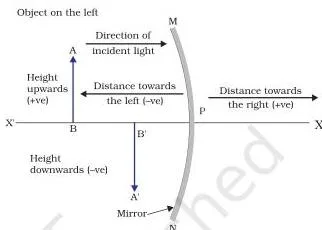
Before solving the questions, you need the following definitions and equations. The New Cartesian Sign Convention is the foundation for all calculations.
| Quantity | Sign convention for mirrors | Sign convention for lenses |
|---|---|---|
| Object distance (u) | Always negative (object left of mirror) | Always negative (object left of lens) |
| Focal length (f) | Concave: negative; Convex: positive | Convex: positive; Concave: negative |
| Image distance (v) | Real image: negative; Virtual image: positive | Real image: positive; Virtual image: negative |
| Height (h, h’) | Above principal axis: positive; Below: negative | Same as mirrors |
| Equation | Formula | Notes |
|---|---|---|
| Mirror formula | \( \frac{1}{v} + \frac{1}{u} = \frac{1}{f} \) | Works for concave and convex mirrors |
| Mirror magnification | \( m = -\frac{v}{u} = \frac{h’}{h} \) | Negative m → real image; positive m → virtual |
| Lens formula | \( \frac{1}{v} – \frac{1}{u} = \frac{1}{f} \) | Note the subtraction – different from mirror formula |
| Lens magnification | \( m = \frac{v}{u} = \frac{h’}{h} \) | No minus sign, unlike mirrors |
| Power of a lens | \( P = \frac{1}{f} \) (f in metres, unit dioptre D) | Convex lens: positive P; Concave lens: negative P |
| Radius and focal length | \( R = 2f \) | True for spherical mirrors of small aperture |
Remember: u is always negative because the object is placed to the left of the mirror or lens. This is the single most common sign error.
How to solve mirror and lens numericals step by step
Follow this five-step process for every numerical problem:
- Write knowns with correct signs – list u, f, h (object height), and assign signs using the New Cartesian Sign Convention.
- Choose the correct formula – mirror formula \( \frac{1}{v} + \frac{1}{u} = \frac{1}{f} \) for mirrors; lens formula \( \frac{1}{v} – \frac{1}{u} = \frac{1}{f} \) for lenses.
- Substitute with units – keep distances in cm or m consistently. Use the same unit throughout.
- Interpret the sign of v and m – v negative for mirrors → real image (same side as object); v positive for mirrors → virtual image. For lenses, positive v → real image. m negative → inverted; positive → erect.
- State the final answer – position, nature (real/virtual, erect/inverted), and size (magnified/diminished/same size) in a full sentence.
Original worked example (new numbers, not from the textbook):
A 2.0 cm tall object is placed 20 cm in front of a concave mirror of focal length 12 cm. Find the position, nature and size of the image.
Step 1: Assign signs.
Object is always left of the mirror, so \( u = -20 \text{ cm} \).
Concave mirror has negative focal length: \( f = -12 \text{ cm} \).
Object height \( h = +2.0 \text{ cm} \).
Step 2: Use the mirror formula: \( \frac{1}{v} + \frac{1}{u} = \frac{1}{f} \).
\( \frac{1}{v} = \frac{1}{f} – \frac{1}{u} = \frac{1}{-12} – \frac{1}{(-20)} = -\frac{1}{12} + \frac{1}{20} \) \( \frac{1}{v} = \frac{-5 + 3}{60} = \frac{-2}{60} = -\frac{1}{30} \) \( v = -30 \text{ cm} \)
- Step 1: Find magnification: \( m = -\frac{v}{u} = -\frac{(-30)}{(-20)} = -\frac{30}{20} = -1.5 \).
- Step 2: Image height: \( h’ = m \times h = -1.5 \times 2.0 = -3.0 \text{ cm} \).
Final answer: The image is formed 30 cm in front of the mirror (real), inverted, and 3.0 cm tall (enlarged).
Two formula traps to watch:
- Mirror vs lens formula: Mirror formula adds the reciprocals (\( 1/v + 1/u = 1/f \)), while the lens formula subtracts (\( 1/v – 1/u = 1/f \)). Mixing them up is the most common error.
- Magnification signs: For mirrors, \( m = -v/u \); for lenses, \( m = v/u \) (no minus sign).
Memory hook: In the mirror formula, the object and image are on the same side for real images, so the reciprocals add; in the lens formula, the real image is on the opposite side, so the reciprocals subtract.
Spherical mirror basics: focus, focal length and rear-view mirrors (Intext Q1–Q4, p. 142)
Question 1: Define the principal focus of a concave mirror.
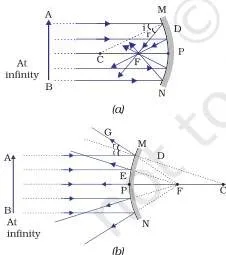
The principal focus of a concave mirror is the point on the principal axis where rays of light that are parallel to the principal axis actually converge after reflection from the mirror. The distance between the pole of the mirror and the principal focus is called the focal length (f).
For a concave mirror, the principal focus lies in front of the mirror.
Question 2: The radius of curvature of a spherical mirror is 20 cm. What is its focal length?
The focal length f of a spherical mirror is half its radius of curvature R, regardless of whether the mirror is concave or convex: \( f = R/2 \).
\( f = \frac{20 \text{ cm}}{2} = 10 \text{ cm} \) Answer: The focal length is 10 cm.
Question 3: Name a mirror that can give an erect and enlarged image of an object.
A concave mirror can produce an erect and enlarged image when the object is placed between its pole and principal focus (i.e., very close to the mirror). In this position, the image is virtual, erect and larger than the object. This is why concave mirrors are used as shaving mirrors or by dentists to see enlarged images of teeth.
Question 4: Why do we prefer a convex mirror as a rear-view mirror in vehicles?
Convex mirrors are preferred as rear-view mirrors for two reasons:
- They always form an erect image (virtual), which is essential for the driver to see traffic in the correct orientation.
- They have a wider field of view because the curved-outward surface enables the mirror to capture light from a larger area than a plane or concave mirror of the same size would.
Even though the image is smaller than the object, the advantage of seeing a broader area behind the vehicle makes convex mirrors the standard choice for safe driving.
Mirror formula: focal length and magnified real images (Intext Q1–Q2, p. 145)
Question 1: Find the focal length of a convex mirror whose radius of curvature is 32 cm.
The radius of curvature is given as 32 cm. For any spherical mirror, the focal length is half the radius of curvature. For a convex mirror, the focal length is positive (by sign convention).
\( f = \frac{R}{2} = \frac{32 \text{ cm}}{2} = +16 \text{ cm} \) Answer: The focal length is +16 cm.
Question 2: A concave mirror produces three times magnified (enlarged) real image of an object placed at 10 cm in front of it. Where is the image located?
The object is placed in front of the mirror, so \( u = -10 \text{ cm} \). The image is real and three times magnified. For a real image, the magnification is negative (inverted). Therefore \( m = -3 \).
Using the magnification formula for mirrors: \( m = -\frac{v}{u} \).
\( -3 = -\frac{v}{(-10)} \) \( -3 = -\frac{v}{-10} = -\left( -\frac{v}{10} \right) = \frac{v}{10} \) \( v = -30 \text{ cm} \) Answer: The image is located 30 cm in front of the mirror (real image).
Refraction: direction of bending, speed of light and optical density (Intext Q1–Q5, p. 150)
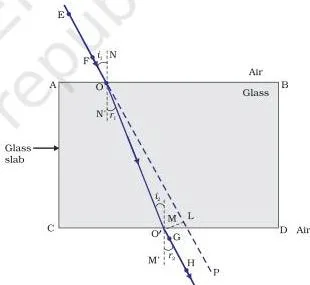
Question 1: A ray of light travelling in air enters obliquely into water. Does the light ray bend towards the normal or away from the normal? Why?
When light travels from a rarer medium (air) to a denser medium (water), it slows down. The decrease in speed causes the light ray to bend towards the normal. This is because the decrease in speed is more pronounced in the denser medium, and the ray must change direction to satisfy Snell’s law (n = sin i / sin r).
The angle of refraction is smaller than the angle of incidence, which means the ray bends towards the normal.
Question 2: Light enters from air to glass having refractive index 1.50. What is the speed of light in the glass? The speed of light in vacuum is 3 × 10⁸ m s⁻¹.
The refractive index n of a medium is defined as the ratio of the speed of light in vacuum c to the speed of light in that medium v: \( n = \frac{c}{v} \).
\( v = \frac{c}{n} = \frac{3 \times 10^8 \text{ m/s}}{1.50} = 2 \times 10^8 \text{ m/s} \) Answer: The speed of light in glass is \( 2 \times 10^8 \text{ m/s} \).
Question 3: Find out, from Table 9.3, the medium having highest optical density. Also find the medium with lowest optical density.
Table 9.3 lists the absolute refractive indices of various materials. The medium with the highest refractive index has the highest optical density, and the one with the lowest refractive index has the lowest optical density.
| Material medium | Refractive index |
|---|---|
| Air | 1.0003 |
| Ice | 1.31 |
| Water | 1.33 |
| Alcohol | 1.36 |
| Kerosene | 1.44 |
| Fused quartz | 1.46 |
| Turpentine oil | 1.47 |
| Benzene | 1.50 |
| Crown glass | 1.52 |
| Canada Balsam | 1.53 |
| Rock salt | 1.54 |
| Carbon disulphide | 1.63 |
| Dense flint glass | 1.65 |
| Ruby | 1.71 |
| Sapphire | 1.77 |
| Diamond | 2.42 |
From the table, the medium with the highest optical density is diamond (refractive index 2.42). The medium with the lowest optical density is air (refractive index 1.0003).
Question 4: You are given kerosene, turpentine and water. In which of these does the light travel fastest? Use the information given in Table 9.3.
From Table 9.3, the refractive indices are:
- Kerosene: 1.44
- Turpentine oil: 1.47
- Water: 1.33
Light travels fastest in the medium with the lowest refractive index because speed v = c/n. Among the three, water has the lowest refractive index (1.33), so light travels fastest in water.
Question 5: The refractive index of diamond is 2.42. What is the meaning of this statement?
The refractive index of diamond is 2.42. This means that the speed of light in diamond is \( 1/2.42 \) times the speed of light in vacuum (or air). In other words, light travels 2.42 times slower in diamond than in vacuum. Mathematically, \( n_{\text{diamond}} = \frac{c}{v_{\text{diamond}}} = 2.42 \), so \( v_{\text{diamond}} = \frac{c}{2.42} \).
Lenses and power of a lens (Intext Q1–Q3, p. 158)
Question 1: Define 1 dioptre of power of a lens.
One dioptre (1 D) is the power of a lens whose focal length is 1 metre. The power of a lens is the reciprocal of its focal length in metres: \( P = 1/f \). So if \( f = 1 \text{ m} \), then \( P = 1 \text{ D} \). The unit dioptre is equivalent to \( \text{m}^{-1} \).
Question 2: A convex lens forms a real and inverted image of a needle at a distance of 50 cm from it. Where is the needle placed in front of the convex lens if the image is equal to the size of the object? Also, find the power of the lens.
When a convex lens produces a real image of the same size as the object, the object must be placed at twice the focal length (2F) from the lens. At this position, the image is also formed at 2F on the other side, and the image distance equals the object distance.
Given: image distance \( v = +50 \text{ cm} \) (real image is on the opposite side, so positive). At 2F, \( v = 2f \), so \( 2f = 50 \text{ cm} \) → \( f = 25 \text{ cm} = 0.25 \text{ m} \).
The object distance is also \( u = -50 \text{ cm} \) (object is left of the lens).
Power of the lens: \( P = \frac{1}{f} = \frac{1}{0.25 \text{ m}} = +4 \text{ D} \).
Answer: The needle is placed 50 cm in front of the lens. The power of the lens is +4 D.
Question 3: Find the power of a concave lens of focal length 2 m.
For a concave lens, the focal length is negative by sign convention. Given focal length \( f = -2 \text{ m} \).
\( P = \frac{1}{f} = \frac{1}{-2 \text{ m}} = -0.5 \text{ D} \) Answer: The power of the concave lens is -0.5 D.
Choosing the right mirror and lens (Exercise Q1–Q6)
Question 1: Which one of the following materials cannot be used to make a lens? (a) Water (b) Glass (c) Plastic (d) Clay
A lens must be made of a transparent material so that light can pass through it and undergo refraction. Among the options, clay is opaque – it does not allow light to pass through. Therefore, clay cannot be used to make a lens. Water, glass and plastic are all transparent and can be shaped into lenses.
Correct answer: (d) Clay
Question 2: The image formed by a concave mirror is observed to be virtual, erect and larger than the object. Where should be the position of the object? (a) Between the principal focus and the centre of curvature (b) At the centre of curvature (c) Beyond the centre of curvature (d) Between the pole of the mirror and its principal focus.
According to Table 9.1 (Image formation by a concave mirror), a virtual, erect and enlarged image is formed when the object is placed between the pole (P) and the principal focus (F) of the concave mirror. In this position, the image is behind the mirror, virtual, erect and larger than the object.
Correct answer: (d) Between the pole of the mirror and its principal focus.
Question 3: Where should an object be placed in front of a convex lens to get a real image of the size of the object? (a) At the principal focus of the lens (b) At twice the focal length (c) At infinity (d) Between the optical centre of the lens and its principal focus.
For a convex lens (converging lens), a real image of the same size as the object is formed when the object is placed at twice the focal length (2F). At this position, the image is also formed at 2F on the other side, and the image size equals the object size.
If the object is at the principal focus, the image is at infinity. If the object is at infinity, the image is at the focus. If the object is between the optical centre and the focus, the image is virtual and enlarged.
Correct answer: (b) At twice the focal length
Question 4: A spherical mirror and a thin spherical lens have each a focal length of -15 cm. The mirror and the lens are likely to be (a) both concave. (b) both convex. (c) the mirror is concave and the lens is convex. (d) the mirror is convex, but the lens is concave.
According to the New Cartesian Sign Convention:
- A concave mirror has a negative focal length.
- A convex mirror has a positive focal length.
- A convex lens has a positive focal length.
- A concave lens has a negative focal length.
Both have focal length -15 cm, meaning the mirror is concave and the lens is concave.
Correct answer: (a) both concave.
Question 5: No matter how far you stand from a mirror, your image appears erect. The mirror is likely to be (a) only plane. (b) only concave. (c) only convex. (d) either plane or convex.
A mirror that always forms an erect image regardless of the object distance can be either a plane mirror or a convex mirror.
- A plane mirror always forms an erect, virtual image of the same size.
- A convex mirror always forms an erect, virtual, diminished image.
- A concave mirror can form an erect image only when the object is placed between the pole and focus; otherwise it forms an inverted image.
Therefore, the mirror must be either plane or convex.
Correct answer: (d) either plane or convex.
Question 6: Which of the following lenses would you prefer to use while reading small letters found in a dictionary? (a) A convex lens of focal length 50 cm. (b) A concave lens of focal length 50 cm. (c) A convex lens of focal length 5 cm. (d) A concave lens of focal length 5 cm.
To read small letters, you need a magnifying glass, which is a convex lens. The magnification produced by a convex lens when the object is within the focal length is given by \( m = 1 + D/f \), where D is the near point distance (approximately 25 cm). A shorter focal length gives higher magnification.
Therefore, a convex lens of focal length 5 cm will magnify the letters more than one of focal length 50 cm. A concave lens always produces a diminished image, so it is not suitable.
Correct answer: (c) A convex lens of focal length 5 cm.
Erect images, mirror uses and the half-covered lens (Exercise Q7–Q9)
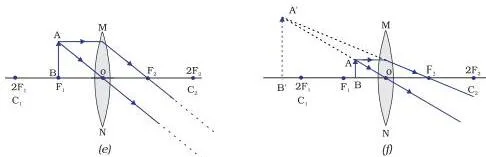
Question 7: We wish to obtain an erect image of an object, using a concave mirror of focal length 15 cm. What should be the range of distance of the object from the mirror? What is the nature of the image? Is the image larger or smaller than the object? Draw a ray diagram to show the image formation in this case.
For a concave mirror, an erect image is obtained only when the object is placed between the pole (P) and the principal focus (F). Since the focal length is 15 cm, the object must be placed at a distance less than 15 cm from the mirror (i.e., between 0 and 15 cm from the pole).
- Range of object distance: 0 < u < 15 cm (i.e., between the pole and the focus).
- Nature of the image: Virtual and erect.
- Size of the image: Larger than the object (enlarged).
Ray diagram description (refer to Fig. 9.7(f) in the textbook):
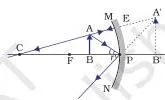
Using the two-ray construction:
- A ray parallel to the principal axis reflects and passes through the focus F.
- A ray striking the pole reflects symmetrically, obeying the law of reflection.
- The reflected rays diverge; extend them backwards behind the mirror – they meet at a point between P and F behind the mirror. This is the virtual image.
Question 8: Name the type of mirror used in the following situations. (a) Headlights of a car. (b) Side/rear-view mirror of a vehicle. (c) Solar furnace. Support your answer with reason.
Part (a): Headlights of a car Mirror used: Concave mirror.
Reason: When a light source is placed at the principal focus of a concave mirror, the reflected rays become a parallel beam of light. This allows the car headlights to throw a strong, parallel beam far ahead on the road.
Part (b): Side/rear-view mirror of a vehicle Mirror used: Convex mirror.
Reason: Convex mirrors always produce an erect image (virtual) and have a wider field of view. This enables the driver to see more of the traffic behind than a plane mirror of the same size would show. The diminished image is acceptable because the key requirement is the larger area visible.
Part (c): Solar furnace Mirror used: Large concave mirror.
Reason: A concave mirror converges sunlight to its focus. By placing the furnace at the focus, a large amount of solar energy is concentrated at a small area, producing intense heat. This is the principle behind solar furnaces.
Question 9: One-half of a convex lens is covered with a black paper. Will this lens produce a complete image of the object? Verify your answer experimentally. Explain your observations.
Answer: Yes, the lens will still produce a complete image of the object, but the image will be less bright (dimmer) than when the full lens is used.
Reason: Every point of an object sends rays of light in all directions, and these rays pass through every part of the lens. Even if half the lens is covered, the uncovered half still receives rays from all points of the object. The lens still refracts these rays to form a complete image at the same position.
However, because only half the area is available to collect light, the amount of light reaching the image is reduced, making the image dimmer.
Experimental verification:
- Take a convex lens and form a sharp image of a candle flame on a screen.
- Cover the upper half of the lens with a black paper (or any opaque material).
- Observe the image on the screen. You will still see a complete image of the candle flame, but it will be fainter.
- If you cover the entire lens, no image is formed.
Conclusion: The covered half does not block the image of any part of the object; it only reduces the intensity of the image.
Lens numericals: position, size and nature of the image (Exercise Q10–Q13)
Question 10: An object 5 cm in length is held 25 cm away from a converging lens of focal length 10 cm. Draw the ray diagram and find the position, size and the nature of the image formed.
Given: object height \( h = +5 \text{ cm} \), object distance \( u = -25 \text{ cm} \) (convention: left of lens), focal length of converging (convex) lens \( f = +10 \text{ cm} \).
Step 1: Use the lens formula.
\( \frac{1}{v} – \frac{1}{u} = \frac{1}{f} \) \( \frac{1}{v} = \frac{1}{f} + \frac{1}{u} = \frac{1}{10} + \frac{1}{(-25)} = \frac{1}{10} – \frac{1}{25} \) \( \frac{1}{v} = \frac{5 – 2}{50} = \frac{3}{50} \) \( v = \frac{50}{3} \approx +16.67 \text{ cm} \) The positive sign of v indicates that the image is formed on the opposite side of the lens (real image).
Step 2: Magnification.
\( m = \frac{v}{u} = \frac{+16.67}{-25} = -\frac{2}{3} \approx -0.67 \) Step 3: Image height.
\( h’ = m \times h = -\frac{2}{3} \times 5 = -\frac{10}{3} \approx -3.33 \text{ cm} \) Final answer:
- Position: 16.7 cm on the other side of the lens (real image).
- Nature: Real and inverted.
- Size: 3.33 cm (diminished, about 2/3 of the object size).
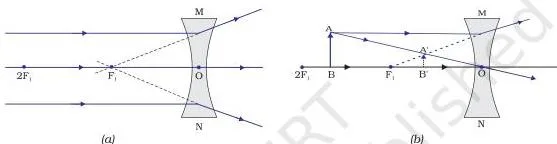
Question 11: A concave lens of focal length 15 cm forms an image 10 cm from the lens. How far is the object placed from the lens? Draw the ray diagram.
Given: concave lens, so \( f = -15 \text{ cm} \). The image is virtual and formed on the same side as the object, so \( v = -10 \text{ cm} \).
Step 1: Lens formula.
\( \frac{1}{v} – \frac{1}{u} = \frac{1}{f} \) \( \frac{1}{u} = \frac{1}{v} – \frac{1}{f} = \frac{1}{-10} – \frac{1}{(-15)} = -\frac{1}{10} + \frac{1}{15} \) \( \frac{1}{u} = \frac{-3 + 2}{30} = -\frac{1}{30} \) \( u = -30 \text{ cm} \) Step 2: Magnification.
\( m = \frac{v}{u} = \frac{-10}{-30} = +\frac{1}{3} \approx 0.33 \) The positive sign indicates the image is erect and virtual. Size is one-third of the object.
Final answer: The object is placed 30 cm from the lens (on the same side). The image is virtual, erect and diminished.
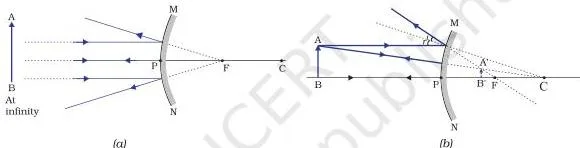
Question 12: An object is placed at a distance of 10 cm from a convex mirror of focal length 15 cm. Find the position and nature of the image.
Given: convex mirror, \( f = +15 \text{ cm} \); object distance \( u = -10 \text{ cm} \).
Step 1: Use the mirror formula (since it’s a mirror).
\( \frac{1}{v} + \frac{1}{u} = \frac{1}{f} \) \( \frac{1}{v} = \frac{1}{f} – \frac{1}{u} = \frac{1}{15} – \frac{1}{(-10)} = \frac{1}{15} + \frac{1}{10} \) \( \frac{1}{v} = \frac{2 + 3}{30} = \frac{5}{30} = \frac{1}{6} \) \( v = +6 \text{ cm} \) Step 2: Magnification.
\( m = -\frac{v}{u} = -\frac{+6}{-10} = +0.6 \) The positive sign indicates the image is virtual and erect. Magnification less than 1 means it is diminished.
Final answer: The image is formed 6 cm behind the mirror (virtual, erect, diminished).
Question 13: The magnification produced by a plane mirror is +1. What does this mean?
Magnification \( m = +1 \) means:
- The image is the same size as the object (magnitude 1).
- The image is erect (positive sign).
- The image is virtual (since the magnification is positive, the image is virtual).
This matches the characteristics of a plane mirror: it always produces a virtual, erect image of the same size as the object.
Convex mirror, concave mirror and lens power numericals (Exercise Q14–Q17)
Question 14: An object 5.0 cm in length is placed at a distance of 20 cm in front of a convex mirror of radius of curvature 30 cm. Find the position of the image, its nature and size.
Given: convex mirror, radius of curvature \( R = +30 \text{ cm} \) (positive for convex). Focal length \( f = R/2 = +15 \text{ cm} \). Object distance \( u = -20 \text{ cm} \). Object height \( h = +5.0 \text{ cm} \).
Step 1: Mirror formula.
\( \frac{1}{v} + \frac{1}{u} = \frac{1}{f} \) \( \frac{1}{v} = \frac{1}{f} – \frac{1}{u} = \frac{1}{15} – \frac{1}{(-20)} = \frac{1}{15} + \frac{1}{20} \) \( \frac{1}{v} = \frac{4 + 3}{60} = \frac{7}{60} \) \( v = \frac{60}{7} \approx +8.57 \text{ cm} \) Step 2: Magnification.
\( m = -\frac{v}{u} = -\frac{+8.57}{-20} = +0.4285 \approx +0.43 \) Step 3: Image height.
\( h’ = m \times h = 0.4285 \times 5.0 = +2.14 \text{ cm} \) Final answer: The image is formed 8.6 cm behind the mirror.
It is virtual, erect and diminished (size ≈ 2.1 cm).
Question 15: An object of size 7.0 cm is placed at 27 cm in front of a concave mirror of focal length 18 cm. At what distance from the mirror should a screen be placed, so that a sharp focussed image can be obtained? Find the size and the nature of the image.
Given: concave mirror, \( f = -18 \text{ cm} \), object distance \( u = -27 \text{ cm} \), object height \( h = +7.0 \text{ cm} \).
Step 1: Mirror formula.
\( \frac{1}{v} + \frac{1}{u} = \frac{1}{f} \) \( \frac{1}{v} = \frac{1}{f} – \frac{1}{u} = \frac{1}{-18} – \frac{1}{(-27)} = -\frac{1}{18} + \frac{1}{27} \) \( \frac{1}{v} = \frac{-3 + 2}{54} = -\frac{1}{54} \) \( v = -54 \text{ cm} \) The negative sign indicates that the image is real and formed on the same side as the object. Thus, a screen should be placed 54 cm in front of the mirror.
Step 2: Magnification.
\( m = -\frac{v}{u} = -\frac{-54}{-27} = -\frac{54}{27} = -2 \) Step 3: Image height.
\( h’ = m \times h = -2 \times 7.0 = -14 \text{ cm} \) Final answer: The screen should be placed 54 cm from the mirror.
The image is real, inverted, and enlarged (14 cm tall).
Question 16: Find the focal length of a lens of power – 2.0 D. What type of lens is this?
The power P of a lens is related to its focal length f (in metres) by \( P = 1/f \).
\( f = \frac{1}{P} = \frac{1}{-2.0 \text{ D}} = -0.5 \text{ m} \) The negative focal length indicates that the lens is a concave lens (diverging lens).
Answer: Focal length = -0.5 m, concave lens.
Question 17: A doctor has prescribed a corrective lens of power +1.5 D. Find the focal length of the lens. Is the prescribed lens diverging or converging?
Given power \( P = +1.5 \text{ D} \).
\( f = \frac{1}{P} = \frac{1}{+1.5} = +0.6667 \text{ m} \approx +0.67 \text{ m} \) The positive focal length indicates that the lens is a convex lens (converging lens).
Answer: Focal length = +0.67 m, converging lens (convex).
Frequently asked questions
Why is the focal length of a concave mirror taken as negative and a convex mirror as positive?
According to the New Cartesian Sign Convention, distances measured from the pole to the left (along the negative x-axis) are taken as negative. The principal focus of a concave mirror lies in front of the mirror (to the left), so its focal length is negative.
For a convex mirror, the focus lies behind the mirror (to the right), so the focal length is positive.
At what position of the object does a concave mirror form a virtual, erect and enlarged image?
When the object is placed between the pole (P) and the principal focus (F) of a concave mirror, the image is virtual, erect and enlarged. This is the principle behind shaving mirrors and dental mirrors.
What is the difference between the mirror formula and the lens formula?
The mirror formula is \( \frac{1}{v} + \frac{1}{u} = \frac{1}{f} \), where the reciprocals of object and image distances are added. The lens formula is \( \frac{1}{v} – \frac{1}{u} = \frac{1}{f} \), where the reciprocal of the object distance is subtracted from that of the image distance. The difference arises because mirrors and lenses form images on opposite sides for real images.
Why does a convex mirror always form a diminished image yet is used as a rear-view mirror?
Although a convex mirror produces a diminished image, it gives a much wider field of view than a plane mirror, allowing the driver to see more of the traffic behind. The image is always erect (virtual), which is essential for orientation.
The diminished size is acceptable because the key requirement is the broader area visible, not the size of each object.
How do you convert the power of a lens into its focal length, and what does the sign tell you?
Power \( P \) (in dioptres) and focal length \( f \) (in metres) are related by \( f = 1/P \). A positive power indicates a convex lens (converging), and a negative power indicates a concave lens (diverging). Always convert the focal length to metres before using the formula.
Why does a pencil partly dipped in water appear bent and raised?
This is due to refraction of light. Light from the submerged part of the pencil travels from water (denser medium) to air (rarer medium) at the interface. The ray bends away from the normal, making the submerged part appear to be at a shallower depth than it actually is.
This causes the pencil to look bent and raised at the water surface.
Where light leads next: related NCERT solutions
The concepts of refraction, lenses and power that you have practised here reappear in Chapter 10: The Human Eye and the Colourful World. You will apply the lens formula and power calculations to understand how the eye works, defects of vision, and phenomena like dispersion and rainbow formation.
For more practice, explore the complete Class 10 Science NCERT Solutions or go directly to NCERT Solutions for Chapter 10: The Human Eye and the Colourful World.
You can also download the Chapter 9 Solutions PDF – it contains all the questions, worked solutions, and ray diagrams with no sign-up required.
Reference: NCERT Class 10 Science textbook, chapter Light – Reflection and Refraction.
Explore Class 10 Science NCERT Solutions
Class 10 Science on LearnCBSE:
Related chapters: