NCERT Solutions for Class 10 Science Chapter 5 Life Processes cover every in-text question and the full end-of-chapter exercise. The chapter explains the four maintenance functions — nutrition, respiration, transportation, and excretion — that keep living organisms alive. This page solves each question with the concept explained first, worked reasoning, and the textbook diagrams in their proper place.
The chapter has four in-text question sets (pages 81, 85, 89, and 96) and a thirteen-question end exercise (pages 99–101). Questions range from one-word MCQs to full structural comparisons such as alveoli vs nephron. Every solution below begins with the principle, works through the answer step by step, and ends with a common-error warning.
Every question solved here is taken word for word from the official NCERT Class 10 Science textbook (Chapter 5), so you can check any answer against the source PDF page by page. For more Class 10 Science help, see our Class 10 Science notes hub and the next chapter on Control and Coordination.
Intext Solutions — 5.1 What are Life Processes? (Page 80–81, Q1–Q4)
These four questions test why unicellular diffusion fails in large organisms, how molecular movement defines life, why raw materials enter the body, and which four processes maintain living structures. The chapter explains that organised molecular order keeps breaking down, so every organism must repair itself using energy from outside. These ncert solutions follow the chapter’s own logic. (NCERT, pp. 80–81)
- Life processes: the maintenance processes that prevent damage and breakdown in living structures. They need energy, which comes from outside the body.
- Cyanobacteria moment: living structures are well-organised but the environment keeps breaking them down; molecules must constantly move to repair them.
- Four processes the chapter names: nutrition, respiration, transportation, excretion.
Question 1: Why is diffusion insufficient to meet the oxygen requirements of multi-cellular organisms like humans?
In a single-celled organism, every part is in direct contact with the surroundings, so oxygen simply diffuses in across the whole surface. A human body is not built that way — most cells lie buried deep inside tissues, very far from the air outside.
For those interior cells, diffusion from the body surface would be far too slow to supply the oxygen they need to release energy.
This is why a multicellular organism builds a transport system: lungs collect oxygen at a surface, blood picks it up using haemoglobin, and the heart pushes that oxygen-rich blood to every cell.
The textbook notes that if diffusion alone moved oxygen in our body, it would take about three years for one oxygen molecule to travel from the lungs to the toes (NCERT, p. 90). Diffusion only works over tiny distances; a body needs a pump and carrier to cover large ones.
Question 2: What criteria do we use to decide whether something is alive?
Visible movement is the everyday test — a running dog, a chewing cow, a shouting person — but it is not reliable. A plant that is not visibly growing is still alive, and some animals breathe without visible movement.
The dependable criterion is molecular movement: the invisible movement of molecules inside the body that repairs and maintains the organised structure of living tissue.
Because the environment constantly breaks down ordered structures, living organisms must keep moving molecules around to repair and rebuild them. Where there is no molecular movement — the chapter cites viruses, which show none until they infect a host — biologists debate whether the thing is truly alive.
So the test is not what we see from the outside, but maintenance through molecular activity. (NCERT, p. 80)
Question 3: What are outside raw materials used for by an organism?
Organisms use outside raw material for two distinct purposes. The first is to provide energy for constant maintenance, even when nothing visible is happening — sitting in class, or being asleep, still requires energy to repair ordered structures. This is supplied through nutrition.
The second purpose is growth: to increase body size, the organism needs carbon-based molecules from outside, since most biological structures are carbon-based.
Energy sources on the outside vary, so the body must break those molecules down and rebuild them into a uniform internal fuel. Oxygen acquired from the environment drives this breakdown through oxidising-reducing reactions — the process we call respiration. So raw materials feed both repair and growth. (NCERT, pp. 80–81)
Question 4: What processes would you consider essential for maintaining life?
The four processes this chapter treats as essential are nutrition, respiration, transportation, and excretion. Nutrition transfers a source of energy from the outside (food) into the body. Respiration acquires oxygen from the outside and uses it in the step-by-step breakdown of food for cellular needs.
Transportation carries food and oxygen from the place they are taken in to every cell that needs them.
The fourth process, excretion, removes the harmful waste by-products created when chemical reactions use the carbon source and oxygen. The chapter stresses that these maintenance jobs must go on even when the organism is asleep — so all four are continuous processes, not occasional activities. (NCERT, p. 81)
Important Concepts for Nutrition Questions — autotrophic, heterotrophic, enzymes, villi
These are the definitions and structural facts the nutrition in-text questions on page 85 actually draw on. Keep them tight — no chapter retelling. (NCERT, pp. 81–86)
- Autotrophic nutrition: the organism uses simple inorganic material — carbon dioxide and water — and an external energy source (sunlight) to synthesise complex organic food. Green plants and some bacteria do this. Excess carbohydrates are stored as starch.
- Heterotrophic nutrition: the organism depends on complex food prepared by other organisms. It must break that complex food down using enzymes (biological catalysts) before it can use it. Animals and fungi are heterotrophs.
- Photosynthesis equation (NCERT, p. 81): \[6\,CO_2 + 12\,H_2O \xrightarrow[\text{Sunlight}]{\text{Chlorophyll}} C_6H_{12}O_6 + 6\,O_2 + 6\,H_2O\]
- Raw materials for photosynthesis: CO₂ (from air through stomata), water (from soil through roots), sunlight, chlorophyll (in leaf chloroplasts — see leaf cross-section), and nitrogen (from soil, absorbed as nitrates or nitrites).
- Role of acid in the stomach (NCERT, p. 85): HCl creates the acidic medium that the protein-digesting enzyme pepsin needs to act; it also kills many bacteria entering with food. Mucus protects the stomach lining from the acid’s corrosive action.
- Digestive enzymes (NCERT, p. 85): biological catalysts that convert complex food into simpler, absorbable molecules — proteins to amino acids, complex carbohydrates to glucose, fats to fatty acids and glycerol.
- Villi (NCERT, p. 86): finger-like projections lining the small intestine that greatly increase the surface area for absorption; they are richly supplied with blood vessels that carry absorbed food to every cell.
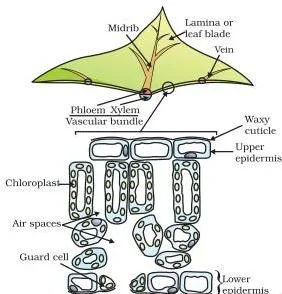
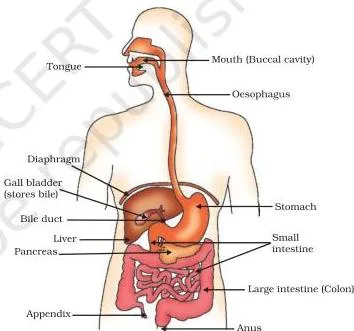
The leaf cross-section above shows the chloroplasts that hold chlorophyll — the reason only the green parts of a variegated leaf turn blue-black with iodine (Activity 5.1). The alimentary canal diagram tracks where each digestion step happens: HCl and pepsin in the stomach, bile and pancreatic juice in the small intestine, absorption through the villi in the small-intestine wall.
Intext Solutions — 5.2 Nutrition (Page 85, Q1–Q5)
These five questions cover the two nutritional modes, the raw materials of photosynthesis, the role of stomach acid, the function of digestive enzymes, and the design of the small intestine for absorption. (NCERT, pp. 81–86)
Question 1: What are the differences between autotrophic nutrition and heterotrophic nutrition?
Autotrophs and heterotrophs differ in where their carbon source comes from, in their dependence on other organisms, and in whether they must use enzymes to break complex food down. Autotrophs build their own food from simple inorganic molecules; heterotrophs consume food that autotrophs have already built. The table below compares them on the three criteria the textbook emphasises.
| Criterion | Autotrophic nutrition | Heterotrophic nutrition |
|---|---|---|
| Food source (complexity) | Simple inorganic material: CO₂ and water | Complex organic material prepared by other organisms |
| Self-feeding vs dependence | Self-synthesises food using an external energy source (sunlight) — green plants, some bacteria | Depends directly or indirectly on autotrophs for food — animals, fungi |
| Use of enzymes | No breakdown of complex intake needed; sunlight drives the build-up of carbohydrates from simple raw materials | Must use digestive enzymes as biological catalysts to break complex food into simpler, absorbable molecules before use |
Both modes ultimately serve the same purpose — supplying carbon-based molecules and energy for maintenance and growth — but the pathway differs fundamentally because one group can build and the other must break down. (NCERT, pp. 81–82)
Question 2: Where do plants get each of the raw materials required for photosynthesis?
Plants gather the four named raw materials from four different routes. Carbon dioxide is taken in from the air through tiny pores on the leaf surface called stomata, whose guard cells control their opening and closing. Water is absorbed from the soil by the roots and carried up through the xylem.
Sunlight is captured by chlorophyll, the green pigment inside chloroplasts in the leaf cells — the leaf cross-section above shows these green dots clearly. Chlorophyll itself is built using nitrogen, which the plant takes up from the soil.
Nitrogen is absorbed mainly as inorganic nitrates or nitrites dissolved in soil water; some plants get it through organic compounds prepared by nitrogen-fixing bacteria. So the four raw materials — CO₂, water, sunlight, and chlorophyll — each arrive by a separate path. (NCERT, pp. 81–83)
Question 3: What is the role of the acid in our stomach?
The gastric glands in the stomach wall release hydrochloric acid alongside a protein-digesting enzyme called pepsin and a protective layer of mucus. HCl plays two roles. First, it creates the acidic medium that pepsin needs to begin protein digestion.
Second, it kills many harmful bacteria that enter the stomach with food, reducing the risk of infection — this is the textbook’s implied function when it asks what else the acid serves.
This acidic environment is corrosive enough to harm the stomach lining. The mucus secreted by the same gastric glands forms a barrier that shields that lining from acid damage under normal conditions. When that mucus protection fails, the acid attacks the lining and we experience acidity — the “acidity” the chapter mentions. (NCERT, p. 85)
Question 4: What is the function of digestive enzymes?
Digestive enzymes are biological catalysts — they speed up the conversion of complex food molecules into simpler ones small enough to be absorbed through the intestinal wall. Without this breakdown, complex food cannot enter the bloodstream. The chapter categorises their action by food type.
Specifically, the intestinal enzymes finally convert proteins to amino acids, complex carbohydrates to glucose, and fats to fatty acids and glycerol (NCERT, p. 85). Before this final step, the stomach’s pepsin begins protein digestion, the pancreas’s trypsin continues it, and lipase breaks down emulsified fats. Each enzyme is specific to one substrate; digestion is a sequential, compartment-by-compartment process. (NCERT, p. 85)
Question 5: How is the small intestine designed to absorb digested food?
The small intestine is designed to absorb digested food efficiently because absorption depends on surface area. The inner lining is folded into numerous finger-like projections called villi (NCERT, p. 86). Each villus is itself a finger of tissue, and the millions of villi together vastly increase the area of wall in contact with the digested food.
Each villus is richly supplied with blood vessels. The absorbed food — glucose, amino acids, fatty acids, glycerol — passes into these blood vessels, which carry it to every cell of the body for energy, tissue building, and repair.
The villi are also finger-thin so that molecules have only a short distance to cross from the intestinal cavity into the blood — a structural shortcut that combines with the large surface area to make uptake fast and complete.
Important Concepts for Respiration Questions — aerobic, anaerobic, ATP, alveoli, haemoglobin
Only the ideas the four respiration in-text questions and the end-exercise respiration questions call on. (NCERT, pp. 87–91)
- Glucose breakdown — first step: in all pathways, the six-carbon glucose molecule first splits into two three-carbon pyruvate molecules; this happens in the cytoplasm.
- Three pyruvate fates:
(1) Aerobic (in mitochondria): pyruvate → CO₂ + water + energy. Uses oxygen; high energy released.
(2) Anabolic in yeast (in cytoplasm): pyruvate → ethanol + CO₂ + energy. No oxygen; fermentation.
(3) Anabolic in muscle cells (in cytoplasm): pyruvate → lactic acid + energy. No oxygen; causes cramps. - ATP — energy currency: energy released during respiration is used to make ATP from ADP and inorganic phosphate. Breaking ATP’s terminal phosphate releases a fixed amount of energy (≈ 30.5 kJ/mol) to drive cellular processes.
\[ADP + P \xrightarrow{\text{Energy}} ATP\] - Alveoli: balloon-like structures at the end of the lung’s branching tubes; thin walls, an extensive network of blood vessels, and (if spread out) an enormous surface area of about 80 m². Residual air volume keeps some air in the lungs between breaths for continuous exchange.
- Haemoglobin: the respiratory pigment in red blood corpuscles, with a very high affinity for oxygen, carries O₂ from lungs to tissues. CO₂ is more soluble in water than O₂, so it is mostly transported dissolved in blood plasma.
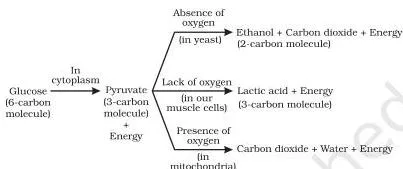
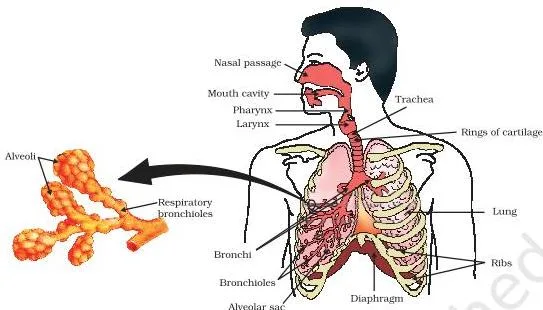
Figure 5.8 is the one diagram that resolves most respiration questions — it shows the split from glucose to pyruvate and the three downstream fates. Figure 5.9 shows the path air takes from nostrils through the cartilage-ringed throat into the lungs; alveoli sit at the very tips of the branching tubes, exactly where air meets blood.
Intext Solutions — 5.3 Respiration (Page 89, Q1–Q4)
These four questions ask why terrestrial organisms have it easier, how glucose is broken down in the three pathways, how gases travel in the blood, and how the lungs are built for maximal gas exchange. (NCERT, pp. 87–91)
Question 1: What advantage over an aquatic organism does a terrestrial organism have with regard to obtaining oxygen for respiration?
Oxygen dissolves poorly in water. An aquatic organism must pump large volumes of water past its gills to scrape out the small amount of dissolved oxygen it needs, so its breathing rate is high. A terrestrial organism breathes air, which is about 21% oxygen — a far richer supply than any water body holds.
Because the surrounding air contains much more oxygen per unit volume, a terrestrial animal extracts the same amount of oxygen with far less breathing effort. Activity 5.6 in the textbook shows this directly: fish open and close their mouths far more often than humans breathe in and out.
In short, land animals get more oxygen, more easily, so they can support higher energy needs. (NCERT p. 89)
Question 2: What are the different ways in which glucose is oxidised to provide energy in various organisms?
In every pathway, glucose is first broken into two three-carbon pyruvate molecules in the cytoplasm. From there, three routes are possible depending on the organism and oxygen availability.
- Aerobic respiration (in mitochondria): pyruvate breaks down using oxygen to give CO₂, water, and a large amount of energy. Most organisms use this route.
- Anaerobic respiration in yeast (in cytoplasm): pyruvate converts to ethanol and CO₂ with a small energy release. This is fermentation.
- Anaerobic respiration in muscle cells (in cytoplasm): when oxygen is in short supply during sudden activity, pyruvate converts to lactic acid, again releasing little energy. The lactic acid build-up causes muscle cramps.
Aerobic releases a lot more energy because glucose is broken down fully; in anaerobic pathways, the products (ethanol, lactic acid) still hold locked-up energy. (NCERT, pp. 87–88)
Question 3: How is oxygen and carbon dioxide transported in human beings?
The two gases travel in the blood by different routes because their solubility in water differs. Oxygen has very low solubility, so it cannot ride dissolved in plasma.
Instead, the respiratory pigment haemoglobin in the red blood corpuscles has a high affinity for oxygen; it binds O₂ in the lungs and releases it in the tissues that are deficient in oxygen (NCERT, p. 90).
Carbon dioxide is more soluble in water than oxygen is, so it is mostly transported dissolved in blood plasma. Some CO₂ is also carried by haemoglobin, but the dominant mode is the dissolved form. So oxygen is carried inside red blood cells by a pigment; carbon dioxide is carried in the fluid medium itself.
Question 4: How are the lungs designed in human beings to maximise the area for exchange of gases?
Exchange of gases requires a large, thin, moist surface supplied with blood. The lung delivers this by ending its branching tubes in millions of balloon-like alveoli (NCERT, p. 90).
Each alveolus has thin walls and is wrapped in an extensive network of blood vessels, so air inside the sac sits separated from blood by only a very thin barrier that gases diffuse across easily.
The collective surface area of all alveoli, if spread out, is about 80 square metres — a huge exchange surface packed into the chest cavity. The design also keeps a residual volume of air in the lungs between breaths, so gas exchange continues even during exhalation; fresh incoming air mixes with this residual air rather than meeting an empty lung. (NCERT, p. 90)
Important Concepts for Transportation Questions — heart chambers, blood vessels, xylem, phloem, transpiration, double circulation
Definitions and structural facts the in-text transportation questions and several end-exercise questions call on. (NCERT, pp. 91–96)
- Heart chambers and valves: the heart has four chambers — two thin-walled atria that receive blood and two thick-walled muscular ventricles that pump blood. The left ventricle is thickest because it pumps blood to the whole body. Valves ensure blood does not flow backwards when atria or ventricles contract.
- Double circulation: in birds and mammals, blood passes through the heart twice per cycle — once in the pulmonary loop (heart → lungs → heart) and once in the systemic loop (heart → body → heart). It keeps oxygenated and deoxygenated blood fully separate.
- Why separation matters: birds and mammals maintain constant body temperature, which requires high, continuous energy supply — only fully separated, oxygen-rich blood delivered at full pressure meets that need.
- Arteries vs veins vs capillaries: arteries carry blood away from the heart under high pressure, so they have thick elastic walls; veins carry blood back to the heart at low pressure, so they have thin walls and valves; capillaries are the smallest vessels, one-cell thick, where actual exchange of materials between blood and cells occurs.
- Xylem: transports water and dissolved minerals from root to leaf, upward only. Driven by root pressure and transpiration pull.
- Phloem: transports the products of photosynthesis (sucrose, amino acids) from leaves to other parts of the plant via translocation, which uses ATP energy and is bidirectional (up or down according to the plant’s needs).
- Blood pressure: the force blood exerts on vessel walls. Normal systolic (ventricular contraction) ≈ 120 mm Hg; diastolic (ventricular relaxation) ≈ 80 mm Hg. Measured with a sphygmomanometer.
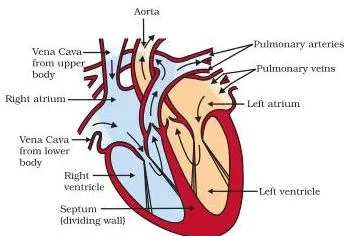
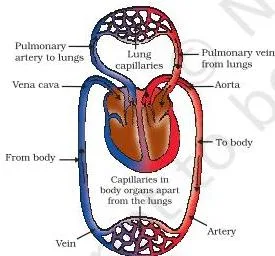
The heart diagram (Figure 5.10) shows the four chambers, the valves between them, and the separation of the oxygen-rich left side from the deoxygenated right side. Figure 5.11 shows where the blood picks up O₂ (lungs) and delivers it (body), and where it drops off CO₂.
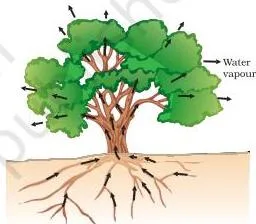
Figure 5.12 shows the continuous water column in the xylem being pulled upward by evaporation at the leaf surface — that pull is transpiration in action.
Intext Solutions — 5.4 Transportation (Page 96, Q1–Q5)
These five questions cover the human transport system, the necessity of separating oxygenated and deoxygenated blood in mammals and birds, the plant vascular system, water and mineral transport, and food transport. (NCERT, pp. 91–96)
Question 1: What are the components of the transport system in human beings? What are the functions of these components?
The human transport system has three components, and each has a distinct job.
- Heart: a muscular pumping organ that pushes blood around the body — the left side pumps oxygenated blood to the body, the right side pumps deoxygenated blood to the lungs.
- Blood: a fluid connective tissue that actually carries materials — red blood corpuscles carry oxygen using haemoglobin, plasma transports food, CO₂, and nitrogenous wastes in dissolved form, white blood cells defend against infection, and platelets help blood clot at injury points.
- Blood vessels: the network of tubes that reaches every tissue — arteries carry blood away from the heart and have thick elastic walls to withstand high pressure; veins collect blood back to the heart and have valves to prevent backflow; capillaries are one-cell thick and are where actual exchange of food, oxygen, and waste between blood and cells occurs.
Together they do one job: move food, oxygen, and waste to and from every cell. (NCERT, pp. 91–93)
Question 2: Why is it necessary to separate oxygenated and deoxygenated blood in mammals and birds?
Mammals and birds are warm-blooded: they use energy continuously to maintain a constant body temperature regardless of the environment. That constant energy demand requires a high and steady supply of oxygen to their cells.
If oxygenated and deoxygenated blood were allowed to mix, the blood reaching the body would be a diluted mixture with less oxygen per unit blood — far too little to support the energy output warm-blooded animals need.
Keeping the two blood streams fully separated ensures the body always receives pure oxygen-rich blood pumped at full pressure. This is why birds and mammals have a four-chambered heart. By contrast, amphibians and many reptiles — which do not maintain a constant body temperature and tolerate some mixing — can survive with three-chambered hearts because their energy needs are lower. (NCERT, p. 92)
Question 3: What are the components of the transport system in highly organised plants?
Highly organised plants have conducting tubes composed of two vascular tissues: xylem and phloem. These two pathways run as independently organised conducting tubes throughout the plant body — xylem moves water and minerals, and phloem moves the products of photosynthesis.
Xylem vessels and tracheids in the roots, stem, and leaves interconnect to form a continuous water-conducting channel reaching all parts of the plant. Phloem’s sieve tubes, with adjacent companion cells, translocate sucrose and other substances from the leaves where they are made to the rest of the plant. Both tissues are part of the vascular tissue system. (NCERT, p. 94)
Question 4: How are water and minerals transported in plants?
Water does not climb a tree by magic. Soil-rooted plants use two forces together to move water and dissolved minerals up the xylem.
First, root pressure: root cells in contact with the soil actively take up ions, creating a concentration difference that draws water into the root xylem. This steadily pushes a column of water upward.
Second, transpiration pull: water evaporates from the stomata in the leaf surfaces, and this loss creates a suction (negative pressure) that pulls more water up the xylem from the roots — the narrow xylem tubes hold a continuous water column that is pulled up like water through a straw.
The textbook says transpiration pull is the major driving force during the day when stomata are open, while root pressure dominates at night. (NCERT, pp. 94–95)
Question 5: How is food transported in plants?
Food transport in plants is called translocation, and it happens in the phloem. Unlike xylem, phloem moves material both upward and downward based on the plant’s needs — to storage organs (roots, fruits, seeds) or to growing buds.
The mechanism uses energy from ATP. Sucrose is loaded into the phloem tissue using ATP; this raises the solute concentration (osmotic pressure) of the phloem, so water from the surrounding xylem moves into it by osmosis.
That incoming water raises the pressure inside the phloem at the source, pushing the sap toward a sink — a region of lower pressure such as a growing root, fruit, or bud. At the sink, sucrose is unloaded and used or stored, water leaves the phloem, pressure drops, and the cycle continues.
Because it depends on the plant’s growth and storage needs, translocation is bidirectional. (NCERT, p. 95)
Important Concepts for Excretion Questions — nephron structure, urine formation, excretion in plants, dialysis
Definitions and mechanism details the excretion questions call on. (NCERT, pp. 96–98)
- Excretion: the biological process of removing harmful nitrogenous metabolic wastes (such as urea, uric acid) from the body. Not the same as defecation.
- Nephron: the structural and functional unit of the kidney. Each nephron has a cup-shaped Bowman’s capsule at one end, wrapped around a cluster of very thin-walled capillaries (the glomerulus), and a long coiled tubule that runs from the capsule.
- Three-step urine formation:
(1) Filtration: blood pressure in the capillary cluster forces water and small dissolved molecules into Bowman’s capsule.
(2) Selective reabsorption: as the filtrate flows along the tubule, the body reclaims useful substances — glucose, amino acids, salts, and most of the water.
(3) What remains is urine, collected by the ureter, stored in the urinary bladder, released through the urethra. - Volume contrast: about 180 L of initial filtrate is produced daily in a healthy adult, but only 1–2 L are actually excreted as urine — the rest is reabsorbed.
- Plant excretion methods: plant waste products are stored in cellular vacuoles; stored as resins and gums in old xylem; shed through falling leaves; or excreted directly into the surrounding soil.
- Artificial kidney (hemodialysis): a device with semi-permeable tubes immersed in dialysing fluid that matches blood’s osmotic pressure but has no nitrogenous waste. Wastes diffuse out of blood into the dialysing fluid. Unlike a real kidney, there is no selective reabsorption step.
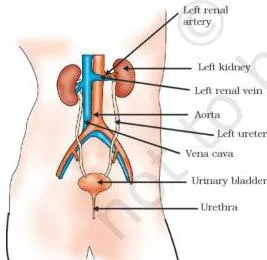
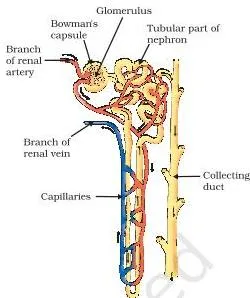
Figure 5.13 places the kidneys in the abdomen, flanking the backbone, and traces urine’s path — ureter → urinary bladder → urethra. Figure 5.14 zooms inside a kidney to show one nephron: the Bowman’s capsule cupping the capillary cluster, and the long coiled tubule where selective reabsorption reclaims useful molecules and the rest drains as urine.
Intext Solutions — 5.5 Excretion (Page 99–101, Q1–Q3)
These three questions ask about the nephron’s structure and functioning, the methods plants use to get rid of waste, and how the body regulates urine volume. (NCERT, pp. 96–98)
Question 1: Describe the structure and functioning of nephrons.
A nephron works like a two-step filter. First it dumps everything small enough through the capillary wall into Bowman’s capsule; then it reclaims the useful molecules as the filtrate flows along the tubule, leaving only the waste behind as urine.
Structure: each nephron begins with a cup-shaped Bowman’s capsule that wraps around a cluster of very thin-walled capillaries (the glomerulus). A long, coiled tubule runs from the capsule, eventually joining a collecting duct that drains into the ureter. (NCERT, p. 96) Functioning:
- Filtration: blood pressure forces water and small dissolved molecules out of the capillary cluster into Bowman’s capsule — this creates a large initial filtrate.
- Selective reabsorption: as the filtrate passes along the tubule, the useful substances — glucose, amino acids, salts, and most of the water — are reabsorbed into the blood vessels around the tubule.
- Remaining waste: the fluid that is left is urine, which passes through the collecting duct into the ureter, then to the urinary bladder for storage and release.
So a kidney “filters” in two stages — dump everything small, then reclaim what is useful. (NCERT, p. 96)
Question 2: What are the methods used by plants to get rid of excretory products?
Plants do not have a dedicated excretory organ, so they get rid of waste in four different low-energy ways. Because a lot of plant tissue is dead anyway, they can simply store waste where it will cause no harm, or shed it.
- Many plant waste products are stored in cellular vacuoles, isolating them from the cytoplasm.
- Some waste products are stored as resins and gums, especially in old xylem tissue that is no longer living and active.
- Some waste is moved into leaves that are about to fall off — the shedding of leaves carries the waste out of the plant.
- Some waste substances are excreted into the surrounding soil directly through the roots.
Oxygen produced during photosynthesis can itself be thought of as a waste product the plant gets rid of through its stomata. Excess water leaves as vapour through transpiration. (NCERT, p. 98)
Question 3: How is the amount of urine produced regulated?
The amount of urine the body produces is regulated at the second step of nephron function — selective reabsorption of water. After filtration, how much water the tubule reabsorbs depends on two things the body senses at that moment: how much excess water is in the body, and how much dissolved waste has to be got rid of.
The tubule adjusts water reabsorption accordingly.
This is why we produce a small volume of concentrated urine on a hot day when we have little excess water (the body reabsorbs more), and a large volume of dilute urine after drinking plenty of water (the body reabsorbs less).
The chapter quantifies the scale: of about 180 L of initial filtrate produced daily in a healthy adult kidney, only 1–2 L are actually excreted — the rest is reabsorbed. The regulation happens at the reabsorption step, not at filtration. (NCERT, p. 96)
End-of-Chapter Exercise Solutions — Q1–Q4 (MCQ Choices and Reasoning)
The first four end-exercise questions are one-mark MCQs. Each is shown with all four options, as printed in the textbook; the correct option is stated, and every distractor is explained so you know why it fails. (NCERT, p. 99)
Question 1: The kidneys in human beings are a part of the system for (a) nutrition. (c) excretion. (b) respiration. (d) transportation.
- (a) nutrition.
- (b) respiration.
- (c) excretion.
- (d) transportation.
Correct answer: (c) excretion. Kidneys filter nitrogenous waste products such as urea and uric acid out of the blood and excrete them as urine — that is an excretory function.
Why each distractor fails:
- (a) Nutrition refers to the intake and use of food by an organism; kidneys do not take in or digest food.
- (b) Respiration is about acquiring oxygen and breaking down food for energy, which happens in the lungs and mitochondria — not the kidneys.
- (d) Transportation itself moves food, oxygen, and waste around the body via the heart and blood vessels — kidneys filter waste, but they are not a transport organ.
So the choice that matches the kidney’s job is excretion — option (c). The common slip: students say kidneys are part of the excretory system but forget that the nephron performs selective reabsorption, not just filtration, which is what makes it a true excretory unit rather than a one-way filter.
Question 2: The xylem in plants are responsible for (a) transport of water. (c) transport of amino acids. (b) transport of food. (d) transport of oxygen.
- (a) transport of water.
- (b) transport of food.
- (c) transport of amino acids.
- (d) transport of oxygen.
Correct answer: (a) transport of water. Xylem vessels and tracheids form a continuous water-conducting channel that moves water and dissolved minerals from the roots up to the leaves.
Why each distractor fails:
- (b) transport of food is the job of phloem, which translocates sucrose and other photosynthetic products from leaves to the rest of the plant.
- (c) transport of amino acids also happens in phloem — translocation moves both sugars and amino acids, not xylem.
- (d) transport of oxygen in plants happens by simple diffusion through stomata and intercellular spaces; plants do not have a dedicated vascular tissue for gases.
So xylem = water + minerals = option (a).
Question 3: The autotrophic mode of nutrition requires (a) carbon dioxide and water. (c) sunlight. (b) chlorophyll. (d) all of the above.
- (a) carbon dioxide and water.
- (b) chlorophyll.
- (c) sunlight.
(d) all of the above.
Correct answer: (d) all of the above. Autotrophic nutrition is photosynthesis — the process by which green plants and some bacteria build their own food. Photosynthesis needs all three inputs the chapter lists in its equation: CO₂ (from air), water (from soil), sunlight (the external energy source), and chlorophyll (the pigment that captures light).
Why each distractor fails:
- (a) CO2 and water alone are not enough — without sunlight to supply energy and chlorophyll to trap it, the reaction cannot proceed.
- (b) Chlorophyll alone is not enough — without the reactants (CO₂ and water) and energy (sunlight), there is nothing to capture or to build with.
- (c) Sunlight alone is not enough — without CO₂, water, and chlorophyll, the light has nothing to drive.
Only (d) all of the above covers the full set, which is exactly what the photosynthesis equation requires.
Question 4: The breakdown of pyruvate to give carbon dioxide, water and energy takes place in (a) cytoplasm. (c) chloroplast. (b) mitochondria. (d) nucleus.
- (a) cytoplasm.
- (b) mitochondria.
- (c) chloroplast.
- (d) nucleus.
Correct answer: (b) mitochondria. When oxygen is available, pyruvate (the three-carbon molecule formed from glucose in the cytoplasm) enters the mitochondria and is broken down completely to CO₂, water, and a large amount of energy. This is aerobic respiration.
Why each distractor fails:
- (a) cytoplasm is where glucose first splits into two pyruvate molecules, and also where the two anaerobic pathways take place — but not the aerobic breakdown of pyruvate itself. The cytoplasm finishes a step before the question’s step.
- (c) chloroplast is the site of photosynthesis in plants, not respiration — the two processes run in opposite directions and in different organelles.
- (d) nucleus controls the cell but is not a site of respiration; no energy-releasing breakdown happens here.
So pyruvate → CO₂ + water + energy takes place in mitochondria — option (b).
End-of-Chapter Exercise Solutions — Q5–Q8 (Digestion, Saliva, Autotrophic Nutrition, Respiration Types)
These four questions move from short reasoning to comparison. Q5 and Q6 are about where and how food components are digested; Q7 asks for the conditions and by-products of autotrophic nutrition; Q8 requires a comparison table between aerobic and anaerobic respiration. (NCERT, pp. 81–88)
Question 5: How are fats digested in our bodies? Where does this process take place?
Fats do not dissolve in water, so enzymes cannot reach inside a fat globule. Bile salts first emulsify the globule into tiny droplets — like soap breaking up grease — vastly increasing the surface area for lipase to attack. Lipase then breaks the fats down into fatty acids and glycerol. The process is two-stage: emulsification first, enzyme action second.
Both stages happen in the small intestine. Bile juice from the liver emulsifies the large fat globules (and also makes the food alkaline so pancreatic enzymes can work). The pancreas secretes lipase, which breaks the emulsified fats into fatty acids and glycerol. The small intestine walls then absorb these small molecules through villi.
So the whole fat-digestion sequence — emulsification followed by lipase action — takes place in the small intestine. (NCERT, p. 85)
Question 6: What is the role of saliva in the digestion of food?
Saliva, secreted by the salivary glands, does two jobs at once. First, it contains the enzyme salivary amylase, which begins the breakdown of starch — a complex carbohydrate — into simple sugar while food is still in the mouth. This is the first enzymatic digestion in the alimentary canal.
Second, saliva moistens the food and makes it soft enough to pass smoothly along the digestive tube.
The muscular tongue mixes food with saliva, and peristaltic movements push the softened bolus down the oesophagus. Activity 5.3 in the textbook tests this directly: saliva added to a starch solution stops the iodine turning blue-black, showing the starch has been broken down. So saliva has both a mechanical role (lubrication and softening) and a chemical role (initial starch digestion).
(NCERT, p. 85)
Question 7: What are the necessary conditions for autotrophic nutrition and what are its by-products?
Autotrophic nutrition is photosynthesis, and it requires four conditions from the photosynthesis equation on page 81: carbon dioxide (taken from the air through stomata), water (absorbed by roots from soil), sunlight (the external energy source), and chlorophyll (the pigment in leaf chloroplasts that captures light energy).
Soil nitrogen is also needed, absorbed as nitrates or nitrites, to build the chlorophyll molecule itself.
The by-products — meaning what the reaction produces alongside glucose — are oxygen and water (six molecules of each for every one glucose molecule formed). The oxygen is released into the air through stomata; indeed, the chapter notes that oxygen release is the major daytime event in plants.
So autotrophic nutrition needs CO₂, water, sunlight, and chlorophyll; and it yields glucose (food), oxygen, and water. (NCERT, p. 81)
Question 8: What are the differences between aerobic and anaerobic respiration? Name some organisms that use the anaerobic mode of respiration.
Aerobic and anaerobic respiration differ on the four dimensions the chapter names — where in the cell each happens, whether oxygen is needed, what the end-products are, and how much energy is released. The table below compares them. All of them start from the same molecule — glucose is first split into pyruvate in the cytoplasm in both cases.
| Criterion | Aerobic respiration | Anaerobic respiration |
|---|---|---|
| Location in cell | Mitochondria | Cytoplasm |
| Oxygen needed? | Yes — pyruvate is broken down using oxygen | No — oxygen absent |
| Products formed | CO₂ + water | Lactic acid (in muscle cells) or ethanol + CO₂ (in yeast) |
| Energy released | High — glucose fully broken down | Low — products still contain locked-up energy |
Organisms that use the anaerobic mode include yeast (fungi, which ferment sugar to ethanol and CO₂) and our own muscle cells during sudden activity when oxygen runs short (producing lactic acid). Some bacteria are also obligate anaerobes. (NCERT, p. 87)
End-of-Chapter Exercise Solutions — Q9–Q13 (Alveoli, Haemoglobin, Double Circulation, Xylem vs Phloem, Alveoli vs Nephron)
The final five questions carry higher weight. Each needs both a structural description and a function. Q11 and Q13 are typically worth the most marks and require the pathway or the comparison to be stated explicitly. (NCERT, pp. 90–98)
Question 9: How are the alveoli designed to maximise the exchange of gases?
Gas exchange by diffusion depends on surface area and on the thinness of the barrier between air and blood. The lung maximises both by ending its branching air passages in millions of balloon-like alveoli.
Each alveolus has thin walls and is wrapped in a dense network of blood vessels, so oxygen in the air and CO₂ in the blood cross only a very thin barrier.
If the alveolar surface were spread out flat, it would cover about 80 square metres — a huge area packed into the chest (NCERT, p. 90). Each alveolus sits at the end of a tiny tube, and the whole network is supplied with blood constantly.
The lungs also retain a residual volume of air between breaths, so the exchange surface never dries out or runs out of air — incoming fresh air always mixes with this residual air, keeping the oxygen concentration at the surface stable.
Together, these three design features — thin walls, extensive blood supply, and enormous surface area held in a protected space — make alveolar exchange highly efficient.
Question 10: What would be the consequences of a deficiency of haemoglobin in our bodies?
Haemoglobin is the respiratory pigment in red blood corpuscles, and it has a very high affinity for oxygen. It carries oxygen from the lungs to every tissue where energy is released. If haemoglobin is deficient, the amount of oxygen delivered to tissues drops sharply — so the cells cannot release enough energy to meet the body’s needs.
The chapter notes that if diffusion alone moved oxygen in our body, a molecule would take about three years to reach our toes from the lungs (NCERT, p. 90) — haemoglobin is what prevents that. The clinical consequences are the ones common in anaemia: fatigue, tiredness, pale skin, shortness of breath, and reduced capacity for physical activity.
The body tries to compensate by increasing the breathing and heart rate, but the underlying oxygen starvation remains. So haemoglobin deficiency means the body cannot transport enough oxygen — even though the lungs are breathing in plenty — because there is not enough pigment to carry it.
Question 11: Describe double circulation of blood in human beings. Why is it necessary?
In human beings, blood passes through the heart twice during one complete cycle of passage through the body — once on its way to the lungs and once on its way to the rest of the body. This is double circulation, and it has two sequential loops.
- Pulmonary loop: deoxygenated blood from the body enters the right atrium, flows into the right ventricle, and is pumped to the lungs. In the lungs it picks up oxygen and drops off CO₂. Oxygen-rich blood returns from the lungs to the left atrium.
- Systemic loop: oxygenated blood from the left atrium enters the thick muscular left ventricle, which pumps it out to the rest of the body. Cells take up the oxygen and release CO₂, and the deoxygenated blood returns to the right atrium to begin the cycle again.
This separation is necessary in warm-blooded mammals and birds because they maintain a constant body temperature. Energy must be supplied at a continuous and high rate, which requires blood to reach the body fully oxygenated and at full pressure.
If oxygenated and deoxygenated blood mixed — as they do in amphibians and reptiles, which tolerate the mixing because they do not keep a constant body temperature — the oxygen delivered to cells would be insufficient for mammals’ high energy needs. (NCERT, p. 92)
Question 12: What are the differences between the transport of materials in xylem and phloem?
Xylem and phloem are the two conducting tissues of plants, but they transport different things in different ways. Xylem moves water and minerals upward by physical forces; phloem moves food in both directions using energy from ATP. The table below compares the two on the four dimensions that matter.
| Criterion | Xylem | Phloem |
|---|---|---|
| What is transported | Water and dissolved minerals (from roots to all parts) | Products of photosynthesis — sucrose, amino acids (from leaves to all parts) |
| Direction of flow | Unidirectional — upward (root → leaf) | Bidirectional — up or down according to the plant’s needs |
| Energy use | Passive — uses physical forces, no ATP required for the flow itself | Active — uses ATP energy to load sucrose into sieve tubes |
| Driving mechanism | Root pressure (at night) and transpiration pull (by day) | Translocation via pressure flow — sucrose loading raises osmotic pressure, water enters, sap is pushed to sink |
So xylem is a one-way upward water channel driven by physical forces; phloem is a two-way food channel driven by energy. (NCERT, pp. 94–95)
Question 13: Compare the functioning of alveoli in the lungs and nephrons in the kidneys with respect to their structure and functioning.
Both alveoli and nephrons are tiny, highly-branching functional units that exchange materials between blood and the outside world across a thin, blood-rich surface. But they work quite differently: alveoli exchange gases by diffusion, while nephrons filter blood and then selectively reabsorb useful molecules before waste leaves as urine. The table below compares them on structure and function.
| Criterion | Alveoli (in lungs) | Nephrons (in kidneys) |
|---|---|---|
| Location | At the ends of the branching air tubes in the lungs | Inside each kidney, packed close together |
| Structure | Balloon-like sacs with very thin walls, wrapped in a dense network of blood capillaries | Bowman’s capsule (cup-shaped) around a capillary cluster, plus a long coiled tubule |
| What is exchanged | O₂ enters the blood, CO₂ leaves it | Waste nitrogenous material leaves the blood; useful molecules are reabsorbed back into blood |
| How exchange happens | By diffusion across the thin walls — no active pumping | Two-step process: filtration first (blood pressure forces fluid out), then selective reabsorption of glucose, amino acids, salts, and most water along the tubule |
| Blood relationship | Blood gains oxygen and loses CO₂ here | Blood loses waste and retains useful substances here |
So alveoli specialise in gas exchange by diffusion, while nephrons specialise in waste removal by filtration plus selective reabsorption. Both are small, thin-walled and richly supplied with blood vessels — that shared design maximises exchange — but the mechanisms they use are very different. (NCERT, pp. 90–96)
Method Recap: A Quick Reviser Before the Exam
One-line snapshots grouped for last-minute revision. This is the student’s 90-second reviser — not paragraphs to read but facts to check you know. (NCERT, pp. 80–98)
Fast-Revision Comparative Table
| Life process | Key facts to recall |
|---|---|
| Nutrition | Two types: autotrophic (self-builds food from CO₂ + water + sunlight + chlorophyll) and heterotrophic (uses enzymes to break complex food). Photosynthesis eq: \(6\,CO_2 + 12\,H_2O \to C_6H_{12}O_6 + 6\,O_2 + 6\,H_2O\). In humans: saliva → salivary amylase → starch to sugar; stomach HCl → pepsin acts; bile → emulsification of fats (small intestine); pancreatic trypsin/lipase completes digestion; villi absorb. |
| Respiration | First step: glucose → pyruvate (cytoplasm). Three fates: aerobic (mitochondria, O₂ present, CO₂ + water + high energy), anaerobic yeast (cytoplasm, ethanol + CO₂), anaerobic muscle (cytoplasm, lactic acid). ATP is the energy currency: \(ADP + P \to ATP\). |
| Transportation | Heart: atria receive, ventricles pump, left ventricle thickest (to body), valves prevent backflow. Double circulation: pulmonary loop (heart↔lungs) + systemic loop (heart↔body). Arteries thick/away from heart; veins thin with valves/back to heart; capillaries one-cell thick for exchange. BP: systolic 120 / diastolic 80 mm Hg; sphygmomanometer. Xylem: water + minerals, upward, unidirectional, root pressure + transpiration pull. Phloem: food, bidirectional, ATP-driven translocation. |
| Excretion | Nephron = structural/functional unit of kidney. Bowman’s capsule + capillary cluster → filtration → selective reabsorption of glucose, amino acids, salts, water → urine. Plant excretion: waste stored in vacuoles, resins/gums in old xylem, shed in falling leaves, excreted into soil. ~180 L filtered daily, only 1–2 L excreted. |
Pristine-Concept Checklist — Words Students Drop That Lose Marks
| Mistake | Correct rule | How to check your answer |
|---|---|---|
| Writing “nutrition” instead of “autotrophic nutrition” or “heterotrophic nutrition” | Name the specific type — autotrophic or heterotrophic — each time you mention a mode of nutrition, especially in comparison answers. | Re-read your answer: did you use the adjective and noun together? If only “nutrition”, add it. |
| Stating lungs “remove CO₂” | State it removes CO₂ from the blood — not from the air. The lung is the site where blood unloads CO₂. | Check: did your sentence link CO₂ removal to blood, or to the air only? |
| Writing “kidneys filter blood” and stopping | Filtering is step one; selective reabsorption is the regulated second step that determines urine volume and composition. | Re-read: did your answer mention selective reabsorption after filtration? If not, add the sentence. |
| Confusing where aerobic vs anaerobic respiration occurs | Aerobic pyruvate breakdown happens in mitochondria; anaerobic pathways happen in the cytoplasm. Glucose → pyruvate is always in the cytoplasm. | Check the location for each pathway you mention. The breakdown step the question asks about matters. |
| Stating alveoli are “small sacs” | State the three design features: thin walls, extensive blood-vessel network, and ~80 m² surface area. | Count: did you name all three design elements? Surface area figure catches the eyes of the examiner. |
Exam-Pattern Guide — Which End-Chapter Questions Carry More Marks
| Question | Expected weight | What a full-marks answer must include |
|---|---|---|
| Q1–Q4 (MCQs) | 1 mark each | One letter + one line reasoning — no explanation of all distractors needed at board level, but knowing why the distractors fail speeds recall. |
| Q5 (fat digestion) | 3 marks | Name of site (small intestine), two-stage mechanism (emulsification by bile salts, then lipase), end-products (fatty acids + glycerol). |
| Q6 (saliva) | 3 marks | Mechanical role (moistening, softening, tongue mixing) AND chemical role (salivary amylase → starch → sugar). |
| Q7 (autotrophic conditions + by-products) | 3 marks | All four conditions (CO₂, water, sunlight, chlorophyll) AND all by-products (oxygen, water from the equation). |
| Q8 (aerobic vs anaerobic respiration) | 5 marks | Comparison table with the four dimensions: location, oxygen, products, energy. Named organisms for anaerobic — yeast, muscle cells. |
| Q11 (double circulation) | 5 marks | Both loops named and traced (pulmonary, systemic), heart chambers involved, and the biological “why” — efficient O₂ supply for warm-blooded animals’ constant body temperature. |
| Q13 (alveoli vs nephron) | 5 marks | Comparison on structure AND functioning; diffusion vs filtration+reabsorption; both units have thin walls, large surface area, rich blood supply — name what makes them different. |
Activity Solutions: What Each Activity Demonstrates
The eight NCERT activities show you the principles behind each life process. Here is what each demonstrates, what you observe, and the one-line principle to remember. (NCERT, pp. 82–95)
Activity 5.1 — Variegated leaf and iodine test
A variegated leaf (money plant or crotons) is kept in the dark for three days to use up stored starch, then exposed to sunlight for six hours. After boiling, decolourising with alcohol, and staining with iodine, only the green (chlorophyll-containing) patches turn blue-black. The whitish patches stay pale.
The conclusion is that chlorophyll is essential for photosynthesis — only the parts with chlorophyll can trap sunlight and make starch.
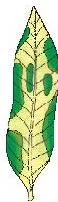
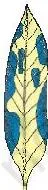
Activity 5.2 — Potassium hydroxide and starch test
Two potted plants are kept in the dark, then placed under separate sealed bell jars — one with a watch-glass of KOH beside it. KOH absorbs CO₂, so that plant has no carbon dioxide to use. After two hours in sunlight, leaves from each plant are tested for starch. The KOH-jar leaf shows no starch; the control jar leaf does.
The conclusion: CO₂ is essential for photosynthesis. Without CO₂, the plant cannot make carbohydrates even with sunlight and chlorophyll present.
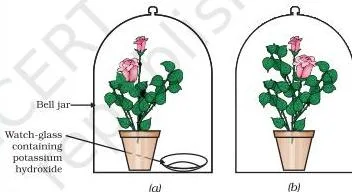
Activity 5.3 — Saliva and starch solution
1 mL of 1% starch solution is placed in two test tubes. Saliva is added to tube A only; both are left for 20–30 minutes. When dilute iodine is added, tube B (no saliva) turns blue-black — starch is still present. Tube A (with saliva) shows no colour change — the starch has been broken down.
The conclusion: salivary amylase in saliva breaks down starch into simpler sugar. This is the first enzymatic digestion in the alimentary canal.
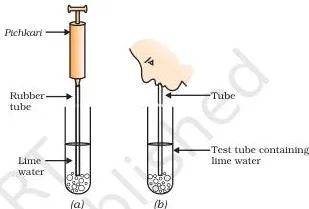
Activity 5.4 — Lime water and exhaled air
Freshly prepared lime water (calcium hydroxide solution) turns milky in the presence of CO₂, because insoluble calcium carbonate forms. When air is pushed into lime water with a syringe, it turns milky slowly. When exhaled air is blown through it, it turns milky much faster.
The conclusion: exhaled (breathed-out) air contains more CO₂ than ordinary air, because respiration has added CO₂ to it in the lungs.
Activity 5.5 — Yeast and sugar fermentation
Yeast is added to fruit juice or sugar solution in a test tube fitted with a bent glass tube that dips into lime water. As fermentation proceeds, a gas passes into the lime water and turns it milky. The gas is CO₂. The conclusion: yeast ferments sugar in the absence of oxygen (anaerobic respiration) and produces CO₂ and ethanol.
This proves fermentation is an anaerobic process that releases CO₂ as a by-product.
Activity 5.6 — Fish and human breathing rate
When you watch fish in an aquarium, you can count the mouth and gill-slit openings per minute. A fish opens and closes its mouth far more often than a human breathes in and out in the same minute.
The conclusion: aquatic organisms breathe faster than terrestrial organisms because the amount of oxygen dissolved in water is much lower than the oxygen available in air. Fish need to pump much more water across their gills to extract the same amount of O₂ a human gets from far fewer breaths of air.
Activity 5.7 — Health-centre visit for haemoglobin range
This is an observational activity rather than a home experiment. Students visit a health centre and a veterinary clinic to compare the normal range of haemoglobin content in humans (children, adult men, adult women) and in animals such as cows or buffaloes (calves, males, females).
The conclusion is that the normal haemoglobin range varies with age, sex, and species, reflecting different oxygen-transport needs. This links to the respiratory-pigment role discussed in the chapter — the same principle (haemoglobin carries oxygen) explains why lower-than-normal levels cause fatigue and anaemia. The practical takeaway is that haemoglobin content is a measurable indicator of the blood’s oxygen-carrying capacity.
Activity 5.8 — Potted plant and transpiration
Two pots of similar size — one with a plant, one with a stick of the same height — are covered with plastic sheets and placed in sunlight for half an hour, with the soil also covered so no water can evaporate from the soil. Water droplets condense on the inside of the jar covering the plant; the stick jar stays dry.
The conclusion: the water vapour released by the plant (transpiration) condensed on the plastic — the plant, not the soil, was the source of the moisture. This shows that plants lose water as vapour from their aerial parts.
Frequently Asked Questions — Life Processes Class 10
Real student questions beyond the exercise. Each is answered directly from chapter grounding. (NCERT, pp. 80–98)
1. Why is blood called a fluid connective tissue and what are its main components?
Blood is called a fluid connective tissue because it has a fluid medium — plasma — in which cells are suspended, and it connects every part of the body by carrying materials between them.
Its main components: red blood corpuscles (carry oxygen using haemoglobin), white blood cells (defend against infection), platelets (help blood clot at injury sites), and plasma itself, which transports food, CO₂, and nitrogenous wastes in dissolved form. (NCERT, pp. 91–93)
2. Why do herbivores have a longer small intestine than carnivores?
Herbivores eat grass and other plant material that contains cellulose, a complex carbohydrate which is difficult to break down. A longer small intestine gives more time and greater surface area for cellulose digestion to complete. Carnivores eat meat, which is easier to digest, so their small intestine is shorter.
The textbook uses this to illustrate that the length of the digestive tract is adapted to the type of food an organism eats. (NCERT, p. 85)
3. What is the difference between respiration and breathing?
Respiration is the biochemical process inside cells in which glucose is broken down — aerobically with oxygen or anaerobically without — to release energy stored as ATP. Breathing is the mechanical process of taking air into the lungs and pushing it out, which supplies the oxygen for respiration and removes the CO₂ produced.
Breathing is a body-level exchange; respiration is a cellular-level chemical process.
4. Why does anaerobic respiration produce less energy than aerobic respiration?
In aerobic respiration, glucose is broken down fully into CO₂ and water, so all the energy locked in the glucose molecule is released. In anaerobic respiration, glucose is only partly broken down — the products, ethanol in yeast or lactic acid in muscles, still contain a lot of energy that is not released.
Because the breakdown is incomplete and does not use oxygen to fully oxidise the carbon, the amount of energy released is much less than in aerobic respiration. (NCERT, p. 87)
5. How does transpiration help a plant even though it loses water?
Transpiration — the loss of water as vapour from the leaf surface — creates a suction pull in the xylem. This pull draws water and dissolved minerals up from the roots to the leaves, against gravity. In tall trees, transpiration pull is the major driving force during the day when stomata are open (root pressure dominates at night).
Transpiration also cools the plant by evaporative cooling, the way sweating cools us. So although water is lost, the same loss drives the upward transport that every leaf needs for photosynthesis. (NCERT, p. 95)
Further Practice and Chapter Resources
For further practice, the full exercise set (pages 99–101) is solved above in the end-of-chapter section. Each question is grounded in the official NCERT Class 10 Science textbook Chapter 5 — open the PDF to check every question and figure page by page against the source.
You may also want our own chapter PDF, which contains the worked solutions and all diagrams with no sign-up needed, for offline practice. The next chapter is Chapter 6 — Control and Coordination — which builds on these maintenance processes by showing how organisms coordinate their responses. Other helpful links include our Class 10 Science notes and our Class 10 notes hub for every subject.
Reference: NCERT Class 10 Science textbook, Chapter 5: Life Processes.
Explore Class 10 Science NCERT Solutions
Class 10 Science on LearnCBSE:
Related chapters: