
This page gives you complete NCERT solutions for Class 10 Science Chapter 12, Magnetic Effects of Electric Current, for the 2026-27 session. All 13 in-text questions and all 9 end-of-chapter exercise questions are reproduced exactly and solved with concept-first explanations, so you can finish homework, check answers, and revise for the board exam without the textbook beside you.
Each answer opens with the principle behind it — why a compass turns, how the right hand thumb rule works, when a fuse melts — then shows the step-by-step working. A short student-tip at the end of every question flags the error students most often make on that exact problem.
All questions are taken from the official NCERT Class 10 Science textbook. You can download the source PDF from the NCERT portal at ncert.nic.in/textbook.php and check any question or diagram page by page while you work through the solutions below.
Magnetic field and field lines: why a compass turns and why two lines never cross
One idea carries this whole section. A compass needle is a small bar magnet (NCERT, p. 2). A bar magnet produces a magnetic field — the region around it in which its force can be detected — and any magnet placed in that field feels a force and turns to line up with it.
The properties of the field lines answer all four questions below.
Question 1: Why does a compass needle get deflected when brought near a bar magnet?
Answer: A compass needle is itself a small bar magnet. When it is brought near a bar magnet, the magnet’s field exerts a force on it.
The needle’s south-seeking end is pulled toward the magnet’s north pole and its north-seeking end away from it, so the needle rotates until its axis points along the direction of the field at that spot.
That rotation is the deflection you see. A compass anywhere near a magnet behaves this way — it aligns with the local field direction, which is exactly how the compass is used to map field lines in Activity 12.3 (NCERT, p. 3).
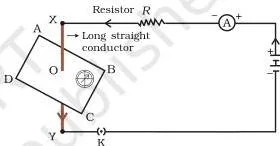
Question 1: Draw magnetic field lines around a bar magnet.
Answer: Start by marking the bar magnet’s boundary on paper. Place the compass near the north pole: the needle’s south end points toward the pole, its north end away.
Mark the two ends of the needle, move the compass so its south end sits where its north end was, mark again, and repeat in small steps until you reach the south pole. Join the marks with a smooth curve — that curve is one field line. Repeat to draw several lines.
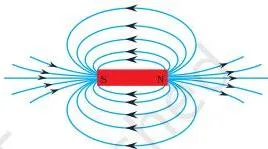
Read Figure 12.4 aloud: lines emerge from the north pole, curve through space, and merge at the south pole; arrows point along the direction a free north pole would move; inside the magnet the lines continue from south to north, so the field lines form closed curves (NCERT, p. 3). The lines crowd together near the poles, where the field is strongest.
Question 2: List the properties of magnetic field lines.
Answer: The three properties the chapter states (NCERT, p. 3):
- Direction: a field line shows the path a free north pole would take; by convention, lines emerge from the north pole and merge at the south pole.
- Strength: the closeness of the lines shows the field strength — crowded lines mean a strong field, spread-out lines a weak one.
- Closed curves: inside the magnet the direction runs from south to north, so every line is a closed loop.
- No crossing: no two field lines ever intersect.
Question 3: Why don’t two magnetic field lines intersect each other?
Answer: At the point where two lines cross, the field would have to point in two directions at once. A compass needle placed there would have to point both ways, which is impossible for a single field. So two magnetic field lines never intersect (NCERT, p. 3).
Fields around a straight wire, a circular loop and a solenoid: patterns and the right hand thumb rule
Two figures carry this section. Around a straight wire the field lines are concentric circles (Fig. 12.6); the right-hand thumb rule (Fig. 12.7) gives their direction. Bend the wire into a loop or a coil and the pattern changes shape, but the rule still decides direction at every point.
Question 1: Consider a circular loop of wire lying in the plane of the table. Let the current pass through the loop clockwise. Apply the right-hand rule to find out the direction of the magnetic field inside and outside the loop.
Answer: For a curved conductor, cup your right hand so the fingers wrap along the current direction; the curled fingers show the field’s turning direction, and the thumb gives the field direction through the centre. This is the same right-hand thumb rule applied to a loop.
For a clockwise current seen from above, curl the fingers of the right hand clockwise: the thumb then points downward, into the table. So the field inside the loop points downward into the plane of the table. Outside the loop the lines curve back around and point upward, out of the plane — the two directions are opposite (NCERT, p. 6).
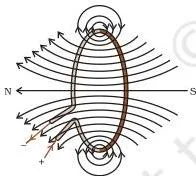
Question 2: The magnetic field in a given region is uniform. Draw a diagram to represent it.
Answer: A uniform field has the same magnitude and the same direction at every point of the region. To draw it, sketch a set of straight, equally spaced, parallel lines and put an arrow on each pointing the same way, say left to right or bottom to top.
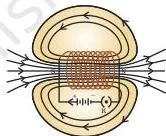
Equal spacing shows equal strength; parallel straight lines show a single direction. The interior of a solenoid (Fig. 12.10) shows exactly this pattern, so it is the standard picture of a uniform field, while Activity 12.6 (Fig. 12.9) shows how the pattern is obtained with iron filings around a coil.
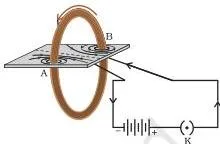
Question 3: Choose the correct option.
The magnetic field inside a long straight solenoid-carrying current
(a) is zero.
(b) decreases as we move towards its end.
(c) increases as we move towards its end.
(d) is the same at all points.
Answer: Inside a long straight solenoid the field lines are parallel straight lines that are equally spaced (NCERT, p. 7) — the definition of a uniform field, the same at all points. So the correct option is (d) is the same at all points.
Each wrong option fails for a clear reason: (a) is wrong because a current-carrying solenoid certainly produces a field inside it; (b) and (c) are wrong because the equal spacing of the parallel lines in Fig. 12.10 means the field does not weaken or strengthen toward the ends — it is uniform throughout the interior.
Force on a current-carrying conductor: Fleming’s left hand rule and direction questions
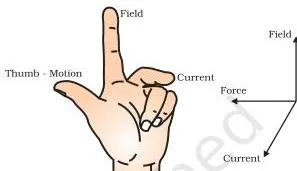
A current-carrying conductor placed in a magnetic field feels a force. Fleming’s left-hand rule (Fig. 12.13) finds its direction: stretch thumb, forefinger and middle finger mutually perpendicular; forefinger = field, middle finger = current, thumb = force (NCERT, pp. 8-9). One convention before solving: conventional current is taken opposite to the motion of electrons, exactly as Example 12.2 applies it (NCERT, p. 9).
Question 1: Which of the following property of a proton can change while it moves freely in a magnetic field? (There may be more than one correct answer.)
(a) mass
(b) speed
(c) velocity
(d) momentum
Answer: A magnetic field exerts a force perpendicular to the particle’s motion. A force at right angles to motion changes its direction but does no work on the particle, so it cannot change speed. Mass is an intrinsic property and never changes from a magnetic force. Velocity is a vector — its direction changes, so velocity changes.
Momentum = mass × velocity: mass stays, but the direction of velocity changes, so momentum changes too.
The correct answers are (c) velocity and (d) momentum.
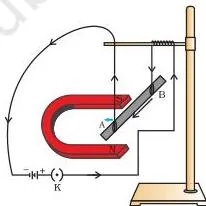
Question 2: In Activity 12.7, how do we think the displacement of rod AB will be affected if (i) current in rod AB is increased; (ii) a stronger horse-shoe magnet is used; and (iii) length of the rod AB is increased?
Answer: The rod is displaced because the magnetic field exerts a force on the current in it (NCERT, p. 8). All three changes make that force larger, so the displacement increases in every case.
Part (i): A larger current produces a stronger magnetic interaction, so the displacement increases. Part (ii): A stronger horse-shoe magnet supplies a stronger external field, so the displacement increases. Part (iii): A longer rod puts more conductor inside the field, so the displacement increases.
Question 3: A positively-charged particle (alpha-particle) projected towards west is deflected towards north by a magnetic field. The direction of magnetic field is
(a) towards south (b) towards east
(c) downward (d) upward
Answer: An alpha particle is positively charged, so conventional current flows in the direction of its motion — that is, toward the west. Apply Fleming’s left hand rule (Fig. 12.13): point the middle finger (current) west, and the thumb (force) north; the forefinger, perpendicular to both, then points upward. So the magnetic field is directed upward — option (d).
Domestic electric circuits: fuses, earthing and the electric oven question
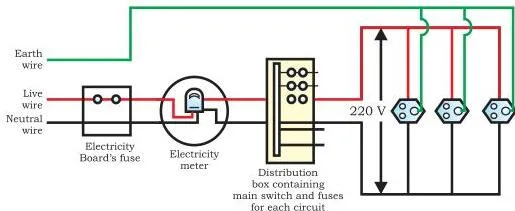
In our homes the mains supply brings 220 V between the live wire (red insulation) and the neutral wire (black insulation); the earth wire (green insulation) is a safety line connected deep into the ground (NCERT, p. 10). Two devices protect the circuit — the fuse and the earth wire — and the three questions below test them, plus one numerical.
Question 1: Name two safety measures commonly used in electric circuits and appliances.
Answer: Two safety measures built into every domestic installation are (1) the electric fuse and (2) the earth wire (earthing). The fuse is a thin wire that melts when the current exceeds its rating, breaking the circuit before appliances are damaged (NCERT, p. 11).
The earth wire carries any leaked current safely to the ground when an appliance’s metallic body develops a fault, protecting the user from shock.
Question 2: An electric oven of 2 kW power rating is operated in a domestic electric circuit (220 V) that has a current rating of 5 A. What result do you expect? Explain.
Answer: Work out the current the oven draws and compare it with the line’s rating. Power \(P = 2\ \text{kW} = 2000\ \text{W}\), voltage \(V = 220\ \text{V}\).
\[ I = \frac{P}{V} = \frac{2000\ \text{W}}{220\ \text{V}} \approx 9.1\ \text{A} \]
The oven draws about 9.1 A, but the circuit is rated for only 5 A. Because the current demanded exceeds the rating, the circuit is overloaded: the wires and the fuse heat up, and the fuse melts (Joule heating, NCERT, p. 11) to cut the supply.
So the expected result is that the fuse blows and the oven does not run; running it would otherwise damage the circuit.
Fresh check to try: a 3 kW geyser on the same line — \( I = \frac{3000\ \text{W}}{220\ \text{V}} \approx 13.6\ \text{A} \), still far above 5 A, so it too would overload a 5 A circuit. The comparison is always watts ÷ volts against the fuse rating; if the current drawn is larger, the fuse melts.
Question 3: What precaution should be taken to avoid the overloading of domestic electric circuits?
Answer: Overloading happens when too much current flows in a circuit — from connecting too many appliances to a single socket, or from a short circuit when damaged insulation lets the live and neutral wires touch (NCERT, p. 11). To avoid it:
- Do not connect too many appliances to one socket or one circuit.
- Keep all insulation in good condition and repair damaged wires.
- Get appliance faults fixed instead of running faulty equipment.
NCERT solutions for exercise questions 1-3: field patterns and circuit safety
Question 1: Which of the following correctly describes the magnetic field near a long straight wire?
(a) The field consists of straight lines perpendicular to the wire.
(b) The field consists of straight lines parallel to the wire.
(c) The field consists of radial lines originating from the wire.
(d) The field consists of concentric circles centred on the wire.
Answer: Around a long straight wire the field lines are concentric circles centred on the wire. Activity 12.5 shows iron filings lining up in exactly this circular pattern (Fig. 12.6, NCERT, pp. 4-5), with the arrow direction given by the right-hand thumb rule. So the correct option is (d).
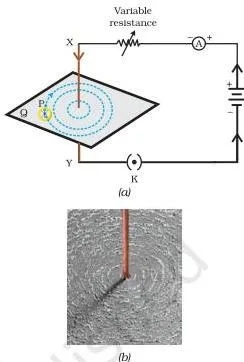
Each wrong option fails because none matches the observed pattern: (a) straight lines perpendicular, (b) straight lines parallel, and (c) radial lines pointing out from the wire like spokes — the real lines loop around the wire as closed circles.
Question 2: At the time of short circuit, the current in the circuit
(a) reduces substantially.
(b) does not change.
(c) increases heavily.
(d) vary continuously.
Answer: At a short circuit the live and neutral wires come into direct contact, so the resistance of the path drops almost to zero. By Ohm’s law, a tiny resistance at the supply voltage means an abruptly large current — the current increases heavily. So the correct option is (c) (NCERT, p. 11).
Question 3: State whether the following statements are true or false.
(a) The field at the centre of a long circular coil carrying current will be parallel straight lines.
(b) A wire with a green insulation is usually the live wire of an electric supply.
Answer: (a) True. At the centre of a long circular coil — just like a solenoid interior — the field lines are parallel straight lines, meaning a uniform field (NCERT, p. 7). (b) False. The wire with green insulation is the earth wire; the live wire has red insulation (NCERT, p. 10).
Two ways to produce a magnetic field and the largest force (Exercise Questions 4-5)
Question 4: List two methods of producing magnetic fields.
Answer: Two methods the chapter shows: (1) a permanent bar magnet, whose field exists around it all the time (NCERT, p. 2); and (2) an electric current through a conductor — a current-carrying wire produces a magnetic field around it (NCERT, p. 4), and a solenoid carrying current behaves like a bar magnet, forming an electromagnet when soft iron is placed inside (NCERT, p. 7).
Question 5: When is the force experienced by a current-carrying conductor placed in a magnetic field largest?
Answer: The force is largest when the direction of the current in the conductor is at right angles to the direction of the magnetic field (NCERT, p. 8, from the observations of Activity 12.7).
The field acts on the component of motion perpendicular to it; when current and field are parallel there is no such component and the force falls to zero, so the perpendicular position gives the maximum force.
Finding directions, short-circuiting and earthing (Exercise Questions 6-9)
Question 6: Imagine that you are sitting in a chamber with your back to one wall. An electron beam, moving horizontally from back wall towards the front wall, is deflected by a strong magnetic field to your right side. What is the direction of magnetic field?
Answer: The electron beam moves from the back wall toward the front wall and is deflected to the person’s right. Since the beam is electrons, conventional current is opposite to electron motion, so current points from the front wall toward the back wall.
Set Fleming’s left hand rule: middle finger (current) backward, thumb (force) to the right; the forefinger, perpendicular to both, points downward. So the magnetic field is directed vertically downward, into the floor.
Question 7: State the rule to determine the direction of a (i) magnetic field produced around a straight conductor-carrying current, (ii) force experienced by a current-carrying straight conductor placed in a magnetic field which is perpendicular to it, and (iii) current induced in a coil due to its rotation in a magnetic field.
Answer:
Part (i): For the magnetic field around a straight current-carrying conductor, use the right-hand thumb rule — grip the wire with the right hand, thumb along the current; the fingers curl in the direction of the field lines (NCERT, p. 5).
Part (ii): For the force on a conductor in a perpendicular magnetic field, use Fleming’s left-hand rule — forefinger along the field, middle finger along the current, thumb gives the force (NCERT, pp. 8-9).
Part (iii): The direction of the current induced in a coil rotating in a magnetic field is given by Fleming’s right hand rule. An honest note: this chapter’s text does not develop that rule — it belongs to the electromagnetic induction material that comes later in the Science book.
Name the rule here, and find its full explanation in the Class 10 Science notes pages linked below.
Question 8: When does an electric short circuit occur?
Answer: A short circuit occurs when the live wire and the neutral wire come into direct contact. This happens when the insulation of the wires is damaged or there is a fault in an appliance (NCERT, p. 11).
With the two wires touching, the path resistance falls almost to zero and the current rises abruptly — that sudden surge is the danger the fuse prevents.
Question 9: What is the function of an earth wire? Why is it necessary to earth metallic appliances?
Answer: The earth wire provides a low-resistance conducting path for any leaked current.
When an appliance with a metallic body develops a fault, current that leaks to the body flows through the earth wire to the ground instead of through the user; the body is held at the potential of the earth, so the user does not get a severe electric shock (NCERT, p. 10).
That is why metallic appliances — electric press, toaster, refrigerator, table fan — must be earthed.
The rules at a glance: thumb rule, left-hand rule, and how to check an answer
Two rules decide nearly every direction answer in this chapter. The table separates them so you never reach for the wrong one.
| Rule | What it finds | How you use it | Used in |
|---|---|---|---|
| Right-hand thumb rule | Direction of the magnetic field around a current-carrying wire | Thumb points along the current; fingers wrap in the direction of the field lines | In-text loop question, Exercise Q7(i) |
| Fleming’s left-hand rule | Direction of the force on a current-carrying conductor inside a magnetic field | Forefinger = field, middle finger = current, thumb = force; all mutually perpendicular | In-text force questions, Exercise Q6, Q7(ii) |
Quick self-check for any direction problem: reverse the current on paper — the field (thumb rule) or the force (left-hand rule) direction must reverse too. This follows from Activity 12.4, where reversing the current reversed the needle’s deflection, and Activity 12.7, where reversing the current or the field reversed the rod’s displacement (NCERT, p. 8).
If the flipped direction comes out the same, you have dropped a sign somewhere.
Board emphasis: the in-text rule questions (right-hand thumb rule, Fleming’s left-hand rule) and the electric oven numerical are the most recycled question styles from this chapter in examinations.
The numerical always has the same shape — divide watts by volts, compare with the fuse rating in amperes — so practise it once with a fresh appliance (a 3 kW geyser draws \( \frac{3000}{220} \approx 13.6\ \text{A} \)) and you can answer any version.
| Common mistake | Correct rule | How to check your answer |
|---|---|---|
| Using the right hand for Fleming’s rule | Fleming’s rule uses the LEFT hand: forefinger field, middle finger current, thumb force | Reverse the current on paper; the force direction must reverse as well |
| Taking electron motion as the current direction | Conventional current flows opposite to electron motion; use that direction in the rule | For an electron, point the middle finger against its motion |
| Thinking two field lines can cross | Lines never intersect; at a crossing a compass would point two ways at once | Check the diagram: every point has exactly one field direction |
For the complete set of study material for this class and subject, see the Class 10 Science notes and the wider Class 10 notes collection; all CBSE notes are designed for the board exam. The fuse principle this chapter leans on comes from Chapter 11 Electricity, and later chapters such as Chapter 13 Our Environment continue the same revision pattern.
Frequently asked questions on magnetic effects of electric current
What is the difference between the right hand thumb rule and Fleming’s left hand rule?
The right-hand thumb rule finds the direction of the magnetic field around a current-carrying wire: thumb points along the current, fingers curl in the field direction. Fleming’s left-hand rule finds the force on a conductor inside a magnetic field: forefinger = field, middle finger = current, thumb = force.
One finds a field, the other finds a force — and the two use opposite hands.
Why is the direction of current taken opposite to the motion of electrons when applying Fleming’s left hand rule?
Conventional current was defined as the flow of positive charge long before electrons were discovered, and we still use that definition. Electrons move toward the positive terminal, so their motion is opposite to the direction conventional current takes. Fleming’s rules work on conventional current, so for electrons you must reverse the direction of motion before applying the rule (NCERT, p. 9).
Why does a fuse blow when too many appliances are switched on in one socket?
Each appliance adds its own current to the socket. When the combined current exceeds the wiring’s fuse rating, the Joule heating in the fuse melts it, breaking the circuit and protecting the wiring and the appliances (NCERT, p. 11).
Why is it necessary to connect the metallic body of an appliance to the earth wire?
A fault can leak current to a metallic body. Without earthing, a person touching the body receives a severe shock. The earth wire gives that leaked current a low-resistance path to the ground, holding the body at earth potential so the user is not harmed (NCERT, p. 10).
Why are the magnetic field lines inside a solenoid parallel and equally spaced?
Inside a long solenoid the current-carrying turns add their fields in one direction, producing straight parallel lines that are equally spaced. Equal spacing in a field diagram means equal field strength at all points — that is the definition of a uniform field (NCERT, p. 7).
Reference: NCERT Class 10 Science textbook, chapter 12 Magnetic Effects of Electric Current.
Explore Class 10 Science NCERT Solutions
Class 10 Science on LearnCBSE:
Related chapters: