This page gives you complete NCERT solutions for Class 10 Science Chapter 8 Heredity for the 2026-27 session, solved from the latest NCERT textbook. Every intext question and every chapter exercise question is answered here with concept-first explanations, worked reasoning, and common-error warnings a competitor’s answer key skips.
Use these solutions to understand Mendel’s experiments, dominance and recessiveness, independent inheritance of traits, and human sex determination. Each answer is written as a teacher would explain it so you can frame full-marks board answers.
Variation, Inheritance and Mendel’s Laws — Intext Questions (Page 131)
In asexually reproducing species, variation accumulates slowly through minor DNA copying errors across generations. The frequency of a trait in the population tells you how long that trait has been propagating, not how recently it appeared.
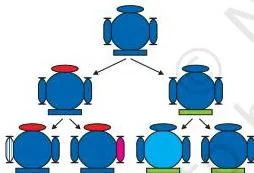
Question 1: If a trait A exists in 10% of a population of an asexually reproducing species and a trait B exists in 60% of the same population, which trait is likely to have arisen earlier?
Concept: In asexual reproduction, there is no recombination of genes from two parents. Every new individual is a copy of its parent, and the only source of variation is small inaccuracies in DNA copying. These copying errors accumulate very slowly. A trait that has existed in the population for many generations passes down to more descendants and spreads wider.
A higher percentage means the trait has been propagating for a longer time, not that it arose recently.
Reasoning: Trait B exists in 60% of the population — six times the proportion of Trait A at 10%. This indicates Trait B has been present and passing through many more rounds of reproduction than Trait A. Trait A’s low proportion of 10% suggests it arose more recently and has had fewer generations to spread.
Answer: Trait B is likely to have arisen earlier than Trait A.
Common error: Students often assume a higher percentage means a trait is newer because it is more widespread. The reverse is true in asexual reproduction — the proportion reflects time accumulated, not novelty.
Question 2: How does the creation of variations in a species promote survival?
Concept: Not every variation in a species offers an equal chance of surviving in the environment. Depending on the nature of a variation, different individuals gain different kinds of advantages. Bacteria that can withstand heat, for example, survive better in a heat wave than bacteria without that resistance (NCERT, p. 1).
The environment acts as a selecting agent, choosing variants with favourable traits and eliminating those without them.
Reasoning: Variations give a species a spread of designs among its individuals. If the environment shifts — a new disease, a change in temperature, scarcity of a resource — some variants are better suited to cope than others. Those individuals survive, reproduce, and pass their advantageous traits to the next generation.
Without variation, an entire species would respond identically to a threat; a single change in the environment could wipe it out.
Answer: Variations promote survival because environmental factors select individuals with advantageous traits, allowing them to live longer, reproduce more, and pass those traits to offspring.
Common error: Students link heat resistance to any one specific bacterial species. The textbook’s heat-resistant bacteria example is a general illustration of how the environment selects variants — not a statement about a named species.
Mendel’s Experiments, Trait Expression and Sex Determination — Intext Questions (Page 132)
Mendel’s work shows that traits are controlled by factors (now called genes), that two copies exist in each sexually reproducing individual, and that these copies segregate and recombine during reproduction. The questions in this section test your understanding of dominance, independent inheritance, blood-group logic, and sex determination.
Question 1: How do Mendel’s experiments show that traits may be dominant or recessive?
Concept: Mendel crossed a tall pea plant with a short pea plant. In the first generation (F1), all plants were tall — there were no medium-height plants. This told Mendel that only one parental trait was expressed in F1 — the other was hidden, not lost (NCERT, p. 3).
When F1 tall plants were self-pollinated, the second generation (F2) had one-quarter short plants — a 3:1 ratio of tall to short. The reappearance of the short trait proved the recessive copy was carried silently through F1 and only expressed when both copies were present.
Reasoning: Both tallness and shortness were inherited by F1 plants. The fact that every F1 plant was tall meant the tallness trait masked shortness. A single copy of T was sufficient to make the plant tall; both copies had to be t for the plant to be short. This is what dominance and recessiveness mean.
The F2 3:1 ratio is the evidence that the recessive trait was present but unexpressed in F1.
Answer: Mendel’s F1 generation showed only the dominant trait (all tall). The F2 generation showed a 3:1 ratio of tall to short, proving both traits were inherited but only one was expressed. Thus, the trait seen in F1 (tallness) is dominant and the trait hidden in F1 (shortness) is recessive.
Common error: Students state the F2 ratio as the answer without explaining what it proves. Name both observations — F1 all tall and F2 showing short — and explain why the ratio reveals recessiveness.
Question 2: How do Mendel’s experiments show that traits are inherited independently?
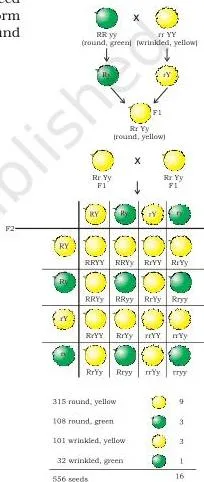
Concept: Mendel crossed a tall plant with round seeds and a short plant with wrinkled seeds. The F1 generation was all tall with round seeds — tallness and round seed shape are the dominant traits. When F1 plants were self-pollinated, the F2 generation showed four kinds of individuals: tall/round, tall/wrinkled, short/round, and short/wrinkled (NCERT, p. 3, 4).
The crucial observation is that F2 had new combinations — tall/wrinkled and short/round — that were not in the parents.
Reasoning: The appearance of new combinations in F2 proves the tall/short trait and the round/wrinkled trait segregated independently during gamete formation. If the two traits were linked, you would only get parental combinations. The fact that you get four phenotypes shows each trait is inherited as a separate unit.
Answer: Mendel’s dihybrid cross showed new trait combinations in F2 (tall/wrinkled, short/round) that were absent in the parents. These new combinations can only arise if the two traits segregate and recombine independently — proving independent inheritance.
Common error: Students memorise the F2 ratio without connecting it to the key evidence. The proof is the appearance of new combinations, not the ratio itself.
Question 3: A man with blood group A marries a woman with blood group O and their daughter has blood group O. Is this information enough to tell you which of the traits – blood group A or O – is dominant? Why or why not?
Concept: Blood groups are governed by multiple alleles (A, B, O), not simple Mendelian dominance between two alleles. A person with blood group A can be homozygous (IAIA) or heterozygous (IAiO). A person with blood group O is always iOiO. The daughter with blood group O (iOiO) must have received one iO allele from each parent.
This tells us the father is heterozygous for the IA allele — he carries the iO allele and passed it on. But this observation alone cannot tell us whether A is dominant over O because the result is consistent with both A being dominant and a simpler interpretation.
Reasoning: To establish dominance, you need to cross a homozygous dominant individual with a recessive one and see every F1 child show the dominant phenotype. Here, we have a single cross of one A parent with one O parent.
The O daughter is one possible outcome whether A is dominant (father IAiO × mother iOiO, giving both A and O children) or O is dominant in some alternative logic. One cross of one pair is insufficient.
Answer: No, this information is not enough to tell which trait is dominant. Blood groups follow multiple alleles, and a single cross of A × O yielding an O daughter is consistent with A being dominant. To determine dominance, you would need controlled crosses across many individuals with known genotypes.
Common error: Students treat blood groups like a simple dominant/recessive two-allele trait. Blood groups follow codominance and multiple alleles, and a single observation cannot prove dominance.
Question 4: How is the sex of the child determined in human beings?
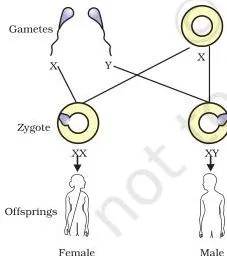
Concept: Human beings have 22 pairs of chromosomes that are perfectly matched in both males and females. But the 23rd pair — the sex chromosomes — differs. Women have a perfect pair, both called X (XX). Men have a mismatched pair: one normal-sized X and one shorter one called Y (XY) (NCERT, p. 5).
All children inherit an X chromosome from their mother, because she only has X to give. From their father, they inherit either an X or a Y, because he has both. If the father’s sperm carries an X, the child is XX — a girl. If it carries a Y, the child is XY — a boy. The probability is 50% each.
Reasoning: The mother is XX, so every egg carries an X regardless. The father is XY, so half his sperm carry X and half carry Y. The sex of the child depends entirely on which type of sperm fertilises the egg. This is why the father’s chromosomes determine the sex of the child.
Answer: The sex of the child is determined by the paternal sex chromosome. All children inherit an X from their mother. A child who inherits an X from the father is a girl (XX); one who inherits a Y is a boy (XY). Thus, the father’s sperm determines sex, with a 50% chance of either.
Common error: Students say the mother determines the sex of the child. She always contributes X; the father’s X or Y is the deciding factor.
Chapter Exercise Solutions — Dominance, Eye Colour, Dog Coat Project and Equal Genetic Contribution
The end-of-chapter exercise tests your ability to read a Mendelian cross, reason about dominance from limited data, design an experiment, and explain the mechanism restoring equal genetic contribution.
Question 1: A Mendelian experiment consisted of breeding tall pea plants bearing violet flowers with short pea plants bearing white flowers. The progeny all bore violet flowers, but almost half of them were short. This suggests that the genetic make-up of the tall parent can be depicted as (a) TTWW (b) TTww (c) TtWW (d) TtWw
- (a) TTWW
- (b) TTww
- (c) TtWW
- (d) TtWw
Concept: Every progeny bore violet flowers. This means violet is dominant over white, and the tall parent must have been homozygous for violet (WW) — if it had been Ww, cross with a short/white parent (ww) would have produced some white-flowered progeny. But almost half the progeny were short. The short parent is tt.
If the tall parent were TT, all progeny would be tall (Tt). For half the progeny to be short, the tall parent must be heterozygous for height (Tt), passing T to half and t to the other half.
Reasoning for each wrong option: TTWW would give all tall progeny — contradicting “almost half were short.” TTww would give all white-flower progeny — contradicting “all bore violet flowers.” TtWw would produce mixed flower colours (Ww × ww gives half violet, half white) — again contradicting “all bore violet flowers.”
Only TtWW satisfies both: Tt crossed with tt gives short progeny; WW crossed with ww gives all violet (Ww).
Answer: Correct option is (c) TtWW.
Common error: Students forget that “almost half short” signals the tall parent is heterozygous (Tt), not homozygous (TT). The flower data tells you WW; the height data tells you Tt.
Question 2: A study found that children with light-coloured eyes are likely to have parents with light-coloured eyes. On this basis, can we say anything about whether the light eye colour trait is dominant or recessive? Why or why not?
Concept: To establish dominance, you need to cross a homozygous dominant individual with a recessive one and observe the trait appearing in all F1 offspring. Here, the study only tells us that two light-eyed parents produced light-eyed children.
This observation is consistent with both possibilities: if light eye colour is dominant, the parents could be EE or Ee (light phenotype) and pass on E alleles; if light eye colour is recessive, the parents could be ee (light phenotype) and pass on e alleles.
Without observing a cross between a dark-eyed and a light-eyed parent, you cannot tell which trait is dominant.
Reasoning: The problem is that light-eyed parents producing light-eyed children tells you only that the trait runs in families — not which allele masks the other. For a trait to be proven dominant, you need a cross where a homozygous dominant parent crossed with a recessive one gives 100% dominant phenotype in the offspring. This study gives no such cross.
Answer: No, this information is not enough to determine whether light eye colour is dominant or recessive. The observation fits both scenarios — light being dominant (parents EE or Ee) or light being recessive (parents ee). A controlled cross between a light-eyed and a dark-eyed parent would be needed to decide.
Common error: Students assume that children resembling parents means the trait is dominant. Resemblance alone proves nothing — both dominant and recessive traits can produce children that look like the parents.
Question 3: Outline a project which aims to find the dominant coat colour in dogs.
Concept: A Mendel-style project needs a pure-breeding parental cross, an F1 observation, and an F2 self-cross to see the recessive trait reappear. Choose two dogs with contrasting coat colours — one black, one brown — where both are pure-breeding. Cross them. Record F1 coat colour. If all F1 pups are one colour, say black, black is likely dominant and brown is recessive.
Self-cross the F1 (or cross two F1 siblings) and record the F2 ratio.
Reasoning: If F2 shows roughly 3 black : 1 brown, black is confirmed dominant. If F2 shows 1 black : 1 brown, the F1 was heterozygous crossed with the recessive — which itself tells you dominance. The reappearance of brown in F2, absent in F1, proves brown was hidden in F1 and is recessive.
Answer: A project outline:
- Step 1: Select two pure-breeding dogs with contrasting coat colours — one black (homozygous), one brown (homozygous).
- Step 2: Cross them; observe the F1 generation’s coat colour. Record whether all pups share one colour or show a mix.
- Step 3: If all F1 show one colour, that colour is dominant. Self-cross (or mate sibling F1 dogs) to produce F2.
- Step 4: Record the F2 ratio — if a recessive trait reappears in F2 at roughly 3:1, the F1-expressed colour is confirmed dominant.
- Step 5: Repeat with more pairs to confirm the result is consistent.
Common error: Students propose a single cross and declare dominance from F1 alone. You need an F2 self-cross to prove the trait was hidden, not just masked once.
Question 4: How is the equal genetic contribution of male and female parents ensured in the progeny?
Concept: Sexually reproducing organisms have two copies of every chromosome — one from the male parent, one from the female parent. Every germ cell (sperm or egg) is formed through meiosis, which separates the two copies so each germ cell carries only one chromosome from each pair.
When a sperm fertilises an egg, the two single sets combine and restore the normal paired number in the progeny (NCERT, p. 5). This means each parent contributes exactly one set of chromosomes, ensuring equal genetic contribution.
Reasoning: Each gene exists in two copies in a parent. If both parents passed on both copies, the progeny would have four copies — and that would double every generation. Meiosis in germ cells halves the genetic material so each sperm and egg carries a single gene set. Fertilisation restores the normal two sets (one maternal, one paternal) in the offspring.
This keeps the chromosome number stable and makes both parents’ contributions equal.
Answer: Each parent contributes one chromosome from every chromosome pair via germ cells formed by meiosis. The progeny receives one set from the mother and one set from the father, which restores the normal diploid number and ensures an equal genetic contribution from both parents.
Common error: Students say parents give equal DNA because the child resembles both. The mechanism is meiosis halving each parent’s genetic material before fertilisation restores the normal number.
Method Recap: How to Frame Heredity Answers for the Board Exam
Board answers in this chapter need clear method, not just memorised ratios. Here is a focused recap of the methods the questions require.
Reading a Monohybrid Cross
A monohybrid cross tracks one trait. Cross a pure-breeding dominant (BB) with a pure-breeding recessive (bb). F1 is all heterozygous (Bb), showing the dominant phenotype. Self-cross F1 and F2 gives 3 dominant : 1 recessive.
Original worked example (not from the textbook): Cross a pure-breeding black-coated guinea pig (BB) with a pure-breeding white-coated guinea pig (bb).
- F1: all Bb — all black (black is dominant).
- F2 (from Bb × Bb): roughly 3 black : 1 white (BB black, 2 × Bb black, bb white).
- The reappearance of white in F2 proves the recessive allele was carried silently through F1.
Dihybrid Cross and Independent Inheritance
A dihybrid cross tracks two traits. The key evidence of independent inheritance is the appearance of new combinations in F2 — parental combinations plus non-parental types.
| Generation | Phenotypes observed | Key evidence |
|---|---|---|
| F1 | Only dominant traits expressed | Both recessive traits masked |
| F2 | Four phenotypes (parental + new combinations) | New combinations prove independent segregation |
| F2 ratio | 9:3:3:1 | Confirms two independent traits |
Dominant vs Recessive Traits — Comparison
| Property | Dominant trait | Recessive trait |
|---|---|---|
| Definition | Expressed even when only one copy present | Expressed only when both copies present |
| Expression condition | Homozygous or heterozygous | Homozygous only |
| F2 ratio evidence | 3/4 of F2 show this trait | 1/4 of F2 show this trait |
Steps to Identify Dominance from a Cross Result
- Observe F1: The trait that appears in all F1 individuals is likely dominant.
- Self-cross F1: Produce an F2 generation.
- Count F2 phenotypes: A 3:1 ratio means the trait in 3/4 of F2 is dominant.
- Check for reappearance: If a phenotype absent from F1 reappears in F2, that is the recessive trait.
- Rule out single-cross conclusions: If only one cross of one pair is observed, you cannot prove dominance — you need an F2 self-cross or multiple crosses.
Common Mistakes in This Chapter
| Mistake | Correct rule | How to check your answer |
|---|---|---|
| Assuming higher percentage in asexual population means newer trait | Higher percentage means trait has existed longer and propagated wider | Ask: in asexual reproduction, trait frequency grows over generations — so more individuals means more time, not recency |
| Assuming children resembling parents means the trait is dominant | Resemblance alone proves nothing; you need a cross of dominant × recessive to prove dominance | Ask: do you have a Dd × dd cross giving all dominant phenotype? If not, you cannot conclude dominance |
| Treating blood groups as simple Mendelian dominance | Blood groups follow multiple alleles (IA, IB, iO) and codominance | Ask: does the cross include more than one pair? One cross of A × O yielding O does not establish dominance |
FAQs — Common Student Questions on Heredity
Why did Mendel choose pea plants for his experiments?
Mendel chose pea plants for their short life cycle, easily controlled pollination, and clearly contrasting visible traits (tall/short, round/wrinkled seeds, white/violet flowers). He could manually transfer pollen to control crosses and count large numbers of offspring, which is essential for arriving at inheritance ratios.
What is the difference between dominant and recessive traits?
A dominant trait is expressed in the heterozygous condition — a single copy of the dominant allele is enough for the trait to appear. A recessive trait is expressed only when both copies of the recessive allele are present (homozygous). In F2 of a monohybrid cross, 3/4 of individuals show the dominant trait and 1/4 show the recessive.
Why is the F2 ratio 3:1 in a monohybrid cross?
When two heterozygous F1 individuals (Tt × Tt) are self-crossed, the F2 gives 1 TT : 2 Tt : 1 tt in genotype. Because T is dominant, TT and Tt are both tall — 3 tall : 1 short phenotypically. The recessive trait reappears because the F1 alleles segregate during gamete formation.
Can a dark-eyed parent have a light-eyed child?
Yes, if the dark-eyed parent is heterozygous for the trait — carrying the recessive allele for light eyes and passing it on, with the other parent also contributing the recessive allele.
The NCERT textbook does not give eye colour gene details, so the answer relies on Mendelian logic: a dark-eyed parent who is a carrier can produce a light-eyed child if crossed with the right partner.
For more help with earlier chapters, see our Class 10 Science notes on How Do Organisms Reproduce and the full Class 10 Science revision notes. You may also find the complete Class 10 notes and our CBSE notes hub useful, or look ahead to Light Reflection and Refraction notes for the next chapter.
Every question solved here is taken word for word from the official NCERT Class 10 Science textbook chapter 8, so you can check any answer against the source.
Reference: NCERT Class 10 Science textbook, chapter 8 Heredity.
Explore Class 10 Science NCERT Solutions
Class 10 Science on LearnCBSE:
Related chapters: