Revising for your exam? Here is the Chemical Reactions and Equations Class 10 formulas sheet — the balanced equations, reaction patterns and oxidation-reduction rules of NCERT Chapter 1, arranged for quick lookup. It covers the word-equation format, the balancing method, and the key reactions for combination, decomposition, displacement, double displacement and precipitation.
Each formula is grouped by the NCERT sub-topic it belongs to, with symbol meanings, when-to-use guidance and original worked examples. For the explanations and step-by-step derivations, see the Chemical Reactions and Equations Class 10 Notes.
Chemical Reactions and Equations Class 10 Formulas at a Glance
The equations on this sheet in one table; the meaning of every symbol follows in the next sections.
| Purpose | Formula |
|---|---|
| Word equation — reaction described in words | \( \text{Magnesium} + \text{Oxygen} \rightarrow \text{Magnesium oxide} \) |
| Balanced form of the magnesium-burning equation (skeletal Eq. 1.2) | \( 2\text{Mg} + \text{O}_2 \rightarrow 2\text{MgO} \) |
| Balanced equation — zinc + sulphuric acid | \( \text{Zn} + \text{H}_2\text{SO}_4 \rightarrow \text{ZnSO}_4 + \text{H}_2 \) |
| Balanced equation with state symbols — iron + steam | \( 3\text{Fe(s)} + 4\text{H}_2\text{O(g)} \rightarrow \text{Fe}_3\text{O}_4\text{(s)} + 4\text{H}_2\text{(g)} \) |
| Reaction condition written over the arrow | \( \text{CO(g)} + 2\text{H}_2\text{(g)} \xrightarrow{340\ \text{atm}} \text{CH}_3\text{OH(l)} \) |
| Photosynthesis — condition and catalyst on the arrow | \( 6\text{CO}_2\text{(aq)} + 12\text{H}_2\text{O(l)} \xrightarrow[\text{Chlorophyll}]{\text{Sunlight}} \text{C}_6\text{H}_{12}\text{O}_6\text{(aq)} + 6\text{O}_2\text{(aq)} + 6\text{H}_2\text{O(l)} \) |
| Combination reaction pattern | \( \text{A} + \text{B} \rightarrow \text{AB} \) |
| Quick lime + water → slaked lime | \( \text{CaO(s)} + \text{H}_2\text{O(l)} \rightarrow \text{Ca(OH)}_2\text{(aq)} + \text{Heat} \) |
| Whitewashing — slaked lime reacts with CO₂ in air | \( \text{Ca(OH)}_2\text{(aq)} + \text{CO}_2\text{(g)} \rightarrow \text{CaCO}_3\text{(s)} + \text{H}_2\text{O(l)} \) |
| Burning of natural gas — exothermic | \( \text{CH}_4\text{(g)} + 2\text{O}_2\text{(g)} \rightarrow \text{CO}_2\text{(g)} + 2\text{H}_2\text{O(g)} \) |
| Respiration — exothermic | \( \text{C}_6\text{H}_{12}\text{O}_6\text{(aq)} + 6\text{O}_2\text{(aq)} \rightarrow 6\text{CO}_2\text{(aq)} + 6\text{H}_2\text{O(l)} + \text{energy} \) |
| Thermal decomposition of limestone | \( \text{CaCO}_3\text{(s)} \xrightarrow{\text{Heat}} \text{CaO(s)} + \text{CO}_2\text{(g)} \) |
| Thermal decomposition of ferrous sulphate | \( 2\text{FeSO}_4\text{(s)} \xrightarrow{\text{Heat}} \text{Fe}_2\text{O}_3\text{(s)} + \text{SO}_2\text{(g)} + \text{SO}_3\text{(g)} \) |
| Thermal decomposition of lead nitrate | \( 2\text{Pb(NO}_3)_2\text{(s)} \xrightarrow{\text{Heat}} 2\text{PbO(s)} + 4\text{NO}_2\text{(g)} + \text{O}_2\text{(g)} \) |
| Electrolytic decomposition of water (from Activity 1.7) | \( 2\text{H}_2\text{O(l)} \xrightarrow{\text{Electricity}} 2\text{H}_2\text{(g)} + \text{O}_2\text{(g)} \) |
| Photolytic decomposition of silver chloride | \( 2\text{AgCl(s)} \xrightarrow{\text{Sunlight}} 2\text{Ag(s)} + \text{Cl}_2\text{(g)} \) |
| Photolytic decomposition of silver bromide | \( 2\text{AgBr(s)} \xrightarrow{\text{Sunlight}} 2\text{Ag(s)} + \text{Br}_2\text{(g)} \) |
| Displacement reaction pattern | \( \text{X} + \text{YZ} \rightarrow \text{XZ} + \text{Y} \) |
| Iron displaces copper from copper sulphate solution | \( \text{Fe(s)} + \text{CuSO}_4\text{(aq)} \rightarrow \text{FeSO}_4\text{(aq)} + \text{Cu(s)} \) |
| Double displacement reaction pattern | \( \text{AB} + \text{CD} \rightarrow \text{AD} + \text{CB} \) |
| Precipitation of barium sulphate | \( \text{Na}_2\text{SO}_4\text{(aq)} + \text{BaCl}_2\text{(aq)} \rightarrow \text{BaSO}_4\text{(s)} + 2\text{NaCl(aq)} \) |
| Oxidation of copper on heating | \( 2\text{Cu} + \text{O}_2 \xrightarrow{\text{Heat}} 2\text{CuO} \) |
| Redox — copper oxide reduced by hydrogen | \( \text{CuO} + \text{H}_2 \xrightarrow{\text{Heat}} \text{Cu} + \text{H}_2\text{O} \) |
All Formulas, Grouped by Topic
The same equations grouped under the sub-topics NCERT uses, each with a one-line note on what it shows.
1.1 Chemical Equations
Start any reaction as a word equation: reactants on the left, products on the right, the arrow pointing toward the products (NCERT, p. 2).
\[ \text{Magnesium} + \text{Oxygen} \rightarrow \text{Magnesium oxide} \]
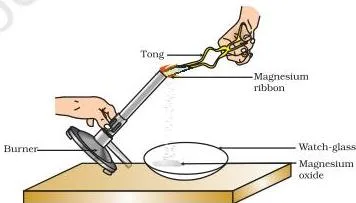
Burning the ribbon in air is the reaction the word equation describes. Because the oxygen atoms differ on the two sides (\( \text{Mg} + \text{O}_2 \rightarrow \text{MgO} \)), that form is a skeletal chemical equation. The balanced form is:
\[ 2\text{Mg} + \text{O}_2 \rightarrow 2\text{MgO} \]
A balanced equation example: zinc with dilute sulphuric acid is balanced as written — every element has equal atoms on both sides (NCERT, p. 3).
\[ \text{Zn} + \text{H}_2\text{SO}_4 \rightarrow \text{ZnSO}_4 + \text{H}_2 \]
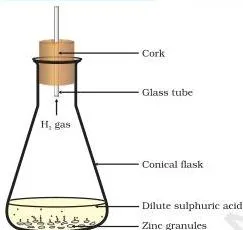
The bubbles in the figure are hydrogen gas — the product written on the right of the equation above.
State symbols: add (s), (l), (g) or (aq) after each formula when the physical state matters. Water used as steam is written \( \text{H}_2\text{O(g)} \) (NCERT, p. 5).
\[ 3\text{Fe(s)} + 4\text{H}_2\text{O(g)} \rightarrow \text{Fe}_3\text{O}_4\text{(s)} + 4\text{H}_2\text{(g)} \]
Conditions on the arrow: temperature, pressure or catalyst can be written above or below the arrow (NCERT, p. 5).
\[ \text{CO(g)} + 2\text{H}_2\text{(g)} \xrightarrow{340\ \text{atm}} \text{CH}_3\text{OH(l)} \]
Photosynthesis shows a condition above the arrow (sunlight) and a catalyst below it (chlorophyll):
\[ 6\text{CO}_2\text{(aq)} + 12\text{H}_2\text{O(l)} \xrightarrow[\text{Chlorophyll}]{\text{Sunlight}} \text{C}_6\text{H}_{12}\text{O}_6\text{(aq)} + 6\text{O}_2\text{(aq)} + 6\text{H}_2\text{O(l)} \]
1.2.1 Combination Reaction
A combination reaction forms a single product from two or more reactants (NCERT, p. 6). The general pattern:
\[ \text{A} + \text{B} \rightarrow \text{AB} \]
Quick lime (calcium oxide) reacts vigorously with water to give slaked lime, releasing a large amount of heat (NCERT, p. 6):
\[ \text{CaO(s)} + \text{H}_2\text{O(l)} \rightarrow \text{Ca(OH)}_2\text{(aq)} + \text{Heat} \]
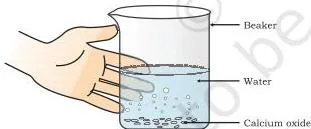
The beaker becomes warm because this combination reaction is also exothermic — heat is released.
Slaked lime solution is used for whitewashing; it reacts with carbon dioxide in air to form a layer of calcium carbonate (NCERT, p. 7):
\[ \text{Ca(OH)}_2\text{(aq)} + \text{CO}_2\text{(g)} \rightarrow \text{CaCO}_3\text{(s)} + \text{H}_2\text{O(l)} \]
Exothermic reactions release heat along with the products. Burning of natural gas and respiration are both exothermic (NCERT, p. 7):
\[ \text{CH}_4\text{(g)} + 2\text{O}_2\text{(g)} \rightarrow \text{CO}_2\text{(g)} + 2\text{H}_2\text{O(g)} \]
\[ \text{C}_6\text{H}_{12}\text{O}_6\text{(aq)} + 6\text{O}_2\text{(aq)} \rightarrow 6\text{CO}_2\text{(aq)} + 6\text{H}_2\text{O(l)} + \text{energy} \]
1.2.2 Decomposition Reaction
A single reactant breaks down into two or more simpler products — the opposite of combination (NCERT, p. 8). Decomposition needs energy as heat, light or electricity, so it is endothermic (NCERT, p. 9).
Thermal decomposition (by heat):
\[ \text{CaCO}_3\text{(s)} \xrightarrow{\text{Heat}} \text{CaO(s)} + \text{CO}_2\text{(g)} \]
\[ 2\text{FeSO}_4\text{(s)} \xrightarrow{\text{Heat}} \text{Fe}_2\text{O}_3\text{(s)} + \text{SO}_2\text{(g)} + \text{SO}_3\text{(g)} \]
Lead nitrate on heating decomposes with the emission of brown fumes of nitrogen dioxide (NCERT, p. 8):
\[ 2\text{Pb(NO}_3)_2\text{(s)} \xrightarrow{\text{Heat}} 2\text{PbO(s)} + 4\text{NO}_2\text{(g)} + \text{O}_2\text{(g)} \]
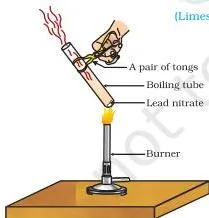
The brown fumes are \( \text{NO}_2 \) — seeing them in a question points straight to this decomposition equation.
Electrolytic decomposition (by electricity): water splits into hydrogen and oxygen. The gas collected in double the amount is hydrogen (NCERT, pp. 9–10).
\[ 2\text{H}_2\text{O(l)} \xrightarrow{\text{Electricity}} 2\text{H}_2\text{(g)} + \text{O}_2\text{(g)} \]
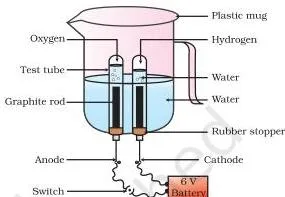
The two test tubes collect the gases in the volume ratio 2 : 1 — hydrogen to oxygen.
Photolytic decomposition (by light): silver chloride and silver bromide decompose in sunlight and are used in black-and-white photography (NCERT, p. 9):
\[ 2\text{AgCl(s)} \xrightarrow{\text{Sunlight}} 2\text{Ag(s)} + \text{Cl}_2\text{(g)} \]
\[ 2\text{AgBr(s)} \xrightarrow{\text{Sunlight}} 2\text{Ag(s)} + \text{Br}_2\text{(g)} \]
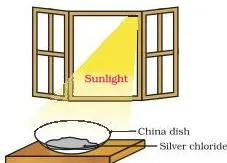
The grey colour is silver metal forming from white silver chloride.
1.2.3 Displacement Reaction
In a displacement reaction, a more reactive element removes a less reactive element from its compound (NCERT, p. 11):
\[ \text{X} + \text{YZ} \rightarrow \text{XZ} + \text{Y} \]
\[ \text{Fe(s)} + \text{CuSO}_4\text{(aq)} \rightarrow \text{FeSO}_4\text{(aq)} + \text{Cu(s)} \]
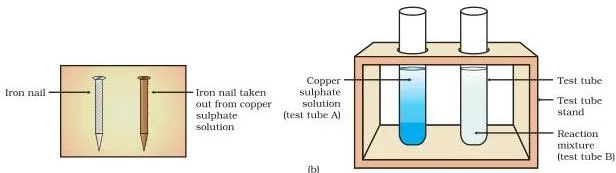
Iron is more reactive than copper, so it displaces copper from copper sulphate solution. The blue colour fades and the nail gains a brownish coating of copper (NCERT, p. 11). Zinc and lead displace copper in the same way.
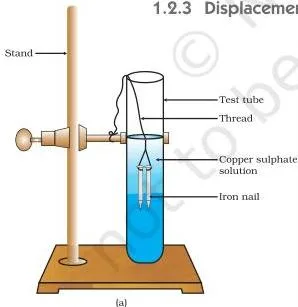
The colour changes that show displacement has occurred are clear when the dipped nail and solution are compared with untouched ones:
Double Displacement and Precipitation Reactions
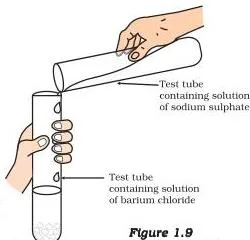
In a double displacement reaction, two compounds exchange ions. When one new product is insoluble, it settles as a precipitate, and the reaction is also called a precipitation reaction (NCERT, p. 11):
\[ \text{AB} + \text{CD} \rightarrow \text{AD} + \text{CB} \]
\[ \text{Na}_2\text{SO}_4\text{(aq)} + \text{BaCl}_2\text{(aq)} \rightarrow \text{BaSO}_4\text{(s)} + 2\text{NaCl(aq)} \]
The white precipitate is barium sulphate, formed by the reaction of \( \text{SO}_4^{2-} \) and \( \text{Ba}^{2+} \) ions; sodium chloride stays dissolved.
1.2.5 Oxidation and Reduction
Oxidation is the gain of oxygen or the loss of hydrogen; reduction is the loss of oxygen or the gain of hydrogen (NCERT, p. 12). The two always occur together — such reactions are called oxidation-reduction or redox reactions.
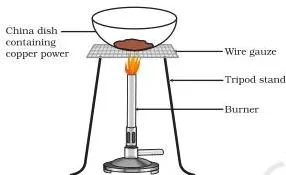
Oxidation example — copper powder turns black on heating because oxygen is added to it (NCERT, p. 12):
\[ 2\text{Cu} + \text{O}_2 \xrightarrow{\text{Heat}} 2\text{CuO} \]
Redox example — CuO loses oxygen (reduced) while H₂ gains oxygen (oxidised) (NCERT, p. 12):
\[ \text{CuO} + \text{H}_2 \xrightarrow{\text{Heat}} \text{Cu} + \text{H}_2\text{O} \]
Everyday applications of oxidation: corrosion (rusting of iron, black coating on silver, green coating on copper) and rancidity (oxidation of fats and oils, which changes their smell and taste). Antioxidants and airtight packing slow oxidation (NCERT, p. 13).
What Each Symbol Means
Every symbol used in the equations above, with its role. Coeffcients are counts; subscripts are also counts — but only coefficients may be changed while balancing.
| Symbol | What it means | Role / unit |
|---|---|---|
| \( \rightarrow \) | Separates reactants (left) from products (right); shows the direction of the reaction | Direction indicator |
| \( + \) | Joins two reactants or two products on the same side | Separator |
| \( \text{(s)} \) | Solid state | State symbol |
| \( \text{(l)} \) | Liquid state | State symbol |
| \( \text{(g)} \) | Gaseous state; \( \text{H}_2\text{O(g)} \) means steam | State symbol |
| \( \text{(aq)} \) | Aqueous — dissolved in water | State symbol |
| Coefficient, e.g. 4 in \( 4\text{H}_2\text{O} \) | Number of formula units of that substance; the only number changed while balancing | Count (whole number) |
| Subscript, e.g. 2 in \( \text{H}_2\text{O} \) | Number of atoms of that element in one formula unit; never changed while balancing | Count (whole number) |
| \( \xrightarrow{\text{Heat}} \) | Reaction carried out by heating — thermal decomposition | Energy supplied |
| \( \xrightarrow{\text{Sunlight}} \) | Reaction carried out in sunlight — photolytic decomposition | Energy supplied |
| \( \xrightarrow{\text{Electricity}} \) | Reaction carried out by electric current — electrolysis | Energy supplied |
| \( \xrightarrow{340\ \text{atm}} \) | Reaction condition (pressure) written over the arrow | Reaction condition |
| \( \xrightarrow[\text{Chlorophyll}]{\text{Sunlight}} \) | Condition (catalyst) below the arrow, energy source above it | Reaction condition |
| \( + \text{Heat} \) or \( + \text{energy} \) on the product side | Heat or energy is released — exothermic reaction | Energy released |
When to Use Each Formula
| Formula or skill | Use it when… | Condition to check |
|---|---|---|
| Word equation | A reaction is given as a sentence and you need its symbolic form | Reactants on the left, products on the right, arrow pointing to products |
| Balancing (hit-and-trial) | Atom counts of any element differ on the two sides | Atoms of every element equal on both sides; never change subscripts |
| State symbols | The question asks for a balanced equation with state symbols | Write (s), (l), (g) or (aq) after every formula |
| Combination pattern \( \text{A} + \text{B} \rightarrow \text{AB} \) | Two or more reactants form a single product | Count the products — exactly one |
| \( \text{CaO} + \text{H}_2\text{O} \rightarrow \text{Ca(OH)}_2 \) | Asked for the reaction of quick lime with water | Reactant is CaO (quick lime); product is Ca(OH)₂ (slaked lime) |
| \( \text{Ca(OH)}_2 + \text{CO}_2 \rightarrow \text{CaCO}_3 \) | Asked about whitewashing walls | Shiny finish is the CaCO₃ layer formed after two to three days |
| Exothermic equations | A reaction releases heat — combustion, respiration | \( + \text{Heat} \) or \( + \text{energy} \) on the product side |
| Thermal decomposition | One reactant breaks into two or more products on heating | Heat written over the arrow; reaction is endothermic |
| Electrolytic decomposition | Decomposition by electricity, such as water | Volume ratio \( \text{H}_2 : \text{O}_2 = 2 : 1 \) |
| Photolytic decomposition | Decomposition by light — silver halides | Sunlight over the arrow; used in black-and-white photography |
| Displacement \( \text{X} + \text{YZ} \rightarrow \text{XZ} + \text{Y} \) | A more reactive element replaces a less reactive one | Reactants are one element and one compound |
| Double displacement \( \text{AB} + \text{CD} \rightarrow \text{AD} + \text{CB} \) | Two compounds exchange ions | Two compounds react and swap their ions |
| Precipitation | An insoluble solid forms when two solutions are mixed | Mark the insoluble product with (s), e.g. BaSO₄ |
| Oxidation / reduction | Identifying oxidised and reduced substances | Gain of O or loss of H = oxidation; loss of O or gain of H = reduction |
Worked Examples
Three skills carry this chapter in exams: balancing an equation, naming the reaction type, and applying the oxidation-reduction rule.
Worked Example 1: Balance the skeletal equation \( \text{Mg} + \text{O}_2 \rightarrow \text{MgO} \)
Step 1: Count atoms on both sides.
Left: Mg = 1, O = 2.
Right: Mg = 1, O = 1.
Oxygen is unequal, so the equation is skeletal.
Step 2: Balance the element with more atoms first — oxygen.
Put coefficient 2 before MgO on the right.
\[ \text{Mg} + \text{O}_2 \rightarrow 2\text{MgO} \]
Step 3: Now magnesium is unbalanced (left 1, right 2).
Put coefficient 2 before Mg on the left.
\[ 2\text{Mg} + \text{O}_2 \rightarrow 2\text{MgO} \]
Step 4: Verify — Mg = 2 on both sides, O = 2 on both sides.
With state symbols: \( 2\text{Mg(s)} + \text{O}_2\text{(g)} \rightarrow 2\text{MgO(s)} \).
Final answer: \( 2\text{Mg} + \text{O}_2 \rightarrow 2\text{MgO} \) — balanced.
Worked Example 2: Identify the type of reaction \( \text{Fe}_2\text{O}_3 + 2\text{Al} \rightarrow \text{Al}_2\text{O}_3 + 2\text{Fe} \)
Step 1: Identify the reactants — one compound (\( \text{Fe}_2\text{O}_3 \)) and one element (Al).
Step 2: The element aluminium replaces iron from its compound.
This fits the displacement pattern \( \text{X} + \text{YZ} \rightarrow \text{XZ} + \text{Y} \), with Al as X, Fe as Y and oxygen as Z.
Final answer: Displacement reaction — aluminium displaces iron from iron oxide.
Worked Example 3: Identify the oxidised and reduced substances in \( \text{CuO} + \text{H}_2 \xrightarrow{\text{Heat}} \text{Cu} + \text{H}_2\text{O} \)
Step 1: Follow the oxygen atoms.
CuO changes to Cu — it loses oxygen.
Step 2: H₂ changes to H₂O — it gains oxygen.
Step 3: Apply the rule: loss of oxygen = reduction; gain of oxygen = oxidation.
Final answer: CuO (and copper in it) is reduced; H₂ is oxidised. Because both occur together, the reaction is a redox reaction.
Practise these skills on the textbook’s own questions in the Chemical Reactions and Equations Class 10 NCERT Solutions.
Common Mistakes to Avoid
| Mistake | Correct rule | How to check your answer |
|---|---|---|
| Changing a subscript while balancing, e.g. writing H₂O₄ instead of 4H₂O | Only coefficients change; every formula stays fixed | Re-count atoms of each element on both sides of your final equation |
| Calling the product of CaO + H₂O “quick lime” | CaO is quick lime; Ca(OH)₂ is slaked lime | In CaO + H₂O → Ca(OH)₂, reactant is quick lime, product is slaked lime |
| Reversing oxidation and reduction | Gain of oxygen (or loss of hydrogen) = oxidation; loss of oxygen (or gain of hydrogen) = reduction | In CuO + H₂ → Cu + H₂O, CuO loses oxygen, so it is reduced |
| Calling double displacement a displacement reaction | Displacement: one element replaces another (X + YZ). Double displacement: two compounds exchange ions (AB + CD) | Count compound reactants — two compounds exchanging ions means double displacement |
| Forgetting state symbols when asked | Write (s), (l), (g) or (aq) after each formula | Does every formula in your answer carry a state symbol? |
| Naming oxygen as the gas collected in double volume in electrolysis of water | Water is H₂O, so hydrogen is produced in double the amount | Volume ratio H₂ : O₂ = 2 : 1 |
| Writing thermal decomposition without the energy condition | Decomposition absorbs energy, so the energy form goes over the arrow | Does your arrow show Heat, Sunlight or Electricity? |
Frequently Asked Questions
1. What is the difference between a skeletal and a balanced chemical equation?
A skeletal chemical equation has unequal numbers of atoms of at least one element on the two sides, for example \( \text{Mg} + \text{O}_2 \rightarrow \text{MgO} \).
A balanced equation has equal numbers of atoms of every element on both sides, for example \( 2\text{Mg} + \text{O}_2 \rightarrow 2\text{MgO} \), so it obeys the law of conservation of mass (NCERT, p. 3).
2. How do I decide which substance is oxidised and which is reduced?
Compare oxygen on the two sides of the equation. The substance that gains oxygen is oxidised; the substance that loses oxygen is reduced. In \( \text{CuO} + \text{H}_2 \rightarrow \text{Cu} + \text{H}_2\text{O} \), CuO loses oxygen so it is reduced, and H₂ gains oxygen so it is oxidised.
3. Why is the amount of gas collected in one test tube double that in the other during electrolysis of water?
Water is \( \text{H}_2\text{O} \) — two hydrogen atoms for every oxygen atom. When it decomposes, hydrogen and oxygen form in the same 2 : 1 atom ratio, so the volume of hydrogen gas collected is double that of oxygen (NCERT, p. 10).
4. Why is respiration considered an exothermic reaction?
Glucose from digested food combines with oxygen in the body’s cells and releases energy: \( \text{C}_6\text{H}_{12}\text{O}_6 + 6\text{O}_2 \rightarrow 6\text{CO}_2 + 6\text{H}_2\text{O} + \text{energy} \). Because energy is released along with the products, respiration is exothermic (NCERT, p. 7).
For revision of other chapters, see the Class 10 Chemistry Formulas collection or browse the full Chemistry Formulas section.
All equations above come from the NCERT Class 10 Science textbook, Chapter 1 — you can verify them in the official NCERT chapter PDF.
Reference: NCERT Class 10 Science textbook, chapter Chemical Reactions and Equations.
Explore Class 10 Chemistry Formulas
More for this chapter:
- Chemical Reactions and Equations Notes
- Chemical Reactions and Equations Important Questions
- Chemical Reactions and Equations MCQ Questions
- Chemical Reactions and Equations Previous Year Questions
- Chemical Reactions and Equations NCERT Solutions
Class 10 Chemistry on LearnCBSE:
Related chapters:
Official source: download the NCERT textbook free from ncert.nic.in.