
What to Expect from This Chapter in the Exam
These chemical reactions class 10 important questions are built for the 2026-27 session and follow the exact skills the NCERT chapter tests, not just definitions to memorise.
Almost every question from this chapter falls into one of three buckets. The first is writing and balancing a chemical equation from a word statement or a skeletal equation (NCERT, p. 2-3). The second is naming the type of reaction — combination, decomposition, displacement, double displacement, or redox (NCERT, p. 6 onward).
The third is applying these ideas to a daily-life situation such as whitewashing, corrosion, or rancidity (NCERT, p. 13).
Boards rarely ask a plain “define combination reaction” question in isolation. They usually attach an equation to it and ask you to balance it, name the type, and sometimes explain the oxidation-reduction happening inside it — all in the same answer.
This page is organised by marks, from 1-mark recall to 5-mark structured answers, so you can practise the exact writing style each mark value expects.
1-Mark Questions (Very Short Answer)
Q1. Why is a magnesium ribbon cleaned with sandpaper before burning it in air?
Answer: Magnesium reacts slowly with moisture and carbon dioxide present in air even at room temperature, forming a thin layer of magnesium oxide or magnesium carbonate on its surface (NCERT, p. 1). This layer coats the metal and prevents it from burning properly in the flame unless it is rubbed off first.
Why this repeats: it checks whether you actually connected Activity 1.1 to a reason, not just memorised “burns with dazzling white flame.” Difficulty: easy.
Q2. Name the reaction in which two or more substances combine to form a single product. Give one example other than magnesium burning in air.
Answer: This is called a combination reaction. Example: calcium oxide reacts with water to form calcium hydroxide.
\[ \text{CaO(s)} + \text{H}_2\text{O(l)} \rightarrow \text{Ca(OH)}_2\text{(aq)} \]
(NCERT, p. 6-7). Why this repeats: it tests the definition alongside a second, non-textbook-headline example, so rote learners who only remember the magnesium case get caught out. Difficulty: easy.
Q3. What is a precipitate? Name the white insoluble compound formed when sodium sulphate solution is mixed with barium chloride solution.
Answer: A precipitate is an insoluble substance that separates out of a solution during a chemical reaction. Mixing sodium sulphate solution with barium chloride solution gives a white precipitate of barium sulphate, along with sodium chloride left in solution (NCERT, p. 11).
\[ \text{Na}_2\text{SO}_4\text{(aq)} + \text{BaCl}_2\text{(aq)} \rightarrow \text{BaSO}_4\text{(s)} + 2\text{NaCl(aq)} \]
Why this repeats: the same reaction doubles as the standard example for both “precipitate” and “double displacement,” so examiners reuse it across question types. Difficulty: moderate.
2-Mark Questions (Short Answer I)
Q4. Balance the skeletal equation \( Al + O_2 \rightarrow Al_2O_3 \) and state whether it is a combination or a decomposition reaction.
- Step 1: Box each formula so you do not accidentally change a subscript while balancing: \(\boxed{Al} + \boxed{O_2} \rightarrow \boxed{Al_2O_3}\).
- Step 2: Count atoms first. Al: 1 on the left, 2 on the right. O: 2 on the left, 3 on the right.
- Step 3: Balance oxygen first since it has the awkward count. LCM of 2 and 3 is 6, so put 3 in front of \(O_2\) and 2 in front of \(Al_2O_3\).
\[ Al + 3O_2 \rightarrow 2Al_2O_3 \]
Step 4: Now Al is unbalanced (1 vs 4).
Put 4 in front of Al on the left.
\[ 4Al + 3O_2 \rightarrow 2Al_2O_3 \]
Step 5: Verify: Al is \(4=4\); O is \(3\times2=6\) on the left and \(2\times3=6\) on the right.
Both match.
Final answer: \(4Al + 3O_2 \rightarrow 2Al_2O_3\) is a combination reaction, since two reactants (aluminium and oxygen) join to give a single product.
Why this pattern repeats: hit-and-trial balancing with an equation you have not seen printed in the textbook is exactly how examiners check whether you understand the method, not just the answer for Mg + O2. Difficulty: moderate.
Q5. Differentiate between exothermic and endothermic reactions with one example each.
Answer: An exothermic reaction releases heat as it proceeds — for example, calcium oxide reacting with water gives out heat: \(CaO(s) + H_2O(l) \rightarrow Ca(OH)_2(aq) + \text{Heat}\) (NCERT, p. 6-7). An endothermic reaction absorbs energy instead — for example, ferrous sulphate crystals need continuous heating to decompose, and the reaction stops the moment heating stops (NCERT, p. 8-9).
Why this repeats: it forces you to give a real chapter example rather than a made-up one, which is where many students lose a mark. Difficulty: easy.
Q6. Why does the blue colour of copper sulphate solution fade when an iron nail is dipped in it? Write the equation.
Answer: Iron is more reactive than copper, so it displaces copper from copper sulphate solution. The blue \(Cu^{2+}\) ions are used up and replaced by pale green \(Fe^{2+}\) ions, so the blue colour fades while the nail gets a brownish coating of deposited copper (NCERT, p. 10, Activity 1.9).
\[ Fe(s) + CuSO_4(aq) \rightarrow FeSO_4(aq) + Cu(s) \]
Why this repeats: it is the chapter’s clearest visual evidence of a displacement reaction, so it gets asked as a “why does this happen” question almost as often as it gets asked as a “balance this equation” question. Difficulty: moderate.
3-Mark Questions (Short Answer II)
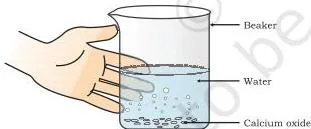
Q7. What happens when calcium oxide reacts with water? Write the balanced equation, name the type of reaction, and state whether it is exothermic or endothermic.
Answer:
- Calcium oxide (quick lime) reacts with water to form calcium hydroxide (slaked lime).
- Equation: \(CaO(s) + H_2O(l) \rightarrow Ca(OH)_2(aq) + \text{Heat}\) (NCERT, p. 6, Activity 1.4).
- It is a combination reaction because two reactants combine to give one product.
- It is exothermic because a large amount of heat is released — you can feel the beaker getting warm during the reaction.
Why this repeats: it is the only reaction in the chapter that lets an examiner test combination-reaction naming and exothermic/endothermic classification together in one short answer. Difficulty: moderate.
Q8. Using the reaction between copper(II) oxide and hydrogen gas, explain oxidation and reduction in terms of gain and loss of oxygen. Identify which substance is oxidised and which is reduced.
Answer:
- Equation: \(CuO + H_2 \xrightarrow{\text{Heat}} Cu + H_2O\) (NCERT, p. 12, Activity 1.11).
- \(CuO\) loses oxygen to become \(Cu\), so copper(II) oxide is reduced.
- \(H_2\) gains oxygen to become \(H_2O\), so hydrogen is oxidised.
- Because oxidation of one substance and reduction of the other happen together, this is called a redox reaction.
Why this repeats: it is the chapter’s reference reaction for defining oxidation and reduction, so almost every board-style question on redox reactions is built around this exact pair of substances. Difficulty: moderate.
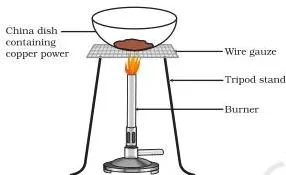
Q9. A shiny brown-coloured element X turns black on heating in air. Identify X, name the black compound formed, and write the balanced equation.
Answer: X is copper. On heating in air, its surface gets coated with black copper(II) oxide (NCERT, p. 12 and p. 16, Exercise Q17).
\[ 2Cu + O_2 \xrightarrow{\text{Heat}} 2CuO \]
Why this repeats: the question describes the observation (colour change) rather than giving the equation directly, so it checks whether you can work backward from an observed colour change to the correct metal and equation. Difficulty: challenging.
5-Mark Questions (Long Answer / Structured)
Q10. Balance the skeletal equation \( Al + CuCl_2 \rightarrow AlCl_3 + Cu \) step by step. Name the reactants and products, state the type of reaction, and identify the element oxidised and the element reduced.
- Step 1: Box each formula: \(\boxed{Al} + \boxed{CuCl_2} \rightarrow \boxed{AlCl_3} + \boxed{Cu}\).
- Step 2: Count atoms. Al: 1 vs 1. Cu: 1 vs 1. Cl: 2 vs 3 — this is the one that is unbalanced.
- Step 3: Balance chlorine first since it gives an awkward 2 vs 3. LCM of 2 and 3 is 6, so put 3 in front of \(CuCl_2\) and 2 in front of \(AlCl_3\).
\[ Al + 3CuCl_2 \rightarrow 2AlCl_3 + Cu \]
Step 4: Now Al is 1 vs 2, and Cu is 3 vs 1.
Put 2 in front of Al on the left and 3 in front of Cu on the right.
\[ 2Al + 3CuCl_2 \rightarrow 2AlCl_3 + 3Cu \]
Step 5: Verify all three elements: Al is \(2=2\); Cl is \(3\times2=6\) on the left and \(2\times3=6\) on the right; Cu is \(3=3\).
Final answer: Balanced equation: \(2Al + 3CuCl_2 \rightarrow 2AlCl_3 + 3Cu\). Reactants are aluminium and copper chloride; products are aluminium chloride and copper. This is a displacement reaction, since aluminium displaces copper from copper chloride. Aluminium is oxidised (it forms a compound, losing its free-element state), and \(Cu^{2+}\) is reduced to metallic copper.
Why this repeats: a 5-mark question that combines balancing, naming reactants/products, classifying the reaction, and identifying oxidation/reduction in one answer is the standard structure examiners use to test whether all four skills sit together in your head, not just one at a time. Difficulty: challenging.
Q11. Describe how you would show, using iron nails and copper sulphate solution, that iron is more reactive than copper. Include the equation, the reaction type, and both colour changes you would observe.
Answer:
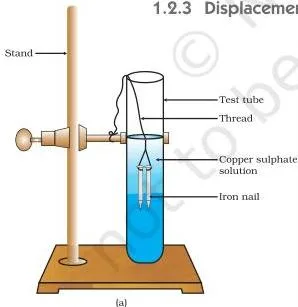
- Clean two iron nails with sandpaper. Tie them with thread and dip them in about 10 mL of copper sulphate solution in one test tube; keep a third, undipped nail aside for comparison.
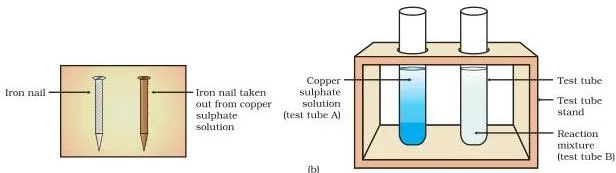
- Leave the dipped nails in the solution for about 20 minutes, then take them out and compare (NCERT, p. 10-11, Activity 1.9).
- Observation 1: the dipped nails turn brownish because copper metal gets deposited on their surface.
- Observation 2: the blue colour of the copper sulphate solution fades because \(Cu^{2+}\) ions are replaced by pale green \(Fe^{2+}\) ions.
- Equation: \(Fe(s) + CuSO_4(aq) \rightarrow FeSO_4(aq) + Cu(s)\).
- This is a displacement reaction. Since iron pushes copper out of the compound, iron must be more reactive than copper.
Why this repeats: this is the chapter’s only activity with a clear before-and-after comparison photograph, so examiners like turning it into a structured, observation-based long answer rather than a plain equation question. Difficulty: moderate.
Why Balancing and Reaction-Type Questions Keep Repeating
The chapter’s own exercise (NCERT, p. 14-16) is built almost entirely around two skills: balancing a skeletal equation, and classifying the reaction it represents. Questions 1-3 are tick-based checks on oxidation/reduction and reaction identification; questions 5-8 are direct balancing-and-naming tasks; questions 9-20 ask you to explain a concept using an equation you write yourself.
That is the same three-step shape used throughout this page — balance first, then classify, then explain the everyday link.
This is an observed pattern in how the chapter’s own exercise is structured, not a prediction of what any specific exam paper will contain. The table below maps each reaction type to how many reactants and products it involves, one example from the chapter, and the marks band where it is commonly asked.
| Reaction type | Reactants | Products | Example from this chapter | Typical marks band |
|---|---|---|---|---|
| Combination | 2 or more | 1 (single product) | \(CaO + H_2O \rightarrow Ca(OH)_2\) | 1, 2, 3 |
| Decomposition | 1 | 2 or more | \(2FeSO_4 \xrightarrow{\text{Heat}} Fe_2O_3 + SO_2 + SO_3\) | 2, 3, 5 |
| Displacement | 1 element + 1 compound | 1 new element + 1 new compound | \(Fe + CuSO_4 \rightarrow FeSO_4 + Cu\) | 2, 3, 5 |
| Double displacement | 2 compounds | 2 new compounds | \(Na_2SO_4 + BaCl_2 \rightarrow BaSO_4 + 2NaCl\) | 1, 2, 3 |
| Redox (oxidation-reduction) | varies | varies | \(CuO + H_2 \rightarrow Cu + H_2O\) | 3, 5 |
If you have already worked through the Class 10 Science notes for the earlier topics, this table is a fast way to check you can place every chapter reaction into its correct row before the exam.
Common Mistakes Students Make in This Chapter
| Mistake | Correct rule | How to check your answer |
|---|---|---|
| Changing a subscript instead of adding a coefficient — e.g. writing \(H_2O_4\) instead of \(4H_2O\) | Only place a whole-number coefficient in front of a formula; never touch the subscripts inside it, since that changes which compound you are writing (NCERT, p. 4) | Read each formula in your balanced equation aloud — if any formula is not a real, recognisable compound, you have edited a subscript by mistake |
| Confusing oxidation with reduction | Gain of oxygen = oxidised; loss of oxygen = reduced. Use the mnemonic OIL RIG — Oxidation Is Loss, Reduction Is Gain — of oxygen, in this chapter’s sense (NCERT, p. 12) | For each substance, ask: did it end up with more oxygen atoms or fewer, compared to before the reaction? |
| Mixing up displacement and double displacement | Displacement: one element replaces another element inside a compound. Double displacement: two compounds swap ions, usually producing a precipitate (NCERT, p. 11) | Count the reactants — one element plus one compound means displacement; two compounds reacting means double displacement |
How to Revise This Chapter the Night Before the Exam
Follow this sequence rather than re-reading the whole chapter passively:
- Write out, from memory, the six core equations of this chapter: \(Mg + O_2\), \(CaO + H_2O\), the decomposition of \(FeSO_4\), \(Fe + CuSO_4\), \(Na_2SO_4 + BaCl_2\), and \(CuO + H_2\). Then check each one against the equations on this page.
- For each equation, say out loud: the reactants, the products, their physical states, and the type of reaction. This forces you to connect the equation to its classification instead of memorising them separately.
- Attempt one fresh 5-mark balancing question with an equation you have not seen before, like Q10 above. If you can balance it without looking, you understand the hit-and-trial method rather than a memorised answer.
- Re-read the “What you have learnt” summary on page 14 of the NCERT textbook as a final checklist before closing the book.
Once this chapter feels settled, moving to the Acids, Bases and Salts important questions page keeps the revision going, since several equation-balancing habits carry over directly into that chapter.
For a wider view of what else is due for revision this term, the Class 10 revision notes section and the general CBSE notes index are useful starting points. If you want to cross-check any equation against the original text, the official NCERT Class 10 Science textbook, Chapter 1 is the source this page is built from.
FAQs on Chemical Reactions and Equations
Is respiration really an exothermic reaction if we don’t feel our body releasing heat?
Yes, chemically it is exothermic. When glucose combines with oxygen inside body cells, energy is released along with carbon dioxide and water (NCERT, p. 7). You do not feel this as obvious heat because the energy is used continuously for body functions rather than being given off all at once.
Why is the iron nail and copper sulphate reaction called displacement and not double displacement?
Because only one element, iron, is replacing another element, copper, inside a single compound (copper sulphate). Double displacement needs two compounds exchanging ions with each other, which is not the case here (NCERT, p. 10-11).
Do I have to write state symbols like (s), (l), (g), (aq) in every balanced equation in the board exam?
The NCERT text notes that state symbols are usually included only when it is necessary to specify them, not in every single equation. If a question specifically asks for state symbols, or if leaving them out would make the equation ambiguous, include them; otherwise a correctly balanced equation without state symbols is still complete.
What is the difference between rusting, corrosion, and rancidity — are they the same thing?
No. Rusting is the specific reddish-brown coating that forms on iron. Corrosion is the broader term for any metal being attacked by substances around it, such as moisture or acids — the green coating on copper and the black coating on silver are also corrosion (NCERT, p. 13).
Rancidity is unrelated to metals; it is the oxidation of fats and oils in food, which changes their smell and taste.
Why does silver chloride turning grey in sunlight count as a decomposition reaction if no heat is involved?
A decomposition reaction just needs energy to break a single reactant into simpler products — that energy can come from heat, light, or electricity (NCERT, p. 9). Silver chloride absorbs light energy and decomposes into silver and chlorine, which is why it turns grey; this reaction is also the basis of black-and-white photography.
How is the reaction between aluminium and iron oxide both a displacement and a redox reaction?
When aluminium reacts with iron(III) oxide, aluminium takes the place of iron in the compound, giving aluminium oxide and free iron — that makes it a displacement reaction. At the same time, aluminium gains oxygen (it is oxidised) while iron oxide loses oxygen (it is reduced), so the same reaction is also a redox reaction.
A reaction can belong to more than one category depending on which feature you are describing.
Reference: NCERT Class 10 Science textbook, chapter Chemical Reactions and Equations.
Explore Class 10 Science Important Questions
- Class 10 Science Important Questions
- Class 10 Important Questions
- CBSE Important Questions for Classes 1 to 12
- Chemical Reactions and Equations Notes
- Chemical Reactions and Equations Formulas
- Chemical Reactions and Equations MCQ Questions
- Chemical Reactions and Equations Previous Year Questions
- Chemical Reactions and Equations NCERT Solutions
Class 10 Science on LearnCBSE:
Related chapters: