These NCERT solutions for Class 10 Science Chapter 4 cover every intext question and every exercise question from Carbon and its Compounds, verified line-by-line against the official NCERT textbook (2026-27 session). You will find electron-dot structures, covalent bonding reasoning, IUPAC naming steps, reaction equations, and the mechanisms behind soaps and detergents — all explained concept-first, not merely answer-keyed.
This chapter asks you to do three things: draw structures, name compounds using IUPAC rules, and explain why carbon behaves the way it does. Each solution below opens with the principle at work, then walks through the steps, then flags the common error that costs students marks.
The official NCERT Class 10 Science textbook PDF for Chapter 4 lets you check any question against the source text page by page. For broader revision, see our Class 10 Science notes hub and the main Class 10 notes index.
Covalent Bonding and Electron Dot Structures (Intext p.61)
Covalent bonds form when atoms share valence electrons so that each atom achieves a stable noble-gas configuration. Carbon, with four valence electrons, cannot gain or lose four electrons — the energy cost is too high — so it shares. The electron-dot structure shows only the outermost-shell electrons as dots around each atom’s symbol; shared pairs sit between the two bonded atoms.
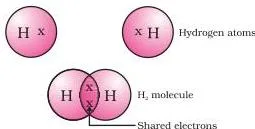
The hydrogen molecule above shows the simplest covalent bond: two H atoms share one electron pair to give each a filled K shell. Apply the same dot-sketching method to CO₂ and S₈ below.
Question 1: What would be the electron dot structure of carbon dioxide which has the formula CO2?
Step 1 — Identify the central atom.
Carbon appears once in the formula; oxygen appears twice.
The atom that appears once goes in the middle, so carbon is central.
A common error is placing carbon at the end (O-C-O), which cannot give both oxygens octets.
Step 2 — Count valence electrons.
Carbon has 4 valence electrons; each oxygen has 6.
Total valence electrons: \( 4 + 6 \times 2 = 16 \).
Step 3 — Determine bond type.
Each oxygen needs 2 more electrons to complete its octet.
Carbon needs 4.
If only single bonds were used, carbon would have 4 shared electrons (not 8) and each oxygen would have only 2 shared electrons (not 8).
So carbon must form double bonds with both oxygens: O=C=O.
Each double bond is two shared electron pairs.
\[ \ddot{\text{O}} {=} {\cdot}{\underset{\displaystyle \cdot}{\text{C}}}{\cdot} {=} \ddot{\text{O}} \]
Step 4 — Verify octets.
Carbon shares 4 electrons with each oxygen (2 from each double bond) → 8 electrons around carbon.
Each oxygen shares 4 electrons with carbon plus has 4 non-bonding electrons → 8 electrons around each oxygen.
All octets satisfied.
Final answer: The electron-dot structure of CO₂ is O=C=O, with carbon central and double bonds to each oxygen, giving each atom a complete octet.
Common error: Students place carbon at the end of CO₂ (writing O-O-C or similar). The rule is: the atom that appears once in the formula is the central atom. In CO₂, carbon appears once → carbon goes in the centre.
Question 2: What would be the electron dot structure of a molecule of sulphur which is made up of eight atoms of sulphur? (Hint – The eight atoms of sulphur are joined together in the form of a ring.)
Step 1 — Recall sulphur’s valency.
Sulphur (atomic number 16) has the electronic configuration 2, 8, 6 — six valence electrons.
It needs 2 more electrons to complete its octet, so it forms two single covalent bonds.
Step 2 — Arrange eight atoms in a ring.
The question gives the hint: the eight sulphur atoms form a ring (crown shape, S₈).
Each sulphur bonds to its two neighbours, one on each side.
Step 3 — Place the electron dots.
Each sulphur shares one electron pair with the sulphur to its left and one with the sulphur to its right.
The remaining four valence electrons on each sulphur appear as two lone pairs.
\[ \text{Ring of 8 S atoms: each S bonded to two neighbours by single bonds, with 2 lone pairs per S.} \]
Final answer: Eight sulphur atoms form a ring (crown-shaped S₈ molecule). Each sulphur shares one electron pair with each of its two neighbours; the remaining four electrons on each sulphur sit as two lone pairs. All atoms achieve complete octets.
Common error: Students draw a straight chain of eight S atoms instead of a ring. The hint in the question is explicit — use it.
Isomers, Nomenclature and Carbon Skeletons (Intext p.68)
Carbon’s versatility comes from two abilities: catenation (forming chains and rings with other carbon atoms) and tetravalency (bonding with four other atoms). Together these produce millions of compounds. Structural isomers arise when the same molecular formula fits two or more different carbon skeletons — the atoms are connected differently.
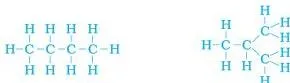
The figure above shows two different carbon skeletons — a straight chain and a branched chain — that share the same molecular formula C₄H₁₀. These are structural isomers: same formula, different connectivity. The same principle applies to the pentane isomers you draw in Question 1 below.
Question 1: How many structural isomers can you draw for pentane?
Principle: Pentane has the molecular formula C₅H₁₂.
Structural isomers differ in how the five carbon atoms are connected — straight chain versus branching at different positions.
Each distinct carbon skeleton gives one isomer.
Isomer 1 — n-pentane (straight chain): All five carbons in a single line: CH₃-CH₂-CH₂-CH₂-CH₃.
Isomer 2 — isopentane (2-methylbutane, branched): Four carbons in a chain with a methyl branch on carbon-2: CH₃-CH(CH₃)-CH₂-CH₃.
Isomer 3 — neopentane (2,2-dimethylpropane, highly branched): A central carbon bonded to four methyl groups: C(CH₃)₄.
Final answer: Pentane (C₅H₁₂) has three structural isomers: n-pentane (straight chain), isopentane (2-methylbutane, one branch), and neopentane (2,2-dimethylpropane, central carbon with four methyl groups).
Common error: Students confuse isopentane and neopentane. In isopentane, one methyl branch sits on carbon-2 of a four-carbon chain. In neopentane, the central carbon carries four methyl groups — there is no long chain at all. Check the branching position before naming.
Question 2: What are the two properties of carbon which lead to the huge number of carbon compounds we see around us?
Principle: Carbon’s enormous compound count comes from two structural features that work together — not one alone.
Property 1 — Catenation: Carbon atoms bond to other carbon atoms, forming long chains, branched chains, and rings.
The carbon–carbon bond is strong and stable, so these chains persist.
No other element catenates as extensively (silicon forms chains of only 7–8 atoms, and those are very reactive).
Property 2 — Tetravalency: Carbon has four valence electrons, so it bonds with four other atoms simultaneously.
This lets carbon combine with hydrogen, oxygen, nitrogen, sulphur, chlorine, and many other elements, producing compounds with vastly different properties.
Carbon’s small size means its nucleus holds shared electrons tightly, making its bonds strong and stable.
Final answer: The two properties are (i) catenation — the ability to form chains and rings with other carbon atoms — and (ii) tetravalency — the capacity to bond with four other atoms, allowing diverse combinations with many elements.
Common error: Listing “catenation” alone and forgetting tetravalency. Both are required — catenation builds chains, tetravalency fills those chains with different heteroatoms. Mention both with one line each on why each matters.
Question 3: What will be the formula and electron dot structure of cyclopentane?
Principle: A cycloalkane is a saturated ring.
Each carbon in the ring bonds to two neighbouring carbons and two hydrogens.
The general formula for cycloalkanes is CₙH₂ₙ — two fewer hydrogens than the open-chain alkane CₙH₂ₙ₊₂, because the ring closes by forming one extra C-C bond in place of two C-H bonds.
Step 1 — Write the formula.
For cyclopentane, n = 5.
Using CₙH₂ₙ: C₅H₁₀.
Step 2 — Draw the ring.
Five carbon atoms form a closed pentagonal ring, each bonded to its two neighbours by single bonds.
Each carbon also carries two hydrogen atoms (two lone pairs of dots, one per H shared with C).
Step 3 — Verify octets.
Each carbon makes 2 bonds to C neighbours + 2 bonds to H → 4 bonds → octet satisfied.
Each H shares 1 pair → 2 electrons = filled K shell.
\[ \text{Cyclopentane: ring of 5 C atoms, each C bonded to 2 C neighbours and 2 H atoms. Formula: } C_5 H_{10} \]
Final answer: The formula of cyclopentane is C₅H₁₀. The electron-dot structure shows a five-membered ring of carbon atoms, each carbon sharing single bonds with its two neighbouring carbons and with two hydrogen atoms.
Common error: Writing C₅H₁₂ (the open-chain formula). A ring loses two hydrogens compared to the open chain because the two end carbons that would carry a third H now bond to each other. Always use CₙH₂ₙ for cycloalkanes.
Question 4: Draw the structures for the following compounds.
(i) Ethanoic acid
(ii) Bromopentane*
(iii) Butanone
(iv) Hexanal.
*Are structural isomers possible for bromopentane?
Principle: Each name encodes the carbon chain length (meth-, eth-, prop-, but-, pent-, hex-) and the functional group (suffix).
Draw the longest carbon chain first, then attach the functional group at the position that gives the lowest locant.
Part (i) — Ethanoic acid: “Eth-” = 2 carbons; “-oic acid” = carboxylic acid group (—COOH) on carbon-1.
Structure: CH₃—COOH (the carbon of —COOH is one of the two chain carbons).
\[ \text{CH}_3 – \text{COOH} \quad \text{(the —COOH carbon is C1)} \]
Part (ii) — Bromopentane: “Pent-” = 5 carbons; “bromo-” = a —Br replacing one hydrogen.
The bromine can sit on different carbons: C1, C2, or C3 (C4 is equivalent to C2 by symmetry, C5 to C1).
Each gives a distinct structure: CH₂Br-CH₂-CH₂-CH₂-CH₃ (1-bromopentane), CH₃-CHBr-CH₂-CH₂-CH₃ (2-bromopentane), or CH₃-CH₂-CHBr-CH₂-CH₃ (3-bromopentane).
\[ \text{1-bromopentane: BrCH}_2\text{CH}_2\text{CH}_2\text{CH}_2\text{CH}_3 \]
Part (iii) — Butanone: “But-” = 4 carbons; “-one” = ketone (C=O between two carbons).
The ketone carbon must have hydrocarbon chains on both sides, so it sits at C2 (if it were at C1, it would be an aldehyde, not a ketone).
Structure: CH₃—CO—CH₂—CH₃ (methyl ethyl ketone).
\[ \text{CH}_3 – \overset{\displaystyle ||}{\underset{\displaystyle O}{C}} – \text{CH}_2 – \text{CH}_3 \]
Part (iv) — Hexanal: “Hex-” = 6 carbons; “-al” = aldehyde (—CHO at the chain end, carbon-1).
Structure: CH₃—CH₂—CH₂—CH₂—CH₂—CHO, where —CHO is the terminal aldehyde.
\[ \text{CH}_3\text{CH}_2\text{CH}_2\text{CH}_2\text{CH}_2\text{CHO} \quad (\text{—CHO at C1, five CH}_2\text{/CH}_3\text{ carbons complete the chain}) \]
Starred question — are structural isomers possible for bromopentane?
Yes.
The bromine can occupy positions 1, 2, or 3 on the five-carbon chain.
Position 4 mirrors position 2, and position 5 mirrors position 1 (numbering from the other end), so only three distinct position isomers exist: 1-bromopentane, 2-bromopentane, and 3-bromopentane.
Branching the carbon chain itself (e.g. 1-bromo-2-methylbutane) adds further isomers.
Final answer: (i) CH₃COOH; (ii) Br-CH₂CH₂CH₂CH₂CH₃ (or 2-/3- bromopentane positional isomers); (iii) CH₃COCH₂CH₃; (iv) CH₃CH₂CH₂CH₂CH₂CHO. Yes — bromopentane has structural isomers (positional: 1-, 2-, 3-bromopentane; plus chain-branching isomers).
Common error: For butanone, students place the ketone carbon at the chain end (CHO). A ketone must sit between two carbon atoms; if C=O is at an end with an H attached, it is an aldehyde, not a ketone. Always check that the functional group matches the suffix.
Question 5: How would you name the following compounds?
(i) CH₃—CH₂—Br
(ii) H—C=O
(iii) H—C—C—C—C—C=C—H
Principle: IUPAC naming follows four steps: identify the longest carbon chain, locate the functional group (use the lowest possible number), apply the prefix or suffix (see Method Recap table), and adjust for any unsaturation (replace “ane” with “ene” or “yne”).
Part (i) — CH₃—CH₂—Br: Two carbons (ethane backbone).
The bromine replaces one hydrogen → prefix “bromo.”
Number from the end nearest the Br, so Br is on carbon-1.
Name: 1-bromoethane (commonly called bromoethane).
\[ \text{CH}_3\text{CH}_2\text{Br} \rightarrow \text{bromoethane (bromo on C1)} \]
Part (ii) — H—C=O: One carbon atom with a —CHO group at the chain terminus.
The suffix for aldehyde is “-al.”
A single-carbon aldehyde is named after “methane” with “e” dropped and “al” added → methanal (commonly called formaldehyde).
\[ \text{H—C(=O)—H} \rightarrow \text{methanal} \]
Part (iii) — a six-carbon chain with a C=C double bond: Count the carbons: six total (prefix “hex”).
The C=C double bond uses the suffix “-ene,” replacing “ane.”
Number the chain so the double bond gets the lowest locant — counting from the right end places the double bond between C1 and C2 → locant 1.
Name: hex-1-ene (or 1-hexene).
\[ \text{Six C chain with one C=C bond nearest to one end} \rightarrow \text{hex-1-ene} \]
Final answer: (i) Bromoethane (1-bromoethane); (ii) Methanal (formaldehyde); (iii) Hex-1-ene (or 1-hexene).
Worked naming example you can reuse: Take 2-pentanone. Step 1 — Identify the chain: five carbons = “pent-.” Step 2 — Find the functional group: “-one” = ketone (C=O between two carbons); it sits at C2. Step 3 — Apply the suffix: pentane → drop “e” → pentan- → add “one” → pentan-2-one (or 2-pentanone). Step 4 — Check saturation: no double or triple bonds, so “ane” base stays.
This four-step method works for any compound the chapter names.
Oxidation, Combustion and Ethyne Reactions (Intext p.71)
Carbon compounds undergo several reaction types — combustion, oxidation, addition, substitution, esterification. Two questions here test whether you understand why a reaction counts as oxidation and why a specific reactant mixture is chosen for welding. Both hinge on oxygen’s role.
Question 1: Why is the conversion of ethanol to ethanoic acid an oxidation reaction?
Principle: In organic chemistry, oxidation is defined as the addition of oxygen to a substance (or removal of hydrogen).
The conversion of ethanol (CH₃CH₂OH) to ethanoic acid (CH₃COOH) adds an oxygen atom to the carbon chain and removes two hydrogen atoms — both signatures of oxidation.
Step 1 — Compare the two formulas: Ethanol is CH₃—CH₂—OH; ethanoic acid is CH₃—COOH.
The —CH₂OH group (which has one C, one O, and three H) becomes —COOH (one C, two O, and one H).
Net change: one oxygen added, two hydrogens removed.
Step 2 — Name the oxidising agents.
This conversion does not happen on its own — it needs an oxidising agent that supplies the oxygen.
The two reagents covered in the NCERT chapter are alkaline potassium permanganate (KMnO₄) and acidified potassium dichromate (K₂Cr₂O₇), both used with heat.
\[ \text{CH}_3\text{CH}_2\text{OH} \xrightarrow[\text{or acidified K}_2\text{Cr}_2\text{O}_7\text{, heat}]{\text{Alkaline KMnO}_4\text{, heat}} \text{CH}_3\text{COOH} \]
Step 3 — Why “oxidation” is the right label.
The oxidising agent supplies oxygen to the ethanol and is itself reduced in the process.
Because oxygen is being added to the organic molecule, the textbook classifies this reaction as oxidation.
Final answer: The conversion of ethanol to ethanoic acid is an oxidation reaction because oxygen is added to the ethanol molecule (and hydrogen is removed) in the presence of an oxidising agent such as alkaline KMnO₄ or acidified K₂Cr₂O₇, both heated.
Common error: Saying “because oxidising agents are used” without naming the reagents or explaining what oxidation means. State the definition (addition of oxygen) AND name at least one oxidising agent for full marks.
Question 2: A mixture of oxygen and ethyne is burnt for welding. Can you tell why a mixture of ethyne and air is not used?
Principle: Welding needs a flame hot enough to melt metals.
The flame temperature depends on how completely the fuel burns and how much of the reacting gas is actually oxygen.
Step 1 — What “air” contains.
Air is roughly 78% nitrogen and only about 21% oxygen.
When ethyne burns in air, nitrogen acts as an inert diluent — it absorbs heat but contributes nothing to combustion.
Step 2 — Consequence for flame temperature.
Because nitrogen soaks up heat, the effective flame temperature of ethyne-air is much lower than ethyne-pure-oxygen.
That temperature is too low to melt steel for welding.
Step 3 — What pure oxygen achieves.
Pure oxygen provides enough oxidant for complete combustion of ethyne to CO₂ and H₂O, releasing the maximum heat the fuel can give.
The oxy-acetylene flame reaches approximately 3000°C — high enough to melt and join metals.
Final answer: Air is about 78% nitrogen, which dilutes the oxygen. When ethyne burns in air, nitrogen absorbs a large part of the heat, so the flame temperature is too low to weld metals. Pure oxygen ensures complete combustion and a much higher flame temperature, which is why an oxygen-ethyne mixture (not air-ethyne) is used for welding.
Common error: Students argue “air contains oxygen, so it should work.” The point is dilution — the 78% nitrogen in air wastes the heat. Always explain why the diluent matters, not just that oxygen is present.
Distinguishing Alcohols and Carboxylic Acids (Intext p.74)
Alcohols and carboxylic acids both contain oxygen, both contain —OH groups, and both are liquids at room temperature. To distinguish them you use a chemical test that exploits the one structural difference: the carboxylic acid has a proton it can release, while an alcohol does not.
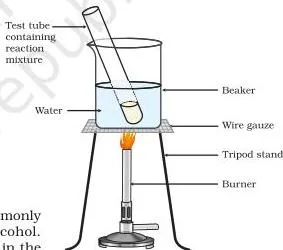
The esterification reaction shown above is one distinguishing chemical property — only the carboxylic acid (ethanoic acid) participates as the acid partner. The two intext questions below ask for simpler diagnostic tests and for a definition of oxidising agents.
Question 1: How would you distinguish experimentally between an alcohol and a carboxylic acid?
Principle: A carboxylic acid releases H⁺ ions in water; an alcohol does not.
Any test that detects that proton release will distinguish them.
The two tests below rely on visible or gas-evolution observations.
Test (a) — Sodium carbonate / sodium hydrogen carbonate test: Add a small amount of sodium carbonate (Na₂CO₃) or sodium hydrogen carbonate (NaHCO₃) to each sample.
A carboxylic acid reacts to produce carbon dioxide gas (brisk effervescence).
An alcohol does not react — no effervescence.
\[ 2\text{CH}_3\text{COOH} + \text{Na}_2\text{CO}_3 \rightarrow 2\text{CH}_3\text{COONa} + \text{H}_2\text{O} + \text{CO}_2 \uparrow \]
Test (b) — Litmus test: Dip blue litmus paper into each sample.
A carboxylic acid turns blue litmus red (because it releases H⁺ ions).
An alcohol does not change the colour of blue litmus (it is neutral).
| Test | Carboxylic acid (ethanoic acid) | Alcohol (ethanol) |
|---|---|---|
| Na₂CO₃ / NaHCO₃ | Effervescence (CO₂ evolved) | No reaction |
| Blue litmus paper | Turns red | Remains blue (no change) |
Final answer: Two experimental tests: (a) Add sodium carbonate or sodium hydrogen carbonate — the carboxylic acid gives brisk effervescence due to CO₂; the alcohol gives no reaction. (b) Test with litmus — blue litmus turns red in a carboxylic acid and stays blue in an alcohol.
Common error: Writing “add oxygen” or just “carboxylic acid is acidic” without naming the reagent or stating the observation (effervescence, CO₂, litmus colour change). Always name the reagent AND the visible result.
Question 2: What are oxidising agents?
Principle: An oxidising agent is a substance that supplies oxygen to another substance (or removes hydrogen from it).
In doing so, the oxidising agent itself gets reduced.
Examples: The two oxidising agents you meet in this chapter are alkaline potassium permanganate (KMnO₄) and acidified potassium dichromate (K₂Cr₂O₇).
Both convert ethanol to ethanoic acid by adding oxygen to the organic molecule.
Final answer: Oxidising agents are substances that supply oxygen to other substances (or remove hydrogen from them), thereby oxidising them. Examples from this chapter: alkaline KMnO₄ and acidified K₂Cr₂O₇, both used to oxidise ethanol to ethanoic acid.
Common error: Writing only “substances that oxidise” — that is circular. Say what they do (supply oxygen) and give the two named examples from this chapter.
Soaps, Detergents and Hard Water (Intext p.78)
Soaps and detergents clean by a structural trick: one end of the molecule dissolves in oil, the other end dissolves in water. Hard water throws a spanner in the works for soap but not for detergent — and that difference is the key exam distinction the two questions below test.
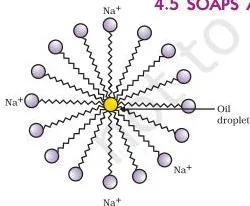
The micelle diagram above shows how soap molecules cluster in water: the hydrophobic (water-repelling) tails point inward and trap the oil droplet, while the hydrophilic (water-loving) ionic heads face outward into the water. This structure is the basis of both questions below.
Question 1: Would you be able to check if water is hard by using a detergent?
Principle: Hardness in water is caused by dissolved calcium (Ca²⁺) and magnesium (Mg²⁺) ions.
Soap reacts with these ions to form an insoluble curdy precipitate called scum, visible and unmistakable.
Detergent does not form scum because its charged ends stay soluble even in the presence of calcium and magnesium ions — that is the whole point of detergent.
Step 1 — Why the usual soap test works.
Shake soap solution with the water sample.
Soft water produces a good lather.
Hard water produces little lather and a white curdy scum.
The scum is a visible signal of hardness.
Step 2 — Why detergent fails the same test.
Detergent molecules’ ionic ends do not form insoluble precipitates with Ca²⁺ or Mg²⁺.
So detergent lathers in both hard and soft water, with no visible scum.
Because the outcome is the same in both types of water, you cannot tell from the detergent test which is which.
Final answer: No. Detergent does not form insoluble scum with the calcium and magnesium ions that make water hard — it lathers in both hard and soft water. Because there is no visible difference between the two, detergent cannot be used to check whether water is hard.
Soap, which forms scum in hard water but not in soft water, is the correct test reagent.
Common error: Students write “detergent forms scum in hard water.” It does NOT — that is the defining difference between soap and detergent. Detergent works in hard water precisely because it does not precipitate. This is the key exam distinction: soap forms scum, detergent does not.
Question 2: People use a variety of methods to wash clothes. Usually after adding the soap, they ‘beat’ the clothes on a stone, or beat it with a paddle, scrub with a brush or the mixture is agitated in a washing machine. Why is agitation necessary to get clean clothes?
Principle: Soap works by forming micelles around oily dirt.
The hydrophobic tail of each soap molecule embeds in the oil; the hydrophilic head faces the water.
But the micelle is only half the job — the oil-in-micelle droplet still has to be dislodged from the fabric surface so the rinse water can carry it away.
Step 1 — Micelles trap the oil.
When soap is added to water, the molecules cluster around the oily dirt with their hydrocarbon tails pointing into the oil and their ionic heads facing the water.
The oil is now encased in a water-soluble shell.
Step 2 — Agitation breaks the oil-fabric bond.
The oily dirt adheres to the cloth fibres.
Beating, scrubbing, or machine agitation provides the mechanical energy that physically detaches the micelle-entrapped oil from the fabric.
Step 3 — Rinse removes the detached dirt.
Once the micelle-oil cluster is free of the fabric, the flowing rinse water washes it away.
Without agitation, the micelles stay stuck to the cloth and the dirt is never actually removed.
Final answer: Agitation is necessary because soap micelles trap the oily dirt but do not by themselves pull it off the fabric. Beating, scrubbing, or machine-agitation supplies the mechanical force that dislodges the micelle-encased oil droplets from the cloth, after which the rinse water carries them away.
Without agitation, the oil stays attached to the fabric even though it is surrounded by soap.
Common error: Answering “so that soap dissolves.” Agitation has nothing to do with dissolving soap — it removes the dirt, not the soap. The sequence is: trap → dislodge → rinse; agitation provides the dislodge step.
Exercise MCQs: Covalent Bonds, Functional Groups, Combustion (Q1–Q3)
The first three exercise questions are multiple-choice. They test three separate ideas — counting covalent bonds in a saturated hydrocarbon, identifying the functional group from a name, and interpreting the visible sign of incomplete combustion.
Question 1: Ethane, with the molecular formula C2H6 has
(a) 6 covalent bonds.
(b) 7 covalent bonds.
(c) 8 covalent bonds.
(d) 9 covalent bonds.
Principle: A covalent bond is one shared pair of electrons.
To count the total covalent bonds in a molecule, draw the structural formula and count every line — each single bond is one shared pair, each double bond is two.
Step 1 — Draw ethane.
Ethane (C₂H₆) has two carbon atoms joined by a single C–C bond and six C–H bonds (three on each carbon).
Step 2 — Count each bond.
1 C–C bond + 6 C–H bonds = 7 covalent bonds.
| Bond type | Number in ethane |
|---|---|
| C–C | 1 |
| C–H | 6 |
| Total | 7 |
Why the other options are wrong: (a) 6 counts only the C–H bonds and forgets the C–C bond; (c) 8 adds one extra bond that does not exist; (d) 9 would require an impossible structure for C₂H₆.
\[ H – \overset{\displaystyle H}{\underset{\displaystyle H}{C}} – \overset{\displaystyle H}{\ underset{\displaystyle H}{C}} – H \quad \Rightarrow \quad 1\text{ C–C} + 6\text{ C–H} = 7\text{ covalent bonds} \]
Correct answer: (b) 7 covalent bonds.
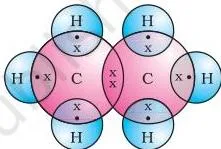
Common error: Counting only the six C–H bonds and forgetting the one C–C bond. Always draw the structure first — then count each line, including the carbon-carbon backbone bond — to reach 7.
Question 2: Butanone is a four-carbon compound with the functional group
(a) carboxylic acid.
(b) aldehyde.
(c) ketone.
(d) alcohol.
Principle: The suffix of an IUPAC name identifies the functional group.
“-one” is the suffix for a ketone, which is a carbonyl group (C=O) bonded to two carbon atoms.
Why (c) is correct: “Butanone” = “but-” (four carbons) + “-one” (ketone).
The functional group is a C=O group flanked by two carbon chains.
The structure is CH₃—CO—CH₂—CH₃.
Why the other options are wrong: (a) carboxylic acid would be named butanoic acid (suffix “-oic acid”); (b) aldehyde would be butanal (suffix “-al”); (d) alcohol would be butanol (suffix “-ol”).
Each functional group has its own suffix — matching the suffix gives the answer.
Correct answer: (c) ketone.
Common error: Confusing “-one” (ketone) with “-ol” (alcohol) or “-al” (aldehyde). Memorise the suffix-to-group table in the Method Recap section — it prevents this slip entirely.
Question 3: While cooking, if the bottom of the vessel is getting blackened on the outside, it means that
(a) the food is not cooked completely.
(b) the fuel is not burning completely.
(c) the fuel is wet.
(d) the fuel is burning completely.
Principle: When a hydrocarbon fuel burns with insufficient oxygen, it undergoes incomplete combustion.
The unburnt carbon deposits as black soot on surfaces near the flame — exactly what you see on the bottom of a cooking vessel.
Why (b) is correct: If the fuel burned completely, it would produce only CO₂ and H₂O — no soot.
Sooty blackening means the air supply is blocked (soot-creating incomplete combustion).
The chapter explicitly connects a blocked gas-stove air inlet to soot deposition.
Why the other options are wrong: (a) is about food doneness, not the vessel exterior; (c) wet fuel would stop a flame, not make soot; (d) complete combustion produces a clean blue flame with no deposit, the opposite of what the question describes.
Correct answer: (b) the fuel is not burning completely.
Common error: Choosing (c) — assuming wet fuel causes blackening. The real cause is insufficient air, which means incomplete combustion. The sooty deposit is carbon that did not get fully oxidised.
Covalent Bond Nature and Electron Dot Structures (Q4–Q5)
These two questions revisit the covalent bond from first principles and ask you to apply the dot-structure method to four different molecules — a carboxylic acid, an inorganic hydride, a ketone, and a diatomic halogen.
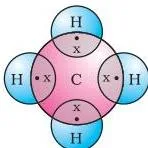
The methane dot-structure above is your template: the carbon shares one electron pair with each of four hydrogens. The same drawing logic extends to CH₃Cl and to the four molecules in Question 5.
Question 4: Explain the nature of the covalent bond using the bond formation in CH3Cl.
Principle: A covalent bond forms when two atoms share a pair of electrons, with one electron contributed by each atom.
The shared pair counts towards the outermost shell of both atoms, letting each reach a noble-gas configuration.
Carbon’s tetravalency lets it share with up to four atoms at once.
Step 1 — Identify valencies.
Carbon has 4 valence electrons, hydrogen has 1, chlorine has 7.
Each H needs 1 more electron; Cl needs 1 more electron; C needs 4 more electrons.
Step 2 — Share to complete octets.
Carbon shares one electron pair with each of three H atoms (3 shared pairs) and one electron pair with one Cl atom (1 shared pair).
The remaining three valence electrons on Cl appear as three lone pairs; carbon has no lone pairs.
Step 3 — Verify each atom.
C: 4 shared pairs = 8 electrons (octet).
Each H: 1 shared pair = 2 electrons (filled K shell).
Cl: 1 shared pair + 3 lone pairs = 8 electrons (octet).
All atoms satisfied.
\[ \ddot{\text{Cl}} {:} \, \underset{\displaystyle \underset{\displaystyle H}{\cdot}}{\overset{\displaystyle \overset{\displaystyle H}{\cdot}}{\text{C}}} {\cdot} \, \underset{\displaystyle H}{\cdot} \]
Final answer: In CH₃Cl, carbon shares one electron pair with each of three hydrogen atoms and one electron pair with chlorine. Each atom achieves a noble-gas configuration (carbon and chlorine reach octets; hydrogen reaches a filled K-shell) through these four shared pairs. This sharing defines the covalent nature of each bond — no ions are formed.
Common error: Writing only “C and Cl share electrons” without explaining the broader nature of the covalent bond or verifying each atom reaches a stable configuration. Be explicit: every shared pair contributes to the octet of both atoms.
Question 5: Draw the electron dot structures for
(a) ethanoic acid.
(b) H2S.
(c) propanone.
(d) F2.
Principle: For each molecule: identify the central atoms, count valence electrons, and place shared pairs so every atom reaches a noble-gas configuration.
Show only outermost-shell electrons.
Single bonds = one shared pair; double bonds = two.
Part (a) — Ethanoic acid (CH₃COOH): Two carbons: one is the —CH₃ carbon (bonded to 3 H and to the other C), one is the carboxyl carbon (double-bonded to O and single-bonded to —OH).
The —CH₃ carbon shares one pair each with three H atoms and one pair with the second C.
The carboxyl carbon shares a double bond (2 pairs) with an oxygen and a single bond with an —OH oxygen, which in turn shares one pair with its hydrogen.
Each oxygen also carries lone pairs.
\[ \text{CH}_3 – \overset{\displaystyle ||}{\underset{\displaystyle O}{C}} – \text{O} – \text{H} \quad (\text{one C=O double bond and one C–O–H single bond on the carboxyl carbon}) \]
Part (b) — H₂S: Sulphur has 6 valence electrons (electronic configuration 2, 8, 6); each H has 1.
Sulphur shares one electron pair with each of two H atoms (2 single bonds) and keeps two lone pairs.
Sulphur reaches an octet; each H fills its K shell.
\[ \text{H} {:}\, \overset{\displaystyle \overset{\displaystyle \cdot}{\cdot}}{\underset{\displaystyle \underset{\displaystyle \cdot}{\cdot}}{S}} \,{:}\ \text{H} \quad (\text{2 single S–H bonds, 2 lone pairs on S}) \]
Part (c) — Propanone (CH₃COCH₃): Three carbons: C1-CH₃, central C2 with =O, C3-CH₃.
Carbon-2 double-bonds to an oxygen (2 shared pairs) and single-bonds to two methyl carbons.
Each outer methyl carbon shares three pairs with three H atoms and one pair with the central C.
Oxygen carries two lone pairs.
\[ \text{CH}_3 – \overset{\displaystyle ||}{\underset{\displaystyle O}{C}} – \text{CH}_3 \quad (\text{central carbon has a C=O double bond between two C–C single bonds}) \]
Part (d) — F₂: Each fluorine has 7 valence electrons and needs one more.
The two fluorines share one electron pair (one single bond), giving each a complete octet; each F also carries three lone pairs.
\[ \ddot{\text{F}} {:}\, \ddot{\text{F}} \quad (\text{one shared pair, 3 lone pairs on each F}) \]
Final answer: (a) Ethanoic acid: CH₃—C(=O)—OH with one C=O double bond on the carboxyl carbon and a C—O—H single bond; (b) H₂S: S at the centre, two single S–H bonds and two lone pairs on S; (c) Propanone: CH₃—C(=O)—CH₃ with a C=O double bond on the central carbon; (d) F₂: one shared pair between the two fluorines, three lone pairs on each.
Common error: Missing the C=O double bond in ethanoic acid and propanone. The carboxyl group has C=O (not C–O), and the ketone group has C=O — both are double bonds, which means two shared pairs drawn between those atoms, not one.
Homologous Series and Ethanol vs Ethanoic Acid (Q6–Q7)
Two ideas run through these questions: a homologous series is a family of compounds that share a functional group and differ by a —CH₂— unit; and ethanol and ethanoic acid can be told apart by both physical and chemical differences.
Question 6: What is an homologous series? Explain with an example.
Principle: A homologous series is a sequence of carbon compounds in which the same functional group replaces a hydrogen atom along a carbon chain.
Each adjacent member differs from the next by one —CH₂— unit and by a fixed mass of 14 u (12 for C + 2 for two H).
Physical properties (melting/boiling points, solubility) change gradually with increasing molecular mass, while chemical properties stay similar because the functional group is unchanged.
Step 1 — Pick a series to illustrate.
Alcohols are the easiest example: methanol (CH₃OH), ethanol (C₂H₅OH), propanol (C₃H₇OH), butanol (C₄H₉OH).
All share the —OH functional group.
Step 2 — Show the —CH₂— difference.
Each successive member has one more carbon and two more hydrogens than the previous one.
Methanol → ethanol adds one —CH₂—; ethanol → propanol adds another.
Step 3 — General formula.
Alcohols fit the general formula CₙH₂ₙ₊₁OH (or CₙH₂ₙ₊₂O).
The alkanes give CₙH₂ₙ₊₂, alkenes CₙH₂ₙ, alkynes CₙH₂ₙ₋₂.
| Alcohol (n) | Formula | Difference from previous |
|---|---|---|
| Methanol (n = 1) | CH₃OH | — |
| Ethanol (n = 2) | C₂H₅OH | + —CH₂— |
| Propanol (n = 3) | C₃H₇OH | + —CH₂— |
| Butanol (n = 4) | C₄H₉OH | + —CH₂— |
Final answer: A homologous series is a family of organic compounds in which the same functional group substitutes for hydrogen along a carbon chain, and each successive member differs from the next by one —CH₂— unit (and 14 u in molecular mass).
Physical properties show a gradual gradation with molecular mass; chemical properties remain similar because the functional group is the same. Example: the alcohol series — methanol (CH₃OH), ethanol (C₂H₅OH), propanol (C₃H₇OH), butanol (C₄H₉OH) — each differs from the previous by —CH₂— and all contain the —OH group.
Common error: Forgetting to mention that chemical properties stay similar while physical properties change gradually. The whole point of a homologous series is that functional-group similarity underlies chemical similarity as the chain length increases.
Question 7: How can ethanol and ethanoic acid be differentiated on the basis of their physical and chemical properties?
Principle: Ethanol (C₂H₅OH) and ethanoic acid (CH₃COOH) have the same carbon count but different functional groups — an alcohol —OH versus a carboxylic acid —COOH.
Those groups cause differences you can see, smell, and test.
A full-marks answer covers both physical and chemical differences.
| Property | Ethanol | Ethanoic acid |
|---|---|---|
| Smell (physical) | Sweet, pleasant alcoholic smell | Pungent vinegar-like smell |
| Melting point (physical) | 156 K | 290 K (freezes in winter, hence “glacial acetic acid”) |
| Boiling point (physical) | 351 K | 391 K |
| Litmus test (physical/chemical) | Neutral — no change to litmus | Turns blue litmus red (acidic) |
| Reaction with NaHCO₃ / Na₂CO₃ (chemical) | No effervescence (no CO₂) | Brisk effervescence — CO₂ evolved |
| Reaction with sodium (chemical) | Reacts to give hydrogen gas and sodium ethoxide | Reacts to give hydrogen gas and sodium ethanoate (the products differ) |
| Esterification (chemical) | Acts as the alcohol partner — reacts with an acid to form an ester | Acts as the acid partner — reacts with an alcohol (in presence of acid catalyst) to form an ester |
\[ 2\text{CH}_3\text{COOH} + \text{Na}_2\text{CO}_3 \rightarrow 2\text{CH}_3\text{COONa} + \text{H}_2\text{O} + \text{CO}_2 \uparrow \quad (\text{acid only}) \]
Final answer: Ethanol and ethanoic acid can be differentiated as follows. Physically: ethanol has a pleasant alcoholic smell, melting point 156 K, boiling point 351 K; ethanoic acid has a pungent vinegar smell, melting point 290 K (so it freezes in cold climates — “glacial acetic acid”), boiling point 391 K.
Chemically: (i) Only ethanoic acid turns blue litmus red (it is acidic); ethanol is neutral. (ii) Only ethanoic acid gives brisk effervescence with sodium carbonate or sodium hydrogen carbonate because it releases CO₂; ethanol does not react. (iii) Both react with sodium metal to release hydrogen, but the organic product differs — sodium ethoxide from ethanol, sodium ethanoate from ethanoic acid.
(iv) Both participate in esterification, but in different roles — ethanol is the alcohol partner and ethanoic acid is the acid partner.
Common error: Giving only the chemical tests (NaHCO₃, litmus) and missing the physical properties. The question explicitly says “physical and chemical properties.” Always include at least two physical differences and two chemical tests for full marks.
Micelles, Fuels and Soap Scum (Q8–Q11)
These four questions probe the special structure of a soap molecule — one end oil-loving, one end water-loving — and what happens when that structure meets hard water, fuel chemistry, and fabric cleaning.
The micelle in the figure is the visual model for Questions 8, 10 and 11 — the hydrophobic tails point inward around the oil, the hydrophilic heads point outward to the water.
Question 8: Why does micelle formation take place when soap is added to water? Will a micelle be formed in other solvents such as ethanol also?
Principle: A soap molecule has two ends with opposing affinities.
The long hydrocarbon chain is hydrophobic (water-repelling) but dissolves in oil.
The ionic (carboxylate) end is hydrophilic (water-loving) but does not dissolve in oil.
In water, this dual nature forces the molecules to arrange themselves so the tails hide from water and the heads face outward — that cluster is a micelle.
Step 1 — Why micelles form in water.
Water is highly polar.
The hydrophobic tails are pushed away from water molecules and cluster together, trapping any oil droplet inside.
The hydrophilic heads face outward and interact with water.
This arrangement minimises the energetically unfavourable contact between hydrocarbon tails and water — nature’s way of shielding the oily parts.
Step 2 — What about ethanol?
Ethanol is an organic solvent whose molecule has both a hydrocarbon-like part (—C₂H₅) and a polar —OH group.
Because ethanol can dissolve both oily (hydrocarbon) and polar (ionic) substances, the two ends of the soap molecule have no reason to segregate.
The hydrophobic tails are not “pushed away” in ethanol the way they are in water.
Step 3 — Conclusion.
No micelle forms in ethanol because the dual-affinity driving force for clustering is absent — ethanol is a good solvent for both ends of the soap molecule.
Final answer: Micelles form in water because soap’s hydrophobic hydrocarbon tails are repelled by water and cluster inward (trapping oil), while the hydrophilic ionic heads face outward into the water.
In ethanol, both ends of the soap molecule dissolve — because ethanol itself has a hydrocarbon part and a polar —OH part — so the tails are not forced to cluster and no micelle forms. Micelle formation is specific to solvents like water that strongly reject the hydrocarbon tails.
Common error: Saying “micelles form in all solvents.” They do not. The driving force is the contrast between the two ends and the water’s inability to dissolve hydrocarbon chains. A solvent like乙醇 подобные both parts defeats the mechanism.
Question 9: Why are carbon and its compounds used as fuels for most applications?
Principle: A good fuel releases a lot of heat per unit mass on burning, is abundant and cheap, and burns cleanly.
Carbon and most carbon compounds do all three, which is why they dominate fuel use.
- High heat release on combustion: Carbon and its compounds burn in oxygen to produce carbon dioxide, water, and a large amount of heat and light (NCERT, p. 69). They have a high calorific value.
- Abundant and easily accessible: Fuels such as coal, petroleum, and natural gas (mostly methane) contain carbon and are available from natural deposits. Wood, too, is carbon-based.
- Clean combustion with sufficient air: With adequate oxygen supply, carbon compounds burn to give CO₂ and H₂O, producing a clean blue flame and little smoke. Their oxidation reactions are exactly the combustion reactions that make them useful as fuels.
- Stable storage and easy ignition: Many carbon fuels (methane in CNG, LPG, petrol, kerosene) are easy to store and ignite in controlled conditions.
Final answer: Carbon and its compounds are used as fuels because (i) they burn in oxygen to release a large amount of heat and light (high calorific value); (ii) they are abundantly available in nature (coal, petroleum, natural gas); (iii) with sufficient air they burn cleanly to CO₂ and H₂O; and (iv) many are easy to store and burn in a controlled way.
The high energy release per unit mass and the ready availability make them the dominant fuels for most applications.
Common error: Listing only one reason (such as “they produce heat”) and stopping. The question asks why they dominate fuel usage — give at least three points, including calorific value, availability, and clean combustion.
Question 10: Explain the formation of scum when hard water is treated with soap.
Principle: Hardness in water comes from dissolved calcium (Ca²⁺) and magnesium (Mg²⁺) ions.
Soap is the sodium (or potassium) salt of a long-chain carboxylic acid.
When these sodium salts meet Ca²⁺ or Mg²⁺ ions, they swap partners: the calcium or magnesium ion displaces sodium and forms an insoluble calcium or magnesium salt of the fatty acid.
That insoluble salt is the visible scum.
Step 1 — The ion exchange.
Sodium in the soap is replaced by calcium or magnesium from the water.
Two soap anions bond to one Ca²⁺ (or Mg²⁺) ion to give an insoluble compound.
Step 2 — The visible result.
The insoluble calcium/magnesium salt of the fatty acid appears as a white, sticky precipitate — scum — that floats on the water or clings to surfaces.
Because some soap is used up in forming scum, less soap is available for cleaning, so hard water needs more soap to produce a lather.
Final answer: Scum forms because hard water contains calcium and magnesium ions, which react with soap (the sodium salt of a long-chain carboxylic acid) to form insoluble calcium or magnesium salts of the fatty acid. These insoluble salts appear as a white, curdy precipitate called scum.
The formation of scum wastes soap — more soap is required in hard water to generate enough free soap molecules to clean effectively.
Common error: Writing “soap reacts with hard water” without naming the ions (Ca²⁺ and Mg²⁺) or explaining the exchange. Name the ions, name the insoluble product, and link scum to wasted soap.
Question 11: What change will you observe if you test soap with litmus paper (red and blue)?
Principle: Soap is the sodium salt of a long-chain carboxylic acid — formed from a strong base (NaOH) and a weak acid (fatty acid).
Salts of strong bases and weak acids give an alkaline solution in water because the carboxylate ion partially hydrolyses, leaving excess OH⁻.
So soap solution is basic, not neutral.
Test with blue litmus: In an alkaline solution, blue litmus stays blue — no visible change.
Test with red litmus: In an alkaline solution, red litmus turns blue.
Final answer: Soap solution is alkaline (it is a sodium salt of a weak carboxylic acid and a strong base, so it hydrolyses to give excess OH⁻ ions). When tested with litmus: red litmus turns blue; blue litmus remains blue (no change). The colour change on red litmus confirms the basic nature of the soap solution.
Common error: Writing “both litmus papers stay the same” — treating soap as neutral. Soap is a salt of a strong base + weak acid, so its solution is alkaline, not neutral. Red litmus turns blue; blue litmus does not change.
Hydrogenation, Addition Reactions and Soap Mechanism (Q12–Q15)
The last four exercise questions cover hydrogenation (addition of H₂ to unsaturated bonds), which hydrocarbons can undergo addition reactions, how to test for saturation, and the step-by-step mechanism by which soap cleans. They connect everything the chapter has taught about bonds, reactions, and the special structure of soap.
Question 12: What is hydrogenation? What is its industrial application?
Principle: Hydrogenation is an addition reaction in which hydrogen (H₂) is added across the double or triple bond of an unsaturated hydrocarbon, in the presence of a catalyst (nickel, palladium, or platinum), to produce a saturated hydrocarbon.
The multiple bond is “opened up” — each of the two previously double-bonded carbons now forms an additional single bond to a hydrogen atom.
\[ \text{R}-\text{CH}=\text{CH}-\text{R} + \text{H}_2 \xrightarrow{\text{Ni catalyst}} \text{R}-\text{CH}_2-\text{CH}_2-\text{R} \]
Industrial application — hydrogenation of vegetable oils: Vegetable oils are liquid at room temperature because their long fatty-acid chains contain C=C double bonds (unsaturated).
Animal fats are solid because their chains are saturated.
In industry, hydrogen is added to vegetable oils using a nickel catalyst at a controlled temperature.
The double bonds become single bonds, the chains become more saturated, and the oil hardens into a solid fat — this is how vegetable ghee (margarine) is manufactured.
Saturated fats have longer shelf-life and higher melting points than the unsaturated oils they come from.
Final answer: Hydrogenation is the addition of hydrogen to an unsaturated hydrocarbon in the presence of a catalyst (nickel, palladium, or platinum) so that the double (or triple) bond is converted into a single bond, producing a saturated compound.
Industrially, hydrogenation is used to convert liquid vegetable oils (which contain C=C double bonds) into solid fats such as vegetable ghee (margarine or butter substitutes) by adding hydrogen across those double bonds with a nickel catalyst.
Common error: Forgetting the catalyst. Hydrogenation does not happen without one — the catalyst lowers the activation energy so H₂ can add across the double bond at a realistic temperature. Always name Ni (or Pd/Pt) and show it above the arrow.
Question 13: Which of the following hydrocarbons undergo addition reactions:
C2H6, C3H8, C3H6, C2H2 and CH4.
Principle: Addition reactions add atoms across a double or triple bond.
Only unsaturated hydrocarbons (alkenes with C=C, alkynes with C≡C) have these multiple bonds, so only they undergo addition.
Saturated hydrocarbons (alkanes, C–C single bonds only) cannot add atoms — they undergo only substitution reactions, not addition.
| Hydrocarbon | Type | Bonding | Addition reaction? |
|---|---|---|---|
| C₂H₆ (ethane) | Alkane | C–C single only | No |
| C₃H₈ (propane) | Alkane | C–C single only | No |
| C₃H₆ (propene) | Alkene | One C=C | Yes |
| C₂H₂ (ethyne) | Alkyne | One C≡C | Yes |
| CH₄ (methane) | Alkane | C–H only (single carbon) | No |
Alkenes and alkynes: The general formulas CₙH₂ₙ (alkene) and CₙH₂ₙ₋₂ (alkyne) reveal unsaturation — the hydrogen count is lower than the alkane formula CₙH₂ₙ₊₂, because some valencies are used in C=C or C≡C bonds.
Those multiple bonds are the “room” into which new atoms can add.
C₃H₆ fits CₙH₂ₙ (alkene); C₂H₂ fits CₙH₂ₙ₋₂ (alkyne).
Both undergo addition.
Alkanes: C₂H₆, C₃H₈ and CH₄ all fit the alkane formula CₙH₂ₙ₊₂.
They have no multiple bonds, so there is no place for atoms to “add.”
Their only reaction type with halogens, for example, is substitution (one H replaced by one Cl in the presence of sunlight).
Final answer: Of the five hydrocarbons listed, only C₃H₆ (propene) and C₂H₂ (ethyne) undergo addition reactions, because they are unsaturated — propene has a C=C double bond (alkene) and ethyne has a C≡C triple bond (alkyne).
C₂H₆, C₃H₈, and CH₄ are alkanes (saturated, only C–C and C–H single bonds), so they do not undergo addition; they undergo only substitution reactions.
Common error: Listing the correct hydrocarbons without explaining why. Always state the rule: addition needs a multiple (double or triple) bond; saturated hydrocarbons (alkanes, matching CₙH₂ₙ₊₂) are excluded. Match the formula to the general formula to identify the class.
Question 14: Give a test that can be used to differentiate between saturated and unsaturated hydrocarbons.
Principle: Unsaturated hydrocarbons have a C=C or C≡C bond.
Bromine (Br₂) can add across one of those bonds — when it does, the reddish-brown colour of bromine disappears as the Br₂ is consumed.
Saturated hydrocarbons have no multiple bond for bromine to add across, so the bromine colour stays.
Test: Add bromine water (or bromine in carbon tetrachloride) to a sample of the hydrocarbon and shake.
Observation for unsaturated hydrocarbon: The orange/reddish-brown colour of bromine water decolourises — bromine adds across the double or triple bond.
Observation for saturated hydrocarbon: The orange/reddish-brown colour of bromine water remains — no reaction takes place because there is no multiple bond to add to.
Final answer: One reliable test is the bromine water test. Add bromine water to the hydrocarbon and shake. If the hydrocarbon is unsaturated (contains C=C or C≡C), bromine adds across the multiple bond and the orange/reddish-brown colour of bromine water is decolourised.
If the hydrocarbon is saturated (alkane, only single bonds), no addition occurs and the bromine water colour remains unchanged.
Common error: Forgetting to mention the colour change. The mark is for the observation (orange-brown to colourless) — not for naming the reagent alone. Include both the test reagent and the visible result.
Question 15: Explain the mechanism of the cleaning action of soaps.
Principle: Soap cleans because its molecules have a dual nature — a long hydrocarbon tail that dissolves in oil (hydrophobic) and an ionic carboxylate head that dissolves in water (hydrophilic).
Dirt on clothes is usually oily; oil does not dissolve in water on its own.
Soap bridges that gap.
Step 1 — Tails enter the oil.
The hydrophobic hydrocarbon tails of many soap molecules embed themselves into the oily dirt on the fabric.
The hydrophilic ionic heads stay outside, projecting into the surrounding water.
Step 2 — Micelle forms around the oil.
A cluster of soap molecules now surrounds the oil droplet, forming a micelle: tails inward (in oil), heads outward (in water).
The micelle is water-soluble because of its outer shell of ionic heads.
Step 3 — Agitation dislodges the micelle.
Mechanical action — scrubbing, beating, or washing-machine tumbling — detaches the micelle-encased oil droplet from the fabric.
Without this step, the trapped oil remains stuck to the cloth.
Step 4 — Rinse removes the dirt.
Because the micelle’s outer surface is hydrophilic, the whole oil-soap cluster dissolves into the rinse water and is carried away.
The fabric is left clean.
- Hydrophobic tail → dissolves in oil (dirt)
- Hydrophilic head → dissolves in water
- Micelle → cluster that traps oil inside a water-soluble shell
- Agitation → mechanical force that pulls the micelle off the fabric
- Rinse → carries the water-soluble micelle away
Final answer: Soap molecules have a hydrophobic hydrocarbon tail that dissolves in oily dirt and a hydrophilic ionic head that dissolves in water. When soap meets oily dirt on a fabric, the tails embed in the oil while the heads remain in the water, forming a spherical cluster called a micelle around the oil droplet.
The micelle’s water-loving outer surface makes the whole droplet water-soluble. Mechanical agitation (scrubbing or machine tumbling) then detaches the micelle from the cloth, and the rinse water carries the trapped dirt away. This four-step mechanism — trap in a micelle, dislodge by agitation, dissolve in water, rinse away — is how soap cleans.
Common error: Writing only that “soap dissolves dirt” — soap does not dissolve oil in water directly. It emulsifies the oil by trapping it inside micelles whose outer surface is water-soluble. Walk through the four steps (tail in oil, head in water, micelle forms, agitation dislodges, rinse removes) in order.
Method Recap: Key Formulas and Structures to Remember
The table below collects the general formulas, functional-group suffixes, and reaction types tested by this chapter’s exercises. Use it to revise the whole chapter on a single screen.
| Category | General formula / suffix | One-line definition |
|---|---|---|
| Alkanes (saturated) | CₙH₂ₙ₊₂ | Single C–C and C–H bonds only |
| Alkenes (unsaturated) | CₙH₂ₙ | One or more C=C double bonds |
| Alkynes (unsaturated) | CₙH₂ₙ₋₂ | One or more C≡C triple bonds |
| Cycloalkanes | CₙH₂ₙ | Saturated ring (two H fewer than open-chain alkane) |
| Functional group | Heteroatom | Suffix used in IUPAC name | Example |
|---|---|---|---|
| Haloalkane | Cl, Br | Prefix: chloro-, bromo- | Chloropropane, bromoethane |
| Alcohol | Oxygen (—OH) | -ol | Propanol (CH₃CH₂CH₂OH) |
| Aldehyde | Oxygen (—CHO at end) | -al | Propanal (CH₃CH₂CHO) |
| Ketone | Oxygen (C=O between two C) | -one | Propanone (CH₃COCH₃) |
| Carboxylic acid | Oxygen (—COOH at end) | -oic acid | Propanoic acid (CH₃CH₂COOH) |
| Alkene | C=C | -ene (replaces “ane”) | Propene |
| Alkyne | C≡C | -yne (replaces “ane”) | Propyne |
| Reaction type | One-line definition | Example |
|---|---|---|
| Combustion | Burning in oxygen to give CO₂ + H₂O + heat | CH₄ + 2O₂ → CO₂ + 2H₂O |
| Oxidation | Addition of oxygen (or removal of H) using an oxidising agent | CH₃CH₂OH → CH₃COOH (alkaline KMnO₄) |
| Addition | Atoms add across a C=C or C≡C bond | R-CH=CH-R + H₂ → R-CH₂-CH₂-R (Ni catalyst) |
| Substitution | One atom/group replaces another in a saturated compound | CH₄ + Cl₂ → CH₃Cl + HCl (sunlight) |
| Esterification | Acid + alcohol → ester + water (acid catalyst) | CH₃COOH + C₂H₅OH → CH₃COOC₂H₅ + H₂O |
| Saponification | Ester + NaOH → alcohol + sodium salt of acid (soap-making) | CH₃COOC₂H₅ + NaOH → C₂H₅OH + CH₃COONa |
| Hydrogenation | Addition of H₂ across C=C with Ni/Pd catalyst | Vegetable oil + H₂ → vegetable ghee (Ni, heat) |
| Mistake | Correct rule | How to check your answer |
|---|---|---|
| Placing carbon at the end of CO₂ | The atom that appears once in the formula goes in the centre | Verify octet on every atom in your dot structure |
| Counting 6 covalent bonds in ethane (missing C–C) | Draw the structure; count each line, including C–C | Check: for CₙH₂ₙ₊₂, total bonds = (n–1) + (2n+2) = 3n+1 |
| Treating soap as neutral in litmus test | Soap is a salt of strong base + weak acid → alkaline | Red litmus should turn blue; blue litmus unchanged |
| Saying detergent forms scum in hard water | Detergent does NOT form scum — this is the defining difference | Lather forms in both hard and soft water with detergent |
| Forgetting the C=O double bond in ethanoic acid / propanone dot structures | Ketone and carboxyl carbons have a double-bonded O (two shared pairs) | Count electron pairs at the carbonyl carbon — should be two, not one |
Frequently Asked Questions on Carbon and its Compounds
The four questions below are the ones students most often search for alongside the NCERT solutions. Each answer is grounded in concepts the chapter has already taught.
Why does carbon form covalent bonds instead of ionic bonds with other elements?
Answer: Carbon (atomic number 6) has four valence electrons.
To form an ionic bond it would have to lose all four (forming C⁴⁺) or gain all four (forming C⁴⁻).
Losing four electrons needs a large amount of energy because the small carbon nucleus with only six protons cannot hold on to just two electrons in the presence of a huge positive charge.
Gaining four electrons creates a C⁴⁻ anion in which the same six-proton nucleus must hold on to ten electrons — also energetically very unfavourable.
Because both ionic routes cost too much energy, carbon shares its four valence electrons instead.
Sharing allows every bonded atom to achieve a noble-gas configuration without the energetic penalty of gaining or losing four electrons, so covalent bonding is the energetically favoured route.
(NCERT, p. 59)
Will soap micelles form in ethanol or only in water?
Answer: Micelles form only in water, not in ethanol.
The driving force for micelle formation is that water is a polar solvent that strongly repels the hydrocarbon tails of soap — so the tails are pushed inward to hide from water while the ionic heads face outward.
Ethanol, however, has both a polar —OH group and a nonpolar C₂H₅ chain, so it can dissolve both the ionic head and the hydrocarbon tail of a soap molecule.
Because neither end is “rejected” by the ethanol, there is no driving force for the tails to cluster, and a micelle does not form.
In a hydrocarbon solvent, the situation reverses — the tails face outward and the heads cluster inward, forming an inverse micelle.
How do you perform the bromine water test for unsaturated hydrocarbons and what do you observe?
Answer: Take a small amount of the hydrocarbon in a test tube.
Add a few drops of bromine water (a reddish-brown solution of Br₂ in water) and shake.
If the hydrocarbon is unsaturated (contains a C=C or C≡C bond), bromine adds across the multiple bond and the reddish-brown colour of bromine water is decolourised — the solution turns colourless.
If the hydrocarbon is saturated (an alkane, only single bonds), no addition reaction occurs and the reddish-brown colour of bromine water persists.
The colour change (or its absence) is the diagnostic observation.
Why does graphite conduct electricity but diamond does not, when both are allotropes of carbon?
Answer: Although both are made of carbon atoms, the two allotropes bond their atoms differently.
In diamond, each carbon atom forms four single covalent bonds to four neighbouring carbons, producing a rigid three-dimensional structure.
All four valence electrons of every carbon are used in bonding, so there are no free electrons to carry a current — diamond is a non-conductor.
In graphite, each carbon atom bonds to three other carbons in flat hexagonal layers.
One of those three bonds is a double bond, which means only three of the four valence electrons of each carbon are used in fixed bonds.
The fourth electron is delocalised and free to move along the layer.
These free, mobile electrons allow graphite to conduct electricity parallel to its layers.
The difference is purely structural — same element, different bonding, different electrical behaviour.
(NCERT, p. 60) For chapter-by-chapter revision across the whole syllabus, browse our CBSE notes archive or jump straight to the Class 10 Science Chapter 3 notes on Metals and Non-Metals and the Chapter 5 notes on Life Processes — these are the chapters students most often revise alongside Carbon and its Compounds.
Reference: NCERT Class 10 Science textbook, chapter Carbon and its Compounds.
Explore Class 10 Science NCERT Solutions
Class 10 Science on LearnCBSE:
Related chapters: