This page gives you step-by-step NCERT solutions for Class 10 Science Chapter 3, Metals and Non-metals, for the 2026-27 NCERT edition. Every one of the 30 NCERT questions — 14 intext questions and 16 end-of-chapter exercise questions — is solved here, each with the reasoning explained before the final answer.
Each answer opens with the principle that decides the result, then shows the worked steps with balanced equations, and ends with the mistake students most often make on that exact question. You can finish homework and revise for exams without keeping the textbook open.
For the full set of revision material, see our Class 10 Science notes; for every subject’s notes, start at Class 10 notes.
Metals and Non-metals: What This Chapter Covers
Chapter 3 of Class 10 Science classifies elements as metals and non-metals by their physical properties first, then by their chemical behaviour.
The chemical story is what exams test hardest: metals lose electrons to form positive ions, non-metals gain electrons to form negative ions, and the reactivity series (NCERT, p. 9) predicts nearly every reaction in the chapter — with oxygen, water, dilute acids and salt solutions.
The chapter then applies this reactivity order to the world around us: how metals occur in the earth, how each metal is extracted from its ore, why iron rusts, how we prevent corrosion, and why metals are alloyed. The 14 intext questions and the 16 exercise questions at the end of the chapter test exactly these ideas.
Below, the intext questions are solved in the order they appear in the textbook (pages 4, 10, 13, 17 and 19), followed by the end-of-chapter exercise questions. The method recap turns the chapter into a repeatable routine, and the FAQs answer the doubts students search for most.
Key Concepts You Need Before the Solutions
Physical properties of metals and non-metals
Metals are generally lustrous, hard, malleable, ductile, sonorous, and good conductors of heat and electricity. Non-metals are the opposite in most of these properties. But physical properties alone cannot classify elements, because there are many exceptions (NCERT, p. 3).
| Property | Metals | Non-metals |
|---|---|---|
| State at room temperature | Solids, except mercury which is a liquid | Solids or gases, except bromine which is a liquid |
| Lustre | Shining surface (metallic lustre) | Dull, except iodine |
| Hardness | Generally hard; hardness varies | Generally soft and brittle |
| Malleability | Can be beaten into thin sheets | Not malleable |
| Ductility | Can be drawn into thin wires | Not ductile |
| Conduction of heat | Good; silver and copper are the best, lead and mercury are poor | Poor |
| Conduction of electricity | Good conductors | Bad conductors, except graphite |
| Sonority | Sonorous — produce sound on striking | Not sonorous |
The five exceptions the textbook names are the ones MCQs are built from:
- Mercury is the only metal that is a liquid at room temperature.
- Gallium and caesium have very low melting points — they melt on the palm of your hand.
- Iodine is a non-metal but it is lustrous.
- Graphite, an allotrope of carbon, is a non-metal that conducts electricity; diamond, another allotrope, is the hardest natural substance.
- Alkali metals (lithium, sodium, potassium) are so soft they can be cut with a knife.
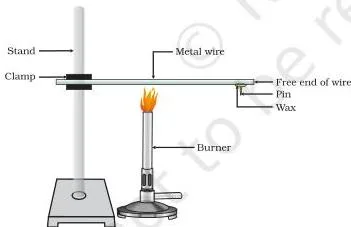
The two photographs below come from Activities 3.5 and 3.6. In the first, a metal wire is heated at its clamped end: heat travels along the wire, melts the wax and drops the pin — proof that metals conduct heat.
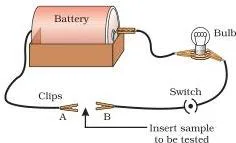
In the second, a metal sample placed between terminals A and B completes the circuit and the bulb glows — proof that metals conduct electricity (NCERT, pp. 2-3).
The reactivity series
The reactivity (or activity) series lists metals in order of decreasing reactivity. It is the single most useful tool in this chapter: it predicts reactions with water, acids, salt solutions and oxides.
| Metal | What this position tells you |
|---|---|
| K, Na | Most reactive; react violently with cold water; catch fire in air; stored in kerosene |
| Ca | Reacts less violently with cold water |
| Mg | Reacts with hot water; burns in air with a dazzling white flame |
| Al | Reacts with steam; oxide is amphoteric; protected by Al2O3 layer |
| Zn | Reacts with steam and dilute acids; more reactive than tin |
| Fe | Reacts with steam to give Fe3O4 |
| Pb | Poor conductor of heat; reacts with steam |
| H (reference) | Metals above hydrogen displace hydrogen from dilute acids |
| Cu | Below hydrogen; does not react with dilute acids or water |
| Hg | Liquid at room temperature; poor conductor of heat |
| Ag | Found free in nature; does not tarnish or corrode easily |
| Au | Least reactive; found free; does not react even at high temperature |
Patterns of reaction
| Reagent | Pattern | Metals that follow it |
|---|---|---|
| Oxygen | Metal + O2 → metal oxide (basic) | Most metals; K and Na catch fire; Ag and Au do not react even at high temperature |
| Cold water | Metal + H2O → metal hydroxide + H2 | K, Na (violent); Ca (less violent) |
| Hot water | Metal + H2O → metal hydroxide + H2 | Mg |
| Steam | Metal + H2O(g) → metal oxide + H2 | Al, Zn, Fe |
| Dilute acid | Metal + dilute acid → salt + H2 | Metals above hydrogen: Mg, Al, Zn, Fe |
| Salt solution | Metal A + salt of B → salt of A + metal B | Only if metal A is more reactive than metal B |
Nitric acid does not evolve hydrogen with metals. It is a strong oxidising agent: it oxidises the hydrogen produced to water and itself gets reduced to nitrogen oxides (N2O, NO, NO2). The only exceptions are magnesium and manganese, which react with very dilute HNO3 to evolve H2 gas (NCERT, p. 8).
Ionic compounds and electron transfer
Metals lose electrons to form cations and non-metals gain electrons to form anions; the oppositely charged ions are then held together by strong electrostatic forces. Compounds formed by this electron transfer are called ionic compounds or electrovalent compounds (NCERT, p. 11).
- Physical nature: solid, hard and brittle.
- Melting and boiling points: high, because a considerable amount of energy is needed to break the strong inter-ionic attraction — NaCl melts at 1074 K and CaO at 2850 K (Table 3.4, NCERT, p. 12).
- Solubility: generally soluble in water, insoluble in kerosene and petrol.
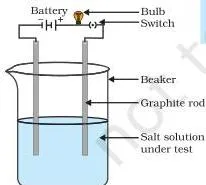
- Conduction: solid state does not conduct electricity because ions cannot move in the rigid lattice; molten state and aqueous solutions conduct because ions move freely.
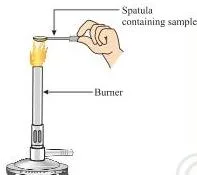
Figures 3.7 and 3.8 show the two laboratory tests for these properties from Activity 3.13: heating a salt sample on a spatula over a flame, and dipping electrodes into a salt solution to see whether the bulb glows.
From ore to metal: extraction depends on reactivity
| Position in the series | Metals | How they are extracted |
|---|---|---|
| Bottom (low reactivity) | Ag, Au; Hg and Cu as sulphide ores | Found in the free (native) state, or oxide reduced by heating alone (HgS → HgO → Hg) |
| Middle (moderate reactivity) | Zn, Fe, Pb | Roasting (sulphides, excess air) or calcination (carbonates, limited air) → oxide → reduction with carbon, e.g. ZnO + C → Zn + CO |
| Top (high reactivity) | K, Na, Ca, Mg, Al | Electrolytic reduction of molten compounds; carbon cannot reduce their oxides |
Gangue (soil, sand and other impurities) is removed from the ore before extraction. Roasting and calcination only convert the ore into an oxide; the oxide-to-metal step is reduction. The full route — enrichment, conversion to oxide, reduction, refining — is summarised in Figure 3.10 in the extraction section below.
Corrosion and alloys
- Corrosion: metals slowly react with moist air. Iron rusts with a brown flaky coat, copper gains a green coat of basic copper carbonate, and silver turns black due to silver sulphide. Rusting needs both air and moisture together (NCERT, p. 17).
- Prevention: painting, oiling, greasing, galvanising (zinc coating), chrome plating, anodising (thick oxide layer on aluminium) and alloying.
- Alloys: homogeneous mixtures of two or more metals, or a metal and a non-metal. Brass (Cu + Zn), bronze (Cu + Sn), solder (Pb + Sn, low melting point, used for welding wires), amalgam (alloy containing mercury), stainless steel (Fe + Ni + Cr, does not rust). 22-carat gold is 22 parts gold with 2 parts silver or copper — harder than soft 24-carat gold (NCERT, p. 18).
Intext Questions: Physical Properties of Metals (Page 4)
Question 1: Give an example of a metal which (i) is a liquid at room temperature. (ii) can be easily cut with a knife. (iii) is the best conductor of heat. (iv) is a poor conductor of heat.
- (i) is a liquid at room temperature.
- (ii) can be easily cut with a knife.
- (iii) is the best conductor of heat.
- (iv) is a poor conductor of heat.
Answer: These four parts test the exceptions that break the general picture of a hard, shiny, solid metal. Most metals are hard solids, but the atomic structure of a few metals breaks that pattern — so the textbook names specific examples for each property.
Part (i): Mercury is a liquid at room temperature — the only metal that is.
Part (ii): Sodium (and the other alkali metals, lithium and potassium) is so soft that it can be cut with a knife.
Part (iii): Silver is the best conductor of heat; copper is the second best.
Part (iv): Lead and mercury are comparatively poor conductors of heat (NCERT, p. 2).
Common error: Students answer ‘copper’ for the best conductor of heat because copper wires are everywhere. The textbook names silver first for heat. Also remember: mercury is the only liquid metal and sodium/potassium are the knife-cuttable ones — these three exceptions appear repeatedly in MCQs.
Question 2: Explain the meanings of malleable and ductile.
Answer: Both words describe how metals can be reshaped without breaking; the difference is the shape they are given. These properties exist because the layers of atoms in a metal can slide over each other when force is applied.
- Malleable: a metal that can be beaten into thin sheets is said to be malleable. Iron, zinc, lead and copper flatten when struck with a hammer, and gold and silver are the most malleable metals (NCERT, p. 2).
- Ductile: a metal that can be drawn into thin wires is said to be ductile. Gold is the most ductile metal — a wire of about 2 km length can be drawn from just one gram of gold (NCERT, p. 2).
Common error: Students swap the two words. Remember the action: hammering gives sheets (malleable); pulling gives wires (ductile). A question asking why metals can be given different shapes is answered with both properties and these two actions.
Intext Questions: Reactions with Oxygen, Water and Acids (Page 10)
Question 1: Why is sodium kept immersed in kerosene oil?
Answer: Sodium is so reactive that it combines vigorously with the oxygen and moisture in ordinary air — the reaction is so violent that sodium can catch fire if kept in the open (NCERT, p. 5). Immersing it in kerosene oil cuts it off from both air and moisture, which protects the metal and prevents accidental fires.
Potassium is stored the same way for the same reason.
Common error: Writing ‘sodium reacts with air’ is only half the answer. Full marks need the two dangers: it reacts with both oxygen and moisture, and it can catch fire — so kerosene isolates it from both.
Question 2: Write equations for the reactions of (i) iron with steam (ii) calcium and potassium with water
- (i) iron with steam
- (ii) calcium and potassium with water
Answer: The violence of a metal–water reaction depends on where the metal sits in the reactivity series. Potassium reacts explosively with cold water; calcium reacts less violently; iron is so unreactive towards water that it needs steam, and the product is the oxide, not the hydroxide.
Part (i): Iron with steam gives the mixed oxide Fe3O4 and hydrogen gas:
\[ 3\text{Fe(s)} + 4\text{H}_2\text{O(g)} \xrightarrow{\text{Heat}} \text{Fe}_3\text{O}_4\text{(s)} + 4\text{H}_2\text{(g)} \]
Part (ii): Calcium reacts with cold water to give calcium hydroxide and hydrogen; the heat released is not enough for the hydrogen to catch fire:
\[ \text{Ca(s)} + 2\text{H}_2\text{O(l)} \rightarrow \text{Ca(OH)}_2\text{(aq)} + \text{H}_2\text{(g)} \]
Potassium reacts violently with cold water, and the reaction is so exothermic that the hydrogen released catches fire:
\[ 2\text{K(s)} + 2\text{H}_2\text{O(l)} \rightarrow 2\text{KOH(aq)} + \text{H}_2\text{(g)} + \text{heat energy} \]
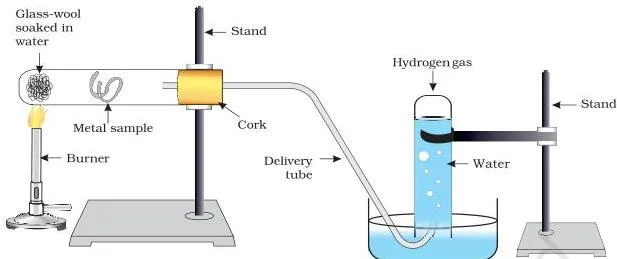
The figure below shows the apparatus used to pass steam over a metal sample — the flask boils water and the steam is led over the metal in the heated tube.
Common error: Writing Fe2O3 for iron with steam. The product is Fe3O4. Check by counting atoms: 3Fe + 4H2O gives 3 Fe, 4 O and 8 H on each side — balanced. Also do not forget potassium’s equation, like sodium’s, carries ‘+ heat energy’.
Question 3: Samples of four metals A, B, C and D were taken and added to the following solution one by one. The results obtained have been tabulated as follows.
| Metal | Iron(II) sulphate | Copper(II) sulphate | Zinc sulphate | Silver nitrate |
|---|---|---|---|---|
| A | No reaction | Displacement | – | – |
| B | Displacement | – | No reaction | – |
| C | No reaction | No reaction | No reaction | Displacement |
| D | No reaction | No reaction | No reaction | No reaction |
Use the Table above to answer the following questions about metals A, B, C and D.
- (i) Which is the most reactive metal?
- (ii) What would you observe if B is added to a solution of Copper(II) sulphate?
- (iii) Arrange the metals A, B, C and D in the order of decreasing reactivity.
Answer: A displacement happens only when the added metal is more reactive than the metal whose salt is in the solution (NCERT, p. 9). So each ‘Displacement’ cell tells you the added metal is above the salt’s metal in the series, and each ‘No reaction’ cell tells you it is below.
- A displaces copper from CuSO4 → A is above Cu; A does not react with FeSO4 → A is below Fe. So Fe > A > Cu.
- B displaces iron from FeSO4 → B is above Fe; B does not react with ZnSO4 → B is below Zn. So Zn > B > Fe.
- C displaces silver from AgNO3 → C is above Ag; C does not react with CuSO4 → C is below Cu. So Cu > C > Ag.
- D reacts with nothing → D is the least reactive of the four.
Part (i): B is the most reactive metal.
Part (ii): B is more reactive than copper (it is above Fe, and Fe is above Cu), so B displaces copper: the blue colour of copper(II) sulphate fades and a reddish-brown deposit of copper appears on B.
Part (iii): Decreasing reactivity: B > A > C > D.
Common error: Reading the table backwards. A ‘No reaction’ cell does not mean the metal is unreactive — it means the added metal is less reactive than the metal in that salt. Always compare the added metal with the salt’s metal, one cell at a time, then join the inequalities.
Question 4: Which gas is produced when dilute hydrochloric acid is added to a reactive metal? Write the chemical reaction when iron reacts with dilute H2SO4.
Answer: Metals above hydrogen in the reactivity series displace hydrogen from dilute acids, so the gas produced is always hydrogen, \( \text{H}_2 \). The metal atom replaces the hydrogen of the acid to form a salt and hydrogen gas.
Iron is above hydrogen, so with dilute sulphuric acid it gives iron(II) sulphate and hydrogen:
\[ \text{Fe(s)} + \text{H}_2\text{SO}_4\text{(aq)} \rightarrow \text{FeSO}_4\text{(aq)} + \text{H}_2\text{(g)} \]
Common error: Testing the gas is the usual follow-up — hydrogen extinguishes a burning candle with a ‘pop’ sound. And remember nitric acid is the exception: being an oxidising agent, it does not give hydrogen with metals (except Mg and Mn with very dilute HNO3).
Question 5: What would you observe when zinc is added to a solution of iron(II) sulphate? Write the chemical reaction that takes place.
Answer: Zinc sits above iron in the reactivity series, so zinc displaces iron from its salt solution — this is a displacement reaction. The green colour of iron(II) sulphate fades as iron is displaced, and a grey deposit of iron forms on the zinc.
\[ \text{Zn(s)} + \text{FeSO}_4\text{(aq)} \rightarrow \text{ZnSO}_4\text{(aq)} + \text{Fe(s)} \]
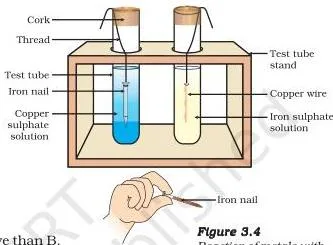
The photograph below shows how such metal-versus-salt-solution tests are set up: an iron nail in copper sulphate solution and a copper wire in iron sulphate solution. Only one test tube reacts, because only one added metal is more reactive than the metal in the solution.
Common error: Reversing the direction of displacement. A metal displaces only a less reactive metal. Zinc displaces iron, but iron would not displace zinc from zinc sulphate. Check the series: Zn is above Fe, so the reaction runs Zn → Fe, never the reverse.
Intext Questions: Ionic Compounds and Electron Transfer (Page 13)
Question 1: (i) Write the electron-dot structures for sodium, oxygen and magnesium. (ii) Show the formation of Na2O and MgO by the transfer of electrons. (iii) What are the ions present in these compounds?
- (i) Write the electron-dot structures for sodium, oxygen and magnesium.
- (ii) Show the formation of Na2O and MgO by the transfer of electrons.
- (iii) What are the ions present in these compounds?
Answer: An electron-dot structure shows only the valence (outermost) electrons of an atom, drawn as dots around its symbol. Metals have one or two valence electrons to lose; a non-metal like oxygen needs electrons to complete its octet. In an ionic compound, the electrons lost by the metal are exactly the electrons gained by the non-metal (NCERT, p. 11).
Part (i): Using the shell configurations (Na: 2,8,1; Mg: 2,8,2; O: 2,6):
- Sodium: Na· — one valence electron.
- Magnesium: ·Mg· — two valence electrons.
- Oxygen: ·O· with two dots above and two below the symbol — six valence electrons, drawn as two lone pairs and two unpaired electrons.
Part (ii): Formation by electron transfer. For Na2O, two sodium atoms each lose one electron to form Na+; oxygen gains both electrons to complete its octet as O2−:
\[ 2\text{Na} \rightarrow 2\text{Na}^+ + 2e^- \qquad \text{O} + 2e^- \rightarrow \text{O}^{2-} \]
For MgO, magnesium loses both its valence electrons and oxygen accepts them:
\[ \text{Mg} \rightarrow \text{Mg}^{2+} + 2e^- \qquad \text{O} + 2e^- \rightarrow \text{O}^{2-} \]
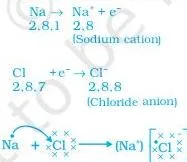
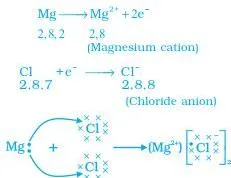
The two figures below show the same electron transfer in the formation of sodium chloride and magnesium chloride — a metal atom’s electrons pass to non-metal atoms, and the resulting oppositely charged ions attract each other and form the compound.
Part (iii): In Na2O, the ions present are two sodium cations, Na+, and one oxide anion, O2−. In MgO, the ions are the magnesium cation, Mg2+, and the oxide anion, O2−.
Common error: Writing Na2+ or O−. Sodium has only one electron to lose, so it is always Na+; oxygen needs two electrons, so it is always O2−. That is why the formula is Na2O — two Na+ ions balance one O2− ion. The same logic answers the classic follow-up ‘name the cation and anion in MgCl2’: Mg2+ and Cl−.
Question 2: Why do ionic compounds have high melting points?
Answer: Melting requires breaking the forces that hold a solid together, and those forces are strong in ionic compounds. The oppositely charged ions are locked in a rigid lattice by strong electrostatic forces of attraction, so a considerable amount of energy is needed to separate them (NCERT, p. 12).
That is why NaCl melts only at 1074 K and CaO at 2850 K (Table 3.4).
Common error: Saying ionic compounds conduct electricity in the solid state. They do not — the ions are fixed in the rigid lattice and cannot move. They conduct when molten or dissolved in water, because only then do the ions move freely to the electrodes.
Intext Questions: Minerals, Ores and Extraction (Page 17)
Question 1: Define the following terms. (i) Mineral (ii) Ore (iii) Gangue
- (i) Mineral
- (ii) Ore
- (iii) Gangue
Answer: The three terms describe one idea at three stages: a natural substance in the earth, the special version of it worth mining, and the waste that comes with it.
- Mineral: the elements or compounds that occur naturally in the earth’s crust — for example, sodium chloride and magnesium chloride, which occur as soluble salts in seawater (NCERT, p. 13).
- Ore: a mineral that contains a very high percentage of a particular metal, so high that the metal can be profitably extracted from it. Every ore is a mineral, but not every mineral is an ore.
- Gangue: the impurities such as soil and sand that contaminate the ore and must be removed before the metal is extracted (NCERT, p. 14).
Common error: Using ‘mineral’ and ‘ore’ as if they mean the same thing. The word ‘profitably’ is the whole difference, and examiners penalise its omission in the definition of ore.
Question 2: Name two metals which are found in nature in the free state.
Answer: Gold, silver, platinum and copper are found in the free (native) state because they sit at the bottom of the reactivity series. Being the least reactive metals, they do not combine readily with oxygen or other elements, so they survive uncombined in the earth’s crust (NCERT, p. 13). Two examples: gold and silver.
Common error: Naming a reactive metal like sodium or aluminium. The rule: the less reactive the metal, the more likely it is found free. Copper and silver are also found in the combined state as sulphide or oxide ores, so their free state is only part of the story.
Question 3: What chemical process is used for obtaining a metal from its oxide?
Answer: Reduction. The metal oxide must lose its oxygen to become the metal, and losing oxygen is reduction. For moderately reactive metals, a suitable reducing agent such as carbon (coke) is used. For highly reactive metals like sodium, magnesium and aluminium, carbon cannot reduce their oxides, so electrolytic reduction of the molten compound is used (NCERT, pp. 15-16).
Do not confuse the steps: roasting and calcination convert sulphide and carbonate ores into oxides; the step that turns an oxide into the metal is reduction. For the least reactive metals, the oxide is reduced by heating alone.
The flow diagram below summarises the whole route from ore to pure metal — enrichment of the ore, conversion to oxide, reduction, and refining.
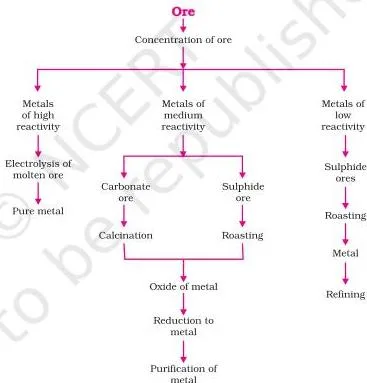
Common error: Quoting ‘roasting’ or ‘calcination’ as the answer. Those processes convert ores into oxides; the oxide-to-metal step is reduction. This one-word answer — reduction — is the exact mark the question carries.
Intext Questions: Displacement and Corrosion (Page 19)
Question 1: Metallic oxides of zinc, magnesium and copper were heated with the following metals. In which cases will you find displacement reactions taking place?
The experiment pairs each oxide with each metal:
| Metal | Zinc | Magnesium | Copper |
|---|---|---|---|
| Zinc oxide | – | – | – |
| Magnesium oxide | – | – | – |
| Copper oxide | – | – | – |
Answer: A metal can displace another metal from its oxide only if it is more reactive — that is, above it in the reactivity series: Mg > Zn > Cu. Working through all nine cells:
- Zinc oxide + magnesium: Mg is above Zn → displacement occurs: \( \text{Mg} + \text{ZnO} \rightarrow \text{MgO} + \text{Zn} \).
- Zinc oxide + zinc / + copper: zinc cannot displace itself, and Cu is below Zn → no reaction.
- Magnesium oxide + zinc / + copper / + magnesium: no reaction in all three — zinc and copper are below Mg, and Mg cannot displace itself.
- Copper oxide + zinc: Zn is above Cu → displacement occurs: \( \text{Zn} + \text{CuO} \rightarrow \text{ZnO} + \text{Cu} \).
- Copper oxide + magnesium: Mg is above Cu → displacement occurs: \( \text{Mg} + \text{CuO} \rightarrow \text{MgO} + \text{Cu} \).
- Copper oxide + copper: same metal → no reaction.
So displacement takes place in three cases: Mg with zinc oxide, Zn with copper oxide, and Mg with copper oxide. In each, the added metal is above the metal of the oxide in the activity series.
Common error: Assuming every reactive metal reacts with every oxide. The comparison is always between the added metal and the metal inside the oxide — if the added metal is below, nothing happens. Memory aid: ‘the upper metal wins the oxygen’.
Question 2: Which metals do not corrode easily?
Answer: The least reactive metals — gold, silver and platinum — do not corrode easily because they do not combine with the oxygen, moisture or sulphur compounds in the air.
Aluminium also resists corrosion in practice, but for a different reason: it is reactive, yet the thin, tough layer of aluminium oxide that forms on its surface seals the metal underneath from further attack (NCERT, p. 5).
Common error: Leaving aluminium out because ‘it is reactive’. Distinguish the two routes to corrosion resistance: least reactive (Au, Ag, Pt) versus protected by a self-formed oxide coat (Al). Both are valid points in a full answer.
Exercise Solutions: Displacement, Rust Prevention and Oxide Nature (Q1-Q5)
Question 1: Which of the following pairs will give displacement reactions? (a) NaCl solution and copper metal (b) MgCl2 solution and aluminium metal (c) FeSO4 solution and silver metal (d) AgNO3 solution and copper metal.
- (a) NaCl solution and copper metal
- (b) MgCl2 solution and aluminium metal
- (c) FeSO4 solution and silver metal
- (d) AgNO3 solution and copper metal.
Answer: (d) AgNO3 solution and copper metal.
A displacement reaction happens only when the added metal is more reactive than the metal in the solution. Check each pair against the reactivity series:
- (a) Na is far above Cu, so copper cannot displace sodium. No reaction.
- (b) Mg is above Al, so aluminium cannot displace magnesium. No reaction.
- (c) Fe is above Ag, so silver cannot displace iron. No reaction.
- (d) Cu is above Ag, so copper displaces silver from silver nitrate: \( \text{Cu} + 2\text{AgNO}_3 \rightarrow \text{Cu(NO}_3\text{)}_2 + 2\text{Ag} \). Reaction occurs.
Common error: Choosing the pair that ‘looks reactive’ instead of locating both metals in the series. The added metal must be ABOVE the metal whose salt it is added to — compare positions, not names.
Question 2: Which of the following methods is suitable for preventing an iron frying pan from rusting? (a) Applying grease (b) Applying paint (c) Applying a coating of zinc (d) All of the above.
- (a) Applying grease
- (b) Applying paint
- (c) Applying a coating of zinc
- (d) All of the above.
Answer: (d) All of the above.
Rusting needs both air and moisture (NCERT, p. 17), so every method that seals the iron surface from air and water prevents rusting. Grease and paint form a barrier coat; a zinc coating is galvanisation, which protects the iron even if the coating is scratched. Each method works, so the correct option is (d).
Common error: Hesitating over paint ‘for a frying pan’. The question is about rust prevention in general, not about which coating is practical for cooking — all three methods prevent rust, which is why (d) is correct.
Question 3: An element reacts with oxygen to give a compound with a high melting point. This compound is also soluble in water. The element is likely to be (a) calcium (b) carbon (c) silicon (d) iron.
- (a) calcium
- (b) carbon
- (c) silicon
- (d) iron.
Answer: (a) calcium.
Calcium burns to calcium oxide, CaO, which is an ionic compound — ionic compounds have high melting points, and CaO dissolves in water to give an alkaline solution of calcium hydroxide. Check the distractors: carbon gives CO2, a gas; silicon gives SiO2, which is insoluble in water; iron gives Fe2O3 or Fe3O4, which are insoluble oxides.
Only calcium’s oxide has both the properties named in the question.
Common error: Picking iron because iron oxides are hard, high-melting solids. The second condition — solubility in water — rules iron out: iron oxides do not dissolve, but CaO reacts with water to give Ca(OH)2.
Question 4: Food cans are coated with tin and not with zinc because (a) zinc is costlier than tin. (b) zinc has a higher melting point than tin. (c) zinc is more reactive than tin. (d) zinc is less reactive than tin.
- (a) zinc is costlier than tin.
- (b) zinc has a higher melting point than tin.
- (c) zinc is more reactive than tin.
- (d) zinc is less reactive than tin.
Answer: (c) zinc is more reactive than tin.
Tin sits below zinc in the reactivity series, so it is less reactive and does not react with the food acids in the can. Zinc, being more reactive, could react with the food contents and spoil them, so food cans are coated with the less reactive metal — tin.
Zinc’s greater reactivity is exactly why galvanised iron uses zinc to protect iron, but the same property makes zinc unsuitable against food.
Common error: Mixing this up with galvanisation. Galvanised iron gets zinc; food cans get tin. The same reactivity series fact is used two ways: zinc protects iron sacrificially, but it is too reactive to sit against food.
Question 5: You are given a hammer, a battery, a bulb, wires and a switch. (a) How could you use them to distinguish between samples of metals and non-metals? (b) Assess the usefulness of these tests in distinguishing between metals and non-metals.
- (a) How could you use them to distinguish between samples of metals and non-metals?
- (b) Assess the usefulness of these tests in distinguishing between metals and non-metals.
Answer: The two tests use the physical properties of malleability and electrical conductivity.
Part (a): Use the hammer to strike each sample on a hard block. Metals are malleable, so they flatten into thin sheets without breaking; non-metals are brittle and shatter. Use the battery, bulb, wires and switch to build a simple circuit, and place each sample between the terminals one by one — the bulb glows when the sample conducts electricity.
Metals conduct; most non-metals do not.
Part (b): These tests are quick and work for most samples, but they are not conclusive on their own because of the exceptions: graphite is a non-metal that conducts electricity, iodine is a lustrous non-metal, and sodium is a soft metal that can be cut with a knife.
So a final verdict needs chemical tests too — for example, whether the element’s oxide is basic (metal) or acidic (non-metal) (NCERT, p. 4).
Common error: Giving only one test. The question names two sets of equipment for a reason — the hammer tests malleability, the circuit tests conductivity. And part (b) wants an honest judgement of the tests’ limits, not just praise for them.
Exercise Solutions: Amphoteric Oxides, Acid Reactions and Electrolytic Refining (Q6-Q8)
Question 6: What are amphoteric oxides? Give two examples of amphoteric oxides.
Answer: Most metal oxides are basic, but a few react with both acids and bases to produce salt and water. Such metal oxides are called amphoteric oxides (NCERT, p. 5). The two textbook examples are aluminium oxide and zinc oxide.
Aluminium oxide reacts with hydrochloric acid as a base and with sodium hydroxide as an acid:
\[ \text{Al}_2\text{O}_3 + 6\text{HCl} \rightarrow 2\text{AlCl}_3 + 3\text{H}_2\text{O} \]
\[ \text{Al}_2\text{O}_3 + 2\text{NaOH} \rightarrow 2\text{NaAlO}_2 + \text{H}_2\text{O} \]
Zinc oxide behaves the same way — it reacts with HCl to give zinc chloride and water, and with NaOH to give sodium zincate and water.
Common error: Naming a basic oxide like Na2O or MgO as amphoteric. The test is in the word: ‘amphi’ means both — the oxide must react with an acid AND a base. Al2O3 and ZnO are the two to memorise, with the equations above.
Question 7: Name two metals which will displace hydrogen from dilute acids, and two metals which will not.
Answer: The dividing line in the reactivity series is hydrogen itself: metals above hydrogen can displace it from dilute acids; metals below hydrogen cannot (NCERT, p. 19).
- Displace hydrogen: zinc and iron (also magnesium and aluminium — all above H). Example: \( \text{Zn} + 2\text{HCl} \rightarrow \text{ZnCl}_2 + \text{H}_2 \).
- Will not displace hydrogen: copper and silver (also mercury and gold — all below H). Copper does not react with dilute HCl at all.
Common error: Quoting nitric acid in the equation. The question means the usual dilute acids; the reaction gives hydrogen only when the acid is not an oxidising agent — dilute HCl or dilute H2SO4. Nitric acid does not evolve hydrogen (except Mg and Mn with very dilute HNO3).
Question 8: In the electrolytic refining of a metal M, what would you take as the anode, the cathode and the electrolyte?
Answer: Electrolytic refining uses electricity to transfer pure metal onto a pure strip, leaving impurities behind (NCERT, p. 16).
- Anode: a thick block of the impure metal M.
- Cathode: a thin strip of pure metal M.
- Electrolyte: a solution of a salt of metal M — for copper, acidified copper sulphate solution.
On passing current, pure metal from the anode dissolves into the electrolyte, and an equivalent amount of pure metal from the electrolyte is deposited on the cathode. Soluble impurities go into the solution, while insoluble impurities settle below the anode as anode mud.
Common error: Reversing anode and cathode. The impure metal is ALWAYS the anode because it dissolves; the pure metal is the cathode because it gains metal. Memory aid: anode loses, cathode gains.
Exercise Solutions: The Sulphur Burning Experiment and Rust Prevention (Q9-Q10)
Question 9: Pratyush took sulphur powder on a spatula and heated it. He collected the gas evolved by inverting a test tube over it, as shown in figure below. (a) What will be the action of gas on (i) dry litmus paper? (ii) moist litmus paper? (b) Write a balanced chemical equation for the reaction taking place.
- (a)(i) dry litmus paper?
- (a)(ii) moist litmus paper?
- (b) Write a balanced chemical equation for the reaction taking place.
Answer: Heating sulphur in air burns it to sulphur dioxide, a non-metal oxide. Non-metal oxides are acidic, but the acidity shows only when water is present to form an acid — that is the whole point of comparing dry and moist litmus.
Part (a)(i): Dry litmus paper shows no change — the gas alone has no H+ ions in the absence of water.
Part (a)(ii): Moist blue litmus turns red — SO2 dissolves in the moisture to form sulphurous acid, which is acidic (NCERT, p. 4, Activity 3.8).
Part (b): The balanced equation for the burning of sulphur in air:
\[ \text{S(s)} + \text{O}_2\text{(g)} \rightarrow \text{SO}_2\text{(g)} \]
Common error: Writing that dry litmus turns red. The moisture is essential — without water there is no acid, so the dry paper is unchanged. This is a favourite ‘trick’ exam item, and the same reasoning explains why non-metal oxides are called acidic oxides.
Question 10: State two ways to prevent the rusting of iron.
Answer: Rusting needs air and moisture together, so every prevention method cuts the iron off from one or both (NCERT, p. 18). Any two of these are correct:
- Painting, oiling or greasing: a protective coat that stops air and moisture reaching the iron.
- Galvanising: coating with a thin layer of zinc; the zinc protects the iron even if the coating is broken.
- Chrome plating or anodising: a surface layer that shields the metal from the surroundings.
- Alloying: mixing iron with nickel and chromium gives stainless steel, which is hard and does not rust.
Common error: Writing only ‘apply paint’. The exam asks for two ways, and any pair from the list scores — but name the method, not just the idea. ‘Galvanising’ is the one examiners most often expect to see named.
Exercise Solutions: Oxide Nature and Reasoning Questions (Q11-Q13)
Question 11: What type of oxides are formed when non-metals combine with oxygen?
Answer: Non-metals form acidic oxides — for example, sulphur burns to SO2, which dissolves in water to form sulphurous acid. Some non-metals form neutral oxides, which show neither acidic nor basic behaviour. This is the chemical opposite of metals, which form basic oxides (NCERT, p. 4).
Common error: Forgetting the word ‘neutral’. The complete board answer is ‘acidic, or neutral in some cases’ — the textbook states both, and the follow-up question usually asks why SO2 turns moist litmus red.
Question 12: Give reasons (a) Platinum, gold and silver are used to make jewellery. (b) Sodium, potassium and lithium are stored under oil. (c) Aluminium is a highly reactive metal, yet it is used to make utensils for cooking. (d) Carbonate and sulphide ores are usually converted into oxides during the process of extraction.
- (a) Platinum, gold and silver are used to make jewellery.
- (b) Sodium, potassium and lithium are stored under oil.
- (c) Aluminium is a highly reactive metal, yet it is used to make utensils for cooking.
- (d) Carbonate and sulphide ores are usually converted into oxides during the process of extraction.
Answer: All four parts are the reactivity series in action — each metal’s behaviour toward air, water and heat is fixed by its position in the series.
Part (a): Platinum, gold and silver sit at the bottom of the reactivity series. They are the least reactive metals, so they do not tarnish or react with air and moisture, and their shine lasts. That makes them suitable for jewellery.
Part (b): Sodium, potassium and lithium sit at the top of the series. They react vigorously with oxygen and moisture — so vigorously that they can catch fire — so they are kept immersed in oil to isolate them from air and water.
Part (c): Aluminium is reactive, but it forms a thin, tough layer of aluminium oxide (Al2O3) on its surface when exposed to air. This protective oxide layer prevents further corrosion, so the metal underneath stays safe — which is why aluminium utensils are safe to use (NCERT, p. 5).
Part (d): It is easier to obtain a metal from its oxide than from its sulphide or carbonate (NCERT, p. 15). So sulphide ores are first heated strongly in excess air (roasting) and carbonate ores in limited air (calcination) to convert them into oxides; the oxide is then reduced to the metal, usually with carbon.
Common error: For (c), saying ‘aluminium is unreactive’ — that is false and loses marks. The correct idea is that aluminium IS reactive but is saved by its self-protecting oxide layer. Also do not confuse roasting (excess air, for sulphides) with calcination (limited air, for carbonates).
Question 13: You must have seen tarnished copper vessels being cleaned with lemon or tamarind juice. Explain why these sour substances are effective in cleaning the vessels.
Answer: The dull green coating on old copper is basic copper carbonate, formed when copper reacts with moist carbon dioxide in the air over time (NCERT, p. 17). Lemon and tamarind juices contain acids. The acid reacts with and dissolves the basic copper carbonate layer, so the fresh, shiny copper surface underneath is exposed and the vessel looks clean again.
Common error: Writing that the acid dissolves the copper metal. The acid attacks the corrosion product — basic copper carbonate — not the metal. That is why only the tarnish is removed and the vessel itself survives.
Exercise Solutions: Chemical Differences and the Goldsmith Detective Story (Q14-Q16)
Question 14: Differentiate between metal and non-metal on the basis of their chemical properties.
Answer: Chemical properties separate metals from non-metals more reliably than physical properties, because physical properties have exceptions. Compare the five chemical behaviours below.
| Chemical property | Metal | Non-metal |
|---|---|---|
| Reaction with oxygen | Forms basic oxides (e.g., Na2O, MgO); a few oxides (Al2O3, ZnO) are amphoteric | Forms acidic oxides (e.g., CO2, SO2) or neutral oxides |
| Reaction with water | Reacts to give metal oxide or hydroxide and hydrogen; reactivity varies from violent (K, Na) to none (Cu, Ag, Au) | Generally does not react with water |
| Reaction with dilute acids | Metals above hydrogen displace hydrogen from dilute acids: salt + H2 | Does not displace hydrogen from dilute acids |
| Ion formation | Loses electrons to form positive ions (cations) | Gains electrons to form negative ions (anions) when reacting with metals |
| Displacement behaviour | A more reactive metal displaces a less reactive metal from its salt solution | Shows no such displacement of metals from salt solutions |
Common error: Answering with physical properties (lustre, malleability). The question says ‘chemical properties’, so the rows of the table above are the board-format answer — name each row explicitly.
Question 15: A man went door to door posing as a goldsmith. He promised to bring back the glitter of old and dull gold ornaments. An unsuspecting lady gave a set of gold bangles to him which he dipped in a particular solution. The bangles sparkled like new but their weight was reduced drastically. The lady was upset but after a futile argument the man beat a hasty retreat. Can you play the detective to find out the nature of the solution he had used?
Answer: The solution was aqua regia — a freshly prepared mixture of concentrated hydrochloric acid and concentrated nitric acid in the ratio 3:1 (NCERT, p. 8).
Here is the detective’s chain of reasoning:
- Ordinary acids cannot clean gold, because gold is the least reactive metal and does not react with them.
- Aqua regia is one of the few reagents that can dissolve gold and platinum, even though neither acid alone can do so.
- When the bangles were dipped in aqua regia, the dull surface layer of gold dissolved, so the bangles looked bright and new.
- But real gold from the bangles had also dissolved in the solution, so their weight dropped sharply.
- The goldsmith’s hasty retreat confirms the trick: the ‘glitter’ cost the lady actual gold.
Common error: Answering ‘nitric acid’. Nitric acid alone cannot dissolve gold — the whole point of aqua regia is the freshly prepared 3:1 mixture of concentrated HCl and concentrated HNO3. The 3:1 ratio is often asked separately, so memorise it.
Question 16: Give reasons why copper is used to make hot water tanks and not steel (an alloy of iron).
Answer: Copper is placed below iron (and below hydrogen) in the reactivity series, so it is much less reactive than the iron inside steel. Copper does not react with hot water or steam, and it does not rust when exposed to water and air.
Steel, being an alloy of iron, contains the reactive metal iron — hot water and steam would slowly corrode the steel, and it would rust. Copper’s resistance to corrosion and good heat conduction make it the safer, longer-lasting choice for hot water tanks.
Common error: Saying ‘copper does not react with water’ without linking it to the reactivity series. Full marks name the comparison: copper is below iron and hydrogen in the series, so it is less reactive than the iron in steel — and unlike iron, it does not rust.
Method Recap: How to Approach Any Metals and Non-metals Question
Most questions in this chapter are one of five patterns. Run them through this routine and the answer almost writes itself (NCERT, pp. 9-10, 15).
- Locate the metals in the reactivity series. Nearly every prediction — acid, water, salt solution, oxide displacement — is just ‘who is above whom’.
- Name the reagent: oxygen, cold water, hot water, steam, dilute acid, a salt solution, or a metal oxide. Each reagent has its own pattern, summarised in the Key Concepts table above.
- Apply the pattern. Metals above H react with dilute acids to give H2; K, Na and Ca attack cold water; Al, Zn and Fe need steam; Pb, Cu, Ag and Au do not react with water at all.
- For displacement, compare the metals: the added metal must be above the metal in the compound. Mark ‘displacement’ or ‘no reaction’ cell by cell in any given table.
- For extraction, connect position to technique: bottom of the series → found free or reduced by heating alone; middle → roasting or calcination then reduction with carbon; top → electrolytic reduction.
- Balance the equation and count atoms on both sides — one element at a time, then check every element again.
Checking a metal–water or metal–acid equation by counting atoms: write the skeleton, then adjust coefficients. Example — iron with steam: \( \text{Fe} + \text{H}_2\text{O} \rightarrow \text{Fe}_3\text{O}_4 + \text{H}_2 \). The oxide needs 4 O, so put 4 before H2O; that gives 8 H, so put 4 before H2; then balance Fe as 3 on each side:
\[ 3\text{Fe} + 4\text{H}_2\text{O} \rightarrow \text{Fe}_3\text{O}_4 + 4\text{H}_2 \;\;\; (3\text{Fe}, 4\text{O}, 8\text{H} \text{ on each side}) \]
The same atom count for calcium and water gives \( \text{Ca} + 2\text{H}_2\text{O} \rightarrow \text{Ca(OH)}_2 + \text{H}_2 \). Relate the chemistry here to the neighbouring chapters: metal oxides and acids connect directly to our Acids, Bases and Salts notes, and covalent compounds in Carbon and its Compounds notes are the contrast to ionic compounds.
Our all-subject notes index collects everything else.
The Eight Mistakes That Cost Marks in This Chapter
| Mistake | Correct rule | How to check your answer |
|---|---|---|
| ‘Copper is the best conductor of heat’ | Silver conducts heat best; copper is second | MCQs quote silver for heat, copper for electricity |
| ‘Sodium is the only liquid metal’ | Mercury is the only metal that is a liquid at room temperature | Recheck the exceptions list before answering ‘liquid at room temperature’ |
| ‘Iron + steam gives Fe2O3’ | The product is Fe3O4: 3Fe + 4H2O → Fe3O4 + 4H2 | Count atoms: 3 Fe, 4 O, 8 H on each side |
| ‘Nitric acid gives hydrogen with metals’ | HNO3 is an oxidising agent; H2 is oxidised to water. Mg and Mn with very dilute HNO3 are the exceptions | If the acid is HNO3, the gas is a nitrogen oxide, not H2 |
| ‘Ionic compounds conduct electricity as solids’ | Ions are fixed in the rigid lattice; they conduct only when molten or dissolved | Picture the lattice: no ion movement, no current |
| ‘Less reactive metal displaces more reactive one’ | A metal displaces only a LESS reactive metal from its salt | Compare positions: the added metal must sit ABOVE |
| ‘Roasting/calcination gives the metal from its oxide’ | Roasting and calcination convert ore to oxide; oxide → metal is reduction | Memorise the three metallurgy steps in order: enrichment, oxide, reduction |
| ‘Aqua regia is nitric acid alone’ | It is freshly prepared conc. HCl + conc. HNO3 in the ratio 3:1 | The 3:1 ratio is the exam’s favourite question about aqua regia |
Frequently Asked Questions
Why is sodium stored in kerosene oil?
Sodium reacts so vigorously with the oxygen and moisture in air that it can catch fire, so it is kept immersed in kerosene oil to cut it off from both air and water. Potassium is stored the same way.
Why do ionic compounds have high melting points?
Ionic compounds are held together by strong electrostatic forces between oppositely charged ions, and a considerable amount of energy is needed to break these inter-ionic attractions. That is why they melt and boil at high temperatures.
Why does copper not react with dilute hydrochloric acid?
Copper is below hydrogen in the reactivity series, and only metals above hydrogen can displace hydrogen from dilute acids. So copper placed in dilute HCl shows no bubbles and no reaction.
What is aqua regia and why does it dissolve gold?
Aqua regia is a freshly prepared mixture of concentrated hydrochloric acid and concentrated nitric acid in the ratio 3:1. It can dissolve gold and platinum, even though neither acid alone can — the mixture attacks the least reactive metals that ordinary acids cannot touch.
Why is aluminium used for cooking utensils even though it is reactive?
Aluminium forms a thin, tough layer of aluminium oxide on its surface when exposed to air. This protective layer prevents further corrosion, so the metal underneath stays safe — which is why aluminium utensils are safe to use.
How can we prevent the rusting of iron?
Rusting needs both air and moisture, so prevention means cutting off one or both. The methods are painting, oiling, greasing, galvanising (zinc coating), chrome plating, anodising, or making alloys such as stainless steel.
Every question on this page is reproduced word for word from the official NCERT Class 10 Science textbook, so you can check any answer against the source itself. To verify any equation, table or activity, open Chapter 3 in the official NCERT Class 10 Science textbook PDF at ncert.nic.in and compare it page by page — no sign-up or login is needed.
Reference: NCERT Class 10 Science textbook, chapter Metals and Non-metals.
Explore Class 10 Science NCERT Solutions
Class 10 Science on LearnCBSE:
Related chapters:
Official source: download the NCERT textbook free from ncert.nic.in.