This chemical reactions class 10 mcq set is built from NCERT Class 10 Science, Chapter 1 — Chemical Reactions and Equations — for the 2026-27 academic session. It covers writing and balancing equations, the law of conservation of mass, the six reaction types, oxidation-reduction, corrosion and rancidity.
These are practice questions written to match NCERT concepts. They are not official CBSE or NCERT question papers, and no question here is “guaranteed” to appear in any exam.
Every option below is explained — the correct one and every wrong one — so a wrong guess actually teaches you something before your next attempt. For the fuller concept walkthrough behind these questions, keep the Class 10 Science notes open alongside this set.
Reaction Type Quick-Clue Table
Use this table to eliminate wrong options fast in a timed test — match the reaction description to its one-line clue before reading all four choices.
| Reaction Type | Quick Identifying Clue |
|---|---|
| Combination | Two or more reactants join to form one single product |
| Decomposition | One reactant breaks into two or more simpler products, using heat, light or electricity |
| Displacement | A single element replaces another element inside a compound, based on reactivity |
| Double displacement | Ions from two compounds swap partners; a precipitate often forms |
| Oxidation-reduction (redox) | One reactant gains oxygen (oxidised) while the other loses oxygen (reduced), in the same step |
| Precipitation | An insoluble solid appears when two solutions are mixed, usually through ion exchange |
Common Mistakes Table
These are the exact errors students repeat on this chapter — check your own answer against this table before you check the answer key.
| Mistake | Correct rule | How to check your answer |
|---|---|---|
| Changing a subscript to balance atoms, e.g. writing \(H_2O_4\) instead of \(4H_2O\) | Only add a coefficient in front of a formula; never touch a subscript, because that changes the compound’s identity (NCERT, p. 4) | Re-read every formula after balancing — if any subscript differs from the original substance, the equation is wrong |
| Assuming every decomposition reaction needs heat | Decomposition can be thermal (heat), photolytic (light) or electrolytic (electricity) (NCERT, p. 9) | Check the label above the arrow — Heat, Sunlight or Electricity |
| Calling any reaction with a precipitate a “displacement reaction” | Displacement replaces one element; double displacement exchanges ions between two compounds (NCERT, p. 11) | Count the reactants — one element + one compound = displacement; two compounds = double displacement |
| Treating corrosion as only “rusting” | Corrosion is any metal reacting with moisture, acids or gases around it — rusting, tarnishing and green coatings are all corrosion (NCERT, p. 13) | Ask if a metal surface changed chemically because of its surroundings — if yes, it is corrosion |
MCQ Set 1: Writing and Balancing Chemical Equations
A chemical equation represents a reaction using formulae instead of full sentences (NCERT, p. 3). Before it is balanced, it is only a skeletal equation — the atom counts on each side may not match yet.
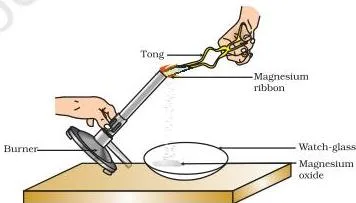
This is exactly the reaction used to introduce equation-writing in the chapter — magnesium plus oxygen gives magnesium oxide (NCERT, p. 2). The same logic applies to the worked example below, using aluminium and oxygen instead of the textbook’s iron-and-steam example.
Worked Example: Balancing Aluminium and Oxygen
Step 1: Write the skeletal equation.
Aluminium reacts with oxygen to give aluminium oxide.
\[ Al + O_2 \rightarrow Al_2O_3 \]
- Step 1: Count atoms on each side. LHS has 1 Al and 2 O; RHS has 2 Al and 3 O. Neither element matches, so this is unbalanced.
- Step 2: Balance aluminium first by placing a coefficient of 2 in front of \(Al\), keeping the formulae untouched.
\[ 2Al + O_2 \rightarrow Al_2O_3 \]
- Step 1: Oxygen still does not match (2 on LHS, 3 on RHS). The lowest common multiple of 2 and 3 is 6, so scale both sides to give 6 oxygen atoms: 3 molecules of \(O_2\) and 2 molecules of \(Al_2O_3\).
- Step 2: Re-balance aluminium for the new coefficient of \(Al_2O_3\): 2 molecules of \(Al_2O_3\) need 4 atoms of Al.
\[ 4Al + 3O_2 \rightarrow 2Al_2O_3 \]
Step 6: Check both sides: Al = 4 on each side; O = 6 on each side.
The equation is balanced.
Final answer: \(4Al(s) + 3O_2(g) \rightarrow 2Al_2O_3(s)\) is the balanced equation, obeying the law of conservation of mass (NCERT, p. 3).
Q1. Which of these is the correctly balanced equation for aluminium reacting with oxygen to form aluminium oxide?
- (a) \(4Al(s) + 3O_2(g) \rightarrow 2Al_2O_3(s)\)
- (b) \(Al(s) + O_2(g) \rightarrow Al_2O_3(s)\)
- (c) \(2Al(s) + 3O_2(g) \rightarrow 2Al_2O_4(s)\)
- (d) \(4Al(s) + 3O_2(g) \rightarrow 4Al_2O_3(s)\)
Correct answer: (a) Option (a) matches every step of the worked example above — 4 Al and 6 O on both sides. Option (b) is only the skeletal form; Al and O do not match, so it is not a chemical equation yet.
Option (c) repeats the exact subscript mistake this chapter warns against — changing \(Al_2O_3\) to \(Al_2O_4\) invents a compound that does not exist in this reaction. Option (d) doubles the product coefficient without rechecking oxygen: it gives 6 O on the left but 12 O on the right, so it is unbalanced despite looking similar to the right answer.
Q2. A student is asked to balance \(Zn + HCl \rightarrow ZnCl_2 + H_2\). Which option is correct, and what error do the wrong options repeat?
- (a) \(Zn(s) + 2HCl(aq) \rightarrow ZnCl_2(aq) + H_2(g)\)
- (b) \(Zn(s) + HCl_2(aq) \rightarrow ZnCl_2(aq) + H_2(g)\)
- (c) \(Zn(s) + HCl(aq) \rightarrow ZnCl_2(aq) + H_2(g)\)
- (d) \(2Zn(s) + 2HCl(aq) \rightarrow 2ZnCl_2(aq) + H_2(g)\)
Correct answer: (a) Option (a) adds a coefficient of 2 in front of \(HCl\), giving 2 Cl and 2 H on each side — correctly balanced. Option (b) makes the classic subscript error: writing \(HCl_2\) invents a compound that is not hydrochloric acid at all. Option (c) is the plain skeletal form — Cl (1 vs 2) and H (1 vs 2) do not match.
Option (d) looks balanced at a glance but doubling every coefficient leaves Cl unbalanced (2 on the left, 4 on the right), a mistake students make when they multiply without recounting.
Q3. Which option correctly represents sodium reacting with water, fully balanced and with correct state symbols?
- (a) \(2Na(s) + 2H_2O(l) \rightarrow 2NaOH(aq) + H_2(g)\)
- (b) \(Na(s) + H_2O(l) \rightarrow NaOH(aq) + H_2(g)\)
- (c) \(2Na + 2H_2O \rightarrow 2NaOH + H_2\)
- (d) \(2Na(s) + 2H_2O(g) \rightarrow 2NaOH(aq) + H_2(g)\)
Correct answer: (a) Option (a) is balanced (Na = 2, O = 2, H = 4 on both sides) and uses the correct physical states — solid sodium reacting with liquid water. Option (b) is unbalanced: Na and H do not match on both sides.
Option (c) is numerically balanced but drops every state symbol; a complete equation with state symbols requires (s), (l), (aq) and (g) as shown on NCERT, p. 5.
Option (d) makes a state-symbol error by marking water as a gas (g) when the reaction uses liquid water, not steam — a mix-up students make after seeing steam used with iron in a different reaction.
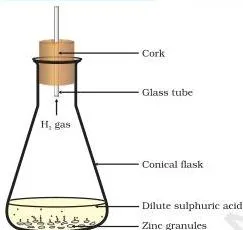
This is the same zinc-and-acid reaction used earlier in the chapter to demonstrate a balanced equation, \(Zn + H_2SO_4 \rightarrow ZnSO_4 + H_2\) (NCERT, p. 3) — every atom of Zn, H, S and O matches on both sides once the formulae are counted correctly.
MCQ Set 2: Combination and Decomposition Reactions
A combination reaction joins two or more substances into a single product (NCERT, p. 7), for example calcium oxide plus water forming slaked lime with heat given out.
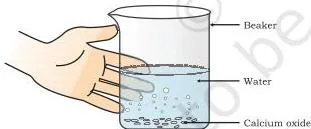
A decomposition reaction is the opposite — one substance breaks into two or more simpler products. It can be driven by heat (thermal), light (photolytic) or electricity (electrolytic) (NCERT, p. 9).
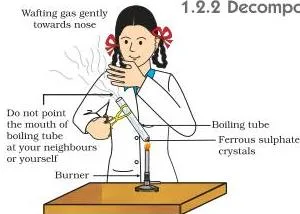
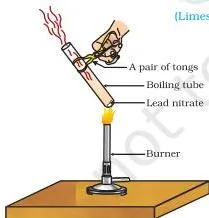
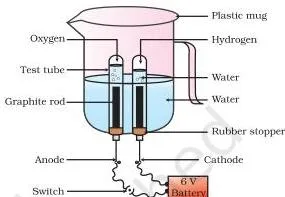
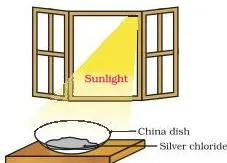
These four figures show all three energy sources for decomposition — heat in Figures 1.4 and 1.5, electricity in Figure 1.6, and light in Figure 1.7. A student who only remembers the heating examples misses the last two, which is exactly the misconception the next question targets.
Q4. Which of these decomposition reactions is driven by light, not heat or electricity?
- (a) \(CaCO_3(s) \xrightarrow{\text{Heat}} CaO(s) + CO_2(g)\)
- (b) \(2AgCl(s) \xrightarrow{\text{Sunlight}} 2Ag(s) + Cl_2(g)\)
- (c) \(2FeSO_4(s) \xrightarrow{\text{Heat}} Fe_2O_3(s) + SO_2(g) + SO_3(g)\)
- (d) \(2H_2O(l) \xrightarrow{\text{Electricity}} 2H_2(g) + O_2(g)\)
Correct answer: (b) Option (b) is the photolytic decomposition of silver chloride, matching Figure 1.7 exactly (NCERT, p. 9). Option (a) is limestone decomposing on heating — thermal, not light-driven. Option (c) is ferrous sulphate breaking down on heating — again thermal. Option (d) is the electrolysis of water — electrical energy, not light.
Students who pick (a) or (c) are falling for the common assumption that all decomposition is thermal.
Q5. The set-up below passes electric current through acidified water and collects gas at both electrodes. How should this reaction be classified?
- (a) A combination reaction, because two gases form together
- (b) A thermal decomposition reaction, because heat drives it
- (c) An electrolytic decomposition reaction, because electrical energy breaks a single compound into simpler substances
- (d) A displacement reaction, because hydrogen displaces oxygen
Correct answer: (c) Option (c) is correct: one compound, water, decomposes into two simpler substances using electricity, exactly as shown in Figure 1.6. Option (a) reverses the direction — combination reactions form one product from many, but here one reactant breaks into two products. Option (b) wrongly names the energy source; no flame or heating is used in electrolysis.
Option (d) misapplies displacement, a term reserved for one element replacing another inside a compound, not for a single compound splitting apart.
Q6. A reaction between two reactants gives a single product and releases heat. Which statement about it is correct?
- (a) It must be a decomposition reaction because heat is involved
- (b) It is a combination reaction; combination reactions can release heat, but heat release itself does not define the reaction type
- (c) It is definitely a redox reaction
- (d) It cannot be a combination reaction, because combination reactions never release heat
Correct answer: (b) Option (b) is correct: forming one product from multiple reactants is the definition of a combination reaction (NCERT, p. 7); calcium oxide plus water (Figure 1.3) proves combination reactions can be exothermic. Option (a) confuses heat release with decomposition — decomposition reactions are mostly endothermic, the opposite pattern.
Option (c) assumes every heat-releasing reaction is redox, which is not stated anywhere in the chapter as a rule. Option (d) is directly contradicted by the slaked-lime example, which is both a combination reaction and exothermic.
MCQ Set 3: Displacement, Double Displacement and Precipitation Reactions
In a displacement reaction, one element replaces another element inside a compound because it is more reactive (NCERT, p. 10). In a double displacement reaction, ions from two different compounds swap partners (NCERT, p. 11).
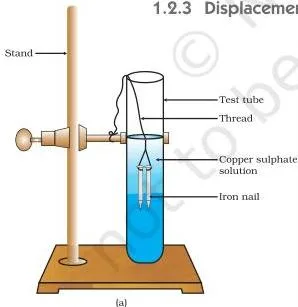
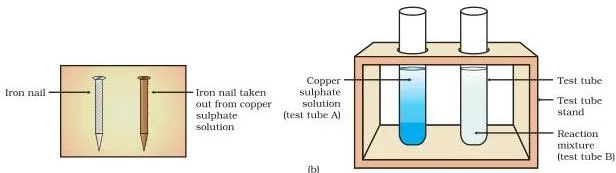
Q7. In the figures above, iron nails placed in copper sulphate solution turn brownish and the blue colour of the solution fades. Which term correctly classifies \(Fe(s) + CuSO_4(aq) \rightarrow FeSO_4(aq) + Cu(s)\)?
- (a) Displacement reaction, because iron, a more reactive element, replaces copper from its compound
- (b) Double displacement reaction, because ions are exchanged between two compounds
- (c) Precipitation reaction, because a solid appears
- (d) Combination reaction, because a single new compound forms
Correct answer: (a) Option (a) is correct — only one element (iron) is replacing another element (copper) inside a compound, which is the exact definition of displacement (NCERT, p. 10). Option (b) is wrong because there is no second compound for ions to exchange with; only one element and one compound react.
Option (c) mistakes the appearance of solid copper for a precipitation reaction; copper deposits because it is displaced, not because two solutions exchanged ions to form an insoluble salt. Option (d) is wrong because two products form here, not one single product.
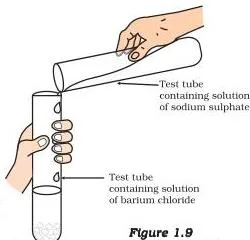
Q8. The figure above shows a white precipitate forming when barium chloride solution is mixed with sodium sulphate solution. Why is \(Na_2SO_4(aq) + BaCl_2(aq) \rightarrow BaSO_4(s) + 2NaCl(aq)\) a double displacement reaction, not a simple displacement?
- (a) Because \(SO_4^{2-}\) and \(Ba^{2+}\) exchange partners with \(Cl^-\) and \(Na^+\) between the two compounds
- (b) Because a white precipitate appears, and any precipitate automatically makes a reaction a displacement
- (c) Because barium is more reactive than sodium, so it displaces sodium
- (d) Because no new substance is formed in the reaction
Correct answer: (a) Option (a) correctly describes the ion exchange that defines a double displacement reaction (NCERT, p. 11). Option (b) is the exact misconception this section warns against — a precipitate can form in a double displacement, but the precipitate alone does not decide the reaction type; the ion swap does.
Option (c) wrongly applies the reactivity-series logic used for element-versus-compound displacement to two compounds reacting with each other, which is not how double displacement works. Option (d) is factually wrong: two new compounds, barium sulphate and sodium chloride, clearly form.
Q9. Which reactant pair gives a double displacement (precipitation) reaction rather than a single displacement?
- (a) \(Zn(s) + CuSO_4(aq) \rightarrow ZnSO_4(aq) + Cu(s)\)
- (b) \(Pb(NO_3)_2(aq) + 2KI(aq) \rightarrow PbI_2(s) + 2KNO_3(aq)\)
- (c) \(Fe(s) + CuSO_4(aq) \rightarrow FeSO_4(aq) + Cu(s)\)
- (d) \(Mg(s) + 2HCl(aq) \rightarrow MgCl_2(aq) + H_2(g)\)
Correct answer: (b) Option (b) is a double displacement between two compounds, lead nitrate and potassium iodide, producing a precipitate of lead iodide — this is the reaction behind Activity 1.2 in the chapter (NCERT, p. 2).
Options (a), (c) and (d) are all single displacement reactions: in each, one element (zinc, iron or magnesium) replaces another element from a compound, which is a different pattern from ion exchange between two compounds.
MCQ Set 4: Oxidation, Reduction and Redox Reactions
A substance is oxidised if it gains oxygen or loses hydrogen; a substance is reduced if it loses oxygen or gains hydrogen (NCERT, p. 12). One easy way to remember this: think “OG for Oxidation-Gains oxygen” and “RL for Reduction-Loses oxygen” — the two always happen together in the same reaction, which is why it is called a redox reaction.
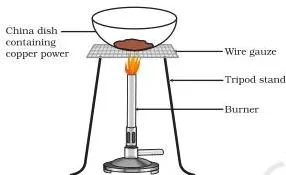
Q10. In \(2PbO(s) + C(s) \rightarrow 2Pb(s) + CO_2(g)\), which statement correctly identifies the oxidised and reduced species?
- (a) PbO is reduced because it loses oxygen to form Pb, and carbon is oxidised because it gains oxygen to form \(CO_2\)
- (b) PbO is oxidised because its colour changes, and carbon is reduced
- (c) Both PbO and carbon are reduced at the same time
- (d) Lead is oxidised because it is left as a pure element
Correct answer: (a) Option (a) applies the definition correctly — PbO loses oxygen (reduced), carbon gains oxygen (oxidised). Option (b) judges oxidation by colour change, which is not the rule the chapter uses; oxygen transfer decides oxidation and reduction, not appearance.
Option (c) is impossible in a redox reaction — one reactant is always oxidised while the other is reduced, never both reduced together.
Option (d) wrongly assumes forming a pure element means oxidation; here, lead becomes a pure element because \(PbO\) lost oxygen, which is reduction, not oxidation.
Q11. Tin is extracted from its ore by heating \(SnO_2\) with carbon: \(SnO_2 + 2C \rightarrow Sn + 2CO\). Which reactant is oxidised and which is reduced?
- (a) \(SnO_2\) is reduced because it loses oxygen to become Sn, and carbon is oxidised because it gains oxygen to become CO
- (b) Tin is oxidised because it appears as a free element in the product
- (c) Carbon is reduced because it is a non-metal
- (d) Both \(SnO_2\) and carbon are oxidised together
Correct answer: (a) Option (a) follows the same oxygen-transfer rule used for copper oxide and hydrogen: \(SnO_2\) loses both oxygen atoms (reduced), carbon gains oxygen to form CO (oxidised). Option (b) repeats the mistake from Q10 — becoming a free metal here is the outcome of reduction, not oxidation.
Option (c) gives an irrelevant reason; being a non-metal has nothing to do with whether a substance is oxidised or reduced. Option (d) is impossible, since a redox reaction always pairs one oxidation with one reduction, never two oxidations.
Q12. What always happens simultaneously in a redox reaction?
- (a) One reactant is oxidised while the other is reduced, at the same time
- (b) Only the reactant that visibly changes colour undergoes any chemical change
- (c) Oxidation happens first and reduction follows later, as two separate steps
- (d) Both reactants in the pair must be metals
Correct answer: (a) Option (a) is the definition of a redox reaction (NCERT, p. 12) — oxidation and reduction are paired, not independent events. Option (b) wrongly assumes only the visibly-changing reactant is reacting chemically; both reactants change, even if only one shows an obvious colour shift, as in the copper oxide example.
Option (c) is wrong because both processes happen in the same single reaction, not in sequence. Option (d) is disproved by the tin example above, where carbon, a non-metal, is one of the two reactants.
MCQ Set 5: Corrosion and Rancidity in Daily Life
Corrosion happens when a metal is attacked by moisture, acids or other substances around it (NCERT, p. 13). Rancidity happens when fats and oils are oxidised, changing their smell and taste (NCERT, p. 13). Both are everyday consequences of the same oxidation chemistry covered in Set 4 — a link worth revising alongside the ionic behaviour in Acids, Bases and Salts.
Q13. Which of these observations count as corrosion?
- (a) Rusting of an iron nail only
- (b) Rusting of iron and blackening of silver only
- (c) Rusting of iron, blackening of silver, and the green coating that forms on copper — all of these
- (d) None of these, since only a physical change is taking place
Correct answer: (c) Option (c) is correct because the chapter names all three as corrosion — a metal reacting chemically with moisture, acids or gases in its surroundings. Option (a) is too narrow; rusting is one example of corrosion, not the only one. Option (b) is still incomplete, leaving out copper’s green coating.
Option (d) is wrong because corrosion is a chemical change that produces a new compound on the metal’s surface, not a mere physical change.
Q14. Why do potato chip manufacturers often flush the packet with nitrogen gas before sealing it?
- (a) To add flavour to the chips
- (b) To prevent the oxidation of fats and oils in the chips, which is what causes rancidity
- (c) To absorb moisture and keep the chips crunchy
- (d) To speed up the natural breakdown of leftover food particles
Correct answer: (b) Option (b) matches the chapter’s explanation directly — nitrogen flushing keeps oxygen away from the fats and oils, slowing the oxidation that causes rancidity (NCERT, p. 13). Option (a) is wrong; nitrogen has no flavour role. Option (c) confuses nitrogen with a moisture-absorbing agent, which is a different job entirely.
Option (d) is the opposite of the goal — packaging is designed to slow down unwanted chemical change, not speed it up.
Assertion-Reason Questions on Chemical Reactions
This is the format CBSE has added to recent Class 10 Science papers. Each item gives an Assertion (A) and a Reason (R). You must judge whether each statement is true on its own, and — separately — whether the Reason actually explains the Assertion.
AR1. Assertion (A): While balancing \(Fe + H_2O \rightarrow Fe_3O_4 + H_2\), a coefficient of 4 is placed in front of \(H_2O\), never rewritten as \(H_2O_4\).
Reason (R): Changing a subscript alters the identity of the compound, while adding a coefficient only changes the number of molecules taking part.
- (a) Both A and R are true, and R is the correct explanation of A.
- (b) Both A and R are true, but R is not the correct explanation of A.
- (c) A is true, but R is false.
- (d) A is false, but R is true.
Correct answer: (a) Both statements are true, and R is exactly why A holds — the chapter states this rule directly when balancing \(Fe + H_2O \rightarrow Fe_3O_4 + H_2\) (NCERT, p. 4). Option (b) fails because R does explain A here, not just coincide with it. Option (c) wrongly rejects R, which is a stated textbook rule.
Option (d) wrongly rejects A, which is the correct balancing method shown step by step in the chapter.
AR2. Assertion (A): Every decomposition reaction needs heat to take place.
Reason (R): Electrolysis of water and the action of sunlight on silver chloride are also examples of decomposition reactions.
- (a) Both A and R are true, and R is the correct explanation of A.
- (b) Both A and R are true, but R is not the correct explanation of A.
- (c) A is true, but R is false.
- (d) A is false, but R is true.
Correct answer: (d) Assertion (A) is false — decomposition reactions can also be driven by light or electricity, as shown in Figures 1.6 and 1.7. Reason (R) is true and is exactly the pair of exceptions that disprove A, so the right combination is (d). Option (a) and (b) wrongly treat A as true.
Option (c) wrongly rejects R, which is a directly stated fact from the chapter (NCERT, p. 9).
AR3. Assertion (A): In \(CuO(s) + H_2(g) \rightarrow Cu(s) + H_2O(l)\), copper(II) oxide is reduced.
Reason (R): Loss of oxygen during a reaction is called reduction, and CuO loses oxygen to form Cu.
- (a) Both A and R are true, and R is the correct explanation of A.
- (b) Both A and R are true, but R is not the correct explanation of A.
- (c) A is true, but R is false.
- (d) A is false, but R is true.
Correct answer: (a) Both statements are true, and R is precisely why CuO is reduced in Figure 1.10’s reaction — it loses oxygen while hydrogen gains it (NCERT, p. 12). Option (b) wrongly separates a true reason from the fact it explains. Option (c) wrongly rejects R, which restates the chapter’s own definition of reduction.
Option (d) wrongly rejects A, which is directly true for this equation.
Competency-Based Case: Reading Temperature Data from a Reaction Experiment
A student dissolves four different salts in water in four separate beakers and records the temperature before and after mixing. Use the table to classify each beaker as exothermic or endothermic.
| Beaker | Salt Added to Water | Initial Temp (°C) | Final Temp (°C) | Temp Change (°C) |
|---|---|---|---|---|
| A | Ammonium nitrate | 26 | 21 | -5 |
| B | Calcium chloride | 26 | 34 | +8 |
| C | Sodium hydroxide | 25 | 38 | +13 |
| D | Potassium nitrate | 27 | 24 | -3 |
C1. Which beaker recorded the largest rise in temperature, and what does this tell you about the process?
- (a) Beaker C, sodium hydroxide dissolving; the +13°C rise shows a strongly exothermic process
- (b) Beaker B, calcium chloride, showing the strongest endothermic process
- (c) Beaker A, ammonium nitrate, because it shows the biggest number change
- (d) Beaker D, potassium nitrate, because its temperature changed the least
Correct answer: (a) Option (a) is correct — Beaker C shows the single largest temperature rise in the table, meaning heat was released into the water, which is the sign of an exothermic process. Option (b) wrongly calls a temperature rise “endothermic”; a rise means heat was released, not absorbed.
Option (c) confuses the size of a drop with a rise — Beaker A’s temperature fell by 5°C, it did not rise. Option (d) picks the smallest change in the table, the opposite of what the question asks.
C2. Which beakers show an endothermic process, and how can you tell from the data?
- (a) Beakers A and D, because their final temperature is lower than their initial temperature, meaning the dissolving process absorbed heat from the water
- (b) Beakers B and C, because their temperature rose
- (c) Only Beaker A, because it shows the biggest drop
- (d) None of the beakers, since dissolving a salt is always exothermic
Correct answer: (a) Option (a) correctly reads the table — a falling temperature means the process took in heat from the surrounding water, which is endothermic. Option (b) wrongly labels a temperature rise as endothermic; a rise indicates heat was released, not absorbed. Option (c) misses Beaker D, which also cooled, just by a smaller amount.
Option (d) is contradicted by the table itself, where two of four beakers cooled down.
C3. A classmate says Beaker C’s reaction must be a decomposition reaction because heat was released. Is this reasoning correct?
- (a) Yes, because release of heat is unique to decomposition reactions
- (b) No, because releasing heat only shows the process is exothermic; sodium hydroxide dissolving in water is not a single compound breaking into simpler products, so it is not decomposition
- (c) Yes, because sodium hydroxide always decomposes in water
- (d) No, because temperature readings cannot show whether a process is exothermic or endothermic
Correct answer: (b) Option (b) is correct: exothermic behaviour alone never identifies the reaction type — it only tells you heat was released. Option (a) gets the pattern backwards; if anything, decomposition reactions are mostly endothermic, not exothermic. Option (c) invents a claim about sodium hydroxide that has no basis in the data or the chapter.
Option (d) contradicts the very purpose of the experiment — temperature change is exactly how exothermic and endothermic processes are told apart.
C4. Ranking the four beakers from most exothermic to most endothermic using the temperature-change data, which order is correct?
- (a) C > B > D > A
- (b) A > D > B > C
- (c) B > C > A > D
- (d) D > A > C > B
Correct answer: (a) Option (a) follows the temperature-change column exactly: +13 (C), +8 (B), -3 (D), -5 (A) — from most heat released to most heat absorbed. Option (b) reverses the order completely. Option (c) wrongly places B ahead of C, when C has the larger rise. Option (d) mixes endothermic and exothermic beakers in the wrong sequence entirely.
Answer Key: Chemical Reactions and Equations MCQs
| Question No. | Correct Answer |
|---|---|
| Q1 | (a) |
| Q2 | (a) |
| Q3 | (a) |
| Q4 | (b) |
| Q5 | (c) |
| Q6 | (b) |
| Q7 | (a) |
| Q8 | (a) |
| Q9 | (b) |
| Q10 | (a) |
| Q11 | (a) |
| Q12 | (a) |
| Q13 | (c) |
| Q14 | (b) |
| AR1 | (a) |
| AR2 | (d) |
| AR3 | (a) |
| C1 | (a) |
| C2 | (a) |
| C3 | (b) |
| C4 | (a) |
Frequently Asked Questions on Chemical Reactions Class 10 MCQs
How many marks does Chemical Reactions and Equations usually carry in objective-type questions in Class 10 Science?
The exact marks fixed for objective questions from this chapter change with the year’s official CBSE syllabus and sample paper, so check that document rather than assume a fixed figure. What stays consistent is the concept load — balancing equations, the six reaction types, and oxidation-reduction show up repeatedly as MCQs, assertion-reason items, and short-answer questions.
What is the quickest way to tell a combination reaction apart from a double displacement reaction in an MCQ?
Count the products. A combination reaction forms exactly one product from two or more reactants. A double displacement reaction always forms two different products, because ions from two compounds swap partners. If you see two compounds on the left and two different compounds on the right, it is double displacement, not combination.
Why is cleaning a magnesium ribbon with sandpaper important before burning it, and how do MCQs test this?
Cleaning removes any coating that may already exist on the ribbon’s surface, so the visible burning you observe is a clean reaction between magnesium metal and oxygen in the air — exactly what Activity 1.1 in the chapter demonstrates. MCQs test this by asking you to reason about the purpose of a preparation step, not just recall the observation.
Are assertion-reason questions from Chemical Reactions and Equations common in the CBSE Class 10 board paper?
Assertion-reason items are part of the question format CBSE has introduced in recent Class 10 Science papers, so practising the two-part judgement — is the reason true, and does it actually explain the assertion — is worth the time. This page includes three such items built from this chapter’s balancing, decomposition and redox concepts.
How do I decide if a reaction is exothermic or endothermic when an MCQ only gives me the equation?
Look for the word “Heat” written as a product or released alongside the products — that signals an exothermic reaction, as in calcium oxide plus water. If heat, light or electricity is written above the arrow as the energy needed to drive the reaction, it is endothermic, as in most decomposition reactions.
Is rancidity the same concept as corrosion for exam purposes?
No. Corrosion affects metals reacting with moisture, acids or gases in their surroundings, while rancidity affects fats and oils that undergo oxidation and develop an unpleasant smell and taste.
Both appear in the same section of the chapter because both are everyday examples of unwanted oxidation, but they apply to different materials and need to be defined separately in an answer.
For the official textbook chapter this set is based on, see the NCERT Class 10 Science Chapter 1 PDF, which carries the full activities, figures and exercise questions referenced above. For revision beyond this chapter, browse the wider Class 10 CBSE notes or the complete CBSE notes index.
Reference: NCERT Class 10 Science textbook, chapter Chemical Reactions and Equations.
Explore Class 10 Science MCQs
More for this chapter:
- Chemical Reactions and Equations Notes
- Chemical Reactions and Equations Formulas
- Chemical Reactions and Equations Important Questions
- Chemical Reactions and Equations Previous Year Questions
- Chemical Reactions and Equations NCERT Solutions
Class 10 Science on LearnCBSE:
Related chapters: