This page collects chemical reactions class 10 previous year questions from the CBSE Class 10 Science papers on hand for 2023, 2024 and 2025. Every question below is a genuine board question, tagged with its true year, set and marks wherever the paper records them, followed by an original step-by-step answer.
If you are revising Chemical Reactions and Equations for the 2026-27 board exam, this chapter has shown up in every science paper reviewed from 2023 to 2025 — usually as one or two short-answer questions plus an objective-type item. No claim here predicts what a future paper will ask; it only reports what these papers actually asked.
Marks Distribution and Most-Tested Topics (2023-2025)
The table below is built only from questions on hand in the corpus. Where a paper did not record marks against a question, that cell shows only the question count, never a placeholder.
| Year | Questions seen | Marks recorded | Question types |
|---|---|---|---|
| 2023 | 3 questions | 1×3m, 1×2m (one question’s marks were not recorded) | Short answer, reasoning-based identification, redox justification |
| 2024 | 9 distinct questions across multiple sets | 3×2m, 1×5m (remaining questions counted without a marks cell) | Objective-type (1 mark), short answer (2 marks), long answer with an OR choice (5 marks) |
| 2025 | 4 questions | 1×3m | Objective-type, short answer with equations |
Most-tested topics inside this chapter, each tied to a real question below:
- Combination and decomposition reactions — calcium oxide reacting with water, and thermal decomposition of ferrous sulphate, lead nitrate or silver chloride.
- Writing a balanced equation while naming the observed change — colour change, temperature change or precipitate formation asked together, not separately.
- Oxidation of copper on heating versus corrosion of copper in open air — two different reactions on the same metal that examiners like to contrast.
- Redox reaction identification, most often built around \( MnO_2 + 4HCl \).
- Spotting which everyday situation is or is not a chemical reaction — a physical change like melting is the usual trap.
Across the papers reviewed, this chapter contributed one 2-3 mark short-answer question in nearly every set, with an occasional 5-mark long question built around combination, decomposition and redox concepts together.
CBSE 2025 Chemical Reactions Questions (Solved)
Q1. Nature of the calcium oxide–water reaction (CBSE 2025, Set 5)
The chemical reaction of solid calcium oxide with water is: (A) exothermic, pH less than 7 (B) endothermic, pH less than 7 (C) endothermic, pH more than 7 (D) exothermic, pH more than 7.
- Step 1: Write the reaction: \( CaO(s) + H_2O(l) \rightarrow Ca(OH)_2(aq) \).
- Step 2: This reaction releases a large amount of heat, so it is exothermic.
- Step 3: The product, calcium hydroxide, is a base dissolved in water, so its pH is more than 7.
Final answer: Option (D) — exothermic and the pH of the solution formed is more than 7.
Q2. One equation each for temperature change, colour change and precipitate formation (CBSE 2025, Set 5)
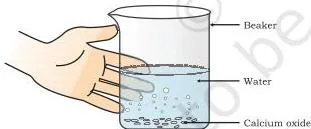
Step 1 (temperature change): Calcium oxide reacting with water releases heat, so the mixture becomes warm.
\[ CaO(s) + H_2O(l) \rightarrow Ca(OH)_2(aq) + \text{Heat} \]
Step 2 (colour change): Green ferrous sulphate crystals turn brown on heating as they decompose.
\[ 2FeSO_4(s) \xrightarrow{\text{Heat}} Fe_2O_3(s) + SO_2(g) + SO_3(g) \]
Step 3 (precipitate formation): Barium chloride solution mixed with sodium sulphate solution gives an insoluble white solid.
\[ BaCl_2(aq) + Na_2SO_4(aq) \rightarrow BaSO_4(s) + 2NaCl(aq) \]
Final answer: Each equation above is labelled with the exact change it demonstrates — this labelling is what a marking scheme checks for, not just the equation.
Q3. Which situation is NOT a chemical reaction (CBSE 2025, Set 1)
Options: (a) milk left open in summer (b) fermentation of grapes (c) iron nail exposed to humid air (d) melting of glaciers.
- Step 1: In options (a), (b) and (c), the identity of the substance changes — souring, fermentation and rusting all form new substances.
- Step 2: Melting of glaciers is only a change of state, from solid ice to liquid water. The substance is still \( H_2O \); nothing new is formed.
Final answer: Option (d) — melting of glaciers is a physical change, not a chemical reaction.
Q4. Copper powder heated versus copper corroding in air (CBSE 2025, Set 3, 3 marks)
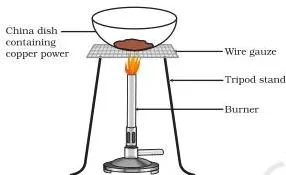
Step 1: On heating, the surface of copper powder becomes coated black.
This is caused by oxidation — copper gains oxygen from the air.
\[ 2Cu(s) + O_2(g) \xrightarrow{\text{Heat}} 2CuO(s) \]
- Step 1: This is a fast reaction driven by heat, producing black copper(II) oxide directly.
- Step 2: Copper left in open air is not heated. It reacts slowly with moisture and gases present in air over time, and a green coating forms on its surface instead of the black oxide.
Final answer: Heating gives fast oxidation to black \( CuO \); ordinary corrosion in open air is a slow reaction at room temperature that leaves a green coating — the two are different rates and different products of attack by oxygen and moisture.
CBSE 2024 Chemical Reactions Questions (Solved)
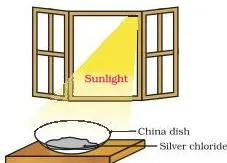
Q5. Essential conditions and equation for AgCl and FeSO4 decomposition (CBSE 2024, Set 3)
Step 1: Silver chloride decomposes only when light energy is supplied — this is the essential condition.
\[ 2AgCl(s) \xrightarrow{\text{Sunlight}} 2Ag(s) + Cl_2(g) \]
- Step 1: This is a decomposition reaction — one reactant breaks into simpler products under light, so it is called a photochemical decomposition.
- Step 2: Ferrous sulphate crystals decompose only when heated — the essential condition is heat.
\[ 2FeSO_4(s) \xrightarrow{\Delta} Fe_2O_3(s) + SO_2(g) + SO_3(g) \]
Final answer: Both are decomposition reactions; AgCl needs sunlight (photochemical decomposition) and FeSO4 needs heat (thermal decomposition).
Q6. One equation each for colour change, temperature change and precipitate formation (CBSE 2024, Set 1)
Step 1 (colour change): Ferrous sulphate crystals change from green towards brown on heating as they decompose.
\[ 2FeSO_4(s) \xrightarrow{\Delta} Fe_2O_3(s) + SO_2(g) + SO_3(g) \]
Step 2 (temperature change/rise): Calcium oxide reacting with water gives out heat.
\[ CaO(s) + H_2O(l) \rightarrow Ca(OH)_2(aq) + \text{Heat} \]
Step 3 (precipitate): Barium chloride and sodium sulphate solutions give an insoluble white solid.
\[ BaCl_2(aq) + Na_2SO_4(aq) \rightarrow BaSO_4(s) + 2NaCl(aq) \]
Final answer: The three equations above, each with its named change, complete the answer — the change and the equation must be stated side by side.
Q7. Naming the reaction with exchange of ions (CBSE 2024, Set 2)
Options: (A) Endothermic Reaction (B) Exothermic Reaction (C) Double Displacement Reaction (D) Displacement Reaction.
Step 1: A reaction in which two compounds exchange ions between the reactants to form two new compounds is a double displacement reaction, as seen when \( Na_2SO_4 \) and \( BaCl_2 \) exchange their sulphate and chloride ions.
Final answer: Option (C) — Double Displacement Reaction.
Q8. Identifying product ‘X’ from CaCO3 decomposition (CBSE 2024, Set 1)
\( CaCO_3 \xrightarrow{\Delta} \text{‘X’} + CO_2 \); Options: (A) Quick lime (B) Gypsum (C) Lime Stone (D) Plaster of Paris. This objective question repeated with the same wording in Set 2 and Set 3 of the same year.
Step 1: On heating, limestone (calcium carbonate) breaks down into calcium oxide and carbon dioxide.
\[ CaCO_3(s) \xrightarrow{\text{Heat}} CaO(s) + CO_2(g) \]
Step 2: Calcium oxide is commonly called quick lime.
Final answer: Option (A) — Quick lime.
Q9. One example each of gas evolution and colour change (CBSE 2024, Set 3)
Step 1 (gas evolution): Zinc granules added to dilute sulphuric acid release hydrogen gas.
\[ Zn(s) + H_2SO_4(aq) \rightarrow ZnSO_4(aq) + H_2(g) \]
Step 2 (colour change): An iron nail dipped in copper sulphate solution turns brownish, and the blue colour of the solution fades.
\[ Fe(s) + CuSO_4(aq) \rightarrow FeSO_4(aq) + Cu(s) \]
Final answer: Both examples above are correct answers for gas evolution and colour change respectively.
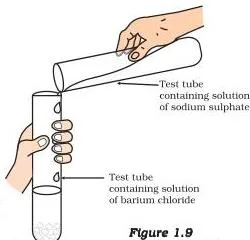
Q10. Copper heated OR barium chloride + sodium sulphate with ions (CBSE 2024, Set 1, 2 marks)
This question also appeared with the same OR structure in Set 2 and Set 3.
Step 1 (Option a): Copper powder heated in a china dish turns black as copper(II) oxide forms.
\[ 2Cu(s) + O_2(g) \xrightarrow{\text{Heat}} 2CuO(s) \]
Step 2 (Option b): Barium chloride solution reacts with sodium sulphate solution to give a white precipitate of barium sulphate.
\[ BaCl_2(aq) + Na_2SO_4(aq) \rightarrow BaSO_4(s) + 2NaCl(aq) \]
Step 3: The ions present in the precipitated compound are \( Ba^{2+} \) and \( SO_4^{2-} \); sodium and chloride ions remain dissolved as \( Na^+ \) and \( Cl^- \).
Final answer: Either route earns full marks: black copper(II) oxide by heating, or barium sulphate precipitate with \( Ba^{2+} \) and \( SO_4^{2-} \) identified.
Q11. Magnesium burning to white ash — reaction type and justification (CBSE 2024, Set 1, 2 marks)
Step 1: Magnesium ribbon burns in air with a dazzling white flame, forming white magnesium oxide ash.
\[ 2Mg(s) + O_2(g) \rightarrow 2MgO(s) \]
- Step 1: Two reactants, magnesium and oxygen, combine to form a single product, magnesium oxide. This makes it a combination reaction.
- Step 2: Heat and light are given out during the reaction, which also makes it exothermic.
Final answer: It is a combination reaction, because two reactants join to give a single product, magnesium oxide.
Q12. Reaction type of calcium oxide and water, with justification (CBSE 2024, Set 1, 2 marks)
- Step 1: Write the equation: \( CaO(s) + H_2O(l) \rightarrow Ca(OH)_2(aq) \).
- Step 2: Two reactants, calcium oxide and water, combine to give a single product, calcium hydroxide.
Final answer: It is a combination reaction; naming the type without this equation and reasoning would earn only partial credit under the marking scheme.
Q13. Five-mark question with an OR choice (CBSE 2024, Set 1, 5 marks)
Option (a) — activities for colour change and temperature change: Heating ferrous sulphate crystals shows a colour change from green towards brown as \( 2FeSO_4(s) \xrightarrow{\Delta} Fe_2O_3(s) + SO_2(g) + SO_3(g) \).
Adding water to calcium oxide shows a temperature rise, felt on touching the container, as \( CaO(s) + H_2O(l) \rightarrow Ca(OH)_2(aq) \).
Option (b), part (i) — decomposition reaction: A decomposition reaction is one where a single reactant breaks down into two or more simpler products.
Electrolysis of water uses electrical energy to split water into hydrogen and oxygen gas.
Silver bromide decomposes into silver and bromine when exposed to sunlight, using light energy.
Option (b), part (ii) — opposite reactions: Calcium oxide is formed when calcium carbonate decomposes on heating: \( CaCO_3(s) \xrightarrow{\text{Heat}} CaO(s) + CO_2(g) \).
This single substance splitting into two products is a decomposition reaction.
Calcium hydroxide is formed when calcium oxide combines with water: \( CaO(s) + H_2O(l) \rightarrow Ca(OH)_2(aq) \).
This is two substances joining into one, a combination reaction — the exact reverse process.
That is why the two reactions are called opposite to each other.
Final answer: Both option (a) and option (b) are complete answers on their own; a student only needs to attempt one in full.
CBSE 2023 Chemical Reactions Questions (Solved)
Q14. Identifying substance ‘X’ and writing the equations (CBSE 2023, Set 1, 3 marks)
Substance ‘X’ is insoluble in water, used as a building material, and reacts with dilute HCl to release a gas that turns lime water milky.
- Step 1: A building material that is insoluble in water and reacts with acid to release a gas is calcium carbonate, commonly found as marble or limestone. So \( X = CaCO_3 \).
- Step 2: Write the reaction of X with dilute hydrochloric acid.
\[ CaCO_3(s) + 2HCl(aq) \rightarrow CaCl_2(aq) + H_2O(l) + CO_2(g) \]
Step 3: The gas released, carbon dioxide, turns lime water milky because it forms an insoluble precipitate.
\[ Ca(OH)_2(aq) + CO_2(g) \rightarrow CaCO_3(s) + H_2O(l) \]
Final answer: X is calcium carbonate \( (CaCO_3) \); the two equations above show its reaction with acid and the lime water test on the gas produced.
Q15. Silver chloride turning grey in sunlight (CBSE 2023, Set 1)
- Step 1: Before exposure to sunlight, silver chloride is white.
- Step 2: On exposure to sunlight, it decomposes into grey silver metal and chlorine gas — a photochemical decomposition reaction.
\[ 2AgCl(s) \xrightarrow{\text{Sunlight}} 2Ag(s) + Cl_2(g) \]
Step 3: This light sensitivity is used in black and white photography.
Silver bromide \( (AgBr) \) behaves the same way and can be used for the same purpose.
Final answer: Silver chloride was white; it decomposes in sunlight (photochemical decomposition) to silver and chlorine; it is used in black and white photography, and silver bromide is the alternative chemical for the same use.
Q16. Is MnO2 + 4HCl a redox reaction? (CBSE 2023, Set 1, 2 marks)
\( MnO_2 + 4HCl \rightarrow MnCl_2 + 2H_2O + Cl_2 \)
- Step 1: Check what each reactant loses or gains. \( MnO_2 \) loses oxygen to become \( MnCl_2 \), so manganese dioxide is reduced.
- Step 2: \( HCl \) loses hydrogen and forms \( Cl_2 \), so hydrochloric acid is oxidised.
- Step 3: Since one reactant is oxidised while the other is reduced in the same reaction, it fits the definition of a redox reaction.
Final answer: Yes, it is a redox reaction — \( HCl \) is oxidised to \( Cl_2 \) and \( MnO_2 \) is reduced to \( MnCl_2 \).
What CBSE Examiners Specifically Reward in This Chapter
Across the 2023-2025 answers above, a bare reaction-type label without the supporting equation earned only partial credit whenever the question wording used “justify” or “write the equation.” The 2-mark short answer questions across the 2024 sets consistently paired “name the reaction type” with “write the balanced equation” — naming the type alone was an incomplete answer for full credit.
Questions that ask to “give one equation” for a colour change, temperature change or precipitate expect the change itself to be named next to the equation, not just the bare equation. Q2, Q6 and Q13 above show this pairing.
When a question offers an OR choice, as in the 2024 five-mark question (Q13), both options are drawn from this same chapter. A student should read both stems first, then attempt whichever option matches their stronger topic — decomposition and redox concepts on one side, combination and decomposition contrast on the other — rather than assuming the two options test different chapters.
For a wider revision of the chapter’s definitions and reaction types before attempting more practice questions, the Class 10 Science notes cover each reaction type with the same equations used above.
Common Mistakes Students Make on Chemical Reactions PYQs
| Mistake | Correct rule | How to check your answer |
|---|---|---|
| Calling the calcium oxide + water reaction a decomposition reaction because heat is released | Decomposition means one reactant splits into two or more products; heat release alone does not decide the type | Count reactants: two substances (CaO and water) joining into one product (\( Ca(OH)_2 \)) is a combination reaction |
| Forgetting state symbols when the question explicitly asks for a “balanced chemical equation with state symbols” | State symbols (s), (l), (g), (aq) must be added when the question says so | Re-read the question stem; if “state symbols” is mentioned, check every formula has one attached |
| Mixing up which reactant is oxidised and which is reduced in a redox answer | Gain of oxygen or loss of hydrogen = oxidation; loss of oxygen or gain of hydrogen = reduction | Track oxygen and hydrogen atoms on each reactant separately, not the whole equation at once |
| Writing a skeletal (unbalanced) equation and stopping there | The number of atoms of each element must match on both sides before an equation is considered complete | List every element in a small table, LHS count vs RHS count, before moving to the next step |
Here is one original worked example using compounds not found anywhere in the NCERT textbook, using the same hit-and-trial method taught for balancing equations.
Worked example: sodium carbonate solution reacting with calcium chloride solution
- Step 1: Write the word equation: sodium carbonate + calcium chloride → calcium carbonate + sodium chloride.
- Step 2: Write the skeletal equation using formulae: \( Na_2CO_3 + CaCl_2 \rightarrow CaCO_3 + NaCl \).
- Step 3: Count atoms on each side. Na: 2 on the left, 1 on the right. Cl: 2 on the left, 1 on the right. Ca, C and O already match.
- Step 4: Fix Na and Cl together by placing a coefficient of 2 before \( NaCl \).
\[ Na_2CO_3 + CaCl_2 \rightarrow CaCO_3 + 2NaCl \]
- Step 1: Recheck every element: Na (2=2), C (1=1), O (3=3), Ca (1=1), Cl (2=2). The equation is balanced.
- Step 2: Add state symbols, since both starting solutions are in water and calcium carbonate is the insoluble product.
\[ Na_2CO_3(aq) + CaCl_2(aq) \rightarrow CaCO_3(s) + 2NaCl(aq) \]
Final answer: This is a double displacement (precipitation) reaction — the \( Ca^{2+} \) and \( CO_3^{2-} \) ions exchange partners with \( Na^+ \) and \( Cl^- \), and the insoluble calcium carbonate settles out as a precipitate.
For the full list of exercise-style questions this chapter carries in the NCERT textbook — useful for building the base before attempting board-style questions — see the broader Class 10 CBSE notes and the CBSE notes section for other chapters and subjects.
Frequently Asked Questions on Chemical Reactions Class 10 Previous Year Questions
How many marks does the Chemical Reactions and Equations chapter usually carry in the CBSE Class 10 Science paper?
In the papers reviewed for 2023 to 2025, this chapter contributed between 2 and 5 marks per paper, usually through one short-answer question of 2-3 marks plus an objective-type item, with one long 5-mark question appearing in the 2024 set reviewed.
Which reaction type from this chapter is asked most often as a short-answer question?
Combination and decomposition reactions were asked most often, especially the calcium oxide–water reaction and the thermal or photochemical decomposition of ferrous sulphate, lead nitrate and silver chloride.
Is the reaction between calcium oxide and water a combination reaction or an exothermic decomposition reaction in past papers?
It is a combination reaction. Two reactants, calcium oxide and water, join to form a single product, calcium hydroxide. The heat released only tells you the reaction is exothermic; it does not change the reaction type, which several past-paper answers got wrong.
Do CBSE board papers expect state symbols in the balanced equation for this chapter’s questions?
Only when the question explicitly asks for state symbols, as seen in some equation-writing questions. When the question simply says “write the balanced equation,” state symbols are good practice but the marking scheme centres on correct balancing and the correct products.
What kind of long answer question has appeared from this chapter, and how is the OR choice structured?
The 5-mark long question seen in the 2024 paper offered an OR between describing activities for colour and temperature change, or defining decomposition reactions with electrolysis and silver bromide examples plus the combination–decomposition opposite-reaction argument. Both halves of the OR are drawn from this same chapter, not from different chapters.
Why does the reaction between silver chloride and sunlight appear repeatedly across different years?
Because it demonstrates three ideas examiners like to test together in one reaction: decomposition, the need for light energy (an endothermic-style requirement), and a real-world use in photography — which makes it useful for testing definitions, equations and applications in a single question.
Reference: CBSE Class 10 Science board question papers via cbse.gov.in; all solutions are original.
Explore Class 10 Science Previous Year Questions
- Class 10 Science Previous Year Questions
- Class 10 Previous Year Questions
- CBSE Previous Year Questions for Classes 1 to 12
More for this chapter:
- Chemical Reactions and Equations Notes
- Chemical Reactions and Equations Formulas
- Chemical Reactions and Equations Important Questions
- Chemical Reactions and Equations MCQ Questions
- Chemical Reactions and Equations NCERT Solutions
Class 10 Science on LearnCBSE: