This page gives you complete NCERT solutions for class 10 science chapter 6 Control and Coordination for the 2026-27 session. Every textbook question from all three intext sets (pages 6, 9, and 12) and the twelve end-exercise questions (page 13) is solved here with concept-first reasoning, not bare answer dumps.
Each solution opens with the biological principle at work, works through the reasoning, and ends with a common-error warning. You can verify any answer against the official NCERT textbook page for Chapter 6. For broader revision, pair these solutions with our Class 10 Science notes and the Life Processes chapter notes.
Nervous System Intext Solutions (page 6)
Section 6.1 of the chapter teaches how animals detect environmental changes and respond. The core concepts are the neuron as the functional unit, the synapse as the junction between two neurons, the reflex arc as a survival shortcut through the spinal cord, and the three divisions of the brain (fore-brain, mid-brain, hind-brain) each handling different tasks (NCERT, p. 103).
Key concepts used in these five questions:
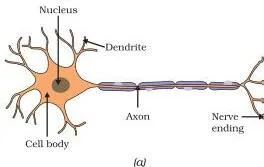
- Neuron pathway: Dendrite tip (acquire) → Cell body → Axon (electrical impulse) → Synapse (chemical signal) → Next neuron or muscle.
- Synapse: The microscopic gap between two neurons. An electrical impulse cannot cross it directly; the first neuron releases chemical neurotransmitters that start a new impulse in the next neuron.
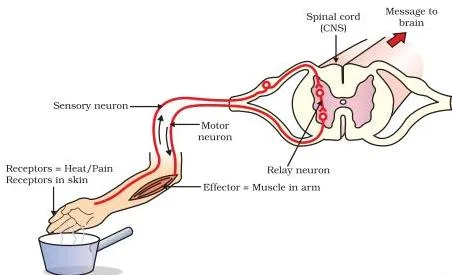
- Reflex arc: Receptor → Sensory neuron → Spinal cord → Motor neuron → Effector muscle. The brain is bypassed for speed but receives information afterwards.
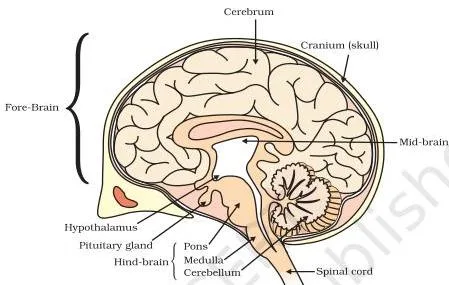
- Brain parts: Fore-brain (thinking, hearing, smell, sight, hunger). Mid-brain and hind-brain (medulla) (involuntary actions like blood pressure, salivation, vomiting). Hind-brain (cerebellum) (precision of voluntary actions, posture, balance).
Question 1: What is the difference between a reflex action and walking?
A reflex action is an involuntary, automatic response to a specific stimulus, routed through a fixed pathway called the reflex arc in the spinal cord. The body acts before the brain consciously thinks.
Walking is a voluntary, learned action controlled by the thinking part of the brain (the fore-brain), which sends instructions to leg muscles based on a conscious decision to move.
The key biological distinction is the routing of the signal. A reflex bypasses the thinking brain to save time in dangerous situations. Walking requires the brain to plan, coordinate, and adjust muscle movements continuously.
Question 2: What happens at the synapse between two neurons?
A neuron’s electrical impulse cannot leap across the physical gap between two cells. At the synapse, the arriving impulse triggers the first neuron’s axon ending to release chemical neurotransmitters into the gap. These chemicals diffuse across, bind to receptors on the next neuron’s dendrite, and start a fresh electrical impulse there. This ensures one-way, controlled signal transmission (NCERT, p. 101).
Question 3: Which part of the brain maintains posture and equilibrium of the body?
The cerebellum, a part of the hind-brain, maintains the posture and equilibrium of the body. It is responsible for the precision of voluntary actions like walking in a straight line and riding a bicycle (NCERT, p. 104). It constantly adjusts muscle signals to keep the body balanced.
Question 4: How do we detect the smell of an agarbatti (incense stick)?
Smell detection works as a signal pathway. The agarbatti’s smoke carries chemical particles into the nose. Olfactory receptors in the nasal cavity detect these chemicals and convert them into electrical impulses. These impulses travel along the olfactory nerve to the fore-brain, where specific regions interpret the signals as the sensation of smell (NCERT, p. 103).
Question 5: What is the role of the brain in reflex action?
The reflex arc is formed in the spinal cord to produce a fast, automatic response without waiting for the brain’s thinking process. However, the brain still receives the sensory information afterwards.
Its role is to process the event consciously (you feel pain after pulling your hand away from a flame) and store the memory so the body avoids the danger next time (NCERT, p. 102).
Coordination in Plants Intext Solutions (page 9)
Section 6.2 explains that plants lack a nervous system and muscles. Instead, they use electrical-chemical signals and hormones for coordination. Plants show two movement types: growth-independent (turgor pressure change, like the sensitive plant) and growth-dependent (directional tropisms) (NCERT, p. 105-107).
- Plant hormones: Auxin (cell elongation, phototropism), Gibberellin (stem growth), Cytokinin (cell division), Abscisic acid (inhibits growth, wilting).
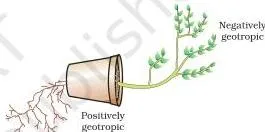
- Tropism: Directional growth toward (positive) or away (negative) from a stimulus. Types include phototropism (light), geotropism (gravity), hydrotropism (water), chemotropism (chemicals).
Question 1: What are plant hormones?
Plant hormones are chemical substances produced naturally in one part of a plant that diffuse to other parts to control growth, development, and responses to the environment. The main examples are auxin, gibberellin, cytokinin, and abscisic acid (NCERT, p. 107).
Question 2: How is the movement of leaves of the sensitive plant different from the movement of a shoot towards light?
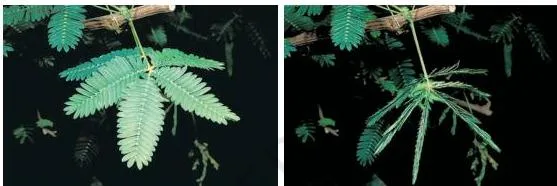
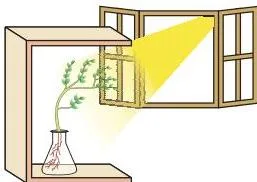
The sensitive plant (chhui-mui) folds its leaves due to turgor pressure changes—water moves out of cells, causing them to change shape. This is a growth-independent, immediate movement. A shoot bending towards light is a growth-dependent movement caused by the hormone auxin diffusing to the shady side, making cells there elongate faster.
The first is a quick electrical-chemical response; the second is a slow, directional tropism.
Question 3: Give an example of a plant hormone that promotes growth.
Auxin is a plant hormone that promotes growth. It is synthesised at the shoot tip and helps cells grow longer. Gibberellin also promotes growth by helping the stem elongate (NCERT, p. 107).
Question 4: How do auxins promote the growth of a tendril around a support?
When a tendril touches a support, auxin concentrates on the side away from the support. This high auxin concentration stimulates those cells to grow longer faster than the contact side. The unequal growth rate causes the tendril to curve inward, wrapping around the object.
Question 5: Design an experiment to demonstrate hydrotropism.
Principle: Hydrotropism is the directional growth of a plant root toward water. To demonstrate it, we must show that roots bend toward a water source even against the pull of gravity.
- Setup: Take a porous pot filled with water and bury it slightly off-centre in a larger container holding dry soil. Plant freshly germinated bean seeds in the dry soil, a few centimetres away from the porous pot.
- Control: Plant identical seeds in a second container with uniformly moist soil and no localized water source.
- Observation: After a few days, dig carefully. The roots in the experimental setup will bend toward the water-filled porous pot. In the control, roots grow normally downward.
- Conclusion: Roots exhibit positive hydrotropism, growing toward the water source despite gravity.
Hormones in Animals Intext Solutions (page 12)
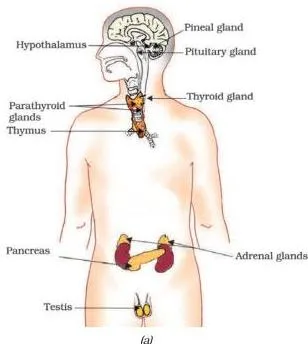
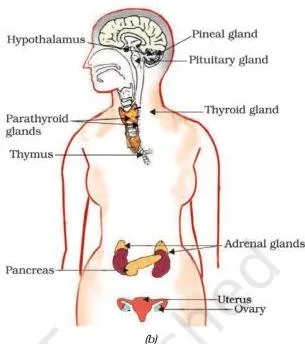
Section 6.3 covers the endocrine system, the body’s second control mechanism alongside the nervous system. Endocrine glands secrete hormones directly into the blood, which carries them to target organs. The effects are body-wide, slower than nerve impulses, but persistent and controlled by a feedback mechanism (NCERT, p. 109-110).
| Hormone | Source Gland | Function |
|---|---|---|
| Adrenaline | Adrenal gland | Fight-or-flight response |
| Thyroxin | Thyroid gland | Regulates metabolism (needs iodine) |
| Growth hormone | Pituitary gland | Regulates body growth |
| Insulin | Pancreas | Regulates blood sugar |
| Testosterone / Oestrogen | Testes / Ovaries | Puberty changes |
Question 1: How does chemical coordination take place in animals?
Chemical coordination is managed by the endocrine system. Specialised glands secrete hormones directly into the bloodstream. The blood carries these hormones throughout the body, but they act only on specific target organs that have matching receptors. This provides a slower but body-wide, persistent method of control compared to the fast, targeted nervous system.
Question 2: Why is the use of iodised salt advisable?
Iodine is essential for the thyroid gland to synthesize the thyroxin hormone, which regulates carbohydrate, protein, and fat metabolism. Without enough iodine, thyroxin cannot be produced, leading to goitre, a condition where the thyroid gland in the neck swells. Iodised salt prevents this dietary deficiency (NCERT, p. 109).
Question 3: How does our body respond when adrenaline is secreted into the blood?
Adrenaline prepares the body for a fight-or-flight response with several simultaneous actions: the heart beats faster to supply more oxygen to muscles, blood is diverted away from the digestive system and skin to the skeletal muscles, and the breathing rate increases for faster oxygen intake. These integrated changes prepare the body for rapid physical action (NCERT, p. 109).
Question 4: Why are some patients of diabetes treated by giving injections of insulin?
Insulin, produced by the pancreas, regulates blood sugar levels by helping cells absorb glucose. In diabetics, the pancreas does not produce enough insulin, causing blood sugar to rise dangerously. External insulin injections compensate for the shortfall, regulating sugar levels artificially (NCERT, p. 110).
End Exercise Solutions (page 13)
The end exercise mixes MCQs, short-answer conceptual questions, and comparison questions spanning all three sections of the chapter.
Plant hormones and MCQs (Questions 1-3)
Question 1: Which of the following is a plant hormone?
(a) Insulin
(b) Thyroxin
(c) Oestrogen
(d) Cytokinin.
Correct answer: (d) Cytokinin.
Cytokinin promotes cell division in plants. Insulin regulates blood sugar in animals, thyroxin regulates metabolism in animals, and oestrogen is an animal sex hormone.
Question 2: The gap between two neurons is called a
(a) dendrite.
(b) synapse.
(c) axon.
(d) impulse.
Correct answer: (b) synapse.
The synapse is the junction between two neurons where chemical neurotransmitters transfer the signal. (a) is a part of the neuron, (c) is the long fibre, and (d) is the signal itself.
Question 3: The brain is responsible for
(a) thinking.
(b) regulating the heart beat.
(c) balancing the body.
(d) all of the above.
Correct answer: (d) all of the above.
The fore-brain handles thinking, the medulla in the hind-brain regulates heartbeat, and the cerebellum balances the body.
Receptors and Neurons (Questions 4-5)
Question 4: What is the function of receptors in our body? Think of situations where receptors do not work properly. What problems are likely to arise?
Receptors are specialised tips of nerve cells located in sense organs that detect stimuli (light, sound, taste, smell, touch) and convert them into electrical impulses. If receptors are damaged, the body fails to detect environmental changes.
For example, if olfactory receptors are damaged, you lose the sense of smell. If gustatory receptors fail, you cannot taste food, which can lead to eating spoiled food unknowingly. Damaged pain receptors mean you might not pull your hand away from a hot surface, causing burns.
Question 5: Draw the structure of a neuron and explain its function.
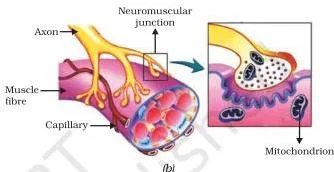
A neuron has three main parts: Dendrites (branch-like structures that receive impulses), the Cell body (containing the nucleus, where the impulse passes through), and the Axon (a long fibre that carries the electrical impulse to the end). The axon ends form a synapse with the next cell.
Function: The neuron acquires information at the dendritic tip, transmits it as an electrical impulse along the axon, and passes it to the next neuron or a muscle cell by releasing chemicals at the synapse.
Tropism and Spinal Cord (Questions 6-8)
Question 6: How does phototropism occur in plants?
When light shines from one side, the plant hormone auxin diffuses toward the shady side of the shoot. This higher auxin concentration makes the cells on the shady side grow longer faster than the lit side. The unequal growth causes the shoot to bend toward the light.
Question 7: Which signals will get disrupted in case of a spinal cord injury?
A spinal cord injury disrupts both: (1) Motor signals from the brain to muscles below the injury, causing paralysis; and (2) Sensory signals from body parts below the injury to the brain, causing loss of sensation. Reflex arcs routed through that spinal segment may also be lost, as the relay pathway is broken.
Question 8: How does chemical coordination occur in plants?
Plants use hormones for chemical coordination. These are synthesised at one site (e.g., auxin at the shoot tip) and diffuse to target areas. Auxin and gibberellin promote growth; cytokinin promotes cell division; abscisic acid inhibits growth (NCERT, p. 107).
Concept Contrasts (Questions 9-12)
Question 9: What is the need for a system of control and coordination in an organism?
Organisms must constantly detect environmental changes and respond appropriately to survive. In multicellular bodies, specialised tissues and systems are needed to integrate these signals. The nervous system provides fast, targeted responses, while hormones provide slower, body-wide, persistent regulation. Together, they ensure controlled, coordinated actions.
Question 10: How are involuntary actions and reflex actions different from each other?
Both happen without conscious thought, but they differ in mechanism and purpose. Involuntary actions (like heartbeat, breathing, digestion) are ongoing, automatic processes controlled by the mid-brain and hind-brain (medulla). Reflex actions are fast, specific responses to a sudden stimulus, routed through a fixed pathway (the reflex arc) in the spinal cord for immediate protection.
Question 11: Compare and contrast nervous and hormonal mechanisms for control and coordination in animals.
| Feature | Nervous Mechanism | Hormonal Mechanism |
|---|---|---|
| Mode of transmission | Electrical impulses via neurons | Chemical hormones via bloodstream |
| Speed | Very fast | Slower |
| Reach | Targeted to connected cells | Body-wide, reaches all cells |
| Duration of effect | Short-lived | Persistent and long-lasting |
| Example | Pulling hand from flame | Adrenaline for fight-or-flight |
Question 12: What is the difference between the manner in which movement takes place in a sensitive plant and the movement in our legs?
The sensitive plant moves its leaves by changing turgor pressure—water moves in or out of plant cells, causing them to swell or shrink. This is independent of growth. Leg movement relies on muscle cells with special proteins that change shape in response to nerve impulses, shortening the muscle.
The plant uses water movement; the animal uses protein shape change driven by nerves (NCERT, p. 106).
Method Recap (Board Revision)
Scan this block before the exam to recall the core pathways and lists.
| Pathway / Concept | Sequence / Details |
|---|---|
| Neuron Signal Path | Dendrite tip → Cell body → Axon → Synapse (chemical) → Next neuron / muscle |
| Reflex Arc | Receptor → Sensory neuron → Spinal cord → Motor neuron → Effector muscle |
| Plant Movement Types | Turgor-based (sensitive plant) vs. Growth-based (tropisms) |
| Plant Hormones | Auxin (elongation), Gibberellin (stem), Cytokinin (division), Abscisic acid (inhibits) |
| Nervous vs Hormonal | Fast/electrical/targeted vs. Slow/chemical/body-wide |
Frequently Asked Questions
What is the difference between a reflex arc and a normal nerve pathway?
A normal nerve pathway routes sensory signals all the way to the brain for conscious processing before sending motor instructions. A reflex arc bypasses the brain—signals route through the spinal cord directly to the muscle for an immediate, automatic response. The brain is informed afterwards.
Why do plants not have a nervous system but still respond to stimuli?
Plants use electrical-chemical signals that pass from cell to cell, even without specialised nervous tissue. They also rely on plant hormones like auxin that diffuse to growth zones, causing directional movements (tropisms) or turgor changes independent of growth.
What happens if the thyroid gland does not get enough iodine?
The thyroid needs iodine to synthesize thyroxin. Without iodine, thyroxin production drops, disrupting the metabolism of carbohydrates, proteins, and fats. This causes the thyroid gland to enlarge, resulting in a swollen neck—a condition called goitre.
How is adrenaline different from other hormones in its speed of action?
Adrenaline acts very quickly because it is secreted directly into the blood in emergency situations, instantly ramping up heart rate and breathing. Most other hormones regulate slower, ongoing processes like growth or metabolism, taking effect over hours or days.
Why do we need both a nervous system and hormones for control and coordination?
The nervous system provides fast, targeted responses for urgent situations, but it only reaches cells connected by neurons. Hormones provide slower, body-wide chemical signals that reach all cells and maintain long-term regulation like growth, metabolism, and reproduction. Both are needed for complete control.
To revise the broader syllabus, check our CBSE notes hub or Class 10 notes index, including the How do Organisms Reproduce chapter.
Reference: NCERT Class 10 Science textbook, chapter Control and Coordination.
Explore Class 10 Science NCERT Solutions
Class 10 Science on LearnCBSE:
Related chapters: