
These NCERT Solutions for Class 10 Science Chapter 11 (Electricity) solve all 23 intext questions and every one of the 18 chapter exercise questions, step by step. Each answer opens with the principle behind it, states the formula with its SI unit, carries units through every substitution, and ends with the common error that loses marks on that exact question.
Everything on this page follows the NCERT Class 10 Science textbook for the 2026-27 session.
The official class 10 Science Electricity chapter PDF on the NCERT site carries the same questions and figures, so you can check any solution here against the printed source page by page — no sign-up needed. For the surrounding chapters, see our Class 10 Science notes.
Electric current and the ampere (Q1–Q3, page 2)
This set builds the two foundation ideas of electricity: what a circuit is, and how current is measured. Current is the rate of flow of charge, \(I = Q/t\), and the coulomb is defined through the charge on an electron.
- Electric circuit: a continuous and closed path of an electric current (NCERT, p. 2).
- Current: \(I = Q/t\); SI unit ampere (A), \(1\ \text{A} = 1\ \text{C/s}\) (NCERT, p. 2).
- Electron charge: an electron carries \(1.6 \times 10^{-19}\ \text{C}\); 1 C is nearly the charge of \(6 \times 10^{18}\) electrons (NCERT, p. 2).
- By convention, current flows opposite to the direction of electron flow (NCERT, p. 2).
Question 1: What does an electric circuit mean?
An electric circuit is a continuous and closed path along which electric current flows. It needs a source (a cell or battery), conducting wires, a switch, and a component such as a bulb. If the path breaks anywhere, or the switch is turned off, the current stops and the bulb does not glow (NCERT, p. 2).
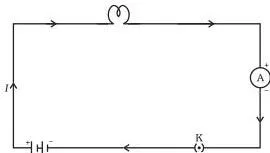
The diagram above is exactly the circuit the question means: the cell pushes charge around a closed loop through the bulb and the ammeter, and the plug key completes or breaks the path.
Question 2: Define the unit of current.
Current measures the rate at which charge flows, so its unit, the ampere (A), is defined from that rate. One ampere is the current when one coulomb of charge passes a cross-section of the conductor in one second:
\[ 1\ \text{A} = \frac{1\ \text{C}}{1\ \text{s}} \]
Smaller currents use the milliampere (\(1\ \text{mA} = 10^{-3}\ \text{A}\)) or the microampere (\(1\ \mu\text{A} = 10^{-6}\ \text{A}\)). An ammeter, connected in series, measures current (NCERT, p. 2).
Question 3: Calculate the number of electrons constituting one coulomb of charge.
Each electron carries a charge \(e = 1.6 \times 10^{-19}\ \text{C}\). To find how many electrons make up a total charge \(Q\), divide \(Q\) by the charge of one electron:
Step 1: Put \(Q = 1\ \text{C}\) and \(e = 1.6 \times 10^{-19}\ \text{C}\).
\[ N = \frac{Q}{e} = \frac{1}{1.6 \times 10^{-19}} = 6.25 \times 10^{18} \]
Final answer: \(6.25 \times 10^{18}\) electrons constitute one coulomb of charge. The textbook rounds this to “nearly \(6 \times 10^{18}\) electrons” (NCERT, p. 2).
Potential difference and the volt (Q1–Q3, page 4)
Potential difference is the “electric pressure” that sets charge in motion. The defining relation is \(V = W/Q\) — work done per unit charge — and its SI unit, the volt, is one joule per coulomb.
- Potential difference: \(V = W/Q\) (NCERT, p. 3).
- Volt: \(1\ \text{V} = 1\ \text{J C}^{-1}\) (NCERT, p. 3).
- Voltmeter measures potential difference and is always connected in parallel across the two points (NCERT, p. 3).
- Energy supplied: \(W = VQ\), so a battery of potential difference \(V\) gives \(V\) joules of energy to each coulomb of charge.
Question 1: Name a device that helps to maintain a potential difference across a conductor.
A cell or a battery maintains the potential difference. The chemical action inside the cell generates a potential difference across its terminals even when no current is drawn; when the cell is connected to a circuit, that difference sets the charges in motion and produces current (NCERT, p. 3).
Question 2: What is meant by saying that the potential difference between two points is 1 V?
It means that 1 joule of work is done to move a charge of 1 coulomb from one point to the other. From \(V = W/Q\), \[ 1\ \text{V} = \frac{1\ \text{J}}{1\ \text{C}} = 1\ \text{J C}^{-1} \]
So the volt is a unit of work per unit charge — not per unit time (NCERT, p. 3).
Question 3: How much energy is given to each coulomb of charge passing through a 6 V battery?
Energy given equals the work done by the battery on the charge, \(W = VQ\). Each coulomb means \(Q = 1\ \text{C}\), and the battery’s potential difference is \(V = 6\ \text{V}\):
\[ W = VQ = 6\ \text{V} \times 1\ \text{C} = 6\ \text{J} \]
Final answer: each coulomb passing through the 6 V battery receives 6 joules of energy.
Ohm’s law, resistance and its factors (Q1–Q5, page 11)
Ohm’s law ties voltage, current and resistance together as \(V = IR\), and the resistance itself depends on the conductor’s geometry and material through \(R = \rho l/A\). Question 5 also asks you to read resistivity values from Table 11.2.
- Ohm’s law: \(V \propto I\) at constant temperature, so \(V = IR\) (NCERT, p. 6).
- Resistance: \(R = V/I\), SI unit ohm (\(\Omega\)); \(1\ \Omega = 1\ \text{V/A}\) (NCERT, p. 6).
- Resistivity: \(R = \rho l/A\), unit \(\Omega\ \text{m}\); a property of the material only (NCERT, p. 8-9).
- The V–I graph for a metallic wire is a straight line through the origin (NCERT, p. 6).
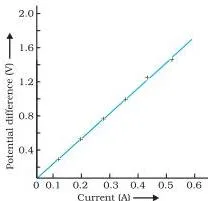
This straight line through the origin is the whole point of Ohm’s law: doubling the current doubles the potential difference, so the ratio \(V/I\) stays constant, and that constant is the resistance \(R\).
Question 1: On what factors does the resistance of a conductor depend?
Resistance depends on three things: the length of the conductor (directly proportional), its area of cross-section (inversely proportional), and the nature of the material. These are combined in \[ R = \rho \frac{l}{A} \]
where \(\rho\) is the resistivity of the material (NCERT, p. 8-9).
Question 2: Will current flow more easily through a thick wire or a thin wire of the same material, when connected to the same source? Why?
Current flows more easily through the thick wire. A thicker wire has a larger area of cross-section \(A\), and since \(R = \rho l/A\), a larger area gives a smaller resistance. With the same source voltage \(V\), Ohm’s law \(I = V/R\) then gives a larger current (NCERT, p. 8).
Question 3: Let the resistance of an electrical component remains constant while the potential difference across the two ends of the component decreases to half of its former value. What change will occur in the current through it?
With resistance fixed, current is directly proportional to voltage, \(I = V/R\). If the voltage halves, the current must also halve:
\[ I_{\text{new}} = \frac{V/2}{R} = \frac{1}{2} \times \frac{V}{R} = \frac{I}{2} \]
Final answer: the current becomes half of its former value.
Question 4: Why are coils of electric toasters and electric irons made of an alloy rather than a pure metal?
Alloys are chosen because they (i) have a higher resistivity than their constituent pure metals, so they produce the heat needed for the appliance, and (ii) do not oxidise (burn) readily at high temperatures, so the coils keep working at red heat without degrading (NCERT, p. 9). Pure metals would melt or oxidise quickly in the same conditions.
Question 5: Use the data in Table 11.2 to answer the following –
- (a) Which among iron and mercury is a better conductor?
- (b) Which material is the best conductor?
Part (a): a lower resistivity means a better conductor. From Table 11.2, iron has resistivity \(10.0 \times 10^{-8}\ \Omega\ \text{m}\) and mercury \(94.0 \times 10^{-8}\ \Omega\ \text{m}\) (NCERT, p. 9).
Part (a) answer: iron is the better conductor because its resistivity is much lower than mercury’s.
Part (b): scan the conductors column for the smallest resistivity value. Silver has \(1.60 \times 10^{-8}\ \Omega\ \text{m}\), the lowest of all listed materials (NCERT, p. 9).
Part (b) answer: silver is the best conductor.
Circuit diagrams and series connections (Q1–Q2, page 15)
These two questions test standard circuit symbols and the behaviour of a series circuit: the same current flows through every resistor, while the supply voltage splits across them in proportion to each resistance.
- Series: \(R_s = R_1 + R_2 + R_3\); current is the same everywhere (NCERT, p. 14).
- Ammeter goes in series; voltmeter goes in parallel across the points being measured (NCERT, p. 2, 3).
- Voltage splits: \(V = V_1 + V_2 + V_3\) and \(V_1 = IR_1\) etc. (NCERT, p. 13-14).
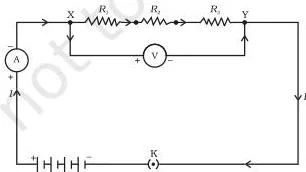
The figure shows the series pattern: the three resistors sit one after another in a single loop, so the same current passes through each in turn — that is the defining feature.
Question 1: Draw a schematic diagram of a circuit consisting of a battery of three cells of 2 V each, a 5 Ω resistor, an 8 Ω resistor, and a 12 Ω resistor, and a plug key, all connected in series.
Use the standard symbols from Table 11.1 (NCERT, p. 4) and arrange everything in one closed loop:
- Battery: three cells of 2 V each joined end to end, positive to negative, giving \(3 \times 2 = 6\ \text{V}\). Represent it either as three separate cell symbols or one battery symbol.
- Resistors: the 5 Ω, 8 Ω and 12 Ω symbols placed one after another in the wire.
- Plug key: closed switch symbol anywhere in the loop.
- Connecting wires join source to resistors and back to the source.
Because all components are in series, they form a single path: battery → 5 Ω → 8 Ω → 12 Ω → plug key → back to battery.
Question 2: Redraw the circuit of Question 1, putting in an ammeter to measure the current through the resistors and a voltmeter to measure the potential difference across the 12 Ω resistor. What would be the readings in the ammeter and the voltmeter?
Wiring: put the ammeter in series — anywhere in the loop, since series current is the same everywhere. Put the voltmeter in parallel, its two terminals joined across the two ends of the 12 Ω resistor only.
- Step 1: total resistance, \(R_s = 5 + 8 + 12 = 25\ \Omega\).
- Step 2: total voltage from the three cells, \(V = 3 \times 2 = 6\ \text{V}\).
- Step 3: current through the circuit, \(I = V/R_s\).
\[ I = \frac{6}{25} = 0.24\ \text{A} \]
Step 4: voltage across the 12 Ω resistor, \(V_{12} = IR = 0.24 \times 12 = 2.88\ \text{V}\).
Final answer: ammeter reads \(0.24\ \text{A}\); voltmeter across the 12 Ω resistor reads \(2.88\ \text{V}\).
Parallel circuits and equivalent resistance (Q1–Q5, page 18)
In parallel, every branch sees the same voltage and the total current is the sum of the branch currents. The equivalent resistance comes from the reciprocal rule \(1/R_p = 1/R_1 + 1/R_2 + 1/R_3\), and is always less than the smallest resistor in the set.
- Parallel: \(1/R_p = 1/R_1 + 1/R_2 + 1/R_3\) (NCERT, p. 16).
- Current split: \(I = I_1 + I_2 + I_3\), voltage same across every branch (NCERT, p. 15-16).
- Equivalent parallel resistance is smaller than the smallest individual resistance.
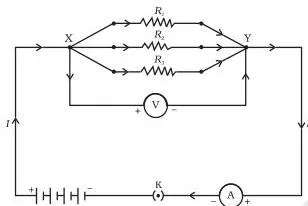
Notice the difference from Figure 11.6: each resistor now has its own path between X and Y, so current divides among the branches instead of flowing through every resistor in turn.
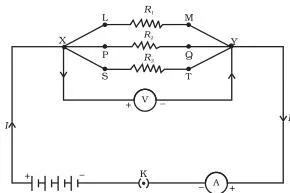
Question 1: Judge the equivalent resistance when the following are connected in parallel – (a) 1 Ω and 10⁶ Ω, (b) 1 Ω and 10³ Ω, and 10⁶ Ω.
- (a) 1 Ω and \(10^6\ \Omega\)
- (b) 1 Ω and \(10^3\ \Omega\), and \(10^6\ \Omega\)
Part (a): apply the reciprocal rule.
\[ \frac{1}{R_p} = \frac{1}{1} + \frac{1}{10^6} = 1 + 10^{-6} \approx 1 \]
Part (a) answer: \(R_p \approx 1\ \Omega\). The huge \(10^6\ \Omega\) branch carries almost no current.
Part (b): three branches in parallel.
\[ \frac{1}{R_p} = \frac{1}{1} + \frac{1}{10^3} + \frac{1}{10^6} = 1 + 0.001 + 0.000001 \approx 1.001 \]
Part (b) answer: \(R_p \approx 0.999\ \Omega\), essentially 1 Ω.
Question 2: An electric lamp of 100 Ω, a toaster of resistance 50 Ω, and a water filter of resistance 500 Ω are connected in parallel to a 220 V source. What is the resistance of an electric iron connected to the same source that takes as much current as all three appliances, and what is the current through it?
The iron must draw the same total current as the three appliances, so its resistance must equal the equivalent parallel resistance of the three.
Step 1: equivalent resistance of the three in parallel.
\[ \frac{1}{R_p} = \frac{1}{100} + \frac{1}{50} + \frac{1}{500} = \frac{5}{500} + \frac{10}{500} + \frac{1}{500} = \frac{16}{500} \]
\[ R_p = \frac{500}{16} = 31.25\ \Omega \]
Step 2: current drawn, \(I = V/R_p\).
\[ I = \frac{220}{31.25} = 7.04\ \text{A} \]
Final answer: the iron must have resistance \(31.25\ \Omega\), and it carries \(7.04\ \text{A}\) from the 220 V source.
Question 3: What are the advantages of connecting electrical devices in parallel with the battery instead of connecting them in series?
- Same voltage to every device: each appliance receives the full supply voltage and works at its rated value (NCERT, p. 17).
- Independent operation: if one device fails or is switched off, the others keep working — in series, one failure breaks the whole circuit.
- Separate currents: each gadget draws the current it needs; a parallel circuit divides current among branches instead of forcing one current through all.
- Lower equivalent resistance: from \(1/R_p = 1/R_1 + 1/R_2 + \dots\), the total resistance falls, which suits devices of different resistances (NCERT, p. 17).
Question 4: How can three resistors of resistances 2 Ω, 3 Ω, and 6 Ω be connected to give a total resistance of (a) 4 Ω, (b) 1 Ω?
- (a) 4 Ω
- (b) 1 Ω
Part (a): 4 Ω needs one resistor of 2 Ω in series with a 2 Ω combination. Connect the 3 Ω and 6 Ω in parallel first:
\[ \frac{1}{R_p} = \frac{1}{3} + \frac{1}{6} = \frac{3}{6} = \frac{1}{2}, \quad R_p = 2\ \Omega \]
Now put this 2 Ω pair in series with the 2 Ω resistor: \(2 + 2 = 4\ \Omega\).
Part (a) answer: 3 Ω and 6 Ω in parallel, then that pair in series with 2 Ω gives 4 Ω.
Part (b): 1 Ω is the classic all-parallel case.
\[ \frac{1}{R_p} = \frac{1}{2} + \frac{1}{3} + \frac{1}{6} = \frac{3+2+1}{6} = 1, \quad R_p = 1\ \Omega \]
Part (b) answer: all three resistors in parallel give exactly 1 Ω.
Question 5: What is (a) the highest, (b) the lowest total resistance that can be secured by combinations of four coils of resistance 4 Ω, 8 Ω, 12 Ω, 24 Ω?
- (a) the highest
- (b) the lowest total resistance
Part (a): resistance is greatest when resistors add, i.e. all four in series.
\[ R = 4 + 8 + 12 + 24 = 48\ \Omega \]
Part (a) answer: highest resistance is \(48\ \Omega\), with all four coils in series.
Part (b): resistance is lowest when the reciprocal rule is applied to every coil, i.e. all four in parallel.
\[ \frac{1}{R_p} = \frac{1}{4} + \frac{1}{8} + \frac{1}{12} + \frac{1}{24} = \frac{6+3+2+1}{24} = \frac{12}{24} = \frac{1}{2} \]
\[ R_p = 2\ \Omega \]
Part (b) answer: lowest resistance is \(2\ \Omega\), with all four coils in parallel.
Heating effect and Joule’s law (Q1–Q3, page 20)
When current flows through a resistor, electrical energy becomes heat. Joule’s law \(H = I^2Rt\) (or \(H = VIt\)) governs how much heat, and it explains why two parts of the same circuit can behave very differently.
- Joule’s law: \(H = VIt = I^2Rt\) (NCERT, p. 19).
- Heat is proportional to \(I^2\), to \(R\), and to time \(t\) (NCERT, p. 19).
- With charge and voltage given, \(W = VQ\) is the fastest route (NCERT, p. 3).
Question 1: Why does the cord of an electric heater not glow while the heating element does?
The cord and the heating element carry the same current because they are in series. Heat produced is \(H = I^2Rt\), so for a fixed current the heat depends on resistance \(R\).
The heating element has a very high resistance, so it produces intense heat and glows; the cord has a very low resistance, produces little heat, and stays cool (NCERT, p. 19).
Question 2: Compute the heat generated while transferring 96000 coulomb of charge in one hour through a potential difference of 50 V.
You are given charge, voltage and time, so use the charge form of the energy relation. The heat equals the work done by the source, \(H = W = VQ\) — no need to find the current separately.
Step 1: \(V = 50\ \text{V}\), \(Q = 96000\ \text{C}\).
\[ H = VQ = 50 \times 96000 = 4.8 \times 10^6\ \text{J} \]
Final answer: heat generated is \(4.8 \times 10^6\ \text{J}\) (Joule).
Question 3: An electric iron of resistance 20 Ω takes a current of 5 A. Calculate the heat developed in 30 s.
Current, resistance and time are all given, so use Joule’s law directly, \(H = I^2Rt\).
Step 1: \(I = 5\ \text{A}\), \(R = 20\ \Omega\), \(t = 30\ \text{s}\).
\[ H = I^2Rt = 5^2 \times 20 \times 30 = 25 \times 600 = 15000\ \text{J} \]
Final answer: heat developed is \(15000\ \text{J}\) (1.5 \times 10^4\ \text{J}).
Electric power and energy (Q1–Q2, page 22)
Power is the rate of energy delivery, \(P = VI\), and energy is power times time. The commercial unit of energy is the kilowatt-hour (kWh), where \(1\ \text{kWh} = 3.6 \times 10^6\ \text{J}\) (NCERT, p. 21).
- Power: \(P = VI = I^2R = V^2/R\), unit watt (W) (NCERT, p. 21).
- Energy: \(E = P \times t\); commercial unit kilowatt-hour (kWh) (NCERT, p. 21-22).
- \(1\ \text{kWh} = 3.6 \times 10^6\ \text{J}\) (NCERT, p. 22).
Question 1: What determines the rate at which energy is delivered by a current?
The rate at which energy is delivered is the electric power, \(P\). Since energy delivered in time \(t\) is \(VIt\), the rate is \[ P = \frac{VIt}{t} = VI \]
So the power (in watts) is set by the product of the potential difference \(V\) and the current \(I\) (NCERT, p. 21).
Question 2: An electric motor takes 5 A from a 220 V line. Determine the power of the motor and the energy consumed in 2 h.
Step 1: power is the product of voltage and current.
\[ P = VI = 220 \times 5 = 1100\ \text{W} = 1.1\ \text{kW} \]
Step 2: energy is power times time, best in kilowatt-hours.
\[ E = Pt = 1.1 \times 2 = 2.2\ \text{kWh} \]
In joules: \(2.2 \times 3.6 \times 10^6 = 7.92 \times 10^6\ \text{J}\).
Final answer: power is \(1100\ \text{W}\) (1.1 kW); energy consumed in 2 h is \(2.2\ \text{kWh} = 7.92 \times 10^6\ \text{J}\).
Chapter exercise: MCQs on resistance, power and heat (Q1–Q4)
The first four exercise questions are one-mark MCQs testing equivalent resistance, the forms of power, how power scales with voltage, and how heat changes between series and parallel wiring.
Question 1: A piece of wire of resistance R is cut into five equal parts. These parts are then connected in parallel. If the equivalent resistance of this combination is R’, then the ratio R/R’ is – (a) 1/25 (b) 1/5 (c) 5 (d) 25
- (a) 1/25
- (b) 1/5
- (c) 5
- (d) 25
Cutting a wire into five equal parts makes five identical pieces, each with resistance \(R/5\). Put them in parallel:
\[ \frac{1}{R’} = 5 \times \frac{1}{(R/5)} = 5 \times \frac{5}{R} = \frac{25}{R} \]
\[ R’ = \frac{R}{25} \]
Therefore \(R/R’ = R/(R/25) = 25\).
Correct answer: (d) 25.
Why the others fail: (a) 1/25 is the reciprocal of the true ratio; (b) 1/5 ignores the five-fold division of each piece; (c) 5 is what you would get from only two such pieces or a misread of the counting.
Question 2: Which of the following terms does not represent electrical power in a circuit? (a) I²R (b) IR² (c) VI (d) V²/R
- (a) \(I^2R\)
- (b) \(IR^2\)
- (c) \(VI\)
- (d) \(V^2/R\)
Power is the rate of energy delivery, and all three valid forms come from \(P = VI\) combined with Ohm’s law: \(P = I^2R\) (using \(V = IR\)) and \(P = V^2/R\) (using \(I = V/R\)).
The expression \(IR^2\) has the wrong power on \(R\) — it is not equal to \(VI\), \(I^2R\) or \(V^2/R\), so it cannot be a power.
Correct answer: (b) \(IR^2\).
The others all work: (a) \(I^2R\) is the Joule heating form, (c) \(VI\) is the defining form, (d) \(V^2/R\) is the voltage-fixed form.
Question 3: An electric bulb is rated 220 V and 100 W. When it is operated on 110 V, the power consumed will be – (a) 100 W (b) 75 W (c) 50 W (d) 25 W
- (a) 100 W
- (b) 75 W
- (c) 50 W
- (d) 25 W
The bulb’s resistance is fixed by its rating: \(R = V^2/P\). When the applied voltage changes, use \(P = V^2/R\) with this same \(R\).
Step 1: find the resistance from the rating.
\[ R = \frac{220^2}{100} = \frac{48400}{100} = 484\ \Omega \]
Step 2: power at 110 V.
\[ P = \frac{110^2}{484} = \frac{12100}{484} = 25\ \text{W} \]
Correct answer: (d) 25 W.
Why the others fail: (a) 100 W would require the full 220 V; (b) 75 W and (c) 50 W come from wrongly assuming power drops in proportion to voltage (it drops as the square).
Question 4: Two conducting wires of the same material and of equal lengths and equal diameters are first connected in series and then parallel in a circuit across the same potential difference. The ratio of heat produced in series and parallel combinations would be – (a) 1:2 (b) 2:1 (c) 1:4 (d) 4:1
- (a) 1:2
- (b) 2:1
- (c) 1:4
- (d) 4:1
The two wires are identical, so each has the same resistance \(R\). Across the same voltage, heat per unit time is \(P = V^2/R_{\text{eq}}\), so heat is inversely proportional to the equivalent resistance.
Step 1: equivalent resistances.
\[ R_{\text{series}} = R + R = 2R, \qquad R_{\text{parallel}} = \frac{R}{2} \]
Step 2: heat ratio (same \(V\), so \(H \propto 1/R_{\text{eq}}\)).
\[ \frac{H_{\text{series}}}{H_{\text{parallel}}} = \frac{1/(2R)}{1/(R/2)} = \frac{R/2}{2R} = \frac{1}{4} \]
Correct answer: (c) 1:4.
Why the others fail: (a) 1:2 and (b) 2:1 forget that heat goes with the square of the resistance change; (d) 4:1 is the reverse of the true ratio.
Chapter exercise: voltmeter connection and wire resistance (Q5–Q6)
Question 5: How is a voltmeter connected in the circuit to measure the potential difference between two points?
A voltmeter is connected in parallel across the two points whose potential difference is to be measured (NCERT, p. 3). Its two terminals go to the two points directly, so it measures the voltage drop across that portion without interrupting the current path of the circuit.
Question 6: A copper wire has diameter 0.5 mm and resistivity of 1.6 × 10⁻⁸ Ω m. What will be the length of this wire to make its resistance 10 Ω? How much does the resistance change if the diameter is doubled?
Rearrange \(R = \rho l/A\) to find length. The critical first step is converting the diameter to metres before finding the area.
Step 1: convert units.
\(d = 0.5\ \text{mm} = 0.5 \times 10^{-3}\ \text{m}\), so radius \(r = 0.25 \times 10^{-3}\ \text{m}\).
Step 2: area of cross-section, \(A = \pi r^2\).
\[ A = \pi (0.25 \times 10^{-3})^2 = \pi \times 6.25 \times 10^{-8} = 1.96 \times 10^{-7}\ \text{m}^2 \]
Step 3: length from \(l = RA/\rho\).
\[ l = \frac{10 \times 1.96 \times 10^{-7}}{1.6 \times 10^{-8}} = 122.5\ \text{m} \]
Step 4: doubling the diameter.
Since \(A = \pi d^2/4\), area is proportional to \(d^2\).
Doubling \(d\) quadruples \(A\), and because \(R \propto 1/A\), resistance falls to one-quarter.
\[ R_{\text{new}} = \frac{10}{4} = 2.5\ \Omega \]
Final answer: length needed is about \(122.5\ \text{m}\). If the diameter is doubled, the resistance drops to \(2.5\ \Omega\).
Chapter exercise: the V–I graph and Ohm’s law (Q7–Q10)
Question 7 uses the plotted V–I graph; Questions 8–10 are direct Ohm’s-law numerics. The model graph, Figure 11.3, is the straight line through the origin whose slope equals the resistance.
Question 7: The values of current I flowing in a given resistor for the corresponding values of potential difference V across the resistor are given below – I (amperes) 0.5 1.0 2.0 3.0 4.0 V (volts) 1.6 3.4 6.7 10.2 13.2 Plot a graph between V and I and calculate the resistance of that resistor.
- \(I\ (\text{A})\): 0.5, 1.0, 2.0, 3.0, 4.0
- \(V\ (\text{V})\): 1.6, 3.4, 6.7, 10.2, 13.2
Plot \(V\) on the vertical axis and \(I\) on the horizontal axis. The points fall almost on a straight line through the origin, exactly as in Figure 11.3, which confirms Ohm’s law. The resistance is the slope of that line, since \(V = IR\) has the form \(y = mx\) with slope \(R\).
Step 1: take two well-separated points on the best-fit line, say \((0.5,\ 1.6)\) and \((4.0,\ 13.2)\).
\[ R = \text{slope} = \frac{\Delta V}{\Delta I} = \frac{13.2 – 1.6}{4.0 – 0.5} = \frac{11.6}{3.5} \approx 3.3\ \Omega \]
Checking each pair: \(1.6/0.5 = 3.2\); \(3.4/1.0 = 3.4\); \(6.7/2.0 = 3.35\); \(10.2/3.0 = 3.4\); \(13.2/4.0 = 3.3\). All are about 3.2–3.4 Ω, confirming a constant resistance near \(3.3\ \Omega\).
Final answer: the V–I graph is a straight line through the origin, and the resistance is approximately \(3.3\ \Omega\).
Question 8: When a 12 V battery is connected across an unknown resistor, there is a current of 2.5 mA in the circuit. Find the value of the resistance of the resistor.
Use Ohm’s law, but first convert the current from milliamperes to amperes.
- Step 1: \(I = 2.5\ \text{mA} = 2.5 \times 10^{-3}\ \text{A}\).
- Step 2: \(R = V/I\).
\[ R = \frac{12}{2.5 \times 10^{-3}} = 4800\ \Omega \]
Final answer: the resistance is \(4800\ \Omega\) (4.8 kΩ).
Question 9: A battery of 9 V is connected in series with resistors of 0.2 Ω, 0.3 Ω, 0.4 Ω, 0.5 Ω and 12 Ω, respectively. How much current would flow through the 12 Ω resistor?
In a series circuit the current is the same through every resistor. So find the total series resistance, then the current, and that same current flows through the 12 Ω resistor.
- Step 1: total resistance, \(R_s = 0.2 + 0.3 + 0.4 + 0.5 + 12 = 13.4\ \Omega\).
- Step 2: current, \(I = V/R_s\).
\[ I = \frac{9}{13.4} \approx 0.67\ \text{A} \]
Final answer: \(0.67\ \text{A}\) flows through the 12 Ω resistor (and through every resistor in the series chain).
Question 10: How many 176 Ω resistors (in parallel) are required to carry 5 A on a 220 V line?
First find the total resistance the line must offer for 5 A to flow, then see how many 176 Ω parallel branches give that.
Step 1: required total resistance, \(R = V/I\).
\[ R = \frac{220}{5} = 44\ \Omega \]
Step 2: if \(n\) resistors of 176 Ω are in parallel, \(1/R_p = n/176\), so \(R_p = 176/n\).
Set this equal to 44:
\[ \frac{176}{n} = 44 \quad \Rightarrow \quad n = \frac{176}{44} = 4 \]
Final answer: 4 resistors of 176 Ω in parallel are required.
Chapter exercise: combinations of resistors (Q11–Q13)
These questions combine series and parallel thinking: building a target resistance from equal resistors, counting lamps on a current-limited line, and finding currents in the three wiring modes of a two-coil oven.
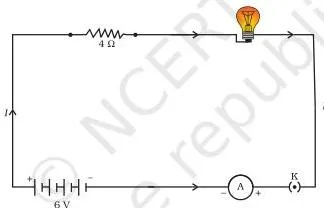
The series-lamp idea in Figure 11.9 is the pattern Question 11 exploits: combining resistors in series and parallel lets you reach resistances no single resistor gives.
Question 11: Show how you would connect three resistors, each of resistance 6 Ω, so that the combination has a resistance of (i) 9 Ω, (ii) 4 Ω.
- (i) 9 Ω
- (ii) 4 Ω
Part (i): 9 Ω needs 6 Ω plus 3 Ω, and 3 Ω is exactly two 6 Ω resistors in parallel.
\[ \frac{1}{R_p} = \frac{1}{6} + \frac{1}{6} = \frac{1}{3}, \quad R_p = 3\ \Omega \]
Now put this 3 Ω pair in series with the third 6 Ω resistor: \(3 + 6 = 9\ \Omega\).
Part (i) answer: two 6 Ω resistors in parallel (giving 3 Ω), then that pair in series with the third 6 Ω resistor gives 9 Ω.
Part (ii): 4 Ω comes from 12 Ω in parallel with 6 Ω. Make 12 Ω by putting two resistors in series:
\[ R_s = 6 + 6 = 12\ \Omega \]
Now put this 12 Ω combination in parallel with the third 6 Ω resistor:
\[ \frac{1}{R_p} = \frac{1}{12} + \frac{1}{6} = \frac{3}{12} = \frac{1}{4}, \quad R_p = 4\ \Omega \]
Part (ii) answer: two 6 Ω resistors in series (giving 12 Ω), then that pair in parallel with the third 6 Ω resistor gives 4 Ω.
Question 12: Several electric bulbs designed to be used on a 220 V electric supply line, are rated 10 W. How many lamps can be connected in parallel with each other across the two wires of 220 V line if the maximum allowable current is 5 A?
Find the current one lamp draws, then divide the line limit by it.
Step 1: current per lamp, \(I = P/V\).
\[ I_{\text{lamp}} = \frac{10}{220} = \frac{1}{22}\ \text{A} \]
Step 2: number of lamps, \(n = 5 \div (1/22)\).
\[ n = 5 \times 22 = 110 \]
Final answer: 110 lamps rated 10 W can be connected in parallel safely on the 5 A line.
Question 13: A hot plate of an electric oven connected to a 220 V line has two resistance coils A and B, each of 24 Ω resistance, which may be used separately, in series, or in parallel. What are the currents in the three cases?
Apply \(I = V/R\) to each of the three wiring modes. Each coil alone has \(R = 24\ \Omega\); series doubles it; parallel halves it.
Case 1 — separately: one coil of 24 Ω across 220 V.
\[ I = \frac{220}{24} \approx 9.17\ \text{A} \]
Case 2 — series: \(R = 24 + 24 = 48\ \Omega\).
\[ I = \frac{220}{48} \approx 4.58\ \text{A} \]
Case 3 — parallel: \(1/R_p = 1/24 + 1/24 = 1/12\), so \(R_p = 12\ \Omega\).
\[ I = \frac{220}{12} \approx 18.33\ \text{A} \]
Final answer: separately \(9.17\ \text{A}\) per coil; in series \(4.58\ \text{A}\); in parallel \(18.33\ \text{A}\).
Chapter exercise: power, energy and cost (Q14–Q16)
Question 14: Compare the power used in the 2 Ω resistor in each of the following circuits: (i) a 6 V battery in series with 1 Ω and 2 Ω resistors, and (ii) a 4 V battery in parallel with 12 Ω and 2 Ω resistors.
- (i) a 6 V battery in series with 1 Ω and 2 Ω resistors
- (ii) a 4 V battery in parallel with 12 Ω and 2 Ω resistors
Part (i) — series circuit: the same current flows through both resistors, so find the series current first.
\[ R_s = 1 + 2 = 3\ \Omega, \qquad I = \frac{V}{R_s} = \frac{6}{3} = 2\ \text{A} \]
Power in the 2 Ω resistor uses the current-fixed form \(P = I^2R\):
\[ P_1 = I^2R = 2^2 \times 2 = 8\ \text{W} \]
Part (ii) — parallel circuit: the 2 Ω resistor sits directly across the 4 V battery, so it sees the full 4 V. Use the voltage-fixed form \(P = V^2/R\):
\[ P_2 = \frac{V^2}{R} = \frac{4^2}{2} = \frac{16}{2} = 8\ \text{W} \]
Final answer: the power used in the 2 Ω resistor is the same in both circuits — 8 W in each.
Question 15: Two lamps, one rated 100 W at 220 V, and the other 60 W at 220 V, are connected in parallel to electric mains supply. What current is drawn from the line if the supply voltage is 220 V?
In parallel, each lamp works at the full 220 V and draws its own rated current. Find each current with \(I = P/V\), then add them, since parallel branch currents add.
\[ I_1 = \frac{100}{220} = 0.4545\ \text{A}, \qquad I_2 = \frac{60}{220} = 0.2727\ \text{A} \]
\[ I = I_1 + I_2 = \frac{100 + 60}{220} = \frac{160}{220} \approx 0.727\ \text{A} \]
Final answer: the line current is about \(0.727\ \text{A}\).
Question 16: Which uses more energy, a 250 W TV set in 1 hr, or a 1200 W toaster in 10 minutes?
Energy is power \(\times\) time, so convert both to the same unit (kWh) and compare.
TV: \(0.25\ \text{kW} \times 1\ \text{h} = 0.25\ \text{kWh}\).
Toaster: 10 minutes is \(10/60 = 1/6\ \text{h}\), so \[ 1.2\ \text{kW} \times \frac{1}{6}\ \text{h} = 0.2\ \text{kWh} \]
Final answer: the TV uses more energy: \(0.25\ \text{kWh}\) versus the toaster’s \(0.2\ \text{kWh}\).
Chapter exercise: heating, fuses and appliance design (Q17–Q18)
Question 17: An electric heater of resistance 44 Ω draws 5 A from the service mains for 2 hours. Calculate the rate at which heat is developed in the heater.
The rate of heat development is the power \(H/t = I^2R\), in watts (joules per second). The 2 hours is a distractor — it would only matter if you were asked for the total heat.
\[ \frac{H}{t} = I^2R = 5^2 \times 44 = 25 \times 44 = 1100\ \text{W} \]
Final answer: the rate at which heat is developed is \(1100\ \text{W}\) (1100 J/s).
Question 18: Explain the following.
- (a) Why is the tungsten used almost exclusively for filament of electric lamps?
- (b) Why are the conductors of electric heating devices, such as bread-toasters and electric irons, made of an alloy rather than a pure metal?
- (c) Why is the series arrangement not used for domestic circuits?
- (d) How does the resistance of a wire vary with its area of cross-section?
- (e) Why are copper and aluminium wires usually employed for electricity transmission?
Part (a): tungsten has a very high melting point, \(3380\ ^\circ\text{C}\) (NCERT, p. 20). The filament must glow white-hot to emit light, and tungsten can reach that temperature without melting, so it is used almost exclusively for lamp filaments.
Part (b): alloys have higher resistivity than their constituent pure metals, so they produce the heat a toaster or iron needs, and they do not oxidise (burn) readily at high temperature, so the coils last longer (NCERT, p. 9).
Part (c): in a series circuit the same current flows through every device, but different appliances need different currents. Also, if one component fails, the circuit breaks and nothing works (NCERT, p. 17). Parallel wiring avoids both problems.
Part (d): resistance is inversely proportional to the area of cross-section: \(R \propto 1/A\) (NCERT, p. 8). A thicker wire (larger area) has smaller resistance.
Part (e): copper and aluminium have low resistivity (they are good conductors), so long transmission lines waste little energy as heat, and both metals are relatively cheap and plentiful (NCERT, p. 9).
Method recap: the formulas that solve every numerical
Every numerical in this chapter is one of these formulas applied once. Keep this table handy while solving, and always write the unit next to each answer.
| Quantity | Formula | SI unit |
|---|---|---|
| Electric current | \(I = Q/t\) | ampere (A) |
| Potential difference | \(V = W/Q\) | volt (V) = J C⁻¹ |
| Ohm’s law | \(V = IR\) | — |
| Resistance | \(R = V/I\) | ohm (Ω) |
| Resistivity | \(\rho = RA/l\) | Ω m |
| Resistors in series | \(R_s = R_1 + R_2 + R_3\) | Ω |
| Resistors in parallel | \(1/R_p = 1/R_1 + 1/R_2 + 1/R_3\) | Ω |
| Heat (Joule’s law) | \(H = VIt = I^2Rt\) | joule (J) |
| Electric power | \(P = VI = I^2R = V^2/R\) | watt (W) |
| Electrical energy | \(E = Pt\) | joule (J) or kWh |
Choosing the right power formula
The three forms \(P = VI\), \(P = I^2R\) and \(P = V^2/R\) are equal, but one is usually easier. Decide by which quantity is fixed across the resistor you care about:
- Current fixed (series circuit, same \(I\) everywhere) → use \(P = I^2R\).
- Voltage fixed (parallel circuit, full \(V\) across each branch) → use \(P = V^2/R\).
- Both \(V\) and \(I\) given directly → use \(P = VI\).
Exercise 14 is the classic trap: the series part needs \(I^2R\), the parallel part needs \(V^2/R\), and both give 8 W.
Worked resistivity example (fresh numbers)
Take a copper wire 100 m long with diameter 2.0 mm. Copper’s resistivity from Table 11.2 is \(\rho = 1.62 \times 10^{-8}\ \Omega\ \text{m}\) (NCERT, p. 9). Find its resistance.
Step 1: convert the diameter to metres.
\(d = 2.0\ \text{mm} = 2.0 \times 10^{-3}\ \text{m}\), so \(r = 1.0 \times 10^{-3}\ \text{m}\).
Step 2: area \(A = \pi r^2\).
\[ A = \pi (1.0 \times 10^{-3})^2 = 3.14 \times 10^{-6}\ \text{m}^2 \]
Step 3: resistance \(R = \rho l/A\).
\[ R = \frac{1.62 \times 10^{-8} \times 100}{3.14 \times 10^{-6}} = \frac{1.62 \times 10^{-6}}{3.14 \times 10^{-6}} \approx 0.52\ \Omega \]
Final answer: the wire’s resistance is about \(0.52\ \Omega\). Notice every unit was converted to metres before substitution — that conversion is what makes the answer come out in ohms.
Series vs parallel — how current, voltage and resistance behave
| Property | Series | Parallel |
|---|---|---|
| Current | Same through every resistor, \(I\) | Divides among branches, \(I = I_1 + I_2 + I_3\) |
| Voltage | Splits, \(V = V_1 + V_2 + V_3\) | Same across every branch, \(V\) |
| Equivalent resistance | \(R_s = R_1 + R_2 + R_3\), greater than any one | \(1/R_p = 1/R_1 + 1/R_2 + 1/R_3\), less than the smallest |
| If one component fails | Whole circuit breaks | Other branches keep working |
This table is why domestic wiring is parallel: independent operation, equal voltage, and a low equivalent resistance that suits devices of different ratings (NCERT, p. 17).
Common mistakes that lose marks in Electricity numericals
Most lost marks in this chapter are not from hard maths — they are from the same handful of slips. Each row ties the mistake to the question where it commonly appears.
| Mistake | Correct rule | How to check your answer |
|---|---|---|
| Confusing resistance with resistivity (Q6, Example 11.5) | Resistance \(R\) depends on length and area (\(\Omega\)); resistivity \(\rho\) is a material property only (\(\Omega\ \text{m}\)) | Resistivity of copper is always \(1.62 \times 10^{-8}\ \Omega\ \text{m}\) — if your \(\rho\) is not near a table value, you used the wrong formula |
| Forgetting the reciprocal at the end of a parallel sum (intext Q1–Q2, p. 18) | Add \(\frac{1}{R_1} + \frac{1}{R_2} + \dots\), then invert the total | Your \(R_p\) must be less than the smallest resistor — if it is bigger, you forgot to invert |
| Wrong power formula (Exercise 14) | Current fixed → \(I^2R\); voltage fixed → \(V^2/R\); both given → \(VI\) | In series the 2 Ω resistor does not get the full battery voltage, so \(V^2/R\) with 6 V is wrong there |
| Skipping unit conversion (Q8, Q6, intext Q2 p. 20) | Minutes→s, mA→A, mm→m before substituting | \(2.5\ \text{mA} = 2.5 \times 10^{-3}\ \text{A}\), not 2.5 A; 0.5 mm must become \(0.5 \times 10^{-3}\ \text{m}\) |
| Connecting ammeter in parallel / voltmeter in series (Q5) | Ammeter in series, voltmeter in parallel across the two points | Voltmeter spans the resistor ends; ammeter sits inside the loop on the wire |
| Mixing hours and seconds in heat/energy (Q2 p. 20, Q16) | Joules need seconds; kWh needs hours | \(1\ \text{h} = 3600\ \text{s}\); 10 min \(= 1/6\ \text{h}\). Convert first, then compute |
Frequently asked questions
Why does the cord of an electric heater stay cool while its coil glows red hot?
Both carry the same current because they are in series. Heat is \(H = I^2Rt\), so for the same current more resistance means more heat. The heating element has a very high resistance and reaches red heat; the cord has a low resistance, produces little heat, and stays cool (NCERT, p. 19).
What is the difference between resistance and resistivity?
Resistance (\(R\), in ohms) is a property of a particular conductor — it depends on the length and area of that wire through \(R = \rho l/A\). Resistivity (\(\rho\), in Ω m) is a property of the material itself, independent of shape and size; it is the constant that connects \(R\) to the geometry (NCERT, p. 8-9).
Why are the coils of toasters and electric irons made of an alloy rather than a pure metal?
Alloys have higher resistivity than their constituent pure metals, so they generate the heat the device needs, and they do not oxidise (burn) readily at high temperatures, so the coil survives prolonged red heat (NCERT, p. 9).
Why is a fuse always connected in series with the appliance it protects?
The fuse must carry the whole current of the appliance, and in series all the current passes through it. If the current exceeds the fuse’s rating, the fuse wire heats up, melts, and breaks the circuit — protecting the appliance from the unduly high current (NCERT, p. 20).
Why is tungsten used for the filament of electric lamps?
Tungsten has an extremely high melting point, \(3380\ ^\circ\text{C}\) (NCERT, p. 20). A filament must glow white-hot to emit light, and tungsten can be heated to that temperature without melting, which is why it is used almost exclusively.
Why are domestic circuits wired in parallel rather than in series?
Parallel wiring gives every device the full 220 V, lets each device draw its own required current, and keeps the other appliances working if one fails — in series, one failure would break the whole circuit and all devices would get the same current (NCERT, p. 17).
Moving on, the NCERT Solutions for Chapter 12: Magnetic Effects of Electric Current continues the story of electric current, and the Chapter 10 solutions on the Human Eye and the Colourful World cover the chapter before this one. For the complete set of resources, browse our Class 10 study material and the full index of CBSE notes.
Reference: NCERT Class 10 Science textbook, chapter Electricity.
Explore Class 10 Science NCERT Solutions
Class 10 Science on LearnCBSE:
Related chapters: