
Dual Nature of Radiation and Matter Class 12 is Chapter 11 of the NCERT Physics Part II textbook, covering printed pages 273 to 289 of the NCERT edition printed for the 2026-27 session. The official chapter PDF is right below, and under it this page explains the photoelectric effect, Einstein’s photoelectric equation and de Broglie’s matter waves in the order the book builds them.
| What the chapter holds | Count | Where it is used |
|---|---|---|
| Printed pages | 16 | |
| Sections in the chapter | 13 | |
| Figures with NCERT captions | 6 | |
| Tables | 1 | |
| Worked examples | 3 | solved step by step in our NCERT Solutions |
| Exercise questions | 11 | answered in our NCERT Solutions |
| Official NCERT PDF | Download the chapter PDF | the chapter exactly as NCERT publishes it |
Chapter at a Glance: Sections, Figures and Exercises
The table below lists what this chapter file holds — its sections, figures, worked examples and exercise questions — taken straight from the book. Use it to see how much of each the chapter contains before you start.
What the Dual Nature of Radiation and Matter Chapter Covers
The chapter starts from one experimental fact — light can knock electrons out of metal — and ends with the conclusion that radiation and matter both carry a dual wave-particle nature. The table below gives the order in which the book builds that argument.
| Section (as printed) | Printed page | What it establishes |
|---|---|---|
| 11.1 Introduction | 273–274 | How the electron was discovered from cathode rays, and how Millikan’s oil-drop experiment showed that electric charge is quantised. |
| 11.2 Electron emission | 274–275 | Why surface electrons cannot simply leave a metal; the work function and the three ways to supply escape energy. |
| 11.3 Hertz’s, Hallwachs’ and Lenard’s observations | 275–277 | The discovery experiments: UV strengthens sparks, discharges a charged zinc plate, and drives current in an evacuated tube. |
| 11.4 Experimental study of photoelectric effect | 277–280 | The standard apparatus and its three results — how photocurrent behaves with intensity, potential and frequency. |
| 11.5 Photoelectric effect and wave theory of light | 280–281 | The three contradictions that the classical wave picture cannot explain. |
| 11.6 Einstein’s photoelectric equation | 281–283 | Energy quanta \(h\nu\), the equation \(K_{\max} = h\nu – \phi_0\), the threshold frequency and Millikan’s verification. |
| 11.7 Particle nature of light: the photon | 283–284 | Photon energy and momentum, and the properties of the photon picture. |
| 11.8 Wave nature of matter | 284–286 | De Broglie’s hypothesis \(\lambda = h/p\), and why matter waves matter for electrons but not for everyday objects like balls. |
The chapter then closes with its SUMMARY, a POINTS TO PONDER list and the exercises numbered 11.1 to 11.11, which together end the chapter on printed pages 286 to 289. Points to Ponder is where the book names the subtle confusions students carry out of this chapter.
Key Concepts in the Order the Chapter Builds Them
Below are the ideas this chapter builds, in the order it builds them. Each subsection opens with the idea in one plain sentence and then gives the physics with a textbook page reference.
Electron Emission and the Work Function
Metals conduct electricity because their electrons are free to move — but free means free inside the metal, not free to leave it. As an electron approaches the surface, the surface acquires a positive charge that pulls it back, so every escaping electron must first overcome this pull (NCERT, p. 275).
The work function \( \phi_0 \) is the minimum energy an electron needs to escape from the metal surface. It is measured in electron volts and it depends on the metal and the nature of its surface (NCERT, p. 275).
One electron volt is the energy gained by an electron accelerated through a potential difference of 1 volt, so \( 1\ \text{eV} = 1.602 \times 10^{-19}\ \text{J} \) (NCERT, p. 275). The unit exists because atomic and nuclear energies are inconveniently small in joules.
The escape energy can be supplied in three ways:
- Thermionic emission — heating the metal so electrons gain enough thermal energy to come out (NCERT, p. 275).
- Field emission — a very strong electric field (about \( 10^8\ \text{V/m} \)) pulls electrons out, as in a spark plug (NCERT, p. 275).
- Photoelectric emission — light of suitable frequency gives electrons the energy; the emitted electrons are called photoelectrons (NCERT, p. 275).
How the Photoelectric Effect Was Discovered
The discovery was accidental: Heinrich Hertz found it in 1887 while testing electromagnetic waves, ten years before the electron was identified. The picture then built up in three steps.
- Hertz (1887) — sparks across a detector gap became stronger when ultraviolet light from an arc lamp fell on the metal plates; light was helping charged particles escape (NCERT, p. 275).
- Hallwachs (1888) — a negatively charged zinc plate lost its charge under UV, and an uncharged plate became positively charged, showing that negative particles were leaving the metal (NCERT, p. 276).
- Lenard — in an evacuated tube with two electrodes, current flowed only while UV light fell on the emitter, and stopped the moment the light was cut off (NCERT, p. 276-277).
After J. J. Thomson identified the electron in 1897, these emitted particles were recognised as electrons and named photoelectrons (NCERT, p. 277).
Two facts matter for later problems. Zinc, cadmium and magnesium respond only to UV light, while alkali metals such as lithium, sodium, potassium, caesium and rubidium respond even to visible light (NCERT, p. 277).
Hallwachs and Lenard also found that no electrons are emitted at all when the frequency of the light is below a certain minimum value — the threshold frequency — which depends on the material of the emitter (NCERT, p. 277).
The Experimental Setup and Its Three Results
This is the experiment every graph in the chapter comes from. Fig. 11.1, explained fully in the figure walkthrough below, shows an evacuated quartz tube with a photosensitive plate C as the emitter, a collector plate A, a battery whose polarity can be reversed, a voltmeter and a microammeter (NCERT, p. 277).
With the frequency and potential fixed, the experiment gives three results:
- Intensity: the photocurrent rises linearly with intensity — a straight line through the origin (Fig. 11.2, NCERT, p. 278). More intense light means more photoelectrons per second.
- Potential: as the collector potential increases, the current saturates once every emitted electron is collected. The saturation current is larger for more intense light, but the stopping potential \( V_0 \) — the retarding potential at which the photocurrent just falls to zero — is the same for every intensity (Fig. 11.3, NCERT, p. 278). The stopping potential measures the most energetic electrons through \( K_{\max} = eV_0 \) (Eq. 11.1, NCERT, p. 278).
- Frequency: for light of higher frequency the stopping potential is more negative, while the saturation current is unchanged (Fig. 11.4, NCERT, p. 279). Plotting stopping potential against frequency gives a straight line (Fig. 11.5, NCERT, p. 279). Below the threshold frequency \( \nu_0 \), no emission occurs at all, however intense the light (NCERT, p. 279-280).
A fourth observation completes the list: emission is instantaneous, starting in about \( 10^{-9} \) s or less even when the light is very dim (NCERT, p. 280).
Why the Wave Theory of Light Fails Here
If light were a continuous wave, a brighter wave would shake electrons harder and give them more energy. The experiment shows it does not. The table sets the wave theory’s three predictions against what is actually observed (NCERT, p. 280-281).
| What the wave theory predicts | What the photoelectric experiment shows |
|---|---|
| Maximum kinetic energy should grow with intensity, because a stronger wave has larger field amplitudes and each electron absorbs more energy. | \( K_{\max} \), read from the stopping potential, is independent of intensity. Only the number of emitted electrons changes (Fig. 11.3). |
| A sufficiently intense beam should emit electrons at any frequency, given enough time — a threshold frequency should not exist. | Below the threshold frequency \( \nu_0 \), no emission occurs however intense or long-lasting the light (Fig. 11.5). |
| Emission should be slow — energy from the whole wavefront is shared among many electrons, and calculations give hours before one electron gathers enough. | Emission is practically instantaneous, \( 10^{-9} \) s or less (NCERT, p. 280). |
This three-way contradiction is exactly why Einstein’s quantum idea became necessary.
Einstein’s Photoelectric Equation and the Photon
Einstein’s 1905 proposal: light energy arrives in discrete lumps, each of energy \( h\nu \), and one electron absorbs one lump. If the lump exceeds the work function, the electron escapes with the leftover energy as kinetic energy (NCERT, p. 281).
\[ K_{\max} = h\nu – \phi_0 \quad \text{(Eq. 11.2)} \]
Here \( h \) is Planck’s constant (\( 6.63 \times 10^{-34}\ \text{J s} \)), \( \nu \) the frequency of the incident light, \( \phi_0 \) the work function and \( K_{\max} \) the maximum kinetic energy of the emitted electrons. This is Einstein’s photoelectric equation (NCERT, p. 281).
Three conclusions follow:
- \( K_{\max} \) depends on frequency, not intensity. A brighter beam means more photons per second, hence more electrons, but each electron still absorbs the same \( h\nu \) (NCERT, p. 282).
- Emission is possible only if \( h\nu \gt \phi_0 \), that is \( \nu \gt \nu_0 \), where the threshold frequency is \( \nu_0 = \phi_0/h \) (Eq. 11.3, NCERT, p. 282). A metal with a larger work function needs a higher threshold frequency.
- Emission is instantaneous because absorption of one quantum by one electron is a single elementary event — dim light does not mean delay (NCERT, p. 282).
Using \( K_{\max} = eV_0 \), the equation becomes a straight-line relation:
\[ V_0 = \frac{h}{e}\nu – \frac{\phi_0}{e} \quad \text{(Eq. 11.4)} \]
The graph of \( V_0 \) against \( \nu \) is therefore a straight line whose slope \( h/e \) is the same for every metal, while the intercept \( -\phi_0/e \) is set by the metal’s work function (NCERT, p. 282).
This is the graph Millikan measured: between 1906 and 1916 he set out to disprove Einstein’s equation, read the slope of the line, and obtained a value of Planck’s constant close to \( 6.626 \times 10^{-34}\ \text{J s} \) — confirming the equation he had hoped to overturn (NCERT, p. 282).
The light quantum was later named the photon (NCERT, p. 283). Its properties:
- Each photon of frequency \( \nu \) carries energy \( E = h\nu = hc/\lambda \) and momentum \( p = h\nu/c = h/\lambda \) (NCERT, p. 283).
- All photons of a given frequency have the same energy regardless of intensity; increasing intensity only increases the number of photons per second crossing a given area (NCERT, p. 283).
- Photons are electrically neutral and are not deflected by electric or magnetic fields (NCERT, p. 283).
- In a photon-electron collision, total energy and total momentum are conserved, but the number of photons need not be — a photon may be absorbed or a new one created (NCERT, p. 283).
de Broglie’s Matter Waves
If a wave — light — can behave as a particle, symmetry suggests a particle can behave as a wave. In 1924 Louis de Broglie proposed that any moving particle of momentum \( p \) carries with it a wavelength (NCERT, p. 285):
\[ \lambda = \frac{h}{p} = \frac{h}{mv} \quad \text{(Eq. 11.5)} \]
The left side, \( \lambda \), is a wave attribute; the right side, \( p \), is a particle attribute; Planck’s constant \( h \) links the two. This is the de Broglie relation, and \( \lambda \) is the de Broglie wavelength of the matter wave (NCERT, p. 285).
The relation agrees with the photon: for a photon \( p = h\nu/c \), so \( h/p = c/\nu = \lambda \) (Eqs. 11.6-11.7, NCERT, p. 285).
The wavelength shrinks as mass or speed grows. A ball of mass 0.12 kg moving at 20 m/s has \( p = 2.40\ \text{kg m/s} \) and \( \lambda = 2.76 \times 10^{-34}\ \text{m} \) — far beyond any measurement, which is why everyday objects never show wave behaviour (NCERT, p. 286).
An electron at \( 5.4 \times 10^6\ \text{m/s} \), however, has \( \lambda = 0.135\ \text{nm} \), comparable to X-ray wavelengths and to the spacing of atomic planes in crystals — a real, measurable wave effect in the atomic domain (NCERT, p. 286).
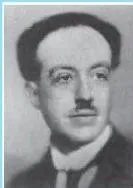
De Broglie’s idea was developed by Erwin Schrödinger into wave mechanics, a full theory of quantum mechanics, and de Broglie received the 1929 Nobel Prize in Physics for the wave nature of electrons (NCERT, p. 285).
Formulas: Symbols, Units and Conversions
These are the equations the numerical questions in this chapter use, with every symbol and its unit. The book collects the physical quantities in a table on printed page 287.
| Formula | What it means | Symbols and units |
|---|---|---|
| \( K_{\max} = eV_0 \) (Eq. 11.1) | Stopping potential gives the maximum kinetic energy of the emitted electrons. | \( e = 1.602 \times 10^{-19}\ \text{C} \), \( V_0 \) in volt, \( K_{\max} \) in joule. |
| \( K_{\max} = h\nu – \phi_0 \) (Eq. 11.2) | Einstein’s photoelectric equation: photon energy minus work function. | \( h = 6.63 \times 10^{-34}\ \text{J s} \), \( \nu \) in Hz, \( \phi_0 \) in joule — convert eV to J first. |
| \( \nu_0 = \phi_0/h \) (Eq. 11.3) | Threshold frequency of a metal. | \( \nu_0 \) in Hz, \( \phi_0 \) in joule, \( h \) in J s. |
| \( V_0 = (h/e)\nu – \phi_0/e \) (Eq. 11.4) | Straight-line form of Einstein’s equation; the slope is \( h/e \). | \( V_0 \) in volt, \( \nu \) in Hz, slope in V s. |
| \( E = h\nu = hc/\lambda \), \( p = h/\lambda \) | Energy and momentum of a photon. | \( c = 3 \times 10^8\ \text{m/s} \), \( \lambda \) in metre, \( p \) in kg m/s. |
| \( \lambda = h/(mv) \) (Eq. 11.5) | De Broglie wavelength of a moving particle. | \( m \) in kg, \( v \) in m/s, \( \lambda \) in metre. |
Conversions and constants to keep beside you:
| Quantity | Value used in this chapter |
|---|---|
| 1 eV | \( 1.602 \times 10^{-19}\ \text{J} \) |
| 1 nm | \( 10^{-9}\ \text{m} \) |
| Planck’s constant \( h \) | \( 6.63 \times 10^{-34}\ \text{J s} \) |
| Speed of light \( c \) | \( 3 \times 10^8\ \text{m/s} \) |
The chapter’s own table on printed page 287 lists Planck’s constant, stopping potential, work function, threshold frequency and de Broglie wavelength with their dimensions and units — keep it open while solving numericals.
Reading the Chapter’s Figures and Graphs
Five diagrams carry the photoelectric story, and each asks you to notice something different. The figures below follow the chapter’s order, with the point each graph makes stated beside it.
Figure 11.1 — The Circuit That Measures Photocurrent
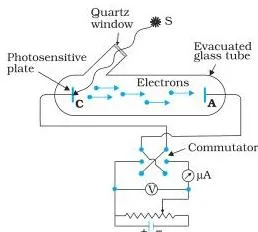
Trace the circuit: monochromatic light passes through the transparent quartz window W and falls on the photosensitive plate C, ejecting electrons. The battery drives the electrons to the positive collector plate A, and the microammeter reads the resulting photocurrent while the voltmeter reads the potential difference (NCERT, p. 277).
The commutator is the part students skip. It reverses the polarity of the plates, so plate A can be made negative with respect to C — that is exactly how a retarding potential is applied and how the stopping potential is found.
Figure 11.2 — Intensity Sets the Current
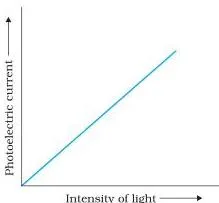
The straight line through the origin states the first result: photocurrent is directly proportional to the intensity of the incident light (NCERT, p. 278). Doubling the intensity doubles the number of photoelectrons emitted per second. Notice what this graph does not claim — it says nothing about the energy of the individual electrons.
Figure 11.3 — The Same Stopping Potential for Every Intensity

The three curves are for intensities \( I_3 \gt I_2 \gt I_1 \). At large positive potentials the currents saturate at different values — the saturation current is proportional to intensity. As the potential is made negative, all three curves fall and reach zero at exactly the same stopping potential \( V_0 \) (NCERT, p. 278).
That sameness is the whole point of the graph: since \( K_{\max} = eV_0 \), the maximum kinetic energy of the photoelectrons is independent of intensity.
Figure 11.4 — Frequency Changes the Stopping Potential
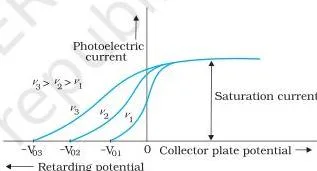
Now the three curves are for frequencies \( \nu_3 \gt \nu_2 \gt \nu_1 \) at the same intensity, so the saturation currents coincide. The stopping potentials do not: \( V_{03} \gt V_{02} \gt V_{01} \), each more negative than the last (NCERT, p. 279).
Greater frequency means greater maximum kinetic energy, so a stronger retarding potential is needed to stop the fastest electrons.
Figure 11.5 — The Graph That Gave Planck’s Constant
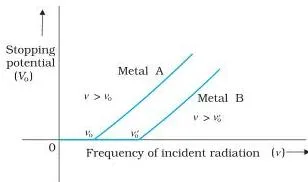
This straight line, \( V_0 = (h/e)\nu – \phi_0/e \), is the chapter’s most important graph. Its slope is \( h/e \), identical for every metal; where the line meets the frequency axis is the threshold frequency \( \nu_0 \); where it meets the potential axis is \( -\phi_0/e \) (NCERT, p. 279).
This is the graph Millikan measured to verify Einstein’s equation, reading Planck’s constant from the slope (NCERT, p. 282). Compare Figs. 11.3 and 11.4 to fix the idea: in Fig. 11.3 the stopping potential is the same because intensity changes; in Fig. 11.4 the stopping potentials differ because frequency changes.
Definitions to Write in the Exam
These are the terms a full answer names, each in one plain sentence with the page where the book defines it.
| Term | Definition | NCERT page |
|---|---|---|
| Work function \( \phi_0 \) | The minimum energy an electron needs to escape from a metal surface. | p. 275 |
| Electron volt (eV) | The energy gained by an electron accelerated through a potential difference of 1 V; \( 1\ \text{eV} = 1.602 \times 10^{-19}\ \text{J} \). | p. 275 |
| Photoelectric effect | The emission of electrons from a metal when light of suitable frequency falls on it. | p. 277 |
| Photoelectrons | The electrons emitted from a metal surface by light. | p. 277 |
| Saturation current | The maximum photocurrent, reached when every emitted photoelectron arrives at the collector. | p. 278 |
| Stopping (cut-off) potential \( V_0 \) | The minimum retarding potential that reduces the photocurrent to zero. | p. 278 |
| Threshold frequency \( \nu_0 \) | The minimum frequency below which no photoelectric emission occurs, however intense the light. | p. 279-280 |
| Photon | A quantum of light carrying energy \( E = h\nu \) and momentum \( p = h/\lambda \). | p. 283 |
| Matter wave (de Broglie wavelength) | The wave associated with a moving particle, \( \lambda = h/p \). | p. 285 |
Common Mistakes Students Make in This Chapter
The chapter closes with a list it calls Points to Ponder — NCERT naming precisely where readers go wrong (NCERT, p. 288). The table below turns those points, plus the classic numerical slips, into mistakes with fixes.
| Mistake | Correct rule | How to check your answer |
|---|---|---|
| Reading “free electrons” as free to leave the metal. | Free means free to move inside the metal; an electron still needs the work function’s energy to escape the surface pull (p. 288). | Whenever an electron leaves a metal, the work function must appear in your energy balance. |
| Treating the work function as a typical escape energy. | Free electrons have a spread of energies, so \( \phi_0 \) is the least energy needed to escape; electrons that start with more energy need less extra energy (p. 288). | \( K_{\max} \) describes the most energetic electrons; the rest come out slower. |
| Thinking intense light below the threshold can still emit. | For \( \nu \lt \nu_0 \) no emission occurs at any intensity (p. 279-280). | Compare \( \nu \) with \( \nu_0 = \phi_0/h \) before thinking about intensity. |
| Treating “absorption in units of \( h\nu \)” as proof light is particles. | The experiment shows energy is absorbed in discrete units \( h\nu \) — not quite the same statement as light consisting of particles (p. 288). | Quote the book’s exact phrasing: absorption of energy takes place in discrete units of \( h\nu \). |
| Mixing eV and joule in one equation. | \( h \) is in J s, so \( h\nu \) and \( \phi_0 \) must both be in joules before subtracting. | Write \( 1\ \text{eV} = 1.602 \times 10^{-19}\ \text{J} \) at the top of the working. |
| Taking the phase velocity of a matter wave as the particle speed. | The phase velocity of a matter wave has no physical meaning; the group velocity equals the particle’s velocity (p. 288). | If asked for the speed of a matter wave, answer: the group velocity equals the particle’s speed. |
Exam-Focused Notes With a Worked Example
Most of the chapter’s exercises are short numericals built on one or two equations, plus one qualitative proof. Textbook contents and the examinable syllabus are not always identical, so check the current official CBSE syllabus before deciding what to revise.
Two patterns appear across the exercises: photon-rate problems all use \( P = NE \) (11.1, 11.4), and slope problems read \( h \) from the \( V_0 \) versus \( \nu \) graph (11.5).
Worked Example: Sodium Under 450 nm Light
The surest way to see the chapter’s equations work together is to solve one numerical end to end. Try it with original numbers:
Sodium has a work function of 2.28 eV. Light of wavelength 450 nm falls on its surface. Find (a) the photon energy in eV and in joule, (b) the maximum kinetic energy of the emitted photoelectrons, (c) the stopping potential.
Step 1 — photon energy in joule.
Use \( E = hc/\lambda \) with \( h = 6.63 \times 10^{-34}\ \text{J s} \), \( c = 3 \times 10^{8}\ \text{m/s} \) and \( \lambda = 450\ \text{nm} = 450 \times 10^{-9}\ \text{m} \).
\[ E = \frac{(6.63 \times 10^{-34})(3 \times 10^{8})}{450 \times 10^{-9}} = 4.42 \times 10^{-19}\ \text{J} \]
Step 2 — photon energy in eV.
Divide the energy in joules by \( 1.602 \times 10^{-19}\ \text{J/eV} \).
\[ E = \frac{4.42 \times 10^{-19}}{1.602 \times 10^{-19}} = 2.76\ \text{eV} \]
Step 3 — maximum kinetic energy.
Apply Einstein’s equation \( K_{\max} = h\nu – \phi_0 \) with \( \phi_0 = 2.28\ \text{eV} \).
\[ K_{\max} = 2.76 – 2.28 = 0.48\ \text{eV} \]
\[ K_{\max} = 0.48 \times 1.602 \times 10^{-19} = 7.7 \times 10^{-20}\ \text{J} \]
Step 4 — stopping potential.
Rearrange \( K_{\max} = eV_0 \) to \( V_0 = K_{\max}/e \).
\[ V_0 = \frac{0.48\ \text{eV}}{e} = 0.48\ \text{V} \]
Final answer: photon energy \( 2.76\ \text{eV} \) (\( 4.42 \times 10^{-19}\ \text{J} \)); maximum kinetic energy \( 0.48\ \text{eV} \) (\( 7.7 \times 10^{-20}\ \text{J} \)); stopping potential \( 0.48\ \text{V} \).
Since the photon energy (2.76 eV) exceeds the work function (2.28 eV), emission occurs — comparing the photon energy with the work function first is the fastest check for any question that supplies a metal and a wavelength.
Map of the Exercises
The exercises close the chapter on pages 288-289. The table maps each question, 11.1 to 11.11, to the equation it tests.
| Exercise | What it tests | Equation to use |
|---|---|---|
| 11.1 | X-ray photon energy from 30 kV electrons | \( E = hc/\lambda \), \( 1\ \text{eV} = 1.602 \times 10^{-19}\ \text{J} \) |
| 11.2 | Maximum kinetic energy, stopping potential, maximum speed | \( K_{\max} = h\nu – \phi_0 \), \( K_{\max} = \frac{1}{2}mv_{\max}^2 \) |
| 11.3 | Cut-off voltage to maximum kinetic energy | \( K_{\max} = eV_0 \) |
| 11.4 | Photon energy, momentum and photon rate | \( E = hc/\lambda \), \( p = h/\lambda \), \( P = NE \) |
| 11.5 | Planck’s constant from graph slope | \( V_0 = (h/e)\nu – \phi_0/e \), slope \( = h/e \) |
| 11.6 | Cut-off voltage from threshold frequency | \( eV_0 = h(\nu – \nu_0) \) |
| 11.7 | Deciding whether emission occurs | compare \( hc/\lambda \) with \( \phi_0 \) |
| 11.8 | Threshold frequency from ejected-electron speed | \( \frac{1}{2}mv^2 = h(\nu – \nu_0) \) |
| 11.9 | Work function from stopping potential | \( \phi_0 = hc/\lambda – eV_0 \) |
| 11.10 | De Broglie wavelength of everyday objects | \( \lambda = h/(mv) \) |
| 11.11 | The photon as its own matter wave | \( p = h\nu/c \), \( \lambda = h/p \) |
Quick Recap: Chapter 11 in a Page
This recap condenses the chapter’s official SUMMARY (pages 286-287) in our own words, so the spine of the chapter can be re-read in about a minute.
- The work function is the minimum energy needed to escape a metal; it can be supplied by heat, by a strong field, or by light of suitable frequency.
- The photoelectric effect is the instantaneous emission of electrons by light; it converts light energy into electrical energy and obeys conservation of energy.
- Photocurrent depends on intensity, applied potential and the emitter material; stopping potential depends on frequency and emitter material but not on intensity (p. 286).
- Below the threshold frequency no emission takes place, however large the intensity (p. 287).
- Wave theory fails on maximum kinetic energy, threshold frequency and time lag; Einstein’s \( K_{\max} = h\nu – \phi_0 \) explains all three, and Millikan’s precise measurements confirmed it (p. 287).
- Photons carry \( E = h\nu \) and \( p = h/\lambda \); intensity is the number of photons per second, so photon energy is fixed by frequency alone (p. 287).
- De Broglie’s \( \lambda = h/p \) gives matter waves that are measurable for electrons and impossibly small for macroscopic objects (p. 287).
Related Resources
This chapter sits between wave optics and atomic physics: the de Broglie idea it introduces is exactly what Chapter 12, Atoms, then builds on. The pages below carry the surrounding material.
- Class 12 Physics chapter notes — the notes hub for this book’s chapters.
- Class 12 study material hub — physics and the other Class 12 subjects.
- CBSE notes home — notes organised by class and subject.
- Wave Optics notes — the previous chapter, where the wave picture of light is developed.
- Moving Charges and Magnetism notes — an earlier chapter of the same book, on the magnetic force on moving charges.
Sources and Data Verification
The page references, figure captions and quantities on this page describe the NCERT Class 12 Physics Part II textbook, Chapter 11 “Dual Nature of Radiation and Matter”, printed pages 273-289 of the NCERT edition available on ncert.nic.in. The current edition of the book can be verified on the official NCERT textbook portal.
This page covers that single NCERT chapter and no other chapter or book.
This listing is maintained for the current academic session using the NCERT information available to us.
NCERT settles textbooks, editions and PDFs; CBSE settles curriculum, syllabus and examinations.
Reference: NCERT Class 12 Physics textbook, chapter 11, official edition on ncert.nic.in.
FAQs on Dual Nature of Radiation and Matter
Short answers to the questions students search before an exam.
What is the difference between threshold frequency and stopping potential in the photoelectric effect?
The threshold frequency \( \nu_0 \) is a property of the metal: below it, no light of any intensity can eject electrons (NCERT, p. 279-280). The stopping potential \( V_0 \) is a measurement you make with a retarding potential — the smallest negative potential that stops even the fastest photoelectrons — and it measures \( K_{\max} = eV_0 \) (NCERT, p. 278).
A metal has one threshold frequency, but its stopping potential grows as the frequency of the incident light rises above the threshold.
Why does increasing the intensity of light not increase the maximum kinetic energy of photoelectrons?
Because intensity is the number of photons per second, not the energy of each photon. Each electron absorbs one photon of energy \( h\nu \), so a brighter beam releases more electrons per second while the stopping potential — and therefore \( K_{\max} \) — stays fixed (NCERT, p. 281).
Fig. 11.3 shows the same result: all three intensity curves reach zero at one common stopping potential.
Why could the wave theory of light not explain the photoelectric effect?
In the wave picture a stronger wave has a larger electric field amplitude, so each electron should absorb more energy and \( K_{\max} \) should grow with intensity — it does not. The wave picture also offers no reason for a threshold frequency, and it predicts electrons should take hours to gather enough energy, while emission is actually instantaneous (NCERT, p. 280-281).
All three predictions contradict the experiment.
What is the de Broglie wavelength and why is it so small for everyday objects?
The de Broglie wavelength is the wavelength of the matter wave carried by a moving particle, \( \lambda = h/(mv) \) (NCERT, p. 285). Planck’s constant \( h \) is about \( 10^{-34}\ \text{J s} \), so for any object weighing grams or kilograms, \( \lambda \) comes out near \( 10^{-34}\ \text{m} \) — far below anything measurable.
For an electron, with a mass near \( 10^{-31}\ \text{kg} \), the wavelength falls in the nanometre range, comparable to X-rays (NCERT, p. 286).
How do you convert electron volt to joule in photoelectric problems?
Multiply the value in eV by \( 1.602 \times 10^{-19} \) — one electron volt is the energy gained by an electron accelerated through one volt (NCERT, p. 275). The conversion is needed whenever \( h \) appears, because \( h \) is given in J s: both \( h\nu \) and \( \phi_0 \) must be in joules before you subtract.
Does photoelectric emission really happen instantly even for very dim light?
Yes. Emission starts in about \( 10^{-9} \) s or less even when the incident radiation is made exceedingly dim (NCERT, p. 280). In Einstein’s picture this is natural: the elementary event is one electron absorbing one quantum \( h\nu \), identical whether the beam is bright or dim. Intensity only decides how many electrons take part in that event (NCERT, p. 282).
Explore Class 12 Physics Books
Class 12 Physics on LearnCBSE:
Related chapters: