
Looking for the Atoms Class 12 chapter PDF? This page carries the official NCERT Class 12 Physics Part II Chapter 12, “Atoms” — 16 printed pages (289–305), current 2026-27 reprint — with a direct download link below. The chapter moves from Thomson’s 1898 plum pudding model, through Rutherford’s nuclear model, to Bohr’s quantised orbits that explain the hydrogen spectrum.
Download the Atoms Class 12 PDF
The official NCERT Class 12 Physics Chapter 12 Atoms PDF is published on ncert.nic.in and contains the same pages as the printed book, so this is the file to save for revision. To browse the whole textbook, use the NCERT textbook portal instead.
| What the chapter holds | Count | Where it is used |
|---|---|---|
| Printed pages | 16 | |
| Sections in the chapter | 9 | |
| Figures with NCERT captions | 9 | |
| Exercise questions | 8 | answered in our NCERT Solutions |
| Official NCERT PDF | Download the chapter PDF | the chapter exactly as NCERT publishes it |
The Atoms chapter at a glance
The table below shows what the chapter holds — sections, figures, equations and exercise questions — so you can see its shape in a few seconds.
This is the chapter where NCERT moves from classical models of the atom to the quantum ideas that explain hydrogen’s spectrum.
What this chapter covers: three models of the atom
The chapter follows one arc: each new experiment forced physicists to replace the previous picture of the atom. Three models carry the story — Thomson’s, Rutherford’s and Bohr’s.
Thomson’s plum pudding model (1898). J. J. Thomson proposed that an atom’s positive charge spreads uniformly through its volume, with electrons embedded in it like seeds in a watermelon (NCERT, p. 289). The model explained why atoms are neutral, but later scattering studies showed the real arrangement is very different.
Rutherford’s nuclear model (1911). Geiger and Marsden fired 5.5 MeV alpha particles from a bismuth-214 source at a gold foil \( 2.1 \times 10^{-7} \) m thick (pp. 291–292). Most alphas passed straight through, but about 1 in 8000 bounced back through more than 90 degrees.
Rutherford concluded that nearly all the mass and all the positive charge sit in a tiny nucleus, making the atom mostly empty space (p. 293).
Bohr’s model (1913). Bohr kept Rutherford’s nucleus and added three quantum postulates: some orbits never radiate, only certain orbits are allowed, and light appears only when the electron changes orbit (pp. 298–299). The result was the hydrogen energy levels \( E_n = -13.6/n^2 \) eV.
de Broglie’s contribution (1923). Louis de Broglie explained why only those orbits exist: the electron behaves as a wave, and only orbits whose circumference holds a whole number of wavelengths form stable standing waves (pp. 301–302).
The comparison below shows what each model builds, what it explains, and where it breaks down.
| Model | Construction of the atom | What it explains | Where it breaks down |
|---|---|---|---|
| Thomson (1898) | Positive charge spread through the whole volume; electrons embedded in it (p. 289) | Electrical neutrality of atoms; presence of identical electrons | Electrostatically unstable — the embedded electrons are not in stable equilibrium (p. 303) |
| Rutherford (1911) | Tiny dense positively charged nucleus holds almost all the mass; electrons orbit it (pp. 291–293) | Alpha scattering data; atom mostly empty space; nuclear size \( 10^{-15} \) to \( 10^{-14} \) m | Orbiting electrons must radiate and collapse; cannot produce line spectra (pp. 297–298) |
| Bohr (1913) | Electrons occupy stationary orbits with quantised angular momentum \( L = nh/2\pi \) (pp. 298–299) | Stability of hydrogen; discrete levels \( E_n = -13.6/n^2 \) eV; hydrogen line spectrum | Only for single-electron atoms; cannot explain relative line intensities (p. 302) |
Key concepts in the Atoms chapter
These six ideas are the chapter’s spine. The formulas only make sense after the ideas, so each concept below is stated in plain words and pinned to its NCERT page.
Rutherford’s scattering experiment and the impact parameter
The question this experiment answered: where inside the atom do the mass and the positive charge actually sit?
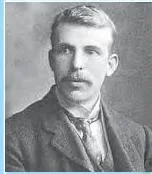
Rutherford, a former research student of Thomson, set up the experiment with Geiger and Marsden around 1911 (p. 291). The source was bismuth-214, which emits 5.5 MeV alphas; lead bricks collimated the beam; the target was a gold foil \( 2.1 \times 10^{-7} \) m thick (p. 292).
The scattered alphas struck a rotatable zinc sulphide screen and made brief flashes, or scintillations, viewed through a microscope — that is how counts at every angle were collected (p. 292).
Two numbers carry the result: only about 0.14% of alphas scatter by more than 1 degree, and about 1 in 8000 by more than 90 degrees (p. 293). A backward bounce needs a large repulsive force, which is only possible if the atom’s positive charge is concentrated in a tiny volume.
The impact parameter \( b \) is the perpendicular distance of the alpha’s initial velocity line from the nucleus (p. 294). A small \( b \) gives a large deflection; a head-on collision sends the alpha back with scattering angle \( \theta \approx \pi \); a large \( b \) leaves it nearly undeviated.
A beam carries a spread of impact parameters, which is why one beam produces every scattering angle at once — Fig. 12.4 in the figure walkthrough makes this visual.
Distance of closest approach
This is the chapter’s one energy calculation in the scattering part. As an alpha approaches the nucleus, kinetic energy converts to electric potential energy; at the turning point the alpha is momentarily at rest.
Conservation of energy gives the distance of closest approach:
\[ d = \frac{2Ze^2}{4\pi\epsilon_0 K} \]
where \( Z \) is the target’s atomic number, \( e = 1.6 \times 10^{-19}\ \text{C} \), \( 1/4\pi\epsilon_0 = 9.0 \times 10^9\ \text{N m}^2/\text{C}^2 \), and \( K \) is the alpha’s kinetic energy in joules.
Step 1: Convert the alpha’s kinetic energy to joules.
A 5.0 MeV alpha has \( K = 5.0 \times 1.6 \times 10^{-13}\ \text{J} = 8.0 \times 10^{-13}\ \text{J} \).
- Step 1: Write the conservation of energy equation — kinetic energy before is converted to electric potential energy at closest approach: \( K = \frac{1}{4\pi\epsilon_0} \frac{(2e)(Ze)}{d} \).
- Step 2: Rearrange for \( d \) and substitute for a copper nucleus (\( Z = 29 \)):
\[ d = \frac{2(9.0 \times 10^9)(1.6 \times 10^{-19})^2(29)}{8.0 \times 10^{-13}} \approx 1.7 \times 10^{-14}\ \text{m} \]
Final answer: \( d \approx 1.7 \times 10^{-14}\ \text{m} = 17\ \text{fm} \), since \( 1\ \text{fm} = 10^{-15}\ \text{m} \). This sets an upper limit on the size of the copper nucleus.
NCERT’s own check: the formula gives about 30 fm for gold, while the measured radius of the gold nucleus is about 6 fm (p. 295). The reason is that the alpha reverses its motion well before it actually touches the nucleus.
Electron orbits in the Rutherford model — and why the atom should collapse
Rutherford pictured the electron as a planet orbiting the nucleus. A charged planet cannot be stable — that classical failure is exactly what Bohr’s quantum ideas had to fix.
Setting the electrostatic attraction equal to the required centripetal force, \( F_e = F_c \), gives the orbit radius \( r = e^2/(4\pi\epsilon_0 m v^2) \) (Eq. 12.3, p. 296). Adding kinetic and potential energy gives the total energy:
\[ E = K + U = -\frac{e^2}{8\pi\epsilon_0 r} \quad \text{(Eq. 12.4)} \]
The negative sign is not a mistake: it means the electron is bound to the nucleus. A positive \( E \) would mean no closed orbit at all (p. 296).
The classical problem: an accelerating charged particle radiates, so the electron’s orbit must shrink and it should spiral into the nucleus (Fig. 12.6, p. 298). Its changing orbital frequency would smear the emitted light into a continuous spectrum, but hydrogen shows sharp lines instead (pp. 297–298).
Bohr’s three postulates and the energy levels of hydrogen
Bohr’s postulates are the rules that fix Rutherford’s model: some orbits never radiate, only certain orbits exist, and light is emitted only when the electron changes orbit.
- Stationary states. An electron can revolve in certain stable orbits without emitting radiant energy, contrary to classical electrodynamics (p. 298).
- Quantised angular momentum. The electron orbits only where \( L = nh/2\pi \), with \( n = 1, 2, 3, \dots \) and \( h = 6.6 \times 10^{-34}\ \text{J s} \) (Eq. 12.5, p. 299).
- Photon emission. A transition from a higher state \( E_i \) to a lower state \( E_f \) emits a photon with \( h\nu = E_i – E_f \) (Eq. 12.6, p. 299).
From these postulates the allowed radii grow as \( r_n \propto n^2 \) (Eq. 12.7) and the energies come out as (p. 299):
\[ E_n = -\frac{13.6}{n^2}\ \text{eV} \quad \text{(Eq. 12.10)} \]
- Ground state \( n = 1 \): \( E_1 = -13.6\ \text{eV} \); ionising the atom from the ground state needs 13.6 eV (p. 300).
- First excited state \( n = 2 \): \( E_2 = -3.40\ \text{eV} \), so excitation from the ground state costs \( E_2 – E_1 = 10.2\ \text{eV} \).
- Second excited state \( n = 3 \): \( E_3 = -1.51\ \text{eV} \), so excitation costs 12.09 eV (p. 300).
To convert between the two unit systems the chapter uses, \( 1\ \text{eV} = 1.6 \times 10^{-19}\ \text{J} \) (p. 299).
Hydrogen line spectra: where the lines come from
A line spectrum is a set of bright lines on a dark background, and each element has its own pattern — the spectral “fingerprint” of the element (p. 296).
Bohr’s third postulate explains the pattern. A jump from \( n_i \) to \( n_f \) emits a photon of frequency \[ h\nu_{if} = E_{n_i} – E_{n_f} \quad \text{(Eq. 12.11, p. 301)} \]
Because \( n_i \) and \( n_f \) are integers, the photon frequencies come out discrete. Continuous orbits would smear the light into a continuous spectrum; quantised levels force quantised lines.
Emission lines appear when an electron falls to a lower level and a photon leaves the atom. Absorption lines appear when white light passes through the gas: atoms absorb photons of exactly the right energy and climb to higher states, leaving dark lines in the transmitted spectrum at precisely the wavelengths of the bright emission lines (p. 301).
This success earned Bohr the 1922 Nobel Prize in Physics (p. 301).
de Broglie’s standing waves: why angular momentum is quantised
Bohr simply postulated \( L = nh/2\pi \). de Broglie showed why nature obeys it: if the electron is a wave, only orbits whose circumference fits a whole number of wavelengths can persist.
\[ 2\pi r_n = n\lambda \quad \text{(Eq. 12.12, p. 302)} \]
Combining this with the de Broglie wavelength \( \lambda = h/mv \) recovers \( mv r_n = nh/2\pi \) — exactly Bohr’s second postulate (p. 302). Waves that do not fit interfere with themselves and die out, like non-resonant waves on a plucked string.
NCERT lists two limitations (p. 302): the model cannot be extended even to two-electron atoms such as helium, because electron-electron forces are comparable to the electron-nucleus force; and it cannot explain the relative intensities of the spectral lines.
Figures in the Atoms chapter, explained
The diagrams in this chapter are evidence, not decoration — each one carries a conclusion of the story. Below, every figure is shown and read aloud.
The Geiger-Marsden experiment set-up (Figs 12.1 and 12.2)
Both figures show the same experiment: Fig. 12.1 is the real apparatus and Fig. 12.2 is its schematic layout (pp. 291–292).
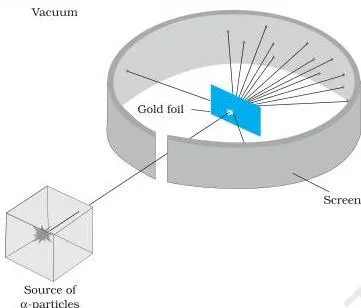
This is the actual machine: a bismuth-214 source, lead collimators, a thin gold foil and the rotatable detector. The whole apparatus sat inside a vacuum chamber, which is not shown in the photograph (p. 292).
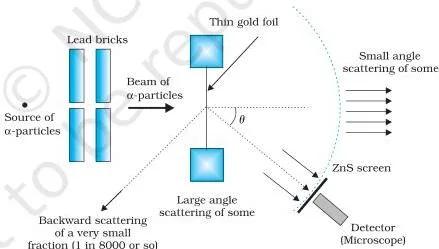
Read the schematic left to right: source, lead bricks, gold foil, rotatable detector. The detector is the part to notice — rotating it is how the counts at every angle were collected.
What the scattering data shows (Fig 12.3)
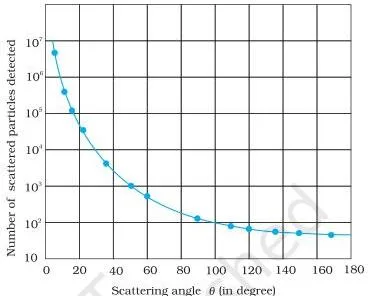
The dots are the Geiger-Marsden data points; the solid curve is the prediction of Rutherford’s nuclear model. Their agreement is the experimental evidence for a small, dense, positively charged nucleus (p. 293).
Read the shape: the count falls steeply with scattering angle. Most alphas emerge at small angles and very few come back — only about 0.14% scatter by more than 1 degree, and about 1 in 8000 by more than 90 degrees. Such a steep fall-off is only possible if the positive charge and mass sit in a tiny volume.
Impact parameter and trajectory (Fig 12.4)
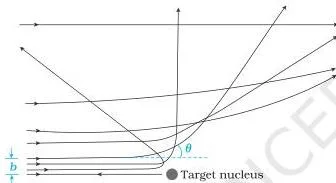
The figure defines the chapter’s two scattering quantities. The impact parameter \( b \) is the perpendicular distance of the alpha’s initial velocity line from the nucleus; \( \theta \) is the scattering angle (p. 294).
The visual lesson is the spread of trajectories: a small \( b \) bends the alpha sharply, a head-on hit sends it back with \( \theta \approx \pi \), and a large \( b \) leaves it almost undeviated. One beam produces all of these at once because its particles carry a distribution of impact parameters.
The classical atom collapses (Fig 12.6)
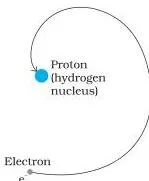
The spiral path is the classical death sentence for Rutherford’s model: an accelerating charged electron radiates energy, its orbit shrinks, and it spirals into the nucleus (p. 298). Bohr’s first postulate — stationary orbits that do not radiate — was invented to stop exactly this.
Reading the hydrogen energy level diagram (Fig 12.7)
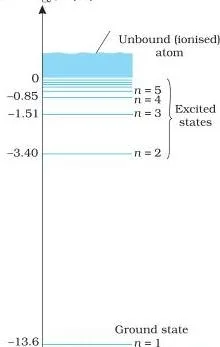
This is the key figure of the chapter — an energy map, not a picture of orbits. The vertical axis is energy in eV with zero at the top, and each horizontal line is an allowed state labelled by the principal quantum number \( n \) (p. 300).
- The levels crowd closer together as \( n \) increases: \( E_2 – E_1 = 10.2\ \text{eV} \), but \( E_4 – E_3 \) is only about 0.66 eV — the spacing shrinks towards the top.
- The \( n = \infty \) line sits at 0 eV: the electron removed from the nucleus and at rest.
- The gap from \( -13.6 \) eV up to 0 eV is the 13.6 eV ionisation energy; excitation from the ground state to \( n = 2 \) costs only 10.2 eV (p. 300).
- Above \( E = 0 \) eV there is a continuum of energy states — a free electron can carry any total energy (footnote, p. 300).
Reading one transition as practice: an electron dropping from \( n = 3 \) (\( -1.51 \) eV) to \( n = 1 \) (\( -13.6 \) eV) releases \( 13.6 – 1.51 = 12.09 \) eV as a photon. At room temperature, most hydrogen atoms sit in the ground state (p. 300).
Standing waves on a circular orbit (Fig 12.8)
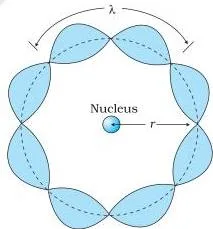
The figure shows the \( n = 4 \) case: four de Broglie wavelengths fit into the orbit’s circumference, \( 2\pi r_4 = 4\lambda \) (p. 302). It is the circular-orbit version of a plucked string — only waves that close on themselves survive as standing waves, and that condition is Bohr’s quantisation of angular momentum in disguise.
Definitions from the Atoms chapter
These are the terms every formula in the chapter assumes, defined the way a student actually understands them.
- Impact parameter — the perpendicular distance of the alpha particle’s initial velocity line from the centre of the nucleus; it decides the scattering angle (p. 294).
- Distance of closest approach — the centre-to-centre distance at which an alpha’s kinetic energy is fully converted to electric potential energy and it momentarily stops; it gives an upper limit on nuclear size (p. 295).
- Nucleus — the tiny central region, about \( 10^{-15} \) to \( 10^{-14} \) m across, that holds nearly all the atom’s mass and all its positive charge; the atom itself is about \( 10^{-10} \) m, so the atom is mostly empty space (p. 293).
- Stationary states — the stable orbits in Bohr’s model in which the electron revolves without emitting radiant energy, each with a definite total energy (p. 298).
- Ground state — the lowest energy state of the atom, \( n = 1 \), with the electron in the smallest orbit, the Bohr radius \( a_0 \) (p. 300).
- Excited state — any higher state \( n \gt 1 \) into which the atom is raised by collisions or by absorbing a photon of the right frequency (p. 300).
- Ionisation energy — the minimum energy needed to free the electron from the ground state, 13.6 eV for hydrogen (p. 300).
- Emission line spectrum — bright lines on a dark background at the discrete wavelengths an excited gas emits; each element has its own pattern (pp. 300–301).
- Absorption spectrum — dark lines in a transmitted continuous spectrum, at precisely the wavelengths the gas’s atoms absorb (pp. 300–301).
- Principal quantum number — the integer \( n \) that labels the stationary states in ascending order of energy (p. 299).
- Hydrogenic atoms — single-electron atoms with a nucleus of charge \( +Ze \), such as hydrogen, singly ionised helium and doubly ionised lithium (p. 302).
Formulas in the Atoms chapter and how to use them
These are the working equations of the chapter, with the meaning and unit of every symbol, so they can be used rather than just read.
| Formula | What it gives | Symbols and units | Applies to |
|---|---|---|---|
| \( F = \frac{1}{4\pi\epsilon_0} \frac{(2e)(Ze)}{r^2} \) (12.1) | Coulomb force between an alpha particle and the nucleus | \( F \) in N; \( e \) in C; \( r \) in m; \( 1/4\pi\epsilon_0 = 9.0 \times 10^9\ \text{N m}^2/\text{C}^2 \) | Alpha scattering (p. 294) |
| \( r = \frac{e^2}{4\pi\epsilon_0 m v^2} \) (12.3) | Orbit radius for a given electron speed | \( m \) in kg; \( v \) in m/s | Classical hydrogen orbit (p. 296) |
| \( E = -\frac{e^2}{8\pi\epsilon_0 r} \) (12.4) | Total energy of the bound electron | \( E \) in J; the negative sign means “bound” | Classical hydrogen orbit (p. 296) |
| \( L = \frac{nh}{2\pi} \) (12.5) | Quantised angular momentum of the electron | \( h = 6.6 \times 10^{-34}\ \text{J s} \); \( n = 1, 2, 3, \dots \) | Bohr orbits (p. 299) |
| \( h\nu = E_i – E_f \) (12.6) | Photon energy emitted or absorbed in a transition | \( \nu \) in Hz; \( E \) in J or eV | Any atomic transition (p. 299) |
| \( r_n = \frac{n^2}{m}\left(\frac{h}{2\pi}\right)^2 \frac{4\pi\epsilon_0}{e^2} \) (12.7) | Radius of the \( n \)-th allowed orbit | \( r_n \) in m; grows as \( n^2 \) | Hydrogenic atoms (p. 299) |
| \( E_n = -\frac{13.6}{n^2}\ \text{eV} \) (12.10) | Energy of the \( n \)-th level | \( E_n \) in eV; \( n = 1 \) gives \( -13.6 \) eV | Hydrogenic atoms — know this one cold (p. 299) |
| \( 2\pi r_n = n\lambda \) (12.12) | Standing wave condition on an orbit | \( \lambda \) in m, the de Broglie wavelength \( h/mv \) | Electron orbits, \( n \) a whole number (p. 302) |
One caveat runs through every Bohr formula: all of them apply to hydrogenic (single-electron) atoms such as hydrogen, singly ionised helium or doubly ionised lithium — not to multi-electron atoms like ordinary helium (p. 302).
Common mistakes in the Atoms chapter (and the corrections)
NCERT’s own Points to Ponder (pp. 303–304) read like a list of where students go wrong, so this section turns each point into a correction you can act on.
| Mistake | Correct rule | How to check your answer |
|---|---|---|
| Confusing why the two early models collapse | Thomson’s model is electrostatically unstable; Rutherford’s fails because orbiting electrons radiate electromagnetic energy (p. 303) | Ask what causes the collapse — if the answer is radiation, it is Rutherford’s model |
| Treating the negative energy of the electron as an error | Negative total energy means the electron is bound; 13.6 eV is the work needed to lift it from \( -13.6 \) eV to 0 eV (p. 300) | More negative = more tightly bound; the ground state is the most negative state |
| Mixing up ionisation energy with excitation to the first excited state | Ionisation from the ground state = 13.6 eV; excitation to \( n = 2 \) = 10.2 eV (p. 300) | Ionisation: \( 0 – (-13.6) = 13.6 \) eV. Excitation: \( -3.40 – (-13.6) = 10.2 \) eV |
| Assuming the photon’s frequency equals the electron’s orbital frequency | The spectral frequency is \( \Delta E/h \); the two coincide only for transitions between very large \( n \) (p. 304) | Given two levels, use \( h\nu = E_i – E_f \), never \( \nu = v/2\pi r \) |
| Treating Bohr orbits as literal paths | The sharp-orbit picture clashes with the uncertainty principle; quantum mechanics views orbits as regions of high electron probability (p. 303) | Remember Bohr’s model is a semiclassical stepping stone, not the final picture |
| Extending Bohr’s model to helium | Electron-electron forces are comparable to the electron-nucleus force, so the model holds only for hydrogenic atoms (p. 304) | If the atom has more than one electron, the Bohr formulas do not apply |
| “Most alpha particles bounce back” | Most pass straight through; only about 1 in 8000 scatters by more than 90 degrees (p. 293) | Quote the experiment: 0.14% scatter beyond 1 degree, 1 in 8000 beyond 90 degrees |
Exam notes: how the exercise questions test each idea
The chapter’s own exercises are the best map of what NCERT thinks matters. Here is what each question actually tests.
- Exercise 12.1 — Thomson vs Rutherford: which model has electrons in stable equilibrium, which is doomed to collapse, and where the mass is distributed.
- Exercise 12.3 — a 2.3 eV level difference: convert eV to joules and apply \( h\nu = \Delta E \) to find a frequency.
- Exercise 12.4 — from the \( -13.6 \) eV ground state, split the total energy into kinetic and potential parts; for hydrogen, \( K = -E = 13.6 \) eV and \( U = 2E = -27.2 \) eV.
- Exercise 12.5 — a photon that excites hydrogen from \( n = 1 \) to \( n = 4 \): use \( E_n = -13.6/n^2 \), then \( h\nu = \Delta E \) for the wavelength and frequency.
- Exercise 12.6 — speeds and orbital periods of the electron for \( n = 1, 2, 3 \), combining Eq. (12.3) with the period \( T = 2\pi r/v \).
- Exercise 12.7 — radii of the \( n = 2 \) and \( n = 3 \) orbits from the innermost radius \( 5.3 \times 10^{-11} \) m, using \( r \propto n^2 \).
- Exercise 12.8 — a 12.5 eV electron beam on room-temperature hydrogen: which excited levels it can reach, and every emission line those levels can produce on de-excitation.
- Exercise 12.9 — applying Bohr’s quantisation \( L = nh/2\pi \) to the Earth-Sun system, treating the earth as a giant “electron”.
The habits these questions reward: convert eV to joules with \( 1\ \text{eV} = 1.6 \times 10^{-19}\ \text{J} \), keep the negative sign until you subtract the two levels, and use \( r \propto n^2 \) for quick radius checks. Note that textbook contents and the examinable syllabus are not always identical — check the current official syllabus for what is examinable this session.
Revision summary: the Atoms chapter in five minutes
This recap is built from NCERT’s own nine-point summary (p. 303), rewritten in fresh words. If you can tick every point, you know the chapter.
- The atom as a whole is electrically neutral, carrying equal positive and negative charge.
- Thomson’s model: a spherical cloud of positive charge with electrons embedded in it — the “plum pudding” picture.
- Rutherford’s model: almost all the mass and all the positive charge sit in a tiny nucleus; electrons revolve around it; the atom is largely empty space, with the nucleus roughly one ten-thousandth to one hundred-thousandth of the atomic size.
- The nuclear model fails twice: accelerated electrons must radiate and spiral into the nucleus, and the model cannot explain line spectra (pp. 297–298).
- Line spectra are characteristic of each element — a set of isolated bright lines that act as atomic fingerprints.
- Bohr’s three postulates: stationary orbits with no radiation; \( L = nh/2\pi \); photon emission with \( h\nu = E_i – E_f \). Absorption is the reverse process.
- Quantisation produces discrete radii \( r_n \propto n^2 \) and discrete energies \( E_n = -13.6/n^2 \) eV, with the ground state at \( -13.6 \) eV.
- de Broglie’s standing-wave condition \( 2\pi r_n = n\lambda \) explains why only these orbits exist, via the wave nature of the electron.
- Bohr’s model is hydrogenic-only and cannot explain relative line intensities — the reasons quantum mechanics was needed (p. 302).
Why the model is still taught: it rests on just three postulates, uses classical concepts, and shows how a theorist can deliberately set aside difficult problems and still make predictions that match experiment (pp. 303–304).
Related resources
For the rest of the book, start from the Class 12 Physics notes and the Class 12 study hub; the main CBSE notes home covers every subject.
The chapters around this one are Dual Nature of Radiation and Matter (NCERT Chapter 11, covered in the Dual Nature notes) and Nuclei (NCERT Chapter 13); other parts of the syllabus such as Magnetism and Matter also have their own notes pages.
Sources and data verification
- The figures and page references on this page describe the NCERT Class 12 Physics Part II textbook, Chapter 12 “Atoms”, current reprint, pages 289–305.
- This page covers that single chapter and its exercise questions, not other Class 12 physics chapters.
- The page is maintained for the current academic session using the NCERT information available to us.
- NCERT settles textbooks, editions and PDFs; CBSE settles curriculum, syllabus and examinations.
Reference: NCERT Class 12 Physics textbook, chapter 12, official edition on ncert.nic.in.
Frequently asked questions about the Atoms chapter
Why do most alpha particles pass straight through a gold foil in the Geiger-Marsden experiment?
Because the atom is mostly empty space. The nucleus is only about \( 10^{-15} \) to \( 10^{-14} \) m across while the atom is about \( 10^{-10} \) m, and the light electrons barely affect a heavy alpha (p. 293). Only an alpha that passes close to a nucleus feels the intense electric field that bends it sharply.
Why is the total energy of the electron in a hydrogen atom negative?
The negative sign means the electron is bound to the nucleus — you would need to supply positive work to remove it. If \( E \) were positive, the electron would not follow a closed orbit at all (p. 296). The 13.6 eV ionisation energy is exactly the work needed to lift the electron from \( -13.6 \) eV to 0 eV.
What is the difference between the ionisation energy and the excitation energy of hydrogen?
Ionisation removes the electron completely: from the ground state at \( -13.6 \) eV to freedom at 0 eV costs 13.6 eV. Excitation only lifts it to a higher bound level: reaching \( n = 2 \) costs \( E_2 – E_1 = 10.2 \) eV, and reaching \( n = 3 \) costs 12.09 eV (p. 300).
Why did de Broglie’s standing wave idea explain Bohr’s quantised orbits?
If the electron is a wave, only orbits whose circumference fits a whole number of wavelengths can form stable standing waves, so \( 2\pi r_n = n\lambda \) (p. 302). Substituting the de Broglie wavelength \( \lambda = h/mv \) turns this into \( mv r_n = nh/2\pi \) — exactly Bohr’s second postulate. Non-fitting waves interfere with themselves and die out.
Can the Bohr model be applied to helium?
No. The model works only for hydrogenic (single-electron) atoms, because it ignores electron-electron forces, which are comparable to the electron-nucleus force in multi-electron atoms (p. 302). It also cannot explain the relative intensities of spectral lines even for hydrogen.
What is the difference between an emission spectrum and an absorption spectrum?
An emission spectrum shows bright lines on a dark background at the discrete wavelengths an excited gas emits. An absorption spectrum shows dark lines in a transmitted continuous spectrum, at precisely those same wavelengths, because the gas atoms absorb photons of exactly the right energy to jump to higher states (pp. 300–301).
Explore Class 12 Physics Books
- Previous: Dual Nature of Radiation and Matter
- Next: Nuclei
Class 12 Physics on LearnCBSE:
Related chapters: