
Electromagnetic Waves Class 12 is Chapter 8 of the NCERT Physics Part I textbook — about 14 printed pages covering displacement current, Maxwell’s equations and the electromagnetic spectrum, in the 2026-27 reprint. The official chapter PDF is right below, and under it a section-by-section walkthrough explains every idea in the chapter.
Electromagnetic Waves Class 12 Chapter PDF: Official Download
NCERT publishes the whole book online, and the file below is the official 2026-27 reprint hosted on ncert.nic.in, the NCERT’s own textbook portal.
Open the Electromagnetic Waves Class 12 chapter (NCERT Physics Part I) official PDF when you want the printed chapter with its figures, tables and exercises in front of you; the explanation on this page works as a companion to read alongside it.
| What the chapter holds | Count | Where it is used |
|---|---|---|
| Printed pages | 14 | |
| Sections in the chapter | 13 | |
| Figures with NCERT captions | 6 | |
| Tables | 1 | |
| Worked examples | 1 | solved step by step in our NCERT Solutions |
| Exercise questions | 10 | answered in our NCERT Solutions |
| Official NCERT PDF | Download the chapter PDF | the chapter exactly as NCERT publishes it |
Chapter 8 at a Glance
The table below lists what the chapter holds — its sections, figures, worked examples, equations and exercise questions — so you can see the size of the file before opening it.
What Chapter 8 Covers
The chapter answers two questions. First: does a changing electric field create a magnetic field, the way Chapter 6 showed a changing magnetic field creates an electric field? Second: if so, what kind of wave do the two changing fields make together? The answer turns out to be light itself (NCERT, p. 201).
The arc of the chapter runs in this order:
- 8.1 Introduction (p. 201): Maxwell notices that Ampere’s law gives contradictory answers for a charging capacitor and proposes a missing current.
- 8.2 Displacement current (pp. 202–204): the contradiction, the missing term, and the generalised Ampere–Maxwell law.
- Maxwell’s equations in vacuum (p. 205): the four equations that, with the Lorentz force, describe all of electromagnetism.
- 8.3 Sources and nature of electromagnetic waves (pp. 205–207): accelerated charges radiate, and E and B sit at right angles in the wave.
- 8.4 Electromagnetic spectrum (pp. 208–211): seven named regions from radio waves to gamma rays, each with its production and detection.
- Table 8.1 (p. 211): a one-page summary of every band’s wavelength range, production and detection.
- Summary (p. 212) and Points to Ponder (p. 213): the book’s own revision material, restated later on this page.
Key Concepts in Electromagnetic Waves
These are the ideas a student must actually understand to follow the chapter: why Ampere’s law broke, how Maxwell fixed it, and what the fix says about light. Each idea below names the page in the book where it lives.
Displacement Current: Why Ampere’s Law Needed a Fix
Ampere’s law says a current produces a magnetic field. A charging capacitor showed the law could not decide what counts as “the current through a surface” — and that ambiguity forced the fix.
Take a circular loop around the wire feeding the capacitor. The current crosses the loop’s surface, so Ampere’s law gives \( B(2\pi r) = \mu_0 i(t) \), and the magnetic field at a point P outside the capacitor is non-zero (NCERT, p. 202).
Now keep the same loop as the rim but choose a different surface — a pot shape that dips between the plates, or a tiffin-box shape whose flat bottom sits between them. No conduction current crosses either surface, so the right side of Ampere’s law is zero.
The same line integral of B cannot be both non-zero and zero: that is the contradiction (NCERT, p. 203).
The missing quantity is the electric field. Between the plates the electric flux is \( \Phi_E = Q/\varepsilon_0 \), so as the charge Q changes, the flux changes with it. Maxwell defined the displacement current from this rate of change (NCERT, pp. 203–204):
\[ i_d = \varepsilon_0 \frac{d\Phi_E}{dt} \]
Adding it to the conduction current gives the total current \( i = i_c + i_d \), and the generalised Ampere–Maxwell law (NCERT, p. 204):
\[ \oint \mathbf{B} \cdot d\mathbf{l} = \mu_0 i_c + \mu_0 \varepsilon_0 \frac{d\Phi_E}{dt} \]
Where each current flows matters throughout the chapter. Outside the plates there is only conduction current, \( i_c = i \) and \( i_d = 0 \); inside the plates there is only displacement current, \( i_c = 0 \) and \( i_d = i \) (NCERT, p. 204).
Despite its name, displacement current is not a flow of charge. It is a changing electric flux, and it produces a magnetic field exactly like a real current — measurably so, since the field at a point M inside the plates equals the field at P just outside (NCERT, p. 204).
This is also why Kirchhoff’s junction rule stays valid at the plates in Exercise 8.1: the displacement current carries the continuity across the gap.
Maxwell’s Equations in Vacuum
The four equations below are the complete set Maxwell assembled. Together with the Lorentz force formula they express every basic law of electromagnetism (NCERT, p. 201).
| Equation | Name | What it governs |
|---|---|---|
| \( \oint \mathbf{E} \cdot d\mathbf{A} = Q/\varepsilon_0 \) | Gauss’s law for electricity | Electric charges are the sources of the electric field |
| \( \oint \mathbf{B} \cdot d\mathbf{A} = 0 \) | Gauss’s law for magnetism | No magnetic charges (monopoles) are known to exist |
| \( \oint \mathbf{E} \cdot d\mathbf{l} = -d\Phi_B/dt \) | Faraday’s law | A changing magnetic flux produces an electric field |
| \( \oint \mathbf{B} \cdot d\mathbf{l} = \mu_0 i_c + \mu_0 \varepsilon_0 \, d\Phi_E/dt \) | Ampere–Maxwell law | Conduction current and changing electric flux produce a magnetic field |
(NCERT, p. 205). The one asymmetry in the set: Gauss’s law for electricity has a charge source term, but Gauss’s law for magnetism has no equivalent, because no magnetic monopole has ever been found (NCERT, p. 204).
Sources: Accelerated Charges Radiate
A wave is a travelling change in a field, and a change needs motion — specifically, acceleration.
- Stationary charges produce electrostatic fields only.
- Charges in uniform motion (steady currents) produce magnetic fields that do not vary with time.
- Accelerated charges radiate electromagnetic waves (NCERT, p. 205).
An oscillating charge is an accelerating charge. Its oscillating E field creates an oscillating B field, which in turn recreates the E field, and the pair regenerates itself as it travels. The emitted wave’s frequency equals the oscillation frequency, and the wave’s energy comes at the expense of the source’s energy (NCERT, p. 205).
Testing this directly with light was out of reach: yellow light sits at about \( 6 \times 10^{14}\ \text{Hz} \), while even modern electronic circuits reach only about \( 10^{11}\ \text{Hz} \) (NCERT, p. 205). So the first demonstrations had to happen in the radio region.
Heinrich Hertz produced and detected the waves in 1887; seven years later Jagdish Chandra Bose, working in Calcutta, produced much shorter waves of 25 mm to 5 mm; and Guglielmo Marconi transmitted waves over many kilometres, beginning the communication revolution (NCERT, pp. 205–206).
Nature of the Wave: E and B Perpendicular to Each Other and to Propagation
In a plane wave the two fields are not free to point anywhere; Maxwell’s equations lock their directions, frequencies and amplitudes together.
For a wave travelling along z, the electric field oscillates along x and the magnetic field along y (NCERT, p. 206):
\[ E_x = E_0 \sin(kz – \omega t), \qquad B_y = B_0 \sin(kz – \omega t) \]
Here \( k = 2\pi/\lambda \) is the magnitude of the wave vector, whose direction is the direction of propagation, and \( \omega \) is the angular frequency (NCERT, p. 206). Maxwell’s equations then give \( \omega = ck \) with \( c = 1/\sqrt{\mu_0\varepsilon_0} \), usually written as \( \nu\lambda = c \), and the amplitudes obey \( B_0 = E_0/c \) (NCERT, p. 207).
Why do \( \mu_0 \) and \( \varepsilon_0 \) fix the speed? \( \mu_0 \) tells how strongly a current or changing flux creates a magnetic field, and \( \varepsilon_0 \) tells how strongly a charge creates an electric field. Together the two constants decide how quickly the changing fields can build each other up into a travelling wave.
Three facts to hold: E and B are perpendicular to each other; both are perpendicular to the direction of travel; and the direction of travel is along \( \mathbf{E} \times \mathbf{B} \). The book notes these are self-sustaining oscillations that need no material medium — which is why light crosses empty space (NCERT, p. 207).
Speed in a Material Medium
In vacuum every electromagnetic wave moves at the same speed c. Inside glass, water or air, the medium’s own properties slow it down.
The medium has a permittivity \(\varepsilon\) and a permeability \(\mu\) that replace \(\varepsilon_0\) and \(\mu_0\) in Maxwell’s equations, so the speed becomes (NCERT, p. 207):
\[ v = \frac{1}{\sqrt{\mu\varepsilon}} \]
This is the speed your next chapter turns into the refractive index, which compares the speed of light in two media (NCERT, p. 207). The constancy of c in vacuum is so firmly established experimentally that it is used to define a standard of length (NCERT, p. 207).
Formula Sheet: Symbols, Units and Page Numbers
One glance at the table below gives every key relation in the chapter with its symbols, units and the NCERT page where it appears.
| Relation | Meaning of symbols | Units | NCERT page |
|---|---|---|---|
| \( i_d = \varepsilon_0 \frac{d\Phi_E}{dt} \) | \( i_d \) displacement current, \( \Phi_E \) electric flux | \( i_d \): A | p. 203 |
| \( i = i_c + i_d \) | \( i_c \) conduction current, \( i_d \) displacement current | A | p. 204 |
| \( \oint \mathbf{B} \cdot d\mathbf{l} = \mu_0 (i_c + \varepsilon_0 \frac{d\Phi_E}{dt}) \) | \( \mu_0 \) permeability of free space | \( B \): T | p. 204 |
| \( E_x = E_0 \sin(kz – \omega t) \) | \( E_0 \) amplitude, \( k \) wave number, \( \omega \) angular frequency | \( E \): V/m | p. 206 |
| \( B_y = B_0 \sin(kz – \omega t) \) | \( B_0 \) amplitude | \( B \): T | p. 206 |
| \( k = \frac{2\pi}{\lambda} \) | \( \lambda \) wavelength | \( k \): rad/m | p. 206 |
| \( \omega = ck \) | \( c \) speed in vacuum | \( \omega \): rad/s | p. 207 |
| \( \nu\lambda = c \) | \( \nu \) frequency, \( \lambda \) wavelength | \( c \approx 3 \times 10^{8}\ \text{m/s} \) | p. 207 |
| \( B_0 = \frac{E_0}{c} \) | amplitudes of the two fields | \( B_0 \): T | p. 207 |
| \( v = \frac{1}{\sqrt{\mu\varepsilon}} \) | \( \mu, \varepsilon \) medium’s permeability and permittivity | \( v \): m/s | p. 207 |
Worked Example: Finding the Magnetic Field from the Electric Field
The most common calculation in this chapter is recovering the magnetic field from the electric field. The method always has two parts: magnitude from \( B_0 = E_0/c \), then direction from \( \mathbf{E} \times \mathbf{B} \). The numbers below are fresh ones, distinct from the textbook’s own examples.
Problem. A plane electromagnetic wave travels in vacuum along the +x direction. At a particular point in space and time, the electric field is \( E = 36\ \text{V/m} \) directed along the +z axis. Find the magnetic field B at that point.
Step 1: Write the given data.
The wave travels along +x; at the instant considered, \( E = 36\ \text{V/m} \) along +z.
Step 2: Find the amplitude of B using \( B_0 = E_0/c \) (Eq. 8.10).
\[ B_0 = \frac{36\ \text{V/m}}{3 \times 10^{8}\ \text{m/s}} = 1.2 \times 10^{-7}\ \text{T} \]
Step 3: Fix the direction.
Propagation is along \( \mathbf{E} \times \mathbf{B} \).
With \( \mathbf{E} \) along \( +\hat{z} \), we need a unit vector \( \hat{B} \) such that \( \hat{z} \times \hat{B} = \hat{x} \).
Since \( \hat{z} \times (-\hat{y}) = \hat{x} \), \( \mathbf{B} \) points along \( -\hat{y} \).
Final answer: \( \mathbf{B} = -1.2 \times 10^{-7}\ \hat{y}\ \text{T} \) — magnitude \( 1.2 \times 10^{-7}\ \text{T} \) along the negative y-axis.
One more quick check with the same wave, using \( \nu\lambda = c \) (Eq. 8.9b): if the frequency is 250 MHz, then \[ \lambda = \frac{c}{\nu} = \frac{3 \times 10^{8}}{250 \times 10^{6}} = 1.2\ \text{m} \]
so a 250 MHz wave has a wavelength of 1.2 m.
Figure Walkthrough: What Each Diagram Shows
NCERT uses its diagrams to make the abstract field ideas visible, and each one repays a careful minute. The diagrams below are the chapter’s key images in order, with what each is really telling you.
Fig 8.1: Three Surfaces, Same Loop, Two Different Answers
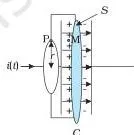
Read the three parts as one argument. Part (a) is the ordinary calculation: the loop around the wire gives \( B(2\pi r) = \mu_0 i(t) \). Parts (b) and (c) keep the same rim — the identical closed loop — but replace the surface.
No conduction current crosses either new surface, yet the rim is the same circle, so the same integral of B cannot give two different answers. That contradiction is the entire motivation for displacement current (NCERT, pp. 202–203).
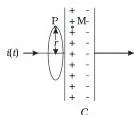
This second image is the visual version of Eq. (8.5): the source of a magnetic field is the total current \( i = i_c + i_d \), not conduction current alone. Hold this picture when a problem asks whether a current is conduction or displacement — the answer depends on the region you are in.
Fig 8.2: Electric and Magnetic Fields Inside the Capacitor
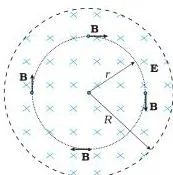
The point of this diagram is that a magnetic field really exists between the plates, where no charge flows. Part (a) shows the uniform E field crossing the gap and, around point M, the circular B field that the displacement current generates. Part (b) is the same picture seen end-on.
The measured B at M equals B at P just outside the wire, so displacement current produces magnetic fields exactly as conduction current does (NCERT, p. 204).
Fig 8.3: The Linearly Polarised Plane Wave
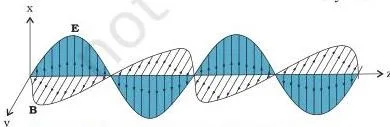
This is the canonical picture of an electromagnetic wave and the figure behind Eqs. 8.7(a) and (b). Read it axis by axis: E oscillates along x, B along y, and the whole pattern moves along z. The two fields share the same k and \( \omega \), so they rise and fall in step, crossing zero together.
The word “linearly polarised” means the E field stays locked in a single plane — which is why such a wave is also called plane polarised (NCERT, p. 206).
Fig 8.4: The Electromagnetic Spectrum
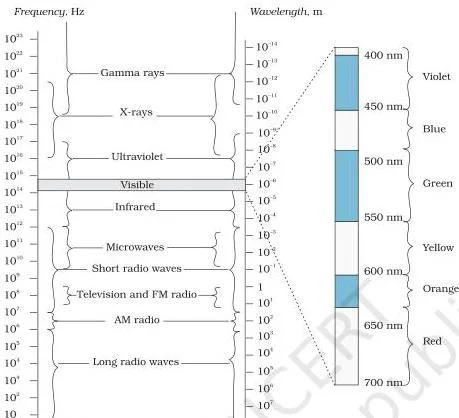
The diagram lays the whole family of electromagnetic waves along one axis, ordered by frequency and wavelength. The book is explicit that there is no sharp division between one kind of wave and the next — the names are assigned roughly by how the waves are produced and detected (NCERT, p. 208).
To fix the order in one pass, from radio to gamma (increasing frequency): radio → microwave → infrared → visible → ultraviolet → X-ray → gamma. A working mnemonic: Raging Martians Invaded Venus Using X-ray Guns.
The Microwave Figure: How These Waves Are Produced
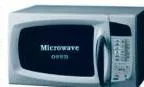
Microwaves are short-wavelength radio waves in the gigahertz range, produced by special vacuum tubes — klystrons, magnetrons and Gunn diodes (NCERT, p. 209). Their short wavelengths suit radar for aircraft navigation and the speed guns used on fast balls, tennis serves and automobiles.
The domestic microwave oven selects a frequency that matches the resonant frequency of water molecules, so the waves transfer energy efficiently to the molecules’ kinetic energy and heat any food containing water (NCERT, p. 209).
Key Definitions in This Chapter
If a term stops you mid-chapter, the table below gives its plain meaning and the page where the book defines or uses it.
| Term | Plain meaning | NCERT page |
|---|---|---|
| Conduction current | Current carried by conductors due to the actual flow of charges | p. 204 |
| Displacement current | The term \( \varepsilon_0\, d\Phi_E/dt \), a changing electric flux; produces magnetic effects identical to conduction current | pp. 203–204 |
| Electric flux \( \Phi_E \) | The measure of electric field passing through a surface; for the capacitor’s surface, \( \Phi_E = Q/\varepsilon_0 \) | p. 203 |
| Electromagnetic wave | Coupled, time-varying electric and magnetic fields that propagate in space | pp. 205–206 |
| Wave vector (propagation vector) \( \mathbf{k} \) | Its magnitude is \( 2\pi/\lambda \); its direction is the direction of propagation | p. 206 |
| Angular frequency \( \omega \) | \( 2\pi\nu \), the rate of phase change of the wave | p. 206 |
| Linearly polarised wave | A wave whose electric field oscillates in a single plane | Fig 8.3, p. 206 |
| Electromagnetic spectrum | The classification of electromagnetic waves according to frequency | p. 208 |
Common Mistakes Students Make
This chapter trips students in a few predictable places. Each entry names the mistake, the correct rule, and a quick way to check yourself.
| Mistake | Correct rule | How to check your answer |
|---|---|---|
| Thinking displacement current is a flow of charge through the capacitor | It is \( \varepsilon_0\, d\Phi_E/dt \) — a changing electric flux, not moving charge (NCERT, p. 203) | Ask: is charge physically crossing the gap? If not, the current there is displacement current. |
| Assuming \( i_c \) and \( i_d \) flow together everywhere | Outside the plates only \( i_c \) exists; inside the plates only \( i_d \) exists (NCERT, p. 204) | Identify the region: inside a capacitor → displacement; in a wire → conduction. |
| Believing electromagnetic waves need a medium | They are self-sustaining oscillations of E and B in free space (NCERT, p. 207) | Sunlight crosses the vacuum of space to reach Earth. |
| Treating spectrum bands as sharply divided | No sharp division; regions overlap and are named roughly by production and detection (NCERT, pp. 208, 213) | The same type of wave can be produced by different sources. |
| Getting the B direction wrong in the wave | Propagation is along \( \mathbf{E} \times \mathbf{B} \) (NCERT, p. 208) | Curl right-hand fingers from E toward B; the thumb points along travel. |
| Confusing c in vacuum with v in a medium | \( c = 1/\sqrt{\mu_0\varepsilon_0} \) in vacuum; \( v = 1/\sqrt{\mu\varepsilon} \) inside a material (NCERT, p. 207) | Check whether the wave is in vacuum or in a medium with its own \( \mu \) and \( \varepsilon \). |
A general caution from the book’s Points to Ponder: every electromagnetic wave travels at the same speed in vacuum, so the real differences between wave types come from wavelength and from how they interact with matter (NCERT, p. 213).
Exam Notes: What the Ten Exercises Test
The chapter ends with ten exercises. The table maps each one to the concept it tests and the relation that answers it, so revision targets the right idea the first time.
| Question | What it tests | Relation or idea to use |
|---|---|---|
| 8.1 | Capacitance of parallel plates, rate of change of potential difference, displacement current across the plates, validity of Kirchhoff’s junction rule | \( C = \varepsilon_0 A/d \) (Ch. 2), \( i_d = \varepsilon_0\, d\Phi_E/dt \), and \( i_d = i_c \) because displacement current continues the current across the gap |
| 8.2 | RMS conduction current in an AC-fed capacitor; equality of conduction and displacement current; amplitude of B at 3.0 cm from the axis | Capacitive AC current from Chapter 7, then \( i_d = i_c \); B from the displacement current as in the M-point of Fig. 8.2 |
| 8.3 | Speed is the physical quantity shared by all electromagnetic waves in vacuum | \( c = 3 \times 10^{8}\ \text{m/s} \), independent of wavelength |
| 8.4 | Directions of E and B; wavelength from frequency | \( \mathbf{E} \perp \mathbf{B} \perp \) propagation; \( \lambda = c/\nu \) |
| 8.5 | Wavelength band from a frequency band | \( \lambda = c/\nu \), applied at both ends of the band |
| 8.6 | Emitted frequency equals the oscillator’s frequency | \( \nu_{\text{wave}} = \nu_{\text{oscillator}} \) |
| 8.7 | Electric amplitude from magnetic amplitude | \( E_0 = B_0 c \) |
| 8.8 | \( B_0, \omega, k, \lambda \) from \( E_0 \) and \( \nu \); writing the E and B expressions | \( B_0 = E_0/c \), \( \omega = 2\pi\nu \), \( k = \omega/c = 2\pi/\lambda \) |
| 8.9 | Photon energy and its eV scale; how energy scales relate to sources | \( E = h\nu \), converting joules to eV |
| 8.10 | Wavelength, B amplitude, equality of average energy densities of E and B | \( \lambda = c/\nu \), \( B_0 = E_0/c \), average energy density of E equals that of B |
Two exercises refer to their own capacitor diagrams printed inside the PDF — Exercise 8.1 to Fig. 8.5 and Exercise 8.2 to Fig. 8.6. Those figures are not reproduced on this page, so work from the diagrams in your book. Textbook contents and the examinable syllabus are not always identical — check the current official CBSE syllabus for what is examinable this session.
Quick Revision Summary
This is the chapter’s own summary (p. 212) restated for quick recall, with the highlights of Points to Ponder (p. 213) folded in.
- Maxwell found Ampere’s law inconsistent for a charging capacitor and added the displacement current \( i_d = \varepsilon_0\, d\Phi_E/dt \), which acts as a source of magnetic field exactly like conduction current (NCERT, p. 212).
- An accelerated charge radiates electromagnetic waves; a charge oscillating at frequency \( \nu \) emits waves of frequency \( \nu \); an electric dipole is the basic source (NCERT, p. 212).
- Hertz first produced and detected electromagnetic waves of a few metres’ wavelength in 1887, verifying Maxwell’s prediction (NCERT, p. 212).
- In a plane wave, E and B oscillate sinusoidally, perpendicular to each other and to the direction of propagation, with \( E_0/B_0 = c \) (NCERT, p. 212).
- \( c = 1/\sqrt{\mu_0\varepsilon_0} \) equals the measured speed of light — so light is an electromagnetic wave; in a material medium, \( v = 1/\sqrt{\mu\varepsilon} \) (NCERT, p. 212).
- The spectrum stretches from gamma rays around \( 10^{-12}\ \text{m} \) to radio waves around \( 10^{6}\ \text{m} \), and the named regions overlap (NCERT, p. 212).
From Points to Ponder (NCERT, p. 213):
- All electromagnetic waves travel at the same speed in vacuum; their differences come from wavelength and interaction with matter.
- Wavelength correlates with the size of the radiating system: gamma rays from atomic nuclei, X-rays from heavy atoms, radio waves from circuits. An antenna radiates most efficiently when its size is about the wavelength.
- Infrared vibrates entire atoms and molecules, not just electrons, raising the substance’s internal energy and temperature — which is why infrared is called heat waves.
- Human eyes evolved to be most sensitive to the sun’s strongest wavelengths.
Related Resources
Continue with the surrounding chapters and revision notes:
- Class 12 NCERT books — browse every Class 12 textbook chapter.
- Class 12 Physics book pages — all chapters of Physics Part I and Part II.
- Alternating Current Class 12 (Chapter 7) — the previous chapter, whose AC ideas Exercise 8.2 builds on.
- Class 12 Physics notes — chapter-wise revision notes for Physics.
- Alternating Current Class 12 notes — revision notes for Chapter 7.
- Class 12 notes and CBSE notes home — the wider notes library.
The next chapter, Ray Optics and Optical Instruments, opens Physics Part II. To confirm what is examinable this session, check the current official syllabus on cbseacademic.nic.in.
Reference: NCERT Class 12 Physics Part I textbook, chapter 8, official edition on ncert.nic.in.
Sources and Data Verification
- The contents described on this page come from the NCERT Physics Part I textbook for Class 12, Chapter 8 Electromagnetic Waves, 2026-27 reprint edition.
- This page covers the chapters of Physics Part I; it does not cover Physics Part II or the other Class 12 subjects.
- The listing is maintained for the current academic session using the NCERT information available to us.
- NCERT settles textbook editions and PDFs; CBSE settles the curriculum, syllabus and examinations. A chapter appearing in the book does not by itself prove it is examinable this session — the current official CBSE syllabus is the authority.
FAQs on Electromagnetic Waves Class 12
Is displacement current a real current that flows through the capacitor?
No. Displacement current is not a flow of charge through the gap — no charge crosses the space between the plates. It is the term \( i_d = \varepsilon_0\, d\Phi_E/dt \), a changing electric flux, which Maxwell added so the magnetic field would not depend on the surface you choose (NCERT, pp. 203–204).
It produces magnetic effects identical to a conduction current, which is why the field inside the plates is measurable and equal to the field just outside.
Why do accelerated charges produce electromagnetic waves while steady currents do not?
Because a wave is a travelling change in a field, and only an accelerated charge makes its fields change with time. Stationary charges give electrostatic fields, and steady currents give magnetic fields that stay constant — neither radiates (NCERT, p. 205).
An oscillating charge’s electric field changes, so it produces a changing magnetic field, which reproduces the electric field, and the pair propagates as a wave of the same frequency.
Do all electromagnetic waves travel at the same speed in vacuum?
Yes. Every electromagnetic wave travels at \( c \approx 3 \times 10^{8}\ \text{m/s} \) in vacuum, independent of its wavelength, to within a few metres per second (NCERT, p. 207). What differs between wave types is their wavelength or frequency, and therefore how they interact with matter (NCERT, p. 213).
How do I find the direction of the magnetic field in an electromagnetic wave?
Use the rule that the direction of propagation is along \( \mathbf{E} \times \mathbf{B} \) (NCERT, p. 208). Curl the fingers of your right hand from E toward B and your thumb gives the travel direction.
For example, if E points along +z and the wave moves along +x, then B points along −y, since \( \hat{z} \times (-\hat{y}) = \hat{x} \).
Do electromagnetic waves need a medium to travel through?
No. Electromagnetic waves are self-sustaining oscillations of electric and magnetic fields in free space, with no material medium involved in their vibrations (NCERT, p. 207). That is what lets sunlight cross the vacuum between the Sun and the Earth.
Why are infrared waves called heat waves?
Because water molecules, carbon dioxide, ammonia and many other molecules absorb infrared strongly (NCERT, p. 210). Once absorbed, the molecules’ thermal motion increases, so the substance heats up and heats its surroundings. Infrared also maintains the Earth’s average temperature through the greenhouse effect (NCERT, p. 210).
Explore Class 12 Physics Books
Class 12 Physics on LearnCBSE:
Related chapters: