
Electrostatic Potential and Capacitance Class 12 is Chapter 2 of the NCERT Physics Part I textbook, and it runs across 36 printed pages of that book. The chapter opens with the work done on a charge moving in an electric field and closes with the energy stored in a capacitor, so the main sections below follow the book’s own order.
If you came for the file itself, the official NCERT Class 12 Physics Chapter 2 Electrostatic Potential and Capacitance PDF from ncert.nic.in is hosted below, ready to open in a tab beside these notes so you can follow each idea as it is explained.
Download the official NCERT Class 12 Physics Chapter 2 PDF
Open the official NCERT Class 12 Physics Chapter 2 Electrostatic Potential and Capacitance PDF from NCERT’s website and keep it in a second tab while you read the chapter contents and formula tables below. This is the same file the printed book is typeset from, so the page numbers cited here match the official edition you are holding.
| What the chapter holds | Count | Where it is used |
|---|---|---|
| Printed pages | 36 | |
| Sections in the chapter | 21 | |
| Figures with NCERT captions | 35 | |
| Tables | 1 | |
| Worked examples | 3 | solved step by step in our NCERT Solutions |
| Exercise questions | 11 | answered in our NCERT Solutions |
| Official NCERT PDF | Download the chapter PDF | the chapter exactly as NCERT publishes it |
Chapter 2 at a glance: what is inside the PDF
The table below shows what the chapter holds, listing the sections, figures, worked examples and exercise count so you know what to expect before you open the file.
What this chapter covers: from potential to capacitance
Chapter 2 builds one continuous idea: work done on a charge becomes potential energy, that work per unit charge becomes potential, and potential differences across conductors become capacitance and stored energy. Each block below matches the order of the book, so you can keep a finger on the NCERT page while reading it.
How the chapter defines potential (Sections 2.1 to 2.3)
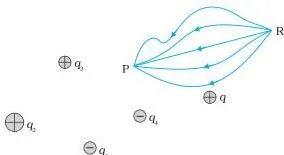
The chapter starts from Class 11’s idea of potential energy for conservative forces. The Coulomb force, like gravity, is conservative: the work done by the electric force in moving a charge between two points depends only on the points, not on the path taken (NCERT, p. 46).
The work done by an external force in moving a charge from R to P is stored as potential energy difference, not as a definite value of potential energy — only the difference matters (NCERT, p. 47).
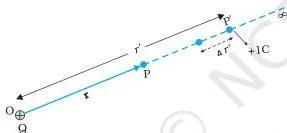
Electrostatic potential at a point is the work done in bringing a unit positive charge from infinity to that point without acceleration (NCERT, p. 47). For a point charge \(Q\), that work comes out as \[ V(r) = \frac{1}{4\pi\varepsilon_0} \frac{Q}{r} \]
The unit is the volt, with \(1\ \text{V} = 1\ \text{J/C}\). Because potential is work per unit charge, a small test charge’s own magnitude never changes the result (NCERT, p. 48).
Dipole and multi-charge potential (Sections 2.4 and 2.5)
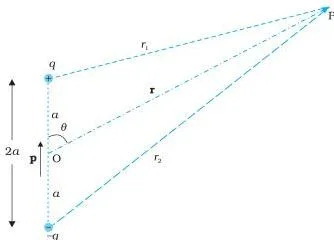
A dipole has total charge zero, so its potential behaves differently from that of a single charge. Using superposition, the dipole potential turns out to be \[ V = \frac{1}{4\pi\varepsilon_0} \frac{p \cos \theta}{r^2} \]
with \(p\) the dipole moment magnitude in C m and \(\theta\) the angle between the position vector \(\mathbf{r}\) and \(\mathbf{p}\) (NCERT, p. 50). Notice the fall-off is \(1/r^2\), not the single-charge \(1/r\), and the potential vanishes in the equatorial plane \(\theta = \pi/2\) is zero (NCERT, p. 50–51).
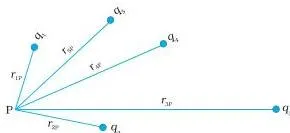
For a system of charges, potential at a point is the algebraic sum of the individual contributions \(q_i/(4\pi\varepsilon_0 r_{iP})\), as in Eq. (2.18) on NCERT p. 51.
Equipotential surfaces and the field-to-potential link (Section 2.6)
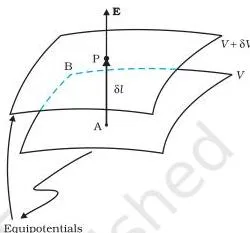
An equipotential surface joins all points with the same potential. The field at any point is normal to the surface through that point; if it had a component along the surface, moving a test charge would require work, contradicting the definition of equal potential (NCERT, p. 54). The magnitude of the field is \[ |\mathbf{E}| = -\frac{\delta V}{\delta l} \]
Equation (2.20) on NCERT p. 55 gives the two conclusions that follow: the field points along the direction of steepest decrease of potential, and its magnitude is the change of potential per unit displacement normal to the surface.
For a charged spherical shell the potential inside is constant and equal to its surface value \(q/(4\pi\varepsilon_0 R)\) (NCERT, p. 51–55).
Potential energy of systems and dipoles in fields (Sections 2.7 and 2.8)
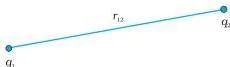
Bringing the first charge costs no work, and the second works against the first field, so the potential energy of two point charges is \[ U = \frac{1}{4\pi\varepsilon_0} \frac{q_1 q_2}{r_{12}} \]
Equation (2.22) on NCERT p. 55, true for any signs of the charges; a third charge adds the terms \(q_1q_3/r_{13}\) and \(q_2q_3/r_{23}\) (NCERT, p. 56).
For a charge \(q\) in an external field, the potential energy is simply \(qV(\mathbf{r})\) (NCERT p. 58–59), and for a dipole in a uniform field the energy is \[ U(\theta) = -\mathbf{p} \cdot \mathbf{E} \]
(NCERT, p. 60), choosing the zero at \(\theta = \pi/2\).
Conductors, electrostatic shielding and dielectrics (Sections 2.9 and 2.10)
Conductors give six electrostatic results that you can list in one line of revision:
- Inside a conductor the electrostatic field is zero (NCERT, p. 62).
- At the surface, the field is normal to the surface at every point (NCERT, p. 62).
- The interior of a conductor can have no excess charge in the static situation (NCERT, p. 62).
- Potential is constant throughout the volume and equals its surface value (NCERT, p. 62).
- Just outside a charged conductor the field has magnitude \(E = \sigma/\varepsilon_0\) (NCERT, p. 63).
- Any cavity inside a conductor is shielded from external electric influence — the cavity field is zero (NCERT, p. 64).
Dielectrics are different: polar and non-polar molecules both develop a net dipole moment in an external field (NCERT, p. 66), the polarisation is \(\mathbf{P} = \varepsilon_0 \chi_e \mathbf{E}\), and the induced surface charges reduce the field rather than cancel it (NCERT, p. 67).
Capacitors and combinations (Sections 2.11 to 2.15)
A capacitor stores charge \(Q\) on one plate and \(-Q\) on the other; the ratio is capacitance \(C = Q/V\) measured in farads, where \(1\ \text{F} = 1\ \text{C/V}\) (NCERT, p. 67). The practical units are \(\mu\text{F}\), nF and pF (NCERT, p. 68).
For parallel plates, \(C = \varepsilon_0 A/d\) (NCERT, p. 68), rising to \(C = \varepsilon_0 K A / d\) with a dielectric of dielectric constant \(K\) (NCERT, p. 70). Two capacitors in series share the same charge \(Q\), so \(1/C = 1/C_1 + 1/C_2\) (NCERT, p. 71); in parallel they share the same \(V\), so \(C = C_1 + C_2\) (NCERT, p. 72).
Energy stored is \[ W = \frac{Q^2}{2C} = \frac{1}{2} C V^2 = \frac{1}{2} Q V \]
with energy density \(u = \frac{1}{2}\varepsilon_0 E^2\) (NCERT, p. 74). A short comparison table keeps the two combinations straight:
| Quantity | Series | Parallel |
|---|---|---|
| Charge on each capacitor | Same \(Q\) on every capacitor, so \(V = V_1 + V_2 + \dots\) | Same \(V\) across each, so \(Q = Q_1 + Q_2 + \dots\) |
| Effective capacitance | \(1/C = 1/C_1 + 1/C_2\dots\) | \(C = C_1 + C_2 + \dots\) |
| Why it follows | Charge conservation through a conducting link (NCERT, p. 71) | Common potential difference (NCERT, p. 72) |
Electrostatic Potential and Capacitance Class 12: key formulas in the chapter
These are the formulas you will use in almost every question of the chapter, with symbols and units so substitution is mechanical. The NCERT page in the last column is where each result is derived.
| Concept | Formula | Meaning of symbols | Unit | NCERT page |
|---|---|---|---|---|
| Potential due to a point charge | \(V = \frac{1}{4\pi\varepsilon_0}\frac{Q}{r}\) | \(Q\) charge; \(r\) distance; \(\varepsilon_0\) permittivity of free space | volt (V) | p. 48 |
| Potential due to a dipole | \(V = \frac{p\cos\theta}{4\pi\varepsilon_0 r^2}\) | \(p\) dipole moment; \(\theta\) angle with \(\mathbf{p}\) | V | p. 50 |
| Potential of a system of charges | \(V = \frac{1}{4\pi\varepsilon_0}\sum_i \frac{q_i}{r_{iP}}\) | algebraic sum with signs | V | p. 51 |
| Field from potential | \(|\mathbf{E}| = -\frac{\delta V}{\delta l}\) | \(\delta l\) normal displacement between surfaces | V/m | p. 55 |
| Potential energy, two charges | \(U = \frac{1}{4\pi\varepsilon_0}\frac{q_1 q_2}{r_{12}}\) | \(r_{12}\) separation | joule (J) | p. 55 |
| Dipole in an external field | \(U = -\mathbf{p}\cdot\mathbf{E}\) | zero chosen at \(\theta = 90^\circ\) | J | p. 60 |
| Field at conductor surface | \(\mathbf{E} = \frac{\sigma}{\varepsilon_0}\hat{\mathbf{n}}\) | \(\sigma\) surface charge density | V/m | p. 63 |
| Capacitance | \(C = Q/V\) | \(Q\) charge on one plate | farad (F = C/V) | p. 67 |
| Parallel plate capacitor | \(C = \varepsilon_0 A/d\) | \(A\) plate area; \(d\) separation | F | p. 68 |
| With dielectric | \(C = \varepsilon_0 K A / d\) | \(K = \varepsilon/\varepsilon_0\) dielectric constant | F | p. 70 |
| Series combination | \(\frac{1}{C} = \frac{1}{C_1} + \frac{1}{C_2}\) | charge common to all | F | p. 71 |
| Parallel combination | \(C = C_1 + C_2\) | voltage common to all | F | p. 72 |
| Energy stored | \(W = \frac{Q^2}{2C} = \frac{1}{2}CV^2 = \frac{1}{2}QV\) | also \(W = \frac{1}{2}\int V\,dQ\) form | J | p. 74 |
| Energy density | \(u = \frac{1}{2}\varepsilon_0 E^2\) | energy per unit volume between plates | J/m³ | p. 74 |
Worked example: a 3 µF capacitor charged to 6 V meets an uncharged 6 µF capacitor
This is the classic energy-sharing problem of Section 2.15. All values here are new ones, different from any example in the textbook; the physics is the same reasoning that Example 2.10 demonstrates (NCERT, p. 75–76).
Step 1: Find the initial charge on the first capacitor: \(Q = CV = 3\ \mu\text{F} \times 6\ \text{V} = 18\ \mu\text{C}\).
Its stored energy is \(U_1 = \frac{1}{2}CV^2 = \frac{1}{2} \times 3\ \mu\text{F} \times (6\ \text{V})^2 = 54\ \mu\text{J}\).
Step 2: Charge is conserved.
After the connection, the total charge \(18\ \mu\text{C}\) spreads over \(C = 3\ \mu\text{F} + 6\ \mu\text{F} = 9\ \mu\text{F}\).
Step 3: The common potential is \(V’ = Q/C = 18\ \mu\text{C} / 9\ \mu\text{F} = 2\ \text{V}\).
Each capacitor now has the same potential difference \(2\ \text{V}\).
- Step 1: Total final energy is \(U_2 = \frac{1}{2} C V’^2 = \frac{1}{2} \times 9\ \mu\text{F} \times (2\ \text{V})^2 = 18\ \mu\text{J}\).
- Step 2: Energy lost = \(54\ \mu\text{J} – 18\ \mu\text{J} = 36\ \mu\text{J}\).
The missing energy does not vanish: it is released as heat and electromagnetic radiation during the brief transient current while the second capacitor charges (NCERT, p. 76).
Final answer: common potential \(2\ \text{V}\) across both; final stored energy \(18\ \mu\text{J}\) of the initial \(54\ \mu\text{J}\); energy lost \(36\ \mu\text{J}\), dissipated as heat and radiation in the transient state.
How to read the key figures in this chapter

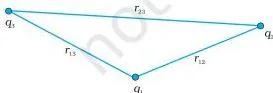
The figures in this chapter carry the definitions, not decoration — each diagram below shows a concept you can trace with one finger on the printed page.
Fig 2.1: work against the Coulomb force
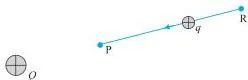
Notice the external force exactly balances the electric force the whole way, so the charge never accelerates (NCERT, p. 46). The work done in that no-acceleration move is stored as potential energy; release the external force and the charge carries the stored energy away as kinetic energy.
Fig 2.4: V falls as 1/r while E falls as 1/r²
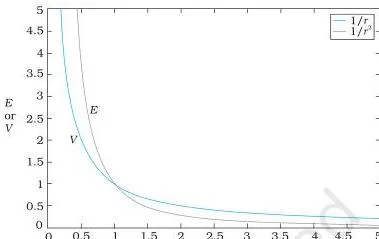
Read the two curves together (NCERT, p. 49): potential dies off as \(1/r\), field as \(1/r^2\), so potential always falls more slowly with distance than field does. That slower fall is why field is a gradient of potential: you differentiate a \(1/r\) curve to get a \(1/r^2\) curve.
Figs 2.9, 2.10 and 2.11: what equipotential surfaces look like
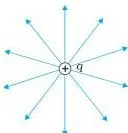
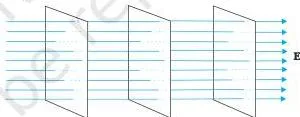
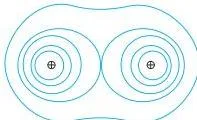
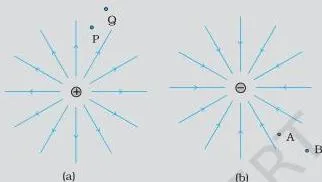
For one charge the surfaces are concentric spheres because \(V\) depends only on \(r\); for a uniform field they are parallel planes; and for a dipole and two identical charges the surfaces bend as the figure shows (NCERT, p. 54).
In all three pictures, draw a field line and it crosses each surface at a right angle — that is the normal condition from Section 2.6.

Figs 2.17 and 2.18: field at a conductor surface and shielding of a cavity
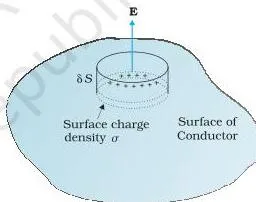
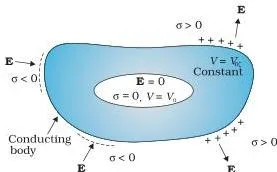
The pill box gets flux only through its outer face, since the field is zero just inside the surface; that single face gives \(E = \sigma/\varepsilon_0\) (NCERT, p. 63). Figure 2.18 then states the shielding result: whatever the charge and field outside, the cavity field stays zero and every excess charge sits on the outer surface (NCERT, p. 64).
Figs 2.25, 2.26 and 2.28: parallel plates, series and parallel capacitors
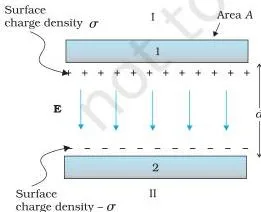
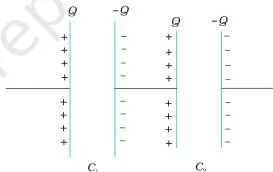
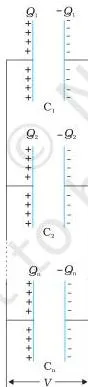
Figure 2.25 shows why the field is localised between two plates: outside the plates the two contributions cancel (NCERT, p. 68). In series, the right plate of \(C_1\) and left plate of \(C_2\) carry equal \(\pm Q\) because the connecting conductor cannot hold a net charge — that is why voltages add (NCERT, p. 71).
In parallel the same \(V\) sits across both, so charges add instead (NCERT, p. 72).
Definitions that carry the chapter
These terms will appear in nearly every line of this chapter, so state them precisely. Each definition is in my own words, as the book states it.
| Term | Definition | NCERT page |
|---|---|---|
| Electrostatic potential | Work done in bringing a unit positive charge from infinity to that point without acceleration, with potential zero chosen at infinity. | p. 47 |
| Potential difference | Work done per unit charge in moving between the two points; only the difference, never the absolute value, is physically significant. | p. 47 |
| Equipotential surface | A surface with a constant value of potential at all its points, requiring the field to be normal to it at every point. | p. 54 |
| Polarisation | Net dipole moment per unit volume induced in a dielectric, \(\mathbf{P} = \varepsilon_0\chi_e\mathbf{E}\), where \(\chi_e\) is the electric susceptibility. | p. 66 |
| Capacitance | Ratio \(Q/V\) for the two conductors of a capacitor; \(Q\) being the charge on one plate, the total charge of the capacitor being zero. | p. 67 |
| Dielectric constant | The ratio \(K = \varepsilon/\varepsilon_0\), the factor by which a dielectric increases capacitance from its vacuum value: \(K = C/C_0\) > 1. | p. 70 |
| Energy density | Energy stored per unit volume of space, \(u = \frac{1}{2}\varepsilon_0\,E^2\), valid for any field configuration. | p. 74 |
Common mistakes in this chapter and corrections
These are the errors the chapter’s own explanations are built to prevent — check yourself against them before you start the exercises.
| Mistake | Correct rule | How to check your answer |
|---|---|---|
| Assuming potential is zero wherever the field is zero | Inside a conductor the field is zero but the potential is constant and equal to its value on the surface, which need not be zero (NCERT, p. 62). | Ask: is work needed to move a charge between two points? Zero field means zero work, so equal potential. |
| Using \(1/r\) for dipole potential at large distance | Dipole potential falls as \(1/r^2\) and depends on angle, falling as \(1/r^2\) at large \(r\) (NCERT, p. 50–51). | Check the equatorial plane: single charge has nonzero potential, a dipole has zero potential there. |
| Calling \(Q\) the total charge of the capacitor | \(Q\) is the charge on one plate; the two plates together always carry zero net charge (NCERT, p. 67). | Write charges on both plates as \(+Q\) and \(-Q\) and add them. |
| Believing energy is conserved when a charged capacitor is connected to an uncharged one | Charge is conserved, energy is not; nearly half the stored energy is lost as heat and electromagnetic radiation in the transient current (NCERT, p. 75–76). | Compare \(\frac{1}{2}CV^2\) before and after — they are not equal for equal capacitors. |
How the exercises and examples test the chapter
Every exercise is a direct application of one of the chapter’s numbered results, so you can revise by question type. The table below pairs each end-of-chapter exercise with the concept it tests and the solved example that mirrors it.
| Exercise | Concept or formula it tests | Section of the chapter | Example that mirrors it |
|---|---|---|---|
| 2.1 | Finding where the potential is zero between two unlike charges of different magnitudes | 2.5 | Example 2.2 |
| 2.2 | Superposition for many charges at a symmetric point | 2.5 | Eq. (2.18) |
| 2.3 | Equipotential surface of two opposite charges and direction of the field on it | 2.6 | Eq. (2.20) |
| 2.4 | Field inside, just outside, and beyond a conducting sphere | 2.9, 2.5 | Eq. (2.19) pair |
| 2.5 | Capacitance when separation halves and a dielectric of K = 6 fills the gap | 2.12–2.13 | Example 2.8 |
| 2.6 | Series combination and voltage division | 2.14.1 | Example 2.9 (network) |
| 2.7 | Parallel combination and charge on each branch | 2.14.2 | Example 2.9 (network) |
| 2.8 | Parallel plate capacitance and \(Q = CV\) | 2.12 | Eq. (2.43) |
| 2.9 | Effect of a mica slab with the supply connected and after disconnection | 2.13 | Example 2.8 |
| 2.10 | Energy stored for a given \(V\) | 2.10 | Eq. (2.69) |
| 2.11 | Energy sharing and energy lost when a charged capacitor meets an uncharged one | 2.15 | Example 2.10 |
Note that textbook contents and the examinable syllabus are not always identical — check the current official syllabus for your board exam before deciding what to prioritise.
Quick recap: the ideas of Chapter 2 in order
This is the one-screen revision list, built from the chapter’s own closing summary in my words, with the NCERT page where each idea lands:
- Electrostatic potential difference is work per unit charge moved, path-independent because the Coulomb force is conservative (p. 46–47).
- Point charge potential: \(V = Q/(4\pi\varepsilon_0 r)\) with zero at infinity (p. 48).
- Dipole potential falls as \(1/r^2\), depends on \(\theta\), and is zero in the equatorial plane (p. 50).
- System of charges: algebraic sum of individual potentials (p. 51).
- Equipotential surfaces are normal to the field; magnitude \(E = -\delta V/\delta l\) (p. 54–55).
- Energy of two charges \(U = q_1q_2/(4\pi\varepsilon_0 r_{12})\) (p. 55–56).
- Energy of a dipole in a field \(U = -\mathbf{p}\cdot\mathbf{E}\) with zero at \(\theta = 90^\circ\) (p. 60).
- The six conductor facts: zero field inside, normal surface field, no interior charge, constant potential, \(E = \sigma/\varepsilon_0\), cavity shielding (p. 62–64).
- Dielectrics reduce the field by induced surface charges; \(\mathbf{P} = \varepsilon_0\chi_e\mathbf{E}\) (p. 66–67).
- Capacitance \(C = Q/V\), farad unit (p. 67). Planar: \(C = \varepsilon_0 A/d\) (p. 68).
- Dielectric constant \(K = C/C_0 \gt 1\) raises capacitance to \(\varepsilon_0 K A/d\) (p. 70).
- Series: same charge, voltages add, \(1/C = \sum 1/C_i\) (p. 71). Parallel: same voltage, charges add, \(C = \sum C_i\) (p. 72).
- Stored energy \(W = Q^2/2C = \frac{1}{2}CV^2 = \frac{1}{2}QV\) and energy density \(u = \frac{1}{2}\varepsilon_0 E^2\) (p. 74).
Related NCERT resources for Class 12 Physics
This listing is maintained for the 2026-27 academic session using the NCERT textbook information available to us. NCERT remains the authority for confirming the latest edition.
Chapter 2 builds directly on Chapter 1’s field ideas, so if any step above feels thin, go back to the Class 12 Physics notes for the previous chapter first. The next chapter, Class 12 Physics Chapter 3 Current Electricity notes, puts these capacitors into circuits and uses the potential differences you have met here.
When you want the source file again, the official NCERT Class 12 Physics Chapter 2 Electrostatic Potential and Capacitance PDF from ncert.nic.in is the authoritative copy to revise from, while the hub page for Class 12 notes lists all your other subjects.
Sources and data verification
This page describes the NCERT Class 12 Physics Part I textbook, Chapter 2 (Electrostatic Potential and Capacitance), official edition on ncert.nic.in, with all page references taken directly from that edition.
It is maintained for the current academic session; NCERT settles textbook editions and PDFs on its site, while CBSE settles the curriculum, syllabus and examinations for which this book is the prescribed text. Textbook contents and the examinable syllabus are not always identical — check the current official syllabus.
Reference: NCERT Class 12 Physics textbook, chapter 2, official edition on ncert.nic.in.
Frequently asked questions about Electrostatic Potential and Capacitance Class 12
What does electrostatic potential mean in Class 12 Physics Chapter 2?
Electrostatic potential at a point is the work done in bringing a unit positive charge from infinity to that point without acceleration, with no loss of energy to heat, and potential zero chosen at infinity (NCERT, p. 47). A positive potential means work was done against the field; a negative potential means the field did the work.
Why is the electric field inside a conductor zero but the potential not zero, in Class 12 Physics Chapter 2?
Zero field means no work is done in moving a charge between any two points inside the conductor, so the potential is the same at every interior point and equals the surface value (NCERT, p. 62). The potential equals the potential of the surface, which itself carries excess surface charge, so it is not generally zero.
What is the dielectric constant and how does inserting a dielectric change capacitance?
The dielectric constant \(K\) is the factor by which a dielectric increases capacitance relative to vacuum: \(K = C/C_0\) (NCERT, p. 70). Inserting one between the plates reduces the field because induced surface charges oppose the external field, and new capacitance becomes \(C = \varepsilon_0 K A / d\).
Where is the electric potential zero on the line joining two opposite charges?
In general there are two such points: one between the charges and one beyond the smaller charge on the far side, found by setting the algebraic sum \(q_1/r_1 + q_2/r_2 = 0\) (NCERT, p. 52). With equal and opposite charges at unequal distances the location shifts accordingly, and in the equatorial plane the potential is zero only for a symmetric arrangement.
Why is energy lost when a charged capacitor is connected to an uncharged capacitor?
Charge is conserved while energy is not: during the transient current a current flows and energy is released as heat and electromagnetic radiation, so only about half the initial energy remains (NCERT, p. 75–76). This is exactly what the worked example above calculates for \(3\ \mu\text{F}\) at \(6\ \text{V}\) and an uncharged \(6\ \mu\text{F}\).
Why does the potential of a dipole fall as 1/r² instead of 1/r if it has two charges?
A dipole has zero net charge, so the leading \(1/r\) part cancels: the two contributions \(q/r_1 – q/r_2\) differ only in the first order in \(a/r\), leaving a \(1/r^2\) term \(p\cos\theta/r^2\) (NCERT, p. 50–51). From far away the dipole looks neutral; only its separation effects remain.
Explore Class 12 Physics Books
Class 12 Physics on LearnCBSE:
Related chapters: