
This page holds the Nuclei Class 12 chapter — Chapter 13 of the NCERT Physics Part II textbook, printed on pages 305 to 322. It answers the three questions the chapter is built around: what a nucleus is made of, what holds it together, and where nuclear energy comes from. The official NCERT PDF is right below.
Download the Nuclei Class 12 NCERT Physics chapter PDF
The file below is the official chapter from NCERT’s own website, in the book’s original layout — the same pages your teacher follows. The chapter runs from printed page 305 to page 322 of Physics Part II, so every page reference on this page matches a place in the file.
Download the official NCERT Nuclei Class 12 Physics chapter PDF from ncert.nic.in — the same file schools and teachers use, complete with figures, equations and the exercise set.
| What the chapter holds | Count | Where it is used |
|---|---|---|
| Printed pages | 17 | |
| Sections in the chapter | 12 | |
| Figures with NCERT captions | 2 | |
| Tables | 1 | |
| Worked examples | 4 | solved step by step in our NCERT Solutions |
| Exercise questions | 10 | answered in our NCERT Solutions |
| Official NCERT PDF | Download the chapter PDF | the chapter exactly as NCERT publishes it |
Chapter at a glance: what this file contains
This file is Chapter 13 of the NCERT Class 12 Physics Part II textbook, in its official NCERT edition. The table on this page lists how much the chapter holds — sections, worked examples, figures and exercise questions — so you can see its size before you start.
In subject terms the chapter is one continuous argument: what a nucleus is made of, how big it is, what holds it together, and how it releases energy. It closes with a Summary, Points to Ponder and the exercise set.
The chapter’s captioned figures carry most of the physical meaning:
- Figure 13.1 — the binding energy per nucleon curve (p. 312): why fission and fusion release energy.
- Figure 13.2 — the potential energy of a pair of nucleons (p. 313): why the nuclear force is short-range.
Both figures are explained in full in their own section further down.
What the Nuclei chapter covers, section by section
The chapter advances in one direction: build the nucleus out of protons and neutrons, measure it, calculate its binding, then release that binding energy. The table below shows each section, the printed page where it starts, and what it establishes.
| Section | Printed page | What it establishes |
|---|---|---|
| 13.1 Introduction | 305 | The atom is mostly empty; the nucleus holds more than 99.9% of the mass inside a radius about \(10^4\) times smaller. |
| 13.2 Atomic masses and composition of nucleus | 307–308 | The atomic mass unit, isotopes, the proton, Chadwick’s neutron, the \(Z, N, A\) notation, isobars and isotones. |
| 13.3 Size of the nucleus | 309 | \(R = R_0A^{1/3}\) with \(R_0 = 1.2\ \mathrm{fm}\); nuclear density \(\sim 2.3 \times 10^{17}\ \mathrm{kg\,m^{-3}}\), independent of \(A\). |
| 13.4 Mass–energy and nuclear binding energy | 310–312 | \(E = mc^2\), mass defect, binding energy and the binding-energy-per-nucleon curve. |
| 13.5 Nuclear force | 313 | A strong, short-range, charge-independent force with saturation. |
| 13.6 Radioactivity | 314 | Alpha, beta and gamma decay of unstable nuclei. |
| 13.7 Nuclear energy | 314–317 | Fission of \(^{235}\mathrm{U}\) at about 200 MeV per fission; fusion and the proton–proton cycle at 26.7 MeV net; Example 13.4 on what “balanced” means in a nuclear equation. |
The binding energy curve is the spine of the chapter. Because binding per nucleon peaks near \(A = 56\), a heavy nucleus splitting into middle-mass fragments releases energy — and two light nuclei joining into a heavier one do the same.
Example 13.4 adds the subtlety students miss most: a nuclear equation conserves proton count and neutron count separately, while mass-energy interconverts through the difference in binding energy (NCERT, p. 317).
Key concepts: from Z, N and A to fission and fusion
This is the teaching heart of the page. Each idea is explained in plain words with the NCERT page to follow along. Read down the list — every concept is used by the next one.
Z, N, A and the nuclide notation
Three numbers describe every nucleus. Once you can read them, the chapter’s shorthand is open.
- Z, atomic number — the number of protons. It also equals the number of electrons in a neutral atom (NCERT, p. 308).
- N, neutron number — the number of neutrons (NCERT, p. 308).
- A, mass number — \(Z + N\), the total number of protons and neutrons (NCERT, p. 308).
A nucleon is simply a proton or a neutron, so A counts nucleons. A nuclear species, or nuclide, is written \({}^A_Z\mathrm{X}\), with X the chemical symbol. Gold, for example, is \(^{197}_{79}\mathrm{Au}\): 197 nucleons, of which 79 are protons and \(197 – 79 = 118\) are neutrons (NCERT, p. 308).
Isotopes, isobars and isotones
All three words compare two nuclides by exactly one number: same protons, same mass number, or same neutrons.
| Name | Same | Different | Example (NCERT, p. 308) |
|---|---|---|---|
| Isotopes | Z (protons) | N (neutrons) | \(^{1}_{1}\mathrm{H},\ ^{2}_{1}\mathrm{H},\ ^{3}_{1}\mathrm{H}\) |
| Isobars | A (mass number) | Z and N | \(^{3}_{1}\mathrm{H}\) and \(^{3}_{2}\mathrm{He}\) |
| Isotones | N (neutrons) | Z | \(^{198}_{80}\mathrm{Hg}\) and \(^{197}_{79}\mathrm{Au}\) |
Keep them apart with a mnemonic: isotopes sit in the same place in the periodic table (the Greek meaning of isotope); an isobar is the same bar of mass number A; an isotone is the same N — N for Neutron.
Hydrogen’s three isotopes also show why nuclei need neutrons at all: deuterium \(^{2}_{1}\mathrm{H}\) carries one proton and one neutron, while tritium \(^{3}_{1}\mathrm{H}\) carries one proton and two neutrons and is unstable (NCERT, p. 308). Because isotopes share electronic structure, they share chemical behaviour.
Atomic mass unit and particle masses
Kilograms are clumsy at the scale of single atoms, so the chapter measures nuclear masses in atomic mass units.
- Atomic mass unit (u): \(1\ \mathrm{u} = \frac{1}{12}\) of the mass of one \(^{12}\mathrm{C}\) atom \(= 1.660539 \times 10^{-27}\ \mathrm{kg}\) (Eq. 13.1, NCERT, p. 307).
- Proton: \(m_p = 1.00727\ \mathrm{u} = 1.67262 \times 10^{-27}\ \mathrm{kg}\) (Eq. 13.2, p. 307) — the hydrogen atom’s mass (1.00783 u) minus one electron mass (0.00055 u).
- Neutron: \(m_n = 1.00866\ \mathrm{u} = 1.6749 \times 10^{-27}\ \mathrm{kg}\) (Eq. 13.3, p. 308) — slightly heavier than the proton. A free neutron decays in about a thousand seconds, but it is stable inside the nucleus.
Why is chlorine’s atomic mass 35.47 u instead of a whole number? Chlorine is a mixture of two isotopes, 34.98 u and 36.98 u, present in 75.4% and 24.6% abundance. The weighted average \((75.4 \times 34.98 + 24.6 \times 36.98)/100\) gives 35.47 u (NCERT, p. 307). The “atomic mass of an element” is always this weighted average.
Nuclear size and density
The previous chapter’s Rutherford experiment showed the nucleus exists; this chapter puts a number on its size.
A nucleus of mass number A has radius
\[ R = R_0 A^{1/3}, \qquad R_0 = 1.2\ \mathrm{fm}, \qquad 1\ \mathrm{fm} = 10^{-15}\ \mathrm{m} \]
(Eq. 13.5, NCERT, p. 309).
Since \(R^3 \propto A\), nuclear volume is proportional to the number of nucleons. Mass is proportional to A as well, so density — mass over volume — is constant: about \(2.3 \times 10^{17}\ \mathrm{kg\,m^{-3}}\) for all nuclei (NCERT, p. 309). Example 13.1 works the iron nucleus (A = 56) to \(2.29 \times 10^{17}\ \mathrm{kg\,m^{-3}}\) (p. 310).
That number is enormous beside ordinary matter — water is \(10^3\ \mathrm{kg\,m^{-3}}\) — because matter made of atoms is mostly empty. Nuclei behave like a liquid drop of fixed density.
The radii come from scattering experiments: alpha particles on gold first placed an upper limit near \(4.0 \times 10^{-14}\ \mathrm{m}\), and electron scattering later gave accurate sizes for many nuclei (NCERT, p. 309).
Mass defect, binding energy and mass–energy equivalence
A nucleus weighs less than the sum of the free nucleons that make it. That missing mass, turned into energy by \(E = mc^2\), is what holds the nucleus together.
Mass defect \(\Delta M\) is the difference between the mass of the free constituents and the nuclear mass (Eq. 13.7, NCERT, p. 311):
\[ \Delta M = [Zm_p + (A-Z)m_n] – M \]
Its energy, \(E_b = \Delta M c^2\) (Eq. 13.8, p. 311), is the binding energy — released when nucleons combine, and exactly what you must supply to pull a nucleus apart (NCERT, p. 311).
For practical units the chapter converts one atomic mass unit: \(1\ \mathrm{u} = 931.5\ \mathrm{MeV/c^2}\) (Example 13.3, p. 311). The binding energy per nucleon \(E_{bn} = E_b/A\) (Eq. 13.9, p. 312) is the fair way to compare nuclei of different size.
The book’s own working is for oxygen-16: subtracting the electron masses from the atomic mass 15.99493 u leaves nuclear mass 15.99053 u, a defect of 0.13691 u — equivalent to 127.5 MeV (NCERT, p. 311).
Worked example — binding energy per nucleon of helium-4. The exercise data on p. 321 gives \(m_{\mathrm{H}} = 1.007825\ \mathrm{u}\), \(m_n = 1.008665\ \mathrm{u}\), and \(m({}^4_2\mathrm{He}) = 4.002603\ \mathrm{u}\).
Step 1: Helium-4 has \(Z = 2\), \(N = 2\), \(A = 4\).
Both sides of the equation carry two electrons, so using atomic masses here automatically cancels the electron masses.
Step 2: Compute the mass defect:
\[ \Delta M = 2m_{\mathrm{H}} + 2m_n – m({}^4_2\mathrm{He}) \]
\[ \Delta M = 2(1.007825) + 2(1.008665) – 4.002603 = 0.030377\ \mathrm{u} \]
- Step 1: Convert to energy using \(1\ \mathrm{u} = 931.5\ \mathrm{MeV/c^2}\):
\[ E_b = 0.030377 \times 931.5 \approx 28.30\ \mathrm{MeV} \] - Step 2: Divide by the number of nucleons:
\[ E_{bn} = \frac{28.30}{4} \approx 7.07\ \mathrm{MeV} \]
per nucleon.
Final answer: helium-4 has total binding energy ≈ 28.3 MeV, about 7.07 MeV per nucleon — below the 8 MeV plateau, exactly where the binding energy curve places a light nucleus.
Worked example — the energy in one milligram of mass. Einstein’s relation (Eq. 13.6, NCERT, p. 310) says tiny masses hold enormous energy.
- Step 1: Write the mass in kilograms: \(m = 1\ \mathrm{mg} = 10^{-6}\ \mathrm{kg}\).
- Step 2: Use \(E = mc^2\) with \(c = 3 \times 10^8\ \mathrm{m/s}\):
\[ E = 10^{-6} \times (3 \times 10^{8})^2 = 10^{-6} \times 9 \times 10^{16} = 9 \times 10^{10}\ \mathrm{J} \] - Step 3: Compare with coal: burning 1 kg of coal releases \(10^7\ \mathrm{J}\) (p. 314), so
\[ \frac{9 \times 10^{10}}{10^{7}} = 9 \times 10^{3} = 9000\ \mathrm{kg\ of\ coal} \]
Final answer: one milligram of mass, fully converted, yields \(9 \times 10^{10}\ \mathrm{J}\) — the same energy as burning roughly 9000 kg of coal.
Nuclear force
Protons repel each other; gravity is far too weak. Something neither describes must glue the nucleus — the nuclear force.
- Much stronger than the Coulomb force, let alone gravity (NCERT, p. 313).
- Short range — it falls to zero within a few femtometres (p. 313).
- Charge-independent — the n-n, p-n and p-p forces are approximately the same (p. 313).
- Saturates — a nucleon feels only its nearest neighbours, which is why binding energy per nucleon stays constant in medium nuclei (p. 313).
There is no simple formula for it like Coulomb’s law. The features above were established experimentally between roughly 1930 and 1950 (NCERT, p. 313).
Radioactivity
Some nuclei are unstable and transform on their own, emitting particles or radiation. That spontaneous decay is radioactivity.
Becquerel found it in 1896 when a uranium compound blackened a photographic plate through black paper and a silver sheet (NCERT, p. 314). Three decay types occur in nature (p. 314):
- Alpha decay — the nucleus emits a helium nucleus, an alpha-particle (p. 314); alpha rays are helium nuclei (Summary, p. 319).
- Beta decay — emission of electrons or positrons (p. 314); beta rays are electrons (Summary, p. 319).
- Gamma decay — emission of high-energy photons, hundreds of keV or more (p. 314); gamma rays are electromagnetic radiation of wavelength shorter than X-rays (Summary, p. 319).
Radioactivity is a sign of nuclear instability. Light nuclei are stable near a neutron-to-proton ratio of 1:1; heavy nuclei need about 3:2 to damp the proton repulsion (Points to Ponder 8, NCERT, p. 320). Only about 10% of known isotopes are stable (p. 320).
Fission and fusion
Both release energy for one reason: nucleons end up more tightly bound. Fission tears a heavy nucleus apart; fusion welds light nuclei together.
Fission. When \(^{235}_{92}\mathrm{U}\) absorbs a slow neutron, it forms \(^{236}_{92}\mathrm{U}\), which splits into two intermediate-mass fragments — for example (Eq. 13.10, NCERT, p. 315):
\[ {}^1_0\mathrm{n} + {}^{235}_{92}\mathrm{U} \rightarrow {}^{236}_{92}\mathrm{U} \rightarrow {}^{144}_{56}\mathrm{Ba} + {}^{89}_{36}\mathrm{Kr} + 3{}^1_0\mathrm{n} \]
Other fragment pairs are Sb-133 + Nb-99 (Eq. 13.11) and Xe-140 + Sr-94 (Eq. 13.12).
The fragments are radioactive and shed beta particles until they reach stable nuclei (p. 315).
The release is about 200 MeV per fission for uranium-like nuclei. The chapter’s estimate: an \(A = 240\) nucleus at 7.6 MeV per nucleon splits into two \(A = 120\) nuclei at about 8.5 MeV per nucleon, gaining \(0.9\ \mathrm{MeV} \times 240 \approx 216\ \mathrm{MeV}\) (NCERT, p. 315). Fission of 1 kg of uranium gives \(10^{14}\ \mathrm{J}\); 1 kg of coal gives \(10^7\ \mathrm{J}\) (p. 314).
Fusion. Light nuclei joining release energy because the product is more tightly bound (p. 315). Examples (Eqs. 13.13(a)–(c), p. 315): two protons form a deuteron with 0.42 MeV; two deuterons can make He-3 plus a neutron with 3.27 MeV, or tritium plus a proton with 4.03 MeV.
But protons repel. The Coulomb barrier for two protons is about 400 keV, which for average particles means \((3/2)kT = 400\ \mathrm{keV}\), giving \(T \sim 3 \times 10^9\ \mathrm{K}\) (NCERT, p. 316). Raising the temperature so particles climb over the barrier is thermonuclear fusion (p. 316).
The sun runs the proton–proton cycle (Eqs. 13.14 and 13.15, p. 316):
\[ 4{}^1_1\mathrm{H} + 2e^- \rightarrow {}^4_2\mathrm{He} + 2\nu + 6\gamma + 26.7\ \mathrm{MeV} \]
Four hydrogen atoms fuse into one helium atom, releasing 26.7 MeV. The sun’s core is only \(1.5 \times 10^7\ \mathrm{K}\) — far below the \(3 \times 10^9\ \mathrm{K}\) average requirement — so it fuses only those protons with far above-average energy (NCERT, p. 316).
| Fission | Fusion | |
|---|---|---|
| What happens | A heavy nucleus splits into two intermediate-mass fragments (p. 314) | Two light nuclei combine into a heavier, more tightly bound nucleus (p. 315) |
| Example reaction | \({}^1_0\mathrm{n} + {}^{235}_{92}\mathrm{U} \rightarrow {}^{144}_{56}\mathrm{Ba} + {}^{89}_{36}\mathrm{Kr} + 3{}^1_0\mathrm{n}\) (Eq. 13.10) | \(4{}^1_1\mathrm{H} + 2e^- \rightarrow {}^4_2\mathrm{He} + 2\nu + 6\gamma + 26.7\ \mathrm{MeV}\) (Eq. 13.15) |
| Energy scale | About 200 MeV per fission (p. 315) | 26.7 MeV net for the proton–proton cycle (p. 316) |
| Why energy comes out | Fragments sit higher on the binding-energy curve: 7.6 \(\rightarrow\) ~8.5 MeV per nucleon (p. 315) | Fusion products are more tightly bound than the reactants (p. 312) |
| Where it happens | Nuclear reactors; uncontrolled in atom bombs (p. 315) | Stars; controlled thermonuclear fusion research needs a ~\(10^8\ \mathrm{K}\) plasma (p. 317) |
| What must be overcome | Initiated by a neutron capture (p. 315) | Coulomb barrier ~400 keV for two protons, so \(T \sim 3 \times 10^9\ \mathrm{K}\) for average particles (p. 316) |
Formula sheet: key equations with their symbols
Every formula in the chapter is a tool for one job. This table names the symbols and units so you never substitute blindly.
| Equation | Symbols | Meaning and units |
|---|---|---|
| \(1\ \mathrm{u} = \frac{1}{12}\) mass of one \(^{12}\mathrm{C}\) atom (13.1) | u = atomic mass unit | \(1\ \mathrm{u} = 1.660539 \times 10^{-27}\ \mathrm{kg}\) (p. 307) |
| \(m_p = 1.00727\ \mathrm{u}\) (13.2) | \(m_p\) = proton mass | \(= 1.67262 \times 10^{-27}\ \mathrm{kg}\) (p. 307) |
| \(m_n = 1.00866\ \mathrm{u}\) (13.3) | \(m_n\) = neutron mass | \(= 1.6749 \times 10^{-27}\ \mathrm{kg}\) (p. 308) |
| \(R = R_0A^{1/3}\) (13.5) | R = nuclear radius, A = mass number, \(R_0 = 1.2\ \mathrm{fm}\) | Radius of any nucleus, in fm (p. 309) |
| \(E = mc^2\) (13.6) | m = mass, c = \(3 \times 10^8\ \mathrm{m/s}\) | Mass–energy equivalence, in joules (p. 310) |
| \(\Delta M = [Zm_p + (A-Z)m_n] – M\) (13.7) | Z = protons, A−Z = neutrons, M = nuclear mass | Mass defect, in u (p. 311) |
| \(E_b = \Delta M c^2\) (13.8) | \(E_b\) = binding energy | Converts the defect to MeV (p. 311) |
| \(E_{bn} = E_b/A\) (13.9) | \(E_{bn}\) = binding energy per nucleon | The fair comparator of stability (p. 312) |
| Conversion | \(1\ \mathrm{u} = 931.5\ \mathrm{MeV/c^2}\) | Energy equivalent of one atomic mass unit (Example 13.3, p. 311) |
| \(Q = [m_A + m_b – m_C – m_d]c^2\) | masses of reactants minus products | Energy released; positive Q = exothermic (Exercise 13.5, p. 321) |
| \(4{}^1_1\mathrm{H} + 2e^- \rightarrow {}^4_2\mathrm{He} + 2\nu + 6\gamma + 26.7\ \mathrm{MeV}\) (13.15) | net proton–proton cycle | The sun’s energy source (p. 316) |
Reading the figures: binding energy and nuclear force curves
Two graphs carry most of the chapter’s physical intuition. If you can read them, you can answer the “why” questions — why fission and fusion release energy, and why the nuclear force saturates.
Figure 13.1 — the binding energy per nucleon curve
This is a plot of \(E_{bn}\) against mass number A for many nuclei (NCERT, p. 312). Up the side is binding energy per nucleon; along the bottom is A.
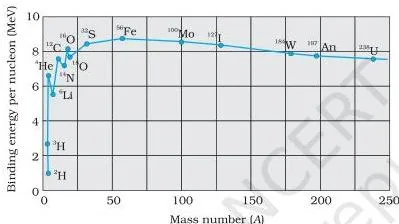
Three features decide everything:
- Flat middle: for \(30 \lt A \lt 170\) the value is nearly constant at about 8 MeV per nucleon (p. 312).
- Maximum: about \(8.75\ \mathrm{MeV}\) at \(A = 56\) — the iron region — falling to 7.6 MeV at \(A = 238\) (p. 312).
- Low ends: lighter nuclei (\(A \lt 30\)) and heavier nuclei (\(A \gt 170\)) both sit lower (p. 312).
Now the payoffs. A heavy nucleus splitting into middle-mass fragments moves up the curve, so the fragments are more tightly bound and energy escapes — that is fission. Two very light nuclei joining move up the curve too, releasing energy — that is fusion (NCERT, p. 312).
The flat middle is itself evidence the nuclear force is short-ranged: a nucleon binds only to nearby neighbours, so adding nucleons far away changes little (saturation, p. 312).
Figure 13.2 — the nucleon potential energy curve
This is a rough plot of the potential energy of a pair of nucleons against their separation (NCERT, p. 313). It answers: how close can two nucleons get, and what force do they feel?
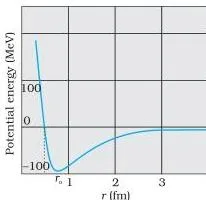
The minimum sits at \(r_0 \approx 0.8\ \mathrm{fm}\). Beyond 0.8 fm the force is attractive; closer than 0.8 fm it turns strongly repulsive — nucleons cannot be squeezed into nothing (NCERT, p. 313).
The short range explains saturation: a nucleon in a big nucleus is bound only to its immediate neighbours, which is why binding energy per nucleon stays flat for middle-mass nuclei. Unlike the Coulomb force, this one has no simple mathematical form (p. 313).
Definitions in plain words
Use this glossary when a term in an exercise or a question stalls you. Each entry is one line, with the NCERT page where the chapter defines it.
| Term | What it means | NCERT page |
|---|---|---|
| Atomic mass unit (u) | 1/12 of the mass of one carbon-12 atom; \(1.660539 \times 10^{-27}\ \mathrm{kg}\) | 307 |
| Isotope | Same Z, different N — same element, different mass | 307 |
| Proton | Nucleus of the lightest hydrogen atom; \(m_p = 1.00727\ \mathrm{u}\), stable | 307 |
| Neutron | Neutral particle nearly as massive as the proton; discovered by Chadwick in 1932; \(m_n = 1.00866\ \mathrm{u}\) | 308 |
| Atomic number Z | Number of protons in the nucleus | 308 |
| Neutron number N | Number of neutrons in the nucleus | 308 |
| Mass number A | \(Z + N\), total number of protons and neutrons | 308 |
| Nucleon | A proton or a neutron | 308 |
| Nuclide | A nuclear species, written \({}^A_Z\mathrm{X}\) | 308 |
| Isobar | Same mass number A, different Z — e.g. H-3 and He-3 | 308 |
| Isotone | Same neutron number N, different Z — e.g. Hg-198 and Au-197 | 308 |
| Mass defect | Mass of free nucleons minus the mass of the intact nucleus | 311 |
| Binding energy | Energy equivalent of the mass defect; needed to break a nucleus into free nucleons | 311 |
| Binding energy per nucleon | \(E_b/A\); average energy per nucleon to separate a nucleus | 312 |
| Radioactivity; alpha, beta, gamma decay | Unstable nuclei spontaneously emitting helium nuclei, electrons/positrons, or high-energy photons | 314 |
| Q-value | Energy released in a reaction: (initial masses − final masses)\(c^2\); positive means exothermic | 321 |
| Thermonuclear fusion | Fusion achieved by raising temperature so nuclei overcome the Coulomb barrier | 316 |
Common mistakes in Nuclei and how to avoid them
The chapter’s own Points to Ponder and Example 13.4 call out the errors students make most. Each row names the mistake, the correct rule, and a way to check yourself.
| Mistake | Correct rule | How to check your answer |
|---|---|---|
| Mixing up isotopes, isobars and isotones | Isotopes share Z, isobars share A, isotones share N (NCERT, p. 308) | Write Z, N, A for each nuclide and compare one pair at a time |
| Using atomic mass where nuclear mass is needed | Subtract the electron masses; the book’s O-16 working uses \(15.99493 – 8 \times 0.00055 = 15.99053\ \mathrm{u}\) (p. 311) | Count electrons on each side — if they cancel, atomic masses are fine |
| Conserving mass and energy separately | Einstein unified them: only total mass-energy is conserved (Points to Ponder 3, p. 320; Example 13.4b, p. 317) | Include masses and kinetic energies together in every reaction |
| Believing chemical reactions involve no mass defect | They do — chemical binding energy also gives a mass defect, but about a million times smaller than nuclear (Example 13.4c, p. 317) | Compare energy scales: eV for chemistry, MeV for nuclei |
| Assuming heavier nuclei are more tightly bound | The measure is binding energy per nucleon, which peaks near A = 56 at 8.75 MeV and falls to 7.6 MeV at A = 238 (p. 312) | Divide total binding energy by A before comparing stability |
| Expecting fusion to be easy | The Coulomb barrier for two protons is about 400 keV, so average particles need \(T \sim 3 \times 10^9\ \mathrm{K}\) (p. 316) | Convert the required kinetic energy to temperature with \((3/2)kT\) |
| Writing 1 u = 931.5 MeV | Correct form: \(1\ \mathrm{u} = 931.5\ \mathrm{MeV/c^2}\) — the \(c^2\) is part of the conversion (p. 311) | When dividing by \(c^2\) cancels out, your units are right |
| Claiming nuclear density grows with A | Nuclear density is constant, of order \(10^{17}\ \mathrm{kg/m^3}\), independent of A; atomic mass density is what varies (Points to Ponder 1, p. 320) | Use \(R = R_0A^{1/3}\): since \(R^3 \propto A\), density \(\propto A/A\) = constant |
| Thinking electron and alpha scattering give the same radius | They differ slightly: electron scattering senses the charge distribution; alpha scattering senses nuclear matter (Points to Ponder 2, p. 320) | Note which probe the question describes before comparing radii |
Exam preparation: which exercise tests which idea
The exercises at the end of the chapter are its practice set, and each one drills a specific skill. Use the map below to target weak spots instead of redoing everything.
| Exercise | Concept it tests |
|---|---|
| 13.1 and 13.2 | Binding energy from mass defect using \(1\ \mathrm{u} = 931.5\ \mathrm{MeV/c^2}\) — nitrogen-14, iron-56 and bismuth-209 |
| 13.3 | Total separation energy of a macroscopic object: a 3.0 g copper coin treated as \(^{63}_{29}\mathrm{Cu}\) atoms |
| 13.4 | Ratio of nuclear radii from \(R = R_0A^{1/3}\) (gold-107 and silver-107) |
| 13.5 | Q-value of two reactions and deciding exothermic or endothermic from the sign |
| 13.6 | Whether fission of iron-56 into two aluminium-28 fragments is energetically possible (sign of Q) |
| 13.7 | Total energy if 1 kg of plutonium-239 fissions at 180 MeV per fission |
| 13.8 | How long 2.0 kg of deuterium fusion keeps a 100 W lamp glowing |
| 13.9 | Coulomb potential barrier height for two touching deuterons |
| 13.10 | Proving nuclear density is independent of A from \(R = R_0A^{1/3}\) |
Start with the printed constants. The data block before the exercises (p. 321) gives \(e\), Avogadro’s number, \(k\), \(1\ \mathrm{MeV} = 1.6 \times 10^{-13}\ \mathrm{J}\), \(1\ \mathrm{u} = 931.5\ \mathrm{MeV/c^2}\), \(1\ \mathrm{year} = 3.154 \times 10^7\ \mathrm{s}\), and the masses of the hydrogen atom, neutron, helium-4 and electron. Use exactly these values and your answers will match the book’s.
Learn the shape of the binding energy curve. The questions that ask whether a reaction can happen — 13.5 and 13.6 — are decided by which side of the curve the products sit on, that is, by the sign of Q.
Syllabus note: textbook contents and the examinable syllabus are not always identical — check the current official syllabus for exam scope.
One-page recap of the entire Nuclei chapter
The chapter closes with its own Summary; here it is as a two-minute revision list. Read it the night before and every major idea is re-anchored.
- An atom is almost empty — the nucleus carries more than 99.9% of the mass in a radius about \(10^4\) times smaller than the atom (p. 305).
- \(1\ \mathrm{u} = 1/12\) of one \(^{12}\mathrm{C}\) atom \(= 1.66 \times 10^{-27}\ \mathrm{kg}\); the proton is 1.00727 u and the neutron is 1.00866 u (pp. 307–308).
- Chadwick discovered the neutron in 1932 by firing alpha particles at beryllium; it is nearly as massive as the proton (p. 308).
- \(Z\) = protons, \(N\) = neutrons, \(A = Z + N\); a nuclide is written \({}^A_Z\mathrm{X}\) (p. 308).
- Isotopes share Z, isobars share A, isotones share N; an element’s atomic mass is a weighted average of its isotopes (pp. 307–308).
- Nuclear radius \(R = R_0A^{1/3}\) with \(R_0 = 1.2\ \mathrm{fm}\); nuclear density is constant, of order \(10^{17}\ \mathrm{kg/m^3}\), independent of A (p. 309).
- Nucleons are held by the short-range strong nuclear force — stronger than Coulomb, charge-independent, and saturating (pp. 312–313).
- Nuclear mass is less than the sum of its parts (mass defect \(\Delta M\)); binding energy \(E_b = \Delta M c^2\); middle-mass nuclei bind at about 8 MeV per nucleon (pp. 311–312).
- Nuclear energies are about a million times chemical energies: 1 kg of fissioning uranium releases \(10^{14}\ \mathrm{J}\), 1 kg of coal \(10^7\ \mathrm{J}\) (p. 314).
- \(Q\) of a nuclear process is final kinetic energy minus initial kinetic energy, equivalently (initial masses − final masses)\(c^2\) (Summary, p. 319).
- Radioactivity is unstable nuclei emitting alpha (helium nuclei), beta (electrons) or gamma (very short-wavelength electromagnetic radiation) rays (p. 319).
- Fission splits heavy nuclei — U-235 fissions release about 200 MeV each; fusion joins light nuclei — the proton–proton cycle releases 26.7 MeV and powers the sun and stars (pp. 315–316).
The Summary also ends with a quick-reference table of nuclear quantities — decay constant \(\lambda\), half-life \(T_{1/2}\), mean life \(\tau\), and activity \(R\) (p. 319) — worth one look before the exam.
Related chapters and resources
This listing is maintained for the 2026-27 academic session using the NCERT textbook information available to us. NCERT remains the authority for confirming the latest edition.
Nuclei builds directly on the previous chapter and feeds the next. Useful nearby pages:
- Atoms — the previous chapter: its alpha-scattering model of the atom is where this chapter starts, and Section 13.3 recalls Rutherford’s experiment.
- Class 12 Physics notes — every chapter of the book in one place.
- Electromagnetic induction — an earlier Class 12 Physics chapter, useful to revise alongside energy conversion.
- Class 12 notes hub and the complete CBSE notes index.
In the book itself, the chapter that follows Nuclei is Semiconductor Electronics.
Sources and data verification
- The page references and figures on this page describe the NCERT Class 12 Physics Part II textbook, Chapter 13 “Nuclei”, printed pages 305–322, in the current official NCERT edition, with the PDF on ncert.nic.in.
- This page covers the Nuclei chapter only. Other chapters of Class 12 Physics have their own pages.
- This listing is maintained for the current academic session using the NCERT information available to us.
- NCERT settles textbook content, editions and PDFs; CBSE settles the curriculum, syllabus and examinations. Textbook contents and the examinable syllabus are not always identical — check the current official syllabus for exam scope.
Reference: NCERT Class 12 Physics textbook, chapter 13, official edition on ncert.nic.in.
Nuclei Class 12: frequently asked questions
Where can I download the official NCERT Class 12 Physics Nuclei chapter PDF?
Use the download link at the top of this page — it points to the official chapter file on ncert.nic.in. The chapter is printed as Chapter 13 of the NCERT Class 12 Physics Part II textbook, pages 305 to 322.
What is mass defect and how is binding energy calculated from it?
Mass defect \(\Delta M\) is the total mass of a nucleus’s free protons and neutrons minus the mass of the intact nucleus: \(\Delta M = [Zm_p + (A-Z)m_n] – M\) (Eq. 13.7, p. 311). The binding energy is \(E_b = \Delta M c^2\), and \(1\ \mathrm{u} = 931.5\ \mathrm{MeV/c^2}\) converts the defect to MeV.
For helium-4, the worked example on this page gives about 28.3 MeV total, or 7.07 MeV per nucleon.
Why is the iron nucleus with A = 56 the most stable nucleus?
Stability is judged by binding energy per nucleon, and that curve peaks near \(8.75\ \mathrm{MeV}\) at \(A = 56\) (p. 312). Iron’s nucleus is the most tightly bound of all, so energy is released whether heavier nuclei split toward it or lighter nuclei fuse toward it.
What is the difference between isotopes, isobars and isotones?
Isotopes have the same Z (same protons), isobars have the same mass number A, and isotones have the same neutron number N (p. 308). Examples from the book: hydrogen’s three isotopes; \(^{3}_{1}\mathrm{H}\) and \(^{3}_{2}\mathrm{He}\) as isobars; \(^{198}_{80}\mathrm{Hg}\) and \(^{197}_{79}\mathrm{Au}\) as isotones.
Why does nuclear fusion require extremely high temperatures?
Both nuclei are positively charged and repel each other electrically. They must climb a Coulomb barrier — about 400 keV for two protons — before the nuclear force can bind them.
For average particles that means \(T \sim 3 \times 10^9\ \mathrm{K}\), while the sun’s core is only \(1.5 \times 10^7\ \mathrm{K}\); the sun fuses because a fraction of its protons carry far above-average energy (p. 316).
What does a positive Q value of a nuclear reaction mean?
A positive Q means the reaction releases energy — it is exothermic. Using the definition from Exercise 13.5, \(Q = [m_A + m_b – m_C – m_d]c^2\), a positive Q means the products weigh less than the reactants and the lost mass appears as energy (Summary, p. 319).
Explore Class 12 Physics Books
Class 12 Physics on LearnCBSE:
Related chapters: