
These moving charges and magnetism class 12 notes give you the teach-me version of Chapter 4 — every key concept, formula with units, direction rule, worked example and exam pointer, compressed for revision. Read them section by section, then test yourself with the formula sheet and the one-minute recap at the end.
This page follows the rationalised NCERT Class 12 Physics Part I textbook, Chapter 4, with page citations so you can trace any derivation to the source. It is part of the CBSE notes library — jump to Class 12 notes or Class 12 physics notes for the rest of the chapters.
How Oersted’s Compass Framed the Study of Magnetism
For over 2000 years, electricity and magnetism were studied as separate subjects. That ended in 1820, when Danish physicist Hans Christian Oersted noticed, during a lecture demonstration, that a current in a straight wire deflected a nearby compass needle (NCERT, p. 108).
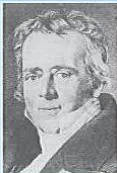
The portrait above is of Oersted himself. His key observations were:
- The needle aligned tangentially to an imaginary circle with the wire as centre, in a plane perpendicular to the wire.
- Reversing the current reversed the needle’s orientation.
- The deflection increased with larger current or with the needle closer to the wire.
- Iron filings around the wire arranged themselves in concentric circles.
- The deflection is cleanly visible when the current is large and the needle is close enough for the earth’s field to be ignored.
Oersted’s conclusion — moving charges (currents) produce a magnetic field in the surrounding space — is the foundation of the whole chapter.
Throughout this chapter, a current or field emerging out of the plane of the paper is shown by a dot (⊙), and one going into the plane by a cross (⊗). Think of a dot as the tip of an arrow coming straight at you, and a cross as the feathered tail of an arrow moving away (NCERT, p. 108).
The magnetic field \( \mathbf{B} \) is a vector field and obeys the principle of superposition: the total field from several sources is the vector sum of the individual fields, exactly as for electric fields (NCERT, p. 109).
The Lorentz Force: The Equation the Whole Chapter Rests On
A charge \( q \) moving with velocity \( \mathbf{v} \) in a region containing an electric field \( \mathbf{E} \) and a magnetic field \( \mathbf{B} \) experiences the Lorentz force (NCERT, p. 109):
\[ \mathbf{F} = q[\mathbf{E}(\mathbf{r}) + \mathbf{v} \times \mathbf{B}(\mathbf{r})] = \mathbf{F}_{\text{electric}} + \mathbf{F}_{\text{magnetic}} \]
For the magnetic part alone, the magnitude is \( F = qvB\sin\theta \), where \( \theta \) is the angle between \( \mathbf{v} \) and \( \mathbf{B} \). The direction is along \( \hat{\mathbf{n}} \), perpendicular to both.
- Sign matters: the force on a negative charge is opposite to that on a positive charge.
- Parallel means no force: the magnetic force is zero when \( \mathbf{v} \) is parallel or antiparallel to \( \mathbf{B} \) because \( \sin\theta = 0 \).
- Rest means no force: only a moving charge feels the magnetic force; if \( v = 0 \), the force vanishes.
The magnetic force is sideways — perpendicular to both \( \mathbf{v} \) and \( \mathbf{B} \) — and its sense comes from the right-hand rule (or screw rule) for the cross product. The electric part \( q\mathbf{E} \) has no such restriction: it can push along the motion and change a particle’s kinetic energy.
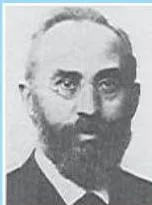
As the diagram illustrates, the force on a positive charge follows the right-hand rule for \( \mathbf{v} \times \mathbf{B} \), and the force on a negative charge is reversed.
The same expression defines the tesla: \( B \) is 1 T when a force of 1 N acts on a charge of 1 C moving at 1 m/s perpendicular to \( \mathbf{B} \). Dimensionally, \( [B] = [F/qv] = \text{N s/(C m)} \). A smaller, non-SI unit still in common use is the gauss: \( 1\ \text{G} = 10^{-4}\ \text{T} \).
The earth’s field is about \( 3.6 \times 10^{-5}\ \text{T} \) (NCERT, p. 109).
Force on a Current-Carrying Conductor: Where F = Il × B Comes From
The single-charge force extends naturally to a wire. Take a straight rod of cross-sectional area \( A \) and length \( l \) carrying a steady current \( I \), with \( n \) mobile charge carriers per unit volume.
The total number of carriers is \( nlA \), so if each has an average drift velocity \( \mathbf{v}_d \), the force in an external field \( \mathbf{B} \) is (NCERT, p. 110):
\[ \mathbf{F} = (nlA)q\, \mathbf{v}_d \times \mathbf{B} \]
Now \( nq\mathbf{v}_d \) is the current density \( \mathbf{j} \), and \( nqv_d A \) is the current \( I \). Substituting gives the compact result:
\[ \mathbf{F} = I\, \mathbf{l} \times \mathbf{B} \]
Here \( \mathbf{l} \) is a vector of magnitude \( l \) pointing in the direction of the current. Three points matter in exams:
- \( \mathbf{B} \) is the external field — not the field the rod itself produces.
- Current \( I \) is not a vector; the vector character is carried by \( \mathbf{l} \).
- For a wire of arbitrary shape, split it into small strips and sum \( \mathbf{F} = \sum_j I\, d\mathbf{l}_j \times \mathbf{B} \), converting the sum to an integral.
The drift velocity \( \mathbf{v}_d \) is the same quantity developed in the current electricity class 12 notes; its average speed sets how the whole chain of carriers drifts.
Circular and Helical Motion of a Charge in a Magnetic Field
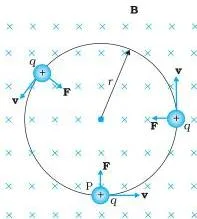
Because the magnetic force is always perpendicular to the velocity, it changes the direction of motion, never the speed. This is why it does no work — unlike the electric force \( q\mathbf{E} \), which can have a component along the motion and transfer energy (NCERT, p. 112).
Misconception autopsy — no work, yet direction changes. Work is \( Fs\cos\phi \), the component of force along displacement. At every instant the magnetic force is perpendicular to \( \mathbf{v} \), so the work done is zero.
Speed and kinetic energy therefore stay constant; the force acts as a centripetal force and only bends the path. This is why a magnetic field can steer a particle without changing its kinetic energy, while an electric field can do both.
For \( \mathbf{v} \) perpendicular to \( \mathbf{B} \), equate the magnetic force with the centripetal force \( mv^2/r \):
\[ \frac{mv^2}{r} = qvB \quad \Rightarrow \quad r = \frac{mv}{qB} \]
The radius grows with momentum: a larger momentum means a larger circle. Using \( v = \omega r \) gives the angular frequency and the cyclotron frequency:
\[ \omega = \frac{qB}{m}, \qquad \nu = \frac{qB}{2\pi m} \]
Neither expression contains \( v \). A faster particle traces a larger circle but completes each revolution in the same time — the fact a cyclotron exploits to accelerate particles (NCERT, p. 112).
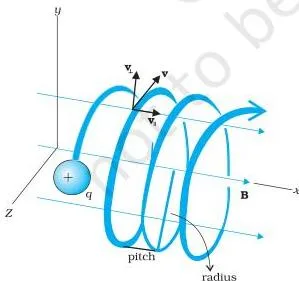
If the velocity has a component \( v_{\parallel} \) along \( \mathbf{B} \), that component stays unchanged because the field exerts no force along itself. The result is a helix: circular motion in the plane perpendicular to \( \mathbf{B} \), plus a steady drift along the field. The distance moved along the field in one revolution is the pitch:
\[ p = v_{\parallel} T = \frac{2\pi m v_{\parallel}}{qB} \]
The radius of the helix is set by the perpendicular component: \( r = mv_{\perp}/qB \) (NCERT, p. 112).
Biot-Savart Law: The Magnetic Field of a Current Element
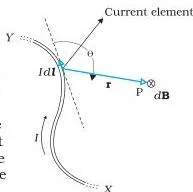
The Biot-Savart law is the source law of magnetostatics: it gives the magnetic field of a single current element. A conductor carrying steady current \( I \), with an infinitesimal element \( d\mathbf{l} \), produces at a point at displacement \( \mathbf{r} \) (NCERT, p. 113):
\[ d\mathbf{B} = \frac{\mu_0}{4\pi} \frac{I\, d\mathbf{l} \times \mathbf{r}}{r^3} \]
with magnitude \[ |d\mathbf{B}| = \frac{\mu_0}{4\pi} \frac{I\, dl\, \sin\theta}{r^2} \]
where \( \theta \) is the angle between \( d\mathbf{l} \) and \( \mathbf{r} \). The proportionality constant is \( \mu_0/4\pi = 10^{-7}\ \text{T m/A} \), so the permeability of free space is \( \mu_0 = 4\pi \times 10^{-7}\ \text{T m/A} \). The field of a full conductor is the vector integral of \( d\mathbf{B} \) over all its elements.
The direction of \( d\mathbf{B} \) is perpendicular to the plane of \( d\mathbf{l} \) and \( \mathbf{r} \), given by the right-hand screw rule: imagine moving from the first vector to the second; anticlockwise motion means the field comes toward you, clockwise means it goes away. Along the line of \( d\mathbf{l} \), the field is zero because \( \theta = 0 \).
There is also a remarkable link between the two vacuum constants: \( \varepsilon_0\mu_0 = 1/c^2 \), where \( c \) is the speed of light. Since \( c \) is fixed, fixing either constant fixes the other (NCERT, p. 114).
Info box — Biot-Savart versus Coulomb’s law. This comparison is a favourite exam question.
| Comparison | Coulomb’s law | Biot-Savart law |
|---|---|---|
| Source | Scalar source: electric charge \( Q \) | Vector source: current element \( I\,d\mathbf{l} \) |
| Field direction | Along the displacement vector from source to field point | Perpendicular to the plane of \( d\mathbf{l} \) and \( \mathbf{r} \) |
| Angle dependence | None | \( \sin\theta \) — zero along the element direction |
| Range | Long range, inverse square | Long range, inverse square |
| Superposition | Applies | Applies |
Both fields are linear in their sources, and both are long range. That shared structure is exactly why \( \mu_0 \) and \( \varepsilon_0 \) appear together in \( \varepsilon_0\mu_0 = 1/c^2 \) (NCERT, p. 114).
Magnetic Field on the Axis of a Circular Current Loop
Take a circular loop of radius \( R \) in the y-z plane, carrying a steady current \( I \), with its centre at the origin. For a point P on the x-axis at distance \( x \) from the centre (NCERT, p. 115):
\[ \mathbf{B} = \frac{\mu_0 I R^2}{2(x^2 + R^2)^{3/2}}\, \hat{\mathbf{i}} \]
Every current element is perpendicular to the displacement vector \( \mathbf{r} \) drawn from the element to P, so each \( d\mathbf{B} \) is tilted. The components of \( d\mathbf{B} \) perpendicular to the x-axis from diametrically opposite elements cancel in pairs; only the x-component survives.
With \( \cos\theta = R/(x^2 + R^2)^{1/2} \), integrating \( dB\cos\theta \) around the loop sums \( dl \) to the circumference \( 2\pi R \). This gives the axial field formula above (NCERT, p. 115).
At the centre, \( x = 0 \), the formula reduces to the exam-favourite special case. For \( N \) closely wound turns, multiply by \( N \):
\[ B_0 = \frac{\mu_0 I}{2R} \qquad \text{and, for } N \text{ turns,} \qquad B_0 = \frac{\mu_0 N I}{2R} \]
The loop is the working element of coils, solenoids and galvanometers — almost every device in the rest of this chapter is built from this centre-field expression.
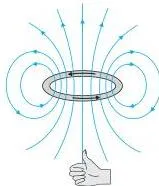
The direction of \( \mathbf{B} \) on the axis needs a second right-hand rule: curl the fingers of your right hand around the loop in the direction of the current; the thumb points along \( \mathbf{B} \), toward the side that behaves like a north pole (NCERT, p. 116).
Ampere’s Circuital Law and the Field of a Straight Wire
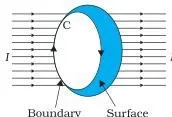
Ampere’s circuital law is the alternative, integral way to express the Biot-Savart law. It states that the line integral of \( \mathbf{B} \) around a closed loop equals \( \mu_0 \) times the current passing through the surface bounded by that loop (NCERT, p. 117):
\[ \oint \mathbf{B} \cdot d\mathbf{l} = \mu_0 I \]
The sign of \( I \) follows the right-hand rule: curl the fingers of the right hand in the direction the loop is traversed; the thumb then points in the positive sense for the current.
In practice a simplified form works when an amperian loop can be chosen such that on it \( \mathbf{B} \) is tangential and constant, or normal, or zero:
\[ BL = \mu_0 I_e \]
Here \( L \) is the length over which \( \mathbf{B} \) is tangential and \( I_e \) the enclosed current.
For an infinite straight wire, choose a circular amperian loop concentric with the wire. The field is tangential and constant on it, so \( B(2\pi r) = \mu_0 I \), giving:
\[ B = \frac{\mu_0 I}{2\pi r} \]
- Cylindrical symmetry: the field has the same magnitude at every point on a circle of radius \( r \) — it depends on one coordinate only.
- Closed field lines: the field lines are concentric circles, unlike electrostatic field lines which start on positive and end on negative charges.
- Not infinite: even an infinite wire gives a finite field at any non-zero distance, proportional to \( I \) and inversely proportional to \( r \).
The straight-wire right-hand rule: grasp the wire with your right hand, thumb pointing along the current; your fingers curl around in the direction of the magnetic field (NCERT, p. 119).
For a wire of circular cross-section of radius \( a \), Ampere’s law gives the field both outside and inside (NCERT, p. 120):
- Outside, \( r \gt a \): \( B = \mu_0 I / 2\pi r \) — field falls as \( 1/r \).
- Inside, \( r \lt a \): only the fraction \( I_e = I(r^2/a^2) \) of the current is enclosed, so \( B = (\mu_0 I / 2\pi a^2)\, r \) — field rises linearly with \( r \).
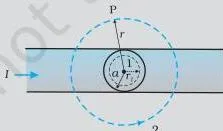
The resulting B-versus-r plot rises linearly from the centre to the surface, then falls as \( 1/r \) beyond it. Ampere’s law relates to the Biot-Savart law as Gauss’s law relates to Coulomb’s law — both hold for steady currents (NCERT, p. 119).
Memory device — the two right-hand rules. Students routinely swap these. The difference is which object is straight:
| Rule | Hand action | Thumb | Curled fingers |
|---|---|---|---|
| Straight wire | Grasp the wire | Direction of current | Direction of B (concentric circles) |
| Current loop | Curl the palm around the loop | Direction of B on the axis (north-pole side) | Direction of current |
Straight wire → straight thumb → current. Loop → curled fingers → current. The thumb and fingers swap roles; whichever follows the current, the other gives the field (NCERT, p. 119).
The Solenoid: A Uniform Field from a Helical Winding
A solenoid is a long wire wound as a tight helix, with enamelled (insulated) turns so neighbouring turns do not short. “Long” means the length is much greater than the radius, so each turn behaves like a circular loop and the net field is the vector sum over all turns (NCERT, p. 121).
- Inside, at the mid-point: the field is uniform, strong and along the axis.
- Outside: the field is weak and along the axis; for an ideal long solenoid it approaches zero.
- Between neighbouring turns: the circular-loop fields cancel, as the enlarged view in the figure shows.
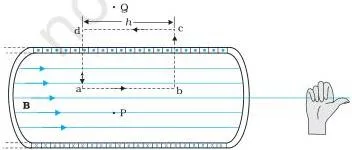
To get the field, take a rectangular amperian loop \( abcd \). Side \( cd \) lies in the zero exterior field; sides \( bc \) and \( ad \) have no tangential component. Only side \( ab \) of length \( h \) contributes. With \( n \) turns per unit length, the enclosed current is \( I(nh) \), so \( Bh = \mu_0 I (nh) \). This gives the clean result:
\[ B = \mu_0 n I \]
The solenoid is the practical source of a uniform magnetic field. Inserting a soft iron core inside it strengthens the field further — that is the subject of the next chapter, magnetism and matter notes (NCERT, p. 121).
Force Between Parallel Currents and the True Meaning of the Ampere
Two long parallel conductors \( a \) and \( b \), a distance \( d \) apart, carry currents \( I_a \) and \( I_b \). Conductor \( a \) produces the field \( B_a = \mu_0 I_a / 2\pi d \) at \( b \), and conductor \( b \) feels the sideways Lorentz force \( F = I_b L B_a \). The force per unit length is (NCERT, p. 122):
\[ \frac{F}{L} = \frac{\mu_0 I_a I_b}{2\pi d} \]
Parallel currents attract; antiparallel currents repel. This is the opposite of the electrostatics rule for charges. The forces on the two wires are equal and opposite, consistent with Newton’s third law: \( \mathbf{F}_{ba} = -\mathbf{F}_{ab} \) (NCERT, p. 123).
Misconception autopsy — why do parallel currents attract but like charges repel? The electrostatic force acts along the line joining the sources, so same-sign charges push apart.
The magnetic force between wires is a sideways Lorentz force. Each wire sits in the other’s \( \mathbf{B} \) field, and \( I\mathbf{l} \times \mathbf{B} \) for same-direction currents points toward the other wire — so parallel motion attracts and antiparallel motion repels (NCERT, p. 123).
The standard conditions define the ampere: the steady current which, maintained in each of two very long, straight, parallel conductors of negligible cross-section placed one metre apart in vacuum, produces a force of \( 2 \times 10^{-7}\ \text{N} \) per metre of length on each conductor.
The coulomb follows from it: 1 C is the charge crossing a section in 1 s when a steady 1 A flows (NCERT, p. 123).
Torque on a Current Loop and the Magnetic Dipole Moment
A rectangular loop of sides \( a \) and \( b \), carrying current \( I \) in a uniform field \( \mathbf{B} \), experiences no net force but a torque — exactly like an electric dipole in a uniform electric field (NCERT, p. 124).
Arms parallel to \( \mathbf{B} \) feel no force; the arms of length \( b \) feel equal and opposite forces \( F_1 = F_2 = IbB \). These forces are not collinear, so they form a couple. When the loop’s normal makes an angle \( \theta \) with \( \mathbf{B} \):
\[ \tau = IAB\sin\theta \]
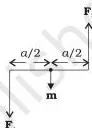
Define the magnetic moment of the loop, with the area vector direction given by the right-hand thumb rule. For \( N \) turns the magnitude is \( NIA \):
\[ \mathbf{m} = N I \mathbf{A} \qquad \text{unit: } \text{A m}^2 \]
Then both torque cases collapse into one vector expression (NCERT, p. 126):
\[ \boldsymbol{\tau} = \mathbf{m} \times \mathbf{B} \]
Equilibrium occurs when \( \mathbf{m} \) is parallel or antiparallel to \( \mathbf{B} \). Parallel is stable: a small rotation produces a restoring torque. Antiparallel is unstable: any rotation increases the torque. This is why a small magnet aligns with an external field (NCERT, p. 126).
At large distances, a circular current loop behaves like a magnetic dipole. For \( x \gg R \), on the axis and in the plane of the loop respectively (NCERT, p. 128):
\[ B_{\text{axial}} = \frac{\mu_0}{4\pi}\frac{2m}{x^3}, \qquad B_{\text{in-plane}} = \frac{\mu_0}{4\pi}\frac{m}{x^3} \]
The analogy with the electric dipole is direct: replace \( \mu_0 \rightarrow 1/\varepsilon_0 \) and \( \mathbf{m} \rightarrow \mathbf{p}_e \).
Magnetic monopoles are not known to exist. An electric dipole is built from two charges, but the current loop is the most elementary magnetic unit. Ampere suggested that all magnetism arises from circulating currents; elementary particles also carry intrinsic magnetic moments (NCERT, p. 129).
The Moving Coil Galvanometer: Measuring Current and Voltage
The moving coil galvanometer (MCG) measures small currents using the torque of the previous section. A many-turn coil, free to rotate about a fixed axis, sits in a uniform radial field created by a cylindrical soft iron core — the core makes the field radial (so \( \sin\theta = 1 \) always) and increases its strength. A spring supplies the counter-torque (NCERT, p. 129).
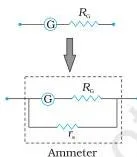
At equilibrium the magnetic torque balances the spring’s counter-torque \( k\phi \), where \( k \) is the torsion constant — the restoring torque per unit twist:
\[ k\phi = NIAB \quad \Rightarrow \quad \phi = \left(\frac{NAB}{k}\right) I \]
Two sensitivities follow (NCERT, p. 130):
- Current sensitivity \( = \phi/I = NAB/k \) — deflection per unit current.
- Voltage sensitivity \( = \phi/V = (NAB/k)(1/R) \) — deflection per unit voltage.
Doubling the number of turns \( N \) doubles the current sensitivity, but the voltage sensitivity stays unchanged because the coil resistance also roughly doubles. So the conversion needed for an ammeter differs from that for a voltmeter (NCERT, p. 130).
- As an ammeter: connect a small shunt resistance \( r_s \) in parallel with the coil, so most of the current bypasses the galvanometer and the net resistance stays low.
- As a voltmeter: connect a large resistance \( R \) in series, so the meter draws a very small current and does not disturb the circuit.
Key Definitions at a Glance
Check every new quantity of the chapter against this table before you revise further.
| Term | Meaning | Example / Unit |
|---|---|---|
| Magnetic field \( \mathbf{B} \) | Vector field set up in space by moving charges; exerts a force on other moving charges | SI unit: tesla (T) |
| Tesla (T) | Field strength that exerts 1 N on a 1 C charge moving at 1 m/s perpendicular to B | 1 T = 1 N s / (C m) |
| Gauss (G) | Smaller, non-SI unit of magnetic field | \( 1\ \text{G} = 10^{-4}\ \text{T} \) |
| Lorentz force | Total force on a charge in electric and magnetic fields: \( \mathbf{F} = q(\mathbf{E} + \mathbf{v}\times\mathbf{B}) \) | N |
| Magnetic moment \( \mathbf{m} \) | \( N I \mathbf{A} \); direction of area vector by right-hand thumb rule | A m² (also J/T) |
| Cyclotron frequency \( \nu_c \) | \( qB/2\pi m \); frequency of circular motion of a charge in B | Hz; independent of speed |
| Pitch \( p \) | Distance a charged particle travels along B in one revolution | \( 2\pi m v_{\parallel}/qB \), in m |
| Amperian loop | Closed imaginary loop on which B is tangential and constant (or normal, or zero) | e.g. a circle around a wire |
| Permeability of free space \( \mu_0 \) | Universal constant linking current to the magnetic field it produces | \( 4\pi \times 10^{-7}\ \text{T m/A} \) |
| Shunt resistance \( r_s \) | Small resistance connected in parallel with a galvanometer to make an ammeter | \( \Omega \) |
| Torsion constant \( k \) | Restoring torque per unit twist of the galvanometer spring | N m rad⁻¹ |
| Current sensitivity | Deflection per unit current: \( \phi/I = NAB/k \) | rad/A |
| Voltage sensitivity | Deflection per unit voltage: \( \phi/V = (NAB/k)(1/R) \) | rad/V |
Moving Charges and Magnetism Class 12 Notes: Formula Sheet
Every expression below follows the official NCERT text; download the NCERT Class 12 Physics Chapter 4 PDF to check any derivation against the source. Use SI units in every substitution.
| Formula | Gives | Symbols and units |
|---|---|---|
| \( \mathbf{F} = q(\mathbf{E} + \mathbf{v}\times\mathbf{B}) \) | Lorentz force on a moving charge | \( q \) in C, \( v \) in m/s, \( B \) in T, \( F \) in N |
| \( \mathbf{F} = I\,\mathbf{l}\times\mathbf{B} \) | Force on a straight conductor | \( I \) in A, \( l \) in m; \( \mathbf{B} \) external |
| \( r = \dfrac{mv}{qB} \) | Radius of circular orbit in perpendicular B | \( m \) in kg, \( v \) in m/s, \( r \) in m |
| \( \omega = \dfrac{qB}{m} \) | Angular frequency of circular motion | rad/s |
| \( \nu = \dfrac{qB}{2\pi m} \) | Cyclotron frequency | Hz; contains no \( v \) |
| \( p = \dfrac{2\pi m v_{\parallel}}{qB} \) | Pitch of helical motion | \( v_{\parallel} \) along B; \( p \) in m |
| \( d\mathbf{B} = \dfrac{\mu_0}{4\pi}\dfrac{I\,d\mathbf{l}\times\mathbf{r}}{r^3} \) | Field of a current element | \( \mu_0 = 4\pi \times 10^{-7}\ \text{T m/A} \) |
| \( B = \dfrac{\mu_0 I R^2}{2(x^2 + R^2)^{3/2}} \) | Field on the axis of a circular loop | \( x \) from centre, \( R \) loop radius, in m |
| \( B_0 = \dfrac{\mu_0 N I}{2R} \) | Field at the centre of an N-turn coil | \( N \) turns, radius \( R \) in m |
| \( B = \dfrac{\mu_0 I}{2\pi r} \) | Field outside a long straight wire | \( r \) in m from the wire axis |
| \( B = \dfrac{\mu_0 I}{2\pi a^2}\, r \) | Field inside a wire of radius a | Rises linearly with \( r \lt a \) |
| \( B = \mu_0 n I \) | Field inside a long solenoid | \( n \) = turns per metre |
| \( \dfrac{F}{L} = \dfrac{\mu_0 I_a I_b}{2\pi d} \) | Force per unit length between parallel wires | \( d \) in m; result in N/m |
| \( \boldsymbol{\tau} = \mathbf{m}\times\mathbf{B} \) | Torque on a current loop | \( m = NIA \) in A m²; \( \tau \) in N m |
| \( B = \dfrac{\mu_0}{4\pi}\dfrac{2m}{x^3} \) | Axial field of a dipole at large distance | Valid for \( x \gg R \) |
| \( k\phi = NIAB \) | Galvanometer equilibrium deflection | \( k \) in N m rad⁻¹, \( \phi \) in rad |
Worked Examples: Three Solved Problems with Fresh Numbers
Worked Example 1: Direction and magnitude of the Lorentz force (cross-product method)
Given: a proton with \( q = +1.6 \times 10^{-19}\ \text{C} \) moves with \( v = 5 \times 10^{6}\ \text{m/s} \) along the +x direction and enters a uniform field \( B = 0.8\ \text{T} \) along the +z direction.
Step 1 — find the direction: the magnetic force is \( q(\mathbf{v} \times \mathbf{B}) \).
Using the cyclic rule \( \hat{\mathbf{i}} \times \hat{\mathbf{k}} = -\hat{\mathbf{j}} \), we get \( \mathbf{v} \times \mathbf{B} = -\hat{\mathbf{j}} \), i.e.
along the −y direction.
Step 2 — apply the sign of q: the proton is positive, so the force keeps this direction: along −y.
Step 3 — magnitude: \( \mathbf{v} \) and \( \mathbf{B} \) are perpendicular, so \( \theta = 90^\circ \) and \( \sin\theta = 1 \).
\[ F = qvB\sin 90^\circ = (1.6 \times 10^{-19})(5 \times 10^6)(0.8)(1) = 6.4 \times 10^{-13}\ \text{N} \]
Final answer: \( F = 6.4 \times 10^{-13}\ \text{N} \) directed along the −y axis. An electron in the same fields would feel the same magnitude along +y.
Worked Example 2: Radius, frequency and energy of a proton in a perpendicular field (circular motion)
Given: proton \( m = 1.67 \times 10^{-27}\ \text{kg} \), \( q = 1.6 \times 10^{-19}\ \text{C} \), \( v = 2 \times 10^{6}\ \text{m/s} \), \( B = 0.5\ \text{T} \), with velocity perpendicular to the field.
Step 1 — radius: use \( r = mv/qB \) (magnetic force = centripetal force).
\[ r = \frac{1.67 \times 10^{-27} \times 2 \times 10^{6}}{1.6 \times 10^{-19} \times 0.5} = \frac{3.34 \times 10^{-21}}{8 \times 10^{-20}} = 4.2 \times 10^{-2}\ \text{m} \]
Step 2 — cyclotron frequency: \( \nu = qB/2\pi m \).
Note it does not contain \( v \).
\[ \nu = \frac{1.6 \times 10^{-19} \times 0.5}{2\pi \times 1.67 \times 10^{-27}} = 7.6 \times 10^{6}\ \text{Hz} = 7.6\ \text{MHz} \]
Step 3 — kinetic energy: \( K = \tfrac{1}{2}mv^2 \).
\[ K = \frac{1}{2} \times 1.67 \times 10^{-27} \times (2 \times 10^6)^2 = 3.34 \times 10^{-15}\ \text{J} \]
Step 4 — convert to keV: divide by \( 1.6 \times 10^{-19}\ \text{J/eV} \).
\[ K = \frac{3.34 \times 10^{-15}}{1.6 \times 10^{-19}} = 2.1 \times 10^4\ \text{eV} = 21\ \text{keV} \]
Final answer: radius \( r = 4.2\ \text{cm} \), frequency \( \nu = 7.6\ \text{MHz} \), kinetic energy \( K = 21\ \text{keV} \).
Worked Example 3: Centre field of a multi-turn circular coil
Given: \( N = 50 \) turns, radius \( R = 4\ \text{cm} \), current \( I = 2\ \text{A} \).
Step 1 — convert units: radius must be in metres before substitution: \( R = 4\ \text{cm} = 0.04\ \text{m} \).
Step 2 — apply the centre-field formula for N turns:
\[ B = \frac{\mu_0 N I}{2R} = \frac{4\pi \times 10^{-7} \times 50 \times 2}{2 \times 0.04} = \frac{4\pi \times 10^{-5}}{0.08} = 1.6 \times 10^{-3}\ \text{T} \]
Final answer: \( B = 1.6 \times 10^{-3}\ \text{T} \) at the centre, along the loop axis by the right-hand thumb rule.
Common Mistakes Students Make
Each pair below is a strict error → correction with the reason, then a quick way to check yourself.
| Students write this | Correct rule | How to check your answer |
|---|---|---|
| Right-hand rule applied directly to an electron | Find \( \mathbf{v}\times\mathbf{B} \) for a positive charge, then flip the force direction because \( q \) is negative | Electron and proton in identical fields must deflect oppositely |
| The wire’s own field used as B in \( \mathbf{F} = I\mathbf{l}\times\mathbf{B} \) | B is always the external field | Ask: which field would exist if the wire carried no current? |
| \( F = qvB\cos\theta \) | Use \( \sin\theta \) of the angle between v and B | Test \( \theta = 0 \): force must vanish, and \( \sin 0 = 0 \) |
| “Magnetic force changes the particle’s speed” | Force is perpendicular to v, does no work; speed stays constant, only direction changes | Kinetic energy of a particle in a pure B field is conserved |
| \( B = \mu_0 n I \) applied to a short, wide coil | Formula assumes a long solenoid with length much greater than radius | Check the length-to-radius ratio before substituting |
| “Like currents repel” | Parallel currents attract; antiparallel currents repel | Apply the right-hand rule to each wire; \( I\mathbf{l}\times\mathbf{B} \) points inward for parallel currents |
Exam Notes: What Examiners Look For
These are observed patterns from the chapter’s emphasis — the steps that earn the mark.
- Lorentz force direction: state the right-hand rule for \( \mathbf{v}\times\mathbf{B} \) AND apply the sign of the charge. The reversal for an electron must be explicit.
- Centre field of a coil: write \( B = \mu_0 N I / 2R \), convert cm → m, and finish with the direction. Substituting units at every step is what earns method marks.
- Cyclotron frequency: the question targets its independence from speed — answer “no, it does not depend on v” directly.
- Definition of the ampere: quote the standard conditions — two very long, straight, parallel conductors of negligible cross-section, 1 m apart in vacuum, force \( 2 \times 10^{-7}\ \text{N} \) per metre.
- Galvanometer conversion: ammeter = small shunt in parallel (most current bypasses the coil); voltmeter = large resistance in series (meter draws negligible current).
- Torque equilibrium: stable when \( \mathbf{m} \parallel \mathbf{B} \), unstable when antiparallel; at \( \theta = 0 \) torque is zero but a small rotation produces a restoring torque.
The NCERT exercise set (Exercises 4.1–4.13, pp. 134–135) is almost entirely numerical. The table maps each pattern to the formula it trains:
| Exercises | Tests | Skill |
|---|---|---|
| 4.1 – 4.4 | \( B = \mu_0 N I/2R \), \( B = \mu_0 I/2\pi r \) | Direct substitution plus direction |
| 4.5 – 4.6 | \( F = IlB\sin\theta \) on a conductor | Magnitude with an angle |
| 4.7 | \( f = \mu_0 I_a I_b / 2\pi d \) | Force between parallel wires |
| 4.8 | \( B = \mu_0 n I \) solenoid | Compute \( n = N/l \) first |
| 4.9 | \( \tau = N I A B \sin\theta \) | Angle taken with the normal |
| 4.10 | \( \phi/I = NAB/k \), \( \phi/V = (NAB/k)(1/R) \) | Sensitivity ratios |
| 4.11 – 4.12 | \( r = mv/qB \), \( \nu = qB/2\pi m \) | Circular motion plus reasoning |
| 4.13 | Torque with N turns | Same area, any shape → same torque |
Quick Revision Recap: The Chapter in One Minute
If you can reproduce these eleven points, you have the chapter. Use them as a self-test checklist.
- Lorentz force: \( \mathbf{F} = q(\mathbf{v}\times\mathbf{B} + \mathbf{E}) \); the magnetic part does no work.
- Force on a conductor: \( \mathbf{F} = I\,\mathbf{l}\times\mathbf{B} \), with \( \mathbf{B} \) the external field.
- Circular orbit: \( r = mv/qB \); cyclotron frequency \( \nu = qB/2\pi m \) is independent of speed.
- Biot-Savart law: \( d\mathbf{B} = (\mu_0/4\pi)(I\,d\mathbf{l}\times\mathbf{r})/r^3 \) for a current element.
- Circular loop: axial field \( B = \mu_0 I R^2/2(x^2 + R^2)^{3/2} \); centre field \( B = \mu_0 I/2R \).
- Ampere’s law: \( \oint \mathbf{B}\cdot d\mathbf{l} = \mu_0 I \); simplified form \( BL = \mu_0 I_e \).
- Straight wire: \( B = \mu_0 I/2\pi r \); field lines are concentric circles.
- Solenoid: \( B = \mu_0 n I \) inside; exterior field approaches zero.
- Parallel currents attract; antiparallel currents repel.
- Magnetic moment: \( \mathbf{m} = N I \mathbf{A} \); torque \( \boldsymbol{\tau} = \mathbf{m}\times\mathbf{B} \); net force zero.
- Galvanometer: \( k\phi = NIAB \); ammeter = small shunt in parallel, voltmeter = large resistance in series.
FAQs on Moving Charges and Magnetism
Why does a magnetic field not do work on a moving charge?
The magnetic force \( q\mathbf{v}\times\mathbf{B} \) is always perpendicular to the velocity. Work is force times displacement along the force, so a force perpendicular to motion does zero work. Speed and kinetic energy stay constant — only the direction of motion changes (NCERT, p. 112).
What is the difference between the Biot-Savart law and Ampere’s circuital law?
The Biot-Savart law gives the field of a single current element, and you integrate it over a whole conductor. Ampere’s circuital law \( \oint \mathbf{B}\cdot d\mathbf{l} = \mu_0 I \) gives the field directly when the geometry has high symmetry.
Both express the same physics for steady currents: Ampere’s law is to Biot-Savart what Gauss’s law is to Coulomb’s law (NCERT, p. 119).
How do I find the direction of the Lorentz force for an electron?
Use the right-hand (screw) rule on \( \mathbf{v}\times\mathbf{B} \) to get the direction for a positive charge, then reverse it because the electron’s charge is negative. For example, v along +x and B along +y gives \( \mathbf{v}\times\mathbf{B} \) along +z for a proton and along −z for an electron.
Why is the cyclotron frequency independent of the particle’s speed?
The expression \( \nu = qB/2\pi m \) contains only charge, field and mass — no v. A faster particle travels in a larger circle, but it covers the larger circumference in proportionally the same time, so the time per revolution is unchanged (NCERT, p. 112).
How is a galvanometer converted into an ammeter and into a voltmeter?
Into an ammeter: connect a small shunt resistance \( r_s \) in parallel with the galvanometer so most of the current bypasses the coil. Into a voltmeter: connect a large resistance R in series so the meter draws very little current and does not disturb the circuit (NCERT, p. 130).
Why do parallel currents attract while like charges repel?
The electrostatic force acts along the line joining charges, so same signs push apart. Between wires, each current sits in the other’s magnetic field, and the Lorentz force \( I\mathbf{l}\times\mathbf{B} \) on parallel currents points toward the other wire — attraction. Antiparallel currents give the opposite geometry and repel (NCERT, p. 123).
Reference: NCERT Class 12 Physics Part I textbook, chapter 4 Moving Charges and Magnetism.
Explore Class 12 Physics Notes
More for this chapter:
Class 12 Physics on LearnCBSE:
Related chapters: