
These dual nature of radiation and matter class 12 notes tell you one clear story: the photoelectric effect proves light behaves as particles (photons), and de Broglie’s hypothesis proves matter behaves as waves. You get every formula with symbol meanings and units, three worked examples, a common-mistakes table, and a one-minute cram card for the night before the exam.
Following the thread matters more than memorising. One equation — Einstein’s photoelectric equation — explains every experimental finding in the chapter.
This revision page follows the rationalised NCERT Class 12 Physics Part II textbook, Chapter 11. You can verify any detail on the official NCERT textbook portal.
What This Chapter Proves: Light as a Particle, Matter as a Wave
Before this chapter you already know light behaves as a wave — that is what interference, diffraction and polarisation show (see the Wave Optics notes). This chapter adds the missing half of the story.
- Wave nature of light — established by interference, diffraction and polarisation.
- Particle nature of light — forced on us by the photoelectric effect: light delivers energy in quanta called photons.
- Wave nature of matter — by symmetry, if radiation is dual-natured, matter should be too. That is de Broglie’s hypothesis.
One equation, \( K_{max} = h\nu – \phi_0 \), explains every experimental finding here. Keep that thread in view and the chapter stays manageable. Revise the other units in the Class 12 Physics notes collection.
How the Electron Was Discovered: Cathode Rays, e/m and Quantised Charge
In a discharge tube at a pressure of about 0.001 mm of mercury, applying an electric field makes a glow appear on the glass opposite the cathode. The radiation behind this glow, called cathode rays, was studied by William Crookes in the 1870s, who suggested it was a stream of fast-moving negatively charged particles (NCERT, p. 1).
J. J. Thomson confirmed this by passing cathode rays through mutually perpendicular electric and magnetic fields. Their speed was about 0.1 to 0.2 times the speed of light, and their charge-to-mass ratio was \[ e/m = 1.76 \times 10^{11}\ \text{C/kg} \]
Three observations made the electron a universal particle (NCERT, p. 1):
- The same \( e/m \) was obtained whatever the cathode metal or the gas in the tube — the particles are identical everywhere.
- Cathode rays, photoelectrons and thermionic electrons all gave the same \( e/m \), so they are the same particle produced by different methods.
- Thomson named these particles electrons in 1897 and proposed they are fundamental constituents of all matter.
In 1913 R. A. Millikan’s oil-drop experiment fixed the charge: every droplet carried charge that was an integral multiple of \( e = 1.602 \times 10^{-19}\ \text{C} \). Electric charge is quantised (NCERT, p. 1). Knowing \( e \) and \( e/m \), the electron’s mass follows directly. The discovery of electrons and X-rays unlocked atomic structure — continue with the Atoms notes.
Electron Emission and the Work Function: Why Electrons Stay Inside a Metal
Metals have free electrons that conduct electricity, but these electrons cannot normally escape. If one tries to leave, the metal surface acquires a positive charge and pulls it back. The minimum energy an electron needs to break free is the work function \( \phi_0 \), measured in electron volts (NCERT, p. 2).
One electron volt is the energy an electron gains when accelerated through a potential difference of 1 V:
\[ 1\ \text{eV} = 1.602 \times 10^{-19}\ \text{J} \]
The work function depends on the properties of the metal and the nature of its surface. Three physical processes can supply the escape energy (NCERT, p. 2):
- Thermionic emission — heating the metal gives free electrons enough thermal energy to come out.
- Field emission — a very strong electric field (of the order of \( 10^8\ \text{V m}^{-1} \), as in a spark plug) pulls electrons out.
- Photoelectric emission — light of suitable frequency illuminates the metal; the released electrons are called photoelectrons.
The Photoelectric Effect: The Experiment and Its Four Findings
Discovery. Hertz noticed in 1887 that ultraviolet light on a metal enhanced spark discharge across a detector loop — light somehow freed charged particles. Hallwachs showed an uncharged zinc plate became positively charged under UV (so negative particles escaped), and Lenard’s two-electrode tube proved current flowed only while the UV was on (NCERT, p. 3).
Metals respond differently: zinc, cadmium and magnesium emit under ultraviolet light, while alkali metals such as lithium, sodium, potassium, caesium and rubidium respond even to visible light (NCERT, p. 3).
The experimental setup (Fig. 11.1)
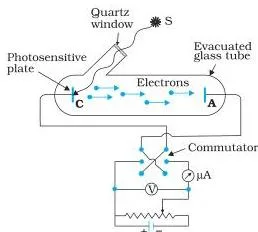
The evacuated glass/quartz tube holds a thin photosensitive emitter plate C and a collector plate A. A quartz window W lets ultraviolet light pass and strike C. The battery, with a commutator, sets A at any positive or negative potential; a voltmeter reads V and a microammeter reads the photocurrent.
Monochromatic light from source S hits C, and the electrons emitted travel to A (NCERT, p. 4).
Finding 1 — intensity sets the photocurrent
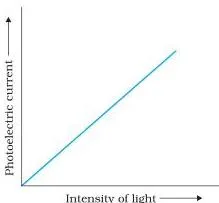
With frequency and potential fixed, the photocurrent rises linearly with intensity. The photocurrent is directly proportional to the number of photoelectrons emitted per second, so more intensity means more photoelectrons per second (NCERT, p. 5).
Finding 2 — potential gives saturation and stopping potential
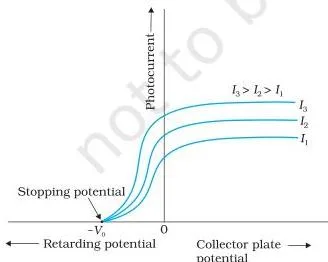
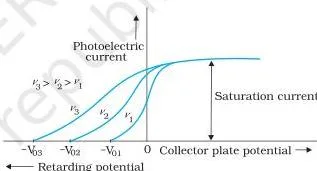
At positive (accelerating) potential the current climbs to a saturation current when every emitted electron reaches the collector. Reversing the polarity, the negative (retarding) potential cuts the current to zero at the stopping potential \( V_0 \), which just stops the fastest electrons (NCERT, p. 5):
\[ K_{max} = eV_0 \quad \text{(Eq. 11.1)} \]
Repeating with higher intensities raises the saturation current but leaves \( V_0 \) unchanged — for a fixed frequency the stopping potential is independent of intensity.
Analogy. Electrons are balls thrown out of a pit. The stopping potential is the height of the wall each ball must clear — it depends on how fast each ball is thrown (frequency), not on how many balls are thrown (intensity).
Finding 3 — frequency sets the stopping potential and the threshold
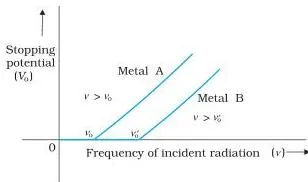
The stopping potential is more negative for higher frequency: \( V_{03} \gt V_{02} \gt V_{01} \) when \( \nu_3 \gt \nu_2 \gt \nu_1 \). Higher frequency means greater maximum kinetic energy, so a larger retarding potential is needed. Below a minimum threshold frequency \( \nu_0 \), which is different for each metal, no emission occurs at all however intense the light (NCERT, p. 6).
Finding 4 — emission is instantaneous
If the frequency exceeds the threshold, emission starts in about \( 10^{-9}\ \text{s} \) or less, even for very dim light (NCERT, p. 7). No time is needed to accumulate energy.
Four observations Einstein must explain (NCERT, p. 7)
- For a given material and frequency, photocurrent is directly proportional to intensity.
- Saturation current rises with intensity, but stopping potential does not.
- A threshold frequency exists; below it no emission happens however intense the light, while above it \( K_{max} \) rises linearly with frequency.
- Emission is instantaneous — about \( 10^{-9}\ \text{s} \) or less.
Why the Wave Picture of Light Failed the Photoelectric Effect
The wave model treats light as a continuous spread of energy over the region it occupies. That picture fails on three predictions at once; each row of the table is a contradiction (NCERT, p. 7).
| Wave theory expectation | Actual observation | What it costs the wave picture |
|---|---|---|
| More intensity means larger field amplitude, so each electron absorbs more energy and \( K_{max} \) should rise | \( K_{max} \) is independent of intensity | Contradicts finding 2 |
| Any frequency, given enough time, should eject electrons | A threshold frequency \( \nu_0 \) exists; below it nothing is emitted | Contradicts finding 3 |
| Energy is absorbed continuously over the whole wavefront, so a single electron needs hours to accumulate enough | Emission is instantaneous (\( \sim 10^{-9}\ \text{s} \)) | Contradicts finding 4 |
The wave picture cannot explain the most basic features of photoelectric emission (NCERT, p. 7). That failure is exactly why Einstein’s quantum idea was needed.
Einstein’s Photoelectric Equation: One Quantum, One Electron
In 1905 Einstein proposed that radiation energy comes in discrete quanta, each of energy \( h\nu \). In photoelectric emission an electron absorbs one quantum; if it exceeds the work function, the electron escapes with maximum kinetic energy (NCERT, p. 8):
\[ K_{max} = h\nu – \phi_0 \quad \text{(Eq. 11.2)} \]
This is Einstein’s photoelectric equation. Because \( K_{max} \) cannot be negative, emission requires \( h\nu \gt \phi_0 \), which defines the threshold frequency (NCERT, p. 9):
\[ \nu_0 = \frac{\phi_0}{h} \quad \text{(Eq. 11.3)} \]
Using \( K_{max} = eV_0 \), the equation becomes the equation of a straight line (NCERT, p. 9):
\[ V_0 = \frac{h}{e}\nu – \frac{\phi_0}{e} \quad \text{(Eq. 11.4)} \]
The line has slope \( h/e \), the same for every metal. Its frequency-axis intercept gives \( \nu_0 \), and the magnitude of the \( V_0 \)-axis intercept gives \( \phi_0/e \). Fig. 11.5 is exactly this graph.
Why did the idea win? Millikan spent 1906–1916 trying to disprove the equation, measured the slope of the line for sodium, and instead obtained \( h = 6.626 \times 10^{-34}\ \text{J s} \) — matching Planck’s constant from a completely different context. The attempted refutation became confirmation (NCERT, p. 9).
The same equation explains all four findings:
- \( K_{max} \) independent of intensity — one quantum is absorbed by one electron, so the basic event ignores intensity.
- A threshold frequency exists — \( h\nu \) must exceed \( \phi_0 \).
- Current proportional to intensity — intensity is the number of photons per unit area per second, so more photons eject more electrons.
- Instantaneous emission — absorbing a quantum is a single act, with no time to accumulate energy.
The Photon: Energy, Momentum and Properties of a Light Quantum
The photoelectric effect showed light interacting with matter as packets of energy \( h\nu \). Einstein showed each quantum also carries momentum \( h\nu/c \) — definite energy and momentum is the signature of a particle, and that particle was named the photon (NCERT, p. 10).
The photon picture of radiation has five properties (NCERT, p. 10):
- In interaction with matter, radiation behaves as if it is made of particles called photons.
- Each photon has energy \( E = h\nu \), momentum \( p = h\nu/c \), and speed \( c \), the speed of light.
- All photons of a given frequency or wavelength carry the same \( E \) and \( p \), whatever the intensity — intensity only changes the number of photons per second crossing a given area.
- Photons are electrically neutral and are not deflected by electric or magnetic fields.
- In a photon–particle collision, total energy and total momentum are conserved, but the number of photons may not be — a photon can be absorbed or a new one created.
Two useful forms for numericals: \( E = hc/\lambda \) and \( p = h/\lambda \). The particle nature of light was further confirmed by Compton’s 1924 experiment on the scattering of X-rays from electrons (NCERT, p. 10).
De Broglie’s Matter Waves: Wave Nature for Moving Particles
Both natures of light show up in different experiments: interference, diffraction and polarisation need the wave picture; photoelectric and Compton effects need photons. If radiation is dual-natured, de Broglie reasoned in 1924, nature’s symmetry demands that matter be dual-natured too — so moving particles should display wave-like properties (NCERT, p. 11).
The de Broglie relation connects the wavelength to momentum (NCERT, p. 11):
\[ \lambda = \frac{h}{p} = \frac{h}{mv} \quad \text{(Eq. 11.5)} \]
Notice the symmetry built into the relation: \( \lambda \) is a wave attribute, \( p = mv \) is a particle attribute, and Planck’s constant \( h \) links the two.
The relation is consistent for a photon: \( p = h\nu/c \), so \( h/p = c/\nu = \lambda \), exactly the wavelength of the light (Eqs. 11.6–11.7).
Why everyday objects show no wave behaviour. The wavelength shrinks for heavier or faster particles. A ball of mass 0.12 kg moving at 20 m/s has \( \lambda = 2.76 \times 10^{-34}\ \text{m} \), far beyond any measurement (NCERT, p. 11). Electrons, by contrast, give wavelengths of the order of X-ray wavelengths, which is why electron diffraction is observable.
Key Definitions to Write Correctly in the Exam
Learn these exact phrasings — they are the short-answer questions of this chapter.
| Term | Meaning | Example / remark |
|---|---|---|
| Work function \( \phi_0 \) | The minimum energy an electron needs to escape from a metal surface | Caesium 2.14 eV; differs for each metal and its surface |
| Electron volt | Energy gained by an electron accelerated through a potential difference of 1 V | \( 1\ \text{eV} = 1.602 \times 10^{-19}\ \text{J} \) |
| Photoelectric effect | Emission of electrons by a metal when illuminated by light of suitable frequency | Zinc needs UV; sodium responds to visible light |
| Photoelectron | The electron ejected from a metal surface by light | Photo(light)-generated electron |
| Threshold (cut-off) frequency \( \nu_0 \) | The minimum frequency below which no emission occurs, however intense the light | \( \nu_0 = \phi_0/h \), different for every metal |
| Stopping potential \( V_0 \) | The minimum retarding potential that just stops the fastest photoelectrons | \( eV_0 = K_{max} \) |
| Saturation current | The maximum photocurrent when every emitted electron reaches the collector | Rises with intensity, not with \( V_0 \) |
| Photon | The particle-like quantum of radiation carrying \( E = h\nu \) and \( p = h/\lambda \) | Electrically neutral; not deflected by fields |
| Matter (de Broglie) wave | The wave associated with a moving material particle | Wavelength \( \lambda = h/p \) |
| Thermionic emission | Ejection of electrons by heating a metal | Hot cathode of a vacuum tube |
| Field emission | Ejection of electrons by a very strong electric field | Order \( 10^8\ \text{V m}^{-1} \), as in a spark plug |
Dual Nature of Radiation and Matter Class 12 Notes: Formula Sheet
Every equation that carries marks in this chapter, with symbols and units.
| Equation | What it gives | Symbols and units |
|---|---|---|
| \( K_{max} = eV_0 \) (11.1) | Maximum kinetic energy from stopping potential | \( e = 1.602 \times 10^{-19}\ \text{C} \); \( V_0 \) in V |
| \( K_{max} = h\nu – \phi_0 \) (11.2) | Einstein’s photoelectric equation | \( h \) in J s; \( \nu \) in Hz; \( \phi_0 \) in J or eV |
| \( \nu_0 = \phi_0/h \) (11.3) | Threshold frequency | Hz |
| \( V_0 = \frac{h}{e}\nu – \frac{\phi_0}{e} \) (11.4) | Straight-line form; slope \( h/e \) | V |
| \( \lambda = h/p = h/mv \) (11.5) | de Broglie wavelength | \( m \) in kg; \( v \) in m/s; \( \lambda \) in m |
| \( E = h\nu = hc/\lambda \) | Photon energy | \( c = 3 \times 10^8\ \text{m/s} \) |
| \( p = h\nu/c = h/\lambda \) | Photon momentum | kg m/s |
| \( 1\ \text{eV} = 1.602 \times 10^{-19}\ \text{J} \) | Energy conversion | Always convert to J when \( h \) is in J s |
Physical quantities with dimensions and units (NCERT, p. 15)
| Symbol | Physical quantity | Dimensions | SI unit | Remark |
|---|---|---|---|---|
| \( h \) | Planck’s constant | \( [ML^2T^{-1}] \) | J s | \( E = h\nu \) |
| \( V_0 \) | Stopping potential | \( [ML^2T^{-3}A^{-1}] \) | V | \( eV_0 = K_{max} \) |
| \( \phi_0 \) | Work function | \( [ML^2T^{-2}] \) | J; eV | \( K_{max} = E – \phi_0 \) |
| \( \nu_0 \) | Threshold frequency | \( [T^{-1}] \) | Hz | \( \nu_0 = \phi_0/h \) |
| \( \lambda \) | de Broglie wavelength | \( [L] \) | m | \( \lambda = h/p \) |
Memory device: S.F.N. — Stopping potential follows Frequency; the Number of photoelectrons follows Intensity. One line that prevents the most common confusion in this chapter.
Solved Examples: Method First, Then Stepwise Working
Example A — Photon energy and photon count
Method: Use \( E = h\nu \) for the energy of one photon, then \( N = P/E \) for the number emitted per second.
Step 1: Given frequency \( \nu = 4.0 \times 10^{14}\ \text{Hz} \) and \( h = 6.63 \times 10^{-34}\ \text{J s} \).
\[ E = h\nu = (6.63 \times 10^{-34})(4.0 \times 10^{14}) = 2.65 \times 10^{-19}\ \text{J} \]
Step 2: Beam power \( P = 1.5 \times 10^{-3}\ \text{W} \) equals \( N \) times the energy per photon.
\[ N = \frac{P}{E} = \frac{1.5 \times 10^{-3}}{2.65 \times 10^{-19}} \approx 5.7 \times 10^{15}\ \text{photons per second} \]
Final answer: (a) each photon carries \( 2.65 \times 10^{-19}\ \text{J} \); (b) the source emits about \( 5.7 \times 10^{15} \) photons per second.
Example B — Einstein’s photoelectric equation
Method: Apply \( K_{max} = h\nu – \phi_0 \), then \( V_0 = K_{max}/e \), then \( \nu_0 = \phi_0/h \).
Step 1: Work function \( \phi_0 = 2.0\ \text{eV} \), incident frequency \( \nu = 7.0 \times 10^{14}\ \text{Hz} \).
Photon energy first:
\[ h\nu = (6.63 \times 10^{-34})(7.0 \times 10^{14}) = 4.64 \times 10^{-19}\ \text{J} \]
\[ \text{In eV: } \frac{4.64 \times 10^{-19}}{1.6 \times 10^{-19}} = 2.90\ \text{eV} \]
Step 2: Maximum kinetic energy is the photon’s energy minus the work function:
\[ K_{max} = 2.90 – 2.0 = 0.90\ \text{eV} = 0.90 \times 1.6 \times 10^{-19} = 1.44 \times 10^{-19}\ \text{J} \]
Step 3: Stopping potential and threshold frequency:
\[ V_0 = \frac{K_{max}}{e} = 0.90\ \text{V}, \qquad \nu_0 = \frac{\phi_0}{h} = \frac{2.0 \times 1.6 \times 10^{-19}}{6.63 \times 10^{-34}} \approx 4.83 \times 10^{14}\ \text{Hz} \]
Final answer: \( K_{max} = 0.90\ \text{eV} = 1.44 \times 10^{-19}\ \text{J} \), \( V_0 = 0.90\ \text{V} \), \( \nu_0 \approx 4.83 \times 10^{14}\ \text{Hz} \).
Example C — de Broglie wavelength
Method: Compute momentum \( p = mv \), then \( \lambda = h/p \).
Step 1: Electron at \( v = 2.0 \times 10^6\ \text{m/s} \), with \( m = 9.11 \times 10^{-31}\ \text{kg} \):
\[ p = (9.11 \times 10^{-31})(2.0 \times 10^6) = 1.82 \times 10^{-24}\ \text{kg m/s} \]
\[ \lambda = \frac{h}{p} = \frac{6.63 \times 10^{-34}}{1.82 \times 10^{-24}} \approx 3.6 \times 10^{-10}\ \text{m} = 0.36\ \text{nm} \]
Step 2: Ball of mass 0.15 kg moving at 20 m/s:
\[ p = 0.15 \times 20 = 3.0\ \text{kg m/s}, \qquad \lambda = \frac{6.63 \times 10^{-34}}{3.0} \approx 2.2 \times 10^{-34}\ \text{m} \]
Interpretation: the electron’s wavelength (0.36 nm) is of the order of X-ray wavelengths — measurable; the ball’s wavelength is far beyond any measurement, so the ball shows no wave behaviour.
Common Mistakes That Cost Marks in This Chapter
| Mistake | Correct rule | How to check your answer |
|---|---|---|
| Writing \( K_{max} = h\nu + \phi_0 \) | \( K_{max} = h\nu – \phi_0 \) | Part of the photon’s energy pays the work function; only the rest becomes kinetic energy, so \( K_{max} \) is smaller than \( h\nu \) |
| Increasing intensity raises \( K_{max} \) | Intensity raises the number of photoelectrons per second, never \( K_{max} \); frequency changes \( K_{max} \) | \( K_{max} = eV_0 \) depends only on frequency and metal, not intensity |
| Stopping potential changes with intensity | For a fixed frequency \( V_0 \) is independent of intensity; only saturation current grows | In Fig. 11.3 all three intensities meet the potential axis at the same \( V_0 \) |
| Threshold frequency is the same for all metals | \( \nu_0 = \phi_0/h \) differs for every metal because \( \phi_0 \) differs | A metal with larger \( \phi_0 \) needs a higher \( \nu_0 \) |
| Mixing eV with \( h \) in J s | Convert eV to joules (\( 1\ \text{eV} = 1.602 \times 10^{-19}\ \text{J} \)) before substituting | Units must come out in J: J s × Hz = J; an eV left in the product breaks the units |
| Calling \( e/m \) the electron’s charge | \( e/m \) is the charge-to-mass ratio \( 1.76 \times 10^{11}\ \text{C/kg} \); the charge alone is \( 1.602 \times 10^{-19}\ \text{C} \) | Two different quantities — a ratio versus a single charge |
Exam Notes: What an Examiner Expects to See
These are observed marking patterns for this chapter. Each bullet is the step that earns the mark.
- Finding Planck’s constant from the graph. The \( V_0 \) versus \( \nu \) graph is a straight line with slope \( h/e \), identical for every metal. Drawing and labelling the line earns the graph mark; then write slope \( = h/e \), so \( h = \text{slope} \times e \) (NCERT, p. 9).
- The line’s intercepts. The \( \nu \)-axis intercept gives the threshold frequency \( \nu_0 \); the magnitude of the \( V_0 \)-axis intercept gives \( \phi_0/e \).
- The full chain in one line. State \( K_{max} = eV_0 = h\nu – \phi_0 \) with SI units and show the eV-to-J conversion explicitly — this is where the substitution mark is awarded.
- Instantaneous emission. The fact that emission starts in about \( 10^{-9}\ \text{s} \) or less is a frequent one-line reason the wave picture fails (NCERT, p. 7).
- de Broglie wavelength of a photoelectron. Combining \( \lambda = h/mv \) with \( K_{max} = \frac{1}{2}mv_{max}^2 = eV_0 \) gives \( \lambda = h/\sqrt{2meV_0} \), a direct shortcut for photoelectron numericals.
- Magnitude sense. Electron de Broglie wavelengths are of the order of X-ray wavelengths, which is why electron diffraction is observable; macroscopic objects give immeasurably small \( \lambda \).
- Physical quantities table. Short-answer questions ask directly for the dimension of \( h \) \( ([ML^2T^{-1}]) \), its unit (J s), and the remark \( E = h\nu \) (NCERT, p. 15).
The chapter exercises (11.1–11.11) split into: photon energy and photon count (11.1, 11.4), Einstein’s equation numericals for \( K_{max} \), stopping potential and threshold frequency (11.2, 11.6, 11.7, 11.8, 11.9), finding \( h \) from the cut-off slope (11.5), and de Broglie wavelengths (11.10–11.11). In every one, state the equation first, then substitute with units.
Revision Recap: One-Minute Cram Card
The whole chapter as exam-ready statements (paraphrasing NCERT’s summary, pp. 13–14).
- Work function \( \phi_0 \) = minimum energy to escape a metal; supply it by heating (thermionic), strong field (field emission) or light (photoelectric).
- Photocurrent depends on intensity, applied potential and emitter material; saturation current means every electron is collected.
- Stopping potential depends only on frequency and material — not intensity — and \( K_{max} = eV_0 \).
- Below threshold frequency \( \nu_0 \), no emission however intense; above it, \( K_{max} \) rises linearly with frequency.
- Wave theory failed on three counts and on the time lag; Einstein’s \( K_{max} = h\nu – \phi_0 \) explained all of them.
- Photons: \( E = h\nu \), \( p = h/\lambda \), electrically neutral; total energy and momentum are conserved in collisions, but the number of photons need not be.
- De Broglie: \( \lambda = h/p = h/mv \); macroscopic objects give immeasurably small wavelengths, so the wave nature shows only for sub-atomic particles.
Frequently Asked Questions
Why is the stopping potential independent of the intensity of incident light?
The stopping potential reflects the fastest photoelectron’s kinetic energy through \( K_{max} = eV_0 \). Raising intensity adds photons and therefore adds photoelectrons, but every photon of that frequency still carries the same energy \( h\nu \). Since each electron absorbs one quantum, \( K_{max} \) — and so \( V_0 \) — is unchanged (NCERT, pp. 5, 8).
What is the difference between threshold frequency and stopping potential?
Threshold frequency \( \nu_0 = \phi_0/h \) is the minimum light frequency needed to eject any electron from a particular metal. Stopping potential \( V_0 \) is the retarding voltage that just halts the fastest photoelectrons, with \( eV_0 = K_{max} \). Threshold frequency is a fixed property of the metal; stopping potential varies with frequency and with the metal (NCERT, pp. 3, 5).
Why does the wave theory of light fail to explain the photoelectric effect?
The wave picture predicted that \( K_{max} \) should grow with intensity, that any frequency could eject electrons given enough time, and that electrons would need hours to accumulate energy over the wavefront.
Experiments show \( K_{max} \) independent of intensity, a threshold frequency that exists, and emission that is instantaneous (\( \sim 10^{-9}\ \text{s} \)) — none of which the wave picture can explain (NCERT, p. 7).
Why do macroscopic objects like a moving ball show no observable wave nature?
The de Broglie wavelength is \( \lambda = h/p \), and \( h \) is extremely tiny. A ball of mass 0.12 kg moving at 20 m/s has \( \lambda \approx 2.76 \times 10^{-34}\ \text{m} \), far beyond any measurement. Wave behaviour is measurable only for sub-atomic particles like electrons, whose wavelengths are of the order of X-ray wavelengths (NCERT, p. 11).
How can you find Planck’s constant from the photoelectric effect experiment?
Plot stopping potential \( V_0 \) against frequency \( \nu \). The graph is a straight line \( V_0 = (h/e)\nu – \phi_0/e \) with slope \( h/e \), independent of the metal. Multiply the measured slope by the electron charge \( e \) to get \( h \). Millikan did exactly this by 1916 and obtained a value close to \( 6.626 \times 10^{-34}\ \text{J s} \), confirming Einstein’s equation (NCERT, p. 9).
Do photons have mass? If not, how can they carry momentum?
A photon’s momentum \( p = h\nu/c = h/\lambda \) is a property of the quantum of radiation, not a mechanical mass moving at speed \( v \). Because photons are electrically neutral, they are not deflected by electric or magnetic fields, yet they still transfer momentum — Compton’s 1924 scattering of X-rays from electrons confirmed this momentum exchange (NCERT, p. 10).
Reference: NCERT Class 12 Physics textbook, chapter Dual Nature of Radiation and Matter.
Explore Class 12 Physics Notes
More for this chapter:
Class 12 Physics on LearnCBSE:
Related chapters: