
This page gives you the official Primary Activities Class 12 PDF — Chapter 4 of NCERT Geography, Fundamentals of Human Geography — plus a section-by-section explanation of what the chapter contains. The official NCERT file is linked right below.
Primary activities are the oldest and most environment-dependent economic activities, from hunting and gathering to pastoralism, agriculture and mining. Use this page to see what the chapter holds, where each map and photograph sits, and how the exercise questions connect to the text.
Download the Primary Activities Class 12 PDF
Open the Primary Activities Class 12 PDF (Chapter 4 of Fundamentals of Human Geography) to read the full chapter exactly as printed — its maps and photographs, its activity definitions, and its end-of-chapter exercises — straight from NCERT’s official textbook server.
| What the chapter holds | Count | Where it is used |
|---|---|---|
| Printed pages | 14 | |
| Figures with NCERT captions | 21 | |
| Exercise questions | 3 | answered in our NCERT Solutions |
| Official NCERT PDF | Download the chapter PDF | the chapter exactly as NCERT publishes it |
Primary Activities Class 12: Chapter 4 at a Glance
The table below shows what Chapter 4 contains — how it is organised into topics, how many figures it carries and how its exercises are laid out — so you can see where to start before you read.
What Chapter 4 Covers: From Hunting and Gathering to Mining
The chapter opens by defining income-generating human activities, then poses the two questions it spends the rest of its pages answering: why are people on the coast engaged in fishing while people on the plains farm, and what physical and social factors shape the primary activities of different regions?
The arc runs from hunting and gathering (the oldest economic activity) to pastoralism — nomadic herding and commercial livestock rearing — then to the long middle of the chapter: agriculture.
Under agriculture, subsistence systems come first: primitive subsistence or shifting cultivation, then intensive subsistence farming dominated either by wet paddy or by crops other than paddy. The commercial systems follow — plantation, extensive grain, mixed, dairy, Mediterranean and market gardening.
The chapter ends with two ways of organising farms — co-operative farming and collective farming — then mining, including the factors that control it and its two methods. The exercises close the chapter with multiple-choice, short-answer and long-answer questions plus a project activity: visit a nearby village, observe crops being cultivated, and list the operations farmers perform.
For the night before an exam, read in this order:
- Definitions at the start of the chapter — economic activities and primary activities.
- Hunting and gathering, including where gathering survives today.
- Pastoralism: nomadic herding and commercial livestock rearing side by side.
- Subsistence agriculture: primitive and intensive.
- Commercial farming systems, one by one, with their map regions.
- Co-operative and collective organisation of farms.
- Mining: factors and the two methods.
Key Concepts in Primary Activities: The Subsistence-Commercial Split
The whole chapter hangs on one contrast: subsistence activities produce for the people doing them, while commercial activities produce for a market. Hold on to that split and every farming system in the chapter sorts itself into place.
Economic activities are human activities that generate income, grouped into primary, secondary, tertiary and quaternary categories. Primary activities are directly dependent on the environment because they use the earth’s resources — land, water, vegetation, building materials and minerals — and so they include hunting and gathering, pastoralism, fishing, forestry, agriculture, and mining and quarrying.
People engaged in primary activities are called red-collar workers, a reference to the outdoor nature of their work. The chapter’s “do you know” boxes add details such as chicle, the part of chewing gum made from the milky juice of the zapota tree, which gatherers once supplied.
Subsistence systems need small capital and operate at low technology, so their yield per person is low and little or no surplus is produced. Commercial systems use large capital, scientific methods and transport links to markets, and their products are processed and exported.
| Activity in Chapter 4 | Subsistence or commercial | One-line marker |
|---|---|---|
| Gathering (traditional) | Subsistence | Small capital, low technology, low yield per person |
| Gathering (modern) | Commercial | Market-oriented collection of leaves, bark and medicinal plants |
| Hunting | Subsistence | Primitive tools limited the kill; poaching has endangered species |
| Nomadic herding (pastoral nomadism) | Subsistence | Moves with livestock in search of pasture and water |
| Commercial livestock rearing | Commercial | Permanent fenced ranches, one animal type, scientific breeding |
| Primitive subsistence agriculture (shifting cultivation) | Subsistence | Forest cleared by fire; patches worked for a few years then shifted |
| Intensive subsistence agriculture (wet paddy) | Subsistence | Small holdings, family labour, high yield per unit area |
| Intensive subsistence agriculture (other crops) | Subsistence | Wheat, soyabean, barley, sorghum; irrigation often used |
| Plantation agriculture | Commercial | Large estates, single-crop specialisation, export-oriented |
| Extensive commercial grain cultivation | Commercial | Huge mechanised farms; low yield per acre, high yield per person |
| Mixed farming | Commercial | Crops and animal husbandry with equal emphasis |
| Dairy farming | Commercial | Capital-intensive rearing of milch animals near urban markets |
| Mediterranean agriculture | Commercial | Citrus fruits and viticulture; winter crops for outside markets |
| Market gardening and horticulture | Commercial | High-value vegetables, fruits and flowers for urban markets |
| Truck farming | Commercial | Vegetables only, within overnight trucking distance of the market |
| Factory farming | Commercial | Livestock in stalls on manufactured feed; heavy capital |
| Co-operative farming | An organisational form | Voluntary pooling of resources; individual farms remain intact |
| Collective farming (Kolkhoz) | An organisational form | Social ownership; land, livestock and labour pooled |
The same contrast shapes mining, where profitability depends on two sets of factors: physical factors — the size, grade and mode of occurrence of the deposits — and economic factors such as the demand for the mineral, the technology and capital available, and the costs of labour and transport.
Worked Example: Identify the Farming System
This is the kind of unseen scenario the chapter’s features let you classify. Decide each feature one at a time and the farming system names itself.
The scenario: a small farm of four hectares in the western Indo-Gangetic plain grows wheat under irrigation. The family supplies the labour, uses farm yard manure, and consumes most of the harvest at home.
- Place: wheat in the western Indo-Gangetic plain matches the chapter’s example of crops grown where wet paddy is not practical. Wet-paddy dominance is ruled out.
- Size and labour: four hectares with family labour and farm yard manure point to small holdings worked by hand, not vast mechanised fields. Extensive commercial grain farming is ruled out.
- Destination of the harvest: the family consumes most of what it grows, so this is subsistence, not market production. Plantation agriculture — profit-oriented, single-crop and built for export — is ruled out.
- Answer: intensive subsistence agriculture dominated by crops other than paddy, using irrigation.
Figure Walkthrough: Reading the Chapter 4 Maps and Photographs
The figures in this chapter fall into two kinds of evidence. The world maps show where each activity is practised; the photographs show what it looks like on the ground. Learn to read both kinds and map-based questions answer themselves.
Where Each Activity Is Found: The World Map Figures
Each map below shades the regions where a particular activity is found. Match the shading to the activity and the region names will stick.
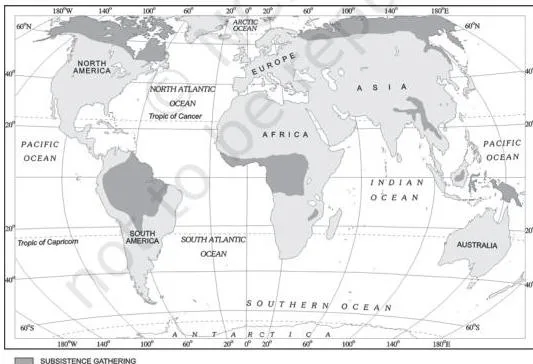
Subsistence gathering survives in two kinds of zones: high latitudes — northern Canada, northern Eurasia and southern Chile — and low latitudes — the Amazon Basin, tropical Africa, the northern fringe of Australia and the interior of Southeast Asia.
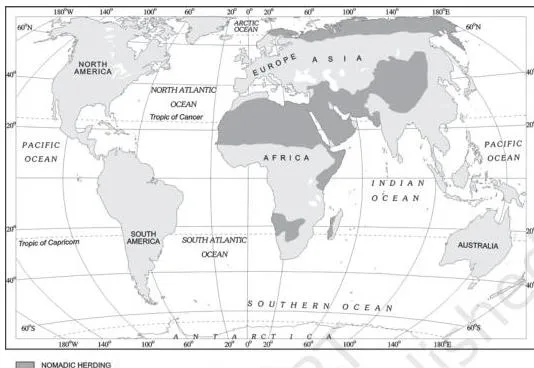
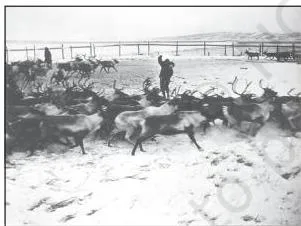
The core nomadic herding region runs from the Atlantic shores of North Africa eastwards across the Arabian peninsula into Mongolia and Central China. A second region covers the tundra of Eurasia, and small areas lie in South-west Africa and on the island of Madagascar.
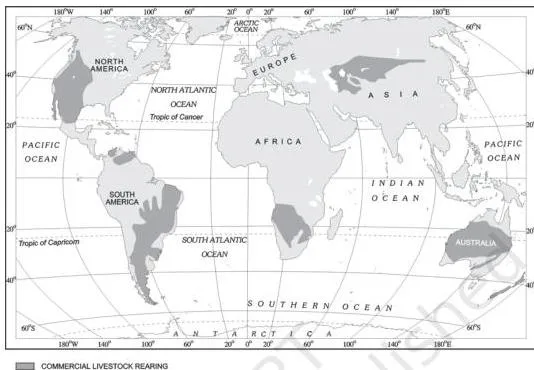
Commercial livestock rearing is concentrated in New Zealand, Australia, Argentina, Uruguay and the United States of America.
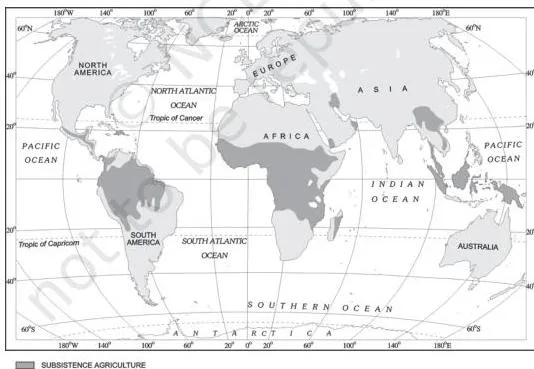
Primitive subsistence agriculture spreads across the tropics: Africa, South and Central America, and Southeast Asia.
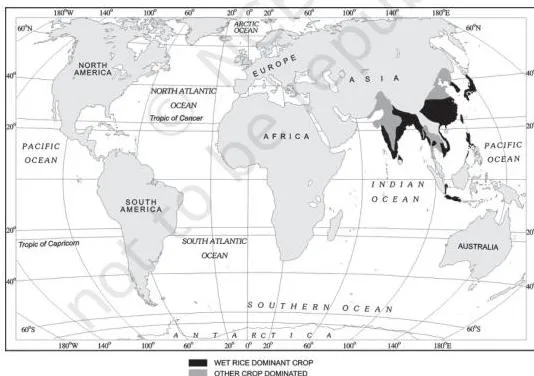
Intensive subsistence farming is a monsoon-Asia phenomenon, found in the densely populated regions where small holdings are worked by family labour.
Extensive commercial grain farming occupies the semi-arid mid-latitude interiors: the Eurasian steppes, the Canadian and American Prairies, the Pampas of Argentina, the Velds of South Africa, the Australian Downs and the Canterbury Plains of New Zealand.

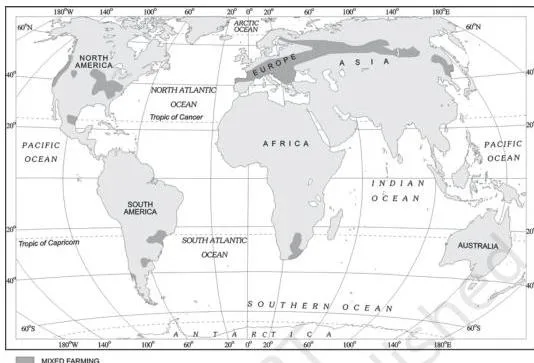
Mixed farming appears in the highly developed parts of the world — north-western Europe, eastern North America, parts of Eurasia — and in the temperate latitudes of the southern continents.
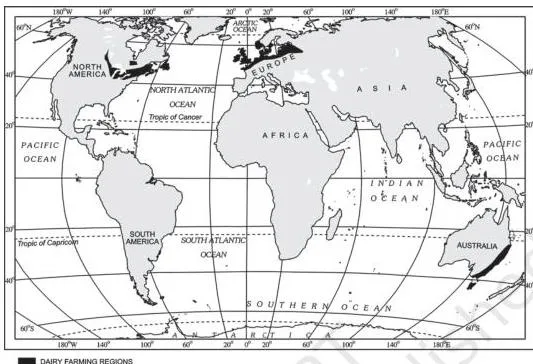
Commercial dairy farming has three main belts: the largest in north-western Europe, the second in Canada, and a third including South-eastern Australia, New Zealand and Tasmania.
| Activity | Regions to remember from the map |
|---|---|
| Subsistence gathering | Northern Canada, northern Eurasia, southern Chile; Amazon Basin, tropical Africa, northern Australia, interior Southeast Asia |
| Nomadic herding | Atlantic North Africa to Mongolia and Central China; Eurasian tundra; South-west Africa and Madagascar |
| Commercial livestock rearing | New Zealand, Australia, Argentina, Uruguay, USA |
| Primitive subsistence agriculture | Tropical Africa, South and Central America, Southeast Asia |
| Intensive subsistence farming | Monsoon Asia |
| Extensive commercial grain farming | Eurasian steppes, Prairies, Pampas, Velds, Australian Downs, Canterbury Plains |
| Mixed farming | North-western Europe, eastern North America, parts of Eurasia, temperate southern continents |
| Dairy farming | North-western Europe, Canada, South-eastern Australia, New Zealand, Tasmania |
What the Photographs and Diagrams Show
The photographs were chosen to make one feature of each activity visible. Read the feature the picture demonstrates, not just the scene.
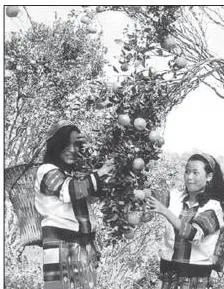
Women gathering oranges in Mizoram show that gathering is not confined to prehistory; the activity still supports communities today, and a modern, market-oriented form of gathering also exists.
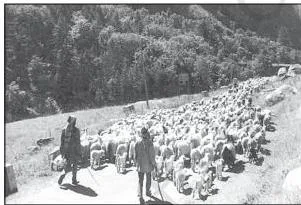
Nomads taking their sheep up to the mountains at the onset of summer illustrate vertical transhumance — migration from plains to mountain pastures in summer and back again in winter.
This photograph of animals on an open ranch shows what ranching looks like: settled and fenced land rather than wandering herds, with grazing regulated by moving animals between parcels.
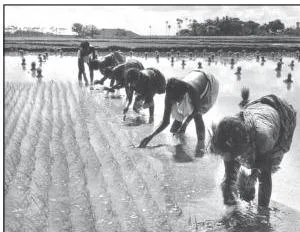
Rice transplantation is the visual signature of wet paddy cultivation — workers transplanting seedlings by hand, the family labour on which intensive subsistence farming depends.
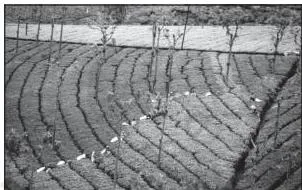
Tea planted on hill slopes shows plantation agriculture using the terrain: slopes are chosen for tea because of favourable geographical conditions, and a single crop is grown in rows.
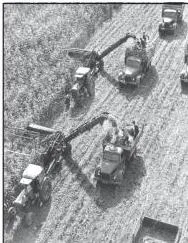
Mechanised grain farming shows why one worker covers so much land: combine crews harvest grain over many hectares in a single day.
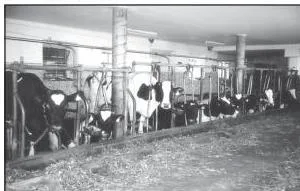
A dairy farm in Austria looks like a factory for milk: sheds, fodder storage and milking machines, the capital equipment that makes dairying the most advanced form of milch-animal rearing.
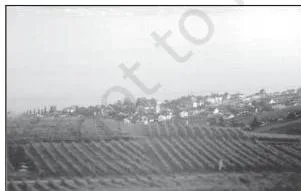
A vineyard in Switzerland is the classic sight of Mediterranean agriculture — rows of grapevines on slopes, the basis of viticulture and the region’s distinctive wines.
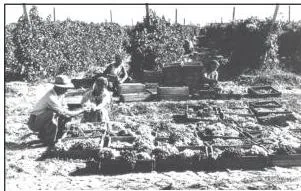
Collection of grapes in a collective farm of Kazakhstan shows collective farming in action — workers pooling their labour on land held under social ownership.
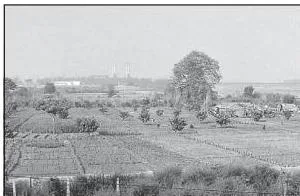
Vegetables grown in the vicinity of the city are market gardening in its simplest form — high-value, perishable produce raised close to the consumers who buy it.
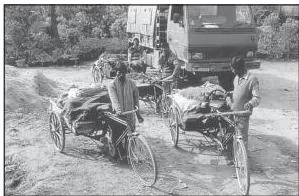
Trucks and cycle carts carrying vegetables to city markets illustrate the transport link that defines market gardening and gives truck farming its name.
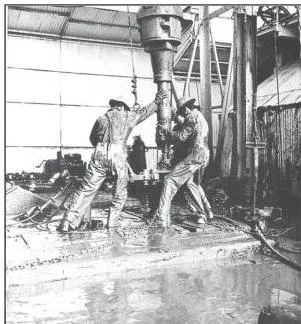
The oil drilling operation in the Gulf of Mexico shows mining as a high-technology industry, very different from the primitive tools of early hunting.
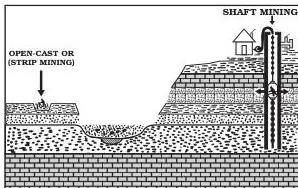
The methods-of-mining diagram contrasts the two techniques side by side: open-cast mining for ore close to the surface, and underground shaft mining where vertical shafts and radiating galleries reach deep ore.
Definitions You Need from Chapter 4
These are the terms the chapter defines and the exercises assume you know. Each entry is kept to one or two sentences so you can scan the whole list the night before an exam.
| Term | What it means |
|---|---|
| Economic activities | Human activities that generate income; grouped into primary, secondary, tertiary and quaternary. |
| Primary activities | Activities directly dependent on the environment that use the earth’s resources — land, water, vegetation, building materials and minerals. |
| Red-collar workers | People engaged in primary activities, so called because of the outdoor nature of their work. |
| Gathering | Collecting plants and animals from the wild to meet needs of food, shelter and clothing; needs little capital, uses low technology and gives low yield per person. |
| Hunting | Killing wild animals for food; earliest humans depended on it, along with plants they gathered. |
| Pastoral nomadism | A primitive subsistence activity in which herders move with their livestock, depending on the amount and quality of pastures and water. |
| Transhumance | Seasonal migration from plains to mountain pastures in summer and back to the plains in winter. |
| Commercial livestock ranching | Capital-intensive, sedentary rearing of one type of animal on permanent fenced ranches, with scientific breeding, for export. |
| Subsistence agriculture | Farming in which the farming areas consume all, or nearly all, of the products locally grown. |
| Shifting cultivation | Primitive subsistence farming in which forest patches are cleared and burned, cultivated for a few years, then abandoned; also called slash and burn agriculture. |
| Intensive subsistence agriculture | Small-holding farming in densely populated monsoon Asia using family labour; yield per unit area is high but per labour productivity is low. |
| Plantation agriculture | Large-scale, profit-oriented single-crop farming introduced by Europeans in their tropical colonies. |
| Extensive commercial grain cultivation | Huge, fully mechanised wheat farms of the semi-arid mid-latitudes; low yield per acre but high yield per person. |
| Mixed farming | Farming that gives equal emphasis to crop cultivation and animal husbandry, with fodder crops, crop rotation and intercropping. |
| Dairy farming | The most advanced and efficient rearing of milch animals; highly capital intensive and practised near urban and industrial centres. |
| Mediterranean agriculture | Highly specialised commercial agriculture of regions with a Mediterranean climate; an important supplier of citrus fruits. |
| Viticulture | Grape cultivation, a speciality of the Mediterranean region. |
| Market gardening | Small-scale cultivation of high-value vegetables, fruits and flowers, solely for urban markets. |
| Truck farming | Market gardening that specialises in vegetables only, located within the distance a truck can cover overnight. |
| Factory farming | Rearing livestock in stalls and pens on manufactured feed, with scientific breeding and disease control; needs heavy capital. |
| Co-operative farming | A group of farmers voluntarily pooling resources for more efficient and profitable farming; individual farms remain intact. |
| Collective farming | Farming based on social ownership of the means of production and collective labour; the Kolkhoz model of the erstwhile Soviet Union. |
| Open-cast mining | Surface mining; the easiest and cheapest way to mine minerals close to the surface, giving large and rapid output. |
| Underground (shaft) mining | Mining deep ore by sinking vertical shafts from which galleries radiate; risky because of gases, fires, floods and caving. |
Common Mistakes Students Make in Primary Activities
Most lost marks in this chapter come from confusing systems that look alike. The table below names each confusion, gives the rule that separates the systems, and tells you how to check your answer.
| Mistake | Correct rule | How to check your answer |
|---|---|---|
| Shifting cultivation is only an Indian practice | It is practised across the tropics under different names: Jhuming in north-eastern India, Milpa in Mexico and Central America, Ladang in Indonesia and Malaysia | When a question gives a region, name the local term, not just “jhum” |
| The jhum cycle shortens for no clear reason | The cycle becomes shorter because fertility is lost in different parcels of land, so the farmer must shift sooner | Link the shorter cycle to soil fertility, not to population alone |
| Commercial grain farming gives high yield per acre | Farms are so large and so fully mechanised that output per person is high, while yield per unit of land stays modest | Ask: who does the work? Machines, so few people — high yield per person |
| Intensive subsistence farming has high labour productivity | Yield per unit area is high, but per labour productivity is low because work is manual with limited machinery | Ask: what does the farmer work with? Family labour — the output per worker stays low |
| Mixed farming means growing several crops | Mixed farming combines crop cultivation AND animal husbandry with equal emphasis; cattle, sheep, pigs and poultry provide income along with crops | Look for livestock in the description; if animals are absent, it is not mixed farming |
| Co-operative and collective farming are the same | Co-operative farming keeps individual farms intact while farmers pool resources voluntarily; collective farming (Kolkhoz) pools land, livestock and labour under social ownership | Ask: who owns the land? Individual farmers = co-operative; society = collective |
| Commercial livestock rearing is nomadic | It is sedentary and specialised — practised on permanent fenced ranches, with one type of animal and scientific breeding | Look for ranches, fences and a single animal type |
| Gathering is always a primitive activity | Some modern gathering is market-oriented: valuable leaves, bark and medicinal plants are collected and sold after simple processing | Check the destination of the product — market sale means commercial gathering |
Exam Notes: What the Exercises Test
The chapter closes with eight multiple-choice questions, three short-answer questions of about 30 words each, two longer answers of up to 150 words, and a project activity. Each question draws on one specific part of the chapter — revise that section if the question type is unclear.
| Exercise question | Section that answers it | What the section tells you |
|---|---|---|
| MCQ (i): which is not a plantation crop? | Plantation Agriculture | Plantation crops are tea, coffee, cocoa, rubber, cotton, oil palm, sugarcane, bananas and pineapples — not wheat |
| MCQ (ii): where co-operative farming was most successful | Co-operative Farming | In Denmark practically every farmer is a member of a co-operative |
| MCQ (iii): growing of flowers | Market Gardening and Horticulture | It is called floriculture; the Netherlands specialises in flowers such as tulips |
| MCQ (iv): cultivation developed by European colonists | Plantation Agriculture | Europeans introduced plantations in their tropical colonies |
| MCQ (v): where extensive grain farming is not practised | Extensive Commercial Grain Cultivation | The map regions are steppes, Prairies, Pampas, Velds, Downs and Canterbury Plains — not the Amazon Basin |
| MCQ (vi): where citrus fruit farming matters | Mediterranean Agriculture | The Mediterranean region is an important supplier of citrus fruits |
| MCQ (vii): slash and burn agriculture | Primitive Subsistence Agriculture | Vegetation cleared by fire gives the activity its name |
| MCQ (viii): which does not follow monoculture | Mixed Farming | Mixed farming gives equal emphasis to crops and animals, so it is not single-crop |
| Q2 (i): future of shifting cultivation | Primitive Subsistence Agriculture | The jhum cycle shortens because fertility is lost in different parcels, and its products cannot compete in world markets |
| Q2 (ii): market gardening near urban areas | Market Gardening and Horticulture | High-value, perishable crops are grown solely for urban markets with good transport links |
| Q2 (iii): dairy and refrigeration | Dairy Farming | Transport, refrigeration and pasteurisation lengthen storage, freeing dairying from neighbourhood demand |
| Q3 (i): nomadic herding vs commercial livestock rearing | Pastoralism (both subsections) | Nomadic is subsistence, mobile and multi-animal; commercial is capital-intensive, sedentary, specialised and export-oriented |
| Q3 (ii): features and crops of plantation agriculture | Plantation Agriculture | Large estates, capital, managerial and technical support, scientific methods, single-crop specialisation, cheap labour, transport to export markets; name crops and the colonial examples |
| Project activity: village cultivation | Agriculture (the whole section) | Observe a crop and list the operations farmers perform, from preparation to harvest |
Textbook contents and the examinable syllabus are not always identical — before the exam, check the current official CBSE syllabus for what is actually assessable from this chapter.
Key Ideas to Take Away from Chapter 4
- Economic activities generate income; primary activities use the earth’s resources directly and depend on the environment.
- Hunting and gathering is the oldest economic activity; some modern gathering is commercial — leaves, bark and medicinal plants — but it cannot compete globally with synthetic products.
- Pastoralism divides into subsistence nomadic herding (with transhumance) and commercial livestock rearing on permanent ranches.
- Subsistence farming has two forms: primitive (shifting cultivation) and intensive; both rely on family labour and produce little surplus.
- Commercial farming includes plantation, extensive grain, mixed, dairy, Mediterranean and market gardening — each tied to particular regions and markets.
- Co-operative farming keeps individual farms while pooling resources; collective farming (Kolkhoz) pools land, livestock and labour under social ownership.
- Mining depends on physical and economic factors and uses open-cast or underground methods; its importance has shifted toward developing countries.
Related Chapters and Books in Class 12 Geography
Primary Activities is Chapter 4 of Fundamentals of Human Geography, the first of three NCERT books for Class 12 Geography. The other two — India: People and Economy and Practical Work in Geography — hold the Indian and practical portions, so check which book a syllabus topic belongs to before you revise.
Move through the book in order: after Chapter 4 comes Secondary Activities. The Class 12 Geography notes hub holds resources for the whole book, and the Class 12 hub covers every subject. Related Geography resources such as Graphical Representation of Data and the main CBSE notes index can help with practical and allied topics.
Sources and Data Verification
This listing is maintained for the 2026-27 academic session using the NCERT textbook information available to us. NCERT remains the authority for confirming the latest edition.
- This page describes NCERT Class 12 Geography, Fundamentals of Human Geography, Chapter 4 Primary Activities, official edition on ncert.nic.in.
- It covers that single chapter only — not India: People and Economy or Practical Work in Geography.
- It is maintained for the current CBSE session from the NCERT edition available on ncert.nic.in.
- NCERT settles textbooks, editions and PDFs; CBSE settles curriculum, syllabus and examinations. Textbook contents and the examinable syllabus are not always identical.
Primary Activities Class 12: Frequently Asked Questions
Where can I download the Primary Activities Class 12 PDF?
The official Primary Activities Class 12 PDF is linked at the top of this page. It is Chapter 4 of NCERT’s Fundamentals of Human Geography, hosted on ncert.nic.in — the same file the book is printed from.
What is the difference between nomadic herding and commercial livestock rearing?
Nomadic herding is a subsistence activity: herders move with their animals in search of pasture and water, occupy traditional territories, and keep a variety of livestock. Commercial livestock rearing is organised and capital intensive: it happens on permanent fenced ranches, specialises in one type of animal, and uses scientific breeding, with products processed and exported.
Why is shifting cultivation called slash and burn agriculture?
Because the vegetation is cleared by fire, and the ashes add to the fertility of the soil. The cultivated patches are small and worked with primitive tools such as sticks and hoes; after three to five years the soil loses fertility and the farmer shifts to another patch.
What is transhumance and which Indian communities practise it?
Transhumance is the seasonal migration of herders — up to mountain pastures in summer and back to the plains in winter. In the Himalayas, the Gujjars, Bakarwals, Gaddis and Bhotiyas practise it, moving from plains to mountains in summers and from high-altitude pastures back to the plains in winters.
Why does commercial grain farming give high yield per person but low yield per acre?
Because the farms are enormous and every operation, from ploughing to harvesting, is mechanised. A small workforce covers a huge area, so output per person is very high, while output per unit of land remains modest.
What is the difference between co-operative farming and collective farming?
In co-operative farming, farmers voluntarily pool resources such as inputs, marketing and processing, but individual farms remain intact. In collective farming, as in the Kolkhoz model of the erstwhile Soviet Union, land, livestock and labour are pooled under social ownership, with only very small plots retained for daily needs.
Reference: NCERT Class 12 Geography (Fundamentals of Human Geography) textbook, Chapter 4, official edition on ncert.nic.in.
Explore Class 12 Geography Books
- Previous: Graphical Representation of Data
- Next: Secondary Activities
Related chapters: