
Looking for the human development class 12 NCERT PDF? This page carries Chapter 3, Human Development, from the official NCERT Class 12 Geography textbook Fundamentals of Human Geography — the edition for the current academic session — and the official chapter file is right below.
The chapter moves from a single pair of words, growth and development, to the four pillars, the HDI and India’s rank in the 2026-27 Human Development Report. Each idea in it is explained below, with the official PDF available for when you want the chapter exactly as NCERT printed it.
Download Human Development Class 12 Chapter 3 PDF
The file below is the official NCERT chapter as published on ncert.nic.in — the same paginated version that schools follow, with every figure, table and exercise in place.
Open the official human development class 12 NCERT PDF from the NCERT website to read the full chapter in print layout, including the photographs, the two classification tables and the three exercise sets at the end.
| What the chapter holds | Count | Where it is used |
|---|---|---|
| Printed pages | 9 | |
| Figures with NCERT captions | 3 | |
| Tables | 3 | |
| Exercise questions | 17 | answered in our NCERT Solutions |
| Activities | 3 | |
| Official NCERT PDF | Download the chapter PDF | the chapter exactly as NCERT publishes it |
Chapter at a Glance: What Is Inside the PDF
The table below lists what the chapter actually holds — how it is organised, and how many figures, activities and exercise questions it carries — so you can see its shape before you open the file.
What This Chapter Covers, Section by Section
The chapter moves in a straight line: it defines two terms, turns them into a theory of a meaningful life, shows how that theory is measured, then compares countries and ends with India.
- Growth and Development — the quantitative-versus-qualitative distinction that frames the whole chapter.
- What is a Meaningful Life? — why a long life is not automatically a good one, and the three key areas of human development.
- The Four Pillars — equity, sustainability, productivity and empowerment.
- Approaches to Human Development — four different ways of looking at the same problem.
- Measuring Human Development — how the HDI score is built, with the HPI and Gross National Happiness beside it.
- International Comparisons — how countries are grouped, and why size and income do not decide the outcome.
- India’s HDI progress — the rise from 0.633 to 0.644 and rank 134 of 193.
The Three Activities in the Chapter and What They Teach
NCERT embeds three short activities inside this chapter. They are easy to skip, but each one is a compact experiment that reveals a core idea (NCERT, p. 14 and p. 16).
- Essay or pictures on growth with and without development. Drawing a city that has grown in size without better housing or services makes the gap between the two words visible.
- A five-minute play on limited choices. Enacting how a lack of income, education or health capability narrows a person’s options turns the abstraction “capability” into a scene.
- Interview with the vegetable vendor. Asking a neighbourhood vendor about schooling and dropping out shows how gender, caste and income quietly limit a person’s choices — the empowerment point from the four pillars.
The chapter also uses the Beti Bachao Beti Padhao programme as a classroom prompt: discussing how it could lead to a more meaningful life for girls connects the theory of a meaningful life to a real government programme.
Growth and Development: The Difference That Runs Through the Chapter
Get this distinction right first, because every later section leans on it. Growth is a quantitative change — a change in size or number — and it is value neutral, so it can carry a positive or a negative sign. Development is a qualitative change, and it is always value positive: it adds something to existing conditions (NCERT, p. 14).
Development happens when positive growth is accompanied by a positive change in quality. The reverse is also true: positive growth does not always lead to development.
Worked example with new numbers. Imagine a town whose annual income rises from Rs 50 crore to Rs 80 crore over ten years — that is positive growth of Rs 30 crore. In the same decade, the number of children completing school falls from 800 to 600, and the hospital still has the same 40 beds it had at the start.
The town has grown, but the quality of life available to its families has gone backwards. That gap is exactly what the chapter means by growth without development.
What a Meaningful Life Means: Health, Education and Access to Resources
The chapter now asks a harder question: is a long life automatically a good life? Its answer is no — a meaningful life must be a life with purpose (NCERT, p. 15).
For that, people must be healthy, be able to develop their talents, participate in society and be free to reach their goals. From this, the chapter names three key areas of human development: access to resources, health and education.
Why these three? Because without capability in them, choices shrink. An uneducated child cannot choose to become a doctor — the lack of education has removed that option. Poor people cannot always choose medical treatment — lack of resources removes it. Building people’s capabilities in these three areas is what enlarges their choices.
The chapter even pictures two lives and asks which is more meaningful; the answer turns on purpose, not years. It then opens a classroom discussion on how the Beti Bachao Beti Padhao programme could lead to a more meaningful life for girls.
The Four Pillars: Equity, Sustainability, Productivity, Empowerment
Just as pillars hold a building up, four ideas support the whole concept of human development (NCERT, p. 16).
| Pillar | What it means | The chapter’s example |
|---|---|---|
| Equity | Equal access to opportunities for everybody, regardless of gender, race, income or caste. | Most school dropouts belong to groups whose choices are limited by lack of access to knowledge. |
| Sustainability | Continuity of opportunities — each generation must have the same opportunities as the last. | A community that does not send its girls to school loses those girls’ future career choices. |
| Productivity | Human labour productivity, constantly enriched by building people’s capabilities. | More knowledge and better health lead to better work efficiency; people are the real wealth of nations. |
| Empowerment | The power to make choices, gained through freedom and capability. | Good governance and people-oriented policies, with special attention to disadvantaged groups. |
Notice how the pillars connect: equity fails when groups cannot access knowledge, and sustainability fails when today’s choices take away tomorrow’s.
Four Approaches to Human Development and What Each One Leaves Out
Economists have looked at the same problem — what drives human development — from four directions. Comparing them side by side keeps them from blurring together (NCERT, p. 17).
| Approach | Core idea | Linked to | What it leaves out |
|---|---|---|---|
| Income | Income level reflects freedom; the higher the income, the higher the development. | One of the oldest approaches | Assumes income equals freedom, though the chapter’s opening shows economic growth alone did little for most people. |
| Welfare | People are beneficiaries of development; higher government spending on education, health and amenities raises development. | A government-centred view | Treats people as passive recipients, not participants. |
| Basic needs | Six basic needs must be met: health, education, food, water supply, sanitation and housing. | International Labour Organisation (ILO) | Ignores the question of human choices. |
| Capability | Build human capabilities in health, education and access to resources to increase development. | Prof. Amartya Sen | No limitation discussed in the chapter — presented as the key to enlarging choices. |
Takeaway: the approaches differ mainly in where they place responsibility — on the individual’s income, on government spending, on minimum provisions, or on building capabilities.
Measuring Human Development: How the HDI Score Is Built
Once the theory is settled, the chapter asks how to measure it. The Human Development Index (HDI) ranks countries on a score from 0 to 1, built from their record in the three key areas (NCERT, p. 17).
- Health is measured by life expectancy at birth.
- Knowledge is measured by the adult literacy rate and the gross enrolment ratio.
- Resources are measured by purchasing power in US dollars.
Each of the three dimensions gets an equal weight of one-third. The closer the final score is to 1, the higher the level of human development.
Worked HDI calculation with new numbers. Suppose a country scores 0.80 on health, 0.85 on knowledge and 0.60 on resources. With equal weights:
\[ \text{HDI} = \frac{0.80 + 0.85 + 0.60}{3} = \frac{2.25}{3} = 0.75 \]
A score of 0.75 places this country in the high human development band (0.700 to 0.799). The HDI measures attainments — what has been achieved — and the book adds that it is not the most reliable measure, because it says nothing about distribution.
Beyond HDI: The Human Poverty Index and Gross National Happiness
The HDI is not the only measure the chapter uses, and mixing these up costs marks.
The Human Poverty Index (HPI) measures the shortfall in development, not the attainment. It is a non-income measure built from four failures: the probability of not surviving to age 40, adult illiteracy, lack of access to clean water, and the number of small children who are underweight (NCERT, p. 17).
The book says the HPI is often more revealing than the HDI, and that reading the two together gives an accurate picture.
Gross National Happiness (GNH) is Bhutan’s official national measure of progress — the only country to proclaim it. Bhutan approaches material progress cautiously, weighing the possible harm to the environment and to cultural and spiritual life, because material progress cannot come at the cost of happiness. GNH encourages us to think of the spiritual, non-material and qualitative aspects of development.
The UNDP has published the Human Development Report every year since 1990, using the HDI and the HPI as two of its indices.
International Comparisons: HDI Categories and India’s Rank
Comparing countries throws up a surprise: neither the size of the territory nor per capita income decides human development (NCERT, p. 18).
Sri Lanka and Trinidad and Tobago rank above India despite smaller economies, and within India, Kerala performs better than Punjab and Gujarat in human development despite lower per capita income.
| Level of human development | HDI score band | Number of countries |
|---|---|---|
| Very High | above 0.800 | 69 |
| High | 0.700 up to 0.799 | 49 |
| Medium | 0.550 up to 0.699 | 42 |
| Low | below 0.550 | 33 |
Source: Human Development Report 2026-27, as printed in Table 3.2 of the chapter.
India’s HDI movement, explained. After a drop in 2021, India’s HDI value rose from 0.633 to 0.644 in 2022, placing it at rank 134 out of 193 countries in the medium human development category (NCERT, p. 19). The same report notes India’s Gender Inequality Index value of 0.437 in 2022 — better than the global average of 0.462 and the South Asian average of 0.478.
The book warns against a tempting explanation: blaming low human development on the culture or religion of a people is misleading. What matters is the pattern of government expenditure on social sectors, the political environment, the freedom people enjoy, and how equitably resources are distributed (NCERT, p. 19).
High-HDI countries invest more in people and are generally free of political turmoil, while low-HDI countries often spend more on defence than on social sectors.
Reading the Chapter’s Photographs: Banda Aceh and Negative Growth
A set of photographs does real teaching work here — one opens the chapter with the old measure of development, and a pair from Banda Aceh makes negative growth concrete.

The opening photograph sits beside the book’s claim that for many decades a country’s development was judged purely by the size of its economy — the bigger the economy, the more developed the country was assumed to be, even when ordinary people’s lives barely changed. The photograph stands for the old view that the rest of the chapter corrects.
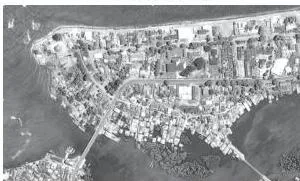
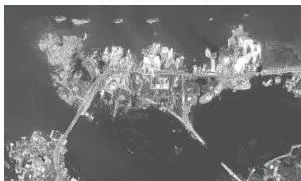
Read the two photographs as a pair, step by step:
- The June 2004 image was taken before the disaster; the December 2004 image was taken after the tsunami struck the same city.
- Side by side, they show the same city after the disaster, its size — in people and structures — sharply reduced.
- That reduction is what the chapter calls negative growth: growth is value neutral, so a city’s size can move downward as well as upward.
- The chapter then asks the question for you: are natural disasters the only reason a city can grow negatively? — inviting you to name economic or political causes of a shrinking city.
This is why the pair appears at the very start of the chapter: it proves, in two photographs, that growth is not always positive — and that a growing economy can coexist with a shrinking quality of life.
Definitions: Twelve Terms This Chapter Hangs On
A quick lookup table of the terms that answers use. Each definition below is the chapter’s idea in short form.
| Term | Meaning | Where the chapter uses it |
|---|---|---|
| Growth | Quantitative change over time; value neutral; can be positive or negative. | Growth and Development |
| Development | Qualitative change; always value positive; occurs with positive growth, but positive growth alone does not guarantee it. | Growth and Development |
| Human development | Development that enlarges people’s choices and improves their lives, with people central (Dr Mahbub-ul-Haq). | Approaches to Human Development |
| Meaningful life | A life with purpose, not just a long one — needing health, talent, participation and freedom. | A Meaningful Life |
| Equity | Equal access to opportunities regardless of gender, race, income or caste. | The Four Pillars |
| Sustainability | Continuity of opportunities — each generation keeps the same opportunities. | The Four Pillars |
| Productivity | Human labour productivity enriched by building capabilities; people are the real wealth of nations. | The Four Pillars |
| Empowerment | The power to make choices, gained through freedom and capability. | The Four Pillars |
| Human Development Index | A 0-to-1 score ranking countries on health, education and resources, each weighted one-third. | Measuring the HDI |
| Human Poverty Index | A non-income measure of the shortfall, not the attainment, in human development. | Beyond HDI |
| Basic needs | The ILO’s six minimum needs: health, education, food, water supply, sanitation and housing. | Four Approaches |
| Gross National Happiness | Bhutan’s official measure of progress, covering spiritual, non-material and qualitative aspects of development. | Beyond HDI |
Common Mistakes Students Make With Human Development
Most of the confusion in this chapter comes from pairs of ideas that look alike but are not. The table names each mistake before you make it.
| Mistake | Correct rule | How to check your answer |
|---|---|---|
| Using growth and development as synonyms. | Growth is quantitative and value neutral; development is qualitative and always value positive. | Ask: is this a change in size or number, or a change in quality? |
| Assuming positive growth always brings development. | Positive growth does not always lead to development; quality must change too. | Look for rising income alongside stagnant schooling or health. |
| Calling the HDI the most reliable measure. | The book says it is not — it shows attainments but hides distribution. | Pair the HDI with the HPI before judging a country. |
| Mixing up the HDI’s indicators. | Life expectancy = health; literacy and enrolment = knowledge; purchasing power = resources. | For each HDI dimension, name its indicator from memory. |
| Confusing HDI with HPI. | HDI measures attainment; HPI measures shortfall. | HPI lists failures like death before age 40 and illiteracy; HDI does not. |
| Blaming culture or religion for low HDI. | The chapter calls this misleading; social-sector spending and political stability matter more. | Cite the spending and freedom argument instead of the people. |
| Misusing the category boundaries. | Above 0.800 Very High; 0.700 up to 0.799 High; 0.550 up to 0.699 Medium; below 0.550 Low. | Check which band 0.780 or 0.540 falls into before writing it. |
Exam Notes: How the Chapter’s Own Exercises Test You
The exercises at the end of the chapter are the best map of what you should be able to do after reading it (NCERT, p. 20). Three sets, three different skills:
- Multiple-choice questions test the definitions — which option best describes development, and which scholar introduced the concept. The chapter’s own text supports the option that calls development “a positive change in quality”, and Dr Mahbub-ul-Haq as the scholar who introduced the concept.
- 30-word answers test recall of complete lists: the three basic areas (access to resources, health, education), the four components (equity, sustainability, productivity, empowerment), and how countries are classified by HDI score. A complete answer should name every item in the list.
- 150-word answers test understanding: define human development in your own words, and explain equity and sustainability within the concept. Open with a one-line definition, then build with the chapter’s examples before concluding.
The chapter also closes with a project suggestion: list the ten most and ten least corrupt countries, compare their HDI scores, and draw inferences using the latest Human Development Report.
Textbook contents and the examinable syllabus are not always identical — check the current official syllabus for what is examinable this session.
What to Remember From Chapter 3
Compressed to six lines for a last-minute read:
- Growth is quantitative and value neutral; development is qualitative and always value positive.
- Positive growth does not automatically mean development — quality must change too.
- People, not economies, are the real wealth of nations.
- The four pillars are equity, sustainability, productivity and empowerment.
- HDI combines health, education and resources with equal one-third weights; HDI shows attainment, HPI shows shortfall.
- India’s HDI rose from 0.633 to 0.644, rank 134 of 193, in the 2026-27 report’s medium category.
Related Chapters and Resources
For the rest of this book, start at the Class 12 Geography hub, which lists the Class 12 Geography chapters with their notes. The primary activities notes and the data processing notes are also part of the Class 12 Geography notes.
For all your other Class 12 subjects, use the Class 12 hub, and for notes across classes, use the CBSE notes index.
The official PDF linked above remains the authoritative version: Human Development, Chapter 3 — official NCERT file on ncert.nic.in.
Reference: NCERT Class 12 Geography textbook, chapter 3, official edition on ncert.nic.in.
Sources and Data Verification
- The figures, tables and page references on this page describe the NCERT Class 12 Geography textbook Fundamentals of Human Geography, Chapter 3, Human Development.
- This page covers that one book and chapter; it does not describe other geography textbooks or the whole CBSE scheme.
- NCERT settles textbooks, editions and official PDFs; CBSE settles the curriculum, syllabus and examinations. Textbook contents and the examinable syllabus are not always identical.
- The textbook is the authority: if you spot a difference between this page and the printed chapter, the NCERT edition is correct.
Frequently Asked Questions About Human Development Class 12
What is the difference between growth and development in human development class 12?
Growth is a quantitative change — in size or number — and is value neutral, so it can be positive or negative. Development is a qualitative change and is always value positive. Development happens when positive growth brings a positive change in quality, which is why a growing economy does not automatically mean a developing country (NCERT, p. 14).
Who introduced the concept of human development?
Dr Mahbub-ul-Haq introduced the concept of human development and created the Human Development Index in 1990. He described human development as development that enlarges people’s choices and improves their lives. Prof. Amartya Sen, who worked with Dr Haq on the early Human Development Reports, is associated with the capability approach to human development (NCERT, p. 14).
What are the four pillars of human development?
The four pillars are equity, sustainability, productivity and empowerment (NCERT, p. 16). Equity means equal access to opportunity for everyone; sustainability means keeping those opportunities available for future generations; productivity means enriching human labour by building capabilities; empowerment means giving people the power to make choices.
How is the Human Development Index measured?
The HDI gives a country a score from 0 to 1 based on three dimensions: health (life expectancy at birth), knowledge (adult literacy rate and gross enrolment ratio) and resources (purchasing power in US dollars). Each dimension carries an equal weight of one-third. So a country scoring 0.80 on health, 0.85 on knowledge and 0.60 on resources gets \( \frac{0.80 + 0.85 + 0.60}{3} = 0.75 \) (NCERT, p. 17).
What is the difference between the Human Development Index and the Human Poverty Index?
The HDI measures attainment — what a country has achieved in health, education and resources. The HPI measures shortfall — what is missing — using non-income indicators: the probability of not surviving to age 40, adult illiteracy, lack of access to clean water, and underweight small children.
The book says the HPI is often more revealing and that the two should be read together (NCERT, p. 17).
Why is India ranked 134 in the Human Development Report 2026-27?
India’s HDI value rose from 0.633 in 2021 to 0.644 in 2022, which placed it at rank 134 out of 193 countries, in the medium human development category (NCERT, p. 19).
The rank reflects how the report scores health, education and resources; the report also notes that global progress is uneven, with rich countries at record highs while half of the world’s poorest countries remain below their pre-crisis level. On the Gender Inequality Index, India’s 2022 value of 0.437 is better than the global average of 0.462 and the South Asian average of 0.478.
Explore Class 12 Geography Books
Related chapters: