This page gives you Our Environment Class 10 — the NCERT Science Chapter 13 textbook chapter, with the official PDF and a plain explanation of every idea inside it. The chapter runs from page 207 to page 217 of the Class 10 Science book, and the official PDF is right here.
Download the official NCERT Our Environment Class 10 Chapter 13 PDF straight from ncert.nic.in — the same chapter students use in class, saved exactly as published so you can read it offline, print it, or follow along while revising.
Chapter 13 at a Glance: What’s Inside the PDF
The chapter divides into two halves. Section 13.1 explains what an ecosystem is and how energy moves through it, starting on page 207; Section 13.2 looks at how human activity damages the environment through ozone depletion and waste disposal, starting on page 212.
The table below lists what the chapter actually contains — its sections, figures, activities and questions — and it describes the NCERT chapter itself, not the larger CBSE syllabus.
| What the chapter holds | Count | Where it is used |
|---|---|---|
| Printed pages | 10 | |
| Sections in the chapter | 5 | |
| Figures with NCERT captions | 4 | |
| Exercise questions | 9 | answered in our NCERT Solutions |
| In-text questions | 7 | |
| Activities | 9 | |
| Official NCERT PDF | Download the chapter PDF | the chapter exactly as NCERT publishes it |
What This Chapter Covers: Ecosystems, Ozone and Waste
The chapter opens with the everyday word ‘environment’ — the word used on television, in newspapers and at global summits — and turns it into a scientific idea. An ecosystem is all the interacting organisms in an area together with the non-living constituents of the environment (NCERT, p. 207).
A garden, a forest, a pond and a lake are all ecosystems; gardens and crop-fields are human-made, forests and ponds are natural.
From there the chapter builds how energy moves through an ecosystem: food chains, trophic levels, food webs, the 10 per cent rule and unidirectional energy flow, and finally biological magnification — the silent way pesticides build up in our bodies (pp. 209–211). This is the part most exam answers draw from.
The second half studies two environmental problems caused by human activity: depletion of the ozone layer (p. 212) and the problem of waste disposal, which introduces the biodegradable and non-biodegradable split (p. 213).
Key Concepts: Ecosystem Components, Food Chains and Energy Flow
This is the science of the chapter — what an ecosystem is made of and how energy moves through it. Four ideas build on each other, so learn them in this order.
Biotic and abiotic components
Every ecosystem answer starts with the two halves of the definition. An ecosystem consists of biotic components — the living organisms — and abiotic components — the physical factors like temperature, rainfall, wind, soil and minerals (NCERT, p. 207).
The book’s example is a garden: plants, insects, frogs and birds interacting with each other, with their growth and reproduction affected by the abiotic factors around them (p. 207). Natural ecosystems include forests, ponds and lakes; gardens and crop-fields are artificial ecosystems.
Producers, consumers and decomposers
These three groups describe every possible way an organism obtains its sustenance. Producers are green plants and certain bacteria that make organic compounds like sugar and starch from inorganic substances, using the radiant energy of the Sun in the presence of chlorophyll — photosynthesis (NCERT, p. 208).
Consumers depend on producers directly or indirectly, and are classed as herbivores, carnivores, omnivores and parasites (p. 208). Decomposers — bacteria and fungi — break down the dead remains and waste products of organisms into simple inorganic substances that go into the soil and are used once more by plants (p. 209).
Food chains and trophic levels
A food chain answers one question: who feeds on whom? A series of organisms feeding on one another forms a food chain (NCERT, p. 209), and each step or level of the chain is a trophic level (p. 210).
Producers (autotrophs) sit at the first trophic level, fixing solar energy and making it available to consumers. Herbivores, or primary consumers, are the second level; small carnivores, or secondary consumers, the third; and larger carnivores, or tertiary consumers, the fourth (p. 210).
The 10 per cent rule and unidirectional flow
This is why food chains are short. Green plants in a terrestrial ecosystem capture only about 1 per cent of the energy of sunlight that falls on their leaves and convert it into food energy (NCERT, p. 210).
When consumers eat, a great deal of that energy is lost as heat, some goes into digestion and doing work, and only the rest supports growth and reproduction — on average, about 10 per cent of the food eaten is turned into the consumer’s own body and made available for the next level of consumers (p. 210).
Worked example, with original numbers, tracing 10 per cent energy transfer through three trophic levels:
Step 1: Take a grassland chain — grass (producer), grasshopper (primary consumer), frog (secondary consumer).
Suppose the producers have stored 10,000 kJ of food energy.
Step 2: Apply the rule: on average 10 per cent of food eaten reaches the next level (NCERT, p. 210).
\[ \text{Energy at primary consumers} = \frac{10}{100} \times 10{,}000\ \text{kJ} = 1{,}000\ \text{kJ} \]
Step 3: Repeat the same transfer from primary to secondary consumers.
\[ \text{Energy at secondary consumers} = \frac{10}{100} \times 1{,}000\ \text{kJ} = 100\ \text{kJ} \]
Final answer: The chain carries 10,000 kJ at the producer level, 1,000 kJ at the primary consumer level and 100 kJ at the secondary consumer level. The missing 9,000 kJ and 900 kJ were lost as heat, in digestion and in doing work (p. 210) — which is why very little usable energy remains after four trophic levels, and chains stay short.
Two consequences follow from this 10 per cent loss. First, the flow of energy is unidirectional: the energy captured by autotrophs does not revert to the solar input, and energy that passes to herbivores does not come back to autotrophs — as it moves through trophic levels it is no longer available to the previous level (NCERT, p. 211).
Second, the energy available at each trophic level diminishes progressively, so lower levels generally hold more individuals, with producers the most numerous of all (p. 210).
Biological magnification
Pesticides enter food chains without being part of them. Chemicals sprayed to protect crops are washed into the soil or into water bodies; from the soil they are absorbed by plants along with water and minerals, and from water bodies they are taken up by aquatic plants and animals — one of the ways they enter the food chain (NCERT, p. 211).
Because these chemicals are not degradable, they accumulate progressively at each trophic level. Since human beings occupy the top level in any food chain, the maximum concentration accumulates in our bodies — this is biological magnification (p. 211). It is why food grains, vegetables, fruits and even meat contain pesticide residues that cannot always be removed by washing (p. 211).
The One Equation in This Chapter: How Ozone Forms
Ozone \( (O_3) \) is the chapter’s one chemical equation, and it explains how a single molecule can be both a poison and a shield. \( O_2 \), the oxygen every aerobic form of life needs, is essential; ozone, by contrast, is a deadly poison at ground level (NCERT, p. 212).
High in the atmosphere, however, ozone performs an essential function: it shields the surface of the Earth from ultraviolet (UV) radiation from the Sun — radiation that is highly damaging to organisms and is known to cause skin cancer in human beings (p. 212).
Ozone at these heights is a product of UV radiation acting on oxygen. First, higher-energy UV radiation splits apart some molecular oxygen into free oxygen atoms:
\[ \text{O}_2 \xrightarrow{\text{UV}} \text{O} + \text{O} \]
These free atoms then combine with molecular oxygen to form ozone:
\[ \text{O} + \text{O}_2 \rightarrow \text{O}_3 \]
The amount of ozone in the atmosphere began to drop sharply in the 1980s. This decrease has been linked to synthetic chemicals like chlorofluorocarbons (CFCs), which are used as refrigerants and in fire extinguishers (p. 213).
In 1987, the United Nations Environment Programme (UNEP) forged an agreement to freeze CFC production at 1986 levels, and it is now mandatory for all manufacturing companies to make CFC-free refrigerators throughout the world (p. 213).
Figure Walkthrough: Reading NCERT’s Four Diagrams
These four figures carry the chapter’s ideas visually. The arrows and levels only make sense once you know how to read them, so this walkthrough explains each one.
Figure 13.1 — Food chain in nature
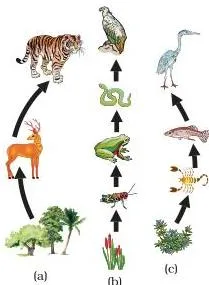
A food chain is a series of organisms feeding on one another (p. 209). Every arrow in the figure means ‘is eaten by’: trace from the prey to the predator.
The three panels make the point that chains look different in a forest, a grassland and a pond, but all follow the same rule — energy moves from the eaten to the eater.
Figure 13.2 — Trophic levels
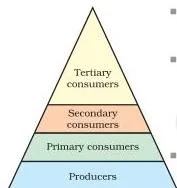
Each step of a food chain is a trophic level (p. 210). The stack shows the order: producers at the first level fix solar energy and make it available to everything above; herbivores (primary consumers) form the second level; small carnivores (secondary consumers) the third; larger carnivores (tertiary consumers) the fourth (p. 210).
Higher levels depend on the levels below them — which is why their energy is always less.
Figure 13.3 — Food web, consisting of many food chains
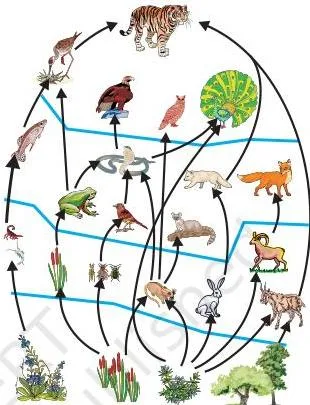
In nature, each organism is generally eaten by two or more other kinds of organisms (p. 210). So a straight-line food chain becomes a series of branching lines — a food web (p. 211). The overlap in the figure is the point: because chains share organisms, removing one species affects several chains, not just one.
Figure 13.4 — Diagram showing flow of energy in an ecosystem
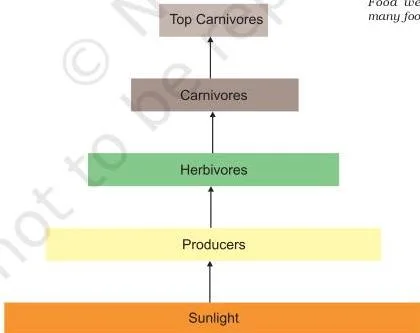
From this diagram two things become clear (p. 211). First, the flow of energy is unidirectional — the energy captured by autotrophs does not revert back to the solar input, and energy passed to herbivores does not come back to autotrophs.
Second, the energy available at each trophic level gets diminished progressively because energy is lost at every step. This is the figure that proves the 10 per cent rule.
Definitions: Write These Terms Correctly in the Exam
If a definition question appears, these are the words to use — one line each, in your own words. The NCERT page tells you where the term is taught.
| Term | What it means | NCERT page |
|---|---|---|
| Ecosystem | All the interacting organisms in an area together with the non-living constituents of the environment | p. 207 |
| Biotic components | The living organisms of an ecosystem | p. 207 |
| Abiotic components | The physical factors of an ecosystem — temperature, rainfall, wind, soil and minerals | p. 207 |
| Producers | Green plants and certain bacteria that make organic compounds from inorganic substances using the Sun’s energy (photosynthesis) | p. 208 |
| Consumers | Organisms that obtain food directly from producers or indirectly by feeding on other consumers — herbivores, carnivores, omnivores and parasites | p. 208 |
| Decomposers | Bacteria and fungi that break down dead remains and waste into simple inorganic substances that return to the soil | p. 209 |
| Food chain | A series of organisms feeding on one another | pp. 209–210 |
| Trophic level | Each step or level of a food chain | p. 210 |
| Food web | Branching, interconnected food chains that form because each organism is generally eaten by two or more other kinds of organisms | p. 211 |
| Biological magnification | Progressive accumulation of non-degradable chemicals at each trophic level, reaching maximum concentration at the top level | p. 211 |
| Ozone | A molecule of three oxygen atoms (\( O_3 \)) — a ground-level poison that shields the Earth from UV radiation high in the atmosphere | p. 212 |
| Biodegradable | Substances that are broken down by biological processes | p. 213 |
| Non-biodegradable | Substances not broken down by biological processes; they persist in the environment for a long time or may harm the ecosystem | p. 213 |
Common Mistakes Students Make in This Chapter
These are the places where answers in this chapter usually go wrong. Each row names the mistake, the correct rule, and a way to check yourself.
| Mistake | Correct rule | How to check your answer |
|---|---|---|
| Energy is recycled in an ecosystem. | Energy flow is unidirectional — energy at one trophic level never returns to the previous level (NCERT, p. 211). | If your answer lets energy flow backwards — say, from a deer back to grass — it is wrong. Decomposers recycle matter, not energy. |
| Biodegradable means it breaks down quickly. | Biodegradable means broken down by biological processes; non-biodegradable materials persist under ambient conditions (p. 213). The test is the process, not the speed. | Write the definition as a process: ‘broken down by the action of bacteria and other saprophytes’ — never ‘quickly’. |
| Decomposers are a link in the food chain. | Decomposers break down dead remains and return simple substances to the soil, but they are not part of the feeding chain (p. 209). | A food chain shows who eats whom. Decomposers are not eaten as a step in that series. |
| Ozone is \( O_2 \). | Ozone is \( O_3 \), a molecule of three oxygen atoms; \( O_2 \) is the oxygen aerobic life needs (p. 212). | Write the formula — three atoms of oxygen is ozone. |
| All biodegradable waste is harmless. | Biodegradable waste can still affect the environment — Exercise Q8 on page 217 asks exactly this, and the intended answer is that there is still an impact (p. 217). | If you answered ‘no impact’ to Q8, revisit it: the question is designed so the answer has to be ‘no, it will still have an impact’. |
| Biological magnification is worst at the bottom of the chain. | Non-degradable chemicals accumulate progressively at each trophic level, so the concentration is highest at the top — the level humans occupy (p. 211). | Trace a pesticide from soil to plant to herbivore to carnivore: the chemical is added at every step, so the top of the chain holds the maximum. |
The pattern behind most of these errors is the same: the chapter’s terms sound like everyday words. In the exam, give the process definition, not the everyday one.
Exam Notes: What the Questions in This Chapter Test
The exercises at the end of the chapter are the clearest guide to what NCERT expects you to be able to do. The table maps each question to the concept it tests and what a full answer needs.
| Question | Concept tested | What a full answer needs |
|---|---|---|
| Q1 (multiple-choice) | Identifying biodegradable items | The intended answer is the group grass, flowers and leather (option a) — every item is biodegradable. Plastic is not broken down by biological processes (p. 213), so any option containing it is wrong. |
| Q2 (multiple-choice) | Recognising a food chain | The listed items must form a feeding series — grass eaten by goat, goat eaten by human (p. 209). |
| Q3 (multiple-choice) | Environment-friendly practices | Each listed practice — cloth bags, switching off unnecessary lights and fans, walking to school — reduces waste or energy use, so all of them count (p. 216). |
| Q4–Q5 | Trophic levels and interdependence | Removing one trophic level breaks the chain for the levels above and below it. No level can be removed without damage, because the components of an ecosystem are interdependent (p. 216). |
| Q6 | Biological magnification | Define it (p. 211) and state that magnification levels differ because chemicals accumulate progressively at each trophic level. |
| Q7–Q8 | Problems of waste disposal | Non-biodegradable waste persists and may harm the ecosystem (p. 213); biodegradable waste is not automatically harmless (p. 217). |
| Q9 | Ozone depletion and protection | State the UV-shielding role and the skin cancer risk (p. 212), the CFC link, the 1987 UNEP agreement to freeze CFC production at 1986 levels, and the worldwide move to CFC-free refrigerators (p. 213). |
The three in-text question blocks (NCERT, pp. 212, 214, 216) ask the same skills at shorter length: defining trophic levels, stating the role of decomposers, explaining why some substances are biodegradable and others not, and suggesting ways to reduce the waste-disposal problem.
One honest caution: textbook contents and the examinable syllabus are not always identical. Check the current official syllabus at cbse.gov.in before deciding what to emphasise for the board exam.
The Nine Activities: What Doing Them Teaches
The activities make the chapter’s ideas visible. Each one is built on the same logic: observe, then connect the observation to a concept.
| Activity | What doing it teaches |
|---|---|
| 13.1 | An aquarium is a human-made ecosystem — fish need space, water, oxygen and food, and adding aquatic plants and animals can make it self-sustaining (p. 208). |
| 13.2 | Order the aquarium organisms as ‘who eats whom’ to form a food chain of at least three steps (p. 209). |
| 13.3 | Debate bans on ready-made food items with pesticide reports — and trace how pesticides reach our food and how intake could be reduced (p. 212). |
| 13.4 | Research which chemicals deplete the ozone layer and whether regulations have reduced the damage (p. 213). |
| 13.5 | Bury household waste and observe every 15 days which materials change form and which remain unchanged (p. 213). |
| 13.6 | Find out how long non-biodegradable substances last and whether new ‘biodegradable’ plastics really harm the environment (p. 214). |
| 13.7 | Measure how much waste a home and a classroom generate in a day, and how much of it is biodegradable (p. 215). |
| 13.8 | Investigate how local bodies treat sewage and how industries treat wastes, so soil and water are not polluted (p. 215). |
| 13.9 | Explore the hazardous materials inside electronic items and the environmental impact of plastic recycling (p. 216). |
The box on disposable cups in trains (p. 215) is the chapter’s own example of a trade-off: plastic cups were replaced for hygiene, clay kulhads were then set aside because making them on a large scale would destroy fertile top-soil, and paper cups are the current choice — every option exchanges one environmental cost for another.
Recap: What You Should Remember from This Chapter
NCERT closes the chapter with a ‘What you have learnt’ list (p. 216). Here are those points, said more directly:
- Everything in an ecosystem is interdependent — change one component and the others are affected.
- Producers make the energy from sunlight available to the rest of the ecosystem.
- Energy is lost at each trophic level, which limits the number of trophic levels a food chain can support.
- Human activities have an impact on the environment.
- Chemicals like CFCs have endangered the ozone layer, which protects against ultraviolet radiation from the Sun.
- The waste we generate is either biodegradable or non-biodegradable.
- The disposal of the waste we generate is causing serious environmental problems.
Related Resources: The Rest of Class 10 Science
This listing is maintained for the 2026-27 academic session using the NCERT textbook information available to us. NCERT remains the authority for confirming the latest edition.
If this chapter made sense, the rest of the book builds on the same habits — definitions first, then reasoning. Work through the Class 10 Science notes for concept-by-concept revision of every chapter.
The Class 10 hub brings together the notes for all subjects in one place, and the main notes index covers every class. To revise in book order, go back to Chapter 12, Magnetic Effects of Electric Current, the chapter that comes just before this one.
Sources and data verification
- This page describes the NCERT Class 10 Science textbook, Chapter 13 ‘Our Environment’, official edition available on ncert.nic.in.
- It covers this one chapter of the NCERT textbook — not the full CBSE scheme, which includes subjects and options not listed here.
- It is maintained for the current academic session using the NCERT information available to us.
- NCERT settles textbooks, editions and PDFs; CBSE settles curriculum, syllabus and examinations.
Frequently Asked Questions About Our Environment Class 10
What is the difference between biodegradable and non-biodegradable substances?
Biodegradable substances are broken down by biological processes — the action of bacteria and other saprophytes — while non-biodegradable substances are not, so they persist in the environment for a long time or may harm the ecosystem (NCERT, p. 213). The test is the process, not the material’s age.
Why do food chains usually have only three or four trophic levels?
Because so little energy reaches the next level. On average only about 10 per cent of the food eaten is turned into the consumer’s own body and made available to the next level, so very little usable energy remains after four trophic levels (NCERT, p. 210).
What is biological magnification and why does it affect humans the most?
Biological magnification is the progressive accumulation of non-degradable chemicals at each trophic level (NCERT, p. 211). Humans occupy the top level of any food chain, so the maximum concentration of these chemicals accumulates in our bodies — which is why pesticide residues appear even in food grains, fruits and meat (p. 211).
How is ozone formed and why is damage to the ozone layer a concern?
In the upper atmosphere, high-energy UV radiation splits \( O_2 \) into free oxygen atoms, and these atoms combine with \( O_2 \) to form ozone, \( O_3 \) (NCERT, p. 213). The concern is that ozone shields the Earth from UV radiation that can cause skin cancer; CFCs have been linked to its sharp drop since the 1980s, so the 1987 UNEP agreement froze their production (pp. 212–213).
Why is the flow of energy in an ecosystem unidirectional?
Energy captured by autotrophs never reverts to the solar input, and energy that passes to herbivores does not come back to autotrophs — as energy moves through trophic levels it is no longer available to the previous level (NCERT, p. 211). Decomposers recycle matter, but not energy.
How can we help in reducing the problem of waste disposal?
Two practical ways: reuse items such as cloth bags for shopping instead of taking disposable ones (NCERT, p. 216), and separate biodegradable from non-biodegradable waste at home so each stream can be treated differently (p. 215). Both shrink the volume of waste that has to be disposed of.
Reference: NCERT Class 10 Science textbook, chapter 13, official edition on ncert.nic.in.
Explore Class 10 Science Books
Class 10 Science on LearnCBSE:
Related chapters:
- Chemical Reactions and Equations
- Acids, Bases and Salts
- Metals and Non-metals