Carbon and its Compounds Class 10 is Chapter 4 of the NCERT Science book. The chapter opens on textbook page 57 and runs about twenty pages, closing with the exercises and Group Activity on page 78. The official NCERT PDF for this chapter is right here, and below it you will find a full guide to what the chapter teaches.
Download the NCERT Class 10 Science Chapter 4 Carbon and its Compounds PDF — this is the official file published by NCERT, so the sections, page numbers and exercises match the printed book exactly. It is the chapter as NCERT printed it: same figures, same tables, same activities.
Chapter at a Glance
The table below lists what the chapter holds — its sections, figures, activities and questions — so you can plan your reading before you start.
| What the chapter holds | Count | Where it is used |
|---|---|---|
| Printed pages | 21 | |
| Sections in the chapter | 16 | |
| Figures with NCERT captions | 16 | |
| Tables | 5 | |
| Exercise questions | 15 | answered in our NCERT Solutions |
| In-text questions | 13 | |
| Activities | 12 | |
| Official NCERT PDF | Download the chapter PDF | the chapter exactly as NCERT publishes it |
Inside the book, the chapter moves through four numbered sections: 4.1 Bonding in Carbon (the covalent bond), 4.2 Versatile Nature of Carbon (catenation, chains, functional groups and naming), 4.3 Chemical Properties of Carbon Compounds (combustion, oxidation, addition and substitution) and 4.4 Some Important Carbon Compounds — Ethanol and Ethanoic Acid. The soap-and-detergent discussion and the chapter exercises follow these.
What This Chapter Covers: A Guided Tour
The tour below maps every section of the chapter to its textbook page, so you can jump straight to the idea you need.
| Section | NCERT page | What it teaches |
|---|---|---|
| 4.1 Bonding in carbon — the covalent bond | pp. 59–61 | Why carbon shares electrons instead of forming ions; low melting and boiling points and poor conduction of covalent compounds |
| Allotropes of carbon | p. 61 | Diamond, graphite and fullerene — same element, different bonding, very different physical properties |
| 4.2 Versatile nature of carbon | p. 62 | Catenation and tetravalency — the two reasons behind millions of carbon compounds |
| 4.2.1 Saturated and unsaturated carbon compounds | pp. 63–64 | Single bonds versus double and triple bonds; ethane, ethene, ethyne; the reactivity difference |
| 4.2.2 Chains, branches and rings | pp. 64–65 | Straight chains, branched chains and rings; structural isomers; the alkane, alkene and alkyne families |
| 4.2.3 Functional groups | pp. 65–66 | Heteroatoms; the –OH, –CHO, –CO– and –COOH groups and the classes they define |
| 4.2.4 Homologous series | pp. 66–67 | Same functional group on chains of different lengths; the CH₂ difference; gradation in physical properties |
| 4.2.5 Nomenclature of carbon compounds | pp. 67–68 | The four naming rules, including dropping the final ‘e’ before a vowel-starting suffix |
| 4.3.1 Combustion | pp. 69–70 | Burning of carbon compounds; clean versus sooty flames; formation of coal and petroleum |
| Oxidation by alkaline KMnO₄ | pp. 70–71 | Ethanol to ethanoic acid; oxidising agents; Activity 4.5 |
| 4.3.3 Addition and 4.3.4 Substitution | p. 71 | Hydrogenation; methane with chlorine in sunlight; catalysts |
| 4.4.1 Properties of ethanol | pp. 72–73 | Reaction with sodium; dehydration to ethene; denatured alcohol; alcohol as a fuel |
| 4.4.2 Properties of ethanoic acid | pp. 73–74 | Vinegar and glacial acetic acid; esterification; saponification; reaction with base and with carbonates |
| Soaps and detergents | pp. 74–76 | Micelles, cleaning action, hard water, scum and why detergents still work |
| What you have learnt, exercises and Group Activity | pp. 77–78 | The chapter’s closing summary list and its end-of-chapter questions |
The margin boxes — Do You Know? and More to Know! — carry denatured alcohol, alcohol as a fuel and oxidising agents. They are easy to skip, but the chapter’s in-text question on oxidising agents and exercise Q9 on fuels draw on them.
Key Concepts in Carbon and its Compounds Class 10
Everything in this chapter builds from one starting point: carbon shares electrons. That single fact explains the millions of carbon compounds, their low melting points, their reactions and even how soap cleans. The concepts below follow the order in which the book develops them.
Why carbon forms covalent bonds (pp. 59–61)
Carbon (atomic number 6) has four valence electrons. To reach a noble gas configuration it would need to gain or lose four electrons — and both options fail.
- Gaining four forming \( \text{C}^{4-} \): a nucleus with six protons cannot hold ten electrons.
- Losing four forming \( \text{C}^{4+} \): removing four electrons needs a large amount of energy.
So carbon shares its four valence electrons with other atoms. A bond formed by sharing an electron pair is a covalent bond (NCERT, p. 60).
Sharing has two visible consequences. First, covalent molecules have weak forces between them, so carbon compounds have low melting and boiling points — compare methane (boiling point 111 K) with any ionic compound from Chapter 3 (Table 4.1, NCERT, p. 59).
Second, no ions form, so carbon compounds are poor conductors of electricity (NCERT, p. 60). This is why the chapter contrasts them with ionic compounds throughout.
Catenation and tetravalency (p. 62)
Two properties of carbon explain why there are millions of carbon compounds and far fewer compounds of every other element combined.
- Tetravalency — carbon bonds with four other atoms at a time.
- Catenation — carbon bonds with other carbon atoms, forming long chains, branched chains or rings (NCERT, p. 62).
The carbon–carbon bond is unusually strong, partly because carbon’s small size lets its nucleus hold shared electron pairs firmly. Silicon makes chains of only seven or eight atoms, and those compounds are very reactive; carbon chains can run to almost any length.
Saturated and unsaturated compounds (pp. 63–64)
Look at the bond between two carbon atoms and you can sort every hydrocarbon into one of two families.
- Saturated compounds have only single bonds between carbons (\( \text{C}_2\text{H}_6 \), \( \text{C}_3\text{H}_8 \)). They are normally not very reactive.
- Unsaturated compounds have a double or triple bond between carbons (\( \text{C}_2\text{H}_4 \), \( \text{C}_2\text{H}_2 \)). They are more reactive (NCERT, p. 63).
Worked example: electron dot structure of ethyne (\( \text{C}_2\text{H}_2 \)). The chapter asks you to draw this in Section 4.2.1, so here is the step-by-step logic.
- Step 1: Join the two carbon atoms with a single bond — one shared pair of electrons.
- Step 2: Each carbon still has three unused valencies, because every carbon needs four bonds in total.
- Step 3: Only the two carbons can satisfy these six remaining valencies.
They must share three pairs — a triple bond.
Step 4: Each carbon now completes its octet: it shares three electrons with the other carbon and one with a hydrogen atom.
\[ \text{H} – \text{C} \equiv \text{C} – \text{H} \]
Final structure: ethyne is \( \text{H} – \text{C} \equiv \text{C} – \text{H} \); the triple bond is what makes it unsaturated and more reactive.
Worked example: counting covalent bonds in propane (\( \text{C}_3\text{H}_8 \)). Count the bonds the same way you would for ethane.
| Compound | C–C bonds | C–H bonds | Total covalent bonds |
|---|---|---|---|
| Ethane \( \text{C}_2\text{H}_6 \) | 1 | 6 | 7 |
| Propane \( \text{C}_3\text{H}_8 \) | 2 | 8 | 10 |
This is the counting that settles exercise Q1 (p. 77): ethane has seven covalent bonds, so the correct option is (b). The bond students forget is the C–C bond — see the structure on p. 63.
Chains, branches, rings and isomers (pp. 64–65)
The same four carbon atoms can be arranged in two ways, and each arrangement is a different compound. Butane (\( \text{C}_4\text{H}_{10} \)) exists as a straight chain and as a branched chain.
Two compounds with the same molecular formula but different structures are structural isomers (NCERT, p. 65). Carbon chains can also close into rings — cyclohexane (\( \text{C}_6\text{H}_{12} \)) and benzene (\( \text{C}_6\text{H}_6 \)) are the book’s examples.
Hydrocarbons contain only carbon and hydrogen. They fall into three families: alkanes (saturated, single bonds only), alkenes (one or more double bonds) and alkynes (one or more triple bonds) (NCERT, p. 65).
Functional groups and the homologous series (pp. 65–67)
A hydrocarbon chain is like a skeleton: replace one hydrogen with another atom, and the whole compound’s chemistry changes. The atom or group that replaces hydrogen is a heteroatom; the group that decides the compound’s properties is a functional group (NCERT, p. 66).
- Haloalkanes — chlorine or bromine replaces hydrogen (chloropropane, bromopropane).
- Alcohols — the –OH group, suffix ‘ol’.
- Aldehydes — the –CHO group, suffix ‘al’.
- Ketones — the –CO– group, suffix ‘one’.
- Carboxylic acids — the –COOH group, suffix ‘oic acid’.
A homologous series is a family of compounds with the same functional group on carbon chains of different lengths — for example \( \text{CH}_3\text{OH} \), \( \text{C}_2\text{H}_5\text{OH} \), \( \text{C}_3\text{H}_7\text{OH} \) and \( \text{C}_4\text{H}_9\text{OH} \) (NCERT, p. 66).
Successive members differ by a \( \text{CH}_2 \) unit, so molecular mass rises by 14 u each step (12 u for carbon plus 2 u for hydrogen). Physical properties — melting point, boiling point, solubility — change gradually along the series, but chemical properties stay similar because the functional group controls them.
Naming carbon compounds (pp. 67–68)
A compound’s name comes from the carbon chain plus a prefix or suffix for the functional group. The book gives four rules.
- Count the carbon atoms: three carbons → propane.
- Add the functional group’s prefix or suffix (Table 4.4, NCERT, p. 67).
- If the suffix begins with a vowel (a, e, i, o, u), drop the final ‘e’ of the chain name — propane becomes propanone, never “propaneone”.
- For a double or triple bond, change ‘ane’ to ‘ene’ or ‘yne’ — propene, propyne.
Combustion and oxidation (pp. 69–71)
Carbon and its compounds burn in oxygen to give carbon dioxide, water and energy — that is why they are fuels.
Combustion is rapid oxidation: \( \text{C} + \text{O}_2 \rightarrow \text{CO}_2 + \text{heat and light} \), and for methane \( \text{CH}_4 + 2\text{O}_2 \rightarrow \text{CO}_2 + 2\text{H}_2\text{O} + \text{heat and light} \) (NCERT, p. 69).
A clean blue flame means enough oxygen; a yellow, sooty flame means incomplete combustion. Saturated hydrocarbons burn with a clean flame, unsaturated ones with a sooty flame (NCERT, p. 69). When the bottom of a cooking vessel blackens, the air holes are blocked and fuel is wasting — the fuel is not wet (exercise Q3, p. 77).
Coal and petroleum are fossil fuels: coal formed from ancient plants, and oil and gas from tiny sea organisms, buried and compressed over millions of years. Their sulphur and nitrogen content releases polluting oxides on burning (NCERT, p. 70).
Why the purple colour of potassium permanganate disappears at first, then stays. In Activity 4.5 (p. 70), alkaline potassium permanganate is added drop by drop to warm ethanol. The permanganate oxidises ethanol to ethanoic acid, and in doing so it is used up — its purple colour vanishes:
\[ \text{CH}_3\text{CH}_2\text{OH} \xrightarrow{\text{alkaline KMnO}_4\ \text{or acidified K}_2\text{Cr}_2\text{O}_7 + \text{heat}} \text{CH}_3\text{COOH} \]
As long as ethanol remains, each new drop is consumed and the colour does not persist. Once all the ethanol has become ethanoic acid, there is nothing left to oxidise — extra permanganate keeps its purple colour.
Substances that add oxygen to others, like alkaline \( \text{KMnO}_4 \) and acidified \( \text{K}_2\text{Cr}_2\text{O}_7 \), are oxidising agents (NCERT, p. 71).
Addition and substitution reactions (p. 71)
Unsaturated and saturated hydrocarbons react in two different ways, and the chapter expects you to tell them apart.
- Addition reaction: atoms add across a double or triple bond. Unsaturated hydrocarbons add hydrogen in the presence of nickel or palladium catalysts to become saturated — this is hydrogenation, used to harden vegetable oils (NCERT, p. 71).
- Substitution reaction: one atom or group replaces another already present. Methane and chlorine react rapidly in sunlight; chlorine replaces hydrogen atoms one by one: \( \text{CH}_4 + \text{Cl}_2 \xrightarrow{\text{sunlight}} \text{CH}_3\text{Cl} + \text{HCl} \) (NCERT, p. 71).
A catalyst is a substance that changes the rate of a reaction without itself being changed (NCERT, p. 71).
Ethanol and its reactions (pp. 72–73)
Ethanol is the alcohol in alcoholic drinks, tincture iodine and cough syrups, and it dissolves in water in all proportions. Two reactions of ethanol are the ones you must be able to write.
- With sodium: hydrogen gas is evolved and sodium ethoxide forms — \( 2\text{Na} + 2\text{CH}_3\text{CH}_2\text{OH} \rightarrow 2\text{CH}_3\text{CH}_2\text{ONa} + \text{H}_2 \) (Activity 4.6, NCERT, p. 72).
- Dehydration: heating ethanol at 443 K with hot concentrated sulphuric acid removes water and gives ethene — \( \text{CH}_3\text{CH}_2\text{OH} \xrightarrow[\text{hot conc. } \text{H}_2\text{SO}_4]{443\ \text{K}} \text{CH}_2=\text{CH}_2 + \text{H}_2\text{O} \) (NCERT, p. 72).
Read the margin box too: denatured alcohol is ethanol made unfit for drinking by adding poisonous methanol and a blue dye. Ethanol is also a cleaner fuel — burning in enough oxygen it gives only carbon dioxide and water.
Ethanoic acid and its reactions (pp. 73–74)
Ethanoic acid is the acid of vinegar — a 5–8% solution in water, used as a preservative in pickles. Pure ethanoic acid melts at 290 K and freezes in winter, which is why it is called glacial acetic acid (NCERT, p. 73).
It is a weak acid: litmus shows it is an acid, but universal indicator shows it is weaker than HCl (Activity 4.7). Four reactions to know:
- Esterification: ethanoic acid + ethanol with an acid catalyst gives a sweet-smelling ester and water. Esters are used in perfumes and flavouring agents (NCERT, p. 73).
- Saponification: the ester reacts with NaOH to give back the alcohol and the sodium salt of the acid. This reaction is used in soap making, so soaps are sodium or potassium salts of long-chain carboxylic acids (NCERT, p. 74).
- Reaction with a base: \( \text{NaOH} + \text{CH}_3\text{COOH} \rightarrow \text{CH}_3\text{COONa} + \text{H}_2\text{O} \) — sodium ethanoate and water (NCERT, p. 74).
- Reaction with carbonates and hydrogencarbonates: carbon dioxide is evolved, confirmed by passing the gas through lime water (Activity 4.9): \( 2\text{CH}_3\text{COOH} + \text{Na}_2\text{CO}_3 \rightarrow 2\text{CH}_3\text{COONa} + \text{H}_2\text{O} + \text{CO}_2 \) (NCERT, p. 74).
The side-by-side comparison below is the answer skeleton for exercise Q7 (p. 77): How can ethanol and ethanoic acid be differentiated?
| Property | Ethanol \( \text{C}_2\text{H}_5\text{OH} \) | Ethanoic acid \( \text{CH}_3\text{COOH} \) |
|---|---|---|
| Physical state | Liquid at room temperature; boiling point 351 K | Liquid; melting point 290 K — freezes into an ice-like solid in cold climates |
| Smell | Characteristic alcoholic smell | Pungent, vinegar-like (vinegar is 5–8% acetic acid) |
| Litmus test | No change — neutral | Blue litmus turns red — acidic, and it is a weak acid |
| Reaction with sodium | Sodium ethoxide + hydrogen gas (p. 72) | Not the chapter’s chosen test — the acid is identified by its reactions with NaOH and with carbonates |
| Reaction with carbonates / hydrogencarbonates | No carbon dioxide shown | Carbon dioxide evolved — salt + water + \( \text{CO}_2 \) (p. 74) |
Soaps and detergents (pp. 74–76)
Soap cleans because one end of its molecule loves water and the other end loves oil. A soap molecule is the sodium or potassium salt of a long-chain carboxylic acid: an ionic head that interacts with water and a long carbon chain that interacts with oil (NCERT, p. 74).
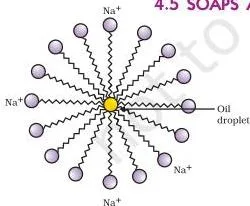
In water, soap molecules cluster into micelles — hydrocarbon tails pointing inward around the oily dirt, ionic heads facing outward into water. The micelle pulls the dirt away from the cloth into the water (NCERT, p. 74). Agitation speeds this up, which is why scrubbing and washing machines work.
Hard water contains calcium and magnesium salts. Soap reacts with these ions and forms a curdy insoluble precipitate — scum — so less foam forms and more soap is needed (Activity 4.11, NCERT, p. 76).
Detergents (sodium salts of sulphonic acids, or ammonium salts) have charged ends that do not precipitate with calcium and magnesium ions, so they keep working in hard water (NCERT, p. 76).
Key Reactions of Ethanol and Ethanoic Acid, With Conditions
This quick-reference table collects the chapter’s important reactions with the conditions you must quote in an answer.
| Reaction | Conditions | Products |
|---|---|---|
| Sodium + ethanol | Sodium metal, room temperature (p. 72) | Sodium ethoxide + hydrogen gas |
| Dehydration of ethanol | Hot concentrated \( \text{H}_2\text{SO}_4 \), 443 K (p. 72) | Ethene + water |
| Combustion of ethanol | Burning in air (p. 69) | Carbon dioxide + water + heat and light |
| Oxidation of ethanol | Alkaline \( \text{KMnO}_4 \) or acidified \( \text{K}_2\text{Cr}_2\text{O}_7 \) + heat (p. 71) | Ethanoic acid |
| Esterification of ethanoic acid and ethanol | Acid catalyst, warm (p. 73) | Ester + water |
| Saponification of the ester | \( \text{NaOH} \) — an alkali (p. 74) | Ethanol + sodium salt of the acid |
| Ethanoic acid + \( \text{NaOH} \) | Room temperature (p. 74) | Sodium ethanoate + water |
| Ethanoic acid + \( \text{Na}_2\text{CO}_3 \) or \( \text{NaHCO}_3 \) | Room temperature (p. 74) | Sodium ethanoate + water + \( \text{CO}_2 \) |
| Hydrogenation of unsaturated hydrocarbons | \( \text{H}_2 \), nickel or palladium catalyst (p. 71) | Saturated hydrocarbons |
| Methane + chlorine | Sunlight (p. 71) | Chloromethane + HCl |
Figure Walkthrough: Reading the Diagrams in This Chapter
The figures in this chapter are not decoration — each one carries the meaning the prose assumes. Here is what to look for in each diagram.
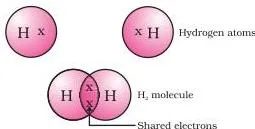
Figures 4.1–4.4: how sharing builds molecules (p. 60)
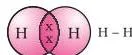
These four diagrams show the same idea in four steps. Figure 4.1 shows a hydrogen molecule; Figure 4.2 redraws the shared pair as a single line — the notation chemists use for a single bond.
Oxygen needs two more electrons per atom, so the two oxygen atoms share two pairs — a double bond, drawn as a double line in Figure 4.3. Nitrogen needs three each, giving the triple bond of Figure 4.4. More shared pairs mean stronger bonds: H₂ single, O₂ double, N₂ triple.
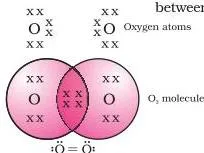
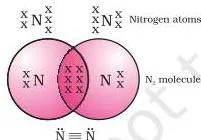
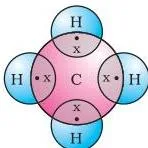
Figure 4.5: the electron dot structure of methane (p. 61)
Methane (\( \text{CH}_4 \)) is carbon’s simplest compound. In Figure 4.5, carbon’s four valence electrons are shared with four hydrogen atoms, so every hydrogen reaches helium’s configuration and carbon completes its octet. This is the template for drawing every other carbon compound.
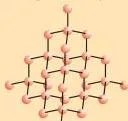
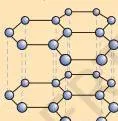
Diamond and graphite: two structures, two personalities (p. 61)
Diamond and graphite are both pure carbon; only the bonding differs. In diamond, every carbon bonds to four others in a rigid three-dimensional network — that is why diamond is the hardest known substance.
In graphite, every carbon bonds to three others in flat hexagonal sheets (one bond is a double bond, so carbon’s valency stays satisfied), and the sheets slide over one another — hence smooth and slippery. Graphite’s free electrons also make it a good conductor, unlike most non-metals.
A third allotrope, fullerene (C-60), has carbon atoms arranged like a football; the chapter describes it in words, so there is no separate diagram for it.
Figures 4.6 and 4.7: building ethane and ethene (pp. 63–64)
Figure 4.6 shows the two-step logic for drawing a carbon compound. First join the carbons with a single bond [Fig 4.6(a)]. Then attach hydrogen atoms until every carbon has four bonds (the book’s step (b), shown in words), giving the complete electron dot structure [Fig 4.6(c)].

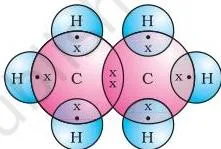
Ethene [Fig 4.7] uses the same logic, but the carbons share two pairs — a double bond — so each carbon carries only two hydrogens.
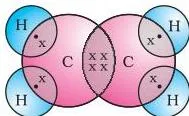
Figures 4.8–4.10: isomers and rings (p. 65)
Figure 4.8(b) shows the two butane isomers side by side: a straight chain and a branched chain, both \( \text{C}_4\text{H}_{10} \). Same formula, different structure — that is the definition of structural isomers.
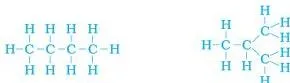
Figures 4.9 and 4.10 show carbon chains closed into rings. Cyclohexane (\( \text{C}_6\text{H}_{12} \)) is saturated — single bonds all around. Benzene (\( \text{C}_6\text{H}_6 \)) has alternating single and double bonds, so it is unsaturated despite being a ring. Straight chains, branches and rings can all be saturated or unsaturated.
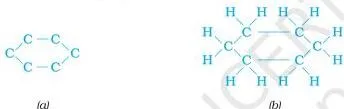
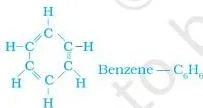
Figure 4.11: making an ester (p. 73)
Figure 4.11 shows the setup for Activity 4.8: ethanol and glacial acetic acid with a few drops of concentrated sulphuric acid are warmed in a test tube placed in a water bath. The sulphuric acid is the acid catalyst; the water bath keeps the temperature gentle. The sweet smell you notice after pouring the mixture into water is the ester.
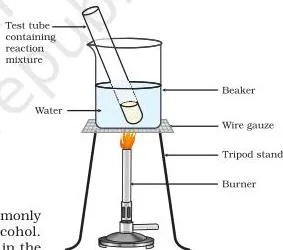
Figure 4.12: the micelle (p. 74)
Figure 4.12 is the most important diagram in the soap section. Soap molecules line up around an oil droplet with their hydrocarbon tails inside the oil and their ionic heads facing the water. This ball-like cluster is the micelle, and it is how soap lifts oily dirt off cloth.
What Each Activity in the Chapter Demonstrates
Every activity in the chapter is an observation designed to prove one idea; the table pairs all twelve activities with what each demonstrates. If you missed the lab, this is what to remember.
| Activity | Page | What it demonstrates |
|---|---|---|
| 4.1 | 58 | Most everyday things — food, clothes, medicines, books — are made of carbon compounds |
| 4.2 | 67 | Successive alcohols differ by a \( \text{CH}_2 \) unit; the family is a homologous series |
| 4.3 | 69 | Carbon compounds burn with heat and light; soot on a plate above the flame shows incomplete combustion |
| 4.4 | 69 | Air supply decides the flame: plenty of oxygen gives a clean blue flame, limited oxygen a yellow sooty one; saturated compounds burn clean, unsaturated ones sooty |
| 4.5 | 70 | Alkaline \( \text{KMnO}_4 \) oxidises ethanol — the purple colour disappears while ethanol remains and persists once oxidation is complete |
| 4.6 | 72 | Sodium + ethanol gives hydrogen gas; sodium ethoxide is the other product |
| 4.7 | 73 | Ethanoic acid is a weak acid: litmus shows acid, universal indicator shows it weaker than HCl |
| 4.8 | 73 | Esters smell sweet — formed from ethanoic acid and ethanol with an acid catalyst |
| 4.9 | 74 | Ethanoic acid + carbonate/hydrogencarbonate gives \( \text{CO}_2 \), confirmed by lime water turning milky |
| 4.10 | 74 | Soap emulsifies oil in water; without soap the oil layer separates again |
| 4.11 | 76 | Hard water gives less foam and a curdy precipitate (scum) with soap |
| 4.12 | 76 | Detergents keep working in hard water where soap fails — no curdy solid forms |
Definitions of Key Terms in This Chapter
These are the chapter’s building-block terms, in the order the book introduces them.
| Term | Plain definition | NCERT page |
|---|---|---|
| Covalent bond | A bond formed when two atoms share a pair of electrons so both complete their outermost shell. | p. 60 |
| Tetravalency | Carbon’s combining capacity of four — it has four valence electrons and forms four shared bonds. | p. 60 |
| Catenation | The property of an element to form bonds with atoms of itself, giving chains, branches or rings. | p. 62 |
| Saturated compound | A carbon compound with only single bonds between its carbon atoms. | p. 63 |
| Unsaturated compound | A carbon compound with a double or triple bond between carbon atoms. | p. 63 |
| Hydrocarbon | A compound containing only carbon and hydrogen. | p. 65 |
| Alkane | A saturated hydrocarbon; the family begins with methane, ethane and propane. | p. 65 |
| Alkene | An unsaturated hydrocarbon containing one or more double bonds, such as ethene. | p. 65 |
| Alkyne | An unsaturated hydrocarbon containing one or more triple bonds, such as ethyne. | p. 65 |
| Structural isomer | One of two or more compounds with the same molecular formula but different structures. | p. 65 |
| Heteroatom | An atom other than carbon or hydrogen (such as Cl, Br, O) that replaces hydrogen in a hydrocarbon chain. | p. 66 |
| Functional group | The heteroatom or group that gives a compound its characteristic properties regardless of chain length. | p. 66 |
| Homologous series | A family of compounds with the same functional group on carbon chains of different lengths, successive members differing by a \( \text{CH}_2 \) unit. | p. 66 |
| Oxidising agent | A substance that adds oxygen to another, such as alkaline \( \text{KMnO}_4 \) or acidified \( \text{K}_2\text{Cr}_2\text{O}_7 \). | p. 71 |
| Hydrogenation | The addition of hydrogen to an unsaturated hydrocarbon in the presence of a catalyst. | p. 71 |
| Catalyst | A substance that changes the rate of a reaction without itself being changed. | p. 71 |
| Substitution reaction | A reaction in which one atom or group replaces another atom or group already present. | p. 71 |
| Ester | A sweet-smelling compound formed when a carboxylic acid reacts with an alcohol. | p. 73 |
| Saponification | The reaction of an ester with an alkali to give back the alcohol and a salt of the acid; used in soap making. | p. 74 |
| Glacial acetic acid | Pure ethanoic acid, so called because it freezes (melting point 290 K) in cold climates. | p. 73 |
| Denatured alcohol | Ethanol made unfit for drinking by adding poisonous substances such as methanol, with a dye for identification. | p. 72 |
| Micelle | A cluster of soap molecules in water with hydrocarbon tails inward around oil and ionic heads outward toward water. | p. 74 |
| Scum | The insoluble curdy precipitate formed when soap reacts with calcium and magnesium salts in hard water. | p. 76 |
| Fossil fuels | Coal and petroleum, formed from biomass buried and transformed over millions of years. | p. 70 |
Common Mistakes Students Make in Carbon and its Compounds Class 10
Most marks in this chapter are lost on a handful of predictable slips. Each row names the mistake, the correct rule and how to check your work.
| Mistake | Correct rule | How to check your answer |
|---|---|---|
| Counting only the six C–H bonds in ethane and forgetting the C–C bond | Ethane \( \text{C}_2\text{H}_6 \) has 7 covalent bonds — one C–C and six C–H (structure, p. 63); exercise Q1’s answer is (b) 7 | Count every line in your drawn structure; each carbon must show exactly four bonds |
| Writing \( \text{C}^{4-} \) or \( \text{C}^{4+} \) ions for carbon | Carbon shares electrons — \( \text{C}^{4-} \) would need six protons to hold ten electrons; losing four needs too much energy (p. 60) | If you have written an ion of carbon, stop — the chapter’s whole argument is that carbon cannot form ions |
| Confusing saturated with unsaturated | Saturated = only single C–C bonds; unsaturated = at least one double or triple bond (p. 63) | Inspect the bonds between carbons in the formula or structure before classifying |
| Writing “propaneone” when the suffix starts with a vowel | Drop the final ‘e’: propane − ‘e’ + ‘one’ = propanone (p. 67) | Say the name aloud — a double ‘e’ or clashing vowel signals the error |
| Treating addition and substitution as the same reaction | Addition adds atoms across double/triple bonds (hydrogenation, p. 71); substitution replaces an atom already there (methane + \( \text{Cl}_2 \) in sunlight, p. 71) | Exercise Q13 (p. 77) asks exactly this — pick the hydrocarbons with double or triple bonds for addition |
| Assuming all carbon compounds conduct electricity | Covalent compounds form no ions, so they are poor conductors (p. 60) | Remember conduction needs charged particles; carbon compounds have none |
| Confusing which cleanser fails in hard water | Soap forms scum with \( \text{Ca}^{2+} \)/\( \text{Mg}^{2+} \) salts; detergent does not (p. 76) | In hard water, soap gives a curdy precipitate; detergent keeps foaming |
| Thinking a blackened vessel means the fuel is wet | Soot on the vessel means incomplete combustion — the air holes are blocked (p. 69; exercise Q3, p. 77) | Check the stove’s air supply; incomplete combustion wastes fuel |
How to Study This Chapter for Exams
This chapter tests four skills, and the end-of-chapter exercises on page 77 map neatly to them. It is not a list of facts to memorise — the exam rewards students who can draw, name, balance and explain.
- Draw electron dot structures of simple molecules (methane, ethane, ethyne, water, \( \text{CO}_2 \)).
- Name a compound from its structure and draw a structure from its name.
- Write the reactions of ethanol and ethanoic acid with the correct conditions.
- Explain soap action, micelles and hard water in words, using a labelled diagram.
| End-of-chapter questions (p. 77) | Skill tested | Where the chapter teaches it |
|---|---|---|
| Q1–Q2 | Bonding and functional groups | 4.1 (p. 60) and 4.2.5 / Table 4.4 (p. 67) |
| Q3 | Combustion and incomplete combustion | 4.3.1 (p. 69) |
| Q4–Q5 | Electron dot structures | 4.1–4.2.1 (pp. 60–63) |
| Q6 | Homologous series | 4.2.4 (p. 66) |
| Q7 | Ethanol versus ethanoic acid | 4.4 (pp. 72–74) |
| Q8, Q10, Q15 | Soaps, micelles and cleaning action | Soap section (pp. 74–76) |
| Q9 | Fuels | 4.3.1 (p. 69) |
| Q11 | Nature of soap (litmus) | Soap section (p. 74) |
| Q12 | Hydrogenation | 4.3.3 (p. 71) |
| Q13–Q14 | Saturated versus unsaturated compounds | 4.2.1 (p. 63) and 4.3.3 (p. 71) |
This page is a guided tour of the chapter, not a solutions page — work the exercises yourself, then check against the sections above. Textbook contents and the examinable syllabus are not always identical, so check the current official CBSE syllabus before deciding what to prioritise.
For practice in question-and-answer form, pair this chapter with our Class 10 Science revision notes and the wider Class 10 notes hub.
The Chapter’s Takeaways in Brief
This is the chapter’s own closing summary on page 77, put more directly.
- Carbon’s versatility rests on tetravalency and catenation.
- Covalent bonding means shared electrons, weak intermolecular forces, low melting and boiling points, and poor electrical conductivity.
- Carbon chains can be straight, branched or rings — and saturated or unsaturated.
- Functional groups (alcohol, aldehyde, ketone, carboxylic acid) decide chemical properties.
- A homologous series differs by a \( \text{CH}_2 \) unit and shows gradation in physical, not chemical, properties.
- Carbon and its compounds are major sources of fuel.
- Ethanol and ethanoic acid are everyday compounds with characteristic reactions.
- Soaps and detergents clean through a dual hydrophilic–hydrophobic structure and micelle formation.
Related Chapters and Resources
Chapter 3 introduced the ionic compounds that this chapter contrasts with covalent ones at the start of Section 4.1 (p. 59); Chapter 5 is the next chapter in the book.
- Class 10 Science NCERT book page — every chapter of this book
- Class 10 NCERT books hub — other subjects
- Chapter 3: Metals and Non-Metals — where ionic bonding is explained
- Chapter 5: Life Processes — the next chapter
Sources and Data Verification
The figures, section titles, page numbers and questions on this page describe the NCERT Class 10 Science textbook, Chapter 4 “Carbon and its Compounds”, pages 57–78 of the printed book. The reprint used is the 2026-27 edition available on ncert.nic.in; you can confirm current editions on NCERT’s textbook portal.
This page covers that one chapter of the NCERT Science book. It does not cover other Class 10 subjects or other books.
This listing is maintained for the academic session 2026-27.
NCERT settles textbooks, editions and official PDFs; CBSE settles the curriculum, syllabus and examinations. For examinable content, check the current official CBSE syllabus.
Chapter-wise notes for this subject are not published yet. The unit-wise syllabus on this page is complete and verified against the official CBSE curriculum document.
Reference: NCERT Class 10 Science textbook, chapter 4, official edition on ncert.nic.in.
Frequently Asked Questions
Why does carbon form covalent bonds instead of gaining or losing four electrons?
Both ion routes fail. A \( \text{C}^{4-} \) ion would need its six-proton nucleus to hold ten electrons; a \( \text{C}^{4+} \) ion would need too much energy to remove four electrons. So carbon shares its four valence electrons, forming covalent bonds (NCERT, p. 60).
How can you tell a saturated hydrocarbon from an unsaturated one?
Burn a small amount on a spatula: saturated hydrocarbons give a clean blue flame, while unsaturated ones give a yellow flame with black smoke and a sooty deposit (Activities 4.3–4.4, pp. 69–70). This is the burning test exercise Q14 asks for. You can also inspect the structure — any double or triple bond between carbons means unsaturated.
Why does soap form scum in hard water while detergent does not?
Soap reacts with the calcium and magnesium salts that cause hardness, forming an insoluble curdy precipitate — scum — so less foam forms. Detergents have charged ends that do not form insoluble precipitates with these ions, so they remain effective in hard water (NCERT, p. 76).
Why does ethanol react with sodium to release hydrogen gas?
The –OH group of ethanol behaves like the –OH of water toward active metals. Sodium replaces the hydrogen of the –OH group, giving sodium ethoxide and hydrogen gas (NCERT, p. 72).
What is the difference between an addition reaction and a substitution reaction?
In an addition reaction, atoms add across a double or triple bond — for example, hydrogen adds to unsaturated vegetable oils in hydrogenation (p. 71). In a substitution reaction, one atom or group already present is replaced — for example, chlorine replaces hydrogen in methane in sunlight (p. 71).
Why is a mixture of ethyne and air not used for welding?
Air contains far less oxygen than pure oxygen, so burning ethyne in air gives incomplete combustion — a sooty flame and a lower temperature (pp. 69–70). Welding needs the high temperature produced by complete combustion in pure oxygen, which is why the oxygen–ethyne mixture is used instead (p. 71).
Explore Class 10 Science Books
Class 10 Science on LearnCBSE:
Related chapters:
- Chemical Reactions and Equations
- Acids, Bases and Salts
- Control and Coordination