This page covers Control and Coordination, Class 10 Science Chapter 6 of the NCERT textbook — how animals and plants detect changes in their environment and respond to them. It occupies NCERT pages 99 to 112, and the official NCERT PDF for the current academic session is right below. Read on for what each section of the file contains and what it means.
Download the Official Control and Coordination Class 10 PDF
This is the complete official chapter file, hosted on NCERT’s own site: Control and Coordination Class 10 Science Chapter 6 PDF contains the three numbered sections, all four activities, the closing summary and the full set of exercises — open it to read online or save it for offline study before exams.
Chapter at a Glance: What Is Inside the PDF
The table below summarises what the chapter contains — its sections, figures, activities and questions — so you know the size of the file before you open it.
The chapter is built as three numbered sections: 6.1 Animals – Nervous System, 6.2 Coordination in Plants and 6.3 Hormones in Animals. Each section carries its own set of questions, and the chapter closes with the ‘What you have learnt’ summary and the exercises.
| What the chapter holds | Count | Where it is used |
|---|---|---|
| Printed pages | 13 | |
| Sections in the chapter | 9 | |
| Figures with NCERT captions | 9 | |
| Tables | 1 | |
| Exercise questions | 12 | answered in our NCERT Solutions |
| In-text questions | 14 | |
| Activities | 4 | |
| Official NCERT PDF | Download the chapter PDF | the chapter exactly as NCERT publishes it |
What This Chapter Covers: Two Systems, One Purpose
The chapter opens with an observation you already trust: if something moves, it is alive — a cat runs because it has seen a mouse. Movement, it argues, is a response to a change in the environment.
Useful movement is carefully controlled — the right response must follow the right event — so living organisms use specialised tissues as systems of control and coordination (NCERT, p. 99). On that foundation the chapter builds three blocks:
- 6.1 Animals – Nervous System — how nerve cells carry information, what happens in reflex actions, the parts of the human brain, and how nervous tissue finally makes a muscle act.
- 6.2 Coordination in Plants — movements that happen without growth and movements caused by growth, plus the plant hormones that control them.
- 6.3 Hormones in Animals — the endocrine system’s chemical signals: adrenaline, thyroxin, growth hormone, the sex hormones and insulin, and how feedback keeps them in balance.
Hold the whole chapter in one line: nervous impulses give fast, targeted responses; hormones give slower, body-wide ones — and plants make do with hormones and cell-to-cell signals alone.
How the Nervous System Works: Neurons, Synapses and Muscles
The nervous system exists to carry one message — ‘something in the environment has changed’ — from the place that detects it to the place that must act. The book traces that message from a receptor to a working muscle (NCERT, p. 101).
All information from the environment is picked up by receptors, the specialised tips of certain nerve cells, usually located in the sense organs. Gustatory receptors detect taste; olfactory receptors detect smell — which is how you know an incense stick (agarbatti) is burning (NCERT, p. 101).
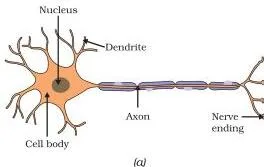
Within a neuron, that information travels as an electrical impulse. Follow the route in Fig. 6.1 (a):
- A change is detected at the dendritic tip, where a chemical reaction sets off an electrical impulse.
- The impulse travels from the dendrite to the cell body and then along the axon to its end.
- At the axon’s end, the impulse triggers the release of chemicals.
- These chemicals cross the gap — the synapse — and start a similar electrical impulse in the dendrite of the next neuron.
- A similar synapse finally delivers the impulse to a muscle cell or a gland, which is the step Fig. 6.1 (b) shows.
The synapse deserves an analogy because it is the one place where the message changes form. Think of a relay race: the impulse is the runner, and at the synapse the baton is handed across as chemicals — electrical in, chemical across the gap, electrical out again (NCERT, p. 101).
The final step is actual movement. When a nerve impulse reaches a muscle, special proteins inside the muscle cells change their shape and arrangement, the cells shorten, and that shortening is the contraction (NCERT, p. 105). Nervous tissue, in short, is a network of neurons specialised to conduct information as electrical impulses.
Reflex Actions: Why Some Responses Bypass Thinking
Some situations are too urgent for thought. Touching a flame is the chapter’s example, and the logic is simple: thinking is a complicated activity built from many impulses from many neurons, and by the time the brain finished, you would be burnt (NCERT, p. 102).
The body’s solution is the reflex arc (Fig. 6.2): connect the input nerve to the output nerve at the first place they meet. That place is the spinal cord, where nerves from all over the body gather on their way to the brain (NCERT, p. 102).
Work a complete example — a hand touching a hot metal plate:
- Heat receptors in the skin of the hand detect the change and fire an impulse.
- A sensory nerve carries the impulse from the hand to the spinal cord.
- In the cord, the sensory neuron connects directly to a motor neuron — that connection is the reflex arc.
- A motor impulse travels back along the nerve to the muscles of the arm.
- The arm muscle contracts and the hand is pulled away — before the brain has finished processing.
- Meanwhile the same sensory input continues to the brain, so you feel the pain and register what happened.
That last point answers the in-text question ‘What is the role of the brain in reflex action?’: the brain is informed and can take stock afterwards, but it does not command the reflex — the spinal cord has already acted (NCERT, p. 103).
Reflex arcs exist, the chapter explains, because thinking networks are not fast enough — many animals have little or no thinking network at all, and even with a complex brain the arc remains the most efficient route for a quick response (NCERT, p. 103).
Walking is the opposite case: it is a voluntary action, decided in the brain and carried out by motor areas commanding the leg muscles — which is why you can choose to stop (NCERT, p. 102).
The Human Brain: Thinking, Balance and Involuntary Control
The spinal cord only handles reflexes; thinking needs the brain, the body’s main coordinating centre. The brain and spinal cord together form the central nervous system, which receives information from all parts of the body and integrates it (NCERT, p. 103).
The peripheral nervous system is the wiring that connects the centre to the rest of the body: cranial nerves arising from the brain and spinal nerves arising from the spinal cord (NCERT, p. 103).
The brain has three regions, and each has a distinct job:
- Fore-brain — the main thinking part, with separate sensory areas for hearing, smell and sight; association areas that interpret new information alongside what is already stored; motor areas that drive voluntary muscles; and a separate hunger centre that signals when you have eaten enough (NCERT, p. 103).
- Mid-brain and hind-brain — control the involuntary actions we never decide, like breathing and digesting food, which go on without our attention (NCERT, p. 104).
- Within the hind-brain sit the medulla and the cerebellum, which run two very different kinds of jobs (NCERT, p. 104).
Two hind-brain names matter most, and students swap them constantly:
- Medulla — controls blood pressure, salivation and vomiting; that is, the involuntary maintenance jobs (NCERT, p. 104).
- Cerebellum — controls the precision of voluntary actions and maintains posture and balance, so you can walk in a straight line, ride a bicycle or pick up a pencil (NCERT, p. 104).
Memory hook: cerebellum pairs with coordination, posture and balance; medulla pairs with the involuntary maintenance jobs — blood pressure, salivation, vomiting — the body runs without asking you.
Both centres are well protected: the brain sits inside a bony box (the skull), contained in a fluid-filled balloon that absorbs shock, and the hard, bumpy structure along the middle of your back — the vertebral column, or backbone — protects the spinal cord (NCERT, p. 105).
Keep the chapter’s three-way classification in mind: the nervous system’s responses are reflex actions, voluntary actions or involuntary actions (NCERT, p. 111).
Coordination in Plants: Immediate Movements and Growth Movements
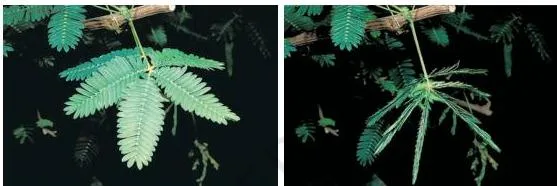
Plants have no nervous tissue and no muscles, yet they respond to their environment. Touch a chhui-mui — the sensitive or touch-me-not plant of the Mimosa family — and its leaves fold up and droop (NCERT, p. 105).
The chapter’s organising idea is that plant movement comes in two kinds, and confusing them is the classic error:
| Type of movement | Example | How it happens | Does growth cause it? |
|---|---|---|---|
| Immediate response to stimulus | Sensitive-plant leaves folding when touched | Cells change shape by changing their water content — swelling or shrinking (NCERT, p. 106) | No — quick and independent of growth |
| Movement due to growth | Tendrils twining; shoots and roots bending | Directional growth, with one side growing faster than the other (NCERT, p. 107) | Yes — stop growth and the movement stops |
The sensitive plant is the harder case to picture. The movement happens away from the point of touch, so information has to be communicated — plants do use electrical-chemical means from cell to cell, but without the specialised conducting tissue animals have (NCERT, p. 106).
Growth movements respond to named stimuli, and the book lists them all (NCERT, p. 107):
- Phototropism — the shoot bends toward light, the root bends away from it.
- Geotropism — roots grow downward, shoots grow upward, in response to gravity (Fig. 6.6 shows both on one seedling).
- Hydrotropism — growth toward water, as the name suggests.
- Chemotropism — growth toward chemicals; the example given is the pollen tube growing toward the ovule.
Notice the scale of speeds the chapter sets out: the sensitive plant folds its leaves in seconds; sunflowers track day and night more slowly; growth movements are slower still (NCERT, p. 107). Fast responses need fast information transfer; slow, steady change is fine for growth.
Plant Hormones: What Makes Shoots Grow, Bend and Stop
Growth movements are coordinated by chemicals — the plant hormones, synthesised at one place and diffusing to the place where they act (NCERT, p. 108).
The key mechanism is auxin. It is synthesised at the shoot tip. When light comes from one side, auxin diffuses toward the shady side, and cells there grow longer — so the shoot bends toward the light (NCERT, p. 108).
The tendril uses the same logic in reverse. When a tendril touches a support, the part in contact grows less rapidly than the free part, so the tendril curves around the support and clings to it (NCERT, p. 106).
| Plant hormone | What it does |
|---|---|
| Auxin | Synthesised at the shoot tip; makes cells grow longer; bends the shoot toward light (NCERT, p. 108) |
| Gibberellins | Help the stem grow (NCERT, p. 108) |
| Cytokinins | Promote cell division; found in greater concentration in fruits and seeds (NCERT, p. 108) |
| Abscisic acid | Inhibits growth; its effects include wilting of leaves (NCERT, p. 108) |
Read the four together and the chapter’s point appears: three of them promote growth, and abscisic acid is the brake. Plants need signals both to grow and to stop growing (NCERT, p. 108).
Animal Hormones: The Endocrine System at Work
Why do animals need chemical signals when nerves are faster? Because nerve impulses reach only cells connected by nervous tissue, and a cell cannot fire again until it resets. A chemical that diffuses can reach every cell in the body and act steadily and persistently (NCERT, p. 107-108).
The chapter sets the scene with a squirrel in danger. It must fight or run — two very different activities, but both need whole-body preparation. Nerve signals alone would reach too few tissues; a chemical signal reaches all of them. That chemical is adrenaline, secreted by the adrenal glands (NCERT, p. 109).
Adrenaline’s effects are the fight-or-flight list the book spells out (NCERT, p. 109):
- The heart beats faster, supplying more oxygen to the muscles.
- Blood to the skin and the digestive system is reduced — the muscles around small arteries in those organs contract — and that blood is diverted to the skeletal muscles.
- The breathing rate rises as the diaphragm and rib muscles work harder.
Together these responses make the body ready to deal with the situation. They are produced by the endocrine system — the second way of control and coordination in the body (NCERT, p. 109).
The chapter then works through the hormones named in Table 6.1:
| Hormone | Gland | Function |
|---|---|---|
| Growth hormone | Pituitary | Stimulates growth in all organs; a deficiency in childhood causes dwarfism (NCERT, p. 110) |
| Thyroxin | Thyroid | Regulates carbohydrate, protein and fat metabolism for balanced growth; needs iodine (NCERT, p. 110) |
| Insulin | Pancreas | Regulates blood sugar; if it is not secreted properly, diabetes results (NCERT, p. 110) |
| Testosterone | Testes | Brings about the changes associated with puberty in males (NCERT, p. 110) |
| Oestrogen | Ovaries | Develops female sex organs and regulates the menstrual cycle (NCERT, p. 110) |
| Adrenaline | Adrenal glands | Prepares the body to fight or flee (NCERT, p. 109) |
| Releasing hormones | Hypothalamus | Stimulate the pituitary to release hormones, such as growth hormone releasing factor (NCERT, p. 110) |
The table’s iodine row is the answer to a question every class asks. Iodine is needed to make thyroxin, so iodised salt is advisable — without iodine, the thyroid cannot work properly and goitre may develop, one visible symptom being a swollen neck (NCERT, p. 110).
Finally, how are hormone levels kept exact? A feedback mechanism regulates the timing and amount of hormone released: when blood sugar rises, cells of the pancreas detect it and produce more insulin, and as the sugar level falls, insulin secretion is cut back (NCERT, p. 110-111).
The hypothalamus plays a related part: when growth hormone is low, it releases a factor that prompts the pituitary to release growth hormone (NCERT, p. 110).
The Four Activities in This Chapter and What They Demonstrate
Each activity is the book asking you to see one concept with your own senses. All four are quick and need only home materials:
- Activity 6.1 (NCERT, p. 101) — taste sugar, then block your nose and taste it again. The taste flattens, which is why food seems bland when you have a cold: smell and taste receptors work together.
- Activity 6.2 (NCERT, p. 107) — germinated bean seeds on a wire mesh over water in a flask, inside a box open on one side to a window. Shoots bend toward the light, roots away from it; turn the flask and only the new growth changes direction. That is directional growth responding to light.
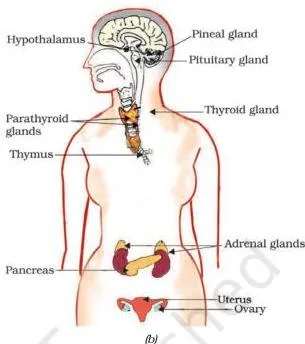
- Activity 6.3 (NCERT, p. 109) — identify the endocrine glands in Fig. 6.7 and match them with Table 6.1, using the library and your teachers for the glands the text does not discuss.
- Activity 6.4 (NCERT, p. 111) — complete Table 6.1 by filling in the hormone, gland or function left blank in each row.
For hydrotropism, a clean design: germinated seeds whose roots can choose between moist soil on one side and dry soil on the other, with light even from all sides so it cannot influence the result. The roots grow toward the moist side, and water is the only directional stimulus — that is hydrotropism (NCERT, p. 108).
Figure Walkthrough: What Each Diagram in This Chapter Shows
The diagrams carry the chapter’s meaning, and reading them is a skill. Here is what each figure shows, in the order it appears in the book.
Figure 6.1 (a) Structure of Neuron, (b) Neuromuscular Junction (NCERT, p. 101)
This is the wiring diagram of the nervous system. Trace the impulse in (a) from the dendritic tip (information in), through the cell body, along the axon (information travels), to the synapse at the end (chemical release). Part (b) shows the point where a neuron meets a muscle cell — the delivery port where the message becomes movement.
The Neuromuscular Junction in Fig. 6.1 (NCERT, p. 101)
This is the second part of Fig. 6.1: the junction between a neuron and a muscle cell. It works like the synapse between two neurons — the impulse releases chemicals, and the muscle cell receives the message and contracts.
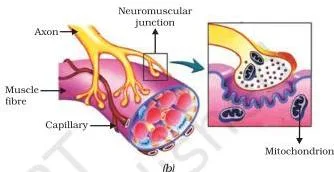
Figure 6.2 Reflex Arc (NCERT, p. 103)
Follow the arrows: a stimulus fires a sensory neuron, which enters the spinal cord; there it connects to a motor neuron; the motor neuron carries the impulse out to the muscle. The brain is not in the loop — it only gets the news afterwards. This diagram is the single best answer to ‘explain a reflex action’.
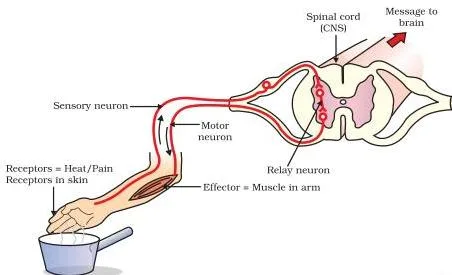
Figure 6.3 Human Brain (NCERT, p. 104)
Locate the three regions. The fore-brain occupies the front and top — thinking, sensory processing, decisions. The mid-brain sits below it, and the hind-brain at the back contains the medulla and the cerebellum. When a question gives you a brain diagram and asks which part does what, read from this map.
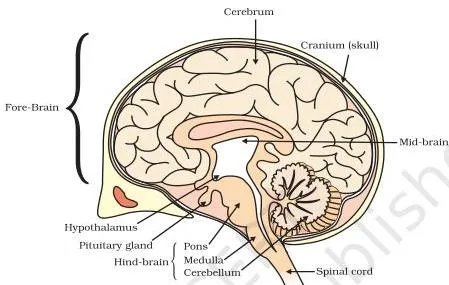
Figure 6.4 The Sensitive Plant (NCERT, p. 106)
The figure shows the result, not the cause: leaves of the chhui-mui folding and drooping after touch. The lesson to attach to this picture is that no growth is involved — the cells lose water, change shape, and the leaf moves.
Controlled Directions of Growth (illustration, NCERT, p. 107)
This unlabelled drawing accompanies the passage that even in animal bodies growth is carefully controlled — arms and fingers grow in set directions, not haphazardly. It is the book’s reminder that controlled movement can be slow, as in growth, or fast, as in nervous responses.
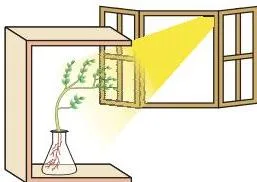
Figure 6.6 Plant Showing Geotropism (NCERT, p. 107)
One seedling, two directions: the root grows downward toward gravity, the shoot grows upward away from it. Contrast this with the phototropism figure — the same shoot would also bend sideways toward light. The chapter is showing that each stimulus pulls growth in its own direction.
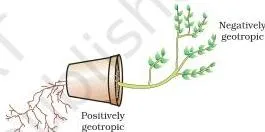
Figure 6.7 Endocrine Glands in Human Beings, Male (NCERT, p. 110)
This is the map for Activity 6.3. Find the pituitary at the base of the brain, the thyroid in the neck, the adrenal glands on the kidneys, the pancreas in the abdomen and the testes — the male sex glands that make testosterone.
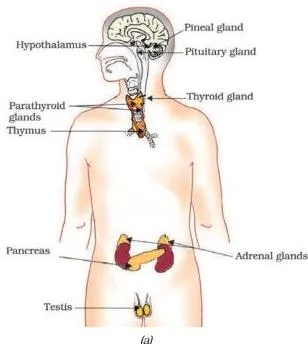
Figure 6.7 Endocrine Glands in Human Beings, Female (NCERT, p. 110)
The same map in the female body: the ovaries replace the testes, producing oestrogen. Every gland named in Table 6.1 can be located on these two diagrams, which is exactly what Activity 6.3 asks you to practise.
Key Terms in Control and Coordination: A Quick Glossary
Every key term the chapter introduces, with a one-line meaning you can say out loud. Page numbers point to where the term is first explained.
| Term | Meaning |
|---|---|
| Receptor | Specialised tip of a nerve cell that detects a change in the environment; usually located in the sense organs (NCERT, p. 101) |
| Gustatory receptor | Receptor that detects taste (NCERT, p. 101) |
| Olfactory receptor | Receptor that detects smell (NCERT, p. 101) |
| Neuron | Nerve cell; the unit of nervous tissue, specialised to conduct information as electrical impulses (NCERT, p. 101) |
| Dendrite | Branched end of a neuron where information is acquired (NCERT, p. 101) |
| Axon | Long extension along which the electrical impulse travels to the neuron’s end (NCERT, p. 101) |
| Synapse | Tiny gap between the axon end of one neuron and the dendrite of the next; chemicals cross it to pass the signal on (NCERT, p. 101) |
| Reflex action | Quick automatic response to a stimulus, done without thinking (NCERT, p. 102) |
| Reflex arc | The direct connection between input and output nerves, made in the spinal cord (NCERT, p. 102) |
| Central nervous system | The brain and the spinal cord together; receives and integrates information from all parts of the body (NCERT, p. 103) |
| Peripheral nervous system | Cranial nerves arising from the brain and spinal nerves arising from the spinal cord (NCERT, p. 103) |
| Fore-brain | The main thinking part: sensory, association and motor areas, plus the hunger centre (NCERT, p. 103) |
| Mid-brain | Brain region that helps control involuntary actions (NCERT, p. 104) |
| Hind-brain | Brain region containing the medulla and the cerebellum (NCERT, p. 104) |
| Cerebellum | Hind-brain part responsible for precision of voluntary actions, posture and balance (NCERT, p. 104) |
| Medulla | Hind-brain part controlling blood pressure, salivation and vomiting (NCERT, p. 104) |
| Hormone | Chemical compound released by cells that diffuses to other cells to transmit information (NCERT, p. 107-108) |
| Auxin | Plant hormone synthesised at the shoot tip; makes cells grow longer and bends the shoot toward light (NCERT, p. 108) |
| Gibberellins | Plant hormones that help the stem grow (NCERT, p. 108) |
| Cytokinins | Plant hormones that promote cell division (NCERT, p. 108) |
| Abscisic acid | Plant hormone that inhibits growth; its effects include wilting of leaves (NCERT, p. 108) |
| Adrenaline | Hormone from the adrenal glands that prepares the body to fight or flee (NCERT, p. 109) |
| Thyroxin | Thyroid hormone regulating metabolism for balanced growth; needs iodine to be made (NCERT, p. 110) |
| Insulin | Pancreatic hormone that regulates blood sugar level (NCERT, p. 110) |
| Feedback mechanism | System that regulates the timing and amount of hormone released, using the body’s own conditions as the signal (NCERT, p. 110-111) |
Common Mistakes Students Make in This Chapter
Six ideas in this chapter are consistently misremembered. Read the table with your book open — each row names the wrong version first and the correct rule second.
| Mistake | Correct rule | How to check your answer |
|---|---|---|
| ‘Reflex actions are controlled by the brain.’ | The reflex arc sits in the spinal cord; the brain is only informed afterwards (NCERT, p. 102-103) | Ask: would the response still happen quickly if the brain were slow? Yes — that is why the cord handles it |
| ‘Plants have a nervous system.’ | Plants use electrical-chemical signals from cell to cell, but have no specialised conducting tissue (NCERT, p. 106) | Check the chapter’s words: ‘no specialised tissue … for the conduction of information’ |
| ‘Auxin makes the shoot bend away from light.’ | Auxin concentrates on the shady side, makes those cells grow longer, so the shoot bends toward light (NCERT, p. 108) | Trace it: light from the right → auxin moves left → left cells lengthen → tip bends right, toward light |
| ‘All plant movement involves growth.’ | The sensitive plant’s response is quick and growth-free (NCERT, p. 105-106) | Compare times: touch-me-not folds in seconds; growth movements take days |
| ‘Involuntary actions and reflex actions are the same.’ | Involuntary actions (heartbeat, digestion) are run by the mid-brain and hind-brain; reflex actions are sudden automatic responses through the spinal cord (NCERT, p. 102, 104) | Name the controller: heart rate = medulla; hand off a hot plate = spinal cord |
| ‘Iodine is a hormone.’ | Iodine is a mineral the thyroid gland needs in order to make thyroxin (NCERT, p. 110) | Remember what each is: iodine is eaten (iodised salt), thyroxin is secreted |
Exam Notes: How to Answer This Chapter’s Questions
The chapter’s own exercises show exactly what NCERT expects you to be able to do. The table below maps each exercise to the concept it tests and the ingredients of a complete answer (NCERT, p. 112).
| Exercise | Concept tested | A complete answer includes |
|---|---|---|
| 1 | Plant hormones | Selecting cytokinin from insulin, thyroxin and oestrogen (NCERT, p. 108) |
| 2 | Neuron structure | Identifying the synapse as the gap between two neurons, not dendrite, axon or impulse (NCERT, p. 101) |
| 3 | Brain functions | Recognising that thinking, heartbeat regulation and balance are all brain responsibilities (NCERT, p. 103-104) |
| 4 | Receptor function | Explaining that receptors detect environmental changes and start impulses; if they fail, the sensation is lost — a blocked nose dulling taste is the chapter’s own example (NCERT, p. 101) |
| 5 | Neuron structure and function | A labelled diagram (dendrite, cell body, axon, synapse) plus the route impulses take along it (NCERT, p. 101) |
| 6 | Phototropism | The auxin mechanism: synthesis at the tip, diffusion to the shady side, longer cells there, shoot bending toward light (NCERT, p. 108) |
| 7 | Spinal cord injury | Understanding that both sensory signals to the brain and motor commands from it are disrupted, since both travel through the cord (NCERT, p. 102-103) |
| 8 | Chemical coordination in plants | Plant hormones made away from where they act, diffusing to their target (NCERT, p. 108) |
| 9 | Need for control and coordination | Controlled movement — the right response to the right event — needs systems to sense and respond (NCERT, p. 99) |
| 10 | Involuntary vs reflex actions | Naming the controller in each: medulla for involuntary, spinal cord for reflex (NCERT, p. 102, 104) |
| 11 | Nervous vs hormonal coordination | The comparison table below — medium, speed, range and duration (NCERT, p. 107-108) |
| 12 | Sensitive plant vs leg movement | Plant: cell water-content change, no growth, no muscles. Leg: muscle proteins shorten on an impulse (NCERT, p. 105-106) |
Two of these exercises deserve a prepared skeleton. For Exercise 5 (draw a neuron), draw and label dendrite, cell body, axon and synapse, then state the function in one sentence: the neuron conducts information as electrical impulses, from the receptor end toward the central nervous system and from it to muscles or glands (NCERT, p. 101).
For Exercise 11 (compare nervous and hormonal coordination), a complete answer names four differences — medium, speed, reach and duration — which is exactly what the table below does:
| Feature | Nervous coordination | Hormonal coordination |
|---|---|---|
| Medium | Electrical impulses along nerve cells | Chemical messengers (hormones) carried in the blood |
| Speed | Very fast | Slower |
| Reach | Only cells connected by nervous tissue | Can reach all cells, as the chemical diffuses |
| Duration | Short; the cell must reset before firing again | Steady and can persist |
| Example from the chapter | Pulling the hand back from a flame | Adrenaline preparing the whole body to fight or flee |
One syllabus note: textbook contents and the examinable syllabus are not always identical. Check the current official CBSE syllabus on cbse.gov.in to see exactly what is examinable this session, then use the mapping table above to revise section by section.
Revision Summary: What You Should Remember
This is the chapter’s own closing list, reworded for a last skim. If you remember nothing else, remember these seven lines (NCERT, p. 111):
- Control and coordination are the functions of the nervous system and hormones.
- Nervous responses are of three kinds — reflex, voluntary and involuntary.
- The nervous system transmits messages as electrical impulses.
- Information comes in from the sense organs; actions are carried out through muscles.
- Chemical coordination exists in both plants and animals.
- A hormone produced in one part of the body acts at another part, away from where it was made.
- Feedback mechanisms regulate the amount and timing of hormone release.
Related Resources
This listing is maintained for the 2026-27 academic session using the NCERT textbook information available to us. NCERT remains the authority for confirming the latest edition.
Continue your revision with the surrounding chapters. The chapter before this one, Life Processes Class 10 notes, explains how organisms stay alive; the chapter after it, How do Organisms Reproduce? Class 10 notes, explains how they continue their kind.
For everything else in the book, use the Class 10 Science notes, the Class 10 hub or the main CBSE notes index.
Reference: NCERT Class 10 Science textbook, chapter 6, official edition on ncert.nic.in.
Sources and Data Verification
This page describes Chapter 6 of the NCERT Class 10 Science textbook — the official edition hosted on ncert.nic.in, and the only book this page covers. Figure numbers, page numbers, section headings and question texts all come from that file.
NCERT settles the textbook, its editions and the official PDFs; CBSE settles the curriculum, syllabus and examinations. This page does not claim any review beyond its official NCERT source.
Frequently Asked Questions
What is the difference between a reflex action and walking?
A reflex action is a sudden automatic response handled by the spinal cord before the brain acts, such as pulling your hand off a hot plate. Walking is a voluntary action: you decide to do it, and the thinking part of the brain, the fore-brain, sends the commands (NCERT, p. 102-104).
What happens at the synapse between two neurons?
The synapse is the tiny gap between the end of one neuron and the next. Chemicals released at the end of the first neuron’s axon cross this gap and start a fresh electrical impulse in the dendrite of the next neuron — the signal changes form, but the message continues (NCERT, p. 101).
How does phototropism occur in plants?
Auxin, made at the shoot tip, moves to the shady side when light comes from one side. Cells on that side grow longer, so the shoot bends toward the light (NCERT, p. 108).
Why is the use of iodised salt advisable?
Because the thyroid gland needs iodine to make thyroxin. Thyroxin regulates carbohydrate, protein and fat metabolism; if iodine is missing, thyroxin cannot be produced properly and goitre may develop — its visible sign is a swollen neck (NCERT, p. 110).
How are involuntary actions different from reflex actions?
Involuntary actions such as heartbeat, breathing and salivation are controlled by the mid-brain and hind-brain and continue without you deciding them. Reflex actions are sudden, specific automatic responses to a stimulus, coordinated in the spinal cord through a reflex arc (NCERT, p. 102, 104).
Compare nervous and hormonal coordination in animals.
Nervous coordination uses electrical impulses along nerve cells: it is very fast and precise, but reaches only cells connected by nervous tissue. Hormonal coordination uses chemicals carried in the blood: it is slower, but can reach all cells and act steadily (NCERT, p. 107-108). The comparison table in the exam notes section lays out the same point in five rows.
Explore Class 10 Science Books
Class 10 Science on LearnCBSE:
Related chapters:
- Chemical Reactions and Equations
- Acids, Bases and Salts
- Metals and Non-metals