This page carries the official Acids, Bases and Salts Class 10 chapter — Chapter 2 of the NCERT Science textbook, in the current NCERT edition. The chapter runs about 20 printed pages, and the official PDF from NCERT is right below. Under the download you will find a section-by-section guide to what the chapter teaches, with its reactions and figures explained.
Use the links to jump straight to any part: the chapter map, the key concepts table, the figures, or the common mistakes you should avoid.
Download the Acids, Bases and Salts Class 10 PDF
The official file is published by NCERT and hosted on ncert.nic.in. Acids, Bases and Salts Class 10 PDF is the complete chapter exactly as printed — text, activities, figures and exercises.
This is the current official NCERT edition. For the other chapters in the same book, keep the NCERT Class 10 Science book page handy.
| What the chapter holds | Count | Where it is used |
|---|---|---|
| Printed pages | 20 | |
| Sections in the chapter | 16 | |
| Figures with NCERT captions | 12 | |
| Tables | 4 | |
| Exercise questions | 15 | answered in our NCERT Solutions |
| In-text questions | 18 | |
| Activities | 15 | |
| Official NCERT PDF | Download the chapter PDF | the chapter exactly as NCERT publishes it |

Reference: NCERT Class 10 Science textbook, chapter 2, official edition on ncert.nic.in.
Chapter 2 at a glance
Here is what sits inside the chapter file:
| What the chapter holds | Count |
|---|---|
| Printed pages | 20 |
| Major sections | 16 |
| Activities | 15 |
| Figures | 12 |
| Tables | 4 |
| Equations | 24 |
| Exercise questions | 15 |
| In-text questions | 18 |
The chapter is a chain: it opens with what acids and bases do (Section 2.1), moves to why they behave that way (Section 2.2), then to how strong they are (Section 2.3), and closes with the salts they form (Section 2.4).
What this chapter covers, section by section
This chapter teaches through reactions and activities rather than through solved examples. Read each section below as a map: the topics it names are the ideas the book wants you to carry forward.
2.1 The reactions of acids and bases (pages 18-22)
Acids and bases are defined here by what they do. So Section 2.1 is a set of reaction families, each with its own observation and gas test.
- Indicators: litmus (a natural dye from lichen), turmeric, methyl orange and phenolphthalein change colour in acids or bases. Olfactory indicators — onion, vanilla and clove — change smell instead (NCERT, pp. 18-19).
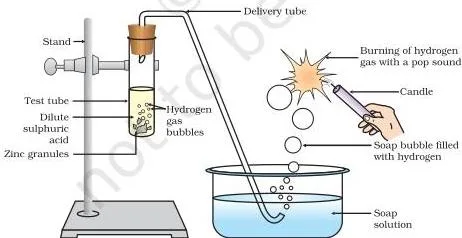
- Acid + metal → salt + hydrogen gas: the metal displaces hydrogen atoms from the acid. Test the gas by passing it through soap solution and holding a burning candle to a bubble — it burns with a pop (Fig. 2.1, NCERT, pp. 19-20).
- Base + metal: not all metals react, but zinc does: \( 2\mathrm{NaOH(aq)} + \mathrm{Zn(s)} \rightarrow \mathrm{Na_2ZnO_2(s)} + \mathrm{H_2(g)} \). The salt is sodium zincate (NCERT, p. 20).
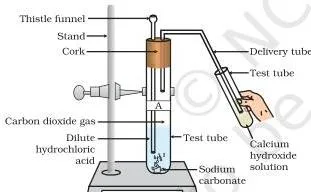
- Metal carbonate / hydrogencarbonate + acid → salt + carbon dioxide + water (NCERT, pp. 20-21). The chapter works out sodium carbonate and sodium hydrogencarbonate with HCl. Here is the same family with a pair the book does not balance for you — chalk, limestone and marble are all \( \mathrm{CaCO_3} \):
\[ \mathrm{CaCO_3(s)} + 2\mathrm{HCl(aq)} \rightarrow \mathrm{CaCl_2(aq)} + \mathrm{H_2O(l)} + \mathrm{CO_2(g)} \]
- Test the gas with lime water: it turns milky because \( \mathrm{Ca(OH)_2(aq)} + \mathrm{CO_2(g)} \rightarrow \mathrm{CaCO_3(s)} + \mathrm{H_2O(l)} \). With excess \( \mathrm{CO_2} \), the milkiness clears — \( \mathrm{CaCO_3} \) becomes soluble \( \mathrm{Ca(HCO_3)_2} \) (NCERT, pp. 20-21).
- Neutralisation: \( \mathrm{NaOH(aq)} + \mathrm{HCl(aq)} \rightarrow \mathrm{NaCl(aq)} + \mathrm{H_2O(l)} \). General form: Base + Acid → Salt + Water (NCERT, p. 21).
- Metal oxides are basic: copper oxide dissolves in HCl to give a blue-green \( \mathrm{CuCl_2} \) solution; metal oxide + acid → salt + water (NCERT, p. 21).
- Non-metal oxides are acidic: the same \( \mathrm{CO_2} + \mathrm{Ca(OH)_2} \) reaction shows a non-metal oxide behaving like an acid (NCERT, p. 22).
Two gas tests are worth memorising exactly: hydrogen pops with a burning candle; carbon dioxide turns lime water milky. If balancing equations feels shaky, the chemical reactions and equations notes rebuild that skill step by step.
2.2 What all acids and bases have in common (pages 22-24)
The whole chapter turns on one idea: an acid’s behaviour comes from hydrogen ions, and those ions form only in water.
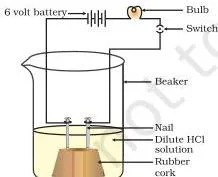
- Acids conduct electricity in water because ions carry the current; glucose and alcohol solutions do not conduct, even though they contain hydrogen (Activity 2.8, Fig. 2.3, NCERT, p. 22).
- What happens in water: \( \mathrm{HCl} + \mathrm{H_2O} \rightarrow \mathrm{H_3O^+} + \mathrm{Cl^-} \). Hydrogen ions cannot exist alone, so always write \( \mathrm{H^+(aq)} \) or \( \mathrm{H_3O^+} \) (NCERT, p. 23).
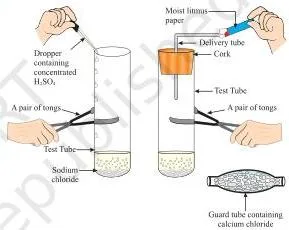
- Dry HCl gas does not change dry litmus — only HCl in solution does. Water is required for acidic behaviour (Activity 2.9, Fig. 2.4, NCERT, p. 23).
- Bases give hydroxide ions in water: \( \mathrm{NaOH(s)} \xrightarrow{\mathrm{H_2O}} \mathrm{Na^+(aq)} + \mathrm{OH^-(aq)} \), with KOH and \( \mathrm{Mg(OH)_2} \) as the parallel examples (NCERT, pp. 23-24).
- Alkali = a base that dissolves in water (NCERT, p. 24).
- Neutralisation in ionic form: \( \mathrm{H^+(aq)} + \mathrm{OH^-(aq)} \rightarrow \mathrm{H_2O(l)} \) (NCERT, p. 24).
- Dilution is highly exothermic. Add acid to water slowly with constant stirring — never water to acid (Activity 2.10, Fig. 2.5, NCERT, p. 24).
2.3 How strong are acid or base solutions (pages 25-28)
Indicators tell you whether something is acidic or basic. This section tells you how much.
- Universal indicator is a mixture of indicators; it gives different colours at different hydrogen-ion concentrations (NCERT, p. 25).
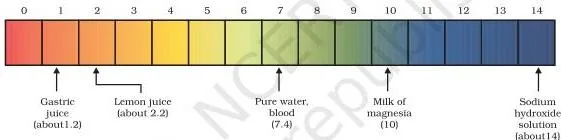
- pH scale: 0 to 14; 7 is neutral, below 7 acidic, above 7 basic. The rule to hold: the higher the hydronium-ion concentration, the lower the pH (Fig. 2.6, NCERT, p. 25).
- Strong vs weak acids: HCl and acetic acid at the same (say 1 M) concentration release different amounts of \( \mathrm{H^+} \) — more \( \mathrm{H^+} \) means a stronger acid (NCERT, p. 26).
- Everyday pH: saliva, lemon juice, coffee and the rest are mapped on pH paper in Fig. 2.7 (NCERT, p. 26).
- Life and pH: the body works within pH 7.0-7.8; rain below pH 5.6 is acid rain and harms aquatic life (NCERT, pp. 26-27).
- Soil pH: plants need a specific pH range for healthy growth — Activity 2.12 shows how to test soil with universal indicator paper (NCERT, p. 27).
- Digestion: the stomach makes HCl; during indigestion the excess acid is soothed by antacids — magnesium hydroxide (milk of magnesia) is a mild base used for this (NCERT, p. 27).
- Tooth decay starts when mouth pH falls below 5.5; enamel (calcium hydroxyapatite) is corroded by the acid, and basic toothpastes neutralise it (NCERT, p. 27).
- Stings: bee stings leave an acid — baking soda gives relief; nettle hair injects methanoic acid (NCERT, pp. 27-28).
- Naturally occurring acids (Table 2.3): acetic (vinegar), citric (orange, lemon), tartaric (tamarind), oxalic (tomato), lactic (sour milk/curd), methanoic (ant and nettle stings) (NCERT, p. 28).
Learning to read pH values is the skill this section is building. Here is a worked classification using five solutions and their pH:
| Solution | pH | Classification |
|---|---|---|
| X1 | 2 | Strongly acidic |
| X2 | 5 | Weakly acidic |
| X3 | 7 | Neutral |
| X4 | 9 | Weakly basic |
| X5 | 13 | Strongly alkaline |
Ranked from most acidic to most alkaline, they run X1 (2), X2 (5), X3 (7), X4 (9), X5 (13). Hydrogen-ion concentration runs the reverse order: X1 has the most \( \mathrm{H^+(aq)} \), X5 the least. That is exactly the reasoning exercise Q9 asks for.
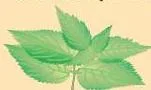
The nettle image belongs with Table 2.3: its stinging hair injects methanoic acid, and the book notes that a dock plant leaf is a traditional remedy because it can neutralise the acid (NCERT, p. 28).
2.4 More about salts (pages 28-33)
Every reaction so far has made a salt. This section studies the salts themselves — their families, their pH, and the everyday chemicals built from common salt.
- Salt families: salts sharing the same positive or negative radical belong to one family — NaCl and \( \mathrm{Na_2SO_4} \) are sodium salts; NaCl and KCl are chloride salts (Activity 2.13, NCERT, p. 28).
- The salt-pH rule: strong acid + strong base → neutral salt (pH 7); strong acid + weak base → acidic salt (pH below 7); strong base + weak acid → basic salt (pH above 7) (Activity 2.14, NCERT, p. 29).
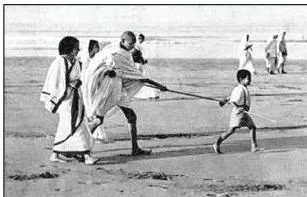
- Sources of common salt: sea water and rock salt — beds of rock salt were formed when ancient seas dried up, and it is mined like coal. The Dandi March made sodium chloride a symbol in India’s freedom struggle (NCERT, p. 29).
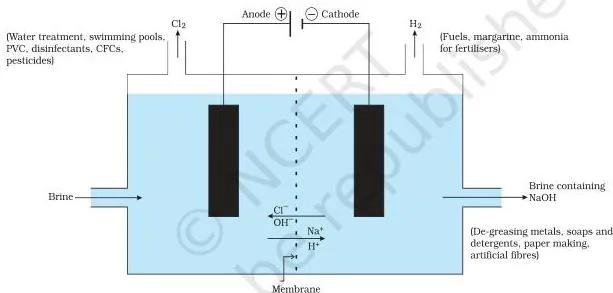
- Chlor-alkali process: electricity through brine (aqueous NaCl) gives \( 2\mathrm{NaCl(aq)} + 2\mathrm{H_2O(l)} \rightarrow 2\mathrm{NaOH(aq)} + \mathrm{Cl_2(g)} + \mathrm{H_2(g)} \) — all three products are useful (Fig. 2.8, NCERT, p. 30).
- Bleaching powder \( \mathrm{Ca(ClO)_2} \): chlorine on dry slaked lime. Used for bleaching cotton, linen, wood pulp and washed clothes; as an oxidising agent in industry; and to make drinking water free from germs (NCERT, pp. 30-31).
- Baking soda \( \mathrm{NaHCO_3} \): heated during cooking it gives \( 2\mathrm{NaHCO_3} \xrightarrow{\text{heat}} \mathrm{Na_2CO_3} + \mathrm{H_2O} + \mathrm{CO_2} \). It is the raising agent in baking powder (with tartaric acid), an antacid ingredient, and the carbonate in soda-acid fire extinguishers (NCERT, p. 31).
- Washing soda \( \mathrm{Na_2CO_3 \cdot 10H_2O} \): recrystallisation of sodium carbonate. Used in glass, soap and paper industries, in making borax, as a domestic cleaning agent, and to remove permanent hardness of water (NCERT, pp. 31-32).
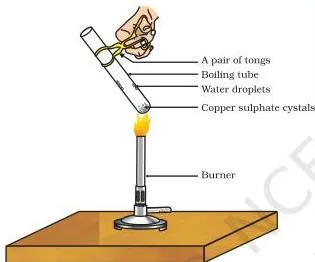
- Water of crystallisation: the fixed number of water molecules in one formula unit of a salt — \( \mathrm{CuSO_4 \cdot 5H_2O} \) is blue, and turns white when heated (Activity 2.15, Fig. 2.9, NCERT, p. 32).
- Plaster of Paris: gypsum (\( \mathrm{CaSO_4 \cdot 2H_2O} \)) heated at 373 K gives \( \mathrm{CaSO_4 \cdot \tfrac{1}{2}H_2O} \). It sets hard because it re-forms gypsum with water: \( \mathrm{CaSO_4 \cdot \tfrac{1}{2}H_2O} + 1\tfrac{1}{2}\mathrm{H_2O} \rightarrow \mathrm{CaSO_4 \cdot 2H_2O} \) (NCERT, pp. 32-33).
The chapter keeps returning to the same four chemicals from common salt. Keep them side by side in one table:
| Chemical | Formula | How the chapter makes it | Uses |
|---|---|---|---|
| Sodium hydroxide | \( \mathrm{NaOH} \) | Chlor-alkali process on brine (p. 30) | One of the three useful products of the process; Fig. 2.8 shows its uses (p. 30) |
| Bleaching powder | \( \mathrm{Ca(ClO)_2} \) | Chlorine gas on dry slaked lime (p. 30) | Bleaching cotton, linen, wood pulp and clothes; oxidising agent; making drinking water germ-free (p. 31) |
| Baking soda | \( \mathrm{NaHCO_3} \) | From sodium chloride, water, carbon dioxide and ammonia (p. 31) | Baking powder with tartaric acid; antacid; soda-acid fire extinguishers (p. 31) |
| Washing soda | \( \mathrm{Na_2CO_3 \cdot 10H_2O} \) | Recrystallisation of sodium carbonate obtained by heating baking soda (p. 31) | Glass, soap, paper industries; making borax; cleaning; removing permanent hardness of water (p. 32) |
The book prints this image in the common-salt section to make the point that sodium chloride was not just food — it was an important symbol in the freedom struggle (NCERT, p. 29).
For the fuller picture of why metals give these reactions, the metals and non-metals notes cover the metal side of these equations.
Key concepts in this chapter
Use this table when you need one concept quickly instead of the whole chapter. Each row connects the idea to its plain meaning and the page where the book develops it.
| Concept | What it means in this chapter | NCERT page |
|---|---|---|
| Indicator | A substance that changes colour (litmus, turmeric, methyl orange, phenolphthalein) or smell (onion, vanilla, clove) to show acid or base | pp. 18-19 |
| Neutralisation reaction | Acid and base react to give salt and water; the ionic core is \( \mathrm{H^+} + \mathrm{OH^-} \rightarrow \mathrm{H_2O} \) | p. 21 |
| Hydronium ion | \( \mathrm{H_3O^+} \) — a hydrogen ion joined to one water molecule; the form in which \( \mathrm{H^+} \) always exists in water | p. 23 |
| Alkali | A base that dissolves in water; not every base is an alkali | p. 24 |
| pH scale | A 0-14 scale measuring hydrogen-ion concentration; 7 neutral, below 7 acidic, above 7 basic | p. 25 |
| Strong and weak acids | Compared at the same concentration, a strong acid releases more \( \mathrm{H^+} \) ions than a weak one | p. 26 |
| Salt families and the salt-pH rule | Salts grouped by a shared radical; the acid and base that form a salt decide whether its solution is acidic, basic or neutral | pp. 28-29 |
| Chlor-alkali process | Electrolysis of brine giving sodium hydroxide, chlorine and hydrogen — all useful | p. 30 |
| Water of crystallisation | The fixed number of water molecules packed into one formula unit of a salt, such as the five in \( \mathrm{CuSO_4 \cdot 5H_2O} \) | p. 32 |
Figures in this chapter, explained
The figures in this chapter are experiments, not decoration — each one is evidence for a claim the text makes.
Zinc granules sit in dilute sulphuric acid; the gas evolved bubbles into soap solution, and a burning candle held to a bubble gives a pop. The pop is the proof that the gas is hydrogen, and the reaction family is acid + metal → salt + hydrogen (NCERT, p. 19).
Carbon dioxide from the acid-carbonate reaction is passed through lime water, and the lime water turns milky. The milkiness is insoluble \( \mathrm{CaCO_3} \) — this is the test for carbon dioxide, and the reason non-metal oxides count as acidic (NCERT, p. 20).
Two nails dip into dilute HCl and connect through a bulb; the bulb glows because the solution carries current by ions. Glucose and alcohol solutions give no glow — they hold hydrogen but no ions — which is how the chapter separates acids from other hydrogen compounds (NCERT, p. 22).
Concentrated sulphuric acid acts on solid NaCl to generate HCl gas, which is tested with dry and then wet blue litmus. Only the wet litmus changes colour — the experiment that proves hydrogen ions form only in water (NCERT, p. 23).
The scale runs 0 to 14. At low pH the \( \mathrm{H_3O^+} \) concentration is high; at high pH the \( \mathrm{OH^-} \) concentration is high. Once you hold that picture, every pH question is the same reasoning: lower pH, more hydrogen ions (NCERT, p. 25).
Everyday substances — saliva, lemon juice, aerated drinks, coffee — are placed on pH paper. The point is practical: pH is not abstract, and the colours are only a rough guide to the value (NCERT, p. 26).
Brine splits into sodium hydroxide, chlorine and hydrogen. The figure shows how each product branches into everyday uses — chlorine, for instance, later becomes bleaching powder. This single process is the factory behind most of Section 2.4 (NCERT, p. 30).
Blue \( \mathrm{CuSO_4 \cdot 5H_2O} \) crystals are heated; water droplets appear in the tube and the salt turns white. Adding a few drops of water restores the blue. This is the activity that defines water of crystallisation (NCERT, p. 32).
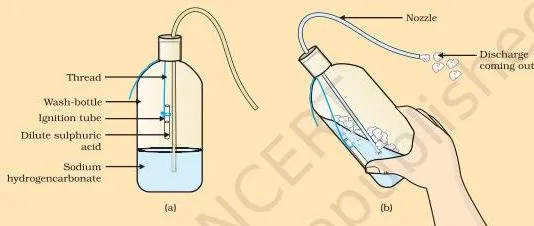
This is the soda-acid fire extinguisher. Tilting the bottle mixes the acid with sodium hydrogencarbonate solution; the carbon dioxide produced builds pressure and drives the discharge out of the nozzle, directed at the fire (NCERT, p. 36).
Definitions to note from this chapter
These are the terms the chapter defines, in the order it reaches them, restated in plain words so you can repeat them correctly.
- Indicator — a substance that changes colour to show whether a solution is acidic or basic; litmus, turmeric, methyl orange and phenolphthalein are examples (NCERT, p. 18).
- Olfactory indicator — a substance whose smell changes in acid or base; onion, vanilla and clove work this way (NCERT, p. 19).
- Neutralisation reaction — the reaction of an acid with a base to give a salt and water (NCERT, p. 21).
- Hydronium ion — a hydrogen ion combined with one water molecule, \( \mathrm{H_3O^+} \); the form in which \( \mathrm{H^+} \) must always be written in water (NCERT, p. 23).
- Alkali — a base that dissolves in water (NCERT, p. 24).
- pH — a number from 0 to 14 that measures the hydrogen-ion concentration of a solution; 7 is neutral (NCERT, p. 25).
- Strong acid / weak acid — at the same concentration, a strong acid produces many \( \mathrm{H^+} \) ions and a weak acid produces few (NCERT, p. 26).
- Water of crystallisation — the fixed number of water molecules present in one formula unit of a salt (NCERT, p. 32).
Common mistakes students make with this chapter
Most confusion in this chapter is settled by the book itself. The table names the slips, the correction, and a way to check your own answer.
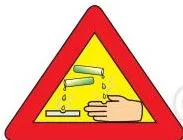
This warning sign is printed on cans of concentrated sulphuric acid and bottles of sodium hydroxide pellets. The book shows it here because the sign is the physical reason behind the dilution rule — the heat of mixing can splash and burn (NCERT, p. 24).
| Mistake | Correct rule | How to check your answer |
|---|---|---|
| Treating dry HCl gas as an acid | H+ ions form only in water; dry HCl gas does not change dry litmus (NCERT, p. 23; exercise Q8) | Ask: is water present? If not, there is no \( \mathrm{H^+} \) and no acidic behaviour. |
| Pouring water into concentrated acid to dilute it | Add the acid slowly to water with constant stirring; the reverse can splash and burn (NCERT, p. 24) | Recite the warning: acid into water, never water into acid. |
| Calling every base an alkali | An alkali is a base that dissolves in water; \( \mathrm{Mg(OH)_2} \) is a base, not an alkali (NCERT, p. 24) | Check solubility first — insoluble bases are not alkalis. |
| Writing \( \mathrm{H^+} \) alone in equations | Hydrogen ions cannot exist alone; write \( \mathrm{H^+(aq)} \) or \( \mathrm{H_3O^+} \) (NCERT, p. 23) | Scan every equation: any bare \( \mathrm{H^+} \) without \( \mathrm{(aq)} \) or water is wrong. |
| Thinking any compound containing hydrogen is an acid | Glucose and alcohol contain hydrogen but release no \( \mathrm{H^+} \) in water, so they are not acids (NCERT, p. 22; exercise Q6) | Ask: does it ionise in water to give \( \mathrm{H^+(aq)} \)? |
| Calling blue copper sulphate crystals dry | The blue colour is water of crystallisation — \( \mathrm{CuSO_4 \cdot 5H_2O} \) (NCERT, p. 32) | Heat a crystal: blue → white with water droplets proves the hidden water. |
| Being puzzled by the “half” water molecule in \( \mathrm{CaSO_4 \cdot \tfrac{1}{2}H_2O} \) | Two formula units of \( \mathrm{CaSO_4} \) share one water molecule, so each is written with half (NCERT, pp. 32-33) | If it helps, rewrite POP as \( 2\mathrm{CaSO_4 \cdot H_2O} \) and count atoms. |
| Thinking basic solutions contain no \( \mathrm{H^+} \) | They do contain \( \mathrm{H^+(aq)} \); a solution is basic when \( \mathrm{OH^-} \) outnumbers \( \mathrm{H^+} \) (NCERT, p. 28) | Remember the chapter’s own question: basic solutions have both ions, but the balance decides the pH. |
Close with the pH shorthand the whole chapter runs on: below 7 acidic, above 7 basic, and a low pH means a lot of hydrogen ions. Low pH, high H⁺ — hold that one sentence and half the pH questions answer themselves.
How this chapter is usually tested
The questions in this chapter repeat a small set of reasoning patterns. Here is which pattern each exercise question uses, so you revise the logic instead of the words.
| Exercise question | What it tests |
|---|---|
| Q1 | Red litmus turning blue shows a basic solution; the only pH above 7 is (d) 10 (p. 25) |
| Q2 | Acid + carbonate gives \( \mathrm{CO_2} \) that turns lime water milky; egg-shells are carbonate, so the solution is (b) HCl (p. 20) |
| Q3 | Neutralisation consumes acid and base in a fixed ratio: 10 mL NaOH needs 8 mL HCl, so 20 mL needs (d) 16 mL (p. 21) |
| Q4 | Antacid is the medicine for indigestion — it neutralises excess stomach acid (p. 27) |
| Q5 | Metal + acid → salt + hydrogen, as word equations and balanced equations (pp. 19-20) |
| Q6 | An activity proving glucose and alcohol are not acids — the Activity 2.8 conductivity setup (p. 22) |
| Q7 | Conduction needs ions: distilled water has none to carry current; rain water does (p. 22) |
| Q8 | Dry HCl gas has no \( \mathrm{H^+} \) without water, so no acidic behaviour (p. 23) |
| Q9 | pH classification and ordering by hydrogen-ion concentration — the inverse relation (p. 25) |
| Q10 | Strong vs weak acid at equal concentration: HCl releases more \( \mathrm{H^+} \) than acetic acid, so fizzing is more vigorous (p. 26) |
| Q11 | Milk turning to curd forms lactic acid, so pH falls below 6 (p. 28) |
| Q12 | Baking soda is a mild basic salt that shifts pH from 6 to slightly alkaline; it also neutralises the lactic acid as it forms, so curdling is delayed (p. 31) |
| Q13 | Plaster of Paris reacts with water and sets hard, so moisture in storage spoils it (p. 33) |
| Q14 | Neutralisation definition, acid + base → salt + water, with two examples (p. 21) |
| Q15 | Uses of washing soda and baking soda (pp. 31-32) |
A full-marks answer in this chapter does three things:
- Names the test and the observation — hydrogen “pops with a burning candle”, carbon dioxide “turns lime water milky”, never just “a gas is given off”.
- Balances every equation and states the physical state where the question asks for it.
- Quotes the pH relation when ordering solutions — lower pH means higher hydrogen-ion concentration.
One style point worth noticing: several exercises ask you to reason from an activity rather than recall a fact. Q6 asks you to describe an activity that proves glucose and alcohol are not acids; Q10 compares two acids used in one experiment.
The chapter teaches through activities rather than solved examples, so “doing” each activity in your head is the most direct revision there is.
Textbook contents and the examinable syllabus are not always identical — check the current official syllabus before you decide what to revise.
What you have learnt: the chapter’s takeaway list
The chapter closes with its own summary, and here it is as a checklist you can tick from memory.
- Acid-base indicators are dyes or mixtures of dyes that signal the presence of acids and bases.
- Acidic nature comes from \( \mathrm{H^+(aq)} \) ions; basic nature comes from \( \mathrm{OH^-(aq)} \) ions.
- Acid + metal gives salt + hydrogen gas.
- Base + metal gives salt + hydrogen gas, and the salt’s negative ion is made of metal and oxygen — sodium zincate is the example.
- Metal carbonate or hydrogencarbonate + acid gives salt + carbon dioxide + water.
- Acid and base solutions conduct electricity because they produce hydrogen and hydroxide ions.
- The pH scale runs 0 to 14: below 7 acidic, 7 neutral, above 7 basic.
- Living organisms survive only within a narrow, optimal pH range.
- Mixing concentrated acids or bases with water is highly exothermic.
- Acids and bases neutralise each other to give salts and water.
- Water of crystallisation is a fixed number of water molecules per formula unit of a salt.
- Salts have many everyday and industrial uses.
When you have ticked the list, the Class 10 Science notes page gathers chapter-wise revision notes, the Class 10 notes hub links every subject, and the main notes index has everything by class.
Related chapters in the Class 10 Science book
These links take you to the rest of the book and its surrounding pages, so you can move on without another search.
- NCERT Class 10 Science book page — every chapter of this book.
- NCERT Class 10 book page — all subjects for Class 10.
- NCERT Class 10 Science Chapter 1 (previous chapter)
- NCERT Class 10 Science Chapter 3 (next chapter)
Sources and data verification
- The page numbers, figures and reactions on this page describe the NCERT Class 10 Science textbook, Chapter 2 “Acids, Bases and Salts”, current official NCERT edition (reprint 2026-27), hosted on ncert.nic.in.
- This page describes the NCERT textbook chapter and its contents. It is not the CBSE syllabus — textbook contents and the examinable syllabus are not always identical, so check the current official syllabus.
- This page is maintained for the current academic session using the NCERT edition named above.
- NCERT settles textbook editions and official PDFs; CBSE settles curriculum, syllabus and examinations.
Reference: NCERT Class 10 Science textbook, chapter 2, official edition on ncert.nic.in.
Frequently asked questions about this chapter
Why does dry HCl gas not turn blue litmus red, while HCl solution does?
Hydrogen ions form only in water. Dry HCl gas contains HCl molecules but no \( \mathrm{H^+} \) ions, and a bare hydrogen ion cannot exist alone — it always appears as \( \mathrm{H^+(aq)} \) or \( \mathrm{H_3O^+} \) (NCERT, p. 23). So dry gas leaves dry litmus unchanged, and the solution turns it red.
While diluting an acid, why must the acid be added to water and not water to acid?
Dissolving an acid in water is highly exothermic. If water is added to concentrated acid, the heat generated can make the mixture splash out and cause burns, and the glass may break from local heating (NCERT, p. 24). Adding the acid slowly to water with constant stirring keeps the heat under control.
How do I tell an acidic solution from a basic one using the pH scale?
Below 7 is acidic, 7 is neutral, above 7 is basic. The lower the pH, the higher the hydrogen-ion concentration (NCERT, p. 25). So pH 2 is strongly acidic, pH 9 is weakly basic, and pH 13 is strongly alkaline.
Why is baking soda used in soda-acid fire extinguishers?
Sodium hydrogencarbonate reacts with the acid from the ignition tube to produce carbon dioxide gas. The gas builds pressure and drives the discharge out of the nozzle toward the fire (NCERT, pp. 31, 36). The chapter builds this exact device in its closing activity (Fig. 2.10).
Which useful chemicals are made from common salt in this chapter?
Sodium hydroxide, chlorine and hydrogen come directly from the chlor-alkali process on brine; chlorine then gives bleaching powder; and sodium chloride is a raw material for baking soda and washing soda as well (NCERT, pp. 30-32).
Where can I download the official NCERT Class 10 Science Chapter 2 PDF?
The download block at the top of this page links to the official chapter file on ncert.nic.in — the same text, figures and exercises as the printed book.
Explore Class 10 Science Books
- Previous: Chemical Reactions and Equations
- Next: Metals and Non-metals
Class 10 Science on LearnCBSE:
Related chapters: