This page gives you the metals and non-metals class 10 chapter — Chapter 3 of the NCERT Class 10 Science textbook, a 21-page chapter that begins on printed page 36 of the official edition.
The official NCERT PDF is here for download, and beneath it lies a full map of the chapter: every section and key concept, what the figures actually show, the definitions, and the mistakes students make, each with its NCERT page reference.
Download the Metals and Non-metals Class 10 NCERT chapter PDF
The file at the link is the chapter exactly as NCERT typesets it, published on NCERT’s own website, so the figures, activities, page numbers and questions you see here all match the printed book.
Open the metals and non-metals class 10 chapter PDF from the official portal when you want the full text in print quality — to repeat the activities yourself, read the ‘Do You Know?’ boxes, or write out the exercises by hand.
The link points to jesc103.pdf, the third chapter file of the Science textbook on ncert.nic.in, part of the same official PDF set as the rest of the Class 10 Science book.
Chapter 3 Metals and Non-metals at a glance
| What the chapter holds | Count | Where it is used |
|---|---|---|
| Printed pages | 21 | |
| Sections in the chapter | 20 | |
| Figures with NCERT captions | 13 | |
| Tables | 7 | |
| Exercise questions | 16 | answered in our NCERT Solutions |
| In-text questions | 14 | |
| Activities | 14 | |
| Official NCERT PDF | Download the chapter PDF | the chapter exactly as NCERT publishes it |
The chapter’s five numbered sections begin on printed page 36 of the official edition: 3.1 Physical Properties (pp. 36–40), 3.2 Chemical Properties (pp. 40–45), 3.3 How Do Metals and Non-metals React (pp. 46–48), 3.4 Occurrence of Metals (pp. 49–52) and 3.5 Corrosion (pp. 53–56). A closing summary called ‘What you have learnt’ and the exercise set wrap up the chapter.
What this chapter covers: one idea leading to the next
The chapter is ordered the way a chemist would teach it. Physical properties come first because you can observe them directly — shine, hardness, hammering into sheets, drawing wires, conductivity. But those properties are full of exceptions, so the book soon admits their limits and moves to chemical behaviour, which sorts metals and non-metals far more cleanly.
Each section then hands a question to the next:
- 3.1 Physical properties — how you would first sort elements, and why that sorting fails.
- 3.2 Chemical properties — reactions with oxygen, water and acids, plus displacement, which together build the reactivity series.
- 3.3 How do metals and non-metals react — the electron transfer that makes ionic compounds, and those compounds’ properties.
- 3.4 Occurrence of metals — where metals come from, and how the activity series picks the extraction method for each metal.
- 3.5 Corrosion — why metals degrade in moist air, and how painting, galvanising and alloying slow that down.
Notice the thread: the reactivity series built in Section 3.2 is the key that unlocks Section 3.4. Every extraction method is chosen from where the metal sits in that series, so if you learn the series, the extraction story almost tells itself.
Key concepts you need from Metals and Non-metals
Each idea below opens with what it is and why the chapter needs it, then gives the facts with its NCERT page so you can follow along with a finger on the book.
Physical properties and the exceptions that break them (pp. 36–40)
This opening section asks a simple question: how would you recognise a metal if you knew no chemistry? The answer comes from a string of quick activities that build a profile — shiny, hard, malleable, ductile, sonorous, and a good conductor of heat and electricity.
But the profile leaks, and the exceptions the book lists are exactly what examiners like to test.
- Metallic lustre — metals in their pure state have a shining surface, visible when the metal is rubbed clean with sand paper (Activity 3.1, NCERT p. 37).
- Hardness — metals are generally hard, but hardness varies; a piece of sodium can be cut with a knife (Activity 3.2, NCERT p. 37).
- Malleability — the ability to be beaten into thin sheets; gold and silver are the most malleable metals (Activity 3.3, NCERT p. 38).
- Ductility — the ability to be drawn into wires; gold is the most ductile, and a wire about 2 km long can be drawn from just one gram of gold (Activity 3.4, NCERT p. 38).
- Heat conduction — metals conduct heat well and have high melting points; silver and copper conduct best, while lead and mercury are comparatively poor (Activity 3.5, NCERT p. 38).
- Electrical conduction — a metal placed in the circuit of Fig. 3.2 makes the bulb glow (Activity 3.6, NCERT p. 39).
- Sonority — metals produce a sound when struck on a hard surface, which is why school bells are made of metal (NCERT p. 39).
Then come the exceptions that demolish the profile (all on NCERT p. 39):
- Mercury is the only metal that is liquid at room temperature.
- Gallium and caesium melt on the palm of your hand — their melting points are that low.
- Iodine is a non-metal with metallic lustre; graphite is a non-metal that conducts electricity; diamond is the hardest natural substance known.
- Alkali metals — lithium, sodium and potassium — are soft enough to be cut with a knife.
Non-metals, for their part, are usually solids or gases (bromine is the one liquid non-metal) and fail most of the tests above (NCERT p. 39). Because the profile leaks in all four directions, the chapter concludes that physical properties alone cannot classify elements (NCERT p. 39) — chemical properties must decide. That verdict is the bridge into Section 3.2.
Chemical properties: oxygen, water and acids (pp. 40–45)
Metals reveal their true ranking when they react. Section 3.2 runs metals against the same three reagents — oxygen, water and dilute acid — and the vigour of each reaction places the metal on a ladder the rest of the chapter depends on.
- Metal + oxygen → metal oxide (NCERT p. 41). Copper heated in air turns black with a coat of copper(II) oxide; aluminium forms aluminium oxide:
\[ 2\text{Cu} + \text{O}_2 \rightarrow 2\text{CuO} \qquad 4\text{Al} + 3\text{O}_2 \rightarrow 2\text{Al}_2\text{O}_3 \]
- Metal oxides are basic; some dissolve in water to form alkalis — \( \text{Na}_2\text{O} + \text{H}_2\text{O} \rightarrow 2\text{NaOH} \) and \( \text{K}_2\text{O} + \text{H}_2\text{O} \rightarrow 2\text{KOH} \) (NCERT p. 41).
- Amphoteric oxides react with both acids and bases to give salt and water — aluminium oxide and zinc oxide are the two examples (NCERT p. 41):
\[ \text{Al}_2\text{O}_3 + 6\text{HCl} \rightarrow 2\text{AlCl}_3 + 3\text{H}_2\text{O} \qquad \text{Al}_2\text{O}_3 + 2\text{NaOH} \rightarrow 2\text{NaAlO}_2 + \text{H}_2\text{O} \]
- Reactivity towards oxygen is not uniform (NCERT p. 41). Potassium and sodium react so vigorously that they catch fire in the open — which is why they are stored immersed in kerosene oil. Magnesium, aluminium, zinc and lead carry a thin protective oxide layer at ordinary temperature. Iron does not burn, but iron filings sprinkled into a flame burn vigorously. Copper does not burn — it just gains a black CuO coat. Silver and gold do not react with oxygen even at high temperatures.
- Anodising deliberately thickens aluminium’s protective oxide layer: a clean aluminium article is made the anode and electrolysed with dilute sulphuric acid; the oxygen evolved at the anode reacts with the aluminium, and the thicker layer can be dyed for an attractive finish (NCERT p. 41).
- Metal + water → metal oxide or hydroxide + hydrogen (NCERT p. 43). Potassium and sodium react violently with cold water, the heat igniting the hydrogen; calcium reacts less violently and floats because hydrogen bubbles stick to it; magnesium needs hot water; aluminium, iron and zinc react only with steam; lead, copper, silver and gold do not react with water at all:
\[ 2\text{Na}(s) + 2\text{H}_2\text{O}(l) \rightarrow 2\text{NaOH}(aq) + \text{H}_2(g) \qquad 3\text{Fe}(s) + 4\text{H}_2\text{O}(g) \rightarrow \text{Fe}_3\text{O}_4(s) + 4\text{H}_2(g) \]
- Metal + dilute acid → salt + hydrogen (NCERT p. 43), with the rate of bubble formation falling in the order \( \text{Mg} \gt \text{Al} \gt \text{Zn} \gt \text{Fe} \); copper gives no bubbles in dilute HCl (NCERT p. 44).
- The nitric acid exception — HNO₃ is a strong oxidising agent: it oxidises the hydrogen produced back to water and is itself reduced to nitrogen oxides (N₂O, NO, NO₂). Only magnesium and manganese, with very dilute HNO₃, give hydrogen (NCERT p. 44).
- Aqua regia (‘royal water’) is a freshly prepared mixture of concentrated hydrochloric acid and concentrated nitric acid in the ratio 3:1. Neither acid alone dissolves gold, but aqua regia does — it also dissolves platinum, and it is the reagent behind the gold bangle trick in Exercise 15 (NCERT p. 44).
Displacement and the reactivity series (pp. 44–45)
Oxygen, water and acids cannot rank every metal, because some metals simply do not react with them. Displacement solves the problem: if metal A throws metal B out of B’s salt solution, then A is more reactive than B — no exceptions (NCERT p. 44).
- The displacement rule — Metal A + salt solution of B → salt solution of A + Metal B, whenever A is more reactive than B.
- Activity 3.12 — an iron nail in copper(II) sulphate reacts, gaining a reddish-brown coat of copper; a copper wire in iron(II) sulphate does not react. Iron is therefore more reactive than copper (NCERT pp. 44–45, Fig. 3.4).
- The activity series (Table 3.2, NCERT p. 45) arranges metals from most to least reactive:
\[ \text{K} \gt \text{Na} \gt \text{Ca} \gt \text{Mg} \gt \text{Al} \gt \text{Zn} \gt \text{Fe} \gt \text{Pb} \gt [\text{H}] \gt \text{Cu} \gt \text{Hg} \gt \text{Ag} \gt \text{Au} \]
Metals above hydrogen displace hydrogen from dilute acids; metals below it do not.
Mnemonic for the order: “King Nathan Can Manage All Zoos; Felix Praises, He Cursed His Aging Aunt.” Take the first letter of each word — K Na Ca Mg Al Zn Fe Pb H Cu Hg Ag Au. If that sentence does not stick, invent your own; only the order of first letters matters.
Worked displacement example — a new pair, lead into silver nitrate. A clean 2.0 g lead strip lowered into silver nitrate solution soon carries a grey-black deposit of silver, because lead sits above silver in the series:
\[ \text{Pb}(s) + 2\text{AgNO}_3(aq) \rightarrow \text{Pb(NO}_3)_2(aq) + 2\text{Ag}(s) \]
Read the coefficients: one lead atom displaces two silver atoms, which is why the deposit keeps thickening as the strip wears away. Reverse the pair — silver dipped in lead nitrate — and nothing happens, because a less reactive metal cannot displace a more reactive one.
Reading the A-B-C-D displacement table, step by step (in-text question, NCERT p. 46). Four metals A, B, C and D were tested against iron(II) sulphate, copper(II) sulphate, zinc sulphate and silver nitrate. The method:
- Translate each entry into an inequality: a displacement means the added metal is more reactive than the salt’s metal; a no reaction means it is less reactive.
- Extract the facts: A displaces Cu (A above Cu) but not Fe (A below Fe). B displaces Fe (B above Fe) but not Zn (B below Zn). C displaces only Ag (C above Ag, below Cu). D displaces nothing (D below Ag).
- Chain the inequalities: \( \text{Zn} \gt \text{B} \gt \text{Fe} \gt \text{A} \gt \text{Cu} \gt \text{C} \gt \text{Ag} \gt \text{D} \).
The answers then fall out: (i) the most reactive metal is B; (ii) B added to copper(II) sulphate displaces copper, so B dissolves and a coat of copper forms on it; (iii) the decreasing reactivity order is B, A, C, D. This three-step method works for any results table of this shape.
How metals and non-metals react: ionic compounds (pp. 46–48)
Why do metals and non-metals combine at all? The chapter’s answer is electron configuration: atoms are driven towards the stable, completely filled valence shell of a noble gas. A metal with one to three outer electrons loses them; a non-metal with five to seven gains them. That transfer makes ions, and ions make the compound.
- Sodium chloride — Na (2, 8, 1) loses its single outer electron to become Na⁺; Cl (2, 8, 7) gains it to become Cl⁻. The opposite charges attract through strong electrostatic forces (NCERT pp. 46–47, Fig. 3.5).
- A crucial subtlety — sodium chloride does not exist as molecules; it is an aggregate of oppositely charged ions (NCERT p. 47).
- Magnesium chloride — Mg (2, 8, 2) loses two electrons, one to each of two chlorine atoms, forming Mg²⁺ and two Cl⁻, hence MgCl₂ (NCERT pp. 47–48, Fig. 3.6). The cation is Mg²⁺ and the anions are Cl⁻.
- Ionic (electrovalent) compounds are exactly the compounds formed by the transfer of electrons from a metal to a non-metal (NCERT p. 47).
Properties of ionic compounds, and the reason for each (Activity 3.13 and Table 3.4, NCERT p. 48):
| Property | Why it is so | Page |
|---|---|---|
| Hard solids, but brittle — they break under pressure | Strong electrostatic attraction between positive and negative ions holds the lattice together; pressure shatters it rather than bending it | NCERT p. 48 |
| High melting and boiling points (NaCl: mp 1074 K, bp 1686 K) | A considerable amount of energy is needed to break the strong inter-ionic attraction | NCERT p. 48 |
| Soluble in water, insoluble in kerosene and petrol | Water separates the ions; non-polar solvents cannot | NCERT p. 48 |
| Conduct electricity only when molten or dissolved, never as solids | Conduction needs charged particles that can move; the rigid solid locks ions in place, while melting or dissolving frees them | NCERT p. 48 |
Occurrence and extraction of metals (pp. 49–52)
If you know the reactivity series, you already know how to mine. The more reactive a metal, the more firmly it holds onto its compounds and the more energy extraction demands. Section 3.4 is simply the activity series translated into factory steps.
Mineral, ore, gangue — minerals are elements or compounds that occur naturally in the earth’s crust; an ore is a mineral from which a metal can be profitably extracted; gangue is the worthless impurity (soil, sand) that must be removed before extraction (NCERT pp. 49–50).
Where metals are found — gold, silver, platinum and copper occur in the free state because they sit at the bottom of the activity series; K, Na, Ca, Mg and Al are so reactive that they are never found free; Zn, Fe and Pb occur mainly as oxides, sulphides or carbonates.
Many ores are oxides simply because oxygen is a reactive and abundant element (NCERT pp. 49–50).
Metals low in the series are obtained by heating alone. Cinnabar (HgS), the ore of mercury, is first converted to mercuric oxide and then reduced to mercury on further heating (NCERT p. 51):
\[ 2\text{HgS}(s) + 3\text{O}_2(g) \xrightarrow{\text{Heat}} 2\text{HgO}(s) + 2\text{SO}_2(g) \]
\[ 2\text{HgO}(s) \xrightarrow{\text{Heat}} 2\text{Hg}(l) + \text{O}_2(g) \]
Metals in the middle come as sulphides or carbonates, which must first be converted into oxides because it is easier to obtain a metal from its oxide. The two conversion processes are a classic comparison (NCERT p. 51):
| Roasting | Calcination | |
|---|---|---|
| Ore type | Sulphide ore | Carbonate ore |
| Air supply | Heated strongly in excess air | Heated strongly in limited air |
| Reaction | \( 2\text{ZnS} + 3\text{O}_2 \xrightarrow{\text{Heat}} 2\text{ZnO} + 2\text{SO}_2 \) | \( \text{ZnCO}_3 \xrightarrow{\text{Heat}} \text{ZnO} + \text{CO}_2 \) |
| Gas given off | Sulphur dioxide (SO₂) | Carbon dioxide (CO₂) |
The metal oxide is then reduced, usually with carbon (coke): \( \text{ZnO}(s) + \text{C}(s) \rightarrow \text{Zn}(s) + \text{CO}(g) \). Sometimes a more reactive metal does the reducing by displacement, as in \( 3\text{MnO}_2 + 4\text{Al} \rightarrow 3\text{Mn} + 2\text{Al}_2\text{O}_3 + \text{Heat} \).
These displacement reductions are so exothermic that the metal is produced in the molten state; the thermit reaction, \( \text{Fe}_2\text{O}_3 + 2\text{Al} \rightarrow 2\text{Fe} + \text{Al}_2\text{O}_3 + \text{Heat} \), is used to join railway tracks and cracked machine parts (NCERT pp. 51–52).
Metals towards the top — carbon cannot reduce their oxides because these metals have more affinity for oxygen than carbon does. Instead, their molten chlorides are electrolysed: Na⁺ + e⁻ → Na at the cathode, and 2Cl⁻ → Cl₂ + 2e⁻ at the anode (NCERT p. 52).
Refining — the metal from any reduction process is impure. In electrolytic refining, the impure metal is made the anode, a thin strip of pure metal is the cathode, and a solution of the metal’s salt is the electrolyte; pure metal deposits on the cathode while insoluble impurities settle below the anode as anode mud (NCERT p. 52).
Corrosion and its prevention (pp. 53–56)
Corrosion is the damage you already know from daily life — rust on iron, black on silver, green on copper. The chapter treats it as a chemical attack by moist air and, more usefully, as something engineers can prevent.
- Three familiar cases (NCERT p. 53): silver turns black from a coating of silver sulphide; copper gains a green coat of basic copper carbonate; iron acquires a brown, flaky coat called rust.
- Rusting needs both air and water — proven by Activity 3.14 (NCERT p. 53). Tube A holds water and air: the nail rusts. Tube B holds boiled distilled water under an oil layer, so no air dissolves in it: no rust. Tube C holds dry air, with anhydrous calcium chloride absorbing any moisture: no rust.
- Which metals do not corrode easily? The least reactive ones — gold, silver and platinum — which is exactly why they are used for jewellery (NCERT pp. 41, 49–50).
- Prevention — painting, oiling, greasing, galvanising, chrome plating, anodising and alloying (NCERT p. 54).
- Galvanisation coats steel or iron with a thin layer of zinc, and the article stays protected even if the zinc layer is scratched (NCERT p. 54).
- Alloys are homogeneous mixtures of two or more metals, or of a metal and a non-metal (NCERT p. 54). Brass is copper + zinc, bronze is copper + tin, solder is lead + tin with a low melting point ideal for welding electrical wires, and if one of the metals is mercury, the alloy is called an amalgam — the chapter’s figure makes that definition visual. Alloys generally have lower electrical conductivity and lower melting point than the pure metal. Pure iron is too soft for most jobs — mixing in about 0.05% carbon makes it hard and strong, and adding nickel and chromium gives stainless steel, which is hard and does not rust. 22-carat gold is 22 parts gold alloyed with 2 parts copper or silver (NCERT p. 54).
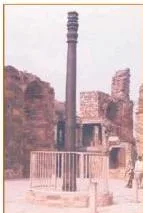
The Delhi iron pillar — NCERT’s ‘More to Know’ box (NCERT p. 54) describes the iron pillar near the Qutub Minar in Delhi, built more than 1600 years ago: 8 m high, weighing 6 tonnes, rust-resistant, and examined by scientists from all over the world.
The book credits the iron workers of ancient India with developing a process that prevented rusting, and holds the pillar up as proof that corrosion can be beaten by deliberate metallurgy.
NCERT does not state a chemical mechanism for the pillar, so keep your answer to what the book says — a process developed by those iron workers prevented the iron from rusting.
Figure walkthrough: what the diagrams in Chapter 3 actually show
The diagrams in this chapter are activity setups, electron-transfer pictures and process flows. Each group below says what the figure shows and what to look for in it.
Conductivity and reaction setups (Figs 3.1–3.3)
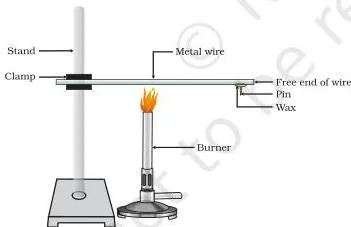
Fig. 3.1 (NCERT p. 38) is Activity 3.5 in picture form. A metal wire is clamped to a stand, and a pin is stuck to its free end with wax. Heating the clamped end makes the wax melt and the pin drop — proof that heat travelled through the metal.
The book adds that the wire itself does not melt, which is also evidence of a high melting point.
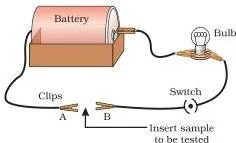
Fig. 3.2 (NCERT p. 39) is Activity 3.6: the metal sample sits between terminals A and B of a battery-bulb circuit. The glowing bulb tells you the metal conducts electricity. The book then asks the reverse question — why electric wires are coated with PVC or rubber — and the answer is the same property: the coating insulates because it does not conduct.
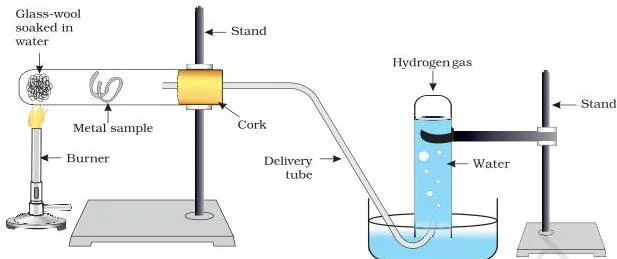
Fig. 3.3 (NCERT p. 43) shows the apparatus Activity 3.10 tells you to build for metals that survive cold and hot water. Aluminium, iron and zinc react with steam — water in the gas state — to form the metal oxide and hydrogen, while lead, copper, silver and gold do not react with water at all.
Displacement and electron transfer (Figs 3.4–3.6)
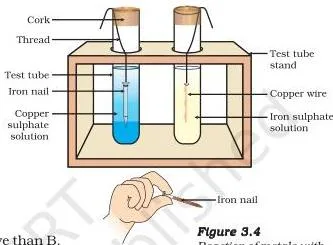
Fig. 3.4 (NCERT p. 45) is the displacement pair from Activity 3.12. In one tube a copper wire sits in iron(II) sulphate — no reaction, because copper is less reactive than iron. In the other, an iron nail sits in copper(II) sulphate, and the nail gains a reddish-brown coat of copper while the blue solution fades.
This single picture proves iron sits above copper in the activity series.
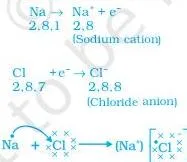
Fig. 3.5 (NCERT p. 47) shows electron transfer in the formation of sodium chloride. Sodium’s single outer electron moves across to a chlorine atom: sodium loses it to become Na⁺, chlorine gains it to become Cl⁻, and the two opposite charges then attract.
The book stresses that sodium chloride is not a set of molecules but an aggregate of ions held by electrostatic forces.
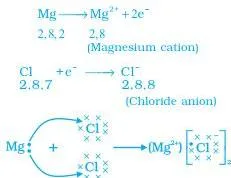
Fig. 3.6 (NCERT p. 48) is the same story twice over. Magnesium has two outer electrons, so it gives one to each of two chlorine atoms, forming Mg²⁺ and two Cl⁻ — and that is exactly why the formula is MgCl₂.
Ionic compounds in action (Figs 3.7–3.8)
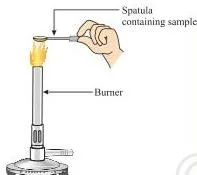
Figs 3.7 and 3.8 (both NCERT p. 48) belong to Activity 3.13 on ionic compounds. Fig. 3.7 shows a salt sample heated directly on a metal spatula in a flame — it does not melt easily, which is the high melting point of ionic compounds in action.
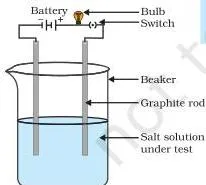
Fig. 3.8 shows a battery-bulb circuit with electrodes dipped into a salt solution; the bulb glows because the dissolved salt has broken into free-moving ions that carry current. Solid salt would not light the bulb — its ions are locked in the rigid lattice, which is why ionic compounds conduct only when molten or dissolved.
Extraction and refining (Figs 3.10–3.12)
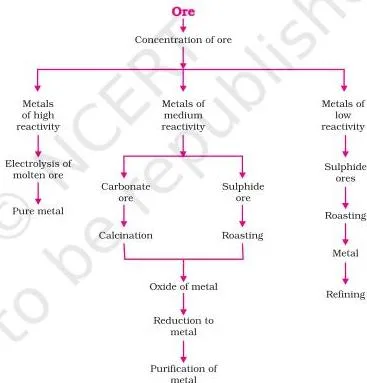
Fig. 3.10 (NCERT p. 50) is the flowchart that organises all of Section 3.4. Every ore first goes through enrichment to remove gangue; then the metal is extracted by a route chosen from its position in the activity series — heat alone for low metals, roasting or calcination followed by reduction for middle metals, electrolysis for top metals; finally, the crude metal is refined.
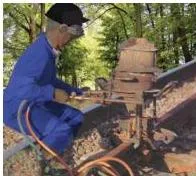
Fig. 3.11 (NCERT p. 52) shows the thermit reaction in real life: white-hot molten iron pouring into the gap between two railway track sections. The reaction Fe₂O₃ + 2Al → 2Fe + Al₂O₃ is so exothermic that the iron produced comes out molten — hot enough to weld railway tracks and cracked machine parts.
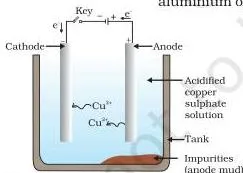
Fig. 3.12 (NCERT p. 52) carries the book’s own full caption as its summary: the electrolyte is acidified copper sulphate, the anode is impure copper, the cathode is a strip of pure copper, and on passing current, pure copper deposits on the cathode.
As pure copper dissolves from the anode into the electrolyte, an equivalent amount deposits on the cathode, while insoluble impurities collect under the anode as anode mud.
Corrosion: the three test tubes (Fig. 3.13)
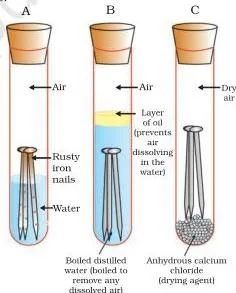
Fig. 3.13 (NCERT p. 53) is the conclusion of Activity 3.14. Tube A has water and air — the nails rust. Tube B has boiled distilled water with a layer of oil on top, so no air dissolves in the water — no rust. Tube C has dry air, with anhydrous calcium chloride absorbing any moisture — no rust.
Two tubes fail and one rusts, which proves the condition for rusting is both air and water acting together.
One figure from the book is not reproduced on this page: Fig. 3.9, ‘Activity series and related metallurgy’ (NCERT p. 50), which maps the three extraction zones directly onto the activity series. The activity series itself appears in full in the key-concepts section above, so you can follow the same mapping.
Definitions from Metals and Non-metals, explained
These are the terms NCERT expects you to be able to define in your own words. Each entry below is reworded, with the page on which the book introduces it.
| Term | Plain definition | NCERT page |
|---|---|---|
| Metallic lustre | The shining surface of a metal in its pure state | p. 37 |
| Malleability | The ability of a metal to be beaten into thin sheets | p. 38 |
| Ductility | The ability of a metal to be drawn into thin wires | p. 38 |
| Sonority | The property of producing a sound when struck on a hard surface | p. 39 |
| Amphoteric oxides | Metal oxides that react with both acids and bases to give salt and water | p. 41 |
| Reactivity (activity) series | A list of metals arranged in decreasing order of their reactivity | p. 45 |
| Ionic (electrovalent) compounds | Compounds formed by the transfer of electrons from a metal to a non-metal | p. 47 |
| Mineral | An element or compound that occurs naturally in the earth’s crust | p. 49 |
| Ore | A mineral from which a metal can be profitably extracted | p. 49 |
| Gangue | The impurities such as soil and sand present in an ore | p. 50 |
| Roasting | Heating a sulphide ore strongly in excess air to convert it to the oxide | p. 51 |
| Calcination | Heating a carbonate ore strongly in limited air to convert it to the oxide | p. 51 |
| Electrolytic refining | Purifying an impure metal by electrolysis, with the impure metal as anode and a pure strip as cathode | p. 52 |
| Anode mud | The insoluble impurities that settle at the bottom of the anode during electrolytic refining | p. 52 |
| Corrosion | The surface attack on a metal when it is exposed to moist air for a long time | p. 53 |
| Galvanisation | Coating iron or steel with a thin layer of zinc to protect it from rusting | p. 54 |
| Alloy | A homogeneous mixture of two or more metals, or of a metal and a non-metal | p. 54 |
| Amalgam | An alloy in which one of the metals is mercury | p. 54 |
| Metallurgy | The extraction of metals from their ores, followed by refining them for use | p. 55 |
Common mistakes students make in this chapter
Each trap below is one the chapter’s own text prepares you against — NCERT states the correct rule, and students state the tempting wrong one. The right column tells you how to check any answer of yours.
| Mistake | Correct rule | How to check your answer |
|---|---|---|
| “All metals are hard solids.” | Mercury is a liquid at room temperature; gallium and caesium melt on the palm; alkali metals can be cut with a knife (NCERT p. 39) | Before writing “all metals…”, name one exception from the list above |
| “All non-metals are dull and do not conduct.” | Iodine is lustrous; graphite conducts electricity; diamond is the hardest natural substance (NCERT p. 39) | Cite iodine, graphite or diamond whenever a blanket statement about non-metals needs a counter-example |
| “Sodium is stored in kerosene to keep it clean.” | K and Na react so violently with oxygen that they can catch fire in the open; kerosene isolates them from air and prevents accidental fires (NCERT p. 41) | A give-reason answer must mention catching fire |
| “Aluminium utensils do not corrode because aluminium is unreactive.” | Aluminium is highly reactive, but its thin oxide (Al₂O₃) layer stops further oxidation (NCERT p. 41) | Mention the protective oxide layer, not low reactivity |
| “Metal + acid always gives salt + hydrogen.” | Nitric acid oxidises the hydrogen produced to water, itself forming nitrogen oxides; only Mg and Mn with very dilute HNO₃ give hydrogen (NCERT p. 44) | For HNO₃, write nitrogen-oxide products unless the acid is very dilute and the metal is Mg or Mn |
| Confusing roasting and calcination | Roasting treats sulphide ores in excess air (SO₂ given off); calcination treats carbonate ores in limited air (CO₂ given off) (NCERT p. 51) | Identify the ore first — sulphide or carbonate — then choose the process |
| Swapping anode and cathode in electrolytic refining | The impure metal is the anode, a pure strip is the cathode, and pure metal deposits on the cathode (NCERT p. 52) | Remember “impure at anode” — anode mud falls from the anode, so the impure metal must be there |
| “Solid ionic compounds conduct electricity.” | Solids do not — ions are locked in a rigid lattice; ionic compounds conduct only when molten or dissolved (NCERT p. 48) | Look at the state given in the question: only molten or dissolved conducts |
| “Zinc displaces any metal from its salt.” | A metal displaces only metals below it in the activity series — Cu and Ag, yes; Al and Mg, no (NCERT p. 44) | Compare both metals on the series before predicting |
| “Rusting needs either air or water.” | Rusting needs both, together — tube A has both and rusts; tubes B and C lack one and do not (NCERT p. 53) | Quote the three-tube result before concluding |
| “Pure iron is the best form for tools.” | Pure iron is soft and stretches when hot; about 0.05% carbon makes it hard and strong, and stainless steel resists rust (NCERT p. 54) | Any “why alloy?” answer should start from the weakness of the pure metal |
Exam notes: the question types this chapter produces
This section maps how the chapter is asked — the question shapes NCERT’s own exercises use — not a list of what to memorise. Textbook contents and the examinable syllabus are not always identical, so check the current official syllabus as well.
- Straight definitions — mineral, ore and gangue (in-text Q1, p. 49); malleable and ductile (in-text Q2, p. 38).
- Give-reasons — Exercise 12(a)–(d): why platinum, gold and silver for jewellery; why Na, K and Li under oil; why aluminium utensils despite reactivity; why sulphide and carbonate ores are converted to oxides. Exercise 16 asks the same style for copper versus steel in hot water tanks.
- Displacement prediction — reading a results table (the A-B-C-D question, in-text Q3, p. 46); choosing the working pair among four options (Exercise 1, where the answer is copper with silver nitrate, because copper sits above silver in the series).
- Balanced equations — metal with steam, calcium and potassium with water (in-text Q2); iron with dilute H₂SO₄ (in-text Q4). Write the state symbols, balance, and remember the nitric acid exception whenever HNO₃ appears.
- Activity-based reasoning — the rusting test tubes (Activity 3.14); using a hammer, battery, bulb, wires and a switch to separate metals from non-metals (Exercise 5); sulphur burning with litmus test (Exercise 9).
- The case question — the gold bangles trick (Exercise 15). The solution is aqua regia: the freshly prepared 3:1 mixture of concentrated HCl and concentrated HNO₃ dissolves gold. The ‘goldsmith’ dipped the bangles in it, so their surface gold dissolved — they sparkled because fresh metal was exposed, and their weight dropped drastically because gold really dissolved away (NCERT p. 44).
- What a full-marks answer must include — the observation (what you see), the rule (why), and the balanced equation where one is asked. For give-reason questions, the marker looks for the specific property — the oxide layer, the protective coating, the position in the series — not a general sentence.
Revision summary built from NCERT’s ‘What you have learnt’
NCERT closes the chapter with its own ‘What you have learnt’ list (NCERT p. 55). This is that list, reworded for a fast read — if you can tick every line, you have the chapter.
- Elements are classified as metals or non-metals by their properties.
- Metals are lustrous, malleable, ductile, and good conductors of heat and electricity; they are solids at room temperature except mercury.
- Metals form positive ions by losing electrons to non-metals.
- Metals combine with oxygen to form basic oxides; aluminium oxide and zinc oxide are amphoteric.
- Different metals show different reactivities with water and dilute acids.
- The activity series lists common metals in decreasing order of reactivity.
- Metals above hydrogen displace hydrogen from dilute acids.
- A more reactive metal displaces a less reactive metal from its salt solution.
- Metals occur free or as compounds; metallurgy means extracting them from ores and refining them for use.
- An alloy is a homogeneous mixture of two or more metals, or of a metal and a non-metal.
- Corrosion is the surface attack on some metals when exposed to moist air for a long time.
- Non-metals have opposite properties: not malleable, not ductile, poor conductors (except graphite), forming negative ions, giving acidic or neutral oxides, and not displacing hydrogen from dilute acids.
Related resources for Class 10 Science
This listing is maintained for the 2026-27 academic session using the NCERT textbook information available to us. NCERT remains the authority for confirming the latest edition.
Continue your study with the Class 10 Science notes on this site, or move through the book in order: Acids, Bases and Salts (Chapter 2) explains the acid–base behaviour this chapter leans on, and Carbon and its Compounds (Chapter 4) is the next chapter. The Class 10 hub and the main CBSE notes index cover every subject.
For the complete set of official textbooks, visit the NCERT textbook portal.
Sources and data verification
This page describes the NCERT Class 10 Science textbook, Chapter 3 Metals and Non-metals, official edition on ncert.nic.in, printed pages beginning at page 36. It covers that one book and chapter only — not other Class 10 subject books, and not the CBSE curriculum beyond what the textbook itself contains.
The listing is maintained for the current academic session using the NCERT information available to us. NCERT settles textbook content, editions and PDFs; CBSE settles the curriculum, syllabus and examinations. No claim of expert review is made here — the teaching above is ordinary, careful reading of the textbook, and page references let you verify every point against the book itself.
Chapter-wise notes for this subject are not published yet. The unit-wise syllabus on this page is complete and verified against the official CBSE curriculum document.
Reference: NCERT Class 10 Science textbook, chapter 3, official edition on ncert.nic.in.
Metals and Non-metals Class 10: common questions answered
Short answers to the questions students keep asking while revising this chapter.
Why is sodium metal kept immersed in kerosene oil?
Sodium (like potassium) reacts so vigorously with oxygen — and moisture — in the air that it can catch fire if left exposed. Keeping it immersed in kerosene oil isolates it from air and prevents accidental fires (NCERT p. 41).
Why do aluminium utensils not corrode even though aluminium is a reactive metal?
Aluminium reacts with oxygen at once, but the thin layer of aluminium oxide that forms on its surface sticks to the metal and stops further oxidation. Anodising makes this protective oxide layer even thicker (NCERT p. 41).
What is the difference between roasting and calcination?
Roasting is heating a sulphide ore strongly in excess air, giving the metal oxide and sulphur dioxide. Calcination is heating a carbonate ore strongly in limited air, giving the metal oxide and carbon dioxide (NCERT p. 51).
Why do ionic compounds have high melting points?
The oppositely charged ions in an ionic compound are held by strong electrostatic forces of attraction, so a considerable amount of energy is needed to break them apart. That is why sodium chloride melts at 1074 K (NCERT p. 48).
Which metals are found in the free state in nature?
The least reactive metals — gold, silver, platinum and copper — are found in the free state, because they sit at the bottom of the activity series and do not readily combine with other elements (NCERT pp. 49–50).
What is aqua regia and why can it dissolve gold?
Aqua regia (‘royal water’) is a freshly prepared 3:1 mixture of concentrated hydrochloric acid and concentrated nitric acid. It can dissolve gold and platinum even though neither acid can do so alone, which is why the ‘goldsmith’ in Exercise 15 used it on the gold bangles (NCERT p. 44).
Explore Class 10 Science Books
Class 10 Science on LearnCBSE:
Related chapters:
- Chemical Reactions and Equations
- Life Processes
- Control and Coordination