This page follows The Human Eye and the Colourful World Class 10 — Chapter 10 of the NCERT Class 10 Science textbook — section by section. The chapter runs across 10 printed pages, NCERT pages 160 to 170.
It covers the human eye, the three defects of vision, refraction through a prism, dispersion, atmospheric refraction and scattering. The official NCERT Class 10 Science Chapter 10 PDF is right below, and the rest of the page explains what the chapter teaches.
Download NCERT Class 10 Science Chapter 10 PDF
The file below is the chapter exactly as NCERT publishes it, with the same text, figures and page numbering as the printed book.
Open the NCERT Class 10 Science Chapter 10 The Human Eye and the Colourful World PDF on the official NCERT textbook page to read the current edition online or save it for offline study.
Everything below the download — the section explanations, figure walkthroughs, worked examples and exercise mapping — uses the same NCERT page numbers as your book, so you can hold the PDF open and follow along.
Chapter at a Glance
The table below lists what the chapter holds — its sections, figures, activities, in-text questions and end-of-chapter exercises.
| What the chapter holds | Count | Where it is used |
|---|---|---|
| Printed pages | 10 | |
| Sections in the chapter | 9 | |
| Figures with NCERT captions | 8 | |
| Exercise questions | 12 | answered in our NCERT Solutions |
| In-text questions | 4 | |
| Activities | 2 | |
| Official NCERT PDF | Download the chapter PDF | the chapter exactly as NCERT publishes it |
The chapter moves in two halves. The first treats the eye as an optical instrument: Section 10.1 introduces each part, 10.1.1 explains accommodation, and 10.2 covers the three vision defects and their corrective lenses.
The second half follows light through the air: refraction by a prism (10.3), dispersion of white light (10.4), atmospheric refraction (10.5) and scattering of light (10.6). Two activities — tracing a ray through a triangular prism (Activity 10.1) and producing a colour band from sunlight (Activity 10.2) — do the experimental work.
A ‘Think it over’ box on eye donation sits inside Section 10.2, and the chapter closes with exercises that test recall, explanation and lens-power calculation.
What This Chapter Covers
This chapter exists because the refraction you studied in light reflection and refraction plays out in two surprising places: inside the human eye, and in the sky above you.
By the end you should be able to explain why a star twinkles, why a rainbow forms opposite the Sun, and why the sky is blue — three everyday sights that come from the same physics.
- The human eye (10.1, p. 160–161): the parts of the eye and how an inverted real image forms on the retina.
- Power of accommodation (10.1.1, p. 161–162): how the lens changes shape to focus near and far; the near point and far point.
- Defects of vision and their correction (10.2, p. 162–164): myopia, hypermetropia and presbyopia, and the lenses that fix them.
- Refraction through a prism (10.3, p. 165): why a ray is deviated by two inclined faces.
- Dispersion of white light (10.4, p. 166–167): the VIBGYOR spectrum, Newton’s recombination experiment and the rainbow.
- Atmospheric refraction (10.5, p. 168): twinkling of stars, advanced sunrise and delayed sunset.
- Scattering of light (10.6, p. 169): the Tyndall effect, the blue sky and red danger signals.
The thread that ties the chapter together is the atmosphere: every phenomenon in the second half is sunlight or starlight interacting with air, water droplets and dust.
Key Concepts Explained
The seven ideas below are the chapter’s whole argument, in the order the book makes it. Each carries its NCERT page number so you can check the book as you read.
The human eye and its parts (NCERT p. 160–161)
The eye is like a camera whose screen never moves: a lens system forms an image on a light-sensitive screen called the retina. Light enters through the cornea, a thin transparent membrane that bulges out at the front of the eyeball.
Here is the point most students miss — most of the refraction happens at the cornea, not at the eye lens. The crystalline lens only makes the finer adjustment of focal length needed to focus objects at different distances.
- Iris — a dark muscular diaphragm behind the cornea that controls the size of the pupil.
- Pupil — the opening that regulates the amount of light entering the eye.
- Retina — a delicate membrane packed with light-sensitive cells; the eye lens forms an inverted real image on it.
- Optic nerve — carries electrical signals from the activated cells to the brain, which interprets them so we perceive objects as they are.
- Eyeball — roughly spherical, about 2.3 cm in diameter.
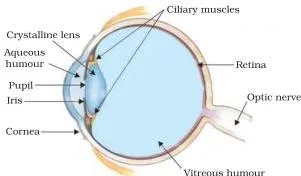
Figure 10.1 shows the transparent bulge of the cornea at the front of the eyeball — the first surface every ray of light meets. Notice how compact the system is: nearly all the bending happens in the first few millimetres, and the lens fine-tunes from there.
Power of accommodation (p. 161–162)
Since the retina cannot move, a nearby object and a distant object would focus at different points unless the lens changed shape. That shape change is accommodation.
The eye lens is fibrous and jelly-like, and the ciliary muscles change its curvature. Muscles relaxed: the lens becomes thin, its focal length increases, and distant objects focus clearly. Muscles contracted: the lens becomes thicker, its focal length decreases, and nearby objects focus.
Accommodation has a limit: the lens cannot focus anything closer than the near point — the minimum distance at which objects are seen most distinctly without strain, also called the least distance of distinct vision. For a young adult with normal vision it is about 25 cm.
The far point is the farthest distance of clear vision — infinity for a normal eye. A normal eye therefore sees clearly between 25 cm and infinity. In old age the crystalline lens can turn milky and cloudy; this condition is called cataract and can be treated by surgery.
Defects of vision and their correction (p. 162–164)
All three defects in this chapter are the same failure in different forms: the image does not land on the retina. Each one needs a different corrective lens.
The three common refractive defects are myopia (near-sightedness), hypermetropia (far-sightedness) and presbyopia.
| Defect | What the person cannot see | Where the image forms | Cause | Corrective lens |
|---|---|---|---|---|
| Myopia (near-sightedness) | Distant objects clearly — the far point is nearer than infinity | In front of the retina | Excessive curvature of the eye lens, or elongation of the eyeball | Concave lens of suitable power |
| Hypermetropia (far-sightedness) | Nearby objects distinctly — the near point lies beyond 25 cm | Behind the retina | Eyeball too small, or eye lens with too long a focal length | Convex lens of suitable power |
| Presbyopia | Nearby objects comfortably — the near point recedes with age | The focusing range of the eye shrinks | Weakening of the ciliary muscles; diminishing flexibility of the eye lens | Bifocal lens — upper concave for distance, lower convex for near vision |
Presbyopia is the slow loss of accommodation that comes with age; the near point gradually recedes. People who have both myopia and hypermetropia often need bifocal lenses — concave on top for distance, convex below for near vision. Contact lenses and surgical correction are also possible today.
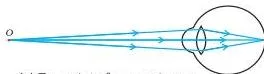
The figure above accompanies the chapter’s presbyopia discussion — it is the book’s reminder that this is a steady, age-driven change rather than a sudden defect. The correction rule for the other two is simple: myopia needs a diverging (concave) lens to push the image back onto the retina, and hypermetropia needs a converging (convex) lens to pull it forward.
Refraction through a prism (p. 165)
A prism is the first place the slab rules change: because its faces are inclined, the emergent ray cannot come out parallel to the incident ray.
A triangular glass prism has two triangular bases and three rectangular lateral surfaces. The angle between its two lateral faces is called the angle of the prism.
Trace a ray through the prism and you meet two rules you already know:
- At the first face (air to glass) the ray bends towards the normal.
- At the second face (glass to air) the ray bends away from the normal.
Because both bends push the ray the same way, the emergent ray leaves at an angle to the incident ray. That angle is the angle of deviation (\( \angle D \)). In a glass slab, by contrast, the faces are parallel and the emergent ray stays parallel to the incident ray, only slightly displaced sideways.
Dispersion of white light (p. 166–167)
White light is a mixture, and a prism proves it every time. A narrow beam of sunlight passing through a prism spreads into a band of colours: violet, indigo, blue, green, yellow, orange and red — remember the order as VIBGYOR.
The band of coloured components of a light beam is its spectrum, and the splitting of white light into these colours is dispersion. It happens because each colour bends by a different angle through the prism — red bends the least and violet the most — so the colours emerge along different paths.
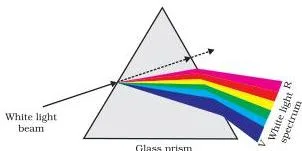
Figure 10.5 shows the experiment: white light enters from the left, the prism spreads it, and the screen catches the colour band. Activity 10.2 is the same setup with a slit of sunlight. Newton carried the experiment one step further — a second identical prism, inverted, recombined the colours back into white light, proving that sunlight is made of seven colours.
The rainbow is the same physics outdoors. Tiny water droplets act as small prisms: sunlight entering a droplet is refracted and dispersed, reflected internally, and refracted again as it leaves. This is why a rainbow always appears in the direction opposite to the Sun.
Atmospheric refraction (p. 168)
The atmosphere is not one uniform layer: its density, and so its refractive index, changes gradually with height. Light bends little by little as it passes through, and four familiar sights follow.
- Twinkling of stars. A star is so distant that it behaves as a point-sized source. Starlight refracts continuously through changing air, so the apparent position fluctuates and the light reaching the eye flickers — the star seems to brighten and fade.
- Planets do not twinkle. A planet is close enough to act as an extended source — many point sources together. The individual variations average out to zero, leaving steady light.
- The star appears higher. Because the atmosphere bends starlight towards the normal, the apparent position of a star is slightly above its true position, most noticeably near the horizon (Fig. 10.9).
- Advanced sunrise and delayed sunset. Atmospheric refraction lifts the Sun’s image above the horizon, so the Sun is visible about 2 minutes before actual sunrise and about 2 minutes after actual sunset. The same refraction flattens the apparent disc of the Sun near the horizon.
Scattering of light (p. 169)
Scattering is what happens when light strikes tiny particles in its path and is sent out in all directions. It gives the sky its colour.
The Tyndall effect is scattering by colloidal particles. A fine beam of sunlight entering a smoke-filled room traces a visible path, and sunlight through the mist of a dense forest does the same.
The colour of scattered light depends on particle size: very fine particles scatter mainly blue light, larger particles scatter longer wavelengths, and large enough particles scatter light that looks white.
Why the sky is blue: air molecules and fine particles are smaller than the wavelength of visible light, and they scatter shorter wavelengths far more strongly than longer ones. Since red light has a wavelength about 1.8 times that of blue light, blue is scattered much more effectively, and scattered blue light reaches your eyes from every direction.
If the earth had no atmosphere there would be no scattering, and the sky would look dark — which is what astronauts see. Danger signals are red because red is scattered least by fog and smoke, so it keeps its colour and stays visible over distance.
Figure Walkthrough — Reading the Diagrams NCERT Expects You to Use
Half of this chapter’s meaning lives in its diagrams, and written answers often expect you to describe them. Here is what each figure shows, in the order the chapter uses them.
Dispersion and recombination: one story (Fig. 10.5 and Fig. 10.6)
Fig. 10.5 spreads: a single prism fans white light into the VIBGYOR band. Fig. 10.6 closes the argument: a second identical prism, inverted, catches the fan and recombines it into white light. Read the pair together — they prove the seven colours were inside the white light all along.
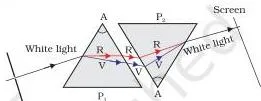
In Fig. 10.6, trace the band from the first prism into the inverted second prism, and then out the other side as a single beam. This is the experiment Newton performed, and it is why the chapter says sunlight is made up of seven colours.
The rainbow (Fig. 10.7 and Fig. 10.8)
Fig. 10.7 shows the result — a rainbow arching across the sky after rain. Fig. 10.8 is the cause, drawn for a single droplet.

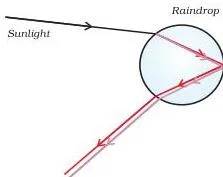
Trace the ray in Fig. 10.8 with your finger: sunlight bends as it enters the droplet and splits into colours, reflects off the inside of the far surface, then bends again as it leaves towards your eye. Because the light must reflect inside the drop before reaching you, the rainbow always forms in the direction opposite to the Sun.
You can see the same effect in the spray of a waterfall with the Sun behind you.
A star that is not where it seems (Fig. 10.9)
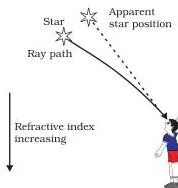
Fig. 10.9 shows the star’s true position and its apparent position. The atmosphere bends starlight towards the normal as it descends, so your eye follows a ray that seems to come from higher up — the star appears above its true position, most obviously near the horizon.
The Sun’s early appearance (Fig. 10.10)
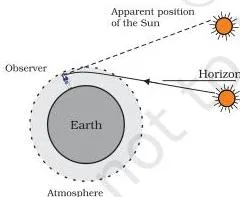
Fig. 10.10 shows the same bending on a bigger scale: the Sun below the horizon is lifted into view by refraction. That is why we see it about 2 minutes before true sunrise and keep seeing it about 2 minutes after true sunset. The figure accompanies the text’s note that the Sun’s disc looks flattened near the horizon for the same reason.
The defect diagrams the text describes (Fig. 10.2 and Fig. 10.3)
The myopia and hypermetropia diagrams on NCERT pages 163–164 are described in the book, so know what each shows. Fig. 10.2(b) shows a distant object’s rays converging to a point in front of the retina; part (c) shows a concave lens spreading the rays so the image lands on the retina.
Fig. 10.3(b) shows a nearby object’s rays converging behind the retina; N marks the hypermetropic eye’s receded near point, while N’ is the normal near point; part (c) shows a convex lens pulling the image forward onto the retina. Sketch both from memory — the before-retina / behind-retina contrast is the idea the exercises return to.
Activities in the Chapter — What They Prove
These two activities are the chapter’s experimental proof. You are not asked to replicate them, but you must know what each demonstrates.
- Activity 10.1 (p. 165) — refraction through a prism. Trace a ray through a triangular glass prism and mark \( \angle i \), \( \angle r \) and \( \angle e \). The ray bends towards the normal on entering the glass and away from it on leaving, and the emergent ray is deviated from the incident direction by \( \angle D \).
- Activity 10.2 (p. 166) — dispersion of sunlight. Pass a narrow beam of sunlight through a prism and observe the spectrum on a screen: violet, indigo, blue, green, yellow, orange and red. The takeaway is that white light is a mixture, and the prism separates it because each colour bends by a different amount.
In Fig. 10.4, the angle marked \( \angle D \) between the incident ray and the emergent ray is the angle of deviation — the quantity that makes a prism different from a slab.
The 12 Exercises — Which Concept Each One Tests
The end-of-chapter exercises are a concept checklist. Revise by idea: pick a row, and make sure you can explain that concept in your own words.
| Question | Concept it tests |
|---|---|
| 1 | Accommodation — the eye adjusts focal length to see at different distances (MCQ). |
| 2 | The retina is the screen on which the eye forms the image (MCQ). |
| 3 | Least distance of distinct vision — the near point, about 25 cm for a young adult (MCQ). |
| 4 | The ciliary muscles change the focal length of the eye lens (MCQ). |
| 5 | Lens power to focal length: \( f = 1/P \) with \( P \) in dioptres. \( P = -5.5\ \text{D} \) gives \( f = -18.2\ \text{cm} \); \( P = +1.5\ \text{D} \) gives \( f = +66.7\ \text{cm} \). |
| 6 | Myopia correction: far point 80 cm. The lens must put the image of an object at infinity at 80 cm, so \( f = -80\ \text{cm} \), \( P = -1.25\ \text{D} \), concave lens. |
| 7 | Hypermetropia correction: near point 1 m. An object at 25 cm must give a virtual image at 1 m: \( u = -25\ \text{cm} \), \( v = -100\ \text{cm} \), so \( f = +33.3\ \text{cm} \), \( P = +3.0\ \text{D} \), convex lens. |
| 8 | The near point — a normal eye cannot focus closer than 25 cm because the lens curvature cannot increase beyond its limit. |
| 9 | Image distance in the eye is fixed by the eye’s length; the lens changes its focal length to keep the image on the retina. |
| 10 | Twinkling of stars — atmospheric refraction of light from a point-sized source. |
| 11 | Why planets do not twinkle — an extended source averages out the flicker. |
| 12 | Why the sky is dark for an astronaut — there is no atmosphere to scatter light at that height. |
The numerical questions above have no new derivation — they use the lens formula from the previous chapter. Two worked examples with fresh numbers follow, and the sign convention is shown at every step.
Worked example: myopia correction with a far point of 40 cm
Problem.
A myopic person’s far point is 40 cm from the eye.
Find the nature, focal length and power of the correcting lens.
Step 1 — decide what the lens must do.
The eye cannot see beyond 40 cm.
The correcting lens must take an object at infinity and form a virtual image at the far point, 40 cm in front of the eye, where the unaided eye can still focus.
Step 2 — apply the lens formula with signs.
Object at infinity, so \( u = -\infty \).
The virtual image is on the same side as the object, so \( v = -40\ \text{cm} \) by the Cartesian sign convention.
\[ \frac{1}{f} = \frac{1}{v} – \frac{1}{u} = \frac{1}{-40} – 0 = -\frac{1}{40}\ \text{cm}^{-1} \]
\[ f = -40\ \text{cm} = -0.40\ \text{m} \]
\[ P = \frac{1}{f} = \frac{1}{-0.40} = -2.5\ \text{D} \]
Final answer: a concave lens of focal length 40 cm and power \( -2.5\ \text{D} \).
Worked example: hypermetropia correction with a near point of 1.2 m
Problem.
A hypermetropic person can see clearly only from 1.2 m onward.
What power of lens is needed for reading at the normal near point of 25 cm?
Step 1 — decide what the lens must do.
The near point has receded to 1.2 m.
The lens must take an object at 25 cm and form a virtual image at 1.2 m, where the eye can focus.
Step 2 — apply the lens formula with signs.
Object distance \( u = -25\ \text{cm} \).
Virtual image on the same side, so \( v = -120\ \text{cm} \).
The positive focal length that comes out tells you the lens is convex.
\[ \frac{1}{f} = \frac{1}{v} – \frac{1}{u} = \frac{1}{-120} – \frac{1}{-25} = \frac{1}{25} – \frac{1}{120} \]
\[ \frac{1}{f} = \frac{120 – 25}{3000} = \frac{95}{3000} \]
\[ f = \frac{3000}{95} \approx 31.6\ \text{cm} = 0.316\ \text{m} \]
\[ P = \frac{1}{0.316} \approx +3.2\ \text{D} \]
Final answer: a convex lens of focal length about 31.6 cm and power about \( +3.2\ \text{D} \).
Common Mistakes and Corrections
The wording of this chapter invites a few specific slips. Read this table before you start answering, and use the right-hand column to check yourself.
| Mistake | Correct rule | How to check your answer |
|---|---|---|
| “Myopia forms the image behind the retina.” | In myopia the image forms in front of the retina; in hypermetropia it forms behind it (p. 163–164). | Match the symptom: cannot see far things → image in front; cannot see near things → image behind. |
| “A convex lens corrects myopia.” | Myopia needs a concave lens to diverge rays onto the retina; hypermetropia needs a convex lens. | The power comes out negative for myopia and positive for hypermetropia in every numerical. |
| “The pupil controls the amount of light entering the eye.” | The iris, a dark muscular diaphragm, controls the pupil’s size; the pupil is the opening it regulates (p. 161). | Ask which structure is muscular — the textbook says the iris is. |
| “The retina receives an erect image because we see objects upright.” | The eye lens forms an inverted real image on the retina; the brain interprets the signals so we perceive objects as they are (p. 161). | The word ‘inverted’ is the book’s own — do not replace it with ‘erect’. |
| “The near point is 25 cm for every person.” | 25 cm is the near point for a young adult with normal vision; with presbyopia the near point recedes farther away (p. 162, 164). | Re-read the phrase in the book: ‘for a young adult with normal vision’. |
| “The sky looks dark to an astronaut because there is no Sun up there.” | The sky is dark because there is no atmosphere to scatter light — scattering is what colours the sky (p. 169). | The chapter says the sky would look dark even with the Sun shining, if the earth had no atmosphere. |
| “Atmospheric refraction makes a star appear lower than its true position.” | The atmosphere bends starlight towards the normal, so the star appears slightly higher than its true position (p. 168). | Draw the normal on Fig. 10.9 — the apparent ray comes from above the true star. |
One more point the chapter itself stops to make. In the ‘Think it over’ box (p. 164), NCERT notes that eyes can live on after death: donors may be of any age or sex, eyes must be removed within 4–6 hours of death, and one pair of donated eyes can give vision to as many as four corneal blind people.
Exam Notes — How to Revise This Chapter
This chapter is almost entirely conceptual, so revision means being able to explain, not just recall. The chapter’s five ‘why’ questions are the backbone — answer each in one grounded line.
- Why do stars twinkle? Atmospheric refraction of light from a point-sized source; changing air makes the apparent position fluctuate (p. 168).
- Why do planets not twinkle? They are extended sources, so the flicker of many points averages out to zero (p. 168).
- Why is the sky blue? Fine particles scatter shorter wavelengths (blue) far more strongly; red is about 1.8 times longer than blue (p. 169).
- Why is the sky dark at high altitude? Scattering needs atmosphere, and it is not prominent at high altitudes (p. 169).
- Why is the Sun visible about 2 minutes before actual sunrise? Atmospheric refraction lifts the Sun’s image above the horizon before the real crossing (p. 168).
The one numerical pattern: defect correction with the lens formula
Every correction numerical in the exercises runs on one pattern from the previous chapter, the light reflection and refraction lens formula \( \frac{1}{f} = \frac{1}{v} – \frac{1}{u} \), with power \( P = \frac{1}{f} \) when \( f \) is in metres. Three sign rules keep the answers right:
- Distances are measured from the correcting lens, so the object distance \( u \) is always negative.
- The virtual image forms on the same side as the object, so \( v \) is also negative — this is the step students most often drop.
- A negative \( f \) means a concave lens (myopia); a positive \( f \) means a convex lens (hypermetropia).
Change the far-point or near-point values in Exercises 6 and 7 and rework them — that fixes the pattern. Numbers the chapter expects you to know: near point 25 cm, far point infinity, about 2 minutes for the sunrise-sunset shift, and red wavelength about 1.8 times blue. Keep VIBGYOR in order, with red bending least and violet most.
One caution in the chapter’s own spirit: textbook contents and the examinable syllabus are not always identical — check the current official CBSE syllabus for what is examinable this session.
Revision Summary — What You Have Learnt
This condenses the chapter’s own closing ‘What you have learnt’ section (p. 170) into lines you can recite the night before.
- Accommodation — the eye’s ability to focus near and distant objects by adjusting the focal length of its lens through the ciliary muscles.
- Near point — the least distance of distinct vision, about 25 cm for a young adult with normal vision; far point — infinity; a normal eye sees clearly from 25 cm to infinity.
- Myopia — image in front of the retina, corrected by a concave lens. Hypermetropia — image behind the retina, corrected by a convex lens. Presbyopia — loss of accommodation with age, often corrected with bifocal lenses.
- Dispersion — the splitting of white light into its component colours; the cause of the rainbow.
- Scattering — the cause of the blue sky, the Tyndall effect, and the reddening of the Sun at sunrise and sunset.
- Now practise: run through the exercise-concept table above once, then rework one myopia and one hypermetropia numerical from fresh numbers.
Sources and Data Verification
This listing is maintained for the 2026-27 academic session using the NCERT textbook information available to us. NCERT remains the authority for confirming the latest edition.
The section titles, figure captions and page references on this page describe the NCERT Class 10 Science textbook, Chapter 10 ‘The Human Eye and the Colourful World’, pages 160–170 of the current official edition published on ncert.nic.in.
This page covers Chapter 10 only. Other chapters of the same textbook have their own pages on this site where available.
NCERT settles textbooks, editions and official PDFs; CBSE settles the curriculum, syllabus and examinations. The chapter file offered on this page is NCERT’s own, so verify anything about what is examinable against the current official CBSE syllabus.
This page is maintained for the current academic session, using the NCERT information available to us.
FAQ — The Human Eye and the Colourful World Class 10
Why is the sky blue according to this chapter?
Air molecules and fine particles in the atmosphere are smaller than the wavelength of visible light, so they scatter shorter wavelengths far more strongly than longer ones. Blue light is scattered in all directions and reaches your eyes from everywhere, while red light — with a wavelength about 1.8 times that of blue — is scattered much less (NCERT, p. 169).
Why do stars twinkle but planets do not?
Stars are so distant that they act as point-sized sources, and the continuously changing atmosphere varies the path of their light, so brightness and apparent position flicker. Planets act as extended sources — many points together — so the individual variations average out to zero and the twinkling disappears (NCERT, p. 168).
What is the difference between myopia and hypermetropia, and which lens corrects each?
In myopia the far point is nearer than infinity and the image of a distant object forms in front of the retina; a concave lens corrects it. In hypermetropia the near point recedes beyond 25 cm and the image of a nearby object forms behind the retina; a convex lens corrects it (NCERT, p. 163–164).
What is the least distance of distinct vision and what is its value for a young adult?
It is the minimum distance at which objects can be seen most distinctly without strain, and it is also called the near point of the eye. For a young adult with normal vision it is about 25 cm (NCERT, p. 162).
Why is the Sun visible about two minutes before actual sunrise?
Atmospheric refraction bends sunlight over the horizon, lifting the Sun’s apparent position above the horizon before the Sun actually crosses it. The same effect keeps the Sun visible about two minutes after actual sunset and flattens the Sun’s disc near the horizon (NCERT, p. 168).
Why does the sky appear dark to an astronaut in space?
The sky’s colour comes from scattering of sunlight by the atmosphere. In space there is no atmosphere to scatter light, and scattering is not prominent at very high altitudes, so the sky looks dark even while the Sun shines (NCERT, p. 169).
For quick revision of other chapters, browse the CBSE notes library or the Class 10 notes hub, and find every chapter of this book in the Class 10 Science notes.
Reference: NCERT Class 10 Science textbook, chapter 10, official edition on ncert.nic.in.
Explore Class 10 Science Books
Class 10 Science on LearnCBSE:
Related chapters:
- Chemical Reactions and Equations
- Acids, Bases and Salts
- Metals and Non-metals