
Reproduction is the one life process that an individual organism does not actually need for its own survival. A single amoeba or a single rose plant can eat, breathe, and grow perfectly well without ever reproducing.
These how do organisms reproduce class 10 notes answer the question the NCERT chapter opens with: if reproduction costs energy and isn’t required to keep one organism alive, why does it happen at all? The short answer is that reproduction is not about the individual — it is about keeping the species going (NCERT, p. 1).
Why Do Organisms Reproduce If It Isn’t Needed to Stay Alive?
We notice a species only because many similar-looking individuals exist around us. If there were just one non-reproducing creature of a kind, anywhere, we probably wouldn’t even register that it exists (NCERT, p. 1). Reproduction is what creates that population of look-alike individuals in the first place.
So while an individual organism can live and die without ever reproducing, a species cannot continue to exist without its members reproducing. That distinction — survival of the individual versus continuation of the species — is the idea this whole chapter is built on, and it is a favourite two-mark reasoning question in exams.
DNA Copying and Variation: The Core Idea Behind Every Method of Reproduction
Every reproductive event, no matter which organism you’re looking at, starts with the same basic step: a cell copies its DNA (deoxyribonucleic acid), the molecule in the nucleus that carries the instructions for building and running the body (NCERT, p. 1).
Copying the DNA alone is not enough — the cell also has to build a second set of cellular machinery, because a bare DNA copy pushed out of the cell would have nothing to run life processes with. Once both the DNA and the apparatus are duplicated, the cell divides into two.
Here is the part students often miss: no chemical reaction is perfectly accurate, and DNA copying is no exception. Small errors creep in every time DNA is copied, so the two resulting cells are similar to the parent but never absolutely identical (NCERT, p. 1). This is why the notes call variation “built in” rather than accidental.
Most of these small variations don’t matter much, but every so often one turns out to be useful — for example, if a population of bacteria living in warm water faces a sudden temperature rise from global warming, most will die, but a heat-resistant variant created by an earlier copying error can survive and multiply (NCERT, p. 2).
This is exactly the raw material that the next chapter on heredity and evolution builds on, so it helps to revise our Class 10 Heredity and Evolution notes alongside this one.
Asexual Reproduction: Six Methods Used by Different Organisms
In asexual reproduction, a single parent organism produces offspring without involving a second individual. The chapter describes six distinct methods, each suited to a different level of body organisation (NCERT, p. 3-6). The table below is organised for quick revision — learn the organism-method pairing first, then the one distinguishing fact, since that is what MCQ distractors usually target.
| Method | Organism example | What splits or grows | Distinguishing fact |
|---|---|---|---|
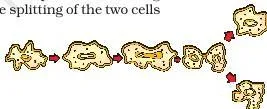
| Binary fission | Amoeba, bacteria | One cell splits into two equal cells | In Amoeba the split can happen along any plane of the cell (NCERT, p. 3) |
| Oriented binary fission | Leishmania | One cell splits into two | Because the cell has a whip-like structure at one end, the split follows a fixed orientation, unlike Amoeba (NCERT, p. 3) |
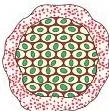
| Multiple fission | Plasmodium (malarial parasite) | One cell divides into many daughter cells at once | Produces several offspring in a single division event, not just two (NCERT, p. 3) |
| Fragmentation | Spirogyra | A mature filament breaks into pieces | Works only because the body has no complex tissue arrangement to disturb (NCERT, p. 4) |
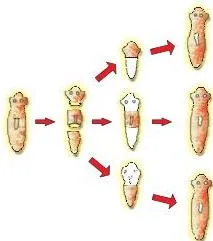
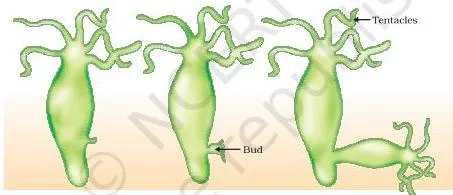
| Regeneration and budding | Hydra, Planaria | Specialised cells proliferate at a cut site or as an outgrowth | Planaria regenerates from cut pieces; Hydra uses the same regenerative cells to grow a bud that detaches as a new individual (NCERT, p. 4-5) |
| Vegetative propagation | Bryophyllum, potato | Root, stem or leaf tissue grows into a new plant | Buds form in the notches along a Bryophyllum leaf margin and fall off to start new plants; potato eyes sprout the same way (NCERT, p. 5-6) |
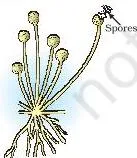
| Spore formation | Rhizopus (bread mould) | Sporangia release thick-walled spores | Spores survive dry conditions and germinate only on contact with a moist surface (NCERT, p. 6) |
Regeneration deserves a special note: Hydra and Planaria can regrow a complete body from a cut piece, but this is not the same as reproduction, because most organisms don’t depend on being cut up to multiply (NCERT, p. 4).
Vegetative propagation, on the other hand, is deliberately used in farming — for sugarcane, roses and grapes — because plants grown this way flower and fruit earlier than seed-grown plants, and it lets us propagate plants like banana and jasmine that have lost the ability to make seeds (NCERT, p. 5).
Why Sexual Reproduction Evolved: Variation, Meiosis and Two Kinds of Gametes
Asexual reproduction copies DNA from a single individual, so variation accumulates slowly — one small error at a time. Sexual reproduction speeds this up by combining the already-accumulated variations of two separate individuals into one new combination, which is novel by definition since it never existed in either parent (NCERT, p. 7).
That is the actual reason sexual reproduction exists in the textbook’s own logic: faster, richer variation for the population, not simply “because there are two sexes.”
But combining two individuals’ DNA creates an obvious problem — each generation would end up with double the DNA of the previous one if nothing were corrected. The solution is meiosis, a special type of cell division in germ-cells that produces gametes with half the number of chromosomes of the body cells.
When two gametes fuse at fertilisation, the full chromosome number is restored in the new individual (NCERT, p. 7). This is exactly why meiosis is described as happening only in specialised germ-cell lineages, not throughout the body.
As body designs grow more complex, the two gametes also become different from each other. One is large and packed with stored food to support the zygote’s early growth — this is the female gamete. The other is small and motile, built to travel and deliver its genetic material — this is the male gamete (NCERT, p. 7).
This single difference in gamete design is the root cause of almost every structural difference between male and female reproductive systems you’ll study next.
Sexual Reproduction in Flowering Plants: From Pollination to Seed Formation
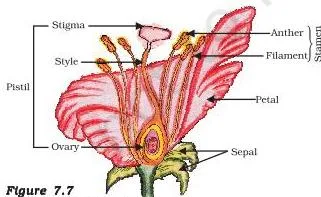
In a flower, the stamen is the male part (anther plus filament) and produces pollen grains; the pistil is the female part, made of the stigma, style and ovary, and the ovary holds the ovules that each contain an egg cell (NCERT, p. 8).
A flower is unisexual if it has only stamens or only a pistil — papaya and watermelon flowers work this way — and bisexual if it carries both, as in Hibiscus and mustard (NCERT, p. 8).
Pollination is simply the physical transfer of pollen from the anther to a stigma. If pollen lands on the stigma of the same flower, it is self-pollination; if it lands on a different flower, it is cross-pollination, and wind, water or animals usually carry it there (NCERT, p. 8).
Pollination on its own does not create an embryo — it only gets the pollen to the right doorstep. After landing on a suitable stigma, the pollen grain grows a tube that travels down through the style to reach the ovary, where the male germ-cell fuses with the egg cell inside the ovule.
That fusion is fertilisation, and it produces the zygote (NCERT, p. 8). After fertilisation, the zygote divides to form an embryo, the ovule hardens into a seed, and the ovary itself ripens into the fruit, while the petals, sepals and stamens usually shrivel and fall off (NCERT, p. 8).
Human Reproductive System: What Each Organ in the Male and Female Tract Does
Before the reproductive organs mature, both boys and girls go through puberty — a period when general body growth slows down and the body starts directing resources into maturing its reproductive tissue instead (NCERT, p. 9). Some puberty changes are common to both sexes: new hair growth in the armpits and genital area, oilier skin, and pimples.
Others are sex-specific: girls develop increased breast size and begin menstruating; boys develop facial hair, a cracking voice, and occasional penile erections (NCERT, p. 9-10). This distinction — common changes versus sex-specific changes — is a recurring two-mark question, so keep the two lists separate when you write the answer.
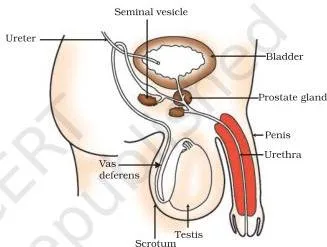
| Organ (Male system) | Function |
|---|---|
| Testes (in the scrotum) | Produce sperm and secrete testosterone; located outside the abdomen because sperm formation needs a lower temperature than the rest of the body (NCERT, p. 11) |
| Vas deferens | Carries sperm from the testes and joins the tube from the urinary bladder |
| Seminal vesicle and prostate gland | Add fluid that provides nutrition and eases sperm transport |
| Urethra | Common passage for both sperm and urine (NCERT, p. 11) |
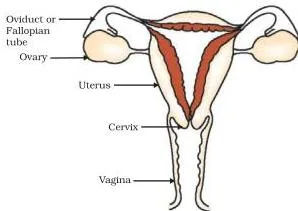
| Organ (Female system) | Function |
|---|---|
| Ovaries | Produce eggs (one egg released per month from one ovary) and secrete hormones (NCERT, p. 11) |
| Fallopian tube (oviduct) | Carries the egg towards the uterus; fertilisation happens here |
| Uterus | Where the embryo implants and develops into a foetus over about nine months |
| Cervix and vagina | Cervix connects the uterus to the vagina; vagina receives sperm during intercourse and is also the birth canal (NCERT, p. 11) |
Menstruation, Pregnancy Support and Reproductive Health Choices
If the egg released each month is not fertilised, it survives for only about one day.
The uterus lining that had thickened to receive a fertilised egg is no longer needed, so it breaks down and passes out through the vagina as blood and mucus — this is menstruation, and it repeats roughly every month, lasting about two to eight days (NCERT, p. 12).
When fertilisation does happen, the embryo implants in the uterine wall and is nourished through the placenta, a disc-shaped tissue with finger-like villi on the embryo’s side surrounded by pools of the mother’s blood.
This arrangement gives a large surface area for glucose and oxygen to pass into the embryo and for waste to pass out into the mother’s blood (NCERT, p. 11). Development inside the mother takes about nine months.
The chapter groups contraceptive methods into four categories (NCERT, p. 12):
| Category | Example | How it works |
|---|---|---|
| Mechanical barrier | Condom | Physically stops sperm from reaching the egg |
| Hormonal | Oral contraceptive pills | Changes hormone balance so eggs are not released |
| Intra-uterine device | Copper-T / loop | Placed in the uterus to prevent pregnancy |
| Surgical | Blocking the vas deferens or the fallopian tube | Stops sperm or egg from reaching the site of fertilisation |
Only the condom among these reduces the risk of transmitting sexually transmitted infections such as gonorrhoea, syphilis, warts or HIV-AIDS; the pill and copper-T only prevent pregnancy, they do not stop infection (NCERT, p. 12). The chapter also notes that sex-selective abortion of female foetuses is illegal, and that a healthy society needs a balanced female-male sex ratio (NCERT, p. 12).
Key Terms From Chapter 7 You Must Be Able to Define
- DNA copying: the creation of a duplicate of a cell’s DNA, accompanied by a duplicate cellular apparatus, so the cell can divide into two (NCERT, p. 1).
- Fission: division of a unicellular organism into two (binary fission) or several (multiple fission) daughter cells (NCERT, p. 3).
- Regeneration: the growth of a complete organism from a cut or broken body piece, carried out by specialised proliferating cells (NCERT, p. 4).
- Budding: an outgrowth formed by repeated cell division at one point on the parent’s body, which detaches as a new individual (NCERT, p. 5).
- Vegetative propagation: growth of a new plant from a root, stem or leaf of the parent plant (NCERT, p. 5).
- Spore formation: production of thick-walled spores inside a sporangium that germinate on contact with a moist surface (NCERT, p. 6).
- Pollination: transfer of pollen from the anther to a stigma — self-pollination if within the same flower, cross-pollination if between two flowers (NCERT, p. 8).
- Fertilisation: fusion of the male germ-cell with the female egg cell to form a zygote (NCERT, p. 8).
- Zygote: the fertilised egg formed after the fusion of two gametes.
- Puberty: the stage during adolescence when reproductive tissues mature (NCERT, p. 9).
- Menstruation: the monthly shedding of the uterine lining when the egg is not fertilised (NCERT, p. 12).
- Placenta: the tissue through which the embryo exchanges nutrients and waste with the mother’s blood (NCERT, p. 11).
- Contraception: deliberate methods used to prevent pregnancy (NCERT, p. 12).
Numbers and Time Periods Examiners Often Ask You to Recall
Chapter 7 has no mathematical formulas, but examiners frequently test the time periods and quantities the chapter states as facts. Treat this table as the numerical-recall equivalent of a formula sheet for this chapter.
| Fact | Value |
|---|---|
| Survival time of an unfertilised egg | About 1 day (NCERT, p. 12) |
| Frequency of the menstrual cycle | About once a month (NCERT, p. 12) |
| Duration of menstrual bleeding | About 2 to 8 days (NCERT, p. 12) |
| Time for development inside the mother | About 9 months (NCERT, p. 11) |
| Eggs released per month | One egg from one ovary (NCERT, p. 11) |
Solved Questions: Applying Reproduction Concepts to New Situations
The two questions below use original numbers and an original scenario — they are practice questions, not examples copied from the NCERT text — designed to check whether you can apply the chapter’s ideas rather than just recall them.
Original Question 1: Bacteria doubling by binary fission
- Step 1: A culture starts with 200 bacterial cells. Each cell divides into two by binary fission every 20 minutes. Find the number of cells after 2 hours.
- Step 2: Convert 2 hours into 20-minute intervals: \( 2\ \text{hours} = 120\ \text{minutes} \), and \( 120 \div 20 = 6 \) doubling intervals.
- Step 3: Each interval doubles the population, so after 6 intervals the population is multiplied by \( 2^6 \).
\[ \text{Final count} = 200 \times 2^6 = 200 \times 64 = 12{,}800 \]
Final answer: After 2 hours the culture will contain 12,800 cells.
Original Question 2: Path of pollen to the ovule in a bisexual flower
- Step 1: A bisexual flower has 40 pollen grains deposited on its stigma after cross-pollination. State the sequence of structures a pollen grain’s contents must pass through to reach the ovule.
- Step 2: Pollination only places the pollen on the stigma; it does not by itself deliver the male gamete to the egg.
- Step 3: A pollen tube grows out of the pollen grain on the stigma and travels down through the style.
- Step 4: The tube reaches the ovary and delivers the male germ-cell to an ovule, where it fuses with the egg cell.
Final answer: The correct sequence is stigma \( \rightarrow \) style \( \rightarrow \) ovary \( \rightarrow \) ovule, and fertilisation occurs only at the last step, inside the ovule.
What the Textbook Activities Are Actually Testing
CBSE occasionally frames a one-mark question around “which activity shows X” — knowing what each activity demonstrates is worth thirty seconds of revision.
- Activity 7.1 (yeast in sugar solution under a microscope) shows budding in yeast.
- Activity 7.2 (wet bread kept in a moist, dark place) shows the growth of Rhizopus and links directly to spore formation.
- Activity 7.3 (permanent slides of Amoeba) shows a normal cell and one undergoing binary fission for comparison.
- Activity 7.4 (pond water with green filaments) shows Spirogyra filaments, used to explain fragmentation.
- Activity 7.5 (potato pieces with and without a notch, kept on wet cotton) shows that only pieces with a bud sprout — this is vegetative propagation.
- Activity 7.6 (money-plant cuttings in water) tests whether a leaf-bearing cutting can grow roots and leaves, again vegetative propagation.
- Activity 7.7 (soaked gram seeds cut open) lets you identify the parts of a germinating seed.
Places Where Students Lose Marks in This Chapter
| Mistake | Correct rule | How to check your answer |
|---|---|---|
| Calling regeneration in Hydra or Planaria “reproduction” | Regeneration is not reproduction, because most organisms do not depend on being cut into pieces to multiply (NCERT, p. 4) | Ask: does the organism normally need to be injured to produce offspring? If no, it’s regeneration, not the organism’s mode of reproduction |
| Treating pollination and fertilisation as the same event | Pollination is the transfer of pollen to a stigma; fertilisation is the fusion of the male and female gametes, and it happens later, inside the ovule (NCERT, p. 8) | Check whether gametes have actually fused. If only pollen has landed on the stigma, fertilisation has not yet occurred |
| Assuming a copper-T or oral pill prevents sexually transmitted infections | Copper-T and pills prevent pregnancy only; only a condom reduces the transmission of infections during the sexual act (NCERT, p. 12) | Separate the two purposes in your answer: contraception (pregnancy) versus protection (infection) — they are not the same guarantee |
| Writing “vas deferens” as part of the female reproductive system | Vas deferens is a male structure that carries sperm; the female structure that carries the egg is the fallopian tube (NCERT, p. 15) | Match the organ to its gamete: sperm travels through vas deferens (male); egg travels through the fallopian tube (female) |
How CBSE Tests This Chapter: Question Pattern to Watch
The chapter’s own exercise questions show a clear pattern worth planning around. Question 7 directly asks students to draw and label the longitudinal section of a flower, so practising that diagram from memory — stamen, pistil, stigma, style, ovary, ovule — is not optional (NCERT, p. 15).
The one-mark MCQs (Q1-Q3) usually hinge on a single exception or distractor: which organism reproduces by budding, which listed organ is not part of the female system, and what the anther actually contains (NCERT, p. 15).
Beyond the MCQs, most short-answer questions ask “why” rather than “what” — why menstruation occurs, why vegetative propagation is practised, why DNA copying matters for reproduction (NCERT, p. 7, p. 14-15).
A full-marks answer to a “why” question needs the underlying reason stated, not just the definition restated — for example, “menstruation occurs because the thickened uterine lining prepared for a fertilised egg is shed when fertilisation does not happen,” not simply “menstruation is monthly bleeding.”
Quick Recap Before You Close the Book
- Reproduction maintains the species, not the individual (NCERT, p. 1).
- Every reproductive event starts with DNA copying, and copying errors create the variation species need to survive changing conditions (NCERT, p. 1-2).
- Asexual reproduction (one parent) includes fission, budding, regeneration, vegetative propagation, spore formation and fragmentation.
- Sexual reproduction (two parents) speeds up variation; meiosis halves the chromosome number in germ-cells so fertilisation restores the normal number (NCERT, p. 7).
- In flowers, pollination (pollen reaching the stigma) always comes before fertilisation (gamete fusion in the ovule) (NCERT, p. 8).
- The male system makes sperm in the testes; the female system makes eggs in the ovaries and hosts the embryo in the uterus (NCERT, p. 11).
- Menstruation happens when the released egg is not fertilised and the uterine lining is shed (NCERT, p. 12).
- Contraception methods fall into four categories: mechanical barrier, hormonal, intra-uterine, and surgical — only barrier methods also protect against infection (NCERT, p. 12).
For the cell-level background on nutrition and respiration that this chapter assumes you already know, revisit the Class 10 Life Processes notes, and browse the full Class 10 Science notes index for the rest of the syllabus.
Frequently Asked Questions on How Organisms Reproduce
What is the difference between regeneration and reproduction in organisms like Hydra and Planaria?
Regeneration is the growth of a complete organism from a cut or broken body piece, carried out by specialised cells that proliferate at the injury site. It is not counted as the organism’s mode of reproduction because most organisms, including Hydra and Planaria in normal conditions, do not depend on being cut into pieces to produce new individuals (NCERT, p. 4).
Hydra does use its regenerative cells for actual reproduction, but through budding, not through being cut up.
Why do organisms reproduce if it is not necessary for an individual’s own survival?
An individual organism can live its full life without ever reproducing, since reproduction is not a life process like nutrition or respiration. But a species survives across time only because its members keep producing new, similar individuals; without reproduction, the population — and eventually the species — would disappear (NCERT, p. 1).
How is pollination different from fertilisation in flowering plants?
Pollination is the physical transfer of pollen grains from the anther to a stigma, either within the same flower (self-pollination) or between two flowers (cross-pollination). Fertilisation happens afterwards, when a pollen tube carries the male germ-cell down through the style into the ovary, where it fuses with the egg cell inside the ovule to form a zygote (NCERT, p. 8).
Pollination is the transport step; fertilisation is the fusion step.
Does using a copper-T protect against sexually transmitted infections?
No. A copper-T is placed inside the uterus to prevent pregnancy, but it does not stop the transmission of infections during the sexual act. Only a covering such as a condom worn during intercourse helps prevent the spread of infections like gonorrhoea, syphilis, warts, or HIV-AIDS (NCERT, p. 12).
Why are the testes located outside the body in the scrotum instead of inside the abdomen?
Sperm formation requires a temperature lower than the normal internal body temperature, and the scrotum, being outside the abdominal cavity, provides this cooler environment (NCERT, p. 11).
Why is DNA copying never completely accurate, and why does that matter for a species?
No biochemical reaction, including the chemical process a cell uses to copy its DNA, is perfectly accurate, so small errors always occur (NCERT, p. 1). Most of these errors are harmless or even fatal to the new cell, but occasionally one produces a variation that helps individuals survive a changed environment, such as heat-resistant bacteria surviving a rise in water temperature.
This inbuilt tendency for variation is what allows a species to adapt when its surroundings change (NCERT, p. 2).
You can also read the original chapter text on the NCERT Class 10 Science textbook page for Chapter 7 if you want to check any line directly against the source before an exam.
Reference: NCERT Class 10 Science textbook, chapter How do Organisms Reproduce?
Explore Class 10 Science Notes
Class 10 Science on LearnCBSE:
Related chapters: