
These thermodynamics class 11 physics notes compress Chapter 11 into revision-ready form: the zeroth, first and second laws, heat versus internal energy, specific heat relations, the five special processes, and the Carnot engine — with original-number worked examples and exam pointers.
Everything below follows the Rationalised NCERT Class 11 Physics Part II textbook, Chapter 11 (Thermodynamics). If a formula looks off during your prep, cross-check it against the official NCERT chapter PDF before you commit it to memory.
Use the jump links to hop straight to any section; the one-page revision table at the end is your night-before checklist.
Thermodynamics Class 11 Physics Notes: The Chapter Roadmap
Thermodynamics is a macroscopic science: it deals with bulk systems and with heat, temperature and the inter-conversion of heat and other forms of energy, without going into molecular structure — that is the job of the kinetic theory of gases (NCERT, p. 227).
Before the modern picture, heat was treated as an invisible fluid called caloric that flowed from hot to cold bodies. The turning point was Count Rumford’s 1798 cannon-boring experiment: he found the heat produced depended on the work done, not on how sharp the drill was.
A sharper drill should have scooped out more “heat fluid” — it did not, so heat was recognised as a form of energy (NCERT, p. 227).
| Law | What it establishes | Core idea |
|---|---|---|
| Zeroth law | Temperature | Equal temperature is the mark of thermal equilibrium |
| First law | Energy conservation | \( \Delta Q = \Delta U + \Delta W \) |
| Second law | Direction of processes | Limits heat-engine efficiency; no perfect engine |
One insight holds the chapter together: heat and work are energy in transit, while internal energy is a state variable that belongs to the state alone. Unlike mechanics, thermodynamics ignores the motion of the system as a whole — a bullet’s flight changes its kinetic energy, not its temperature, until it stops and that kinetic energy converts to heat (NCERT, p. 227).
Thermal Equilibrium and the Walls That Define It
An equilibrium state of a system is one whose macroscopic variables — pressure, volume, temperature, mass, composition — do not change with time (NCERT, p. 228). Whether a system stays in equilibrium depends on the nature of the wall separating it from its surroundings, exactly as Fig. 11.1 shows.
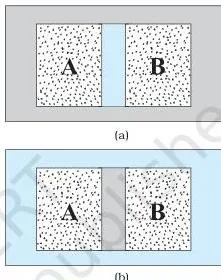
In Fig. 11.1(a) gases A and B sit behind an adiabatic wall — an insulating wall that allows no heat flow. Here any pair \((P_A, V_A)\) stays in equilibrium with any pair \((P_B, V_B)\).
In Fig. 11.1(b) the wall is diathermic — conducting — so heat flows until both gases reach equilibrium states with each other; after that there is no more energy transfer, and the systems are in thermal equilibrium (NCERT, p. 228).
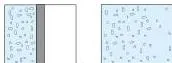
Not every situation is an equilibrium state. As Fig. 11.6 shows, a gas expanding freely into vacuum, or a petrol-air mixture exploding, has pressure and temperature that are not uniform — such states cannot be described by single state variables (NCERT, p. 233).
Thermodynamic state variables describe equilibrium states. The connection between them is the equation of state — for an ideal gas, \( PV = \mu RT \) (NCERT, p. 233). The pressure–volume curve at a fixed temperature is an isotherm.
State variables split into two kinds. Use the divide-in-two rule: imagine the equilibrium system cut into two equal parts. Extensive variables halve — internal energy \(U\), volume \(V\), total mass \(M\); intensive variables stay the same — pressure \(P\), temperature \(T\), density \(\rho\) (NCERT, p. 234).
| Term | Meaning | Example |
|---|---|---|
| Adiabatic wall | Insulating wall that allows no heat flow | Two gases separated by it keep any \((P,V)\) pair in equilibrium |
| Diathermic wall | Conducting wall that allows heat flow | Gases behind it settle to thermal equilibrium |
| Thermal equilibrium | No net heat flow; temperatures equal | Two bodies in contact reaching the same temperature |
| Equilibrium state | Macroscopic variables do not change in time | Gas in a closed, insulated rigid container |
| Extensive variable | Proportional to system size; halves when the system is divided | \(U, V, M\) |
| Intensive variable | Unchanged when the system is divided | \(P, T, \rho\) |
| Isotherm | \(P\)–\(V\) curve at constant temperature | \(PV =\) constant for an ideal gas |
Zeroth Law: The Law That Gives Us Temperature
The zeroth law answers how temperature enters physics formally. In Fig. 11.2(a), systems A and B are separated by an adiabatic wall, yet each is in contact with a third system C through a conducting wall, so both settle into equilibrium with C.
Now replace the adiabatic wall between A and B with a conducting wall, as in Fig. 11.2(b): their states change no further — they are already in thermal equilibrium with each other (NCERT, p. 229).
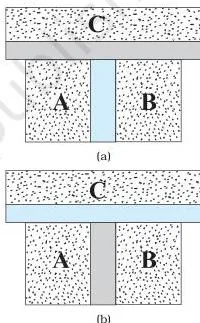
Zeroth Law of Thermodynamics: two systems in thermal equilibrium with a third system separately are in thermal equilibrium with each other. R. H. Fowler named it in 1931, long after the first and second laws, because logically it comes before them (NCERT, p. 229).
The takeaway: when two systems are in thermal equilibrium, some physical quantity has the same value in both — that quantity is temperature \(T\). This is why a thermometer works: it reaches equilibrium with your body and then reports your temperature.
One trap from the “points to ponder” list: temperature tracks the average internal (disordered) energy, not the kinetic energy of the body moving as a whole. A bullet fired from a gun is not hotter because of its speed (NCERT, p. 242).
Heat, Work and Internal Energy: Three Different Ideas
Internal energy \(U\) of a system is the sum of the kinetic and potential energies of its molecules, measured in the frame where the centre of mass is at rest (Fig. 11.3). It includes translational, rotational and vibrational motion, but never the kinetic energy of the box moving as a whole (NCERT, p. 230).
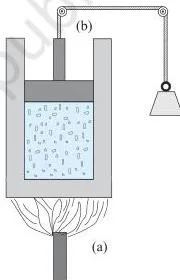
The decisive property: \(U\) depends only on the state of the system, not on how it got there — it is a state variable. Heat and work are different. Heat is energy transfer caused by a temperature difference; work is energy transfer by other means, such as a moving piston (NCERT, p. 230).
So “a gas in a given state has a certain amount of internal energy” is meaningful, while “a gas in a given state has a certain amount of heat” or “… of work” is not. Heat and work are not properties of a state — they are transactions.
Bank-account analogy: internal energy \(U\) is your account balance. Heat is a deposit; work is a withdrawal. After any transaction, the new balance depends only on where you started and where you ended — the path (how many deposits or withdrawals, in what order) does not change the final balance. It only changes which parts were deposits and which were withdrawals.
This is exactly what Count Rumford’s experiment settled: heat is not a fluid stored in pores but energy in transit, produced from work (NCERT, p. 227). Specific heat itself was defined earlier in the thermal properties of matter chapter, which these notes build on.
First Law of Thermodynamics: The Energy Balance Sheet
The First Law of Thermodynamics is the general law of conservation of energy applied to a thermodynamic system (NCERT, p. 231): the heat supplied to the system goes partly into raising its internal energy and partly into work done by the system on its surroundings.
\[ \Delta Q = \Delta U + \Delta W \]
The equation carries a fixed sign convention (NCERT, p. 241):
| Quantity | Positive | Negative |
|---|---|---|
| \(\Delta Q\) | Heat added to the system | Heat removed from the system |
| \(\Delta W\) | Work done by the system | Work done on the system |
For a gas in a cylinder, work done against a constant pressure is \(\Delta W = P \Delta V\), because force is pressure times area, and area times displacement is a volume change (NCERT, p. 231).
Why path matters: \(\Delta U\) depends only on the initial and final states, but \(\Delta Q\) and \(\Delta W\) usually depend on the path. The First Law says their combination \(\Delta Q – \Delta W\) is path-independent.
When \(\Delta U = 0\) — as in the isothermal expansion of an ideal gas — \(\Delta Q = \Delta W\), so all heat supplied goes into work (NCERT, p. 231).
Check the numbers with the textbook’s water-to-vapour example: 1 g of water absorbs 2256 J of latent heat; the 1671 cm³ expansion against atmospheric pressure does 169.2 J of work; so \(\Delta U = 2256 – 169.2 = 2086.8\) J — most of the heat goes into internal energy (NCERT, p. 231).
Specific Heat Capacity and the Cp − Cv = R Relation
Specific heat capacity \( s = \frac{1}{m}\frac{\Delta Q}{\Delta T} \) has unit J kg⁻¹ K⁻¹; molar specific heat capacity \( C = \frac{1}{\mu}\frac{\Delta Q}{\Delta T} \) has unit J mol⁻¹ K⁻¹ (NCERT, p. 232).
The molar form is what makes gas theory simple, because \(C\) depends on the process — that is why a gas needs two values, \(C_p\) and \(C_v\).
For a solid, equipartition of energy gives each vibrating atom an average energy \(3k_B T\), so one mole has \(U = 3RT\). Since \(\Delta V\) is negligible, \(C = \frac{\Delta U}{\Delta T} = 3R \approx 24.9\) J mol⁻¹ K⁻¹ (NCERT, p. 232). Measured values agree at room temperature except for carbon:
| Solid | Molar specific heat (J mol⁻¹ K⁻¹) |
|---|---|
| Aluminium | 24.4 |
| Copper | 24.5 |
| Lead | 26.5 |
| Silver | 25.5 |
| Carbon | 6.1 (exception) |
One calorie was defined as the heat needed to raise 1 g of water from 14.5 °C to 15.5 °C, because water’s specific heat varies slightly with temperature (Fig. 11.5). In SI units, \(1\) cal \(= 4.186\) J and water’s specific heat is 4186 J kg⁻¹ K⁻¹. The old “mechanical equivalent of heat” is simply this calorie-to-joule conversion factor (NCERT, p. 233).
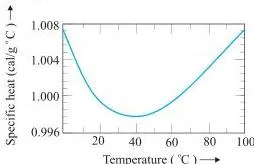
For an ideal gas the two molar specific heats satisfy a simple relation, \( C_p – C_v = R \) (NCERT, p. 233). Why it holds: for 1 mole, \(\Delta Q = \Delta U + P\Delta V\). At constant volume, \(C_v = \Delta U / \Delta T\). At constant pressure, \(C_p = C_v + P(\Delta V/\Delta T)_p\).
Since \(PV = RT\), the term \(P(\Delta V/\Delta T)_p = R\), so \(C_p = C_v + R\).
Isothermal, Adiabatic, Isobaric, Isochoric and Cyclic Processes
First define the workhorse. A quasi-static process is infinitely slow: at every stage the system stays in equilibrium with its surroundings, with only infinitesimal differences in pressure and temperature (NCERT, p. 234). Real processes merely approximate it.
| Process | Fixed quantity | Work formula | First-law form |
|---|---|---|---|
| Isothermal | \(T\) constant, \(PV =\) constant | \(W = \mu RT \ln(V_2/V_1)\) | \(\Delta U = 0\), so \(Q = W\) |
| Adiabatic | \(\Delta Q = 0\), \(PV^\gamma =\) constant | \(W = \frac{\mu R(T_1 – T_2)}{\gamma – 1}\) | \(\Delta U = -W\) |
| Isobaric | \(P\) constant | \(W = P(V_2 – V_1) = \mu R(T_2 – T_1)\) | Heat raises \(U\) and does work |
| Isochoric | \(V\) constant | \(W = 0\) | \(Q = \Delta U\) |
| Cyclic | Returns to initial state | — | \(\Delta U = 0\), so \(Q = W\) |
For an isothermal expansion the work is \(W = \int_{V_1}^{V_2} P\, dV = \mu RT \ln(V_2/V_1)\) (Eq. 11.12, NCERT, p. 235). When \(V_2 \gt V_1\) the gas absorbs heat and does positive work; when \(V_2 \lt V_1\), work is done on it and heat is released.
In an adiabatic process the system is insulated, so \(\Delta Q = 0\) and \(PV^\gamma =\) constant, with \(\gamma = C_p/C_v\) (NCERT, p. 236). Figure 11.8 compares the two curves on a \(P\)–\(V\) diagram.
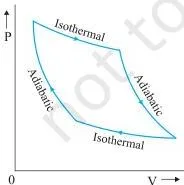
Read the diagram this way: the adiabatic curve through a point is steeper than the isotherm, because in adiabatic compression the volume shrinks and the temperature rises, so pressure climbs faster. Exam trap: isothermal uses Boyle’s law \(PV =\) constant; adiabatic uses \(PV^\gamma =\) constant — never mix them.
Adiabatic free expansion (gas into vacuum) has \(\Delta Q = 0\) and \(W = 0\), so \(\Delta U = 0\); for an ideal gas, whose \(U\) depends only on temperature, this means \(\Delta T = 0\) (NCERT, p. 236). This is the result behind the two-cylinder stopcock question.
Second Law of Thermodynamics: What Nature Forbids
The First Law allows things nature never does. A book on a table could in principle leap upward by cooling the table and turning some of its internal energy into mechanical energy — the First Law would raise no objection, yet it never happens (NCERT, p. 237). The missing restriction is the Second Law of Thermodynamics.
Kelvin–Planck statement: no process is possible whose sole result is absorbing heat from a reservoir and completely converting it into work. Clausius statement: no process is possible whose sole result is transferring heat from a colder object to a hotter object (NCERT, p. 237). The two statements are equivalent.
Put simply: no heat engine can have efficiency \(\eta = 1\), and no refrigerator can have an infinite coefficient of performance. In real life this is why a perpetual-motion machine of the second kind — one that extracts work from a single reservoir — cannot exist, and why every refrigerator needs external work to push heat the “wrong” way.
Reversible and Irreversible Processes
A process is reversible if it can be turned back so that both the system and the surroundings return to their original states, with no other change anywhere else in the universe. That demands two conditions: the process must be quasi-static and free of dissipative effects such as friction and viscosity (NCERT, p. 237).
Most natural processes are irreversible. Common examples (NCERT, p. 237):
- Free expansion of a gas into vacuum
- Combustion of a petrol–air mixture ignited by a spark
- Heat diffusing through the base of a vessel until it reaches uniform temperature
- Cooking gas leaking from a cylinder and diffusing through the room
- Stirring a liquid, which converts work into internal energy
Irreversibility has two causes: non-equilibrium intermediate states, and dissipative effects. Because dissipation is everywhere and can only be minimised, irreversibility is the rule in nature (NCERT, p. 237).
Why this matters for engines: a reversible engine operating between two temperatures achieves the highest efficiency possible, and any irreversibility lowers it (NCERT, p. 238). This directly sets up the Carnot engine.
Carnot Engine: The Four-Step Cycle and Maximum Efficiency
A Carnot engine is a reversible engine operating between a hot reservoir at \(T_1\) and a cold reservoir at \(T_2\). Heat must be absorbed and released isothermally (no finite temperature difference), and the temperature changes must be adiabatic (no heat flow with any reservoir), so the cycle is two isotherms joined by two adiabatics (NCERT, p. 238).
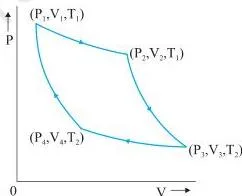
The four steps, in order (Eqs. 11.18–11.21, NCERT, p. 238):
- Isothermal expansion at \(T_1\) — the gas absorbs heat \(Q_1\), doing work \(W_{1 \to 2} = \mu R T_1 \ln(V_2/V_1)\).
- Adiabatic expansion — the gas cools from \(T_1\) to \(T_2\), doing work \(W_{2 \to 3} = \frac{\mu R (T_1 – T_2)}{\gamma – 1}\).
- Isothermal compression at \(T_2\) — the gas releases heat \(Q_2 = \mu R T_2 \ln(V_3/V_4)\) to the cold reservoir.
- Adiabatic compression — the gas warms from \(T_2\) back to \(T_1\), taking in work \(W_{4 \to 1} = \frac{\mu R (T_1 – T_2)}{\gamma – 1}\).
Memory device: “Iso-hot Expand, Adiabatic Cool, Iso-cold Compress, Adiabatic Heat.” Structurally: the two isotherms set the temperatures \(T_1\) (top) and \(T_2\) (bottom), and the adiabatics are the sloping sides connecting them — isotherms at top and bottom, adiabatics on the sides.
The efficiency of the Carnot engine is (Eq. 11.27, NCERT, p. 239):
\[ \eta = 1 – \frac{T_2}{T_1} \]
Using the adiabatic relations between the four states shows \(\ln(V_3/V_4) = \ln(V_2/V_1)\), which cancels in the efficiency expression to leave \(\eta = 1 – T_2/T_1\), with temperatures in kelvin (NCERT, p. 239).
Carnot’s theorem: no engine working between the same two temperatures can exceed Carnot efficiency, and that maximum efficiency is independent of the working substance.
The proof couples an irreversible engine to a Carnot refrigerator (Fig. 11.10): if the engine beat Carnot, the combined device would extract heat from the cold reservoir and turn it fully into work — a direct violation of the Second Law (NCERT, p. 239).
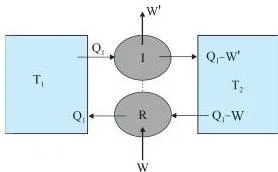
Reversing the Carnot cycle gives an ideal refrigerator. And because the efficiency result holds for any working substance, \(Q_1/Q_2 = T_1/T_2\) is a universal relation that can define a thermodynamic temperature scale independent of any particular substance (NCERT, p. 239).
Worked Examples with Stepwise Solutions
These use original numbers and the same sign conventions you must apply in the exam.
Worked Example 1: Isothermal Expansion of an Ideal Gas
Method: First Law for an isothermal process — \(\Delta U = 0\), so \(Q = W = \mu RT \ln(V_2/V_1)\).
- Step 1: List the data: \(\mu = 2.5\) mol, \(T = 350\) K, \(V_1 = 0.020\) m³, \(V_2 = 0.080\) m³, \(R = 8.31\) J mol⁻¹ K⁻¹.
- Step 2: Volume ratio \(V_2/V_1 = 0.080/0.020 = 4\), and \(\ln 4 \approx 1.386\).
\[ W = \mu RT \ln\left(\frac{V_2}{V_1}\right) = 2.5 \times 8.31 \times 350 \times 1.386 \]
\[ = 20.775 \times 350 \times 1.386 = 7271.25 \times 1.386 \approx 1.01 \times 10^{4}\ \text{J} \]
Step 3: \(\Delta U = 0\) for an ideal gas at constant temperature, so \(Q = W\).
Final answer: \(W = Q \approx 1.01 \times 10^{4}\ \text{J} \approx 10.1\ \text{kJ}\).
Worked Example 2: Adiabatic Compression of a Diatomic Gas
Method: Adiabatic work formula \(W = \frac{\mu R (T_1 – T_2)}{\gamma – 1}\), with \(W \gt 0\) meaning work done by the gas.
- Step 1: Data: \(\mu = 1.5\) mol, \(T_1 = 300\) K, \(T_2 = 410\) K, \(\gamma = 7/5 = 1.4\), \(R = 8.31\) J mol⁻¹ K⁻¹.
- Step 2: \(\Delta Q = 0\), so from the First Law \(\Delta U = -W\).
\[ W = \frac{\mu R (T_1 – T_2)}{\gamma – 1} = \frac{1.5 \times 8.31 \times (300 – 410)}{1.4 – 1} = \frac{12.465 \times (-110)}{0.4} \]
\[ W = \frac{-1371.15}{0.4} \approx -3.43 \times 10^{3}\ \text{J} \]
Step 3: The negative sign means work is done on the gas, so its internal energy rises and the temperature climbs from 300 K to 410 K.
Final answer: \(W \approx -3.4\ \text{kJ}\), i.e. about 3.4 kJ of work done on the gas.
Worked Example 3: Carnot Engine Efficiency
Method: Carnot efficiency \(\eta = 1 – T_2/T_1\), temperatures always in kelvin.
Step 1: Data: source \(T_1 = 520\) K, sink \(T_2 = 310\) K.
\[ \eta = 1 – \frac{T_2}{T_1} = 1 – \frac{310}{520} = 1 – 0.5962 \approx 0.404 \]
Step 2: Efficiency about 40.4%.
With \(Q_1 = 1200\) J absorbed per cycle:
\[ W = \eta Q_1 = 0.404 \times 1200 \approx 485\ \text{J}; \quad Q_2 = Q_1 – W = 1200 – 485 \approx 715\ \text{J} \]
Final answer: \(\eta \approx 0.404\) (40.4%), work \(\approx 485\) J per cycle, heat rejected \(\approx 715\) J.
Worked Example 4: Adiabatic Free Expansion
Method: First Law for an insulated free expansion — no heat, no work, so no change in internal energy.
- Step 1: Two equal cylinders joined by a stopcock — one holds gas, the other is evacuated; the whole system is thermally insulated.
- Step 2: Open the stopcock: the gas expands into vacuum.
\(W = 0\) because nothing pushes against it, and \(\Delta Q = 0\) because it is insulated.
\[ \Delta U = \Delta Q – W = 0 \]
Step 3: For an ideal gas, \(U\) depends only on temperature, so \(\Delta T = 0\).
Doubling the available volume at constant temperature halves the pressure via \(PV = \mu RT\).
Final answer: \(\Delta U = 0\), \(\Delta T = 0\); the gas occupies both cylinders at half the original pressure.
Thermodynamics: Common Mistakes and How to Fix Them
| Students write X | Correct is Y, because… | How to check your answer |
|---|---|---|
| “A gas in a given state contains a certain amount of heat” | It contains internal energy \(U\), not heat — heat is energy in transit, not a property of a state | Ask: does the quantity depend on the path? Heat does; \(U\) does not |
| \(\Delta W \gt 0\) when work is done on the gas | In \(\Delta Q = \Delta U + \Delta W\), \(\Delta W\) is work done by the system, so work done on it is negative | Write the sign convention before substituting numbers |
| Using \(PV^\gamma =\) constant for an isothermal process | Isothermal uses Boyle’s law \(PV =\) constant; \(PV^\gamma =\) constant is the adiabatic relation | Check what is fixed: \(T\) (isothermal) or \(\Delta Q = 0\) (adiabatic) |
| Putting \(\Delta U \neq 0\) in a cyclic process | A cyclic process returns to its initial state; since \(U\) is a state variable, \(\Delta U = 0\) and \(Q = W\) | Does the process end where it began? Then \(\Delta U = 0\) |
| “A gas has one specific heat” | Molar specific heat depends on the process, giving \(C_p\) and \(C_v\) with \(C_p – C_v = R\) | Ask how the heat is supplied — constant volume or constant pressure |
| Carnot efficiency with Celsius temperatures | \(T_2/T_1\) is a ratio of absolute temperatures — use kelvin | Convert \(T(\text{K}) = T(\text{°C}) + 273.15\) before substituting |
Exam Notes: What Actually Earns the Mark
- The sign convention earns the first mark. Writing \(\Delta Q = \Delta U + \Delta W\) with the correct signs for added or removed heat and for work by or on the system is a repeated marks earner — state it before substituting.
- The isothermal work formula \(W = \mu RT \ln(V_2/V_1)\) is frequently examined — show the \(\ln(V_2/V_1)\) step, never skip it.
- Carnot efficiency questions hinge on kelvin temperatures and on \(\eta = 1 – T_2/T_1\) being independent of the working substance.
- The divide-in-two rule for extensive versus intensive variables is a quick-check tool examiners like in reasoning questions.
- Compact results worth memorising: \(C_p – C_v = R\) for an ideal gas and \(C = 3R\) for solids.
- Points-to-ponder reasoning (NCERT, p. 242): a moving bullet is not hot because temperature tracks internal energy, not centre-of-mass kinetic energy — ideal for one-mark reasoning questions.
For the rest of the syllabus, the main Class 11 Physics notes page collects every chapter; the Class 11 notes hub and the wider CBSE notes index round out your revision plan.
One-Page Revision Summary for Thermodynamics
| Law / result | Key statement or formula | One exam reminder |
|---|---|---|
| Zeroth law | Two systems in thermal equilibrium with a third are in equilibrium with each other | It is the formal source of temperature |
| First law | \(\Delta Q = \Delta U + \Delta W\) | Sign convention: \(\Delta W \gt 0\) is work by the system |
| Specific heats | \(s = \frac{1}{m}\frac{\Delta Q}{\Delta T}\), \(C = \frac{1}{\mu}\frac{\Delta Q}{\Delta T}\), \(C = 3R\) (solids), \(C_p – C_v = R\), 1 cal = 4.186 J | Molar form for gases; carbon is the solids exception |
| Isothermal | \(W = \mu RT \ln(V_2/V_1)\), \(\Delta U = 0\) | Boyle: \(PV =\) constant |
| Adiabatic | \(W = \frac{\mu R(T_1 – T_2)}{\gamma – 1}\), \(PV^\gamma =\) constant, \(\Delta U = -W\) | Curve is steeper than the isotherm |
| Isobaric | \(W = P(V_2 – V_1) = \mu R(T_2 – T_1)\) | Heat raises \(U\) and does work |
| Isochoric | \(W = 0\), \(Q = \Delta U\) | All heat goes to internal energy |
| Cyclic | \(\Delta U = 0\), \(Q = W\) | Ends where it began |
| Second law | Kelvin–Planck (no perfect engine); Clausius (no perfect refrigerator) | Forbids \(\eta = 1\) and infinite coefficient of performance |
| Carnot engine | \(\eta = 1 – T_2/T_1\), \(Q_1/Q_2 = T_1/T_2\) | Kelvin; reversible; working substance irrelevant |
Sign-convention one-liner: heat added is \(+\), heat removed is \(-\); work done by the system is \(+\), work done on it is \(-\).
Points to ponder that students forget (NCERT, p. 242):
- Temperature tracks average internal energy, not centre-of-mass kinetic energy — a fired bullet is not hot because of speed.
- Thermodynamic equilibrium means macroscopic variables do not change with time; mechanical equilibrium means net force and torque are zero — different ideas.
- Even in thermodynamic equilibrium, the microscopic constituents keep moving — they are not in mechanical equilibrium.
- Heat capacity depends on the process the system undergoes, not just the substance.
- In an isothermal quasi-static process, heat flows even though the gas matches the reservoir temperature — because the temperature difference is infinitesimal.
Reference: NCERT Class 11 Physics textbook, chapter Thermodynamics.
Thermodynamics Class 11 Physics Notes: Frequently Asked Questions
Why does a gas heat up when compressed adiabatically but not isothermally?
In adiabatic compression \(\Delta Q = 0\), so the work done on the gas goes entirely into internal energy \((\Delta U = -W \gt 0)\); for an ideal gas \(U\) depends only on temperature, so the temperature rises. In isothermal compression the temperature is held fixed — any heat generated flows out to the reservoir, so \(\Delta U = 0\) and \(T\) stays constant (NCERT, p. 235).
What is the difference between heat and internal energy of a system?
Internal energy \(U\) is stored in the system — the sum of molecular kinetic and potential energies in the centre-of-mass frame — and depends only on the state. Heat is energy in transit due to a temperature difference; it is not a property of the state. “A gas contains internal energy” is meaningful; “a gas contains heat” is not (NCERT, p. 230).
Why can a Carnot engine never be 100 percent efficient?
Its efficiency is \(\eta = 1 – T_2/T_1\), which equals 1 only if \(T_2 = 0\) K — an unattainable absolute-zero sink. The Second Law also forbids it: Kelvin–Planck states that complete conversion of heat into work is impossible (NCERT, p. 239).
When do we take the work done by a gas as positive and when as negative?
In the First Law \(\Delta Q = \Delta U + \Delta W\), \(\Delta W\) is work done by the system. \(\Delta W \gt 0\) when the gas expands and does work on its surroundings; \(\Delta W \lt 0\) when work is done on the gas, as in compression (NCERT, p. 241).
How does the zeroth law define temperature, and why is it called the zeroth law?
If A and B are each in thermal equilibrium with C, they are in thermal equilibrium with each other — so all three share a common physical quantity, which is defined as temperature. R. H. Fowler named it in 1931, after the first and second laws existed, because as the foundation of temperature it must logically come before them (NCERT, p. 229).
Explore Class 11 Physics Notes
More for this chapter:
Class 11 Physics on LearnCBSE:
Related chapters: