
These kinetic theory class 11 notes condense NCERT Class 11 Physics Chapter 12 (Kinetic Theory, pp. 245–256) into revision-ready form. The chapter connects the microscopic motion of molecules to measurable gas properties — pressure, temperature, specific heats and molecular size.
This page gives you definitions, formulas with units, three fully solved numericals, a common-mistakes table and exam pointers. Work through it in order, or jump to any section from the contents below. When you need the full derivations and exercises, open the NCERT textbook itself.
What Kinetic Theory Explains: Chapter at a Glance
Kinetic theory rests on one assumption: a gas is a huge collection of tiny molecules in ceaseless random motion (NCERT, p. 245). Intermolecular forces are short-range, so they dominate in solids and liquids but can be neglected between gas molecules except during collisions. The whole chapter builds one logical chain:
- Molecular nature of matter — matter is made of atoms and molecules about \(10^{-10}\) m across; a gas is mostly empty space (p. 246).
- Ideal gas equation — \(PV = \mu RT = Nk_BT\) summarises the link between pressure, volume, temperature and amount of gas (p. 247).
- Pressure from collisions — molecules striking the container wall transfer momentum; that momentum transfer is the pressure we measure (p. 250).
- Temperature as molecular energy — the average translational kinetic energy per molecule is \(\frac{3}{2}k_BT\) (p. 251).
- Equipartition of energy — every energy mode receives \(\frac{1}{2}k_BT\), which predicts specific heats (p. 253).
- Mean free path — frequent collisions deflect molecules, which is why gases diffuse slowly despite fast molecules (p. 255).
The idea that matter is made of atoms is ancient — Kanada in sixth-century India and Democritus in Greece both conjectured it — but Dalton’s atomic theory and Avogadro’s hypothesis gave it experimental legs (NCERT, p. 246). The chapter’s payoff: from molecular motion you can derive gas pressure, interpret temperature, predict specific heats and estimate molecular sizes.
Kinetic Theory Class 11 Notes: Key Concepts and Laws
1. Molecular Nature of Matter: Why the Atomic Hypothesis Matters
The atomic hypothesis states that all things are made of atoms — little particles in perpetual motion, attracting each other at small separations and repelling when squeezed together (NCERT, p. 245). Modern instruments such as electron and scanning tunnelling microscopes let us see these molecules directly.
- Solids and liquids: atoms are tightly packed, roughly 2 Å (or \(2 \times 10^{-10}\) m) apart; intermolecular forces keep them together (NCERT, p. 246).
- Gases: interatomic distances stretch to tens of Å, so forces are negligible and molecules travel freely in straight lines.
- Mean free path preview: the average distance a molecule travels without colliding is called the mean free path, typically thousands of Å in a gas — far larger than the molecular size (p. 246).
A molecule is about \(10^{-10}\) m in size. Gases at ordinary pressure have molecules roughly 10 times farther apart than in solids, which is the simple reason gases are the easiest state to model.
2. Ideal Gas Equation and the Gas Laws It Contains
An ideal gas is defined as a gas that obeys \(PV = \mu RT\) exactly at all pressures and temperatures (NCERT, p. 247). No real gas is truly ideal, but every gas approaches ideal behaviour at low pressures and high temperatures, where molecules are far apart and interactions are negligible.
\[ PV = \mu RT = Nk_BT, \qquad P = nk_BT \]
Here \(\mu\) is the number of moles, \(N\) the number of molecules, \(n\) the number density (molecules per unit volume), \(T\) the absolute temperature in kelvin, \(R = 8.314\ \text{J mol}^{-1}\text{K}^{-1}\) the universal gas constant and \(k_B = 1.38 \times 10^{-23}\ \text{J K}^{-1}\) the Boltzmann constant.
A third useful form uses mass density \(\rho\) and molar mass \(M_0\): \(P = \rho RT/M_0\) (p. 247).
One mole contains Avogadro’s number of molecules: \(N_A = 6.02 \times 10^{23}\ \text{mol}^{-1}\). At STP (273 K, 1 atm) one mole of any gas occupies 22.4 litres, and its mass in grams equals its molecular weight (NCERT, p. 247). Equal volumes of all gases at the same temperature and pressure contain the same number of molecules — this is Avogadro’s hypothesis.
Fixing different variables in the ideal gas equation produces the classical gas laws:
| Law | Condition | Statement |
|---|---|---|
| Boyle’s law (p. 247) | \(\mu\) and \(T\) fixed | \(PV = \text{constant}\); pressure varies inversely with volume |
| Charles’ law (p. 248) | \(P\) fixed | \(V \propto T\); volume proportional to absolute temperature |
| Dalton’s law (p. 248) | mixture of non-interacting ideal gases | \(P = P_1 + P_2 + \dots\); total pressure is the sum of partial pressures |
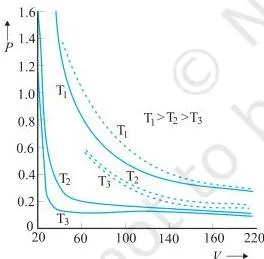
Figure 12.2 shows experimental pressure–volume curves for steam (solid lines) against Boyle’s law predictions (dotted lines). The curves coincide where pressure is low and temperature is high — exactly the regime where interactions are unimportant. This is your visual proof that the ideal gas model is a limit, not a fact.
3. Pressure of an Ideal Gas: The Wall Collision Argument
Pressure is macroscopic; molecular collisions are microscopic. The derivation connects them (NCERT, pp. 249–250). When a molecule with velocity \((v_x, v_y, v_z)\) hits a wall perpendicular to the x-axis, the collision is elastic: only \(v_x\) reverses, and the momentum given to the wall per collision is \(2mv_x\).
- In time \(\Delta t\), a molecule reaches the wall only if it starts within the distance \(v_x\Delta t\) of it — inside the volume \(Av_x\Delta t\).
- On average half the molecules in that volume move toward the wall; the other half move away.
- Molecules with velocity \((v_x, v_y, v_z)\) therefore transfer total momentum \(Q = (2mv_x)(\frac{1}{2}nAv_x\Delta t)\) to the wall.
- Pressure is momentum transferred per unit time per unit area: \(P = Q/(A\Delta t) = nmv_x^2\).
- Averaging over all molecules and using isotropy, \(\overline{v_x^2} = \overline{v_y^2} = \overline{v_z^2} = \frac{1}{3}\overline{v^2}\), gives the key result:
\[ P = \frac{1}{3}nm\overline{v^2} \]
Two assumptions carry the derivation: collisions are elastic, and molecular collisions do not disturb the steady velocity distribution (NCERT, p. 250). The container shape is irrelevant — for any shape take a small planar patch, repeat the argument, and \(A\) cancels. Pascal’s law then spreads the same pressure through the gas.
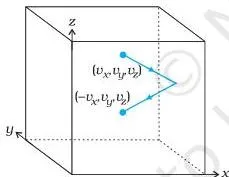
Reading the wall-collision diagram: the molecule approaches the wall with velocity components \((v_x, v_y, v_z)\) and leaves with \((-v_x, v_y, v_z)\). Only the x-component flips, which is why the impulse delivered to the wall is exactly \(2mv_x\) — a common exam question asks for exactly this change in momentum.
A fresh analogy: gas pressure is like steady hail drumming on a tin roof. Each hailstone delivers a tiny impulse; you never notice one stone, but the continuous rattle is a steady force spread over the roof. Each molecule does the same to the container wall — the reading on a pressure gauge is the time-averaged drumming of billions of collisions.
4. Kinetic Interpretation of Temperature and rms Speed
Combine the kinetic result with the ideal gas equation. Since the internal energy \(E\) of an ideal gas is purely translational, \(E = N\cdot\frac{1}{2}m\overline{v^2}\), and \(PV = \frac{2}{3}E\) (NCERT, p. 251). Putting \(P = nk_BT\) gives the central result:
\[ \frac{1}{2}m\overline{v^2} = \frac{3}{2}k_BT \]
Temperature is a measure of the average translational kinetic energy per molecule — independent of pressure, volume and the nature of the gas (NCERT, p. 251). A heavier molecule at the same temperature simply moves more slowly. The one quantity connecting the microscopic and macroscopic worlds is the Boltzmann constant.
\[ v_{\text{rms}} = \sqrt{\frac{3k_BT}{m}} = \sqrt{\frac{3RT}{M}} \]
The square root of the mean squared speed is the root mean square (rms) speed, \(v_{\text{rms}} = \sqrt{\langle v^2\rangle}\). For nitrogen at 300 K, \(m = 4.65 \times 10^{-26}\) kg gives \(v_{\text{rms}} \approx 516\ \text{m/s}\) — of the order of the speed of sound (NCERT, p. 251). Lighter molecules always have the larger rms speed at a given temperature.
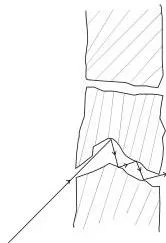
Figure 12.5 shows molecules passing through a porous wall; lighter molecules leak out faster. This is why the rate of diffusion is inversely proportional to the square root of molecular mass, and how uranium isotopes were separated for enrichment (NCERT, p. 252).
Why does rapid compression heat a gas? A moving piston behaves like a bat moving toward a ball: a molecule rebounding from an approaching piston leaves with increased speed, so average kinetic energy — and temperature — rise (NCERT, p. 252, Example 12.7).
5. Degrees of Freedom and the Law of Equipartition of Energy
A degree of freedom is one independent way a molecule can store energy, corresponding to one squared term in its energy expression (NCERT, p. 253).
| Molecule | Degrees of freedom | Energy terms |
|---|---|---|
| Monatomic (single atom) | 3 translational | \(\frac{1}{2}mv_x^2 + \frac{1}{2}mv_y^2 + \frac{1}{2}mv_z^2\) |
| Rigid diatomic (dumbbell) | 3 translational + 2 rotational | + \(\frac{1}{2}I_1\omega_1^2 + \frac{1}{2}I_2\omega_2^2\) |
| Diatomic with vibration | + 1 vibrational mode | + \(\frac{1}{2}m(dy/dt)^2 + \frac{1}{2}ky^2\) (two squared terms) |
A vibrational mode contributes two squared terms — kinetic and potential — so it counts as two modes of energy absorption (NCERT, p. 253).
The law of equipartition of energy states that in thermal equilibrium at absolute temperature \(T\), the total energy is shared equally among all energy modes, each mode receiving an average energy \(\frac{1}{2}k_BT\) (NCERT, p. 253). Translational and rotational degrees of freedom each earn \(\frac{1}{2}k_BT\); a vibrational mode, having both kinetic and potential parts, earns \(k_BT\).
6. Specific Heat Capacities of Gases and Solids
Applying equipartition gives the internal energy per mole \(U\); differentiating with respect to \(T\) gives \(C_v\), and \(C_p = C_v + R\) for every ideal gas (NCERT, p. 254). The difference \(C_p – C_v = R\) exists because at constant pressure the gas does expansion work as it heats, so it needs extra energy beyond the rise in internal energy.
| Gas type | Degrees of freedom | \(U\) per mole | \(C_v\) | \(C_p\) | \(\gamma = C_p/C_v\) |
|---|---|---|---|---|---|
| Monatomic | 3 | \(\frac{3}{2}RT\) | \(\frac{3}{2}R\) | \(\frac{5}{2}R\) | \(\frac{5}{3} \approx 1.67\) |
| Rigid diatomic | 5 | \(\frac{5}{2}RT\) | \(\frac{5}{2}R\) | \(\frac{7}{2}R\) | \(\frac{7}{5} = 1.40\) |
| Diatomic with vibration | 7 | \(\frac{7}{2}RT\) | \(\frac{7}{2}R\) | \(\frac{9}{2}R\) | \(\frac{9}{7} \approx 1.29\) |
| Polyatomic (with \(f\) vibrational modes) | \(6 + f\) | \((3+f)RT\) | \((3+f)R\) | \((4+f)R\) | \(\frac{4+f}{3+f}\) |
Memory pattern: each added mode adds \(\frac{1}{2}R\) to \(C_v\), and \(C_p\) is always \(C_v + R\). So \(C_v\) runs \(\frac{3}{2}R \rightarrow \frac{5}{2}R \rightarrow \frac{7}{2}R\), while \(\gamma\) falls \(\frac{5}{3} \rightarrow \frac{7}{5} \rightarrow \frac{9}{7}\). For polyatomic gases the same idea gives \(C_v = (3+f)R\), where \(f\) counts vibrational modes.
The predictions match measurement at ordinary temperatures: helium has \(C_v \approx 12.5\ \text{J mol}^{-1}\text{K}^{-1} = \frac{3}{2}R\), and oxygen and nitrogen sit near \(21\ \text{J mol}^{-1}\text{K}^{-1} \approx \frac{5}{2}R\) (NCERT, Tables 12.1 and 12.2, p. 254).
Solids: each atom vibrates about its mean position in three dimensions. A one-dimensional oscillation has average energy \(k_BT\), so in 3-D one atom has \(3k_BT\); one mole has \(U = 3RT\) and molar specific heat \(C = 3R \approx 25\ \text{J mol}^{-1}\text{K}^{-1}\) (NCERT, p. 255).
Aluminium, copper, lead, silver and tungsten all fit this prediction; carbon is the notable exception at about \(6.1\ \text{J mol}^{-1}\text{K}^{-1}\) (Table 12.3).
Notice the link to the next chapter: for an ideal gas, internal energy \(U = \frac{3}{2}Nk_BT\) depends only on temperature, not on volume or pressure — the starting point for the first law of thermodynamics, treated in the thermodynamics notes.
7. Mean Free Path: Why Gas Spreads Slowly
A gas leaking from a cylinder takes a long time to reach the opposite corner of a kitchen, even though molecules fly at hundreds of metres per second. The reason is that collisions constantly deflect them (NCERT, p. 255). The mean free path \(l\) is the average distance a molecule travels between two successive collisions.

Treat molecules as spheres of diameter \(d\). In time \(\Delta t\), a molecule with average speed \(\langle v\rangle\) sweeps a cylinder of volume \(\pi d^2\langle v\rangle\Delta t\); any molecule whose centre lies inside that cylinder collides with it.
The collision rate is \(n\pi d^2\langle v\rangle\), and because all molecules move, the average relative speed replaces \(\langle v\rangle\), introducing a factor \(\sqrt{2}\) (NCERT, p. 256):
\[ l = \frac{1}{\sqrt{2}\,n\pi d^2} \]
Reading the swept-volume diagram: the cylinder’s radius equals the molecule diameter \(d\), because two molecules collide when their centres come within distance \(d\). Wider molecules or denser gas mean a shorter cylinder before a collision — hence \(l\) depends inversely on both \(n\) and \(d^2\).
For air at STP, \(n = 2.7 \times 10^{25}\ \text{m}^{-3}\) and \(d = 2 \times 10^{-10}\) m give \(l \approx 2.9 \times 10^{-7}\) m \(\approx 1500d\) (NCERT, p. 256). In a highly evacuated tube \(n\) is tiny, so \(l\) can grow to the length of the tube itself.
Kinetic Theory Glossary: Terms You Need for Numericals
Look up any term here before attempting numericals — each meaning is in the form you will use it in a calculation.
| Term | Meaning | Example |
|---|---|---|
| Ideal gas | A gas obeying \(PV = \mu RT\) exactly at all pressures and temperatures; real gases approximate it at low \(P\) and high \(T\) | Helium at room pressure and temperature (p. 247) |
| Mole | Amount of substance containing \(N_A = 6.02 \times 10^{23}\) molecules; at STP it occupies 22.4 litres | 18 g of water = 1 mole (p. 247) |
| Avogadro number | Number of molecules in one mole, \(6.02 \times 10^{23}\ \text{mol}^{-1}\) | 1 mole of any gas at STP contains \(N_A\) molecules (p. 247) |
| Boltzmann constant | The universal conversion factor \(k_B = R/N_A = 1.38 \times 10^{-23}\ \text{J K}^{-1}\) linking energy per molecule to temperature | \(\frac{3}{2}k_BT\) = average kinetic energy per molecule (p. 251) |
| Number density | Number of molecules per unit volume, \(n = N/V\) | \(n = P/(k_BT)\) for an ideal gas (p. 247) |
| Partial pressure | Pressure a gas in a mixture would exert alone at the same volume and temperature | Dalton’s law: \(P = P_1 + P_2 + \dots\) (p. 248) |
| rms speed | Square root of the mean squared speed, \(v_{\text{rms}} = \sqrt{\langle v^2\rangle}\) | N₂ at 300 K: about 516 m/s (p. 251) |
| Degree of freedom | An independent squared energy term of a molecule | 3 translational for monatomic; 5 for rigid diatomic (p. 253) |
| Equipartition of energy | In equilibrium, energy is shared equally among modes, each getting \(\frac{1}{2}k_BT\) | Each rotational mode gets \(\frac{1}{2}k_BT\) (p. 253) |
| Mean free path | Average distance a molecule travels between successive collisions | Air at STP: \(2.9 \times 10^{-7}\) m (p. 256) |
| Molar specific heat \(C_v\) | Heat needed to raise 1 mole of gas by 1 K at constant volume | Monatomic gas: \(\frac{3}{2}R\) (p. 254) |
| Molar specific heat \(C_p\) | Heat needed to raise 1 mole of gas by 1 K at constant pressure | \(C_p = C_v + R\) for any ideal gas (p. 254) |
Kinetic Theory Formulas: Symbols, Units and When They Apply
This formula bank covers every equation the chapter derives. The page numbers point to where NCERT introduces each one.
| Formula | Symbols and units | Notes |
|---|---|---|
| \(PV = \mu RT = Nk_BT\) | \(P\): Pa; \(V\): m³; \(\mu\): mol; \(R = 8.314\ \text{J mol}^{-1}\text{K}^{-1}\); \(N\): molecules; \(T\): K | Ideal gas equation (p. 247) |
| \(P = nk_BT\) | \(n\): m⁻³; \(k_B = 1.38 \times 10^{-23}\ \text{J K}^{-1}\) | Number-density form (p. 247) |
| \(P = \rho RT/M_0\) | \(\rho\): kg m⁻³; \(M_0\): kg mol⁻¹ | Mass-density form (p. 247) |
| \(P = \frac{1}{3}nm\overline{v^2}\) | \(m\): kg per molecule; \(\overline{v^2}\): m² s⁻² | Pressure from kinetic theory (p. 250) |
| \(PV = \frac{2}{3}E\) | \(E = N\cdot\frac{1}{2}m\overline{v^2}\): J | Translational internal energy link (p. 251) |
| \(\frac{1}{2}m\overline{v^2} = \frac{3}{2}k_BT\) | \(T\): K | Temperature interpretation (p. 251) |
| \(v_{\text{rms}} = \sqrt{\frac{3k_BT}{m}} = \sqrt{\frac{3RT}{M}}\) | \(M\): kg mol⁻¹ | rms speed (Summary, p. 257) |
| Energy per equipartition mode \(= \frac{1}{2}k_BT\) | vibrational mode \(= k_BT\) | Per degree of freedom (p. 253) |
| \(C_p – C_v = R\) | J mol⁻¹ K⁻¹ | True for every ideal gas (p. 254) |
| \(C_v = \frac{3}{2}R\), \(\frac{5}{2}R\) or \(\frac{7}{2}R\) | monatomic / rigid diatomic / vibrating diatomic | From equipartition (p. 254) |
| Solid \(C = 3R\) | \(\approx 25\ \text{J mol}^{-1}\text{K}^{-1}\) | 3-D vibration of each atom (p. 255) |
| \(l = \frac{1}{\sqrt{2}n\pi d^2}\) | \(d\): m; \(n\): m⁻³ | Mean free path (p. 256) |
Worked Examples: rms Speed, Heat Required and Mean Free Path
Three numerical types dominate kinetic theory questions: rms speed, heat at constant volume, and mean free path. The method is named first in each, then applied stepwise.
Worked Example 1: rms Speed of CO₂ at 27 °C
Method: use \(v_{\text{rms}} = \sqrt{3k_BT/m}\), converting temperature to kelvin and molar mass to mass per molecule first.
- Step 1: Convert temperature to kelvin: \(T = 27 + 273 = 300\) K.
- Step 2: Mass per molecule from molar mass \(M = 44 \times 10^{-3}\) kg mol⁻¹:
\[ m = \frac{M}{N_A} = \frac{44 \times 10^{-3}}{6.02 \times 10^{23}} \approx 7.31 \times 10^{-26}\ \text{kg} \]
Step 3: Substitute \(k_B = 1.38 \times 10^{-23}\ \text{J K}^{-1}\):
\[ v_{\text{rms}} = \sqrt{\frac{3k_BT}{m}} = \sqrt{\frac{3 \times 1.38 \times 10^{-23} \times 300}{7.31 \times 10^{-26}}} \approx 412\ \text{m/s} \]
Final answer: \(v_{\text{rms}} \approx 4.1 \times 10^2\) m/s for CO₂ at 27 °C. CO₂ is heavier than N₂, so its rms speed is lower than nitrogen’s 516 m/s at the same temperature — a quick sanity check.
Worked Example 2: Heat to Raise 2.0 mol of N₂ by 10 K at Constant Volume
Method: identify the gas type first — N₂ is diatomic, treated as a rigid rotator, so \(C_v = \frac{5}{2}R\); at constant volume, \(Q = nC_v\Delta T\).
- Step 1: For a rigid diatomic gas, \(C_v = \frac{5}{2}R\).
- Step 2: Numerically, \(\frac{5}{2}R = 2.5 \times 8.314 \approx 20.8\ \text{J mol}^{-1}\text{K}^{-1}\).
- Step 3: At constant volume no work is done, so all heat goes into internal energy:
\[ Q = nC_v\Delta T = 2.0 \times 20.8 \times 10 \approx 416\ \text{J} \]
Final answer: \(Q \approx 4.2 \times 10^2\) J. Had the gas been heated at constant pressure, the same temperature rise would need \(nC_p\Delta T\) — more heat — because the gas would do expansion work.
Worked Example 3: Mean Free Path at 2.0 atm and 300 K
Method: compute number density from the ideal gas equation first (\(n = P/k_BT\)), then apply \(l = 1/(\sqrt{2}n\pi d^2)\).
- Step 1: Convert pressure to SI: \(P = 2.0\ \text{atm} = 2.0 \times 1.013 \times 10^5 \approx 2.03 \times 10^5\) Pa.
- Step 2: Number density from \(P = nk_BT\):
\[ n = \frac{P}{k_BT} = \frac{2.03 \times 10^5}{1.38 \times 10^{-23} \times 300} \approx 4.9 \times 10^{25}\ \text{m}^{-3} \]
Step 3: Apply the mean free path formula with \(d = 3.7 \times 10^{-10}\) m:
\[ l = \frac{1}{\sqrt{2}\,n\pi d^2} = \frac{1}{1.41 \times 4.9 \times 10^{25} \times 3.14 \times (3.7 \times 10^{-10})^2} \approx 3.4 \times 10^{-8}\ \text{m} \]
Final answer: \(l \approx 3.4 \times 10^{-8}\) m — about 90 molecular diameters. Doubling the pressure doubles \(n\), which alone would halve the STP value; the larger diameter \(d = 3.7 \times 10^{-10}\) m shortens it further because \(l \propto 1/d^2\).
Common Mistakes in Kinetic Theory and Their Corrections
These are the slips that cost marks most often. The right column states the rule; the last column gives a way to catch the error in your own work.
| Mistake | Correct rule | How to check your answer |
|---|---|---|
| Using \(C_v = \frac{3}{2}R\) for every gas | Only monatomic gases have \(C_v = \frac{3}{2}R\); a rigid diatomic gas has \(C_v = \frac{5}{2}R\) because it has 5 degrees of freedom | Count degrees of freedom first (3 translational + 2 rotational = 5), then \(C_v = \frac{5}{2}R\) |
| Writing mean free path as \(1/(n\pi d^2)\) | The correct form is \(l = \frac{1}{\sqrt{2}n\pi d^2}\) | Check for the \(\sqrt{2}\) — it comes from all molecules moving, not one molecule moving through stationary ones (p. 256) |
| Treating \(\langle v^2\rangle\) as \((\langle v\rangle)^2\) | The average of squares is not the square of the average | Test: for speeds 1 and 3, \(\langle v\rangle = 2\) but \(\langle v^2\rangle = 5\), not 4 (Points to Ponder, p. 258) |
| Using gauge pressure in \(PV = \mu RT\) | The ideal gas equation needs absolute pressure | Absolute = gauge + atmospheric; add the 1 atm before substituting (Exercise 12.4 uses gauge readings) |
| Forgetting \(C_p – C_v = R\) | The difference equals \(R\) for all ideal gases, monatomic or polyatomic | If your \(C_p – C_v \neq 8.31\ \text{J mol}^{-1}\text{K}^{-1}\), one value is wrong (p. 254) |
Exam Notes: How to Attempt Kinetic Theory Numericals
These are observed patterns in how kinetic theory questions are set — a working checklist, not a prediction. The first step shown is the one that earns the opening mark.
- Density or number density given → start from \(P = nk_BT\) or \(P = \rho RT/M_0\). This is the fastest route and the first mark in most ideal-gas numericals.
- rms speed comparisons → only temperature and molar mass matter. Since \(\frac{1}{2}m\langle v^2\rangle = \frac{3}{2}k_BT\), the composition of a mixture by mass is irrelevant: argon and chlorine at the same temperature give a per-molecule kinetic energy ratio of exactly 1:1 (NCERT, p. 252).
- Heat calculations → identify constant volume vs constant pressure first, then choose \(C_v\) or \(C_p\). A fixed cylinder means constant volume; heat required \(= nC_v\Delta T\).
- Convert °C to K before substituting. \(T = \theta + 273\); every gas law and rms speed formula needs absolute temperature.
- Quote \(R\), \(k_B\) and \(N_A\) correctly. \(R = 8.314\ \text{J mol}^{-1}\text{K}^{-1}\), \(k_B = 1.38 \times 10^{-23}\ \text{J K}^{-1}\), \(N_A = 6.02 \times 10^{23}\ \text{mol}^{-1}\). A wrong power of ten costs the whole answer.
- Mean free path questions → compute \(n\) from pressure first. \(n = P/(k_BT)\), then \(l = 1/(\sqrt{2}n\pi d^2)\). Check that pressure is in Pa.
- State the conclusion in words after the number. Answers that end with a bare value miss the point the examiner set — for example, “lower temperature gives lower rms speed.”
One-Page Revision Summary for Kinetic Theory
The night before the exam, run this chain: ideal gas equation → pressure from collisions → temperature as kinetic energy → equipartition → specific heats → mean free path (NCERT, pp. 257–258).
| Big idea | Key result |
|---|---|
| Ideal gas equation | \(PV = \mu RT = Nk_BT\), and \(PV = \frac{2}{3}E\) for translational energy \(E\) |
| Pressure from collisions | \(P = \frac{1}{3}nm\overline{v^2}\) |
| Temperature meaning | \(\frac{1}{2}m\overline{v^2} = \frac{3}{2}k_BT\); \(v_{\text{rms}} = \sqrt{3k_BT/m}\) |
| Equipartition | Each mode gets \(\frac{1}{2}k_BT\); a vibrational mode gets \(k_BT\) |
| Specific heats | Monatomic \(\frac{3}{2}R, \frac{5}{2}R, \frac{5}{3}\); rigid diatomic \(\frac{5}{2}R, \frac{7}{2}R, \frac{7}{5}\); vibrating diatomic \(\frac{7}{2}R, \frac{9}{2}R, \frac{9}{7}\); polyatomic \((3+f)R, (4+f)R\) |
| Mean free path | \(l = \frac{1}{\sqrt{2}n\pi d^2}\); air at STP \(\approx 2.9 \times 10^{-7}\) m \(\approx 1500d\) |
Constants box: \(R = 8.314\ \text{J mol}^{-1}\text{K}^{-1}\), \(k_B = R/N_A = 1.38 \times 10^{-23}\ \text{J K}^{-1}\), \(N_A = 6.02 \times 10^{23}\ \text{mol}^{-1}\).
Revise the neighbouring chapters too: internal energy and the first law are developed in the thermodynamics notes, and the vibrational modes counted here are one-dimensional oscillators — see the oscillations notes for simple harmonic motion. For every other chapter, go to the Class 11 Physics hub, the Class 11 notes hub, or the main CBSE notes index.
You can verify the full chapter text and exercises on the official NCERT textbook page for Class 11 Physics Part II.
Frequently Asked Questions About Kinetic Theory
Why is the average kinetic energy of a gas molecule (3/2) k_B T regardless of the gas?
Because the derivation forces it. The kinetic result \(P = \frac{1}{3}nm\overline{v^2}\) combined with the ideal gas equation \(P = nk_BT\) leaves \(\frac{1}{2}m\overline{v^2} = \frac{3}{2}k_BT\), and nothing in either equation refers to the mass or chemical nature of the molecule (NCERT, p. 251).
A heavier molecule simply has a smaller \(\overline{v^2}\), keeping the product \(m\overline{v^2}\) the same at a fixed temperature.
What is the difference between mean free path and the average distance between molecules?
The mean free path is the average distance a molecule travels between two successive collisions — for air at STP about \(2.9 \times 10^{-7}\) m, nearly 1500 molecular diameters (NCERT, p. 256).
The average intermolecular distance in a gas is far smaller, of the order of tens of Å (p. 246). A molecule crosses many empty gaps before it finally hits another, which is why the mean free path can be hundreds of times the spacing.
Why does a gas heat up when it is compressed rapidly by a piston?
A moving piston is like a bat moving toward a ball: a molecule rebounding from an approaching piston leaves with extra speed, so the average kinetic energy of the molecules rises, and temperature is exactly that average (NCERT, p. 252, Example 12.7). Slow compression lets heat escape to the surroundings; rapid compression does not, so the temperature climbs.
How can I remember the C_v and C_p values for monatomic, diatomic and polyatomic gases?
Count modes and add in steps of \(\frac{1}{2}R\). Monatomic: 3 modes \(\rightarrow C_v = \frac{3}{2}R, C_p = \frac{5}{2}R, \gamma = \frac{5}{3}\). Rigid diatomic: add 2 rotations \(\rightarrow C_v = \frac{5}{2}R, C_p = \frac{7}{2}R, \gamma = \frac{7}{5}\). Add vibration: 2 more squared terms \(\rightarrow C_v = \frac{7}{2}R, C_p = \frac{9}{2}R, \gamma = \frac{9}{7}\). \(C_p\)
is always \(C_v + R\), so you only ever need to remember \(C_v\).
When does the law of equipartition of energy fail for real gases?
Equipartition is a classical result, and real gases deviate from it whenever a mode cannot absorb the classical share of energy. Measured specific heats of gases such as \(Cl_2\) and \(C_2H_6\) exceed the simple predictions of Table 12.1, and agreement improves when vibrational modes are included (NCERT, p. 254).
One rotational mode of a diatomic molecule also stays inactive for quantum mechanical reasons (footnote, p. 253), so the rigid-rotator picture works best at moderate temperatures.
Reference: NCERT Class 11 Physics textbook, chapter Kinetic Theory.
Explore Class 11 Physics Notes
More for this chapter:
Class 11 Physics on LearnCBSE:
Related chapters: