
These Thermal Properties of Matter Class 11 notes condense NCERT Physics Part II Chapter 10 (pages 203–225) into a revision-ready form.
Every key concept is here — temperature and heat, temperature scales and absolute zero, thermal expansion, specific heat and calorimetry, latent heat and change of state, the three modes of heat transfer, and Newton’s law of cooling — with textbook page references so you can verify any claim in seconds.
If you are short on time, start with the formula sheet and the three worked examples, then scan the definitions table and common mistakes. The full explanations below are there when a concept resists memorising.
This page is part of our Class 11 Physics notes, and you can verify any formula against the official NCERT Physics Part II Chapter 10 PDF at ncert.nic.in.
Temperature Scales and the Absolute Scale
Heat is the form of energy transferred between two systems, or between a system and its surroundings, by virtue of a temperature difference (NCERT, p. 203). Its SI unit is the joule (J). Temperature is the relative measure of the hotness or coldness of a body; its SI unit is the kelvin (K), while °C is a commonly used unit.
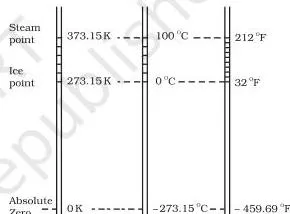
Thermometers use a measurable property that changes with temperature — the volume of mercury or alcohol in a liquid-in-glass thermometer. Any scale needs two fixed reference points: the ice point (0 °C = 32 °F) and the steam point (100 °C = 212 °F). The Celsius–Fahrenheit conversion follows from the straight-line graph between the two scales (Eq. 10.1, p. 204):
\[ \frac{t_F – 32}{180} = \frac{t_C}{100} \]
which is usually written as \(t_F = \frac{9}{5}t_C + 32\). Why does a gas thermometer beat a liquid one? Liquid thermometers disagree at intermediate temperatures because different liquids expand differently. Low-density gases, however, all obey the same laws, so a gas thermometer gives the same reading whatever gas is used (NCERT, p. 204).
At constant temperature, \(PV = \text{constant}\) (Boyle’s law); at constant pressure, \(V/T = \text{constant}\) (Charles’ law). For low-density gases these combine into the ideal-gas equation (Eq. 10.2, p. 204):
\[ PV = \mu RT \]
Here \(\mu\) is the number of moles and \(R = 8.31\ \text{J mol}^{-1}\ \text{K}^{-1}\) is the universal gas constant. The same equation returns in thermodynamics, so fix it firmly now.
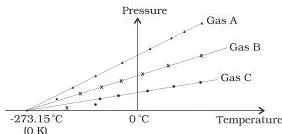
At constant volume the equation gives \(P \propto T\), which is how a constant-volume gas thermometer reads temperature by pressure. Extrapolating the straight P–T lines for different gases to zero pressure gives the same temperature for all of them: −273.15 °C, called absolute zero (NCERT, p. 205). At absolute zero, molecular activity is the least possible.
The Kelvin scale takes this as its zero, and because the kelvin and Celsius units are the same size (Eq. 10.3, p. 205):
\[ T = t_c + 273.15 \]
The modern fixed point of thermometry is the triple point of water, assigned exactly 273.16 K (NCERT, p. 212). It is preferred over the ice and steam points because it is a unique, reproducible condition, while melting and boiling points shift with pressure.
Thermal Expansion: Linear, Area and Volume
The increase in the dimensions of a body due to an increase in its temperature is called thermal expansion (NCERT, p. 205). Expansion in length is linear expansion, in area it is area expansion, and in volume it is volume expansion, as Fig. 10.5 shows.
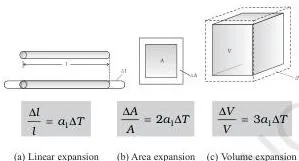
For a rod, the fractional change in length is directly proportional to the temperature change (Eq. 10.4, p. 205):
\[ \frac{\Delta l}{l} = \alpha_l \Delta T \]
Here \(\alpha_l\) is the coefficient of linear expansion, a property of the material with unit K⁻¹. The corresponding volume definition (Eq. 10.5, p. 206) is \[ \alpha_v = \left(\frac{\Delta V}{V}\right)\frac{1}{\Delta T} \]
Typical values from Tables 10.1–10.2 (pp. 205–206): aluminium \(2.5\), copper \(1.7\), iron \(1.2\) (all \(\times 10^{-5}\ \text{K}^{-1}\)) for linear expansion; mercury \(18.2\), water \(20.7\), alcohol \(110\) (all \(\times 10^{-5}\ \text{K}^{-1}\)) for volume expansion. Metals expand about five times more than pyrex glass for the same rise in temperature.
The three coefficients are related. Imagine a cube of side \(l\) that expands equally in all directions. Then, neglecting the \((\Delta l)^2\) and \((\Delta l)^3\) terms because \(\Delta l\) is small compared with \(l\) (Eqs. 10.7–10.8, p. 207):
\[ \Delta V = (l + \Delta l)^3 – l^3 = 3l^2\Delta l = 3V\alpha_l\Delta T \]
\[ \alpha_v = 3\alpha_l \]
Memory device: LAV 1–2–3. Linear expansion involves one direction (\(\alpha_l\)), Area involves two directions (\(2\alpha_l\)), Volume involves three directions (\(3\alpha_l\)). A rod can grow only in length, a sheet in two directions, a cube in three — the more directions that expand, the larger the coefficient.
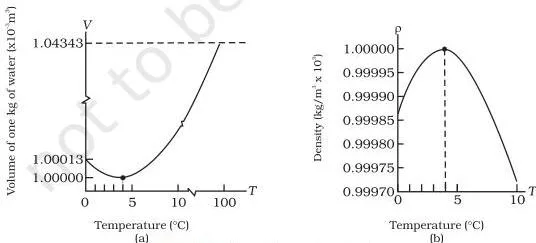
Water breaks the pattern. It contracts on heating between 0 °C and 4 °C and has its maximum density at 4 °C (NCERT, p. 207, Fig. 10.7). This is why lakes freeze at the top first:
- Surface water cools, becomes denser and sinks; warmer bottom water rises.
- This circulation continues until the whole body of water reaches 4 °C.
- Further cooling makes the surface layer less dense than the water below, so it stays on top and freezes.
- The ice sheet insulates the water beneath, preserving aquatic life.
If water behaved normally, lakes would freeze from the bottom up and destroy their plant and animal life.
If a rod is prevented from expanding, the rigid supports compress it. The compressive strain is \(\Delta l/l = \alpha \Delta T\), so the thermal stress developed is \[ \text{stress} = Y\frac{\Delta l}{l} = Y\alpha\Delta T \]
NCERT’s steel-rail example (pp. 207–208): a 5 m rail of cross-section 40 cm², prevented from expanding while the temperature rises 10 °C, develops a strain of \(1.2 \times 10^{-4}\), a stress of \(2.4 \times 10^{7}\ \text{N m}^{-2}\), and a force of about \(10^{5}\ \text{N}\) — enough to bend the rails. This is why blacksmiths heat iron rings before fitting them and why rails need expansion gaps.
Specific Heat Capacity and Calorimetry
The heat needed to warm a substance is characterised by three quantities (Eqs. 10.10–10.12, pp. 208–209):
\[ S = \frac{\Delta Q}{\Delta T} \quad \text{(heat capacity, J K}^{-1}\text{)} \]
\[ s = \frac{1}{m}\frac{\Delta Q}{\Delta T} \quad \text{(specific heat capacity, J kg}^{-1}\text{ K}^{-1}\text{)} \]
\[ C = \frac{1}{\mu}\frac{\Delta Q}{\Delta T} \quad \text{(molar specific heat capacity, J mol}^{-1}\text{ K}^{-1}\text{)} \]
For gases, two molar specific heats are defined: \(C_p\) with pressure held constant and \(C_v\) with volume held constant (NCERT, p. 209). The difference between them is explained in the kinetic theory of gases notes.
Water has the highest specific heat capacity among common substances: 4186 J kg⁻¹ K⁻¹ (Table 10.3, p. 209). This single number explains several everyday effects:
- Automobile radiators and hot-water bags use water because it absorbs or releases a lot of heat for a small temperature change.
- Land heats and cools faster than the sea. By day, air over warm land rises and cooler sea air moves in — the sea breeze; at night the cycle reverses.
- Deserts heat up quickly by day and cool quickly at night because sand has a small specific heat.
Why? A high specific heat means 1 kg of water needs 4186 J to warm by 1 K, so it soaks up engine heat without boiling. The same reasoning keeps the sea cooler than the land by day and warmer by night.
Calorimetry is the measurement of heat. The working principle: when a hot body meets a cold body in an isolated system, heat lost by the hot body = heat gained by the cold body (NCERT, p. 210).
A calorimeter is a metallic vessel with a stirrer of the same material (copper or aluminium), kept inside a wooden jacket packed with an insulator such as glass wool. The outer jacket acts as a heat shield and a thermometer dips in through an opening (p. 210).
The calorimeter itself absorbs heat, so its mass and specific heat must be added to the heat-gained side — the worked Example 2 shows the full method.
Change of State, Latent Heat and the Triple Point
During a change of state, the temperature of a substance stays constant even though heat keeps flowing in or out (NCERT, p. 211, Fig. 10.9). The heat is used to change the state, not to raise the temperature.
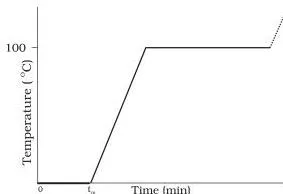
- Melting or fusion: solid → liquid; the coexistence temperature is the melting point.
- Freezing: liquid → solid.
- Vaporisation: liquid → vapour; the coexistence temperature is the boiling point.
- Sublimation: solid → vapour directly, as with dry ice (solid CO₂) and iodine (p. 212).
Pressure changes the boiling point. The boiling point rises when pressure rises — that is how a pressure cooker works — and falls at high altitude, which is why cooking is difficult on hills (NCERT, p. 212). Why?
At higher pressure, vapour molecules are pushed back into the liquid, so the liquid must be heated to a higher temperature before its vapour pressure can match the external pressure.
Regelation (p. 211): a wire weighted with heavy blocks passes through an ice slab without splitting it. The increased pressure lowers the melting point, so ice melts just under the wire; once the wire has passed, the water refreezes above it. The same effect gives skating its film of lubricating water.
Latent heat is the heat per unit mass absorbed or released during a change of state at constant temperature (Eq. 10.13, p. 213):
\[ Q = mL, \qquad L = \frac{Q}{m} \]
\(L_f\) is the latent heat of fusion and \(L_v\) the latent heat of vaporisation. For water, \(L_f = 3.33 \times 10^{5}\ \text{J kg}^{-1}\) and \(L_v = 22.6 \times 10^{5}\ \text{J kg}^{-1}\) (Table 10.5, p. 213).
Fig. 10.12 plots temperature against heat for water: the flat portions at 0 °C and 100 °C are the phases where all added heat goes into the change of state, and the differing slopes of the rising segments show that ice, water and steam have different specific heats.
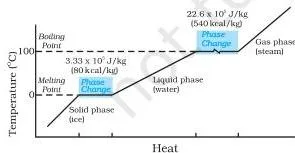
Steam burns are more serious than boiling-water burns because steam at 100 °C carries an extra \(22.6 \times 10^{5}\ \text{J kg}^{-1}\); when it condenses on the skin, it releases all that heat (NCERT, p. 213).
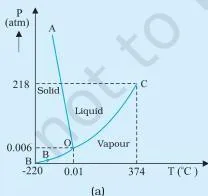
A P–T phase diagram divides the plane into solid, liquid and vapour regions, separated by the fusion curve, the vaporisation curve and the sublimation curve. The temperature and pressure at which all three curves meet — where all three phases coexist — is the triple point. For water, the triple point is at 273.16 K and \(6.11 \times 10^{-3}\ \text{Pa}\) (NCERT, p. 212).
Heat Transfer: Conduction, Convection and Radiation
Heat transfer takes place by three distinct modes: conduction, convection and radiation (NCERT, p. 214, Fig. 10.13).
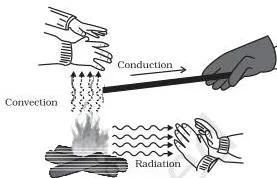
| Feature | Conduction | Convection | Radiation |
|---|---|---|---|
| Medium needed | Yes — solid or fluid | Yes — fluid only | No — travels through vacuum |
| Mechanism | Energy passed by molecular collisions | Bulk motion of heated fluid | Electromagnetic waves |
| Speed | Depends on the material’s conductivity | Slow fluid currents | Speed of light, \(3 \times 10^{8}\ \text{m/s}\) |
| Everyday example | Rod in a flame becomes hot along its length | Sea breeze, trade winds | Heat from the Sun reaching Earth |
In conduction, heat flows because neighbouring parts of a body are at different temperatures, with no flow of matter. For a bar of length \(L\) and uniform cross-section \(A\) with ends at temperatures \(T_c\) and \(T_D\) in the steady state, the heat current is (Eq. 10.14, p. 215):
\[ H = KA\frac{T_c – T_D}{L}, \qquad (T_c \gt T_D) \]
\(K\) is the thermal conductivity, with SI unit W m⁻¹ K⁻¹. In the steady state, the same heat current passes through every cross-section and the temperature falls uniformly along the bar. Metals conduct well — silver 406, copper 385 — while air is a poor conductor at 0.024 W m⁻¹ K⁻¹ (Table 10.6, p. 216). Why?
Metals have free electrons that carry energy rapidly; in gases the molecules are far apart, so collision-based energy transfer is slow.
Convection is heat transfer by the actual motion of matter — possible only in fluids. In natural convection, heated fluid expands, becomes less dense and rises under buoyancy; cooler fluid sinks to replace it. In forced convection, a pump or the heart drives the fluid — the human circulatory system and automobile cooling systems work this way (NCERT, p. 217).
Natural convection explains the sea breeze, and the same circulation on a global scale produces the trade winds (pp. 217–218). Because convection demands fluid flow, it uses the ideas developed in mechanical properties of fluids.
Radiation needs no medium: electromagnetic waves carry the energy at the speed of light, which is how the Sun heats the Earth across empty space (NCERT, p. 218). All bodies emit thermal radiation by virtue of their temperature.
Black or dark surfaces absorb and emit radiation better than light surfaces — hence white clothes in summer, dark clothes in winter, and blackened utensil bottoms. The Dewar flask silveres the inner and outer walls to reflect radiation and evacuates the space between them to stop conduction and convection (p. 218).
Thermal radiation has a continuous spectrum. For a blackbody, the wavelength \(\lambda_m\) at which energy is maximum obeys Wien’s displacement law (Eq. 10.15, p. 219):
\[ \lambda_m T = 2.9 \times 10^{-3}\ \text{m K} \]
As \(T\) rises, \(\lambda_m\) shifts to shorter wavelengths — that is why heated iron turns from dull red to reddish yellow to white hot, and why the law can estimate stellar surface temperatures: for the Sun, \(\lambda_m = 4753\ \text{Å}\) gives about 6060 K, and the moon’s 14 µm peak gives about 200 K (p. 219).
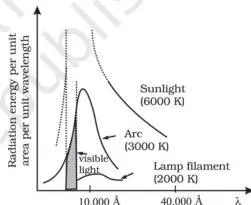
The total energy radiated per unit time is given by the Stefan–Boltzmann law (Eqs. 10.16–10.17, p. 219):
\[ H = Ae\sigma T^4 \]
Here \(\sigma = 5.67 \times 10^{-8}\ \text{W m}^{-2}\ \text{K}^{-4}\) is the Stefan–Boltzmann constant and \(e\) is the emissivity — 1 for a perfect radiator, about 0.4 for a tungsten filament. A body also receives radiation from its surroundings, so the net loss is (Eq. 10.18, p. 219):
\[ H = e\sigma A (T^4 – T_s^4) \]
Why kelvin here? The law is stated for absolute temperature, and because \(T\) appears to the fourth power, using Celsius would change the result enormously. Convert first, then substitute. The textbook works out a human body radiating about 66 W at rest (p. 219).
Newton’s Law of Cooling
Newton’s law of cooling states: the rate of loss of heat of a body is directly proportional to the difference of temperature between the body and its surroundings — valid only for small temperature differences (NCERT, p. 220).
\[ -\frac{dQ}{dt} = k(T_2 – T_1) \]
\(k\) is a positive constant depending on the area and nature of the surface (Eq. 10.19, p. 220). For a body of mass \(m\) and specific heat \(s\), \(dQ = ms\,dT_2\), so (Eqs. 10.20–10.21, p. 220):
\[ \frac{dT_2}{T_2 – T_1} = -\frac{k}{ms}dt = -K\,dt \]
Integrating gives the exponential form (Eqs. 10.22–10.23, p. 221):
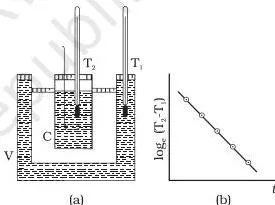
\[ \ln(T_2 – T_1) = -Kt + c \qquad \Rightarrow \qquad T_2 = T_1 + C’e^{-Kt} \]
The cooling curve in Fig. 10.19 shows the rate is highest at the start and falls as the body approaches room temperature.
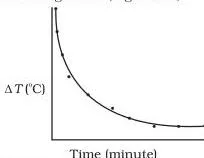
Why only small differences? For large \(\Delta T\), the radiation part of the loss behaves as \(T^4 – T_s^4\), which is not linear. For small \(\Delta T\), \(T^4 – T_s^4 \approx 4T_s^3(T – T_s)\) — a linear dependence — so conduction, convection and radiation together give one linear law.
Verification: the apparatus of Fig. 10.20 keeps a copper calorimeter of hot water inside a double-walled vessel; plotting \(\ln(T_2 – T_1)\) against time gives a straight line with negative slope, exactly as Eq. 10.22 predicts (p. 221).
Key Definitions at a Glance
| Term | Meaning | Example |
|---|---|---|
| Heat | Energy transferred by virtue of a temperature difference | Tea cools because heat leaves it to the air |
| Temperature | Relative measure of hotness or coldness of a body | 100 °C water is hotter than 0 °C ice |
| Thermal expansion | Increase in dimensions of a body on heating | Mercury rising in a thermometer |
| Coefficient of linear expansion (\(\alpha_l\)) | Fractional change in length per unit temperature change | \(\Delta l/l = \alpha_l\Delta T\); copper \(1.7 \times 10^{-5}\ \text{K}^{-1}\) |
| Coefficient of volume expansion (\(\alpha_v\)) | Fractional change in volume per unit temperature change | \(\Delta V/V = \alpha_v\Delta T\); water \(20.7 \times 10^{-5}\ \text{K}^{-1}\) |
| Heat capacity (\(S\)) | Heat required to change the temperature by one unit | \(S = \Delta Q/\Delta T\), unit J K⁻¹ |
| Specific heat capacity (\(s\)) | Heat per unit mass per unit temperature change | \(s = \frac{1}{m}\frac{\Delta Q}{\Delta T}\); water 4186 J kg⁻¹ K⁻¹ |
| Molar specific heat capacity (\(C\)) | Heat per mole per unit temperature change | \(C = \frac{1}{\mu}\frac{\Delta Q}{\Delta T}\), unit J mol⁻¹ K⁻¹ |
| Latent heat of fusion (\(L_f\)) | Heat per unit mass to melt a solid at constant temperature | \(3.33 \times 10^{5}\ \text{J kg}^{-1}\) for ice |
| Latent heat of vaporisation (\(L_v\)) | Heat per unit mass to vaporise a liquid at constant temperature | \(22.6 \times 10^{5}\ \text{J kg}^{-1}\) for water |
| Thermal conductivity (\(K\)) | Heat current per unit area per unit temperature gradient | Silver 406, air 0.024 W m⁻¹ K⁻¹ |
| Emissivity (\(e\)) | Fraction of blackbody radiation that a surface emits | \(e = 0.4\) for tungsten, about 0.97 for skin |
| Triple point | Unique temperature and pressure where solid, liquid and vapour coexist | Water: 273.16 K and \(6.11 \times 10^{-3}\ \text{Pa}\) |
| Absolute zero | Minimum possible temperature; zero of the Kelvin scale | −273.15 °C = 0 K |
| Regelation | Refreezing of water after pressure-induced melting | Wire passing through an ice slab |
Formula Sheet for Quick Revision
| Quantity | Formula | Symbols and units |
|---|---|---|
| Celsius–Fahrenheit conversion | \( \frac{t_F – 32}{180} = \frac{t_C}{100} \) | \(t_F\) in °F, \(t_C\) in °C |
| Ideal-gas equation | \( PV = \mu RT \) | \(\mu\) in mol; \(R = 8.31\ \text{J mol}^{-1}\ \text{K}^{-1}\) |
| Kelvin–Celsius relation | \( T = t_c + 273.15 \) | \(T\) in K, \(t_c\) in °C |
| Linear expansion | \( \frac{\Delta l}{l} = \alpha_l \Delta T \) | \(\alpha_l\) in K⁻¹ |
| Volume expansion | \( \frac{\Delta V}{V} = \alpha_v \Delta T \) | \(\alpha_v\) in K⁻¹ |
| Relation of coefficients | \( \alpha_v = 3\alpha_l \) | Area coefficient is \(2\alpha_l\) |
| Heat capacity | \( S = \frac{\Delta Q}{\Delta T} \) | J K⁻¹ |
| Specific heat capacity | \( s = \frac{1}{m}\frac{\Delta Q}{\Delta T} \) | J kg⁻¹ K⁻¹ |
| Molar specific heat | \( C = \frac{1}{\mu}\frac{\Delta Q}{\Delta T} \) | J mol⁻¹ K⁻¹ |
| Latent heat | \( Q = mL \) | \(L\) in J kg⁻¹ |
| Heat conduction | \( H = KA\frac{T_c – T_D}{L} \) | \(K\) in W m⁻¹ K⁻¹; steady state, \(T_c \gt T_D\) |
| Wien’s displacement law | \( \lambda_m T = 2.9 \times 10^{-3}\ \text{m K} \) | \(\lambda_m\) in m, \(T\) in K |
| Stefan–Boltzmann law | \( H = Ae\sigma T^4 \) | \(\sigma = 5.67 \times 10^{-8}\ \text{W m}^{-2}\ \text{K}^{-4}\) |
| Net radiation loss | \( H = e\sigma A(T^4 – T_s^4) \) | \(T_s\) = surroundings temperature in K |
| Newton’s law of cooling | \( -\frac{dQ}{dt} = k(T_2 – T_1) \) | Valid only for small \(T_2 – T_1\) |
Worked Examples with Step-by-Step Solutions
Example 1: Linear expansion of a copper rod
Method: apply the coefficient of linear expansion, \(\Delta l = l\alpha_l\Delta T\).
Step 1: Write the data.
\(l = 2.0\ \text{m}\), \(T_1 = 30\ ^\circ\text{C}\), \(T_2 = 130\ ^\circ\text{C}\), \(\alpha_l = 1.7 \times 10^{-5}\ \text{K}^{-1}\).
Step 2: Find the temperature change.
\(\Delta T = 130 – 30 = 100\ \text{K}\) — a change of 1 °C equals a change of 1 K, so the units match.
Step 3: Substitute into the formula.
\[ \Delta l = 2.0 \times 1.7 \times 10^{-5} \times 100 = 3.4 \times 10^{-3}\ \text{m} \]
Final answer: the rod lengthens by \(3.4 \times 10^{-3}\ \text{m} = 3.4\ \text{mm}\), so its new length is 2.0034 m.
Example 2: Specific heat of a metal by calorimetry
Method: principle of calorimetry — heat lost by the hot body = heat gained by the water and the calorimeter together.
Step 1: Data.
Metal block \(m = 0.20\ \text{kg}\) at 120 °C; water \(m_w = 0.50\ \text{kg}\) at 25 °C in a copper calorimeter \(m_c = 0.10\ \text{kg}\); final steady temperature 30 °C.
\(s_w = 4186\ \text{J kg}^{-1}\ \text{K}^{-1}\), \(s_{cu} = 386\ \text{J kg}^{-1}\ \text{K}^{-1}\).
Step 2: Heat lost by the metal: \(\Delta T_m = 120 – 30 = 90\ \text{K}\).
\[ Q_{\text{lost}} = m s \Delta T = 0.20 \times s \times 90 = 18s\ \text{J} \]
Step 3: Heat gained by water: \(\Delta T = 30 – 25 = 5\ \text{K}\).
\[ Q_w = 0.50 \times 4186 \times 5 = 10465\ \text{J} \]
Step 4: Heat gained by the calorimeter — this is the step students skip.
\[ Q_c = 0.10 \times 386 \times 5 = 193\ \text{J} \]
Step 5: Equate and solve.
\[ 18s = 10465 + 193 = 10658 \qquad \Rightarrow \qquad s = \frac{10658}{18} \approx 592\ \text{J kg}^{-1}\ \text{K}^{-1} \]
Final answer: \(s \approx 5.9 \times 10^{2}\ \text{J kg}^{-1}\ \text{K}^{-1}\), a value close to that of iron.
Example 3: Newton’s law of cooling — time for a stated fall
Method: for small intervals, use the average temperature of each interval and the relation \(\frac{\text{change in temperature}}{\text{time}} = K\Delta T\).
Step 1: First interval: body cools from 75 °C to 65 °C in 5 minutes; room is 25 °C.
Average temperature \(= (75 + 65)/2 = 70\ ^\circ\text{C}\), excess \(\Delta T = 70 – 25 = 45\ \text{K}\).
\[ \frac{10}{5} = K(45) \qquad \Rightarrow \qquad 2 = 45K \]
Step 2: Second interval: cool from 55 °C to 50 °C in unknown time \(t\).
Average \(= 52.5\ ^\circ\text{C}\), excess \(= 52.5 – 25 = 27.5\ \text{K}\).
\[ \frac{5}{t} = K(27.5) \]
Step 3: Divide the two equations to eliminate \(K\).
\[ \frac{10/5}{5/t} = \frac{45}{27.5} \qquad \Rightarrow \qquad \frac{2t}{5} = 1.636 \]
Step 4: Solve for \(t\).
\[ t = \frac{1.636 \times 5}{2} \approx 4.09\ \text{min} \]
Final answer: it takes about 4.1 minutes (≈ 4 min 6 s) to cool from 55 °C to 50 °C.
Common Mistakes Students Make
| Mistake | Correct rule | How to check your answer |
|---|---|---|
| Writing \(T = t_c + 273\) | \(T = t_c + 273.15\) | With 273.15 the melting point of ice works out to ≈ 0 °C; the triple point is fixed at 273.16 K |
| Putting °C into the Stefan–Boltzmann law | Always convert to kelvin first | \(T\) appears to the fourth power, so a 273 K origin shift changes \(H\) by a huge factor |
| Writing \(\alpha_v = 2\alpha_l\) | \(\alpha_v = 3\alpha_l\); the area coefficient is \(2\alpha_l\) | Picture a cube: all three directions expand — LAV 1–2–3 |
| Forgetting the calorimeter absorbs heat | Add \(m_{cal} s_{cal} \Delta T\) to the heat-gained side | Write: heat lost = heat gained by water + calorimeter + anything else that warms |
| Assuming water expands uniformly on heating | Water contracts from 0 °C to 4 °C; maximum density at 4 °C | Check Fig. 10.7: volume is minimum at 4 °C |
| Applying Newton’s law for large temperature differences | The law holds only for small \(T_2 – T_1\) | For large differences the radiation term \(T^4 – T_s^4\) is not linear in \(\Delta T\) |
Exam Notes: What Examiners Look For
This chapter is tested mostly through direct facts and short numericals. Observed patterns:
- The conversion \(t_F = \frac{9}{5}t_C + 32\) appears as a 1-mark direct question — write the formula first, then substitute.
- The derivation \(\alpha_v = 3\alpha_l\) is a standard 2–3 mark question — show the cube expansion and state that the \((\Delta l)^2\) and \((\Delta l)^3\) terms are neglected.
- In calorimetry, writing “heat lost = heat gained” first earns the method mark even if the arithmetic slips.
- The triple point of water (273.16 K) and absolute zero (−273.15 °C) are frequently asked one-line facts.
- In conduction problems, stating the steady-state condition — the heat current is the same at every cross-section — is the insight examiners expect.
- In Newton’s cooling numericals, using the average temperature of the interval is the step that earns the mark.
| Formula | How it is typically tested | Step that earns the mark |
|---|---|---|
| \(PV = \mu RT\) | Gas-thermometer numerical | Convert °C to kelvin before substituting |
| \(\Delta l = l\alpha_l\Delta T\) | Direct expansion numerical | State \(\Delta T\) in kelvin (same size as °C) |
| \(Q = mL\) | Ice → water → steam heating chain | List every stage: warm solid, melt, warm liquid, vaporise |
| \(H = KA(T_c – T_D)/L\) | Junction temperature of two rods | Equate the heat currents in the steady state |
| \(H = e\sigma A(T^4 – T_s^4)\) | Radiation numerical | Kelvin conversion plus \(T^4 – T_s^4\) written explicitly |
| Newton’s cooling | Time for a stated fall of temperature | Average temperature of each interval |
Revision Summary: Thermal Properties of Matter Class 11 Notes
A 5-minute read to anchor everything:
- Heat is energy transferred by a temperature difference; temperature measures hotness. Scales relate by \((t_F – 32)/180 = t_C/100\) and \(T = t_c + 273.15\); the triple point of water fixes 273.16 K.
- An ideal gas obeys \(PV = \mu RT\), with \(\mu\) in moles and \(R = 8.31\ \text{J mol}^{-1}\ \text{K}^{-1}\); extrapolating P–T lines to zero pressure gives absolute zero at −273.15 °C.
- Expansion: \(\Delta l/l = \alpha_l\Delta T\), \(\Delta V/V = \alpha_v\Delta T\), and \(\alpha_v = 3\alpha_l\) because a cube expands in three directions. Water is anomalous — maximum density at 4 °C, so lakes freeze top-first.
- Thermal stress: a rod that cannot expand develops stress \(Y\alpha\Delta T\) — the steel-rail problem.
- Specific heat: \(s = \frac{1}{m}\frac{\Delta Q}{\Delta T}\); water’s 4186 J kg⁻¹ K⁻¹ drives sea breezes and desert extremes. In calorimetry, never forget the calorimeter: heat lost = heat gained by everything that warms.
- Phase change: temperature stays constant during melting and boiling; \(Q = mL\) with \(L_f = 3.33 \times 10^{5}\) and \(L_v = 22.6 \times 10^{5}\ \text{J kg}^{-1}\) for water. Steam burns worse for the same reason.
- The triple point is where the fusion, vaporisation and sublimation curves meet — 273.16 K and \(6.11 \times 10^{-3}\ \text{Pa}\) for water.
- Heat transfer: conduction \(H = KA\Delta T/L\), convection moves fluids, radiation needs no medium. Wien: \(\lambda_m T = 2.9 \times 10^{-3}\ \text{m K}\); Stefan–Boltzmann: \(H = e\sigma A(T^4 – T_s^4)\).
- Newton’s cooling: \(-dQ/dt = k(T_2 – T_1)\), integrated form \(T_2 = T_1 + C’e^{-Kt}\), valid for small differences; the graph of \(\ln(T_2 – T_1)\) versus time is a straight line with negative slope.
These revision notes sit inside our Class 11 notes collection. When you are ready, move on to thermodynamics or browse all CBSE notes by class and subject.
Frequently Asked Questions
Why does water have maximum density at 4 °C and how does this affect lakes freezing?
Water contracts as it is cooled from room temperature down to 4 °C, so its volume is smallest and density greatest at 4 °C; below 4 °C it expands again (NCERT, p. 207). In a lake, surface water cools, becomes denser and sinks until the whole body is near 4 °C.
Further cooling makes the surface layer less dense, so it stays on top and freezes; the ice insulates the water below and protects aquatic life.
Why are steam burns more serious than boiling water burns?
Steam at 100 °C carries \(22.6 \times 10^{5}\ \text{J kg}^{-1}\) more heat than boiling water at 100 °C — its latent heat of vaporisation. When steam touches the skin it condenses and releases that heat directly onto the skin, while boiling water releases only the sensible heat of cooling (NCERT, p. 213).
Why must temperature be in kelvin in the Stefan–Boltzmann law?
The law \(H = e\sigma A(T^4 – T_s^4)\) is stated for absolute temperature. Because \(T\) is raised to the fourth power, using a Celsius value — which is off by 273 units — changes the result by an enormous factor, and the law would also predict radiation at what should be absolute zero. Always convert to kelvin first.
What is the difference between heat and temperature?
Heat is energy in transit caused by a temperature difference, measured in joules; temperature is a measure of hotness (K or °C) related to the average kinetic energy of the molecules.
They are different quantities: during a phase change a body absorbs heat at constant temperature, so temperature alone does not tell you how much heat a body holds (NCERT, pp. 203, 211).
Why does cooking take longer at high altitudes?
At high altitude the atmospheric pressure is lower, so water boils below 100 °C and food cooks at a lower temperature — hence it takes longer. A pressure cooker traps steam, raising the pressure and therefore the boiling point, so cooking is faster (NCERT, p. 212).
Reference: NCERT Class 11 Physics Part II textbook, chapter 10 (Thermal Properties of Matter).
Explore Class 11 Physics Notes
More for this chapter:
Class 11 Physics on LearnCBSE:
Related chapters: