
These units and measurement class 11 notes condense NCERT Chapter 1 into a revision-ready form. You will learn the SI system of base and derived units, the complete rule set for significant figures, how to round off numbers and perform arithmetic with measured values, and finally the concept of dimensions and dimensional analysis — the techniques to check equations and deduce relations.
Everything you need for a quick revision of this foundational chapter is here, with definitions, tables, worked examples, and exam pointers.
Chapter at a Glance: The Four Blocks of Units and Measurement
NCERT Chapter 1 (pages 1–10) is built from four logical blocks, taught in this order because each block depends on the previous one:
- Measurement and the SI system (pages 1–3): Why we need units, the seven base units, two supplementary dimensionless units, and units retained for daily use.
- Significant figures (pages 3–5): How to count the reliable digits in a measurement; the effect of changing units; scientific notation as the fix for ambiguity; order of magnitude.
- Arithmetic with significant figures (pages 5–7): The rules for rounding off and the two operation rules (multiplication/division vs addition/subtraction).
- Dimensions and dimensional analysis (pages 7–10): Dimension as power of base quantities; dimensional formula versus dimensional equation; the principle of homogeneity; checking equations; deducing relations.
A student who masters these four blocks in that sequence will find all the chapter’s numerical and conceptual questions manageable.
The SI System: Seven Base Units plus Radian and Steradian
Any measurement compares a physical quantity with an internationally accepted reference standard called a unit. The units for fundamental (base) quantities are base units; all other units, obtained by combining these, are derived units. The complete set — base units plus derived units — is a system of units.
Until recently, three older systems were common: the CGS (centimetre, gram, second), the FPS (foot, pound, second) and the MKS (metre, kilogram, second). Today the worldwide standard is the SI (Système International d’Unités), adopted and revised by the General Conference on Weights and Measures (NCERT, p. 1–2).
Comparison of the Four Systems
| System | Length | Mass | Time | Status |
|---|---|---|---|---|
| CGS | centimetre (cm) | gram (g) | second (s) | Older, replaced |
| FPS (British) | foot (ft) | pound (lb) | second (s) | Older, replaced |
| MKS | metre (m) | kilogram (kg) | second (s) | Older, replaced |
| SI (modern) | metre (m) | kilogram (kg) | second (s) | Globally accepted (2018 revision) |
Memory device: The seven base quantities of SI can be remembered by the mnemonic My Kind Supervisor Always Keeps Me Calm — Metre, Kilogram, Second, Ampere, Kelvin, Mole, Candela.
Seven SI Base Units (Table 1.1, NCERT, p. 2)
| Base quantity | Name | Symbol |
|---|---|---|
| Length | metre | m |
| Mass | kilogram | kg |
| Time | second | s |
| Electric current | ampere | A |
| Thermodynamic temperature | kelvin | K |
| Amount of substance | mole | mol |
| Luminous intensity | candela | cd |
The textbook notes that the detailed definitions (caesium frequency, Planck constant, etc.) need not be remembered for exams — only the names and symbols matter (NCERT, p. 2).
Supplementary Units: Plane Angle and Solid Angle
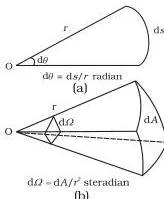
A plane angle is defined as the ratio of arc length to radius: \( d\theta = ds / r \). A solid angle is the ratio of intercepted spherical area to the square of the radius: \( d\Omega = dA / r^2 \). Both are ratios of like quantities, so they are dimensionless. Their SI units are the radian (rad) and the steradian (sr) respectively.
Some Units Retained for General Use (NCERT, Table 1.2, p. 3)
| Unit | Symbol | SI value |
|---|---|---|
| minute | min | 60 s |
| hour | h | 3600 s |
| litre | L | 10⁻³ m³ |
| tonne | t | 1000 kg |
| degree | ° | (π/180) rad |
Significant Figures: The Complete Rule Set
Significant figures are all the digits of a measured number that are known reliably plus the first one that is uncertain. Example: a period of 1.62 s has three significant figures — 1 and 6 are certain, 2 is uncertain. Changing units never changes the count: 4.700 m = 4.700 × 10² cm = 4.700 × 10³ mm, all have four figures (NCERT, p. 3).
Counting Rules (NCERT, pp. 3–4)
- All non-zero digits are significant.
- Zeros between two non-zero digits are significant. (e.g., 2.308 has four figures)
- Leading zeros in a decimal number less than 1 are not significant. (0.0023 has two)
- Trailing zeros without a decimal point are not significant. (12300 has three)
- Trailing zeros with a decimal point are significant. (3.500 has four)
- For numbers in scientific notation \( a \times 10^b \), all digits in \( a \) are significant. This removes ambiguity with trailing zeros. Example: 4.700 m written as 4.700 × 10⁻³ km still shows four significant figures (NCERT, p. 4).
- Exact numbers in formulas (like 2 in \( r = d/2 \), \( n \) in \( T = t/n \)) have infinite significant figures.
The order of magnitude of a number is the exponent \( b \) in \( 10^b \) after rounding \( a \) to 1 (if \( a \leq 5 \)) or to 10 (if \( a \gt 5 \)). Example: Earth’s diameter 1.28 × 10⁷ m has order 7; a hydrogen atom at 1.06 × 10⁻¹⁰ m has order −10 — a difference of 17 orders of magnitude (NCERT, p. 4).
Arithmetic with Significant Figures and the Rounding-Off Convention
The principle: the result of a calculation cannot be more precise than its least precise input (NCERT, p. 5).
Two Operation Rules
| Operation | Rule | Example |
|---|---|---|
| Multiplication/division | Keep the number of significant figures in the input with the least significant figures. | (4.237 g ÷ 2.51 cm³ = 1.688… → 1.69 g cm³) (three sig fig) |
| Addition/subtraction | Keep as many decimal places as the term with the fewest decimal places. | 436.32 g + 227.2 g + 0.301 g = 663.821 g → 663.8 g (one decimal place) |
WARNING: Do not apply the multiplication rule to addition, or vice versa (NCERT, p. 5). The result 664g would be wrong for the addition example; 3.00 × 10³ m would be wrong for the subtraction 0.307 m − 0.304 m = 0.003 m = 3 × 10⁻³ m (correct value).
Rounding Off the Digit 5 (NCERT, p. 5)
The rule for the digit 5 is elevated by convention: if the digit immediately after the last significant digit is exactly 5, look at the preceding digit:
| Preceding digit | Action | Example |
|---|---|---|
| Even | Drop the 5; leave the preceding digit unchanged. | 2.745 → 2.74 |
| Odd | Drop the 5; raise the preceding digit by 1. | 2.735 → 2.74 |
For complex multi-step calculations, keep one extra digit in intermediate steps to avoid cumulative round‑off error. For example, 1/9.58 = 0.1044 (not 0.104) and then later the reciprocal yields the original 9.58 (NCERT, p. 6–7).
Dimensions, Dimensional Formulae and Dimensional Equations
Dimensions are the powers to which the base quantities (length [L], mass [M], time [T], electric current [A], temperature [K], amount of substance [mol], luminous intensity [cd]) are raised to represent a physical quantity (NCERT, p. 7). In mechanics we only need [L], [M], [T].
Dimensional formula is the expression showing which base quantities form the quantity and their exponents. Dimensional equation equates the physical quantity to its dimensional formula.
| Physical quantity | Dimensional formula | Dimensional equation |
|---|---|---|
| Volume | \([M^0 L^3 T^0]\) | \([V] = [M^0 L^3 T^0]\) |
| Speed / velocity / all velocities | \([M^0 L T^{-1}]\) | \([v] = [M^0 L T^{-1}]\) |
| Acceleration | \([M^0 L T^{-2}]\) | \([a] = [M^0 L T^{-2}]\) |
| Force | \([M L T^{-2}]\) | \([F] = [M L T^{-2}]\) |
| Mass density | \([M L^{-3} T^0]\) | \([\rho] = [M L^{-3} T^0]\) |
| Energy / work | \([M L^2 T^{-2}]\) | \([E] = [M L^2 T^{-2}]\) |
| Pressure | \([M L^{-1} T^{-2}]\) | \([P] = [M L^{-1} T^{-2}]\) |
Note: The magnitude is ignored; average speed, instantaneous speed and any velocity share the same dimensions (NCERT, p. 7).
Dimensional Analysis: Homogeneity, Checking and Deducing Relations
Principle of Homogeneity (NCERT, p. 8)
Only quantities with identical dimensions can be added or subtracted. This is the fundamental check for equation correctness.
Check example: \( x = x_0 + v_0 t + \frac12 a t^2 \)
- \([x] = [L]\; [x_0] = [L]\)
- \([v_0 t] = [L T^{-1}][T] = [L]\)
- \([\frac12 a t^2] = [L T^{-2}][T^2] = [L]\)
Each term on the RHS has dimension [L] matching the LHS — dimensionally consistent (NCERT, p. 8).
Misconception autopsy: A dimensionally consistent equation is not necessarily exactly correct. It may be wrong due to (NCERT, p. 8):
- Wrong dimensionless constant (dimensional analysis cannot detect it)
- Missing dimensionless variable/multiple of similar dimensions (e.g., kinetic energy ½mv² and E = mgh have same dimensions but different meaning)
- Trigonometric/log/exponential arguments always must be dimensionless (NCERT, p. 8)
Application: Deducing Relations (NCERT, p. 9)
If a physical quantity \( T \) depends on \( l \), \( m \), \( g \), we write \( T = k l^x m^y g^z \), equate dimensions, and solve for exponents. The known dimensionless constant \( k \) must be found by experiment or prior knowledge.
Pendulum example: suppose \( T = k l^x m^y g^z \). Equating dimensions: [L⁰M⁰T¹] = [L¹]ˣ [L¹T⁻²]⁹ [M¹]⁹ → solving gives \( x = \frac12 \), \( y = 0 \), \( z = -\frac12 \) → \( T = k \sqrt{\frac{l}{g}} \). Actually \( k = 2\pi \) (NCERT, p. 9). The method cannot determine \( k \).
Key Terms and Definitions You Must Know
| Term | Meaning | Example |
|---|---|---|
| Measurement | Comparing a physical quantity with a chosen standard (unit) | Length of pencil = 15.0 cm |
| Unit | Arbitrarily chosen, internationally accepted reference standard used for comparison | metre, kilogram, second |
| Base quantity | One of the seven fundamental quantities in SI | Length, mass, time, electric current… |
| Base unit | Unit of a base quantity | m, kg, s, A, K, mol, cd |
| Derived unit | Unit obtained by combining base units | N (kg m s⁻²), J (kg m² s⁻²) |
| Significant figures | Reliable digits plus the first uncertain digit | 1.62 s has three |
| Order of magnitude | Exponent \( b \) of \( 10^b \) after rounding \( a \) to 1 or 10 | Earth’s diameter: order 7 |
| Dimension | Powers to which base quantities are raised | Force has [M L T⁻²] |
| Dimensional formula | Expression showing dimensions of base quantities | \( [v] = [M^0 L T^{-1}] \) |
| Dimensional equation | Equation equating a physical quantity with its dimensional formula | \( [v] = [M^0 L T^{-1}] \) |
| Principle of homogeneity | Only same_dimension quantities can be added or subtracted | x, x₀, v₀t, ½at² all have [L] |
Worked Examples (Original Numbers)
Example 1: Density and significant figures
Step 1: Write known data.
Mass = 8.46 g (3 sig fig), Volume = 2.4 cm³ (2 sig fig).
- Step 1: Compute density = mass / volume = 8.46 / 2.4 = 3.525 g cm⁻³.
- Step 2: The volume has only 2 sig fig, so round result to 2 sig fig.
3.5 → check next digit 2 5 → round down.
Final answer: Density = \( 3.5 \; \text{g cm}^{-3} \).
Example 2: Addition with decimal-place rounding
- Step 1: Add numbers 12.34 m + 2.1 m + 0.873 m.
- Step 2: Determine decimal places: 12.34 has two decimal places, 2.1 has one, 0.873 has three.
- Step 3: The term with the fewest decimal places is 2.1 (one decimal).
So the sum must be reported with one decimal place.
Step 4: Actual sum = 15.313 m → rounding to one decimal place: 15.3 m.
Final answer: \( 15.3 \; \text{m} \).
Example 3: Rounding the digit 5
Step 1: Round 3.685 to three significant figures.
The last digit to retain is 8; the next digit is 5.
Step 2: Preceding digit (8) is even.
So keep 8 unchanged, drop the 5.
Step 3: Similarly round 3.675 to three sig fig: preceding digit (7) is odd → raise to 8.
Final answers: 3.685 → \( 3.68 \), 3.675 → \( 3.68 \). (Both round to the same value by rule.)
Example 4: Consistency test for P = ρgh
- Step 1: Write dimensions of each symbol: [ρ] = [M L⁻³], [g] = [L T⁻²], [h] = [L].
- Step 2: Multiply dimensions: \( [\rho g h] = [M L^{-3}] [L T^{-2}] [L] = [M L^{-1} T^{-2}] \).
- Step 3: Dimensions of pressure \( [P] = [M L^{-1} T^{-2}] \) (force per area: \( [M L T^{-2}] / [L^2] \)).
Conclusion: The dimensions match — the equation \( P = \rho gh \) is dimensionally consistent.
Example 5: Deriving a relation for frequency of a string
Step 1: Suppose frequency \( f \) (dimension [T⁻¹]) depends on length \( L \) ([L]), tension \( F \) ([M L T⁻²]) and linear density \( μ ([M L⁻¹]).\lt /p\gt \lt p class=”icse-solution-step”\gt \lt strong\gt Step 2:\lt /strong\gt Write: \( f \propto L^x F^y μ^z \), i.e. \( f = k L^x F^y μ^z \).
- Step 1: Equate dimensions: \( [M^0 L^0 T^{-1}] = [L]^x \cdot [M L T^{-3}]^{y} \cdot [M L^{-1}]^{z} \).
- Step 2: Collect exponents: mass: \( y + z = 0 \); length: \( x + y – z = 0 \); time: \( -2y = -1 \).
Solving gives \( y = \frac12 \), \( z = -\frac12 \), \( x = -1 \).
Final form: \( f = \frac{k}{L} \sqrt{\frac{F}{\mu}} \). The constant \( k \) (later found to be 1/2) cannot be determined by dimensions alone.
Common Mistakes in Units and Measurement — and the Correct Fix
| Mistake | Correct Rule | How to check |
|---|---|---|
| Writing 4700 m has 4 significant figures (ignoring zeros trailing without decimal) | Trailing zeros without a decimal are not significant. 4700 m has 2 (4,7), not 4. | Write in scientific notation: \( 4.7 \times 10^3 \) m shows 2 sig fig. |
| Rounding 2.745 to 2.75 (always rounding 5 up) | Even prefix (4) → 5 dropped: 2.74; odd prefix (3) → 2.74 after raising. So both 2.745 and 2.735 give 2.74. | In exam, if unsure, practice with two numbers: \( 2.745 \to 2.74 \), \( 2.735 \to 2.74 \). The rule is not “5 always up”. |
| Adding numbers by fewest significant figures: 12.34 + 2.1 + 0.873 = 15.3 m (but wrongly: 15 m?) | Addition uses decimal places, not significant figures. The term with fewest decimal places decides: here 2.1 (one decimal) → result has one decimal: 15.3 m, not 15 m. | Count decimal places in each term, pick the smallest count, then round the sum to that many decimal places. |
| Assuming that a dimensionally consistent equation is always correct | It may still be wrong — dimensionless constants, missing quantities, incorrect function form. | Example: \( \frac12 \)mv² and mv² both have dimensions of energy; you need the correct coefficient. |
| Mixing up multiplication sign with addition rule in a combined problem | Always identify operation type: multiplication/division → sig fig as; addition/subtraction → decimal places. | Scan the entire operation: if you have both, break into steps, apply rule for each step, then combine. |
Exam Notes: How These Ideas Are Tested
The following patterns appear commonly in Class 11 physics exams (no specific year claims — these are consistent with the textbook approach):
- Density-type numerical: The mark is earned by identifying the input with the fewest significant figures. Volume with 2 sig fig limits the answer to 2 sig figs, not the mass with 4.
- Dimensional check questions: You must show the dimension of each term (\( x, v_0 t, \frac12\rangle at²) individually and then state they all have same dimension. A one-liner avoids the mark.\lt /li\gt \lt li\gt \lt strong\gt Rounding rule (digit 5 question):\lt /strong\gt A 1-mark question drilling “round 2.745 to three sig fig” or “round 2.735”. Remember the even/odd preceding digit rule – do NOT just round up always.\lt /li\gt \lt li\gt \lt strong\gt Exact number recognition:\lt /strong\gt Identifying that \( n \) in \( T = t/n \) (count of oscillations is exact) and 2 in \( r = d/2 \) have infinite significant digits stops false reduction in subsequent calculations.
- “Which formula can be ruled out?” format: In a multiple-choice context (like Example 1.4), check which options have different dimensions or add mismatched quantities. Dimensional analysis can rule out (a),(c),(e) that have \( m^2 v^2 \), \( ma \), and sum of differing dimensions, but cannot choose between (b) and (d) (NCERT, p. 9).
Revision Summary: One-Minute Recap Table
| Concept | Key rule | Quick example |
|---|---|---|
| SI Base Units | Seven: L (m), M (kg), T (s), A, K, mol, cd | Force uses kg, m, s: dimensions=M L T⁻² |
| Supplementary units | Radian (rad) and steradian (sr); dimensionless | Plane angle = arc/radius |
| Significant figures counting | Non-zero digits always significant; leading zeros no; trailing with decimal yes | 0.0304 has 3 sig fig; 304 has 3; 30400 has 3 |
| Multiplication / Division | Keep fewest sig fig | 8.46 g / 2.4 cm³ = 3.5 g cm³ (2 sig fig) |
| Addition / Subtraction | Keep fewest decimal places | 12.34 + 2.1 + 0.873 → 15.3 m (1 decimal) |
| Rounding digit 5 | Even prefix→drop; odd prefix→raise | 2.745→2.74; 2.735→2.74 |
| Dimension definition | Powers of base quantities [L], [M], [T] | Force: [M L T⁻²] |
| Dimensional analysis | Test of consistency (not proof of correctness) | Passes test: dimensions match; may still be wrong. |
Frequently Asked Questions
How many significant figures are in 0.0070 m² and why?
Two significant figures. In a number less than 1, leading zeros (the three zeros after the decimal) are not significant. The non-zero digit ‘7’ is significant, and the trailing zero after ‘7’ is significant because after a decimal point and after a non-zero digit, trailing zeros are significant. So the digits that matter are 7 and 0 → two significant figures. In scientific notation: 7.0 × 10⁻³ m².
Why are radian and steradian called dimensionless units?
Because they are both defined as ratios of like quantities: radian = arc length / radius → [L]/[L] = dimensionless; steradian = area / radius² → [L²]/[L²] = dimensionless. They are just treated as units (rad, sr) for convenience but have no physical dimension. (NCERT, p. 2)
What is the difference between a dimensional formula and a dimensional equation?
The dimensional formula shows the exponents of base quantities: e.g., \( [M^0 L T^{-1}] \) for speed. The dimensional equation is an equality statement: \( [v] = [M^0 L T^{-1}] \). In short, formula expresses the pattern; equation expresses the assignment. (NCERT, p. 7)
Why can dimensional analysis not find the value of the constant \( k \) in \( T = k \sqrt{\frac{l}{g}} \)?
Because the constant \( k \) is a pure dimensionless number. Dimensional analysis works only on dimensions (powers of length, mass, time). A dimensionless constant has zero dimension, so it contributes no equation to solve for its value. The actual value (here \( 2\pi \)) must come from experimental data or from a detailed model. (NCERT, p. 9)
Does a dimensionally consistent equation have to be exactly correct?
No. It may still be wrong (NCERT, p. 8–9).
A dimensionally consistent equation falls short because: it may miss a dimensionless constant (like \( k \) instead of \( 1/2 \) in kinetic energy sin) ; it may confuse quantities with same dimensions (e.g., work and torque both [M L² T⁻²] butare not identical physically) ; or it may have a correct dimensional match but an incorrect functional form (for example, it may be missing a factor that has dimensions but happens to match).
So consistency is a necessary but not sufficient condition for correctness.
Reference: NCERT Class 11 Physics Part I textbook, chapter 1 Units and Measurement.
Explore Class 11 Physics Notes
More for this chapter:
Class 11 Physics on LearnCBSE:
Related chapters:
Official source: download the NCERT textbook free from ncert.nic.in.