
This sheet collects the thermodynamics class 11 formulas you need most often from NCERT Chapter 11: the first law of thermodynamics, heat capacity and specific heats, the ideal gas equation of state, work done in isothermal, adiabatic, isobaric and isochoric processes, and the Carnot engine.
Every equation follows the NCERT sign convention: \( \Delta Q \) is heat supplied to the system and \( \Delta W \) is work done by the system. Each formula is grouped by topic, with the meaning and SI unit of every symbol, when-to-use guidance, and three worked examples using original numbers.
This sheet is part of the Class 11 physics formulas collection, and you can verify every equation against the official NCERT Physics Part II textbook (ncert.nic.in).
Thermodynamics Class 11 Formulas at a Glance
Quick index of the formulas on this sheet; the full list with conditions follows below.
| Purpose (what you are finding) | Formula |
|---|---|
| First law: connect heat, work and internal energy in any process | \( \Delta Q = \Delta U + \Delta W \) |
| Work done against a constant pressure | \( \Delta W = P\,\Delta V \) |
| First law in the constant-pressure form | \( \Delta Q = \Delta U + P\,\Delta V \) |
| Heat capacity of a substance | \( S = \dfrac{\Delta Q}{\Delta T} \) |
| Specific heat capacity (per unit mass) | \( s = \dfrac{1}{m}\dfrac{\Delta Q}{\Delta T} \) |
| Molar specific heat capacity (per mole) | \( C = \dfrac{1}{\mu}\dfrac{\Delta Q}{\Delta T} \) |
| Molar specific heat of a solid at ordinary temperatures | \( C = 3R \) |
| Relation between the molar specific heats of an ideal gas | \( C_p – C_v = R \) |
| Ideal gas equation of state | \( PV = \mu RT \) |
| Isothermal process: pressure-volume relation | \( PV = \text{constant} \) |
| Isothermal work and heat for an ideal gas, when \( \Delta U = 0 \) | \( Q = W = \mu R T \ln\left(\dfrac{V_2}{V_1}\right) \) |
| Adiabatic process: pressure-volume relation | \( PV^{\gamma} = \text{constant} \) |
| Ratio of specific heats | \( \gamma = \dfrac{C_p}{C_v} \) |
| Work done by an ideal gas in an adiabatic process | \( W = \dfrac{\mu R (T_1 – T_2)}{\gamma – 1} \) |
| Work done at constant pressure (isobaric) | \( W = P(V_2 – V_1) = \mu R (T_2 – T_1) \) |
| Cyclic process: net heat equals net work, since \( \Delta U = 0 \) | \( Q = W \) |
| Efficiency of any heat engine | \( \eta = \dfrac{W}{Q_1} = 1 – \dfrac{Q_2}{Q_1} \) |
| Maximum (Carnot) efficiency between two reservoirs | \( \eta = 1 – \dfrac{T_2}{T_1} \) |
| Carnot cycle: heat and temperature ratio | \( \dfrac{Q_1}{Q_2} = \dfrac{T_1}{T_2} \) |
All Formulas, Grouped by Topic
First Law of Thermodynamics
The first law is the principle of conservation of energy applied to a thermodynamic system: the heat \( \Delta Q \) supplied to the system goes partly into increasing its internal energy and partly into work done by the system (NCERT, p. 231).
\[ \Delta Q = \Delta U + \Delta W \]
For a gas, work done against a constant external pressure is \( \Delta W = P\,\Delta V \), where \( \Delta V \) is the change in volume. Substituting this gives the constant-pressure form (NCERT, p. 231):
\[ \Delta Q = \Delta U + P\,\Delta V \]
When \( \Delta U = 0 \) — for instance in the isothermal process of an ideal gas — all the heat supplied becomes work: \( \Delta Q = \Delta W \). Each term has the dimension of energy, \( [ML^{2}T^{-2}] \), in joules (NCERT, p. 241).
Sign convention used throughout the textbook (NCERT, p. 241):
| Situation in symbols | Meaning |
|---|---|
| \( \Delta Q \gt 0 \) | Heat is added to the system |
| \( \Delta Q \lt 0 \) | Heat is removed from the system |
| \( \Delta W \gt 0 \) | Work is done by the system |
| \( \Delta W \lt 0 \) | Work is done on the system |
Specific Heat Capacity
The heat capacity of a substance is the heat needed per unit temperature rise; dividing by mass or by the number of moles gives the two intensive forms (NCERT, pp. 231-232):
\[ S = \frac{\Delta Q}{\Delta T}, \qquad s = \frac{1}{m}\frac{\Delta Q}{\Delta T}, \qquad C = \frac{1}{\mu}\frac{\Delta Q}{\Delta T} \]
The unit of \( s \) is J kg-1 K-1 and of \( C \) is J mol-1 K-1. Both depend on the nature of the substance, its temperature and, for \( C \), the conditions under which heat is supplied.
For a solid at ordinary temperatures, the law of equipartition of energy gives (NCERT, p. 232):
\[ C = 3R \]
For an ideal gas, the molar specific heats at constant pressure and constant volume satisfy Mayer’s relation (NCERT, p. 232):
\[ C_p – C_v = R \]
Why it holds: the internal energy of an ideal gas depends only on temperature, so \( C_v = \Delta U/\Delta T \), and the one-mole ideal gas equation \( PV = RT \) gives \( P(\Delta V/\Delta T)_p = R \).
Old unit of heat: 1 cal = 4.186 J, defined as the heat needed to raise 1 g of water from 14.5°C to 15.5°C. The SI value for water is 4186 J kg-1 K-1 (NCERT, p. 232).
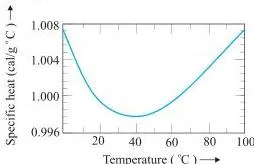
The graph shows why \( s \) is quoted with a stated temperature interval: even for water, the specific heat is not perfectly constant between 0 and 100°C (NCERT, p. 232). For a finite change this is the same as \( \Delta Q = m\,s\,\Delta T \), which is accurate when \( s \) is nearly constant over the interval.
Equation of State
Equilibrium states of a gas are described by state variables — pressure, volume, temperature, internal energy and mass. Heat and work are not state variables; their values depend on the path. The equation of state connects the state variables; for an ideal gas (NCERT, p. 233):
\[ PV = \mu RT \]
Internal energy \( U \), volume \( V \) and mass are extensive variables (they halve when the system is divided into two equal parts); pressure \( P \), temperature \( T \) and density \( \rho \) are intensive variables.
Isothermal Process
An isothermal process keeps temperature fixed. For an ideal gas the equation of state gives Boyle’s law (NCERT, p. 235):
\[ PV = \text{constant} \]
Work done by an ideal gas expanding isothermally from \( V_1 \) to \( V_2 \), and the heat absorbed, are equal because \( \Delta U = 0 \) for an ideal gas at constant \( T \) (NCERT, p. 235):
\[ Q = W = \mu R T \ln\left(\frac{V_2}{V_1}\right) \]
In expansion \( V_2 \gt V_1 \), so \( W \gt 0 \): the gas absorbs heat and does work. In compression the signs reverse.
Adiabatic Process
In an adiabatic process the system is insulated and no heat flows, so \( \Delta Q = 0 \). For an ideal gas the pressure and volume obey (NCERT, p. 235):
\[ PV^{\gamma} = \text{constant}, \qquad \gamma = \frac{C_p}{C_v} \]
Between two states, \( P_1 V_1^{\gamma} = P_2 V_2^{\gamma} \). The work done by the gas in an adiabatic change from \( (P_1, V_1, T_1) \) to \( (P_2, V_2, T_2) \) is (NCERT, pp. 235-236):
\[ W = \frac{\mu R (T_1 – T_2)}{\gamma – 1} = \frac{1}{1 – \gamma}\left(P_2 V_2 – P_1 V_1\right) \]
If the gas expands, \( W \gt 0 \) and the equation gives \( T_2 \lt T_1 \): the gas cools, because the work is done at the cost of its internal energy. Compression heats the gas.
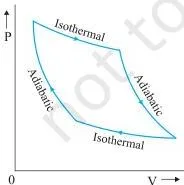
This P-V graph shows two adiabatic curves of an ideal gas connecting two isotherms (NCERT, p. 235). Because \( \gamma \gt 1 \), the adiabatic curve is steeper than an isotherm passing through the same state.
Isobaric and Isochoric Processes
Isobaric process (pressure fixed). Work done by the gas (NCERT, p. 236):
\[ W = P(V_2 – V_1) = \mu R (T_2 – T_1) \]
Temperature changes, so internal energy also changes; the heat absorbed goes partly into internal energy and partly into work.
Isochoric process (volume fixed). No work is done, \( W = 0 \), so all the heat goes into internal energy:
\[ \Delta Q = \Delta U \]
The temperature change for a given heat is governed by \( C_v \) at constant volume and by \( C_p \) at constant pressure.
Cyclic Process
In a cyclic process the system returns to its initial state, so \( \Delta U = 0 \). The first law then gives (NCERT, p. 236):
\[ Q = W \]
the total heat absorbed over the full cycle equals the total work done by the system.
Carnot Engine
The Carnot engine is the ideal reversible engine working between a hot reservoir at \( T_1 \) and a cold reservoir at \( T_2 \). Its cycle consists of two isothermal steps joined by two adiabatic steps (NCERT, pp. 238-239).
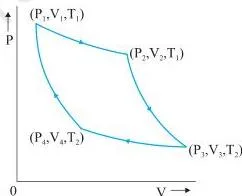
| Step | Process | Work done by the gas |
|---|---|---|
| \( 1 \rightarrow 2 \) | Isothermal expansion at \( T_1 \), heat \( Q_1 \) absorbed | \( W_{1 \rightarrow 2} = Q_1 = \mu R T_1 \ln\left(\frac{V_2}{V_1}\right) \) |
| \( 2 \rightarrow 3 \) | Adiabatic expansion, temperature falls to \( T_2 \) | \( W_{2 \rightarrow 3} = \frac{\mu R (T_1 – T_2)}{\gamma – 1} \) |
| \( 3 \rightarrow 4 \) | Isothermal compression at \( T_2 \), heat \( Q_2 \) released (work done on the gas) | \( W_{3 \rightarrow 4} = Q_2 = \mu R T_2 \ln\left(\frac{V_3}{V_4}\right) \) |
| \( 4 \rightarrow 1 \) | Adiabatic compression, temperature rises to \( T_1 \) (work done on the gas) | \( W_{4 \rightarrow 1} = \frac{\mu R (T_1 – T_2)}{\gamma – 1} \) |
The net work in one cycle is the difference of the two isothermal works (NCERT, p. 239):
\[ W = \mu R T_1 \ln\left(\frac{V_2}{V_1}\right) – \mu R T_2 \ln\left(\frac{V_3}{V_4}\right) \]
Efficiency is defined as work output per unit heat absorbed:
\[ \eta = \frac{W}{Q_1} = 1 – \frac{Q_2}{Q_1} \]
The two adiabatic steps give \( \frac{V_2}{V_3} = \frac{V_1}{V_4} \), so \( \frac{V_3}{V_4} = \frac{V_2}{V_1} \) and the volume logarithms cancel (NCERT, p. 239). The Carnot efficiency then depends only on the reservoir temperatures:
\[ \eta = 1 – \frac{T_2}{T_1} \]
A universal relation for the Carnot cycle (NCERT, p. 239):
\[ \frac{Q_1}{Q_2} = \frac{T_1}{T_2} \]
Carnot’s theorem: no engine working between the same two temperatures can have efficiency greater than this, and the Carnot efficiency is independent of the working substance (NCERT, p. 239). The two statements of the Second Law behind this limit are (NCERT, pp. 236-237):
- Kelvin-Planck statement: no process is possible whose sole result is the absorption of heat from a reservoir and the complete conversion of that heat into work.
- Clausius statement: no process is possible whose sole result is the transfer of heat from a colder object to a hotter object.
So an efficiency of \( \eta = 1 \) (a perfect heat engine) and an infinite coefficient of performance (a perfect refrigerator) are both impossible.
What Each Symbol Means
| Symbol | What it means | Unit |
|---|---|---|
| \( \Delta Q \) | Heat supplied to the system | J |
| \( \Delta W \) | Work done by the system | J |
| \( \Delta U \) | Change in internal energy of the system | J |
| \( P \) | Pressure | Pa (N m-2) |
| \( V_1, V_2 \) | Initial and final volumes | m3 (any matching unit when used as a ratio) |
| \( T_1, T_2 \) | Initial and final temperatures on the absolute scale | K |
| \( T \) | Temperature in an isothermal process | K |
| \( S \) | Heat capacity of a substance | J K-1 |
| \( s \) | Specific heat capacity (per unit mass) | J kg-1 K-1 |
| \( C \) | Molar specific heat capacity (per mole) | J mol-1 K-1 |
| \( C_p, C_v \) | Molar specific heats at constant pressure and constant volume | J mol-1 K-1 |
| \( m \) | Mass of the substance | kg |
| \( \mu \) | Number of moles | mol |
| \( R \) | Universal gas constant | J mol-1 K-1 |
| \( \gamma \) | Ratio of specific heats \( C_p / C_v \) | Dimensionless |
| \( Q_1 \) | Heat absorbed from the hot reservoir at \( T_1 \) | J |
| \( Q_2 \) | Heat released to the cold reservoir at \( T_2 \) | J |
| \( \eta \) | Efficiency of a heat engine | Dimensionless (often given as a percentage) |
Remember: \( \Delta Q \) and \( \Delta W \) are not state variables — they depend on the path taken — while \( \Delta U \) depends only on the initial and final states (NCERT, p. 231).
When to Use Each Formula
| Situation | Formula to use | Condition to check |
|---|---|---|
| Relating heat, internal energy and work in any process | \( \Delta Q = \Delta U + \Delta W \) | Always valid; settle signs first from the convention table |
| Finding work when pressure is constant | \( \Delta W = P\,\Delta V \) | \( P \) fixed; use m3 when \( P \) is in Pa |
| Heat needed for a given temperature rise | \( \Delta Q = m\,s\,\Delta T \) or \( \Delta Q = \mu C \Delta T \) | Use mass with \( s \), moles with \( C \) |
| Getting \( C_p \) from \( C_v \) or vice versa for a gas | \( C_p – C_v = R \) | Ideal gas only |
| Molar specific heat of a solid | \( C = 3R \) | Ordinary temperatures; carbon is an exception |
| Linking \( P, V, T \) of an ideal gas | \( PV = \mu RT \) | Equilibrium state; \( \mu \) in moles, \( T \) in kelvin |
| Process at fixed temperature (ideal gas) | \( Q = W = \mu R T \ln(V_2/V_1) \) | \( T \) constant, so \( \Delta U = 0 \) |
| No heat flow — insulated or very fast process | \( PV^{\gamma} = \text{constant} \); \( W = \frac{\mu R (T_1 – T_2)}{\gamma – 1} \) | \( \Delta Q = 0 \) |
| Work at constant pressure | \( W = P(V_2 – V_1) = \mu R (T_2 – T_1) \) | \( P \) fixed throughout |
| Process at constant volume | \( W = 0 \), \( \Delta Q = \Delta U \) | \( V \) fixed |
| Full cycle returning to the initial state | \( Q = W \) | \( \Delta U = 0 \) over the cycle |
| Maximum possible efficiency between two temperatures | \( \eta = 1 – T_2/T_1 \) | Reversible (Carnot) engine; \( T \) in kelvin; real engines give less |
Worked Examples
Example 1: First law with constant-pressure work
Given: \( \Delta Q = +200\ \text{J} \), \( P = 1.0 \times 10^{5}\ \text{Pa} \), \( V_1 = 2.0 \times 10^{-3}\ \text{m}^3 \), \( V_2 = 5.0 \times 10^{-3}\ \text{m}^3 \).
Step 1: Pressure is constant, so select \( \Delta W = P\,\Delta V \).
The gas expands, so \( \Delta V \) is positive and \( \Delta W \) is work done by the gas.
\[ \Delta W = (1.0 \times 10^{5})(5.0 \times 10^{-3} – 2.0 \times 10^{-3}) = 1.0 \times 10^{5} \times 3.0 \times 10^{-3} = 300\ \text{J} \]
Step 2: Apply the first law \( \Delta U = \Delta Q – \Delta W \).
Heat is supplied to the gas, so \( \Delta Q = +200\ \text{J} \); work is done by the gas, so \( \Delta W = +300\ \text{J} \).
\[ \Delta U = 200 – 300 = -100\ \text{J} \]
Final answer: \( \Delta U = -100\ \text{J} \). The gas did 300 J of work using 200 J of heat plus 100 J drawn from its internal energy, so its internal energy decreased by 100 J.
Example 2: Isothermal expansion of an ideal gas
Given: \( \mu = 3.0\ \text{mol} \), \( T = 350\ \text{K} \), \( V_1 = 4.0\ \text{L} \), \( V_2 = 12.0\ \text{L} \), \( R = 8.31\ \text{J mol}^{-1}\text{K}^{-1} \).
Step 1: Temperature is fixed, so this is an isothermal process.
For an ideal gas \( U \) depends only on \( T \), hence \( \Delta U = 0 \) and \( Q = W \).
Select \( W = \mu R T \ln(V_2/V_1) \).
The logarithm takes a volume ratio, so litres cancel — no unit conversion is needed.
\[ W = 3.0 \times 8.31 \times 350 \times \ln\left(\frac{12.0}{4.0}\right) = 8725.5 \times \ln 3 \]
\[ W = 8725.5 \times 1.0986 \approx 9.6 \times 10^{3}\ \text{J} \]
Final answer: \( W = 9.6 \times 10^{3}\ \text{J} \) and, since \( \Delta U = 0 \), the heat absorbed is \( Q = W = 9.6 \times 10^{3}\ \text{J} \).
Example 3: Carnot efficiency and work per cycle
Given: hot reservoir at \( T_1 = 600\ \text{K} \), cold reservoir at \( T_2 = 350\ \text{K} \), heat absorbed per cycle \( Q_1 = 1200\ \text{J} \).
Step 1: This is a reversible engine between two temperatures, so use \( \eta = 1 – T_2/T_1 \).
Both temperatures are already in kelvin, so substitute directly.
\[ \eta = 1 – \frac{350}{600} = 1 – \frac{7}{12} = \frac{5}{12} \approx 0.417 \]
Step 2: Work per cycle from \( \eta = W/Q_1 \).
\[ W = \eta\,Q_1 = \frac{5}{12} \times 1200 = 500\ \text{J} \]
Final answer: \( \eta \approx 0.417 \) (41.7%), and each cycle converts 500 J of the 1200 J of heat into work, releasing \( Q_2 = 1200 – 500 = 700\ \text{J} \) to the cold reservoir. Check: \( Q_1/Q_2 = 1200/700 \approx 1.71 \) equals \( T_1/T_2 = 600/350 \approx 1.71 \).
Common Mistakes to Avoid
| Mistake | Correct rule | How to check your answer |
|---|---|---|
| Using \( PV = \text{constant} \) for an insulated or very fast process | \( PV = \text{constant} \) holds only isothermally; adiabatic processes follow \( PV^{\gamma} = \text{constant} \) | Does heat flow? If \( \Delta Q = 0 \), the answer must involve \( \gamma \) |
| Applying \( \Delta Q = \Delta U + P\,\Delta V \) when pressure is not constant | The \( P\,\Delta V \) form needs constant pressure; otherwise \( \Delta W = \int P\,dV \) | Is \( P \) stated as fixed in the question? |
| Plugging temperatures in °C into \( \eta = 1 – T_2/T_1 \) | The Carnot formula needs absolute temperatures in kelvin | 27°C becomes 300 K; if \( T_2/T_1 \geq 1 \), you forgot to convert |
| Wrong sign for the logarithmic term in isothermal work | \( W = \mu R T \ln(V_2/V_1) \); expansion \( (V_2 \gt V_1) \) must give \( W \gt 0 \) | Check the direction: expansion means positive work by the gas |
| Using litres or kJ without converting inside \( P\,\Delta V \) | With \( P \) in Pa, use \( \Delta V \) in m3 (1 L = 10-3 m3); the \( \ln \) ratio cancels any matching unit | Convert first; gas-scale work values are of the order of hundreds to tens of thousands of joules |
| Taking \( C_p \) when the volume is fixed, or \( C_v \) when pressure is fixed | Constant volume \( \rightarrow C_v \); constant pressure \( \rightarrow C_p \); for an ideal gas \( C_p = C_v + R \) so \( C_p \gt C_v \) | Which variable is fixed in the process? Also \( \gamma = C_p/C_v \gt 1 \) |
| Sign error in \( \Delta U = \Delta Q – \Delta W \) | Heat added increases \( U \); work done by the system decreases \( U \) | Substitute signs from the convention table first, then compute |
Frequently Asked Questions
Why is the Carnot efficiency 1 – T2/T1 the maximum possible?
The Carnot engine is a completely reversible engine, and every irreversible effect (friction, viscosity, finite temperature differences) lowers work output for the same heat absorbed. Carnot’s theorem shows that if any engine beat it, the two engines could be coupled to convert heat from the cold reservoir entirely into work, contradicting the Kelvin-Planck statement (NCERT, p. 239).
The formula also shows that 100% efficiency would need \( T_2 = 0\ \text{K} \), which the Second Law rules out.
What is the difference between heat and internal energy?
Internal energy \( U \) is a state variable: it depends only on the present state of the system, not on how that state was reached.
Heat is energy in transit — “a gas in a given state has a certain amount of heat” is meaningless, while “a gas in a given state has a certain amount of internal energy” is meaningful (NCERT, p. 230).
When can I write Q = W?
Whenever \( \Delta U = 0 \). The two common cases are the isothermal process of an ideal gas (since \( U \) depends only on \( T \), constant temperature means no change in internal energy) and any cyclic process, where the system returns to its initial state (NCERT, pp. 231, 236).
When does Cp – Cv = R apply?
Mayer’s relation is derived from \( PV = \mu RT \) and from the fact that the internal energy of an ideal gas depends only on temperature, so it applies to ideal gases. It is not the same as \( C = 3R \), which is the molar specific heat of a solid at ordinary temperatures from the law of equipartition of energy (NCERT, p. 232).
For equations from other chapters, browse all physics formula sheets on this site.
Reference: NCERT Class 11 Physics textbook, chapter Thermodynamics.
Explore Class 11 Physics Formulas
More for this chapter:
Class 11 Physics on LearnCBSE:
Related chapters: