
These gravitation class 11 notes cover NCERT Chapter 7 in the order a teacher builds the subject: Kepler’s laws, Newton’s universal law of gravitation, the variation of \( g \) with height and depth, gravitational potential energy and escape speed, and finally satellite motion and orbital energy.
Every formula is given with its symbols and units, and each skill carries a fresh worked example with full steps, so you can revise the whole chapter from this single page the night before the exam.
Use the page in two passes. First read the teaching-order sections to fix the concepts; then drill the formula sheet, the common-mistakes table, and the ten-line recap at the end. The diagrams section shows how to read the figures the textbook asks you to interpret, and the exam notes tell you which exercises test which skill.
Reference: NCERT Class 11 Physics textbook, chapter Gravitation.
From Kepler to satellites: how this chapter is arranged
This is the teaching order, not just the textbook’s section order — each stage builds on the one before it.
- Kepler’s observational laws, extracted from Tycho Brahe’s naked-eye data, describe how planets actually move (NCERT, p. 129).
- Newton’s universal law of gravitation, the superposition principle and the two spherical-shell theorems (pp. 130–131).
- Acceleration due to gravity on, above and below the Earth’s surface (pp. 133–134).
- Gravitational potential energy and escape speed (pp. 135–137).
- Earth satellites — orbital speed, time period and orbital energy (pp. 138–139).
The chapter’s own Summary and physical-quantities table on pp. 140–141 are the revision core; everything on this page traces back to them. You can revise any other unit from the Class 11 Physics notes, or jump to the Class 11 notes home and the wider CBSE notes library.
The core ideas in teaching order
Work through the blocks below in order. Each one gives the student-friendly idea before the formula, because gravitation rewards understanding over memorising.
Kepler’s laws: orbits, equal areas, periods
Tycho Brahe spent a lifetime recording planetary positions; his assistant Johannes Kepler compressed that data into three laws of planetary motion (NCERT, p. 129).
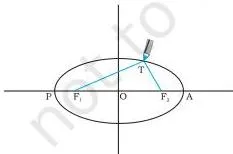
- Law of orbits: every planet moves in an ellipse with the Sun at one focus. In Fig 7.1(a), the closest point is P (perihelion) and the farthest is A (aphelion); PO = AO is the semimajor axis.
- Law of areas: the line joining a planet to the Sun sweeps equal areas in equal times. The planet moves faster near the Sun and slower far from it.
- Law of periods: the square of the period \( T \) is proportional to the cube of the semimajor axis \( a \): \( T^2 \propto a^3 \). Table 7.1 confirms that \( T^2/a^3 \) is nearly identical for all eight planets (p. 129).
Why the equal-area law holds: gravity is a central force, so the planet’s angular momentum \( L \) stays constant. The area swept per unit time is \[ \frac{\Delta A}{\Delta t} = \frac{L}{2m} \]
Since \( L = mrv \) is constant, \( \Delta A/\Delta t \) is constant — that is the law of areas (p. 129). The same conservation of angular momentum you meet in the systems of particles and rotational motion notes is doing the work here.
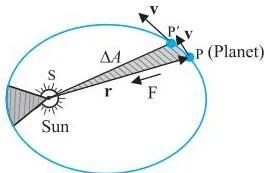
Perihelion–aphelion connection. From \( L = mr_pv_p = mr_Av_A \) we get \( v_p/v_A = r_A/r_p \) (Example 7.1). Because \( r_A \gt r_p \), the planet truly moves fastest at perihelion.
Analogy to lock it in: a figure skater pulling in her arms spins faster because her angular momentum is conserved. A planet does the same thing — gravity simply pulls its “arms in” near the Sun, so smaller \( r \) means larger \( v \) while \( mrv \) stays the same.
Newton’s universal law and the two shell results
Newton’s universal law of gravitation: every body in the universe attracts every other body with a force directly proportional to the product of their masses and inversely proportional to the square of the distance between them (NCERT, p. 130). In magnitude, \[ F = G\frac{m_1 m_2}{r^2} \]
In vector form, \( \mathbf{F} = -G\frac{m_1m_2}{r^2}\hat{\mathbf{r}} \). The minus sign means the force is attractive — it points from \( m_2 \) back toward \( m_1 \) — and by Newton’s third law \( \mathbf{F}_{12} = -\mathbf{F}_{21} \) (p. 131).
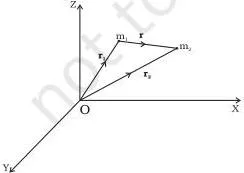
For a collection of point masses, the force on any one is the vector sum of the forces from all the others — the superposition principle. For extended bodies, two spherical-shell results do the work (p. 131):
- Outside a uniform spherical shell, the force acts as if the whole mass of the shell sat at its centre — the perpendicular components cancel, leaving a pull along the centre line.
- Inside a uniform spherical shell, the net force is zero — the pulls from different parts of the shell cancel exactly.
These two results let us treat the Earth as a point mass from outside, and ignore all shells outside a point inside the Earth.
Cavendish’s torsion balance (p. 132). Henry Cavendish (1798) measured G by letting the gravitational attraction between large and small lead spheres twist a suspended wire. At equilibrium the gravitational torque \( FL \) balances the restoring torque \( \tau\theta \):
\[ G\frac{Mm}{d^2}L = \tau\theta \]
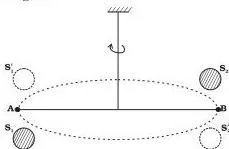
This gave \( G = 6.67 \times 10^{-11}\ \text{N m}^2 \text{kg}^{-2} \). Because knowing G, g and \( R_E \) fixes \( M_E = gR_E^2/G \), it is famously said that “Cavendish weighed the earth” (p. 133).
Why g changes with height and depth
On the Earth’s surface, any mass \( m \) feels \( F = GmM_E/R_E^2 \), so (NCERT, p. 133) \[ g = \frac{GM_E}{R_E^2} \approx 9.8\ \text{m s}^{-2} \]
Above the surface at height \( h \), the distance from the centre is \( R_E + h \), giving (p. 134) \[ g(h) = \frac{GM_E}{(R_E+h)^2} \]
For \( h \ll R_E \), the binomial expansion gives the exam-friendly form \( g(h) \approx g\left(1 – \frac{2h}{R_E}\right) \).
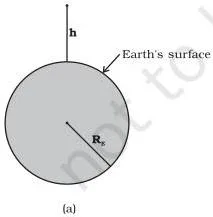
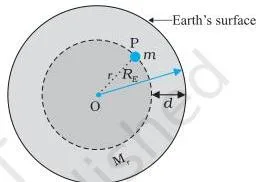
Below the surface at depth \( d \), the shell theorem removes the outer shell of thickness \( d \); only the inner sphere of radius \( R_E – d \) contributes, and its mass scales as the cube of its radius. The result is (p. 134) \[ g(d) = g\left(1 – \frac{d}{R_E}\right) \]
The memorable conclusion: g is maximum at the Earth’s surface and decreases whether you go up or down. Fig 7.7 shows the inside case — the outer shell carries the point and contributes zero force.
Gravitational potential energy to escape speed
Gravity is a conservative force, so it has a potential energy function (NCERT, p. 135). Near the surface, the work to lift mass \( m \) from height \( h_1 \) to \( h_2 \) is \( W_{12} = mg(h_2 – h_1) \), which is why the familiar \( U = mgh \) works there. But that formula is only an approximation for heights much smaller than \( R_E \).
At arbitrary distance \( r \) from the centre, integrating the inverse-square force gives the general result, with zero potential chosen at infinity:
\[ U(r) = -\frac{GM_E m}{r} \]
Only differences of potential energy have physical meaning; the arbitrary constant you add always cancels out of any difference (p. 135). For two masses \( m_1 \) and \( m_2 \) the same formula reads \( U = -Gm_1m_2/r \).
Escape speed. If a projectile just reaches infinity with speed tending to zero, its energy there is zero. Setting the launch energy equal to zero — kinetic plus potential — gives (p. 137) \[ v_e = \sqrt{\frac{2GM_E}{R_E}} = \sqrt{2gR_E} = 11.2\ \text{km s}^{-1} \]
The Moon’s escape speed is only about 2.3 km/s, because both its surface gravity and its radius are smaller. Gas molecules moving faster than this escape the Moon’s pull, which is why it has no atmosphere (p. 137).
Satellites: speed, period and energy
A satellite in a circular orbit of radius \( R_E + h \) needs a centripetal force, which gravity supplies (NCERT, p. 138):
\[ \frac{mV^2}{R_E+h} = \frac{GmM_E}{(R_E+h)^2} \quad\Rightarrow\quad V^2 = \frac{GM_E}{R_E+h} \]
So higher orbits have slower orbital speed. The time period follows from one circumference divided by \( V \):
\[ T = 2\pi\sqrt{\frac{(R_E+h)^3}{GM_E}} \]
This is Kepler’s third law applied to Earth satellites. For an orbit very close to the surface, \( T_0 = 2\pi\sqrt{R_E/g} \approx 85 \) minutes (p. 138).
Energy. With zero potential at infinity (NCERT, p. 139), \[ K = +\frac{GMm}{2r}, \qquad U = -\frac{GMm}{r}, \qquad E = K + U = -\frac{GMm}{2r} \]
The total energy is negative — that is the signature of a bound orbit. Kinetic energy is positive and equal in magnitude to half the potential energy. If the total energy were zero or positive, the object would escape to infinity.
Real application. Set \( T = 24 \) hours in the period equation and you get the single unique orbital height of a geostationary satellite — one that stays fixed over the same point on the equator. Communication satellites sit at exactly this height so their ground dishes never need re-aiming.
Reading the diagrams: ellipse, equal areas, shell and g
Examiners ask what a diagram shows, so learn to read these figures instead of memorising them. Now view Fig 7.10 below and note the two important marks in Fig 7.10 — the neutral point N where the pulls of masses \( M \) and \( 4M \) cancel, and the distance \( r = 2R \) measured from the centre of the lighter sphere.
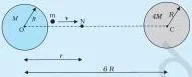
Equating \( GMm/r^2 = 4GMm/(6R-r)^2 \) gives \( r = 2R \) (Example 7.4). A projectile only needs the energy to reach N — after that, the heavier sphere’s pull completes the journey (p. 137). Treating a uniform solid sphere as if its whole mass sat at its centre is the same external-force picture you meet in the mechanical properties of solids notes.
For the other key figures: in Fig 7.1(a) locate the perihelion P, aphelion A and the semimajor axis OA. In Fig 7.2 the shaded sector is the area swept in a small time \( \Delta t \) — equal sectors in equal times is the second law.
In Fig 7.7 the point inside the Earth lies inside the outer shell, so that shell contributes zero force; in Fig 7.8(a) the point is above the surface and the whole Earth pulls. Each figure teaches exactly one idea: where the mass acts, and what cancels.
Term table: words you must be able to define in the exam
Definitions are rewritten for speed; units follow the chapter’s physical-quantities table (NCERT, p. 141).
| Term | Meaning | Example / value |
|---|---|---|
| Gravitational constant \( G \) | Universal constant in Newton’s law of gravitation | \( 6.67 \times 10^{-11}\ \text{N m}^2 \text{kg}^{-2} \) |
| Acceleration due to gravity \( g \) | Acceleration of a freely falling body due to a planet’s pull | \( \approx 9.8\ \text{m s}^{-2} \) on Earth |
| Gravitational potential energy | Work done to bring a mass from infinity to that point | \( U = -GMm/r \), zero at infinity (p. 135) |
| Gravitational potential | Potential energy per unit mass | \( U = -GM/r \), units \( \text{J kg}^{-1} \) (p. 141) |
| Gravitational intensity | Force per unit mass; equals g | \( \mathbf{g} = -(GM/r^2)\hat{r} \), vector, \( \text{m s}^{-2} \) (p. 141) |
| Escape speed | Minimum launch speed needed to reach infinity | \( 11.2\ \text{km s}^{-1} \) from Earth (p. 137) |
| Perihelion | Point of closest approach to the Sun | Planet moves fastest here (p. 129) |
| Aphelion | Point farthest from the Sun | Planet moves slowest here (p. 129) |
| Semimajor axis | Half the longest diameter of an ellipse, the \( a \) in Kepler’s third law | Half of \( PA \) in Fig 7.1(a) |
G versus g — know the difference.
| Property | \( G \) | \( g \) |
|---|---|---|
| Name | Universal gravitational constant | Acceleration due to gravity |
| Value | \( 6.67 \times 10^{-11}\ \text{N m}^2 \text{kg}^{-2} \) | \( \approx 9.8\ \text{m s}^{-2} \) on Earth |
| Universal? | Same everywhere in the universe | Changes with height, depth and planet (p. 134) |
| What it depends on | Nothing — a constant of nature | Mass and radius of the body: \( g = GM/R^2 \) |
Gravitation Class 11 Notes: formula sheet with meanings and units
Everything you need the night before, with every symbol and unit named; each entry is checked against the pages cited.
| Formula | Symbol meanings | Units | When it applies |
|---|---|---|---|
| \( F = G\frac{m_1m_2}{r^2} \) | \( m_1, m_2 \) masses, \( r \) separation | N | Point masses; outside a uniform sphere (p. 130) |
| \( g = \frac{GM}{R^2} \) | \( M \) planet mass, \( R \) its radius | \( \text{m s}^{-2} \) | Planet surface (p. 133) |
| \( g(h) \approx g\left(1-\frac{2h}{R}\right) \) | \( h \) height above surface, \( h \ll R \) | \( \text{m s}^{-2} \) | Small heights above surface (p. 134) |
| \( g(d) = g\left(1-\frac{d}{R}\right) \) | \( d \) depth below surface, uniform density | \( \text{m s}^{-2} \) | Below the surface (p. 134) |
| \( U = -\frac{Gm_1m_2}{r} \) | Potential energy, zero at infinity | J | Any separation (p. 135) |
| \( v_e = \sqrt{\frac{2GM}{R}} = \sqrt{2gR} \) | Escape speed from a body of mass \( M \), radius \( R \) | \( \text{m s}^{-1} \) | Launch from the surface (p. 137) |
| \( V = \sqrt{\frac{GM}{R+h}} \) | \( V \) orbital speed at height \( h \) | \( \text{m s}^{-1} \) | Circular orbit (p. 138) |
| \( T = 2\pi\sqrt{\frac{(R+h)^3}{GM}} \) | \( T \) time period of revolution | s | Circular orbit (p. 138) |
| \( K = +\frac{GMm}{2r} \) | Kinetic energy of orbiting mass \( m \) | J | Circular orbit (p. 139) |
| \( E = -\frac{GMm}{2r} \) | Total energy; negative for a bound orbit | J | Circular orbit (p. 139) |
Constants to quote: \( G = 6.67 \times 10^{-11}\ \text{N m}^2 \text{kg}^{-2} \), \( g \approx 9.8\ \text{m s}^{-2} \), escape speed from Earth \( = 11.2\ \text{km s}^{-1} \), low-orbit satellite period \( \approx 85 \) minutes.
Worked examples: fresh numbers, full steps
Three skills carry most of the marks in this chapter: the inverse-square behaviour of g, escape speed, and orbital energy changes. Each example names the method first and shows every substitution with units.
Height at which g drops to 8.8 m/s squared
Method: inverse-square law for g outside a spherical Earth.
- Step 1: Write the law for a point at height \( h \): \( g(h) = \frac{GM}{(R+h)^2} \), and at the surface \( g_0 = \frac{GM}{R^2} \).
- Step 2: Divide the two equations: \( \frac{g(h)}{g_0} = \left(\frac{R}{R+h}\right)^2 \).
- Step 3: Put in \( g_0 = 9.8\ \text{m s}^{-2} \), \( R = 6400\ \text{km} \), \( g(h) = 8.8\ \text{m s}^{-2} \).
- Step 4: Rearrange: \( R+h = R\sqrt{\frac{g_0}{g(h)}} = 6400 \times \sqrt{\frac{9.8}{8.8}} \approx 6400 \times 1.055 \approx 6752\ \text{km} \).
- Step 5: Subtract the Earth’s radius: \( h \approx 6752 – 6400 = 352\ \text{km} \).
Final answer: \( h \approx 352\ \text{km} \). Check: the ratio \( g(h)/g_0 = (6400/6752)^2 \approx 0.90 \), so g has fallen by about 1 m/s², as expected.
Escape speed from the Moon
Method: escape speed from a spherical body, \( v_e = \sqrt{2gR} \) (NCERT, p. 137).
- Step 1: Use the Moon’s surface gravity \( g = 1.6\ \text{m s}^{-2} \) and radius \( R = 1.74 \times 10^{6}\ \text{m} \): \( v_e = \sqrt{2 \times 1.6 \times 1.74 \times 10^{6}} \).
- Step 2: Multiply inside the root: \( 2 \times 1.6 \times 1.74 \times 10^{6} = 5.568 \times 10^{6} \).
- Step 3: Take the square root: \( v_e \approx 2.36 \times 10^{3}\ \text{m s}^{-1} \).
- Step 4: Convert to km/s: \( v_e \approx 2.36\ \text{km s}^{-1} \).
Final answer: \( v_e \approx 2.4\ \text{km s}^{-1} \), about five times smaller than Earth’s 11.2 km/s. Gas molecules moving faster than this escape the Moon, so it cannot hold an atmosphere.
Moving a satellite from radius 2R_E to 3R_E
Method: total energy of a circular orbit, \( E = -GMm/(2r) \), with \( GM = gR_E^2 \) (NCERT, p. 139).
- Step 1: Initial energy at \( r = 2R_E \): \( E_i = -\frac{GMm}{2(2R_E)} = -\frac{GMm}{4R_E} \).
- Step 2: Final energy at \( r = 3R_E \): \( E_f = -\frac{GMm}{2(3R_E)} = -\frac{GMm}{6R_E} \).
- Step 3: Change in total energy: \( \Delta E = E_f – E_i = \frac{GMm}{12R_E} = \frac{g\,mR_E}{12} \).
- Step 4: Substitute \( g = 9.8\ \text{m s}^{-2} \), \( m = 500\ \text{kg} \), \( R_E = 6.4 \times 10^{6}\ \text{m} \): \( \Delta E = \frac{9.8 \times 500 \times 6.4 \times 10^{6}}{12} \approx 2.61 \times 10^{9}\ \text{J} \).
- Step 5: Separate the parts.
Since \( K = +\frac{GMm}{2r} \), \( \Delta K = -\frac{GMm}{12R_E} = -2.61 \times 10^{9}\ \text{J} \); since \( U = -\frac{GMm}{r} \), \( \Delta U = +\frac{GMm}{6R_E} = +5.23 \times 10^{9}\ \text{J} \).
Final answer: total energy must increase by \( 2.61 \times 10^{9}\ \text{J} \); kinetic energy falls by \( 2.61 \times 10^{9}\ \text{J} \) and potential energy rises by \( 5.23 \times 10^{9}\ \text{J} \). The outward move makes the total energy less negative (less bound), so energy must be supplied.
Common mistakes students make in Gravitation (with corrections)
These are the recurring error patterns in this chapter — check each one against the way you would answer.
| Mistake | Correct rule | How to check your answer |
|---|---|---|
| Escape speed depends on the body’s mass | \( v_e = \sqrt{2GM/R} \) has no \( m \) — both kinetic and potential energy scale with \( m \) and cancel | Two objects launched from the same spot need the same \( v_e \) |
| g is zero at a height above the Earth | \( g(h) = GM/(R+h)^2 \) only approaches zero at infinity | Plug in a large h; you get a small positive g, not zero |
| Inside a hollow shell you are shielded from all gravity | The shell exerts zero net force, but other outside bodies still pull — gravitational shielding is impossible (p. 142) | Compare with the electric shell, which does shield charges |
| Kepler’s second law needs the inverse-square law | The equal-area law holds for any central force because only central forces conserve angular momentum (p. 142) | Ask: would the law survive if the force were not \( 1/r^2 \)? Yes |
| Satellite total energy is \( -GMm/r \) | \( E = -GMm/(2r) \), because \( K = +GMm/(2r) \) and \( U = -GMm/r \) | Remember K is half the magnitude of U in a circular orbit (p. 139) |
| \( mgh \) is correct at every height | \( mgh \) is only the near-surface approximation of \( U = -GMm/r \) (p. 135) | At h comparable to \( R_E \), the two formulas disagree badly |
Exam notes: what the textbook’s exercises expect from you
Read with an examiner’s mindset: the chapter’s own exercise set (pp. 142–143) concentrates on a few skills. The table below maps each group of exercises to the concept it tests so revision can be targeted.
| Exercises | Concept they test | What a full answer shows |
|---|---|---|
| 7.2, 7.15, 7.16 | g above and below the surface; weight at a height | Define \( g(h) \) or \( g(d) \) first, then substitute |
| 7.3, 7.4, 7.13, 7.14 | Kepler’s third law: weigh the Sun, compare planet years | Write \( T^2 = ka^3 \) with the right k, convert units |
| 7.17, 7.18, 7.19 | Escape speed; energy needed to remove a satellite | Total-energy equation before any numbers |
| 7.7, 7.8 | What escape speed depends on; conserved quantities in a comet orbit | Quote \( v_e = \sqrt{2gR} \); state angular momentum conservation |
| 7.9, 7.12 | Weightlessness of astronauts; Earth–Sun neutral point | Free-fall reasoning; equate the two forces and solve for r |
Example 7.6 is the two-method “weigh the Earth” problem: once from surface g using \( g = GM_E/R_E^2 \), and once from the Moon’s orbit using Kepler’s third law. The step that earns the mark is writing the defining equation before substituting numbers, and converting days to seconds and km to m before computing.
The Points to Ponder (p. 142) that reappear as short questions: weightlessness in orbit is free fall, gravitational shielding is not possible, and angular momentum is conserved in orbital motion while linear momentum is not. The Rationalised Class 11 Physics Part I textbook (Chapter 7, Gravitation) is the authority for every figure here and is freely available from the official NCERT website.
Night-before revision recap: Gravitation in ten lines
- Kepler’s laws: (1) elliptical orbits with the Sun at a focus, (2) equal areas in equal times, (3) \( T^2 \propto a^3 \).
- Universal law: \( F = G\frac{m_1m_2}{r^2} \), with \( G = 6.67 \times 10^{-11}\ \text{N m}^2 \text{kg}^{-2} \).
- Shell theorems: outside a uniform shell the mass acts at the centre; inside, the net force is zero.
- \( g = GM/R^2 \approx 9.8\ \text{m s}^{-2} \), maximum at the surface.
- \( g(h) \approx g(1-2h/R) \) and \( g(d) = g(1-d/R) \) — both decrease away from the surface.
- Potential energy \( U = -Gm_1m_2/r \), zero at infinity; only differences matter.
- Escape speed \( v_e = \sqrt{2GM/R} = \sqrt{2gR} = 11.2\ \text{km s}^{-1} \) from Earth.
- Satellite speed \( V = \sqrt{GM/(R+h)} \), period \( T = 2\pi\sqrt{(R+h)^3/GM} \).
- Low-orbit period \( \approx 85 \) minutes.
- Total satellite energy \( E = -GMm/(2r) \lt 0 \) — the signature of a bound orbit.
FAQs: doubts that come up while revising Gravitation
Why does a planet move faster at perihelion than at aphelion?
Because its angular momentum is conserved. Since \( L = mrv \) stays constant and \( r \) is smallest at perihelion, the speed \( v \) is largest there (NCERT, p. 129).
Why is the total energy of an orbiting satellite negative?
With potential energy zero at infinity, the satellite’s \( U = -GMm/r \) is negative and twice the magnitude of the positive kinetic energy, so \( E = -GMm/(2r) \lt 0 \). A negative total energy means the orbit is bound and cannot escape to infinity (p. 139).
Why is the escape speed from the Moon so much smaller than from the Earth?
Because both the Moon’s surface gravity and its radius are smaller, \( v_e = \sqrt{2gR} \) works out to about 2.3 km/s against Earth’s 11.2 km/s. Fast-moving gas molecules can therefore leave the Moon, which is why it has no atmosphere (p. 137).
What is the difference between gravitational potential and gravitational potential energy?
Gravitational potential \( -GM/r \) is the potential energy per unit mass, so its unit is \( \text{J kg}^{-1} \); gravitational potential energy \( -Gm_1m_2/r \) is the total energy of the pair in joules (pp. 135, 141).
Why do astronauts feel weightless inside an orbiting spacecraft?
Not because gravity is weak but because both the astronaut and the spacecraft are in free fall toward the Earth. The spacecraft falls with them, so there is no reaction force from a floor (p. 142).
Is mgh always equal to the gravitational potential energy?
No. \( mgh \) is the near-surface approximation of the exact \( U = -GMm/r \), valid only for heights much smaller than the Earth’s radius. For large heights you must use the full formula (p. 135).
Explore Class 11 Physics Notes
More for this chapter:
Class 11 Physics on LearnCBSE:
Related chapters: