
These laws of motion class 11 notes condense Chapter 4 of the NCERT Class 11 Physics Part I textbook into a revision-ready form. You get the three laws, momentum and impulse, friction, and circular motion on level and banked roads — each explained in shorter, plainer words than the textbook, with page references, formulas, worked examples on fresh numbers, and exam pointers.
That combination is enough to revise from alone the night before a test. Directions for use: run through the chapter map below, study the concept sections in order, memorise the formula sheet, then attempt the worked examples yourself before checking the steps. Finish with the mistakes table — it collects the reasoning traps this chapter is famous for.
Everything here is grounded in the NCERT text. The official PDF at the NCERT textbook portal is the final authority when a formula or page reference needs verification.
Laws of Motion Class 11 Notes: The Chapter Map
Chapter 3 described motion; this chapter answers what causes it — force (NCERT, p. 50). The topics build in a strict order, so a one-glance map helps you plan revision.
| Topic | Textbook page | Key idea |
|---|---|---|
| Aristotle’s fallacy | p. 50–51 | Common-sense view that force is needed to keep motion — wrong because friction is ignored. |
| Law of inertia | p. 51 | Uniform motion continues forever with zero net force. |
| First law | p. 52 | Zero net force means zero acceleration. |
| Second law and momentum | p. 54–55 | \( F = \frac{\mathrm{d}p}{\mathrm{d}t} = ma \). |
| Impulse | p. 56 | \( F\Delta t = \Delta p \) for large, brief forces. |
| Third law | p. 56–57 | Forces occur in equal-opposite pairs on different bodies. |
| Conservation of momentum | p. 57–58 | Total momentum of an isolated system stays constant. |
| Equilibrium of a particle | p. 58–59 | Net force zero; solved with free-body diagrams. |
| Friction | p. 60–63 | Static, kinetic and rolling friction; \( \mu_s, \mu_k \). |
| Circular motion | p. 63–65 | Centripetal force; level-road and banked-road speeds. |
| Solving problems in mechanics | p. 65–66 | The five-step free-body diagram method. |
This page teaches in the order the ideas depend on each other: inertia → second law → impulse → third law → conservation → friction → circular motion. Related revision help is in the Class 11 Physics notes collection.
From Aristotle’s Fallacy to Galileo’s Law of Inertia
Aristotle (384–322 BC) held that an external force is required to keep a body in motion — an arrow keeps flying because the air keeps pushing it (p. 50). The view feels natural: a toy car stops the instant you stop pulling it.
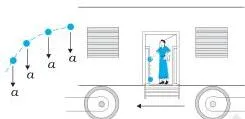
The flaw: the car stops because the floor’s friction opposes it. When the child’s pull exactly cancels friction, the net force on the car is zero and it moves uniformly (p. 50–51). So no force is needed for the motion itself — only to overcome friction. Galileo reached the correct picture with two experiments (p. 51):
- Motion on a horizontal plane: a ball rolling down accelerates, rolling up retards; on a frictionless horizontal plane it is the intermediate case — no acceleration, constant velocity (Fig. 4.1(a)).
- Double inclined plane: a ball released on one side climbs to nearly the same height on the other. Flatten the second plane and the ball travels farther; when the second plane is horizontal, its motion would never cease (Fig. 4.1(b)).
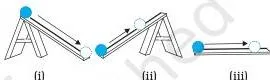
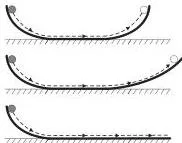
The conclusion: rest and uniform motion are equivalent states — both have zero net force. This property of a body is called inertia, meaning resistance to change of its state of rest or uniform motion (p. 51). Interestingly, the vega of the ancient Indian Vaisesika theory — the persistent tendency to move in a straight line — comes close to this idea (p. 52).
Newton’s First Law: Zero Net Force Means Zero Acceleration
Newton’s first law: every body continues in its state of rest or of uniform motion in a straight line unless compelled by some external force to act otherwise (p. 52). Its working form: if the net external force on a body is zero, its acceleration is zero.
The law is used in two directions (p. 52):
- Forces known → motion known: a spaceship far from all objects, rockets off, has zero net force; therefore its acceleration is zero and it keeps a uniform velocity.
- Motion known → forces known: a book is observed at rest on a table. From the first law, the net force on it must be zero, so the normal force \( R \) equals the weight \( W \). Note the reasoning order: the observed rest forces the conclusion \( R = W \) — the equality does not come first.
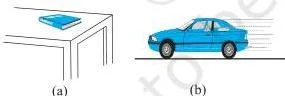
The inertia of the body explains everyday jerks: when a bus starts suddenly, our feet move with the floor but the rest of the body stays behind due to inertia, so we are thrown backward; when it stops, we are thrown forward (p. 53).
A clean example of the law: an astronaut separated from a small spaceship in interstellar space — no nearby stars exert gravity, so the net force on him is zero and his acceleration is zero (Example 4.1, p. 53).
Momentum and Newton’s Second Law: Force Is the Rate of Change of Momentum
Momentum is the product of mass and velocity (Eq. 4.1, p. 54): \( \mathbf{p} = m\mathbf{v} \). It is a vector, with SI unit \( \text{kg m/s} \). Both mass and speed matter: a loaded truck is harder to stop than a small car, and a fast bullet pierces more than the same bullet fired slowly (p. 54).
Analogy that sticks: think of momentum as water stored in a tank and force as the rate at which water flows in or out. You can fill a tank slowly over a long time or pour the same total water in one instant — either way the same amount is stored.
Similarly, the same change in momentum can come from a small force acting for a long time or a large force acting briefly. What decides the force is not the momentum change alone but how fast the change happens.
Newton’s second law: the rate of change of momentum of a body is proportional to the applied force and takes place in the direction of the force (p. 55). Writing \( \mathbf{F} = k\, \frac{\mathrm{d}\mathbf{p}}{\mathrm{d}t} \) and choosing \( k = 1 \) defines the unit of force:
\[ \mathbf{F} = \frac{\mathrm{d}\mathbf{p}}{\mathrm{d}t} = m\mathbf{a} \quad (4.5) \]
One newton is the force that gives a 1 kg mass an acceleration of \( 1\ \text{m/s}^2 \): \( 1\ \text{N} = 1\ \text{kg m/s}^2 \) (p. 55).
Four caution points about the second law (p. 55–56):
- Consistent with the first law: \( F = 0 \) implies \( a = 0 \).
- Vector law: it is three component equations, \( F_x = ma_x \), \( F_y = ma_y \), \( F_z = ma_z \). A force not parallel to velocity changes only the component of velocity along it — in projectile motion, gravity changes only the vertical component.
- Works for a system: \( F \) is the total external force and \( a \) is the acceleration of the system as a whole (of its centre of mass). Internal forces never enter \( F \).
- Local relation: acceleration here and now is decided by the force here and now, not by the motion’s history.
Impulse: When a Large Force Acts for a Very Short Time
When a ball strikes a wall, the force and the contact time cannot be measured separately, but the product of the two — the change in momentum — is measurable. That product is called impulse (p. 56):
\[ \text{Impulse} = \text{Force} \times \text{time duration} = \text{Change in momentum} \quad (4.7) \]
Its SI unit is \( \text{N s} \), which is the same as \( \text{kg m/s} \). An impulsive force is simply a large force acting for a short time; Newtonian mechanics gives it no special status (p. 56).
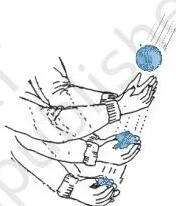
Real-life application — vehicle safety: airbags, crumple zones and seat belts use exactly this physics. They stretch the time over which a passenger’s momentum falls to zero, so the average force on the passenger drops: same \( \Delta p \), longer \( \Delta t \), smaller \( F = \Delta p/\Delta t \).
A cricketer catching a fast ball does the same by pulling his hands back; a novice who keeps his hands fixed stops the ball almost instantly and feels a much larger force (p. 54, Fig. 4.3).
In straight-line impulse problems, choose one direction as positive and compute \( J = m(v – u) \) with signs, then state the direction of the impulse as part of the answer.
Newton’s Third Law: Forces Come in Pairs and Act on Different Bodies
Newton’s wording — to every action there is always an equal and opposite reaction — is famous but easily misread. The clear form: forces always occur in pairs; force on A by B is equal and opposite to force on B by A (p. 56–57):
\[ \mathbf{F}_{AB} = -\mathbf{F}_{BA} \quad (4.8) \]
Three points prevent the classic errors (p. 56–57):
- Both are forces. “Action” and “reaction” are just names; either member of the pair may be called action.
- They are simultaneous. There is no cause-effect order — the force on A by B and the force on B by A act at the same instant.
- They act on different bodies. Therefore they can never cancel on one body. But as internal forces of a two-body system they sum to zero, which is why the second law applies to systems.
The earth-and-stone question is the classic test: the stone pulls the earth upward with a force equal to its own weight. We do not notice the earth’s motion because the earth’s mass is enormous, so its acceleration is negligible (p. 56).
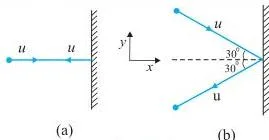
The billiard-ball problem (Example 4.5, p. 57) shows the method: find the impulse on the ball by resolving momentum into components along and normal to the wall. Only the normal component reverses, so the impulse — and therefore the force on the ball — is normal to the wall in both cases.
The third law then gives the force on the wall: normal to the wall even when the ball arrives at \( 30^\circ \) to the normal.
Conservation of Momentum: Why a Gun Recoils Backward
The second and third laws together give conservation of momentum. For a fired gun: the force on the bullet is \( F \), the force on the gun is \( -F \), and both act for the same time \( \Delta t \). So the momentum changes are \( F\Delta t \) and \( -F\Delta t \); their sum is zero (p. 57).
Law of conservation of momentum: the total momentum of an isolated system of interacting particles is conserved (p. 58). In collision form:
\[ \mathbf{p}’_A + \mathbf{p}’_B = \mathbf{p}_A + \mathbf{p}_B \quad (4.9) \]
This holds for elastic and inelastic collisions alike; elasticity adds the separate condition that total kinetic energy is conserved (p. 58), studied in the work, energy and power notes (Chapter 5).
Applications of the law: gun recoil, a nucleus at rest disintegrating into two fragments that must fly off in opposite directions, and rocket propulsion — the rocket gains forward momentum while the expelled gases gain equal opposite momentum.
Equilibrium of a Particle: Three Forces and Free-Body Diagrams
Equilibrium means the net external force on a particle is zero — so, by the first law, it is at rest or in uniform motion (p. 58). Conditions: two forces require \( \mathbf{F}_1 = -\mathbf{F}_2 \) (Eq. 4.10); three concurrent forces require \( \mathbf{F}_1 + \mathbf{F}_2 + \mathbf{F}_3 = 0 \) (Eq. 4.11), with the component form \( F_{1x} + F_{2x} + F_{3x} = 0 \), etc. (Eq. 4.12, p. 59).
Three forces in equilibrium can be drawn as the sides of a closed triangle; \( n \) forces, as a closed \( n \)-sided polygon.

The solving procedure for any mechanics problem (p. 65–66):
- Draw a diagram of the assembly — bodies, links, supports.
- Choose a convenient part of the assembly as the system.
- Draw its free-body diagram with all forces on the system. Never include forces that the system exerts on the environment.
- Mark known forces; treat the rest as unknowns.
- Repeat for another part if needed, using the third law: if the force on A by B is \( F \), then the force on B by A is \( -F \).
The suspended-mass pattern (Example 4.6, p. 59): for the weight, \( T_2 = mg \). For point P, resolve into components: \( T_1 \cos\theta = T_2 \) and \( T_1 \sin\theta = F \), giving \( \tan\theta = F/(mg) \). Notice the answer is independent of the rope length. Translational equilibrium is only part of the story — rotational equilibrium (zero net torque) arrives in Chapter 6.
Friction: Static, Kinetic and Rolling — with a Comparison Table
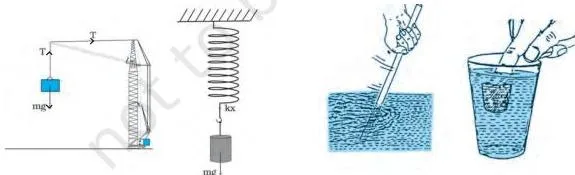
Common forces in mechanics (p. 59–60): the normal reaction is the component of the contact force normal to the surfaces; friction is the component parallel to the surfaces; tension is the restoring force in an inextensible string; the spring force is \( F = -kx \).
Except for gravity, all these contact forces trace back to electrical forces between the charged constituents (nuclei and electrons) of matter (p. 60).
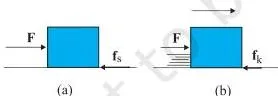
Static vs Kinetic Friction: Comparison Table
| Property | Static friction \( f_s \) | Kinetic friction \( f_k \) |
|---|---|---|
| When it acts | Opposes impending motion — motion that would occur if friction were absent | Opposes actual relative sliding between surfaces |
| Size | Self-adjusting, up to a maximum: \( f_s \leq \mu_s N \) | Fixed for given surfaces: \( f_k = \mu_k N \) |
| Coefficients | \( \mu_s \), coefficient of static friction | \( \mu_k \), coefficient of kinetic friction; experiments show \( \mu_k \lt \mu_s \) |
| Example | A box staying put on the accelerating floor of a train | A block sliding across a table after being pushed |
Both types are independent of the area of contact (p. 60–61). The limiting value is \( (f_s)_{\max} = \mu_s N \); equality holds only when the body is just about to slide. Friction opposes relative motion, not motion itself: a box stationary on an accelerating train floor is accelerating with the train — the static friction is what provides its acceleration (p. 61).
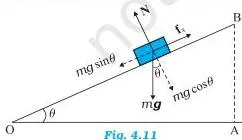
Two result patterns to remember: the maximum acceleration a box can survive on a train floor is \( a_{\max} = \mu_s g \) (Example 4.7, p. 61); and a body just begins to slide on an incline at \( \tan\theta_{\max} = \mu_s \) (Example 4.8, p. 62), independent of its mass.
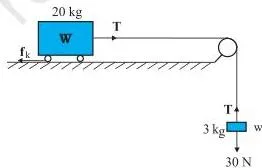
For a two-body block-and-trolley system with kinetic friction (Example 4.9 pattern, p. 62), write one second-law equation for each body — block: \( mg – T = ma \); trolley: \( T – f_k = Ma \) — and eliminate the common tension \( T \).
Rolling friction (p. 62–63): ideally zero for a body rolling without slipping, because the point of contact has no motion relative to the surface. In practice it is much smaller — by up to 2 or 3 orders of magnitude — than sliding friction, because the surfaces deform momentarily at contact. This is why the wheel was a milestone.
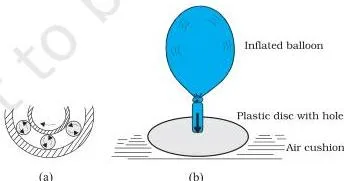
Friction is reduced with ball bearings and air cushions (Fig. 4.13), yet friction is also essential: we walk, cars accelerate, and brakes stop vehicles only because of it.
Circular Motion: Level Road, Banked Road and the Optimum Speed
A body moving in a circle of radius \( R \) with uniform speed \( v \) has acceleration \( v^2/R \) toward the centre, so the required force is the centripetal force (Eq. 4.16, p. 63):
\[ f_c = \frac{mv^2}{R} \]
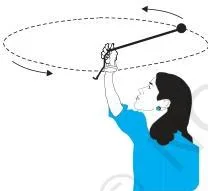
The centripetal force is not a new kind of force — it is the name given to whatever real force (tension, gravity, friction) provides the inward acceleration (p. 68). The derivation of the circular-motion speeds uses the acceleration \( v^2/R \) from the motion in a plane notes (Chapter 3).
Level road (p. 63–64): vertically \( N = mg \); friction alone provides the centripetal force. Setting \( f \leq \mu_s N \) gives \[ v^2 \leq \mu_s R g \quad \Rightarrow \quad v_{\max} = \sqrt{\mu_s R g} \quad (4.18) \]
Notice the mass of the car cancels — the maximum speed on a flat curve is the same for a car and a truck.
Banked road (p. 64–65): the road is tilted at angle \( \theta \), so the normal reaction itself has an inward horizontal component. Resolving \( N \) and \( f \) vertically and horizontally gives the starting equations \( N\cos\theta = mg + f\sin\theta \) and \( N\sin\theta + f\cos\theta = mv^2/R \) (Eqs. 4.19a, 4.19b).
Putting \( f = \mu_s N \) yields the maximum safe speed, and putting \( \mu_s = 0 \) yields the optimum speed:
\[ v_{\max} = \left( Rg\, \frac{\mu_s + \tan\theta}{1 – \mu_s \tan\theta} \right)^{1/2} \quad (4.21) \qquad v_o = \sqrt{Rg\tan\theta} \quad (4.22) \]
where \( \mu_s \) is the coefficient of static friction, \( \theta \) the banking angle and \( R \) the radius of the turn.
Memory device: O for Optional — at the Optimum speed \( v_o \), friction is Optional. The road’s tilt alone provides the centripetal force, so tyres suffer least wear at \( v_o \).
Drive faster than \( v_o \) and friction must act down the slope to help; drive slower than \( v_o \) and friction acts up the slope to stop the car sliding in.
Two extra facts follow from the same equations: a car can be parked on a bank only if \( \tan\theta \leq \mu_s \), and \( v_{\max} \) on a banked road is always greater than on a flat road (p. 64–65). Note that Fig. 4.14, the usual level-road and banked-road diagrams, has no separate image here — the geometry above is stated in words.
Key Terms in Laws of Motion: A Definitions Table
| Term | Meaning | Example |
|---|---|---|
| Inertia | Resistance to change of the state of rest or uniform motion | Passengers thrown forward when a bus stops (p. 51–53) |
| Momentum | Product of mass and velocity; a vector | \( \mathbf{p} = m\mathbf{v} \), unit \( \text{kg m/s} \) (p. 54) |
| Impulse | Force × time = change in momentum | A ball bouncing off a wall (p. 56) |
| Impulsive force | A large force acting for a very short time | Force on a ball during bat contact (p. 56) |
| Normal reaction | Component of contact force normal to the surfaces | Upward force of a table on a book (p. 59) |
| Friction | Component of contact force parallel to the surfaces, opposing relative motion | Force that stops a sliding block (p. 60) |
| Static friction | Opposes impending motion; self-adjusting up to \( \mu_s N \) | Box held by friction on a train floor (p. 60–61) |
| Kinetic friction | Opposes actual relative sliding; equals \( \mu_k N \) | Block sliding on a table (p. 61) |
| Coefficient of friction | Constant for a given pair of surfaces; \( \mu_k \lt \mu_s \) | \( \mu_s = 0.15 \) for a box on a train floor (p. 61) |
| Centripetal force | Net inward force providing the \( v^2/R \) acceleration | Tension in a whirled stone’s string (p. 63) |
| Equilibrium | Zero net external force; rest or uniform motion | Book at rest on a table (p. 58) |
| Isolated system | A system with no external force on it | Bullet + gun just after firing (p. 57) |
| Free-body diagram | Diagram of one chosen system showing only the forces on it | Point P with three forces in Fig. 4.8(c) (p. 65) |
Formula Sheet: Laws of Motion Equations, Symbols and Units
Every equation you may need to reproduce, with symbols, SI units and dimensions. The quantity rows follow the NCERT summary table (p. 67).
| Quantity / Law | Equation | SI unit | Dimension |
|---|---|---|---|
| Momentum | \( \mathbf{p} = m\mathbf{v} \) | \( \text{kg m/s} = \text{N s} \) | \( [\text{MLT}^{-1}] \) |
| Second law | \( \mathbf{F} = \frac{\mathrm{d}\mathbf{p}}{\mathrm{d}t} = m\mathbf{a} \) | \( \text{N} = \text{kg m/s}^2 \) | \( [\text{MLT}^{-2}] \) |
| Component form | \( F_x = ma_x,\ F_y = ma_y,\ F_z = ma_z \) | \( \text{N} \) | \( [\text{MLT}^{-2}] \) |
| Impulse | \( J = F\Delta t = \Delta p \) | \( \text{N s} = \text{kg m/s} \) | \( [\text{MLT}^{-1}] \) |
| Third law | \( \mathbf{F}_{AB} = -\mathbf{F}_{BA} \) | \( \text{N} \) | \( [\text{MLT}^{-2}] \) |
| Conservation of momentum | \( \mathbf{p}_A + \mathbf{p}_B = \mathbf{p}’_A + \mathbf{p}’_B \) | \( \text{kg m/s} \) | \( [\text{MLT}^{-1}] \) |
| Spring force | \( F = -kx \) | \( \text{N} \) | \( [\text{MLT}^{-2}] \) |
| Static friction | \( f_s \leq \mu_s N \) | \( \text{N} \) | \( [\text{MLT}^{-2}] \) |
| Kinetic friction | \( f_k = \mu_k N \) | \( \text{N} \) | \( [\text{MLT}^{-2}] \) |
| Angle of repose | \( \tan\theta_{\max} = \mu_s \) | — | — |
| Centripetal force | \( f_c = mv^2/R \) | \( \text{N} \) | \( [\text{MLT}^{-2}] \) |
| Level-road max speed | \( v_{\max} = \sqrt{\mu_s R g} \) | \( \text{m/s} \) | \( [\text{LT}^{-1}] \) |
| Banked-road max speed | \( v_{\max} = \left( Rg\, \frac{\mu_s + \tan\theta}{1 – \mu_s \tan\theta} \right)^{1/2} \) | \( \text{m/s} \) | \( [\text{LT}^{-1}] \) |
| Optimum banked speed | \( v_o = \sqrt{Rg\tan\theta} \) | \( \text{m/s} \) | \( [\text{LT}^{-1}] \) |
Symbols: \( \mu_s \), \( \mu_k \) = coefficients of static and kinetic friction; \( \theta \) = banking angle; \( R \) = radius of the turn; \( g = 9.8\ \text{m/s}^2 \) (the chapter exercises take \( g = 10\ \text{m/s}^2 \), p. 69).
Worked Examples: Step by Step with Original Numbers
These four problems use fresh numbers so you can watch the method, not memorise answers. Every step carries its units.
Example 1: Second law with uniform retardation — a bullet stopping in a block
Method: use kinematics \( v^2 = u^2 + 2as \) to find the acceleration, then \( F = ma \).
- Step 1: Convert the stopping distance: \( 5\ \text{cm} = 0.05\ \text{m} \).
- Step 2: Here \( u = 120\ \text{m/s} \), \( v = 0 \), \( s = 0.05\ \text{m} \).
\[ a = \frac{-u^2}{2s} = \frac{-(120)^2}{2 \times 0.05} = \frac{-14400}{0.1} = -1.44 \times 10^5\ \text{m/s}^2 \]
Step 3: The negative sign means acceleration opposite to the motion — a retardation.
\[ F = m|a| = 0.02 \times 1.44 \times 10^5 = 2880\ \text{N} \]
Final answer: the average resistive force of the block is \( 2880\ \text{N} \), opposing the bullet’s motion.
Check: stopping a fast bullet in 5 cm demands thousands of newtons — plausible for the impact of an average rifle bullet.
Example 2: Impulse with a given sign convention — a ball hit straight back
Method: impulse equals the change in momentum; fix one direction as positive and carry the signs.
Step 1: Take the return direction as positive.
The ball arrives moving opposite to it: \( u = -25\ \text{m/s} \), and leaves at \( v = +18\ \text{m/s} \).
Mass \( m = 0.16\ \text{kg} \).
\[ J = m(v – u) = 0.16\,(18 – (-25)) = 0.16 \times 43 = 6.88\ \text{N s} \approx 6.9\ \text{N s} \]
Final answer: the impulse on the ball is \( 6.9\ \text{N s} \) in the return direction.
Check: the positive sign matches the chosen positive direction, so the direction statement is part of the answer.
Example 3: Equilibrium of a point under three forces — rope with a horizontal pull
Method: resolve the forces at the point into vertical and horizontal components; each must sum to zero.
- Step 1: The hanging mass gives the vertical tension: \( T_2 = mg = 5 \times 10 = 50\ \text{N} \).
- Step 2: Vertical balance: \( T_1\cos\theta = T_2 = 50\ \text{N} \).
- Step 3: Horizontal balance: \( T_1\sin\theta = 40\ \text{N} \).
- Step 4: Divide the two equations to eliminate \( T_1 \):
\[ \tan\theta = \frac{40}{50} = 0.8 \quad \Rightarrow \quad \theta = \tan^{-1}(0.8) \approx 38.7^\circ \]
Final answer: the rope makes an angle of about \( 38.7^\circ \) with the vertical.
Check: the horizontal force (40 N) is less than the vertical tension (50 N), so the angle is below \( 45^\circ \) — consistent.
Example 4: Banked-road speeds — optimum and maximum speed on a racetrack
Method: apply the banked-road formulas \( v_o = \sqrt{Rg\tan\theta} \) and Eq. (4.21) for \( v_{\max} \).
Data: \( R = 200\ \text{m} \), \( \theta = 20^\circ \), \( \mu_s = 0.25 \), \( g = 9.8\ \text{m/s}^2 \), \( \tan 20^\circ = 0.364 \).
Step 1: Optimum speed — no friction needed:
\[ v_o = \sqrt{200 \times 9.8 \times 0.364} = \sqrt{713.4} \approx 26.7\ \text{m/s} \]
Step 2: Maximum safe speed — friction fully used:
\[ v_{\max} = \sqrt{200 \times 9.8 \times \frac{0.25 + 0.364}{1 – 0.25 \times 0.364}} = \sqrt{1960 \times \frac{0.614}{0.909}} = \sqrt{1324} \approx 36.4\ \text{m/s} \]
Final answer: \( v_o \approx 26.7\ \text{m/s} \) (tyres least worn) and \( v_{\max} \approx 36.4\ \text{m/s} \) (above this the car skids).
Check: \( v_{\max} \gt v_o \), and setting \( \mu_s = 0 \) in (4.21) reduces it to \( v_o \) — so the formulas agree.
Example 5 (short): Flat curve — friction alone provides the centripetal force
Method: for a level road, \( v_{\max} = \sqrt{\mu_s R g} \).
Take \( R = 25\ \text{m} \), \( \mu_s = 0.3 \), \( g = 9.8\ \text{m/s}^2 \).
\[ v_{\max} = \sqrt{0.3 \times 25 \times 9.8} = \sqrt{73.5} \approx 8.6\ \text{m/s} \]
Final answer: the car cannot take the curve faster than about \( 8.6\ \text{m/s} \) without skidding.
Common Mistakes in Laws of Motion: Error and Correction Pairs
This misconception autopsy isolates the reasoning traps the chapter is known for — each row gives the wrong step, the correct rule, and a way to check your own answer in the exam.
| Mistake | Correct rule | How to check your answer |
|---|---|---|
| “Since \( W = R \), the forces cancel, therefore the book is at rest.” | The book is observed at rest, so by the first law the net force must be zero, which forces \( R = W \) (p. 52). | State which fact you started from — the motion or the forces. Rest first → equality follows. |
| Adding action and reaction and saying the net force on a body is zero. | Action and reaction act on different bodies and can never cancel on one body (p. 56–57). | Ask: do the two forces act on the same body? If no, they are not a balance pair. |
| Writing \( f_s = \mu_s N \) in every friction problem. | \( f_s \leq \mu_s N \); equality holds only at the limiting value just before sliding (p. 60, 68). | Is the body just about to slide? If not, \( f_s \) balances whatever force is applied. |
| Thinking \( v = 0 \) at the top of a throw means \( a = 0 \). | The weight still acts at the top, so \( a = g \) even when \( v = 0 \) (p. 68). | List the forces acting at that instant. Zero force, not zero velocity, gives zero acceleration. |
| Drawing \( ma \) as an extra force on a free-body diagram. | \( F \) in \( F = ma \) is the net external force; \( ma \) is the effect, never another force (p. 68). | Every arrow on the diagram must point along a real agent’s push or pull. |
| Treating centripetal force as a new material force. | It is the name for the net inward force supplied by tension, gravity or friction (p. 68). | Name the material source of the inward force; if you cannot, you have not found it. |
| Using \( mg = R \) for a body in an accelerating lift. | \( mg = R \) holds only in equilibrium; in an accelerating lift write \( R – mg = \pm ma \) (p. 68). | Is the body’s velocity changing? If yes, write the unbalanced equation with \( ma \). |
Exam Notes: Question Patterns in This Chapter
The NCERT exercise set (p. 69–71) tests a small number of repeated patterns. Classifying them tells you what to practise.
- Zero-net-force identification: rain drop at constant speed, floating cork, stationary kite, car at constant velocity (Q4.1); pebble thrown up — including the highest point (Q4.2); stone dropped from a stationary, uniform-velocity and accelerating train (Q4.3). The examiner’s point: \( v = 0 \) at the top does not mean \( a = 0 \), and a released stone carries no horizontal force.
- \( F = ma \) numerics: retarding force and stopping time (Q4.5), force changing speed (Q4.6), two perpendicular forces (Q4.7), three-wheeler braking (Q4.8), rocket thrust (Q4.9).
- Two-body systems: string tension under a 600 N pull (Q4.15); Atwood-type masses over a pulley (Q4.16) — one second-law equation per body, then eliminate the tension.
- Impulse: from a position-time graph (Q4.14); rebounding billiard balls (Q4.18); batsman deflecting a ball by \( 45^\circ \) (Q4.20). Direction must be stated.
- Conservation of momentum: nucleus disintegration into two fragments (Q4.17); gun recoil (Q4.19).
- Weighing scale in a lift: uniform motion, upward and downward acceleration, free fall (Q4.13) — \( mg = R \) only when there is no acceleration.
- Circular motion: the net force on a whirled particle as an MCQ (Q4.4); tension in a whirled stone and the maximum speed (Q4.21); trajectory after the string breaks (Q4.22) — tangentially, not radially.
- Conceptual explanations: horse-cart in empty space, passengers thrown forward, lawn mower pull vs push, cricketer’s hands (Q4.23).
Exam-readiness notes: the exercise set takes \( g = 10\ \text{m/s}^2 \) (p. 69), and you may too if you state it. The steps that earn marks are a drawn free-body diagram, a stated sign convention, and units carried through every substitution. For impulse answers, give the direction; for stopping-force answers, say the force opposes the motion.
The most repeated reasoning traps — the lift equation and static friction at its limit — both live in the points-to-ponder list (p. 68).
One-Page Revision Summary: Laws of Motion in Tables
Three tables cover the whole chapter. First, the three laws side by side:
| Law | One-line statement | Equation | Typical exercise |
|---|---|---|---|
| First law | Zero net force means zero acceleration | \( F_{\text{net}} = 0 \Rightarrow a = 0 \) | Q4.1–4.3 — identify zero-force situations |
| Second law | Force is the rate of change of momentum | \( F = \mathrm{d}p/\mathrm{d}t = ma \) | Q4.5–4.9 — numericals |
| Third law | Forces occur in equal-opposite pairs on different bodies | \( F_{AB} = -F_{BA} \) | Q4.15–4.19 — recoil and impulse pairs |
Second, friction and circular motion condensed:
| Situation | Rule | Key formula |
|---|---|---|
| Static friction | Opposes impending motion; self-adjusting | \( f_s \leq \mu_s N \) |
| Kinetic friction | Opposes actual sliding | \( f_k = \mu_k N \), with \( \mu_k \lt \mu_s \) |
| Rolling friction | Much smaller than sliding; momentary contact deformation | Treated as a small opposing force |
| Car on level road | Friction alone provides the centripetal force | \( v_{\max} = \sqrt{\mu_s R g} \) |
| Car on banked road | Normal reaction contributes; friction optional at \( v_o \) | \( v_o = \sqrt{Rg\tan\theta} \); \( v_{\max} = \left(Rg\,\frac{\mu_s + \tan\theta}{1 – \mu_s\tan\theta}\right)^{1/2} \) |
Third, the quantities with units and dimensions (NCERT summary, p. 67):
| Quantity | Symbol | Unit | Dimension |
|---|---|---|---|
| Momentum | \( \mathbf{p} \) | \( \text{kg m/s} = \text{N s} \) | \( [\text{MLT}^{-1}] \) |
| Force | \( \mathbf{F} \) | \( \text{N} \) | \( [\text{MLT}^{-2}] \) |
| Impulse | \( J \) | \( \text{N s} = \text{kg m/s} \) | \( [\text{MLT}^{-1}] \) |
| Static friction | \( f_s \) | \( \text{N} \) | \( [\text{MLT}^{-2}] \) |
| Kinetic friction | \( f_k \) | \( \text{N} \) | \( [\text{MLT}^{-2}] \) |
How to attack any mechanics problem in five lines:
- Draw the assembly diagram.
- Choose the system — a body, a point, or a group of bodies.
- Draw its free-body diagram: only forces on the system.
- Write \( F = ma \) along convenient axes, resolving forces where needed.
- Connect interacting bodies with the third law and solve the equations.
More revision material is waiting in the Class 11 notes index and the main CBSE notes library.
Frequently Asked Questions
Why is no force needed to keep a body moving with uniform velocity?
Uniform motion and rest are equivalent states — both have zero net force and zero acceleration (p. 51–52). A toy car stops only because the floor’s friction opposes it; once the push cancels friction, no further force is needed for the motion itself.
Why do action and reaction forces never cancel each other?
Because they act on different bodies. Cancellation requires two equal-opposite forces on the same body. Action and reaction are on different bodies, so they can never cancel on either one; as internal forces of a two-body system they do sum to zero (p. 56–57).
Why is kinetic friction less than static friction?
Experimentally, once relative motion starts, the friction force drops from the static maximum: \( \mu_k \lt \mu_s \) (p. 61). The empirical laws of friction are approximate, but this ordering is well established and holds for the usual pairs of surfaces.
At what speed is friction not needed on a banked road?
At the optimum speed \( v_o = \sqrt{Rg\tan\theta} \), the horizontal component of the normal reaction alone provides the centripetal force, so friction is optional and tyre wear is least (p. 64). Above \( v_o \) friction acts down the slope; below \( v_o \) it acts up the slope.
Why does a cricketer pull his hands back while catching a fast ball?
Impulse is fixed — it equals the change in momentum of the ball. Pulling the hands back increases the stopping time, so the same impulse needs a smaller average force; a novice who stops the ball almost instantly needs a much larger force and gets hurt (p. 56, Fig. 4.3).
When should I use impulse instead of F = ma in a problem?
Use impulse when the force and contact time cannot be measured separately but the change in momentum is known — such as a ball striking a wall or a bat hitting a ball (p. 56). Use \( F = ma \) when you know the forces and want acceleration, or when the acceleration is uniform and known.
Reference: NCERT Class 11 Physics textbook, chapter Laws of Motion.
Explore Class 11 Physics Notes
More for this chapter:
Class 11 Physics on LearnCBSE:
Related chapters: