
This page is your work energy and power class 11 notes for Chapter 5, Work, Energy and Power, of NCERT Physics Part I. The chapter stacks one idea on another: the scalar product supplies the maths tool, work uses that tool, the work-energy theorem links work to motion, and potential energy turns work into stored energy.
Everything below is compressed into a revision-ready form you can finish in one sitting.
Inside you get the chapter map in teaching order, eight core ideas with page references, a definitions table, the full formula box with SI units and unit conversions, three worked examples with fresh numbers, a graph-reading walkthrough, the common mistakes that cost marks, exam patterns, and a one-page night-before recap.
You can verify any formula or table directly against the official NCERT chapter PDF.
The sections follow the order a teacher would build the topic, so read top to bottom if you have time. If you are revising quickly, use the table of contents to jump to the formula box or the worked examples.
Work Energy and Power Class 11 Notes: The Chapter at a Glance
Nine learning blocks make up this chapter. Each one answers a specific question, and each sits on the NCERT pages shown.
| Learning block | What it answers | NCERT pages |
|---|---|---|
| Scalar (dot) product | How much of one vector acts along another | pp. 72–73 |
| Work and its sign conventions | When work is positive, negative or zero | pp. 74–75 |
| Kinetic energy and the work-energy theorem | How work changes the energy of motion | pp. 73–75 |
| Work done by a variable force | Work as the area under an F-x graph | pp. 76–77 |
| Potential energy and conservative forces | When work is stored, and what a potential function is | pp. 78–79 |
| Conservation of mechanical energy | Why K + V stays constant | pp. 79–80 |
| Potential energy of a spring | Spring force, ½kx², maximum speed | pp. 81–83 |
| Power | How fast work is done | pp. 83–84 |
| Collisions | Momentum and kinetic energy conservation in 1D and 2D | pp. 84–86 |
The order is deliberate. The scalar product builds on the vectors you met in earlier chapters on motion, so brush up with the motion in a plane notes if the component form feels shaky. The work-energy theorem itself rests on Newton’s second law from Chapter 4, covered in our laws of motion notes.
Everything later — springs, power, collisions — reuses these two foundations.
The Eight Core Ideas of Work, Energy and Power
Read these eight ideas before touching any numerical. Each one is the physical meaning you must be able to state in your own words.
- Dot product is a projection. The scalar product \( \mathbf{A} \cdot \mathbf{B} = AB\cos\theta \) measures how much of one vector points along the other. In components, \( \mathbf{A} \cdot \mathbf{B} = A_xB_x + A_yB_y + A_zB_z \) (NCERT, pp. 72–73).
- Work is energy transferred by a force over a displacement. With \( W = \mathbf{F}\cdot\mathbf{d} = Fd\cos\theta \), work is positive when force and displacement point the same way, negative when they oppose, and zero when they are perpendicular or the displacement is zero (NCERT, p. 74).
- Kinetic energy is the energy of motion. \( K = \tfrac{1}{2}mv^2 \) is a scalar and always positive — a moving body can do work by virtue of its motion (NCERT, p. 75).
- Work-energy theorem. The change in kinetic energy equals the work done by the net force: \( K_f – K_i = W \). It holds for constant forces and, after integration, for variable forces as well (NCERT, pp. 73, 77).
- Conservative forces store work as potential energy. A conservative force can be written as \( F(x) = -\mathrm{d}V/\mathrm{d}x \), so its work depends only on the start and end points, never the path. That is why the work can be stored. Gravity and the spring are conservative; friction is not (NCERT, pp. 78–79).
- Mechanical energy is conserved. When only conservative forces do work, \( K + V \) stays constant: \( K_i + V_i = K_f + V_f \). Kinetic and potential energy may trade places, but their sum never changes (NCERT, p. 79).
- Power is the rate of doing work. \( P = \mathrm{d}W/\mathrm{d}t = \mathbf{F}\cdot\mathbf{v} \), measured in watts, with 1 hp = 746 W (NCERT, p. 83).
- Collisions always conserve momentum. Total linear momentum is conserved in every collision because the mutual impulsive forces are equal and opposite at every instant. Kinetic energy is conserved only in elastic collisions — and even then only after the collision is over (NCERT, pp. 84–85).
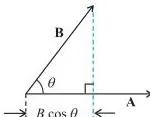
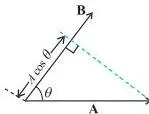
The two panels above are the same idea seen twice: \( \mathbf{A}\cdot\mathbf{B} \) is |A| times the projection of B onto A, or |B| times the projection of A onto B. When you compute work \( W = Fd\cos\theta \), you are multiplying displacement by exactly this projection of force.
| Feature | Conservative force | Non-conservative force |
|---|---|---|
| Can a potential energy be defined? | Yes — \( F(x) = -\mathrm{d}V/\mathrm{d}x \) | No, the work cannot be stored |
| Does work depend on the path? | No, only on the end points | Yes, the path matters |
| Work around a closed loop | Zero | Not zero (friction) |
| Examples | Gravity, spring force | Friction, air resistance |
The closed-loop test is the fastest way to classify a force: if taking an object around any closed path and returning it to the start does zero net work, the force is conservative. Friction fails this test, which is why no potential energy can be defined for it.
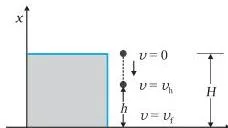
The falling ball in Fig 5.5 is mechanical energy conservation in one picture. At height H the energy is all potential \( mgH \); at ground level it is all kinetic \( \tfrac{1}{2}mv^2 \); at any height h in between it is \( mgh + \tfrac{1}{2}mv_h^2 \). Equating the two extremes gives \( v = \sqrt{2gH} \), the familiar fall speed (NCERT, p. 80).
| Feature | Elastic collision | Completely inelastic collision |
|---|---|---|
| Total linear momentum conserved? | Yes | Yes |
| Total kinetic energy conserved after the collision? | Yes | No — part is lost as heat and sound |
| Do the bodies move together after? | No, they separate | Yes, they stick and move as one |
| Everyday example | Billiard balls, marbles | Two lumps of clay sticking together |
Momentum conservation is the one guarantee in every collision; kinetic energy conservation is the special extra condition that defines the elastic case. That single distinction drives every collision formula in the chapter.
Definitions You Must Write Correctly in the Exam
These are the definitions a definition-question or a short-answer expects. Learn the meaning first, the example second, the formula third.
| Term | Meaning | Example |
|---|---|---|
| Work | Energy transferred by a force when it acts over a displacement; \( W = Fd\cos\theta \) | A crane lifting a load 5 m does positive work; tension and gravity do opposite-signed work on the load. |
| Kinetic energy | Energy a body has because it is moving; \( K = \tfrac{1}{2}mv^2 \), always positive | A fast-flowing stream carries kinetic energy that can grind corn. |
| Potential energy | Stored energy by virtue of position or configuration | A stretched bow string holds energy that launches the arrow when released. |
| Gravitational potential energy | Energy due to height above a chosen ground, \( V(h) = mgh \) | A ball at height h has mgh, which becomes kinetic energy as it falls. |
| Mechanical energy | The sum of kinetic and potential energy, \( E = K + V \) | A swinging pendulum trades the two while E stays constant. |
| Conservative force | A force whose work depends only on the end points and can be stored as potential energy | Gravity and the spring force. |
| Spring constant | The stiffness k in Hooke’s law \( F_s = -kx \), unit N m⁻¹ | A stiff spring has large k; a soft spring has small k. |
| Power | The rate at which work is done, \( P = \mathrm{d}W/\mathrm{d}t \) | A motor doing 44 000 J in 1 s delivers 44 000 W. |
| Elastic collision | A collision in which the system’s total kinetic energy is conserved after impact | Two billiard balls colliding. |
| Completely inelastic collision | A collision in which the bodies stick and move together after impact | Two clay balls that merge on contact. |
| Watt | SI unit of power, 1 W = 1 J s⁻¹ | A 100 W bulb uses 100 J of energy every second it is on. |
| Kilowatt hour | A unit of energy, 1 kWh = 3.6 × 10⁶ J | The unit in which electricity bills are written. |
| Horsepower | A power unit still used for vehicles, 1 hp = 746 W | Car engine output is quoted in hp. |
Work, Energy and Power Formula Box: Every Equation with Symbols and Units
This is the page to memorise for numericals. Each formula gives the symbol meanings, the SI unit, and the textbook page to verify it against.
Scalar product
| Equation | Symbols | SI unit | Page |
|---|---|---|---|
| \( \mathbf{A} \cdot \mathbf{B} = AB\cos\theta \) | A, B magnitudes; θ the angle between them | scalar (no unit of direction) | p. 72 |
| \( \mathbf{A} \cdot \mathbf{B} = A_xB_x + A_yB_y + A_zB_z \) | components of A and B | — | p. 73 |
| \( \hat{\mathbf{i}}\cdot\hat{\mathbf{i}} = \hat{\mathbf{j}}\cdot\hat{\mathbf{j}} = \hat{\mathbf{k}}\cdot\hat{\mathbf{k}} = 1 \), \( \hat{\mathbf{i}}\cdot\hat{\mathbf{j}} = 0 \), etc. | unit vectors along the axes | — | p. 72 |
Work and kinetic energy
| Equation | Symbols | SI unit | Page |
|---|---|---|---|
| \( W = \mathbf{F}\cdot\mathbf{d} = Fd\cos\theta \) | F force, d displacement, θ angle between them | J | p. 74 |
| \( K = \tfrac{1}{2}mv^2 \) | m mass, v speed | J | p. 75 |
| \( K_f – K_i = W \) | W work done by the net force | J | pp. 73, 77 |
| \( W = \int_{x_i}^{x_f} F(x)\,\mathrm{d}x \) | variable force, area under the F-x curve | J | pp. 76–77 |
Potential energy and conservation
| Equation | Symbols | SI unit | Page |
|---|---|---|---|
| \( F(x) = -\mathrm{d}V/\mathrm{d}x \) | V(x) potential energy function | N | p. 78 |
| \( V(h) = mgh \) | m mass, g gravity, h height above ground | J | p. 78 |
| \( K_i + V_i = K_f + V_f \) | conservation of mechanical energy | J | p. 79 |
| \( E_f – E_i = W_{nc} \) | W_nc work by non-conservative forces | J | p. 83 |
Spring
| Equation | Symbols | SI unit | Page |
|---|---|---|---|
| \( F_s = -kx \) | k spring constant, x displacement from equilibrium | N | p. 81 |
| \( V(x) = \tfrac{1}{2}kx^2 \) | spring potential energy | J | p. 81 |
| \( W_s = \tfrac{1}{2}kx_i^2 – \tfrac{1}{2}kx_f^2 \) | spring work between two positions | J | p. 81 |
| \( v_m = \sqrt{k/m}\,x_m \) | v_m maximum speed at x = 0 | m s⁻¹ | p. 82 |
Power
| Equation | Symbols | SI unit | Page |
|---|---|---|---|
| \( P_{av} = W/t \) | W work, t time taken | W | p. 83 |
| \( P = \mathrm{d}W/\mathrm{d}t = \mathbf{F}\cdot\mathbf{v} \) | F force, v instantaneous velocity | W | p. 83 |
Collisions (m₁ moving, m₂ at rest)
| Equation | Symbols | SI unit | Page |
|---|---|---|---|
| \( v_f = \dfrac{m_1}{m_1+m_2}v_{1i} \) | common speed after a completely inelastic collision | m s⁻¹ | p. 85 |
| \( \Delta K = \dfrac{1}{2}\dfrac{m_1m_2}{m_1+m_2}v_{1i}^2 \) | kinetic energy lost in that collision | J | p. 85 |
| \( v_{1f} = \dfrac{m_1-m_2}{m_1+m_2}v_{1i} \) | elastic, first body’s final speed | m s⁻¹ | p. 85 |
| \( v_{2f} = \dfrac{2m_1}{m_1+m_2}v_{1i} \) | elastic, second body’s final speed | m s⁻¹ | p. 85 |
| Equal masses: \( v_{1f} = 0 \), \( v_{2f} = v_{1i} \) | the two bodies swap speeds | m s⁻¹ | p. 85 |
| Heavy target \( m_2 \gg m_1 \): \( v_{1f} \approx -v_{1i} \) | light body bounces back, heavy body unmoved | m s⁻¹ | p. 85 |
| Glancing equal masses: \( \theta_1 + \theta_2 = 90^\circ \) | final velocities are perpendicular | degrees | p. 86 |
Unit conversions for work and energy
| Unit | Value |
|---|---|
| 1 erg | 10⁻⁷ J |
| 1 electron volt (eV) | 1.6 × 10⁻¹⁹ J |
| 1 calorie (cal) | 4.186 J |
| 1 kilowatt hour (kWh) | 3.6 × 10⁶ J |
| 1 horsepower (hp) | 746 W (a power unit, not energy) |
Two useful conversions to internalise: 36 km h⁻¹ = 10 m s⁻¹ (NCERT uses it twice), and kWh is energy, not power — 100 W × 10 h = 1 kWh = 3.6 × 10⁶ J (NCERT, p. 83). All these values appear in the chapter’s Tables 5.1 and the power section, so confirming them against the official PDF takes seconds.
Worked Examples: Step-by-Step Solutions with Fresh Numbers
Each example names the method first, then works step by step with units at every stage. Reproduce this structure in the exam.
Example 1 — Method: scalar product to find the angle between force and displacement
Step 1: Write both vectors.
\( \mathbf{F} = 2\hat{\mathbf{i}} + 3\hat{\mathbf{j}} – 4\hat{\mathbf{k}} \) N, \( \mathbf{d} = 3\hat{\mathbf{i}} – 2\hat{\mathbf{j}} + \hat{\mathbf{k}} \) m.
Step 2: Take the dot product using the component form \( \mathbf{F}\cdot\mathbf{d} = F_xd_x + F_yd_y + F_zd_z \).
\[ \mathbf{F}\cdot\mathbf{d} = 2(3) + 3(-2) + (-4)(1) = 6 – 6 – 4 = -4\ \text{J} \]
Step 3: Find the magnitudes: \( |\mathbf{F}| = \sqrt{F_x^2+F_y^2+F_z^2} \).
\[ |\mathbf{F}| = \sqrt{4+9+16} = \sqrt{29}\ \text{N}, \qquad |\mathbf{d}| = \sqrt{9+4+1} = \sqrt{14}\ \text{m} \]
Step 4: Use \( \mathbf{F}\cdot\mathbf{d} = |\mathbf{F}||\mathbf{d}|\cos\theta \) to find the angle.
\[ \cos\theta = \frac{-4}{\sqrt{29}\,\sqrt{14}} = \frac{-4}{\sqrt{406}} \approx -0.198 \]
\[ \theta = \cos^{-1}(-0.198) \approx 101.4^\circ \]
Final answer: \( \theta \approx 101.4^\circ \). Because the angle is obtuse, \( \cos\theta \lt 0 \), so the work \( W = Fd\cos\theta \) is negative — the force does work against the motion.
Example 2 — Method: conservation of mechanical energy for a car hitting a spring
Step 1: Convert the speed.
A 900 kg car moves at 36 km h⁻¹ = 10 m s⁻¹ and strikes a horizontal spring with \( k = 3.6 \times 10^3\ \text{N m}^{-1} \).
- Step 1: The car’s kinetic energy at the moment of impact is \[ K = \tfrac{1}{2}mv^2 = \tfrac{1}{2} \times 900 \times (10)^2 = 4.5 \times 10^4\ \text{J} \]
- Step 2: At maximum compression all kinetic energy has become spring potential energy.
\[ \tfrac{1}{2}kx_m^2 = K \;\Rightarrow\; x_m^2 = \frac{2K}{k} = \frac{9.0 \times 10^4}{3.6 \times 10^3} = 25 \;\Rightarrow\; x_m = 5.0\ \text{m} \]
Final answer: \( x_m = 5.0\ \text{m} \).
Bonus — with friction: If the surface has \( \mu = 0.2 \), friction also does work, so use the work-energy theorem instead: \( \tfrac{1}{2}kx^2 + \mu mg x = \tfrac{1}{2}mv^2 \).
\[ 1800x^2 + 1800x = 45000 \;\Rightarrow\; x^2 + x – 25 = 0 \]
\[ x = \frac{-1+\sqrt{101}}{2} \approx \frac{-1+10.05}{2} \approx 4.5\ \text{m} \]
With friction: \( x \approx 4.5\ \text{m} \), less than 5.0 m because friction steals some kinetic energy. This matches the textbook’s result that friction reduces the compression.
Why this matters in real crashes: the spring in this problem smooths the stop. A crumple zone or an airbag does the same job — for a fixed amount of kinetic energy \( \tfrac{1}{2}mv^2 \), spreading the stop over a longer distance d lowers the average force, because \( W = Fd \) with the same W. Longer stopping distance, smaller force.
That is where the safety design comes from.
Example 3 — Method: momentum and kinetic energy conservation in a 1D elastic collision
Step 1: Identify the masses.
\( m_1 = 2\ \text{kg} \) moving at \( v_{1i} = 3\ \text{m s}^{-1} \) hits \( m_2 = 4\ \text{kg} \) at rest.
Step 2: Use the elastic collision results for body 1.
\[ v_{1f} = \frac{m_1-m_2}{m_1+m_2}v_{1i} = \frac{2-4}{2+4} \times 3 = \frac{-2}{6} \times 3 = -1\ \text{m s}^{-1} \]
Step 3: Use the result for body 2.
\[ v_{2f} = \frac{2m_1}{m_1+m_2}v_{1i} = \frac{4}{6} \times 3 = 2\ \text{m s}^{-1} \]
Step 4: Check energy conservation: initial KE = final KE.
\[ K_i = \tfrac{1}{2}(2)(9) = 9\ \text{J}, \qquad K_f = \tfrac{1}{2}(2)(1) + \tfrac{1}{2}(4)(4) = 1 + 8 = 9\ \text{J} \]
Final answer: \( v_{1f} = -1\ \text{m s}^{-1} \) (the 2 kg body rebounds), \( v_{2f} = 2\ \text{m s}^{-1} \). Kinetic energy check confirms 9 J = 9 J.
Memory device: in a 1D elastic collision, equal masses swap speeds, and a heavy stationary target bounces the light mass back with almost unchanged speed. The first case gives v₁f = 0, v₂f = v₁ᵢ; the second gives v₁f ≈ −v₁ᵢ with the heavy body barely moving (NCERT, p. 85).
Reading the Graphs: Area under F-x, Spring Plots and Collision Geometry
The chapter tests three visual skills. Each figure below teaches one of them.
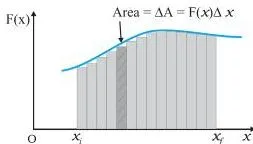
Skill 1 — work as area. Split the force-displacement curve into thin strips of height F(x) and width Δx. Each strip has area F(x)Δx, the work over that tiny step. As Δx tends to zero the sum becomes the integral, and the total work is exactly the area under the curve.
Area below the x-axis counts as negative because there F(x) is negative (NCERT, pp. 76–77).
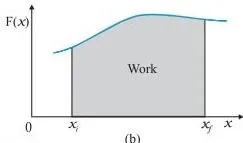
Skill 2 — mixed areas. In the woman-and-trunk problem, the applied force falls linearly from 100 N to 50 N over 20 m, giving a rectangle of area 1000 J plus a trapezium of area 750 J, so work by the applied force is 1750 J. Friction is a constant −50 N, a rectangle on the negative side of the axis worth −1000 J.
The area on the negative side of the force axis carries a negative sign (NCERT, p. 76).
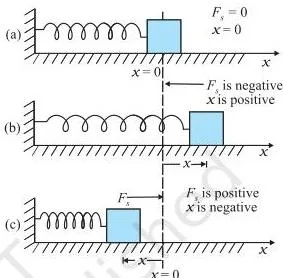
Skill 3 — the spring triangle. Spring force \( F_s = -kx \) plots as a straight line through the origin. The shaded triangle has area \( \tfrac{1}{2} \times x_m \times kx_m = \tfrac{1}{2}kx_m^2 \), but because force and displacement oppose each other, the spring’s work is negative: \( W_s = -kx_m^2/2 \) (NCERT, p. 81).
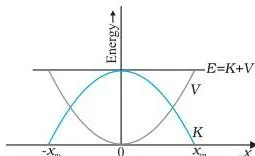
Skill 4 — the spring’s energy parabolas. The potential energy \( V(x) = \tfrac{1}{2}kx^2 \) is a parabola opening upward; kinetic energy \( K(x) = E – V(x) \) is the same parabola flipped so the two are complementary. At x = 0 all energy is kinetic, so speed is maximum; at x = ±x_m all energy is potential, so the block stops and turns back.
The total mechanical energy E is the constant horizontal line between them (NCERT, p. 82).
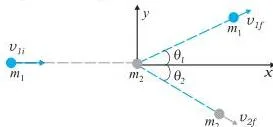
Skill 5 — collision geometry. For the 2D collision of m₁ with a stationary m₂, momentum conservation splits into two component equations: the x-component \( m_1v_{1i} = m_1v_{1f}\cos\theta_1 + m_2v_{2f}\cos\theta_2 \) and the y-component \( 0 = m_1v_{1f}\sin\theta_1 – m_2v_{2f}\sin\theta_2 \).
These two equations, plus energy conservation when the collision is elastic, are exactly what the picture shows (NCERT, p. 84).
Common Mistakes in Work, Energy and Power (Error → Correction)
| Students write | The correct rule is | How to check yourself |
|---|---|---|
| “I pushed a wall and got tired, so work was done on the wall” | Displacement is zero, so W = 0. Tiredness is internal muscle work, not work on the wall | Ask: did the wall move at all? If not, no work (NCERT, p. 74). |
| “Work = force × distance” | W = Fd cosθ. A perpendicular force does zero work | Check the angle between F and d; perpendicularity gives zero (NCERT, p. 74). |
| “Friction does positive work” | Friction opposing motion has θ = 180°, cos 180° = −1, so its work is negative | Friction and motion opposite → negative work (NCERT, p. 74). |
| “kWh is a unit of power” | It is energy: 1 kWh = 3.6 × 10⁶ J | Convert kWh to J; bills charge energy, not power (NCERT, p. 83). |
| “In an elastic collision each body’s kinetic energy is conserved” | Only the system’s total kinetic energy is conserved after the collision | Compare each body’s K before and after; only the sum holds (NCERT, pp. 84–85). |
| “Third law ⇒ work A-on-B = −work B-on-A” | The third law applies to forces, not work. The cyclist case: road does −2000 J on the cycle, cycle does 0 J on the road | Force pairs are equal and opposite, but displacements differ (NCERT, pp. 74–75). |
| “Changing the zero of potential energy mid-problem” | The zero is arbitrary but must stay fixed throughout the solution | The textbook warns: you cannot change horses in midstream (NCERT, p. 82). |
Misconception autopsy — KE is not constant during an elastic collision. Even in a perfectly elastic collision, the kinetic energy is not constant while the bodies are in contact. The bodies deform, and the textbook pictures the pair as a compressed spring: the energy is temporarily stored as deformation energy and reappears as kinetic energy after the collision.
That is why conservation of kinetic energy applies after the collision is over, not at every instant (NCERT, p. 88).
Exam Notes: Question Patterns That Keep Returning
These patterns appear in NCERT’s own worked examples and exercises. For each one, the listed step is the one that earns the mark.
- Angle between two vectors: writing the component form \( \mathbf{A}\cdot\mathbf{B} = A_xB_x + A_yB_y + A_zB_z \) before substituting is the mark-earning step (NCERT, p. 73).
- Sign of work: state the angle θ and its cosine explicitly. Zero displacement, zero force, or perpendicularity all give zero work (NCERT, p. 74; the Exercise 5.1 style question).
- Deriving the work-energy theorem for a variable force: begin from \( \mathrm{d}K/\mathrm{d}t = Fv \), then integrate from \( x_i \) to \( x_f \) (NCERT, pp. 76–77).
- Conservation problems: define the zero of potential energy in the first line and keep it throughout, as Examples 5.7 and 5.8 do (NCERT, pp. 79–82).
- Equal-mass glancing elastic collision: the final velocities are perpendicular, \( \theta_1 + \theta_2 = 90^\circ \) (NCERT, p. 86).
- 1D elastic special cases: equal masses swap velocities; a much heavier target sends the light mass back with nearly the same speed (NCERT, p. 85).
- Elevator or motor power: net upward force \( F = mg + f \), then \( P = Fv \), and convert watts to horsepower (NCERT, p. 84).
These are observations drawn from the chapter’s own material, not predictions. A fresh question can always restate the same idea from a different angle — the mark-earning step stays the same.
One-Page Revision Recap of Work, Energy and Power
The whole chapter in one logical chain: the dot product tells you how much of a force acts along a displacement; that product is work. Work changes kinetic energy — the work-energy theorem \( K_f – K_i = W \). For conservative forces the work is stored as potential energy, so mechanical energy \( K + V \) is conserved. A spring stores \( \tfrac{1}{2}kx^2 \).
Power measures how fast work is done. Collisions always conserve total momentum and only sometimes conserve kinetic energy.
| Quantity | Symbol | Dimensions | SI unit |
|---|---|---|---|
| Work | W | [ML²T⁻²] | J |
| Kinetic energy | K | [ML²T⁻²] | J |
| Potential energy | V(x) | [ML²T⁻²] | J |
| Mechanical energy | E | [ML²T⁻²] | J |
| Spring constant | k | [MT⁻²] | N m⁻¹ |
| Power | P | [ML²T⁻³] | W |
The energy chapter flows straight into the rotating-body story of Chapter 6, so keep our systems of particles and rotational motion notes handy for the vector product and moment of inertia. For more help across the year, browse the full set of Class 11 Physics notes, the broader Class 11 notes hub, or the complete CBSE notes index.
Reference: NCERT Class 11 Physics textbook (Physics Part I), chapter Work, Energy and Power.
FAQ: Work, Energy and Power Doubts, Answered
Q. Why is the work done by the tension in a pendulum string zero even though the bob moves?
Tension always acts along the string, while the bob’s displacement is momentarily perpendicular to the string (tangent to the circle). With θ = 90°, cos 90° = 0, so W = Td cos 90° = 0. That is why, in Example 5.7, only gravity does work on the swinging bob (NCERT, p. 80).
Q. Is the work done by friction always negative?
When friction opposes the displacement, θ = 180° and its work is negative. The sign always comes from the angle between the force and the displacement. What is certain for friction is that its work over a closed path is not zero, which is why friction is non-conservative and no potential energy can be associated with it (NCERT, pp. 74, 88).
Q. Why does a skidding cyclist have negative work done by the road, while the cycle does zero work on the road?
In Example 5.3, the stopping force from the road on the cycle is 200 N opposite to the motion, so the road does −2000 J on the cycle, halting it. By Newton’s third law the cycle exerts an equal and opposite 200 N on the road — but the road does not move, so with zero displacement the cycle does 0 J.
The third law applies to forces, not to work (NCERT, pp. 74–75).
Q. What is conserved in an elastic collision — and what is not?
Total linear momentum is conserved in every collision because the mutual impulsive forces are equal and opposite at every instant. In an elastic collision the system’s total kinetic energy is also conserved after the impact — but individual kinetic energies change, and the kinetic energy is not constant during the contact because it is temporarily stored as deformation energy (NCERT, pp. 84–85, 88).
Q. Why is kWh a unit of energy and not a unit of power?
Power is the rate of using energy. Multiplying power by time gives energy: 100 W × 10 h = 1 kWh = 3.6 × 10⁶ J. A kWh is an amount of energy consumed, which is why electricity bills are written in kWh (NCERT, p. 83).
Q. When does the conservation of mechanical energy stop working?
When non-conservative forces such as friction or air resistance do work. The modified statement is \( E_f – E_i = W_{nc} \): mechanical energy changes by exactly the work done by non-conservative forces. Total energy, including heat and sound, is still conserved — but mechanical energy alone is not (NCERT, p. 83).
Explore Class 11 Physics Notes
More for this chapter:
Class 11 Physics on LearnCBSE:
Related chapters:
Official source: download the NCERT textbook free from ncert.nic.in.