
These waves class 11 notes compress Chapter 14 of your NCERT Physics book into one revision page: wave types, the progressive wave equation, speed of travelling waves, superposition, standing waves, normal modes and beats — with worked numericals, tables and exam pointers. Revise the sections in order, or jump straight to the formula sheet before the test.
Waves at a Glance: Chapter 14’s Revision Map
Chapter 14 builds wave physics in one logical chain. Fix this order in your head and every later section will connect to what came before:
- Wave types — transverse vs longitudinal, and mechanical vs electromagnetic vs matter waves.
- Wave equation — \( y(x,t) = a\sin(kx – \omega t + \varphi) \) with each symbol’s meaning.
- Speed of a travelling wave — \( v = \lambda/T \) and the medium-dependent formulas for strings, fluids, bars and gases.
- Superposition — waves add algebraically; this one principle explains interference, standing waves and beats.
- Reflection — rigid boundaries invert a pulse, open boundaries do not.
- Standing waves and normal modes — nodes, antinodes, and the harmonics of strings and pipes.
- Beats — interference in time between two close frequencies.
If the Oscillations chapter is still shaky, the wave equation here uses harmonic motion at every point, so a quick revision of SHM pays off. For the full syllabus map, start from the Class 11 Physics revision notes hub or the main Class 11 CBSE notes index.
Transverse and Longitudinal Waves: What Oscillates Where
Drop a pebble in still water and circular ripples move outward. Tiny cork pieces floating on the surface bob up and down but do not drift away from the centre (NCERT, p. 279). That single observation defines what a wave is: the disturbance travels, the medium does not flow with it.
Waves transfer energy and information from point to point, not matter.
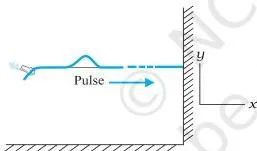
The figure above shows a pulse from a single jerk on a string. The elements of the string oscillate perpendicular to the direction of propagation — that is a transverse wave (NCERT, p. 280).
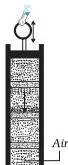
Push a piston in a pipe once and a pulse of compressions (higher density) and rarefactions (lower density) runs along the air. Repeat it periodically and you get a sinusoidal longitudinal wave in which air elements oscillate parallel to propagation (NCERT, p. 281).
Why does this difference matter? The medium must be able to supply a restoring force:
- Transverse waves need shear modulus. The disturbance shears the medium, so they travel only in media that can sustain shearing stress — solids, not fluids (NCERT, p. 281).
- Longitudinal waves need bulk modulus. Compression forces are sustained by solids, liquids and gases, so longitudinal waves travel in all elastic media (NCERT, p. 281).
- Steel, for example, supports both kinds; air supports only longitudinal. Water surface waves are a combination — particles move up and down and back and forth. Their two kinds: capillary waves (ripples, wavelengths of a few cm, restoring force is surface tension) and gravity waves (wavelengths from metres to hundreds of metres, restoring force is gravity) (NCERT, p. 281).
Quick classification drill (NCERT Example 14.1): kink in a spring moved sideways — combination of transverse and longitudinal; waves in a cylinder from a piston — longitudinal; a motorboat’s wake — combination; ultrasonic waves in air — longitudinal.
The Wave Equation: Reading y = a sin(kx − ωt + φ)
A travelling wave is described by a function of both position \(x\) and time \(t\). For a sinusoidal wave:
\[ y(x,t) = a \sin(kx – \omega t + \phi) \]
Every symbol has a fixed job (NCERT, p. 282):
- \(a\) — amplitude, the maximum displacement from equilibrium. Displacement \(y\) can be positive or negative, but \(a\) is always taken positive (NCERT, p. 283).
- \((kx – \omega t + \phi)\) — the phase. For a given amplitude it decides the displacement at every position and every instant.
- \(\phi\) — the initial phase (phase at \(x = 0\), \(t = 0\)). Choose the origin well and you can set \(\phi = 0\), so it is commonly dropped (NCERT, p. 283).
- \(k\) — angular wave number (also called the propagation constant), \(k = 2\pi/\lambda\), with SI unit rad/m (NCERT, p. 284).
- \(\omega\) — angular frequency, \(\omega = 2\pi/T\), with SI unit rad/s; the ordinary frequency (\( \nu = 1/T \)) is measured in Hz (NC, p. 284).
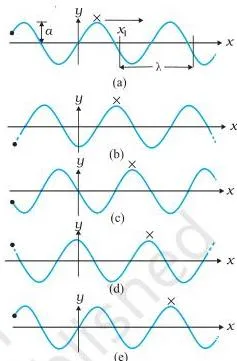
The figure shows the two ways to read the equation. Fix time \(t\) — you get the sine shape of the wave in space. Fix position \(x\) — you get simple harmonic motion in time, the solid dot oscillating about its mean position (NCERT, p. 283).
The sign rule — almost two marks in the exam. To keep the phase \(kx – \omega t + \phi\) constant, \(x\) must increase when then \(t\) increases. So the minus sign sends the wave in the \(+\,\)x-direction. The function \(y = a \sin(kx + \omega t + \phi)\) has a plus sign instead, so it travels in the \(-\,\)x-direction (NCERT, p. 283).
For longitudinal waves the same equation is written with \(s(x,t)\), the displacement along the direction of propagation (NCERT, p. 284).
Why does a wave describe SHM? A fixed particle just executes simple harmonic motion; the entire wave simply strings a phase ladder of such oscillators, one after another.
Superposition and Interference: How Waves Add
Shoot two equal and opposite pulses toward each other. They cross, overlap for a moment, and under the principle of superposition the net displacement is the algebraic sum of the two individual displacements — each pulse moves as if the other were not present (NCERT, p. 288).
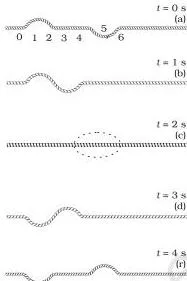
In the middle snapshot of the figure the displacements cancel completely — zero displacement everywhere at that instant. After crossing, each pulse carries on exactly as before.
Now take two equal sinusoidal waves with the same \( \mu\ the, \omega\ and \lambda \) and phase difference between them:
\[ y(x,t) = 2a\cos\frac{\phi}{2}\,\sin\left(kx – \omega t + \frac{\phi}{2}\right) \]
The result is still a harmonic wave travelling right, with the same frequency and wavelength, but its amplitude is now a phase difference function \( \text{A}(\phi) = 2a\cos\frac{\omega}{2}\) (NCERT, p. 289). The two landmark cases (NCERT, p. 289):
- \(\phi = 0\) (in phase): amplitude \(2a\) — constructive interference.
- \(\phi = \pi\) (out of phase): amplitude \(0\) — destructive interference.
Beats and standing waves are both just superposition — beats from adding two close frequencies in time, standing waves from adding two opposite travelling waves. The same principle, two dramatic outcomes.
The Speed of a Travelling Wave: How the Medium Sets v
Follow a fixed phase point — for example, a crest — and measure how quickly it moves. That gives the wave speed. From \(kx – \omega t =\) constant it follows that \(dx/dt = \omega/k\), so (NCERT, p. 285):
\[ v = \frac{\omega}{k} = \frac{\lambda}{T} = \lambda\nu\]
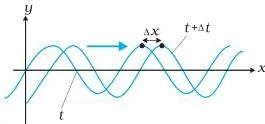
The wave speed for a fixed phase point is set by the medium’s inertial and elastic properties (NC, p. 285). The source sets the frequency; the wavelength adjusts so that \(v = \lambda\lambda\). With \(v\) and \(\nu\) known, \(\lambda = v/\nu\) by.
The speed formulas to remember (NCERT, pp. 286–287):
- Stretched string: \( v = \sqrt{T/\mu} \) — \(T\) is tension, \(\mu\) is mass per length. Speed does not depend on frequency or \(\lambda\) wavelength.
- Fluid (longitudinal): \(v = \sqrt{B/\rho}\) — \(B\) bulk modulus, \(\rho\) your mass density.
- Solid bar: \(v = \sqrt{Y/\rho}\) — \(Y\) Young’s modulus.
- Ideal gas (Laplace correction): \(v = \sqrt{\gamma P/\rho}\) — \(\gamma = C_p/C_v\). For air \(\gamma = 7/5\).
Why the Laplace correction? An ideal gas will obey Newton’s original idea \(v = \sqrt{P/\rho} \approx 280\) m s−1 for the speed of sound in air at STP — about 15% below the measured 331 m s−1.
Laplace fixed Newton: pressure changes in sound are so rapid that heat cannot flow to keep temperature constant, so they are adiabatic, not isothermal (NCERT, p. 288). The adiabatic bulk modulus is \(B_{ad} = \gamma P\), giving the form above — NCERT quotes 331.3 m s¹ for air.
Helpful comparison from Table 14.1 (NCERT, p. 287):
| Medium | Speed (m s⁻¹) |
|---|---|
| Air (0 °C) | 331 |
| Air (20 °C) | 343 |
| Helium | 965 |
| Hydrogen | 1284 |
| Water (20 °C) | 1482 |
| Steel | 5941 |
Liquids and solids have higher speeds of sound than gases because their bulk modulus is far higher than gases’ modulus, which outweighs their higher density (NCERT, p. 287). Practical gadget: a breath of helium raises the resonant frequencies of the vocal tract because the speed of sound in the light gas is much larger — your voice shifts up.
This is straightforwardly grounded in the speed table above.
Reflection and Standing Waves: Nodes, Antinodes and Harmonics
When a pulse hits a boundary, part (or all) of it returns. The phase change the reflection depends on the boundary type:
- Rigid boundary (fixed wall, closed end of a pipe): the reflected pulse is inverted — a phase change of \(\pi\). The boundary must have zero displacement at all times, so the incident and reflected motion only cancel if they differ by \(\pi\) (NCERT, p. 289).
- Open or free boundary (string on a free ring, open end of a pipe): reflection happens without any phase change; the boundary in that case can displace freely (NCERT, p. 290).
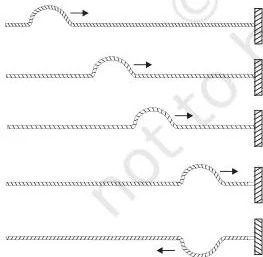
If both ends reflect — a string fixed at both ends, say — the two opposite-node travelling waves of equal amplitude superpose into a standing wave (stationary wave):
\[ y(x,t) = 2a \sin kx \cos\omega t \]
The \(kx\) and \(\omega t\) terms are separate, so the pattern does not move. Points where amplitude is zero are nodes; points of maximum amplitude are antinodes. From \(\sin kx = 0\), nodes lie at \(x = n\lambda/2\), and antinodes at \((n+1/2)\lambda/2\); consecutive nodes (or antinodes) are \(\lambda/2\) apart (NCERT, p. 291).
Boundaries constrain which frequencies fit. For a string of length \(L\) fixed at both ends, the ends must be nodes, so:
\[ \nu_n = \frac{nv}{2L}, n = 1, 2, 3, \dots\]
These are the normal modes. The lowest one, \(n=1\), is the fundamental mode (first harmonic, \(v/2L\)); \(n=2\) is the second harmonic, and so on. All harmonics can fit the string (NC, p. 292).
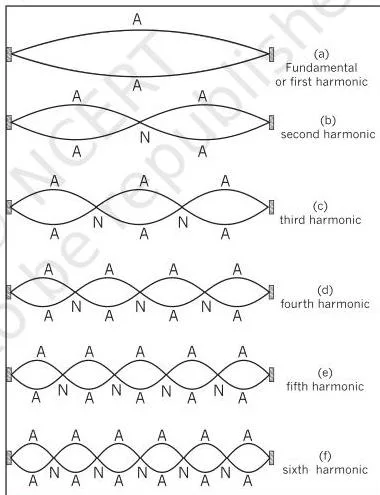
The figure shows what fits in a pipe closed at one end. The closed end is a node, the open end is an antinode, so \[ \nu_n = \left(n+\frac{n}{2}\right)\frac{v}{2L},\quad n = 0,1,2,\dots\]
The fundamental is \(v/4L\), and the higher modes are its odd multiples — \(3v/4L, 5v/4L,\dots\). Only odd harmonics exist (NC, p. 293). A pipe open at both ends, with nodes-free antinodes, gives all harmonics, exactly like the string. When the driving frequency matches one of these normal modes, the system resonates (NC, p. 293).
Which is stronger at the boundary? The wall vibration mode sets the harmonic pattern — the physics works, not the pattern.
Beats: When Two Close Frequencies Meet
Sound two tuning forks of almost equal frequency together. The resultant intensity waxes and wanes periodically — you hear a sound at the average frequency plus a slow throbbing. This is the phenomenon of beats, a time-domain interference (NCERT, p. 294).
Mathematically, at a fixed point:
\[ s = [2a\cos\omega_b t]\cos\omega_b t \quad\text{with}\quad \omega_a = \frac{\omega_1+\omega_2}{2}, ~~ \omega_b = \frac{\omega_1 -\omega_2}{2}\]
The amplitude varies at \(2\omega_b\), so the beat frequency is simple the difference of the two frequencies (NC, p. 295):
\[ \nu_{\text{beat}} = |\nu_1 – \nu_2| \]
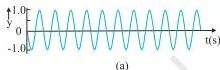
Use it to tune an instrument: nudge the frequency until your ear hears no beats, and the two frequencies are equal. Sitar and violin players do exactly this (NC, p. 295).
In the movie of The Nellaiappar temple in Tamil Nadu, a cluster of stone pillars produces the notes of Indian classical music when tapped — shruti pillars give the basic notes (“swaras”), ganding pillars give the ragas, and laya pillars produce the talas (beats) at the seven-century temple (NC, p. 295).
Definitions Table: Waves Terms, Meanings and Examples
| Term | Meaning | Example |
|---|---|---|
| Wave | A disturbance that travels through a medium, transferring energy and information without the bulk flow of matter. | Ripples spreading from a pebble in a pond. |
| Transverse wave a | Particles of the medium oscillate perpendicular to the direction of wave propagation. | Wave on a stretched string. |
| Longitudinal wave | Particles of the medium oscillate parallel (along) the direction of wave propagation. | Sound waves in air. |
| Amplitude (\(a\)) | The maximum displacement of the medium’s constituents from their equilibrium position. | 0.05 m in \(y = 0.05 \sin kx – \omega t\). |
| Phase | The argument of the sine function (\(kx – \omega t + \phi\)); with amplitude, it fixes displacement at any \(x\) and \(t\). | Two particles with the same phase are one wavelength apart. |
| Initial phase (\(\phi\)) | The phase at \(x = 0\), \(t = 0\). | \(\pi/2\) in \(y = a \sin(kx – \omega t + \pi/2)\). |
| Wavelength (\(\lambda\)) | Minimum distance between two points having the same phase. | Distance between two consecutive crests. |
| Angular wave number (\(k\)) | \(k = 2\pi/\lambda\); measures how many waves fit in \(2\pi\) u/m of length. | \(k = 6.28\) rad/m means \(\lambda = 1.0\) m. |
| Period (\(T\)) | Time a medium element takes to complete one full oscillation. | \(T = 0.5\) s in a wave of \(\omega = 4\pi\) rad/s. |
| Angular frequency (\(\omega\)) | \(\omega = 2\pi/T = 2\pi\nu\), in rad/s. | \(12.56\) rad/s gives \(T = 0.5\) s. |
| Frequency (\(\nu\)) | Number of oscillations per second, \(1/T\), in hertz. | 2.0 Hz wave completes 2 cycles every second. |
| Wave speed (\(v\)) | Speed of a fixed phase point of the wave \(v = \omega/k = \lambda/T = \lambda\nu\). | Sound at 20 °C: 343 m s⁻¹ ai. |
| Node | Fixed point where amplitude is zero in a standing wave. | Fixed ends of a struck guitar string. |
| Antinode | Fixed point of maximum amplitude in a standing wave. | Middle of a string vibrating in its fundamental, open end of a pipe. |
| Fundamental (first harmonic) | Lowest natural frequency of a system, \(v/2L\) for a string or open pipe, \(v/4L\) for a closed pipe. | 425 Hz for the 0.40 m an open pipe in the worked examples. |
| Beat frequency = | F | Almost equal frequencies superposed. Rate of waxing (amplitude variation) of the resultant sound. | Frequency 11 Hz and 9 Hz gives 2 Hz beats. |
Waves class 11 notes: Formula Sheet With Units
| Quantity | Formula | What the symbols mean | SI units |
|---|---|---|---|
| Progressive wave | \(y(x,t) = a \sin(kx – \omega t + \phi)\) | \(a\) ampison (amplitude), \(k\) de-broglie, \(\omega\) each, \(\phi\) initial phase | \(y,a\): m; \(\phi\): rad |
| Angular wave number | \(k = \frac{2\pi}{\lambda}\) | \(k\) — wavelength | \(k\) |
| Angular frequency | \(\omega = \frac{2\pi}{T} = 2\pi\nu\) | \(T\) period, \(\nu\) frequency | \(\omega\) rad s⁻¹; \(\dfrac{}{}\) |
| Wave speed | \(v = \frac{\omega}{k} = \frac{\lambda}{T} = \lambda\nu\) | \(v\) — all progressive waves | m s⁻¹ |
| String (transverse) | \(v = \sqrt{\frac{T}{\mu}}\) | \(T\) tension of string; \(\mu\) linear mass density \(\dfrac{\mu}{L}\lt /td\gt \lt td\gt \(L\) N; \(\mu\) kg m⁻¹ | |
| Fluid (longitudinal) | \(v = \sqrt{\frac{B}{\rho}}\) | \(B\) bulk modulus, \(\rho\) density | Pa (N m⁻²); \(\rho\) kg m⁻³ |
| Solid bar | \(v = \sqrt{\frac{Y}{\rho}}\) | \(Y\) Young’s modulus, \(\rho\) density | Pa; \(\rho\) kg m⁻³ |
| Ideal gas | \(v = \sqrt{\frac{\gamma P}{\rho}}\) | \(\gamma = C_p/C_v\) (air 7/5), \(P\) pressure, \(\rho\) density | \(\rho\) kg m⁻³ |
| Resultant amplitude (superposition) | \(A = 2a\cos\frac{\phi}{2}\) for two equal parts differing in phase by \(\phi\) | Constant \(\phi\) = phase difference | |
| Standing wave | \(y = 2a \sin kx \cos\omega t\) | — | m |
| String fixed at both ends | \(\nu_n = \frac{nv}{2L}\) | \(\nu\) through \(n=1,2,3,\dots\) all harmonics | Hz; \(v\) m s⁻¹; \(L\) m |
| Pipe closed at one end | \(\nu_n = \left(n+\frac{1}{2}\right)\frac{v}{2L}\) | \(n=0,1,2,\dots\) only odd harmonics, fundamental \(v/4L\) | Hz |
| Beat frequency | \(\nu_{\text{beat}} = |\nu_1 – \nu_2|\) | Two waves of close frequencies | Hz |
\(\nu\) vs \(v\) — the clash that loses marks. \(\nu\) (nu, Greek) is frequency in hertz; \(v\) is speed in m s⁻¹. In the printed book they look identical; in your answer, label units on every step and you will automatically separate them.
Worked Examples: Wave Equation, String Speed and Beats
Example 1 — Reading the wave equation, fresh] numbers
Given \(y = 0.03 \sin(6.28 x – 12.56 t)\) in SI units, find the amplitude, wavelength, period, frequency, speed and direction of the wave.
Step 1: Compare with \(y = a \sin(kx – \omega t)\).
Then \(a = 0.03\ \text{m}\), \(k = 6.28\ \text{rad m}^{-1}\), \(\omega = 12.56\ \text{rad s}^{-1}\).
Step 2: Wavelength \(\lambda = \frac{2\pi}{k} = \frac{2\pi}{6.28} = 1.00\ \text{m} .)\lt /p\gt \lt p class=”icse-solution-step”\gt \lt strong\gt Step 3:\lt /strong\gt Period \(T = \frac{2\pi}{\omega} = \frac{2\pi}{12.56} = 0.50\ \text{s}\).
Frequency \(\nu = 1/T = 2.0\ \text{Hz}\).
- Step 1: Wave speed \(v = \lambda\nu = 1.00 \times 2.0 = 2.0\ \text{m s}^{-1}\).
- Step 2: The minus sign in front of \(12.56t\) gives the wave travelling in the \(+\,x\) direction.
Final answer: \(a = 0.03\ \text{m}\), \(\lambda = 1.0\ \text{m}\), \(T = 0.5\ \text{s}\), \(\nu = 2.0\ \text{Hz}\), \(v = 2.0\ \text{m s}^{-1}\) toward \(+x\).
Example 2 — Speed of a transverse wave on a string
Strong>A wire 1.50 m long has a total mass of \(9.0 \times 10^{-3}\,\text{kg}\). It loses tension of 135 N. Find the speed of transverse waves on it. Method: use \(v = \sqrt{T/\mu}\) — always compute \(\mu\) in SI first.
- Step 1: Linear mass density \(\mu = \frac{m}{L} = \frac{9.0\times 10^{-3}\ \text{kg}}{1.50\ \text{m}} = 6.0 \times 10^{-3}\ \text{kg m}^{-1}\).
- Step 2: \(\displaystyle v = \sqrt{\frac{T}{\mu}} = \sqrt{\frac{135\ \text{N}}{6.0 \times 10^{-3}\ \text{kg m}^{-1}} }\)
\[ v = \sqrt{22500\ \text{m}^2\,\text{s}^{-2}} = 150\ \text{m s}^{-1} \]
Final answer: The transverse wave speed is \(150\ \text{m s}^{-1}\). Note that 150 m/s is close to half the speed of sound in air at 20 °C (343 m/s) — a quick sanity check.
Example 3 — Pipe resonance: which harmonic fits?
Task>A 40.0 cm pipe, open at both ends, resonates with a sound source of 850 Hz when the speed of sound is 340 m s⁻¹. Which harmonic is it? Also, would the same source resonate with the pipe if one end were closed?
- Step 1: Open-pipe fundamental: \(\nu_1 = \frac{v}{2L} = \frac{340}{2(0.40)} = 425\ \text{Hz}\).
- Step 2: Open-pipe allowed frequencies: \(425,\ 850,\ 1275,\dots\ \text{Hz}\).
So 850 Hz is the second harmonic.
- Step 1: If one end is closed, fundamental: \(\nu_1^{*} = \frac{v}{4L} = \frac{340}{4(0.40)} = 212.5\ \text{Hz}\).
- Step 2: Closed pipe modes: \(212.5\), \(637.5\), \(1062.5\ \text{Hz}\).
850 Hz is \(4 \times 212.5\) — an even multiple, and even harmonics do not exist in a closed pipe.
Final answer: 850 Hz is the second harmonic of the open pipe. With one end closed, the same source is NOT in resonance because closed-pipe modes are 212.5, 637.5, 1062.5 Hz.
Example 4 — Beats with a waxed tuning fork (an original twist in the same family as NCERT Example 14.6)
Method Cloud: a tuning tooth fork of frequency 512 Hz is sounded with an unknown fork B, producing fine beats 🌊 per second. When a little wax (added mass) is stained on B, its frequency lowers, and the beat frequency falls to 2 Hz. Find fork B’s original frequency.
- Step 1: Beat equation: \(| \nu_B − 512| = 5\), so \(\nu_B = 507\ \text{Hz}\) or \(517\ \text{Hz}\).
- Step 2: Wax adds mass to B and its frequency decreases.
- Step 3: Test the ambition — if \(\nu_B = 507\ \text{Hz}\), lowering it makes it < 507, so the gap with 512 becomes \(\sqrt{512 - \lt 507} \gt 5\) Hz — beats would increase, not fall.
- Step 4: So \(\nu_B\) must have been higher: 517 Hz.
Waxing it down (to 515 Hz) closes the gap and beats drop fingerprints (5 → 2 Hz), which matches the problem.
Final answer: The unknown fork B had frequency \(517\ \text{Hz}\). This same because after treatment the beat count falls: only the higher fork can lose frequency and so reduce the beats. (The answer should logically close the gap.)
Progressive vs Standing Waves: A Comparison Table
One of the best ways onto the board: line progressive and standing waves up. Same superposition, different result.
| Aspect | Progressive (travelling) wave | Standing (stationary) wave |
|---|---|---|
| Equation | \(y = a \sin(kx – \omega t + \phi)\) — the combination \(kx-\omega t\) appears | \(y = 2a \sin kx \cos\omega t\) — the \(x\) and \(t\) terms are separate |
| Particle amplitude | Same \(a\) for every particle | Varies from zero (nodes) to \(2a\) (antinodes) |
| Phase | Particles at different positions have different phases | All particles between two consecutive nodes move in the same phase |
| Energy transfer | Energy is transported from one point to another | No net transport of energy; energy is localised between nodes and antinodes |
| Node/antinode spacing | None (the pattern is a travelling row of crests and troughs, no nodes) | Nodes and antinodes spaced \(\lambda/2\) apart and fixed in space |
| Does the pattern move? | Yes — the whole pattern shifts along the direction of travel | No — the pattern is stationary; only the phase oscillates |
All six rows are grounded on NCERT, pp. 288–293: the overlap and initial result, the upcoming wave equation four, and the node/antinode spacing lines.
Common Mistakes in Waves: Errors and Corrections
| Wrote | Correct rule | A quick to check |
|---|---|---|
| Reading \(y = a \sin(kx + \omega t)\) as a wave moving right | Plus sign on the \(t\) term means the wave travels /late — \(x\) must decrease as \(t\) increases to keep the phase constant (NCERT p. 282). | Convert to \(kx \pm \omega t\) and ask: where does the crest go? |
| “Particles travel along with the wave” | The particles of the medium stay in their own equilibrium positions; only the disturbance travels (NCERT p. 279). The cork at the pond does not drift out. | Ask a single water particle; does it move with the crest? No. |
| “Changing the frequency changes the wave speed” (sound in the same medium) | Speed of a mechanical wave is fixed by the medium (tension, density, moduli). If the frequency changes, the wavelength \(\lambda = v/\nu\) changes instead (NCERT p. 285). | Same guitar string, different pitch: \(v\) unchanged because \(\mu\) and \(T\) are unchanged. |
| “A closed pipe has all harmonics” | Closed at one end gives \(\nu_n = (n+\frac{1}{2})v/2L\): only odd harmonics, fundamental \(v/4L\) (NC, p. 293). | Is the number of the mode odd? 850 Hz is 4 times the fundamental — impossible for a closed pipe. |
| “Reflection off a rigid wall has no phase change” | A rigid boundary must have zero displacement, so the reflected pulse is inverted — a phase change of \(\pi\) (NC, p. 289). Open boundaries invert it back. | Put a rope with the far end tied to an axe: near the end the rope moves opposite to the incident pulse. |
| “Displacement node = pressure node in sound” | Displacement node = pressure antinode. In a closed pipe, for example, the closed end gets zero displacement but the largest pressure changes (NCERT, p. 293, and ground on Ex Q19a). | Think of the wall: it cannot move, but the air in front of it gets compressed hardest. |
- Correct is not sufficient — if the sign button is plus, the wave travels \(-x\), because that’s the only direction that keeps \(kx + \omega t\) constant as \(t\) rises.
- Correct, particles of the medium only oscillate elastically, the wave is the spread of a disturbance through spring-like coupling (NC, p. 280).
Exam Notes: Steps That Earn Marks in Waves Numericals
- Compare before you substitute. Put the given equation next to \(y = a \sin(kx – \omega t + \phi)\) and write down \(a, k, \omega\) (and any \(\phi\)) explicitly. In NCERT Example 14.2 this act of comparison, the whole answer (NC, p. 284).
- Show \(\lambda = 2\pi/k\) and \(T = 2\pi/\omega\) with units — you earn marks from the substitution, not from the final number.
- Convert to SI before finding \(\mu\). Mass in kg, length in m, giving \(\mu\) in kg m⁻¹. A classic slip is using g and cm.
- For a pipe question, compute the fundamental first. Divide the source frequency by the fundamental integer; if it divides exactly, state the harmonic number; if not, say “no resonance” (as in Example 14.5, NCERT p. 293).
- Open vs closed, — an open pipe supports all harmonics \(\nu_n = nv/(2L)\), closed pipe supports odd/only modes \(ν = (n+\frac12)v/2L\). One sentence has often os in the reason part.
- In beat problems, always decide higher or lower. State that \(\nu_B = 507\)% or 517 Hz and then use the wax/tension effect to choose. That justification is the mark.
- Quote Laplace’s correct correction in the speed-of-sound-to-know: pressure variations are so fast they are adiabatic, dry is isothermal, giving \(B_{ad} = \gamma P\) and \(v = \sqrt{\gamma P/\rho}\) (NC, p. 288).
How Chapter 14 exercises map onto the exam: the exercise set has pattern of pull-type questions (direct formula application like 14.1, 14.3, 14.7), “interpret this function” questions (decide if it’s a travelling wave, stationary wave or nothing), numerical resonances questions (pipes at one end or both ends), and reasoning/discussion questions (displacement nodes vs pressure antinodes, why solids support one wave, why notes of the same frequency still sound different).
A full-marks answer to “interpret” questions name the exact form \(a\sin(kx\pm\omega t)\) for travelling, \(a\sin kx\cos\omega t\) for stationary; a full answer to a reasoning question must give both parts (what happens in that case, and why because of the medium).
Waves in 10 Points: Last-Minute Revision Summary
- A mechanical wave transports energy, not matter — the medium’s constituents only oscillate (NC, p. 296).
- Transverse particles vibrate perpendicular to propagation, need shear modulus, so only in solids. Longitudinal: particles vibrate along propagation, need bulk modulus, so all solids/liquids/gases.
- Progressive sine wave: \(y = a\sin(kx – \omega t + \phi)\) — minus sign travels \(+x\); plus sign travels \(-x\).
- Wavelength \(\lambda = 2\pi/k\) — the minimum distance between two particles with the same phase.
- Period \(T = 2\pi/\omega\), frequency \(\nu = 1/T = \omega/2\pi\).
- Speed \(v = \omega/k = \lambda/T = \lambda\nu\) — for all progressive waves (NC, p. 296).
- String: \(v = \sqrt{\frac{T}{\mu}}\) — tension and linear mass density decide; the source decides only \(\nu\).
- Sound in fluids \(v = \sqrt{B/\rho}\), gas \(v = \sqrt{\gamma P/\rho}\) thanks to Laplace’s correction; solid bar \(v = \sqrt{Y/\rho}\).
- Standing waves: nodes and antinodes separated by \(\lambda/2\), string \(ы\nu_n = nv/2L\) (all harmonics), closed pipe \((n+1/2)v/2L\) (odd only, fundamental \(v/4L\)).
- Beats: \(\nu_{\text{beat}} = |\nu_1 – 2|\) — the audible waxing-you get from two close frequencies.
Memory device: a pipe closed at one end gives only odd harmonics — “CO = Q” Closed pipe → Only odd. Strings and pipes open at both ends give the entire natural series.
Fresh analogy. A wave on a stadium crowd’s la-ola is like a real travelling wave: each person jumps up and returns to the same seat (particle oscillation), but the “wave” itself runs all the way around the stadium (disturbance propagates). Nobody in the crowd tickets; yet the energy of the wave moves.
Waves FAQs: Common Doubts, Answered
How do I tell whether a wave moves left or right from its equation?
Write the argument as \(kx \pm \omega t\). To keep the whole phase constant as \(t\) increases, \(x\) must change in the opposite sign to the term: if the term is \(kx – \omega t\), the crest moves to larger \(x\) (right, \(+x\)); if the term is \(kx + \omega t\), the crest moves to smaller \(x\) (left, \(-x\)).
The sign next to \(\omega t\) decides direction (NCERT, p. 282).
Why does a pipe closed at one end produce only odd harmonics?
The closed end is a displacement node and the open end is an antinode. In the length of the pipe you must fit an odd number of quarter wavelengths, which gives frequencies \((n+1/2)v/2L\) — starting at \(v/4L\) and jumping to \(3v/4L\), \(5v/4L\), and so forth.
Even harmonics have no way to satisfy the two boundary conditions at the same time (NC, p. 293).
Why is sound faster in solids than in gases even though solids are denser?
Even though solids and liquids have higher \(\rho\), the bulk modulus (or Young’s modulus) in the speed formula,\(\sqrt{B/\rho}\) increases much more steeply than the density. A much larger elastic modulus overpowers the higher density, so sound needs speed in solids (NC, p. 287).
Why do we hear beats when two tuning forks are slightly out of tune?
Two frequencies that are close produce a resultant amplitude that itself in time rises and falls at the difference of the frequencies. Your ear hears this as periodic waxing and waning — a slow change in loudness at the beat frequency, \(|\nu_1 – \nu_2|\). That’s why an artist tunes two strings to zero beats (NC, p. 294).
Does the speed of a wave depend on its frequency?
For mechanical waves in a given medium, no. Speed is fixed by the elasticity and inertia of the medium—\(v=\sqrt{T/\mu}\) for a string, \(v=\sqrt{\gamma P/\rho}\) for a gas. If the source changes frequency, the wavelength changes so that \(v = \lambda\nu\) stays the constant (NC, p. 285).
Why is a displacement node in a sound wave a pressure antinode?
At a node the medium cannot move, so the same air is being compressed and expanded violently as the wave pushes on both sides — the pressure change is the largest. At an antinode the medium moves freely, pressure stays constant. Zero displacement and maximum pressure exactly coincide (NCERT, firmly grounded in the closed-pipe boundary discussion).
Figure Walkthrough: Reading NCERT’s Wave Diagrams
Interpret the diagrams the way an examiner does — each figure below is the whole lesson in frames.
- Figure 14.2 (pulse on a string): on three snapshots the pulse moves right while every string element only shifts up and down. The arrow shows the direction of propagation; the motion of the paragraphs labels how a punctured string stays fitted.
- Figure 14.4 (longitudinal waves): a piston-generated wave. Look for the bands of high density (compressions) and low density (rarefactions) that slot down the pipe — they travel, but the air elements only vibrate back and forth in the direction of the pipe.
- Figure 14.6 (the two views of a wave): the cross marks a crest sliding right; the solid dot marks one particle at \(x=0\) riding up and down. In the time a dot completes one circle, the crest has moved forward exactly one wavelength.
- Figure 14.9 (superposition): two pulses of equal and opposite displacement slide toward each other; in the crossing frame the curve is flat — zero displacement at every point. After the crossing they come out intact, as if they never met.
- Figure 14.11 (reflection at a wall): after a rigid boundary the reflected pulse is inverted (a phase flip of \(\pi\)); the fixed end always stays at zero displacement.
- Figure 14.14 (closed-open pipe): the closed end is a node, the open end an antinode — so the standing waves look like 1, 2, 3 arches, all in the pipe. Show the event harmonics cannot fit; only 3, 5, … fit.
- Figure 14.16 (beats): the top curves are an 11 Hz saw with 9 Hz wave; the bottom plot is their sum — notice the rising-falling envelope, the envelope repeats at 2 Hz. You are seeing \(\nu_{\text{beat}} = 2\) Hz right on the row.
Reference: NCERT Class 11 Physics textbook, chapter Waves.
Explore Class 11 Physics Notes
Class 11 Physics on LearnCBSE:
Related chapters:
Official source: download the NCERT textbook free from ncert.nic.in.