
These oscillations class 11 notes condense NCERT Physics Part II, Chapter 13 (Oscillations) into one revision page built for a test or the night before the exam.
You get every definition, the SHM equations with symbol meanings and units, velocity and acceleration, the force law, energy, the simple pendulum result, three fully worked examples with original numbers, a common-mistakes table, exam pointers and a formula sheet.
Read it top to bottom for a full revision, or jump to the section you need from the list below. Every key result is tied to its textbook page so you can verify it in the book in seconds.
Periodic and Oscillatory Motion: What Repeats and Why
A motion is periodic if it repeats itself at regular intervals of time (NCERT, p. 260). A planet orbiting the Sun, a child on a swing, a boat tossing in a river, the piston of an engine going back and forth — all repeat their path after a fixed time.
An oscillatory motion is a special kind of periodic motion: to-and-fro motion about a mean position. The pendulum of a wall clock is the classic example (NCERT, p. 260).
Here is the one logical point the chapter hammers, and it is a favourite one-mark question:
- Every oscillatory motion is periodic — it repeats, so it qualifies.
- Not every periodic motion is oscillatory — uniform circular motion returns to the same point every revolution, yet it never moves to and fro, so it is periodic but not oscillatory (NCERT, p. 261).
Oscillations happen because the body has a stable equilibrium position somewhere inside its path:
- At equilibrium, no net force acts on the body; if left at rest, it stays there (NCERT, p. 260–261).
- A small displacement triggers a restoring force that pulls the body back toward equilibrium.
- The body overshoots, is pulled back again, and the result is oscillation.
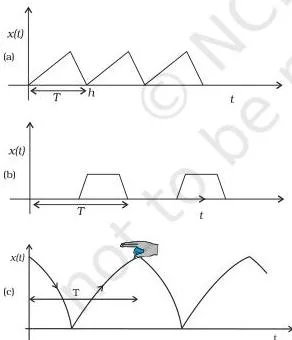
The graphs above show three periodic motions — an insect on a ramp, a child on a step, and a bouncing ball. Notice that the bouncing ball’s curved sections are parabolas from \( h = ut \pm \frac{1}{2}gt^2 \), with different initial speed \(u\) each bounce. What matters for now: the same shape repeats after the period T.
Two more terms to fix before moving on:
- Oscillation vs vibration — same idea; at low frequency we say oscillation (swinging branch), at high frequency vibration (guitar string) (NCERT, p. 261).
- Why atoms matter — in a solid, atoms vibrate about their equilibrium positions, average energy proportional to temperature, which links this chapter to the kinetic theory of gases.
The simplest oscillation is simple harmonic motion: it arises when the restoring force is directly proportional to the displacement and always directed toward the mean position (NCERT, p. 261). That is what the rest of the chapter builds on.
Period, Frequency and Displacement: Key Definitions
Before any equation, fix the vocabulary. The chapter uses the word displacement in a wide sense: it means the change with time of any physical property under study, not only a position change (NCERT, p. 262). So a spring block has displacement \(x\), a pendulum has angular displacement \(\theta\), an AC circuit has voltage, and sound has pressure.
| Term | Meaning | Example / note |
|---|---|---|
| Period T | Smallest interval after which the motion repeats itself; SI unit second (NCERT, p. 261). | Heart rhythm: T = 0.8 s. |
| Frequency ν | Number of repetitions per unit time; \(\nu = 1/T\); unit hertz, 1 Hz = 1 s⁻¹ (NCERT, p. 261). | 75 beats/min → ν = 1.25 Hz. |
| Displacement variable | Change with time of any physical property under consideration (NCERT, p. 262). | x of spring block, θ of pendulum, AC voltage, sound pressure. |
| Amplitude A | Magnitude of the maximum displacement (NCERT, p. 263). | Piston stroke 1.0 m → A = 0.5 m. |
| Phase (ωt + φ) | Time-dependent argument that fixes the state of motion (NCERT, p. 264). | Grows by 2π each period. |
| Phase constant φ | Phase at t = 0; set by initial displacement and velocity (NCERT, p. 264). | x(0) = A cos φ. |
| Angular frequency ω | \(\omega = 2\pi/T = 2\pi\nu\); unit rad s⁻¹ (NCERT, p. 264). | Radians per second. |
Function forms you must recognise: \(f(t) = A\cos\omega t\) repeats when \(\omega t\) grows by 2π, so its period is \(T = 2\pi/\omega\) (Eq. 13.3b, NCERT, p. 262).
A linear combination \(A\sin\omega t + B\cos\omega t\) is also periodic with the same T, and can be rewritten as \[ f(t) = D\sin(\omega t + \phi), \quad D = \sqrt{A^2 + B^2}, \quad \phi = \tan^{-1}\left(\frac{B}{A}\right) \]
Fourier’s theorem is why these two functions matter so much: any periodic function can be expressed as a superposition of sine and cosine functions of different periods with suitable coefficients (NCERT, p. 262).
NCERT’s Example 13.1 counts a heartbeat: 75 beats per minute gives \(\nu = 75/60 = 1.25\ \text{Hz}\) and \(T = 1/\nu = 0.8\ \text{s}\) (NCERT, p. 261).
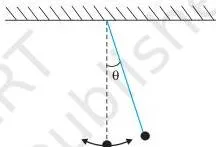
The block–spring picture above is the model system of the whole chapter. Its displacement variable \(x\) is measured from the equilibrium position — the natural origin for every SHM problem.
Simple Harmonic Motion: The Defining Equation
Simple harmonic motion (SHM) is periodic motion in which the displacement is a sinusoidal function of time (NCERT, p. 262). A particle oscillating between the limits +A and −A about the origin is in SHM when \[ x(t) = A\cos(\omega t + \phi) \quad \text{(Eq. 13.4, NCERT, p. 262)} \]
Read each constant:
- A — amplitude: the magnitude of maximum displacement; cosine swings between +1 and −1, so x swings between +A and −A (NCERT, p. 263).
- ω — angular frequency: how fast the phase advances; unit rad s⁻¹.
- (ωt + φ) — phase: the time-dependent argument that fixes position and velocity at every instant (NCERT, p. 264).
- φ — phase constant: the phase at t = 0; gives x(0) = A cos φ.
Why \(\omega = 2\pi/T\)? Cosine first repeats when its argument changes by 2π. Requiring \(x(t) = x(t+T)\) forces \(\omega(t+T) = \omega t + 2\pi\), so \(\omega = 2\pi/T\) (NCERT, p. 264).
Examiners test one idea hard: SHM is not every periodic motion — only the one whose displacement is sinusoidal. A function such as \(e^{-\omega t}\) falls without ever repeating; it is neither periodic nor SHM.
A displacement given in any of these three forms is still SHM (Points to Ponder, NCERT, p. 274):
- \(x = A\cos\omega t + B\sin\omega t\)
- \(x = A\cos(\omega t + \alpha)\)
- \(x = B\sin(\omega t + \beta)\)
The three are completely equivalent — any one can be converted into either of the other two.
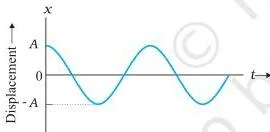
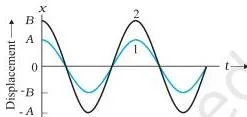
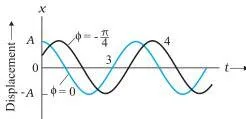
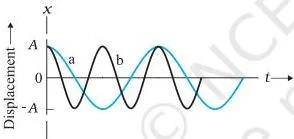
The three pairs of plots above isolate the role of each constant. Keeping ω and φ fixed but changing A stretches the curve vertically (Fig. 13.7a). Keeping A fixed but changing φ slides the curve sideways in time (Fig. 13.7b).
Keeping A and φ fixed but changing ω compresses or stretches the period — curve (b) has half the period and twice the frequency of curve (a) (Fig. 13.8).
The skill examiners repeatedly test is reading A, ω and φ straight off an equation: A is the number in front of the cosine; ω is the coefficient of t inside the argument; φ is the added constant inside the argument. Then \(T = 2\pi/\omega\).
SHM as a Projection of Uniform Circular Motion
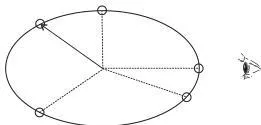
Here is a visual path to the same equation. Tie a ball to a string, make it move in uniform circular motion in a horizontal plane, and view it edge-on — the ball appears to oscillate to and fro along a line, with the rotation point as the midpoint (NCERT, p. 264).
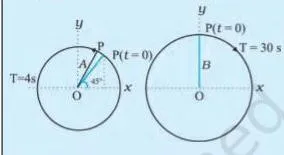
The mathematics: a particle P moves uniformly on a circle of radius A with angular speed ω. If its initial position vector makes angle φ with the x-axis, then in time t the vector OP makes angle \(\omega t + \phi\) with the x-axis. The x-projection of OP, called P′, has \[ x(t) = A\cos(\omega t + \phi) \]
which is exactly the defining equation of SHM (NCERT, p. 265). So the projection of a particle in uniform circular motion onto a diameter executes SHM. P is the reference particle and the circle is the reference circle.
Project onto the y-axis instead and you get \(y = A\sin(\omega t + \phi)\) — SHM of the same amplitude, but phase-shifted by \(\pi/2\) (NCERT, p. 265).
One honest caveat from the text: the force in linear SHM is NOT the centripetal force of circular motion. The circle is only a geometric aid, not a physical cause (NCERT, p. 265–266).
Velocity and Acceleration in SHM
Differentiate the displacement once to get velocity, and again to get acceleration (NCERT, p. 266):
\[ v(t) = \frac{dx}{dt} = -\omega A\sin(\omega t + \phi) \quad \text{(Eq. 13.9)} \]
\[ a(t) = \frac{dv}{dt} = -\omega^2 A\cos(\omega t + \phi) = -\omega^2 x(t) \quad \text{(Eq. 13.11)} \]
The comparison table below is the single most quoted table in this chapter — learn the amplitudes and phase relationships.
| Quantity | Equation | Amplitude (maximum) | Phase vs x | Where it is maximum |
|---|---|---|---|---|
| Displacement x | \(A\cos(\omega t + \phi)\) | A | reference | extremes ±A |
| Velocity v | \(-\omega A\sin(\omega t + \phi)\) | \(v_m = \omega A\) | leads x by π/2 | mean position (x = 0) |
| Acceleration a | \(-\omega^2 A\cos(\omega t + \phi) = -\omega^2 x\) | \(a_m = \omega^2 A\) | anti-phase (π) with x | extremes ±A |
Three consequences you must be able to state in one line:
- Speed is maximum \(\omega A\) at the mean position and zero at the extremes.
- Acceleration is zero at the mean and maximum \(\omega^2 A\) at the extremes.
- Acceleration always points toward the mean position — when x is positive, a is negative, and vice versa (NCERT, p. 266–267).
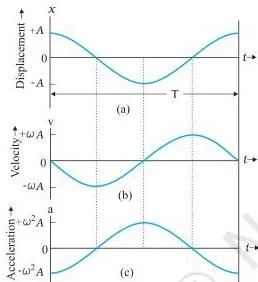
The plots above all share the period T; only their maxima differ and the curves sit at different phases — the acceleration curve is exactly inverted relative to the displacement curve.
Memory rule for the phase order: every differentiation shifts the phase forward by a quarter cycle. Velocity is the first derivative, so it leads displacement by \(\pi/2\) (a quarter turn); acceleration is the second derivative, so it leads by \(\pi\) (half a turn) and is exactly opposite to displacement.
Clock picture: if x sits at 3 o’clock, v is at 12 o’clock and a is at 9 o’clock.
Force Law and the Spring–Block System
Combine Newton’s second law with \(a = -\omega^2 x\) (NCERT, p. 267):
\[ F = ma = -m\omega^2 x \]
Define \(k = m\omega^2\), so \[ F = -kx \quad \text{(Eq. 13.13)}, \qquad \omega = \sqrt{\frac{k}{m}} \quad \text{(Eq. 13.14b)} \]
k is the force constant (spring constant), unit N m⁻¹. The negative sign makes F a restoring force — always directed toward the mean position. That is why the body oscillates.
This gives the two equivalent definitions of SHM (NCERT, p. 268):
- by displacement equation \(x = A\cos(\omega t + \phi)\), or
- by force law \(F = -kx\).
Differentiate the displacement equation twice to reach the force law; integrate the force law twice to recover the displacement equation. The force is linearly proportional to x, so the system is a linear harmonic oscillator with period (NCERT, p. 268, Summary item 8):
\[ T = 2\pi\sqrt{\frac{m}{k}} \]
The classic two-spring case (Example 13.6, NCERT, p. 268): displace the block a small distance x to the right. The left spring elongates by x and pulls the block back (force −kx); the right spring compresses by x and pushes it back (force −kx). Both forces act the same way, so \[ F = -2kx, \qquad T = 2\pi\sqrt{\frac{m}{2k}} \]
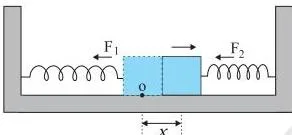
The physical idea: two identical springs in parallel give an effective force constant 2k, so the period is divided by \(\sqrt{2}\). This ‘effective k’ line of reasoning is a favourite extension in exams.
Energy in Simple Harmonic Motion
With \(v = -\omega A\sin(\omega t + \phi)\) and \(k = m\omega^2\), the kinetic energy is (NCERT, p. 269):
\[ K = \frac{1}{2}mv^2 = \frac{1}{2}kA^2\sin^2(\omega t + \phi) \quad \text{(Eq. 13.15)} \]
Because the spring force is conservative, potential energy is (NCERT, p. 269):
\[ U = \frac{1}{2}kx^2 = \frac{1}{2}kA^2\cos^2(\omega t + \phi) \quad \text{(Eq. 13.17)} \]
Adding them and using \(\sin^2 + \cos^2 = 1\), \[ E = K + U = \frac{1}{2}kA^2 \quad \text{(Eq. 13.18)} \]
The total mechanical energy is constant — independent of time, exactly as expected for a conservative force (NCERT, p. 269).
| Position | Kinetic energy K | Potential energy U |
|---|---|---|
| Mean position (x = 0) | maximum \(\frac{1}{2}kA^2\) | zero |
| Extremes (x = ±A) | zero | maximum \(\frac{1}{2}kA^2\) |
| Any interior point | K + U = \(\frac{1}{2}kA^2\) always | |
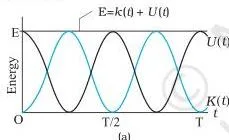
Two facts from the graph worth memorising (NCERT, p. 269):
- Both K and U peak twice per cycle — each has period T/2, because the square of a sine or cosine repeats twice in one period of the motion itself.
- At x = 0 all energy is kinetic; at x = ±A all energy is potential; between them, energy is continuously exchanged.
Energy also gives the quickest route to speed at any point: \(K = E – \frac{1}{2}kx^2\), so \(v = \sqrt{\frac{2}{m}\left(E – \frac{1}{2}kx^2\right)}\).
The Simple Pendulum and the Small-Angle Approximation
A simple pendulum is a small bob of mass m tied to an inextensible massless string of length L, the other end fixed to a rigid support (NCERT, p. 270).
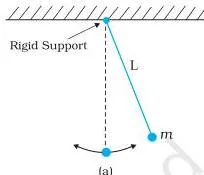
Only two forces act on the bob: tension T along the string and weight mg vertically. Resolve mg:
- mg cos θ along the string — balanced by tension, gives no torque about the support.
- mg sin θ tangential — this is the restoring force.
Torque about the support is entirely from the tangential component (NCERT, p. 271):
\[ \tau = -L(mg\sin\theta) \quad \text{(Eq. 13.19)} \]
With Newton’s rotational law \(\tau = I\alpha\), \[ I\alpha = -mgL\sin\theta \]
The crux is the small-angle approximation. For θ up to about 20°, \(\sin\theta \approx \theta\) — but only when θ is in radians. NCERT’s Table 13.1 shows it plainly (NCERT, p. 271):
| θ (degrees) | θ (radians) | sin θ |
|---|---|---|
| 0 | 0 | 0 |
| 5 | 0.087 | 0.087 |
| 10 | 0.174 | 0.174 |
| 15 | 0.262 | 0.259 |
| 20 | 0.349 | 0.342 |
With \(\sin\theta \approx \theta\), the equation becomes \(\alpha = -(mgL/I)\theta\) — mathematically identical to \(a = -\omega^2 x\), so the pendulum is SHM in angular form (Eq. 13.24, NCERT, p. 271). Therefore \[ \omega = \sqrt{\frac{mgL}{I}}, \qquad T = 2\pi\sqrt{\frac{I}{mgL}} \]
For a point bob, \(I = mL^2\), giving the celebrated result (Eq. 13.26, NCERT, p. 272):
\[ T = 2\pi\sqrt{\frac{L}{g}} \]
Two famous consequences:
- T does not depend on the mass of the bob — m cancelled out.
- T does not depend on the amplitude (for small angles). This contrasts with Kepler’s third law, where orbital period depends on the orbit size — a point the chapter flags in Points to Ponder (NCERT, p. 274).
Worked Examples: SHM Step by Step
Worked Example 1: Finding x, v and a at a Given Time
Method: read the constants from \(x(t) = 3\cos(\pi t + \pi/6)\ \text{cm}\), then evaluate x, v and a at t = 0.5 s.
Step 1: Compare with \(x(t) = A\cos(\omega t + \phi)\).
Here \(A = 3\ \text{cm} = 0.03\ \text{m}\), \(\omega = \pi\ \text{rad s}^{-1}\), \(\phi = \pi/6\).
Step 2: Phase argument at t = 0.5 s:
\[ \omega t + \phi = \pi(0.5) + \frac{\pi}{6} = \frac{\pi}{2} + \frac{\pi}{6} = \frac{2\pi}{3}\ \text{rad} \]
Step 3: Displacement:
\[ x = A\cos\frac{2\pi}{3} = (3\ \text{cm})\left(-\frac{1}{2}\right) = -1.5\ \text{cm} \]
Step 4: Velocity from \(v = -\omega A\sin(\omega t + \phi)\):
\[ v = -\pi(3)\sin\frac{2\pi}{3}\ \text{cm s}^{-1} = -3\pi\left(\frac{\sqrt{3}}{2}\right) \approx -8.16\ \text{cm s}^{-1} \]
Step 5: Acceleration — fastest via \(a = -\omega^2 x\):
\[ a = -\pi^2(\text{rad s}^{-1})^2(-0.015\ \text{m}) \approx +0.148\ \text{m s}^{-2} \]
Final answer: at t = 0.5 s, \(x = -1.5\ \text{cm}\), \(v \approx -8.16\ \text{cm s}^{-1}\) (toward the origin), \(a \approx +0.148\ \text{m s}^{-2}\) (toward the mean).
Sign check that earns marks: displacement is negative, so acceleration must be positive — that is the restoring property \(a = -\omega^2 x\) in action.
Worked Example 2: Energy Conservation in a Spring–Block System
Method: find ω and total energy from the amplitude; at x = 4 cm compute U, then K = E − U, then speed.
- Step 1: Convert data: m = 500 g = 0.5 kg, k = 200 N m⁻¹, A = 8 cm = 0.08 m.
- Step 2: Angular frequency:
\[ \omega = \sqrt{\frac{k}{m}} = \sqrt{\frac{200}{0.5}} = \sqrt{400} = 20\ \text{rad s}^{-1} \]
Step 3: Total energy from the extreme position, where all energy is potential:
\[ E = \frac{1}{2}kA^2 = \frac{1}{2}(200)(0.08)^2 = 0.64\ \text{J} \]
Step 4: At x = 4 cm = 0.04 m, potential energy:
\[ U = \frac{1}{2}kx^2 = \frac{1}{2}(200)(0.04)^2 = 0.16\ \text{J} \]
Step 5: Kinetic energy and speed:
\[ K = E – U = 0.64 – 0.16 = 0.48\ \text{J}, \qquad v = \sqrt{\frac{2K}{m}} = \sqrt{\frac{0.96}{0.5}} \approx 1.39\ \text{m s}^{-1} \]
Check: at x = 0.08 m, U = ½kA² = 0.64 J and K = 0, matching E.
Energy is conserved at every point.
Final answer: ω = 20 rad s⁻¹, E = 0.64 J; at x = 4 cm, K = 0.48 J, U = 0.16 J and v ≈ 1.39 m s⁻¹.
Worked Example 3: Pendulum Period on the Moon
Method: find the length L from the Earth period, then substitute the Moon’s g; the ratio \(T \propto 1/\sqrt{g}\) gives a quick check.
Step 1: Given \(T_e = 2.5\ \text{s}\) at \(g_e = 9.8\ \text{m s}^{-2}\), Moon \(g_m = 1.7\ \text{m s}^{-2}\).
From \(T = 2\pi\sqrt{L/g}\):
\[ L = \frac{g_e T_e^2}{4\pi^2} = \frac{9.8 \times (2.5)^2}{4\pi^2} = \frac{61.25}{39.48} \approx 1.55\ \text{m} \]
Step 2: Moon period with the same length:
\[ T_m = 2\pi\sqrt{\frac{L}{g_m}} = 2\pi\sqrt{\frac{1.55}{1.7}} = 2\pi(0.955) \approx 6.0\ \text{s} \]
Step 3 (ratio route for checking):
\[ \frac{T_m}{T_e} = \sqrt{\frac{g_e}{g_m}} = \sqrt{\frac{9.8}{1.7}} = \sqrt{5.76} = 2.4, \qquad T_m = 2.5 \times 2.4 = 6.0\ \text{s} \]
Final answer: L ≈ 1.55 m and the pendulum takes about 6.0 s per swing on the Moon — about 2.4 times longer than on Earth, because T ∝ 1/√g.
Common Mistakes in Oscillations
These are the chapter-specific errors that cost marks. Each has the rule and a way to check your own work.
| Mistake | Correct rule | How to check your answer |
|---|---|---|
| Using \(\sin\theta \approx \theta\) with θ in degrees | θ must be in radians: the series expansion and Table 13.1 (NCERT, p. 271) only work in radians. | Compare numbers: 20° = 0.349 rad ≈ sin 20° = 0.342; the degree number 20 is nothing like 0.342. |
| Treating frequency ν and angular frequency ω as the same | \(\omega = 2\pi\nu\); ν is cycles per second (Hz), ω is radians per second (NCERT, p. 261, 264). | Units give it away: Hz vs rad s⁻¹; also \(T = 1/\nu = 2\pi/\omega\). |
| Writing acceleration as \(a = +\omega^2 x\) | \(a = -\omega^2 x\) (Eq. 13.11); the negative sign is the whole point — acceleration points back to the mean (NCERT, p. 267). | If x is positive, a must be negative. Test with x = +A. |
| Believing pendulum period depends on bob mass | It does not: \(T = 2\pi\sqrt{L/g}\) has no m (NCERT, p. 272; Points to Ponder, p. 274). | Swap the bob for a heavier one — the formula is unchanged. |
| Thinking K and U peak once per cycle | Each peaks twice per cycle, with period T/2, because K ∝ sin² and U ∝ cos² (NCERT, p. 269). | Count the humps on Fig. 13.16 over one full period. |
| Reading stroke as amplitude | Stroke = 2A. Exercise 13.14 makes it explicit: piston stroke 1.0 m means A = 0.5 m (NCERT, p. 277). | Amplitude is displacement from the mean to one extreme, not the full travel. |
Exam Notes: What Examiners Look For
These are observed recurring question shapes, written with an examiner’s mindset. No question is guaranteed; the point is what earns the mark when it appears.
- Reading an equation. The most repeated skill is extracting A, ω and φ from a form like \(x = 5\cos(2\pi t + \pi/4)\). The mark-carrying step is identifying ω correctly from the argument, because that drives \(T = 2\pi/\omega\).
- Classifying motion. Questions give functions such as \(\sin\omega t – \cos\omega t\), \(\sin^2\omega t\), or \(e^{-\omega t}\) and ask which is SHM, which is periodic-but-not-SHM, and which is non-periodic. Rewrite with trig identities first: \(\sin^2\omega t = \frac{1}{2} – \frac{1}{2}\cos 2\omega t\), so it is periodic with period \(\pi/\omega\) but not SHM (its mean position is shifted to ½). Contrast with \(e^{-\omega t}\), which never repeats (NCERT, p. 263–264).
- Energy conservation. Total energy \(E = \frac{1}{2}kA^2\) and the check \(K + U = E\) at every x is the mark-carrying step. Verify by computing E twice: at the extremes from potential energy, and as K + U at an interior point.
- Pendulum algebra. Rearranging \(T = 2\pi\sqrt{L/g}\) for L or g with T in seconds; g-dependence questions reduce to \(T \propto 1/\sqrt{g}\), so a lower-gravity situation lengthens the period.
- Physical-quantity table. Period, frequency, angular frequency, phase constant and force constant with dimensions and units (NCERT, p. 273) is direct one-mark territory — memorise it.
For the full set of chapter tools, keep the Class 11 Physics notes index handy, and when you move on, the Waves chapter notes build directly on coupled oscillations.
Oscillations Class 11 Notes: Formula Sheet
Table A — core SHM formulas (all symbols as used in the chapter; NCERT, p. 272–274).
| Quantity | Formula | Key fact / unit |
|---|---|---|
| Displacement | \(x = A\cos(\omega t + \phi)\) | swings between +A and −A |
| Velocity | \(v = -\omega A\sin(\omega t + \phi)\) | max \(\omega A\) at the mean |
| Acceleration | \(a = -\omega^2 A\cos(\omega t + \phi) = -\omega^2 x\) | max \(\omega^2 A\) at extremes; always toward mean |
| Force | \(F = -kx,\ k = m\omega^2\) | restoring force, N m⁻¹ for k |
| Spring–block | \(\omega = \sqrt{k/m},\ T = 2\pi\sqrt{m/k}\) | linear harmonic oscillator |
| Kinetic energy | \(K = \frac{1}{2}kA^2\sin^2(\omega t + \phi)\) | period T/2 |
| Potential energy | \(U = \frac{1}{2}kx^2 = \frac{1}{2}kA^2\cos^2(\omega t + \phi)\) | period T/2 |
| Total energy | \(E = K + U = \frac{1}{2}kA^2\) | constant in time |
| Simple pendulum | \(T = 2\pi\sqrt{L/g}\) | small angles only; no m |
Table B — physical quantities (structured after NCERT, p. 273).
| Quantity | Symbol | Dimensions | Unit | Remark |
|---|---|---|---|---|
| Period | T | [T] | s | least time for motion to repeat |
| Frequency | ν | [T⁻¹] | s⁻¹ | ν = 1/T |
| Angular frequency | ω | [T⁻¹] | s⁻¹ | ω = 2πν |
| Phase constant | φ | dimensionless | rad | initial phase of displacement in SHM |
| Force constant | k | [MT⁻²] | N m⁻¹ | F = −kx |
Also remember the three equivalent SHM displacement forms (NCERT, p. 274): \(x = A\cos\omega t + B\sin\omega t\), \(x = A\cos(\omega t + \alpha)\) and \(x = B\sin(\omega t + \beta)\) — any one can be converted into the others.
For a wider revision sweep, use the Class 11 notes hub or the main CBSE notes library. Every formula and figure on this page can be checked against the official NCERT textbook portal (ncert.nic.in).
FAQs on Oscillations Class 11
What is the difference between periodic and oscillatory motion?
Periodic motion repeats itself at regular intervals of time. Oscillatory motion is periodic motion that is also to-and-fro about a mean position — so every oscillatory motion is periodic, but not every periodic motion is oscillatory.
Uniform circular motion is the standard counterexample: it is periodic (it repeats every revolution) but never moves to and fro, so it is not oscillatory (NCERT, p. 261).
Why is acceleration in SHM always directed towards the mean position?
Because \(a = -\omega^2 x\). The negative sign means acceleration is always opposite to the displacement: when x is positive (body right of the mean), a is negative (pulling left); when x is negative, a is positive. At every point between −A and +A, acceleration points back toward the centre (NCERT, p. 266–267).
Does the period of a simple pendulum depend on the mass of the bob?
No. For small angles, \(T = 2\pi\sqrt{L/g}\) — the mass m cancelled out of the derivation, so the period depends only on length L and gravity g (NCERT, p. 272). For the same reason, the period does not depend on the amplitude either, provided the small-angle approximation holds.
Is sin²ωt a simple harmonic motion?
No. Since \(\sin^2\omega t = \frac{1}{2} – \frac{1}{2}\cos 2\omega t\), it is periodic with period \(\pi/\omega\), but it is not SHM because it oscillates about the shifted mean value ½ instead of about zero (NCERT, p. 264, Example 13.3). SHM requires sinusoidal displacement about the equilibrium position.
How does the period of a pendulum change on the Moon?
It becomes longer, because \(T = 2\pi\sqrt{L/g}\) and \(T \propto 1/\sqrt{g}\). The Moon’s gravity (1.7 m s⁻²) is weaker than Earth’s (9.8 m s⁻²), giving a factor \(\sqrt{9.8/1.7} \approx 2.4\). A pendulum with a 3.5 s period on Earth would take about 8.4 s on the Moon (NCERT, p. 277, Exercise 13.15).
Reference: NCERT Class 11 Physics Part II textbook, chapter Oscillations.
Explore Class 11 Physics Notes
More for this chapter:
Class 11 Physics on LearnCBSE:
Related chapters: