
These Mechanical Properties of Fluids Class 11 Notes compress chapter 9 of the NCERT Physics Part II textbook into a revision-ready map of pressure, Bernoulli’s principle, viscosity and surface tension. You get every definition the examiner expects, each formula with its symbols and units, the conditions under which each law holds, and the exact mistakes that cost marks.
Use the page in this order: read the definitions table, then the formula table, then attempt the three worked examples step by step. If a concept still feels shaky, jump back to the section that explains it. Everything here follows the rationalised NCERT textbook, and it is part of our Class 11 Physics notes collection.
How These Mechanical Properties of Fluids Class 11 Notes Are Organised
Fluids are substances that can flow — liquids and gases. Unlike solids, they offer almost no resistance to shear stress, and a fluid has no shape of its own (NCERT, p. 180). This chapter builds up in a definite order, and revision should follow it:
- Foundations first: pressure and density are the two quantities you must understand before anything else.
- Fluids at rest: Pascal’s law and the pressure–depth relation P = Pa + ρgh describe static fluids.
- Fluids in motion: the equation of continuity and Bernoulli’s principle govern steady flow.
- Real-fluid effects: viscosity and surface tension add the two properties that ideal fluids lack.
This page does not solve the end-of-chapter exercises; it gives you the theory, formulas and method you need to attempt them. For the previous topic, see Mechanical Properties of Solids notes.
Pressure and Density: The Two Foundations
When a fluid is at rest, the force it exerts on any surface is always normal (perpendicular) to that surface. If any parallel component existed, Newton’s third law would make the fluid flow along the surface — which cannot happen in a fluid at rest (NCERT, p. 181).
The figure below shows this normal force acting on a submerged object and on the container walls.
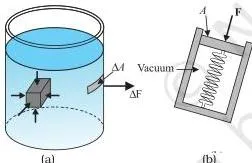
Average pressure is the normal force acting per unit area:
\[ P_{av} = \frac{F}{A} \quad (9.1) \]
By shrinking the area to a point, pressure is defined in a limiting sense as \( P = \lim_{\Delta A \to 0} \frac{\Delta F}{\Delta A} \). Its SI unit is the pascal (Pa), equal to \( \text{N m}^{-2} \), with dimensions \( [ML^{-1}T^{-2}] \).
Misconception autopsy — why pressure is scalar: students see \( P = F/A \) and assume pressure is a vector because force is.
It is not.
The F in the numerator is only the normal component of the force, and this component carries no direction of its own — the direction of the force is fixed by the orientation of the surface, not by the pressure.
So pressure has magnitude but no direction; it is a scalar (NCERT, p. 181 and Points to Ponder).
Density is mass per unit volume, \( \rho = \frac{m}{V} \) (Eq. 9.3), with SI unit \( \text{kg m}^{-3} \). Liquids are nearly incompressible, so their density is almost constant; gases show large density changes with pressure (NCERT, p. 182).
Relative density is the ratio of a substance’s density to the density of water at \( 4^\circ\text{C} \) (\( 1.0 \times 10^3\ \text{kg m}^{-3} \)); it is dimensionless — aluminium having relative density 2.7 means its density is \( 2.7 \times 10^3\ \text{kg m}^{-3} \).
| Pressure unit | Value in pascals |
|---|---|
| 1 atmosphere (atm) | \( 1.013 \times 10^{5}\ \text{Pa} \) |
| 1 bar | \( 10^{5}\ \text{Pa} \) |
| 1 torr (= 1 mm of Hg) | 133 Pa |
Pascal’s Law and the Working of Hydraulic Machines
Pascal’s law states two things (NCERT, p. 182 and p. 186):
- In a fluid at rest, pressure is the same at all points at the same height.
- An external pressure applied to an enclosed fluid is transmitted undiminished and equally in all directions, including to the walls of the vessel.
The proof uses a tiny right-angled prism of fluid in equilibrium. The fluid presses normally on each face; balancing forces and using geometry gives \( P_a = P_b = P_c \), so the pressure is equal in every direction (NCERT, p. 182).
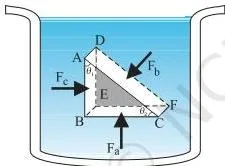
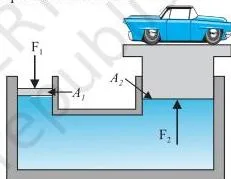
Because pressure is transmitted undiminished, a small force on a small piston produces a large force on a large piston. If \( F_1 \) acts on area \( A_1 \), the pressure \( P = F_1/A_1 \) reaches the piston of area \( A_2 \), giving \[ F_2 = P A_2 = \frac{F_1 A_2}{A_1} \]
The force is multiplied by the factor \( A_2/A_1 \), called the mechanical advantage of the device (NCERT, p. 186). This is the principle of the hydraulic lift shown below and of hydraulic brakes, where a small pedal force is transmitted equally to all four wheels so braking effort is equal on each wheel.
Pressure Changes With Depth: Absolute vs Gauge Pressure
Take a cylindrical column of fluid of base area A and height h. For the fluid to be at rest, the upward pressure force on the base must balance the weight plus the downward force on the top. This gives the fundamental result (NCERT, p. 183):
\[ P_2 – P_1 = \rho g h \quad (9.6) \]
If the upper point is the open surface, \( P_1 = P_a \), and the pressure at depth h becomes \[ P = P_a + \rho g h \quad (9.7) \]
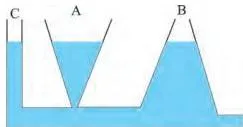
The area of the cylinder does not appear in the result, so only the vertical height matters, not the shape or width of the container.
This is the hydrostatic paradox: vessels A, B and C of different shapes connected at the bottom all hold water to the same level because the pressure at the bottom is the same under each section (NCERT, p. 184).
The gauge pressure is the excess of actual pressure over atmospheric pressure: \( P – P_a = \rho g h \). Measuring devices such as the tyre gauge and the blood pressure gauge (sphygmomanometer) read gauge pressure, not absolute pressure (NCERT, pp. 184–185).
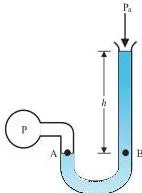
Torricelli’s mercury barometer measures atmospheric pressure as the height of the mercury column it supports, about 76 cm at sea level. An open-tube manometer measures pressure differences by the height difference of its liquid column. The table below compares the two pressure concepts with a real diving example.
| Quantity | Absolute pressure | Gauge pressure |
|---|---|---|
| Formula | \( P = P_a + \rho g h \) | \( P – P_a = \rho g h \) |
| Meaning | Total pressure above a vacuum | Pressure above the atmosphere |
| Read by | Barometer | Tyre gauge, sphygmomanometer |
| Diving example | At 10 m depth ≈ 2 atm | At 10 m depth ≈ 1 atm |
At a depth of 10 m in a lake, water adds \( \rho g h = 1000 \times 10 \times 10 = 10^5\ \text{Pa} \), so the absolute pressure doubles to about 2 atm while the gauge pressure is about 1 atm (NCERT, p. 184).
Streamline Flow and the Equation of Continuity
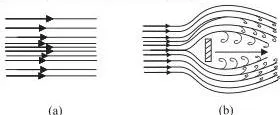
Flow is steady when the velocity of every fluid particle passing a given point is constant in time — the velocity may differ from point to point, but it does not change with time at any one point. A streamline is a curve whose tangent at any point points along the fluid velocity at that point.
In steady flow, no two streamlines can cross, because a particle at the crossing point would then have two possible velocities (NCERT, p. 187).
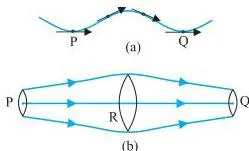
Consider a pipe of changing cross-section. The mass of fluid entering a section in time \( \Delta t \) must equal the mass leaving it. For a fluid of density \( \rho \), this conservation of mass gives \[ \rho_1 A_1 v_1 = \rho_2 A_2 v_2 \]
For an incompressible fluid (density constant), this reduces to the equation of continuity (NCERT, p. 187):
\[ A v = \text{constant} \quad (9.11) \]
The product \( Av \) is the volume flux (volume per second) and stays constant along the pipe. So where streamlines crowd together and the area is small, the speed is high, and vice versa. Steady laminar flow exists only up to a critical speed; beyond it the flow becomes turbulent — the chaotic flow seen in ‘white water’ rapids (NCERT, p. 187).
Bernoulli’s Principle: Pressure, Speed and Height
Bernoulli’s equation is energy conservation applied to a fluid in steady flow. For an incompressible, non-viscous fluid moving along a streamline, the sum of pressure, kinetic energy per unit volume and potential energy per unit volume stays constant (NCERT, p. 188):
\[ P + \frac{1}{2}\rho v^2 + \rho g h = \text{constant} \quad (9.13) \]
Between two points 1 and 2 along the same streamline:
\[ P_1 + \frac{1}{2}\rho v_1^2 + \rho g h_1 = P_2 + \frac{1}{2}\rho v_2^2 + \rho g h_2 \quad (9.12) \]
Memory device: keep the three terms in this order along the streamline — Pressure, Kinetic, Potential.
Just remember ‘P–K–P in order’, and you can always reconstruct the equation: \( P + \frac{1}{2}\rho v^2 + \rho g h = \text{const} \).
Restrictions — before using Bernoulli in any answer, state them: the flow must be steady, non-viscous, incompressible, and along a single streamline. It fails for turbulent flow and for viscous flow, where internal friction converts kinetic energy to heat (NCERT, p. 188). When the fluid is at rest, the equation reduces to \( P_1 – P_2 = \rho g (h_2 – h_1) \), which is exactly Eq. (9.6).
Torricelli’s law: for a tank open to the atmosphere with a small hole at depth h below the surface, the speed of efflux is (NCERT, p. 189):
\[ v = \sqrt{2gh} \quad (9.15) \]
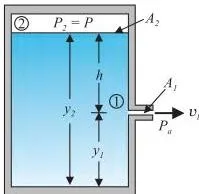
If the tank is pressurised so \( P \gg P_a \), the efflux speed is set by the container pressure — the situation in rocket propulsion.
Dynamic lift also follows from Bernoulli: a spinning ball drags air, crowding streamlines on one side and speeding the air there, so a pressure difference pushes the ball sideways (the Magnus effect, seen in a swinging cricket ball).
An aerofoil (aircraft wing) is shaped so streamlines crowd above it; the higher speed above means lower pressure above, producing upward lift that balances the plane’s weight (NCERT, p. 190).
Viscosity and Stokes’ Law: When Fluids Resist Flow
Viscosity is the internal friction of a fluid — it resists relative motion between adjacent layers. Picture a liquid between two parallel plates, the bottom fixed and the top moving at speed v.
The layer touching each plate moves with that plate’s velocity, so velocities increase uniformly from zero at the bottom to v at the top; this is laminar flow, with layers sliding like the pages of a book (NCERT, p. 191).
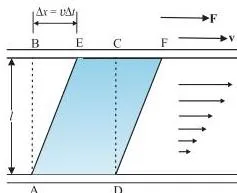
The coefficient of viscosity \( \eta \) is the ratio of shearing stress to the rate of shearing strain (NCERT, p. 191):
\[ \eta = \frac{F/A}{v/l} = \frac{Fl}{vA} \quad (9.16) \]
Its SI unit is the poiseuille (Pl), also written \( \text{N s m}^{-2} \) or Pa s, with dimensions \( [ML^{-1}T^{-1}] \). In a pipe, the velocity is maximum along the axis and falls to zero at the walls.
Stokes’ law gives the viscous drag on a small sphere of radius a moving at speed v through a fluid of viscosity \( \eta \) (NCERT, p. 193):
\[ F = 6\pi \eta a v \quad (9.17) \]
When a sphere falls through a fluid, it accelerates until the viscous drag plus buoyancy balances its weight. It then falls at constant terminal velocity \( v_t \):
\[ v_t = \frac{2a^2(\rho – \sigma)g}{9\eta} \quad (9.18) \]
where \( \rho \) is the density of the sphere and \( \sigma \) that of the fluid. Note the two dependences the examiner loves: \( v_t \) depends on the square of the radius and inversely on the viscosity (NCERT, p. 193).
The temperature rule is the reverse for liquids and gases: viscosity of liquids falls as temperature rises (atoms become more mobile), while viscosity of gases rises (random motion increases). This connects to the ideas in Thermal Properties of Matter notes.
Surface Tension: Energy, Drops, Bubbles and Capillary Rise
A molecule inside a liquid is attracted by neighbours on all sides, so it has negative potential energy. A molecule at the surface has neighbours only on one side, so its energy is less negative — surface molecules carry extra energy. A liquid therefore tends to reduce its surface area to the minimum the surroundings allow (NCERT, p. 194).
This is why drops are spherical: for a given volume, the sphere has the least area.
From the film-stretching experiment — a movable bar of length l pulling a soap film has two surfaces, so the extra area is \( 2ld \). This gives the surface tension (NCERT, p. 194):
\[ S = \frac{F}{2l} \quad (9.20) \]
So surface tension is the force per unit length, or equivalently the surface energy per unit area, at a liquid interface. Its SI unit is \( \text{N m}^{-1} \). Like viscosity, it usually falls as temperature rises (NCERT, p. 195).
The angle of contact \( \theta \) is the angle between the tangent to the liquid surface and the solid surface, measured inside the liquid. It decides whether a liquid wets a solid (NCERT, p. 196):
- Acute \( \theta \) — liquid molecules are strongly attracted to the solid; water wets glass (spreads).
- Obtuse \( \theta \) — molecules attract each other more than the solid; mercury on glass forms drops and does not wet it.
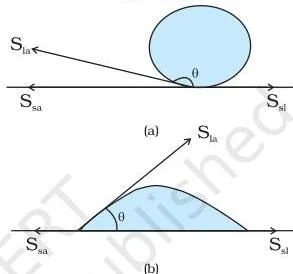
Because the surface has energy, the pressure inside a curved surface is higher on the concave side. For a spherical drop or a cavity in a liquid there is one liquid–air interface (NCERT, pp. 196–197):
\[ P_i – P_o = \frac{2S}{r} \quad (9.25) \]
A soap bubble has two such surfaces, so you must blow harder — the excess pressure is doubled:
\[ P_i – P_o = \frac{4S}{r} \quad (9.26) \]
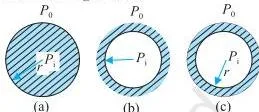
The table below is a frequent exam favourite — memorise the factor.
| Object | Number of liquid–air surfaces | Excess pressure |
|---|---|---|
| Liquid drop in air | 1 | \( 2S/r \) |
| Air bubble in a liquid | 1 | \( 2S/r \) |
| Soap bubble in air | 2 | \( 4S/r \) |
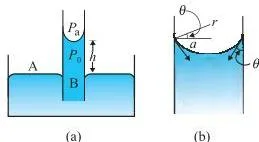
The same pressure difference drives capillary rise. In a narrow tube of radius a, water with an acute contact angle forms a concave meniscus; the lower pressure just under the meniscus pulls water up until the hydrostatic pressure balances it. The rise is (NCERT, p. 197):
\[ h = \frac{2S \cos\theta}{\rho g a} \]
If \( \cos\theta \) is negative — mercury, with an obtuse contact angle — the level falls in the capillary instead of rising.
Definitions Table: Terms You Must Write Correctly
These are the definitions examiners expect in short-answer questions. Learn them in your own words, always with the meaning and one example.
| Term | Meaning | Example |
|---|---|---|
| Fluid | A substance that can flow; it has no fixed shape of its own | Water, air |
| Pressure | Normal force per unit area acting on a surface; a scalar | A sharp needle pierces skin, a spoon back does not |
| Gauge pressure | Pressure above atmospheric: \( P – P_a = \rho g h \) | Tyre pressure gauge reading |
| Streamline | A curve whose tangent at each point is the fluid velocity direction there | Flow map around a wing |
| Steady flow | Flow in which the velocity at every point is constant in time | Slow water from a tap |
| Coefficient of viscosity | Ratio of shearing stress to strain rate, \( \eta = \frac{F/A}{v/l} \) | Honey is more viscous than oil |
| Terminal velocity | Constant fall speed when viscous drag plus buoyancy balances weight | Falling raindrop |
| Surface tension | Force per unit length, or energy per unit area, of a liquid interface | Water droplet stays spherical |
| Angle of contact | Angle between the tangent to the liquid surface and the solid surface, inside the liquid | Water on glass: acute; mercury on glass: obtuse |
The Chapter’s Formulas in One Table
Every formula you need, with its symbols, units and the condition that must hold. If you want to verify any equation against the printed page, open the official NCERT Class 11 Physics Part II PDF on ncert.nic.in.
| Formula | Symbols and units | When to use |
|---|---|---|
| \( P = \frac{F}{A} \) | \( F \) normal force (N), \( A \) area (m²) | Average pressure; only the normal component of force counts |
| \( P = P_a + \rho g h \) | \( \rho \) density (kg m⁻³), \( h \) depth (m) | Absolute pressure at depth in a liquid |
| \( P – P_a = \rho g h \) | same | Gauge pressure at depth |
| \( A v = \text{constant} \) | \( A \) cross-section (m²), \( v \) speed (m s⁻¹) | Steady, incompressible flow; volume flux is conserved |
| \( P + \frac{1}{2}\rho v^2 + \rho g h = \text{const} \) | \( P \) pressure (Pa) | Bernoulli: steady, non-viscous, incompressible flow along one streamline |
| \( v = \sqrt{2gh} \) | \( h \) depth of hole below surface (m) | Torricelli’s law for an open tank |
| \( F = 6\pi\eta a v \) | \( a \) sphere radius (m), \( v \) speed (m s⁻¹) | Stokes’ law: viscous drag on a small sphere |
| \( v_t = \frac{2a^2(\rho-\sigma)g}{9\eta} \) | \( \rho \) sphere, \( \sigma \) fluid density (kg m⁻³) | Terminal velocity; grows as \( a^2 \), falls as \( 1/\eta \) |
| \( S = \frac{F}{2l} \) | \( l \) length of the film edge (m) | Surface tension; factor 2 because a film has two surfaces |
| \( P_i – P_o = \frac{2S}{r} \) | \( r \) radius (m) | Excess pressure in a drop or an air cavity |
| \( P_i – P_o = \frac{4S}{r} \) | \( r \) radius (m) | Excess pressure in a soap bubble |
| \( h = \frac{2S\cos\theta}{\rho g a} \) | \( a \) tube radius (m), \( \theta \) contact angle | Capillary rise; negative \( \cos\theta \) → level falls |
Unit conversions to have ready: 1 atm = \( 1.013 \times 10^5\ \text{Pa} \); 1 bar = \( 10^5\ \text{Pa} \); 1 torr = 133 Pa = 1 mm of Hg.
Worked Examples: Pressure, Hydraulics and Terminal Velocity
Example 1: Absolute and Gauge Pressure at the Bottom of a Pool
Step 1: List what is given and check units.
Water depth \( h = 2.5\ \text{m} \) (already SI), \( \rho = 1000\ \text{kg m}^{-3} \), \( g = 9.8\ \text{m s}^{-2} \), \( P_a = 1.013 \times 10^{5}\ \text{Pa} \).
No conversion needed.
Step 2: Compute the gauge pressure using \( P – P_a = \rho g h \).
\[ P – P_a = 1000 \times 9.8 \times 2.5 = 2.45 \times 10^{4}\ \text{Pa} \]
Step 3: Add atmospheric pressure to obtain the absolute pressure.
\[ P = 1.013 \times 10^{5} + 0.245 \times 10^{5} = 1.258 \times 10^{5}\ \text{Pa} \approx 1.26 \times 10^{5}\ \text{Pa} \]
Final answer: gauge pressure \( 2.45 \times 10^{4}\ \text{Pa} \); absolute pressure \( \approx 1.26 \times 10^{5}\ \text{Pa} \) — about 1.24 atm.
Example 2: Force Needed on a Hydraulic Lift (Pascal’s Law)
- Step 1: Convert radii from cm to metres: \( r_1 = 2.0\ \text{cm} = 2.0 \times 10^{-2}\ \text{m} \), \( r_2 = 8.0\ \text{cm} = 8.0 \times 10^{-2}\ \text{m} \).
- Step 2: Weight of the 800 kg car: \( F_2 = mg = 800 \times 9.8 = 7840\ \text{N} \).
- Step 3: Find the mechanical advantage as the area ratio (radii are squared):
\[ \frac{A_2}{A_1} = \left(\frac{r_2}{r_1}\right)^2 = \left(\frac{8.0}{2.0}\right)^2 = 16 \]
Step 4: Pressure is transmitted undiminished, so the input force is \[ F_1 = F_2 \times \frac{A_1}{A_2} = \frac{7840}{16} = 490\ \text{N} \]
Final answer: a 490 N push on the small piston lifts 7840 N; mechanical advantage = 16.
Example 3: Terminal Velocity of a Steel Ball in Oil (Stokes’ Law)
Step 1: Convert radius from mm to metres: \( a = 1.0\ \text{mm} = 1.0 \times 10^{-3}\ \text{m} \).
Given \( \rho = 7800\ \text{kg m}^{-3} \), \( \sigma = 960\ \text{kg m}^{-3} \), \( \eta = 0.98\ \text{Pa s} \), \( g = 9.8\ \text{m s}^{-2} \).
- Step 1: Density difference: \( \rho – \sigma = 7800 – 960 = 6840\ \text{kg m}^{-3} \).
- Step 2: Substitute into \( v_t = \frac{2a^2(\rho-\sigma)g}{9\eta} \).
\[ v_t = \frac{2 \times (10^{-3})^2 \times 6840 \times 9.8}{9 \times 0.98} = \frac{0.134}{8.82}\ \text{m s}^{-1} = 0.0152\ \text{m s}^{-1} \]
Step 4: Convert to cm/s: \( 0.0152\ \text{m s}^{-1} = 1.52\ \text{cm s}^{-1} \).
Final answer: \( v_t \approx 1.5\ \text{cm s}^{-1} \).
Common Mistakes Students Make in This Chapter
| Mistake | Correct rule | How to check your answer |
|---|---|---|
| Writing \( P = \rho g h \) for absolute pressure | \( \rho g h \) alone is gauge pressure; absolute is \( P = P_a + \rho g h \) | At \( h = 0 \), \( P \) must equal \( P_a \approx 1\ \text{atm} \) — if not, you missed \( P_a \) |
| Using the diameter, not the radius, in area ratios | Halve the diameter first, then square: \( A_2/A_1 = (r_2/r_1)^2 \) | Radii 2 cm and 8 cm must give ratio 16, not 4 |
| Using \( 2S/r \) for a soap bubble | A bubble has two surfaces → \( 4S/r \); a drop or cavity has one → \( 2S/r \) | Ask: how many liquid–air surfaces exist? |
| Saying viscosity of liquids rises with temperature | Liquids: \( \eta \) falls with temperature; gases: \( \eta \) rises | Table 9.2: water \( \eta \) drops from 1.0 mP at 20 °C to 0.3 mP at 100 °C |
| Applying Bernoulli’s equation to turbulent flow | Valid only for steady, non-viscous, incompressible flow along one streamline | Ask: does the velocity fluctuate in time? If yes, Bernoulli fails |
Exam Notes: What the Examiner Expects
These patterns come from the chapter’s own Summary and Points to Ponder (NCERT, pp. 198–199). Definitions are the most frequently tested items in short-answer questions.
- Definitions to write exactly: coefficient of viscosity, terminal velocity, surface tension, angle of contact, and the statement of Bernoulli’s principle. Quote each with its formula or condition attached.
- Explain-why favourites: blood pressure is greater at the feet than at the brain (pressure rises with depth in a column); blowing over paper lifts it (faster air, lower pressure); a spinning cricket ball curves (Magnus effect); mercury falls in a capillary while water rises (contact angle sign).
- The mark-earning step in numericals: converting all units to SI before substituting, and writing gauge pressure explicitly as \( P – P_a \). In the pool example, the step that earns the mark is separating the two pressures.
- State Bernoulli’s restrictions first: in any long answer, write “steady, non-viscous, incompressible flow along a streamline” before applying the equation. The examiner checks whether you know when it fails (viscous and turbulent flow).
- Hydrostatic pressure is scalar: Points to Ponder stresses that pressure exists at every point in a fluid, not just on solid surfaces, and that a fluid element is in equilibrium because pressures on its faces are equal.
Revision Summary: Fluids in One Page
| Area | Key law / result | One-line takeaway |
|---|---|---|
| Fluids at rest | Pressure is scalar; same at equal heights | Pascal’s law governs still fluids |
| Pressure with depth | \( P = P_a + \rho g h \) | Depth sets pressure, not container shape |
| Fluid motion | \( Av = \text{const} \); Bernoulli | Faster flow → lower pressure |
| Viscosity | \( F = 6\pi\eta a v \); \( v_t \propto a^2/\eta \) | Drag resists motion; terminal speed reached |
| Surface tension | \( S = F/2l \); \( \Delta P = 2S/r, 4S/r \); \( h = 2S\cos\theta/(\rho g a) \) | Surfaces store energy |
Application map — connect each equation to a device, a favourite exam framing:
- Hydraulic lift, hydraulic brakes → Pascal’s law
- Syringe, spray pump → equation of continuity
- Aerofoil (aircraft wing) → Bernoulli’s principle
- Capillary wick, sap rising in trees → surface tension
- Raindrop’s terminal velocity → Stokes’ law
For more support, browse the full Class 11 notes hub or the CBSE notes index.
Frequently Asked Questions
Why is pressure a scalar quantity when it is defined as force per unit area?
Only the normal component of the force appears in the definition. Pressure has magnitude but no direction of its own — the direction of the force is set by the orientation of the surface, so pressure itself cannot be assigned a direction.
Why does water rise in a capillary tube while mercury falls in the same tube?
The sign of \( \cos\theta \) decides. Water on glass has an acute contact angle, so \( \cos\theta \) is positive and \( h = 2S\cos\theta/(\rho g a) \) is positive (rise). Mercury on glass has an obtuse angle, so \( \cos\theta \) is negative and \( h \) comes out negative — the level falls.
Why can Bernoulli’s equation not be used for water flowing through a rapid in a river?
Flow in a rapid is turbulent, not steady. Velocity and pressure fluctuate with time, which violates the condition of steady flow that Bernoulli’s equation requires.
When applying Bernoulli’s equation, does it matter if we use gauge pressure instead of absolute pressure?
No, as long as both points use the same datum. The atmospheric term \( P_a \) cancels on both sides of the equation, so the result is unchanged. Keep the \( \rho g h \) height terms consistent, and it works.
What is the difference between excess pressure inside a liquid drop and inside a soap bubble?
A liquid drop has one liquid–air surface, so the excess pressure is \( 2S/r \). A soap bubble has two such surfaces, so the excess pressure doubles to \( 4S/r \) — that is why you have to blow harder to form a bubble.
Why does a falling raindrop eventually reach a constant terminal velocity?
As the drop speeds up, viscous drag grows. When viscous drag plus buoyancy equals the drop’s weight, the net force becomes zero, acceleration stops, and the drop falls at constant \( v_t = 2a^2(\rho-\sigma)g/(9\eta) \).
Reference: NCERT Class 11 Physics textbook, chapter Mechanical Properties of Fluids.
Explore Class 11 Physics Notes
More for this chapter:
Class 11 Physics on LearnCBSE:
Related chapters: