
These mechanical properties of solids class 11 notes compress Chapter 8 into one page you can revise from the night before an exam: the definitions of stress and strain, Hooke’s law, the stress-strain curve, the three elastic moduli, elastic energy and the applications that explain real engineering choices. Every concept carries a formula, a unit and an exam pointer.
The chapter moves in one direction: a solid deforms under load, that deformation is described by stress and strain, and their ratio inside the elastic limit defines a material constant. Work through the sections in order or jump straight to a weak point from the contents below. For the rest of the syllabus, start at the Class 11 Physics notes hub.
Mechanical Properties of Solids Class 11 Notes: Chapter 8 at a Glance
This table maps the six learning blocks of the chapter. Revise them in this order; each block builds on the one before it.
| Concept | One-line takeaway | NCERT pages |
|---|---|---|
| Elasticity vs plasticity | Solids deform under load; elastic solids regain shape when the load is removed | pp. 168–169 |
| Stress and strain | Stress = F/A; strain = fractional change; three types of each | p. 169 |
| Hooke’s law and stress-strain curve | Stress ∝ strain in the linear region; curve shows yield, plastic flow and fracture | pp. 170–171 |
| Three elastic moduli | Y handles length, G handles shape, B handles volume | pp. 171–175 |
| Poisson’s ratio and elastic energy | Lateral strain ratio; stored energy density u = ½σε | p. 175 |
| Applications | Crane ropes, I-beams and the 10 km mountain limit | pp. 176–177 |
Elasticity and Plasticity: What “Regaining Shape” Really Means
Solids are not perfectly rigid (NCERT, p. 168). Even a hard steel bar stretches, compresses or bends when a sufficiently large force acts on it. Deformation happens in every solid; the question is whether it recovers.
Elasticity is the property by which a body tends to regain its original size and shape when the applied force is removed, and the deformation it recovers from is called elastic deformation. Pull a helical spring gently by its ends and release: it springs back. That recovery is elasticity in action.
By contrast, plasticity means permanent deformation. A lump of putty or mud pressed by your hand stays pressed; it has no tendency to regain its previous shape. Putty and mud are close to ideal plastics (NCERT, p. 168).
Why engineers care: designing a building, bridge, automobile or ropeway requires knowing these elastic properties of steel, concrete and other materials (NCERT, p. 168). The “why is the railway track I-shaped” question is answered by the same elastic ideas.
Stress and Strain: The Three Ways a Solid Can Deform
When a body is under a deforming force while staying in static equilibrium, a restoring force develops inside it — equal in magnitude and opposite in direction to the applied force. Stress is this restoring force per unit area (NCERT, p. 169).
\[ \text{Stress} = \frac{F}{A} \qquad (8.1) \]
Its SI unit is \( \text{N m}^{-2} \) (also called pascal, Pa) and its dimensional formula is \( [ML^{-1}T^{-2}] \) (NCERT, p. 169).
A solid can change dimension in three distinct ways, and each produces its own strain:
- Longitudinal strain — change in length over original length, \( \Delta L/L \), from stretching or compressing (Eq. 8.2).
- Shearing strain — relative sideways displacement of faces over original length, \( \Delta x/L = \tan\theta \approx \theta \) (Eqs. 8.3–8.4).
- Volume strain — change in volume over original volume, \( \Delta V/V \), from uniform hydraulic pressure (Eq. 8.5).
Because strain is a ratio of two same-dimension quantities, it has no units and no dimensional formula (NCERT, p. 169).
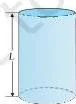
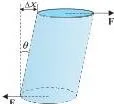
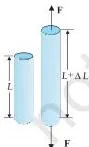
Fig. 8.1(a) shows length change under tensile stress; Fig. 8.1(b) shows shape change under shearing stress, where the top face slides sideways by \( \Delta x \) and the cylinder tilts by angle \( \theta \); Fig. 8.1(d) shows a sphere under hydraulic compression, where volume shrinks but the geometrical shape stays the same (NCERT, p. 169).
Hooke’s Law and the Stress-Strain Curve: Where Elasticity Ends
For small deformations, stress is directly proportional to strain for most materials — that statement is Hooke’s law (NCERT, p. 170):
\[ \text{stress} = k \times \text{strain} \qquad (8.6) \]
The constant \( k \) is the modulus of elasticity, a characteristic of the material. Hooke’s law is empirical — found by experiment, not derived — and some materials (elastomers) do not obey it (NCERT, p. 170).
A typical metal stress-strain curve (NCERT, pp. 170–171) has these landmarks:
- O to A — linear region; Hooke’s law holds; the body regains its original dimensions when the load is removed.
- A to B — stress and strain are no longer proportional, but the body still recovers fully on unloading.
- B (yield point / elastic limit) — the stress here is the yield strength \( \sigma_y \). Beyond B, deformation is permanent.
- B to D — plastic region; strain rises quickly for small stress changes; unloading from any point C leaves a permanent set.
- D (ultimate tensile strength) — \( \sigma_u \), the maximum stress; beyond D, fracture follows even under reduced force.
- E — fracture.
If D and E are close, the material is brittle; if far apart, it is ductile. Materials like rubber and the tissue of the aorta, which stretch to large strains with no well-defined plastic region, are called elastomers (NCERT, p. 171).
Figure Walkthrough: Reading a Stress-Strain Graph Point by Point
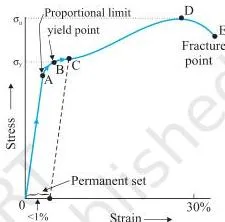
Diagram questions in this chapter (NCERT Exercises 8.2 and 8.3, pp. 178–179) ask you to read material constants off a graph. Use this repeatable method:
- Find the straight-line part of the curve — that is the region O to A where Hooke’s law is obeyed.
- The slope of that straight line equals Young’s modulus \( Y = \sigma/\varepsilon \). A steeper slope means a larger Y.
- The yield point B, the end of elastic behaviour, gives the yield strength \( \sigma_y \) (read the stress value on the vertical axis).
- The highest point D gives the ultimate tensile strength \( \sigma_u \).
- Compare the gap between D and E: close means brittle, far apart means ductile.
Exercise 8.2 supplies a strain-stress curve and asks for Y and the yield strength; Exercise 8.3 shows two curves at the same scale and asks which material is stiffer and stronger. Both are solved entirely by steps 1–5 above.
Three Elastic Moduli: Young’s, Shear and Bulk
Inside the elastic limit, the ratio of stress to strain is a constant called the modulus of elasticity, and it is a characteristic of the material (NCERT, p. 171). Three moduli cover the three deformation types.
Young’s modulus \( Y \) is the ratio of tensile (or compressive) stress to longitudinal strain (Eq. 8.7–8.8):
\[ Y = \frac{F/A}{\Delta L/L} = \frac{FL}{A\Delta L} \]
Shear modulus (or modulus of rigidity) \( G \) is the ratio of shearing stress to shearing strain (Eqs. 8.10–8.11):
\[ G = \frac{F/A}{\Delta x/L} = \frac{F}{A\theta} \]
Bulk modulus \( B \) is the ratio of hydraulic stress to volume strain (Eq. 8.12):
\[ B = -\frac{p}{\Delta V/V} \]
| Modulus | Stress ÷ strain | What changes | Applies to | Steel value |
|---|---|---|---|---|
| Young’s \( Y \) | \( \dfrac{F/A}{\Delta L/L} = \dfrac{FL}{A\Delta L} \) | Length | Solids only | 200 GPa |
| Shear \( G \) | \( \dfrac{F/A}{\Delta x/L} = \dfrac{F}{A\theta} \) | Shape | Solids only | 84 GPa |
| Bulk \( B \) | \( -\dfrac{p}{\Delta V/V} \) | Volume | Solids, liquids and gases | 160 GPa |
The units of all three are \( \text{N m}^{-2} \) or Pa. Shear modulus is generally less than Young’s modulus; for most materials \( G \approx Y/3 \) (NCERT, p. 173). Bulk modulus applies to solids, liquids and gases, while Y and G apply only to solids because only solids have a definite shape (NCERT, p. 177).
Mnemonic: Young’s handles Length, Shear handles Shape, Bulk handles Volume. If a numerical changes length, open with Y; if it changes shape, open with G; if it changes volume, open with B.
The reciprocal of bulk modulus is compressibility, \( k = 1/B \), the fractional change in volume per unit increase in pressure (Eq. 8.13, NCERT, p. 174). Gases are about a million times more compressible than solids, which is why solids are the least compressible state of matter.
Poisson’s Ratio and Energy Stored in a Stretched Wire
Lateral strain is the strain perpendicular to the applied force. When a wire is stretched, its length grows and its diameter shrinks slightly. Poisson’s ratio is the ratio of lateral strain to longitudinal strain (NCERT, p. 175):
\[ \text{Poisson’s ratio} = \frac{\Delta d/d}{\Delta L/L} \]
It is a ratio of two strains, so it is a pure number with no units. Its value depends only on the material: 0.28–0.30 for steels, about 0.33 for aluminium alloys (NCERT, p. 175).
Stretching a wire does work against the inter-atomic forces, and that work is stored as elastic potential energy. For a wire of length L and area A stretched by amount l, the work done integrates to give elastic potential energy per unit volume (NCERT, p. 175):
\[ u = \frac{1}{2}\sigma\varepsilon \qquad (8.14) \]
Think of a spring: the work you put into stretching it is recovered when it snaps back. The wire stores that same kind of energy, expressed per unit volume as \( \frac{1}{2} \times \text{stress} \times \text{strain} \).
Where Elasticity Matters: Cranes, I-Beams and the 10 km Mountain
Crane ropes. A crane rope must not deform permanently under its maximum load, so the stress must stay below the yield strength. The minimum area is (NCERT, p. 176):
\[ A \geq \frac{W}{\sigma_y} = \frac{Mg}{\sigma_y} \qquad (8.15) \]
For a 10-tonne load with mild steel yield strength \( 300 \times 10^6\ \text{N m}^{-2} \), this gives \( A \geq 3.3 \times 10^{-4}\ \text{m}^2 \), a radius of about 1 cm.
A safety factor of about ten in the load is usual, so a thicker rope of radius about 3 cm is used — and because a single 3 cm wire would behave like a rigid rod, real ropes are braided from many thin wires for ease of manufacture, flexibility and strength (NCERT, p. 176).
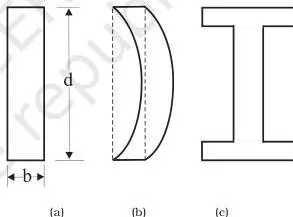
Beams. A beam of length l, breadth b and depth d, loaded at the centre by load W, sags by (NCERT, p. 176):
\[ \delta = \frac{Wl^3}{4bd^3Y} \qquad (8.16) \]
The sag depends on \( d^{-3} \) but only \( b^{-1} \), so increasing the depth d reduces bending far more effectively than increasing the breadth. Too much depth without support causes buckling (Fig. 8.7(b)); the compromise is the I-shaped section (Fig. 8.7(c)) which gives a large load-bearing surface with enough depth, saving weight and cost (NCERT, p. 176).
The 10 km mountain limit. At the bottom of a mountain of height h, the vertical stress due to the weight above is \( h\rho g \), with a shear component of about the same size because the sides are free (NCERT, p. 177).
Setting this equal to the elastic limit of rock, \( 30 \times 10^7\ \text{N m}^{-2} \), with \( \rho = 3 \times 10^3\ \text{kg m}^{-3} \) and \( g = 10\ \text{m s}^{-2} \):
\[ h = \frac{30 \times 10^7}{3 \times 10^3 \times 10} = 10\ \text{km} \]
So no mountain on Earth can be much taller than about 10 km — more than the height of Mt Everest — because the rock at the base would flow under the shear stress (NCERT, p. 177). The value of g used here comes from Gravitation notes, and the hydraulic stress idea connects to the Mechanical Properties of Fluids notes.
Definitions Table: Terms to Reproduce in Your Answer
| Term | Meaning in your own words | Example |
|---|---|---|
| Elasticity | Tendency of a body to regain its original size and shape when the deforming force is removed | A coiled spring returns to its length when released |
| Plasticity | Permanent deformation; no tendency to regain the original shape | A lump of putty stays deformed after pressing |
| Stress | Restoring force per unit area set up inside a deformed body | \( F/A \) in a stretched wire |
| Strain | Fractional change in a dimension of the body | \( \Delta L/L \) for a stretched wire |
| Longitudinal strain | Change in length divided by original length | \( \Delta L/L \) under tension or compression |
| Shearing strain | Relative sideways displacement of faces divided by original length | \( \Delta x/L = \tan\theta \approx \theta \) |
| Volume strain | Change in volume divided by original volume | \( \Delta V/V \) for a sphere in a fluid |
| Hooke’s law | For small deformations, stress is proportional to strain | Linear region O–A of the stress-strain curve |
| Modulus of elasticity | Proportionality constant k = stress/strain; a material characteristic | Y, G, B each for one deformation type |
| Yield strength | Stress at the yield point where permanent deformation begins | Steel \( \sigma_y = 250 \times 10^6\ \text{N m}^{-2} \) |
| Ultimate tensile strength | Maximum stress a material withstands before fracture | Steel \( \sigma_u = 400 \times 10^6\ \text{N m}^{-2} \) |
| Elastomer | Material that stretches to large strains with no well-defined plastic region | Aorta tissue, rubber |
| Poisson’s ratio | Ratio of lateral strain to longitudinal strain; a pure number | 0.28–0.30 for steel |
| Elastic potential energy | Work stored in a deformed wire against inter-atomic forces | \( u = \frac{1}{2}\sigma\varepsilon \) per unit volume |
Formula Sheet: Stress, Strain and Moduli
All equations below are for use inside the elastic limit. Strain is dimensionless; stress and all moduli share the unit \( \text{N m}^{-2} \) (Pa). Every formula can be verified in the official NCERT Class 11 Physics PDF.
| Formula | Symbols | SI unit | When to use |
|---|---|---|---|
| Stress \( \sigma = F/A \) | F = force normal to cross-section, A = area | \( \text{N m}^{-2} \) (Pa) | Any deforming force |
| Longitudinal strain \( \Delta L/L \) | ΔL = change in length, L = original length | Dimensionless | Tension or compression |
| Shearing strain \( \Delta x/L = \tan\theta \approx \theta \) | Δx = relative displacement, L = length | Dimensionless | Tangential forces, small θ |
| Volume strain \( \Delta V/V \) | ΔV = change in volume, V = original volume | Dimensionless | Hydraulic pressure |
| Hooke’s law \( \sigma = k\varepsilon \) | k = modulus of elasticity | \( \text{N m}^{-2} \) | Linear region only |
| Young’s modulus \( Y = FL/(A\Delta L) \) | Y = Young’s modulus | \( \text{N m}^{-2} \) | Length change; solids; elastic limit |
| Shear modulus \( G = F/(A\theta) \) | G = modulus of rigidity | \( \text{N m}^{-2} \) | Shape change; solids; elastic limit |
| Bulk modulus \( B = -p/(\Delta V/V) \) | p = pressure increase | \( \text{N m}^{-2} \) | Volume change; all states; elastic limit |
| Compressibility \( k = 1/B \) | k = compressibility | \( \text{m}^{2}\text{N}^{-1} \) | Mostly liquids and gases |
| Poisson’s ratio \( (\Delta d/d)/(\Delta L/L) \) | d = original diameter | Dimensionless | Lateral vs longitudinal strain |
| Elastic energy density \( u = \frac{1}{2}\sigma\varepsilon \) | u = energy per unit volume | \( \text{J m}^{-3} \) | Stretched wire, elastic limit |
| Beam sag \( \delta = Wl^3/(4bd^3Y) \) | W = load, l = length, b = breadth, d = depth | m | Beam loaded at the centre |
These equations follow NCERT Class 11 Physics Part II, Chapter 8. You can verify Table 8.1, Figures 8.1 to 8.11 and Exercises 8.1 to 8.16 in the official NCERT PDF for this chapter, and the full set of Class 11 notes is available on this site.
Worked Examples: Solving with Y, G and B
Worked Example 1: Young’s Modulus of a Hanging Steel Wire
Method: use \( \sigma = F/A \) for the stress, then \( \varepsilon = \sigma/Y \) for the strain, then \( \Delta L = \varepsilon L \) for the elongation.
Given: steel wire \( L = 2.0\ \text{m} \), \( A = 4.0 \times 10^{-6}\ \text{m}^2 \), hanging mass \( m = 60\ \text{kg} \), \( g = 9.8\ \text{m s}^{-2} \), \( Y = 2.0 \times 10^{11}\ \text{N m}^{-2} \).
- Step 1: weight of the suspended mass \( F = mg = 60 \times 9.8 = 588\ \text{N} \).
- Step 2: tensile stress \( \sigma = F/A \).
\[ \sigma = \frac{588}{4.0 \times 10^{-6}} = 1.47 \times 10^8\ \text{N m}^{-2} \]
Step 3: longitudinal strain \( \varepsilon = \sigma/Y \).
\[ \varepsilon = \frac{1.47 \times 10^8}{2.0 \times 10^{11}} = 7.35 \times 10^{-4} \]
Step 4: elongation \( \Delta L = \varepsilon L \).
\[ \Delta L = 7.35 \times 10^{-4} \times 2.0 = 1.47 \times 10^{-3}\ \text{m} = 1.47\ \text{mm} \]
Final answer: stress \( 1.47 \times 10^8\ \text{N m}^{-2} \), strain \( 7.35 \times 10^{-4} \), elongation \( 1.47\ \text{mm} \).
Worked Example 2: Shear Modulus of a Fixed Cube
Method: find the face area, then shear stress \( = F/A \), then shear strain \( = \sigma_s/G \), then displacement \( \Delta x = \text{strain} \times L \).
Given: cube side \( L = 0.10\ \text{m} \) fixed at its base, tangential force \( F = 4.0 \times 10^4\ \text{N} \), \( G = 2.0 \times 10^{10}\ \text{N m}^{-2} \).
- Step 1: area of the top face \( A = L^2 = 0.10 \times 0.10 = 1.0 \times 10^{-2}\ \text{m}^2 \).
- Step 2: shear stress \( \sigma_s = F/A \).
\[ \sigma_s = \frac{4.0 \times 10^4}{1.0 \times 10^{-2}} = 4.0 \times 10^6\ \text{N m}^{-2} \]
Step 3: shearing strain \( = \sigma_s/G \).
\[ \text{strain} = \frac{4.0 \times 10^6}{2.0 \times 10^{10}} = 2.0 \times 10^{-4} \]
Step 4: displacement of the top face \( \Delta x = \text{strain} \times L \).
\[ \Delta x = 2.0 \times 10^{-4} \times 0.10 = 2.0 \times 10^{-5}\ \text{m} \]
Final answer: shear stress \( 4.0 \times 10^6\ \text{N m}^{-2} \), top face displaced by \( 2.0 \times 10^{-5}\ \text{m} \).
Worked Example 3: Bulk Modulus of a Steel Sphere
Method: use \( B = -p/(\Delta V/V) \); take magnitudes so \( \Delta V/V = p/B \), then \( \Delta V = (\Delta V/V) \times V \).
Given: steel sphere volume \( V = 1.0 \times 10^{-3}\ \text{m}^3 \), pressure increase \( p = 8.0 \times 10^6\ \text{Pa} \), \( B = 1.6 \times 10^{11}\ \text{Pa} \).
Step 1: fractional volume change \( \Delta V/V = p/B \).
\[ \frac{\Delta V}{V} = \frac{8.0 \times 10^6}{1.6 \times 10^{11}} = 5.0 \times 10^{-5} \]
- Step 1: change in volume \( \Delta V = 5.0 \times 10^{-5} \times 1.0 \times 10^{-3} = 5.0 \times 10^{-8}\ \text{m}^3 \).
- Step 2: pressure increases, so the volume decreases: \( \Delta V = -5.0 \times 10^{-8}\ \text{m}^3 \).
Final answer: the sphere’s volume decreases by \( 5.0 \times 10^{-8}\ \text{m}^3 \).
Common Mistakes in Mechanical Properties of Solids (with Fixes)
| Mistake | Correct rule | Why it matters |
|---|---|---|
| Using \( A = \pi d^2 \) for a wire of diameter d | Use \( A = \pi (d/2)^2 \) because stress = F/A uses the radius | A diameter-to-radius slip makes A 4 times too large, so the stress comes out 4 times too small |
| Substituting area in cm² while force is in N | Convert to m² first: 1 cm² = 10⁻⁴ m² | Mixed units push stress off by a factor of 10⁴ and silently wreck every answer that follows |
| Writing strain as a percentage inside a formula | Use the decimal \( \Delta L/L \) (e.g. 0.001, not 0.1%) | Strain is a pure ratio; plugging a percent into Y = σ/ε makes the modulus 100 times too large |
| Treating stress as a vector | The force has a direction, but stress cannot be assigned a specific direction | NCERT Points to Ponder states stress is not a vector; describing it as one loses the mark |
| Thinking rubber is more elastic than steel because it stretches more | Steel is more elastic because for the same stress it stretches far less | Elasticity means resistance to deformation; a higher Young’s modulus means more elastic |
Exam Notes: The Four Numerical Patterns in NCERT Exercises 8.1 to 8.16
The exercises on pp. 178–179 fall into four repeatable problem families. Know which formula opens each one and the step that earns the mark.
| Problem family | Exercises | First formula to write | Step that earns the mark |
|---|---|---|---|
| Two wires under the same load | 8.1, 8.10 | \( W/A = Y(\Delta L/L) \) set equal for both wires | Stating the equal-tension / equal-stress condition before substituting |
| Shear displacement | 8.4, 8.6 | \( \Delta x = (\sigma_s/G)L \) with \( \sigma_s = F/A \) | Converting the face area to m² before computing stress |
| Hydraulic compression | 8.12–8.15 | \( \Delta V/V = p/B \) | Explaining the negative sign in words — pressure rise means volume fall |
| Vertical circle | 8.11 | Find the tension at the lowest point first | Using \( T = m(v^2/r + g) \) at the bottom before applying \( \Delta L = TL/(AY) \) |
Exercises 8.2 and 8.3 are graph-reading questions and use the figure-walkthrough method above. In every numerical, write the unit at each substituted value — it is the habit that catches the unit-conversion mistakes in the table above.
Mechanical Properties of Solids Class 11: Revision Recap in 5 Minutes
| Deformation type | Stress | Strain | Modulus |
|---|---|---|---|
| Tension / compression | Longitudinal \( \sigma = F/A \) | \( \Delta L/L \) | Young’s \( Y \) |
| Shear | Shearing \( \sigma_s = F/A \) | \( \Delta x/L = \tan\theta \approx \theta \) | Shear \( G \) |
| Hydraulic | Pressure \( p \) | \( \Delta V/V \) | Bulk \( B \) |
- Solids are not perfectly rigid — even steel deforms under a large enough force.
- Hooke’s law, stress = k × strain, holds only in the linear region (O–A) of the curve.
- Young’s handles Length, Shear handles Shape, Bulk handles Volume.
- Elastic energy density is \( u = \frac{1}{2}\sigma\varepsilon \).
- Elastic design explains crane rope areas, I-shaped beams and the ~10 km maximum mountain height.
For the complete CBSE revision library, visit the CBSE notes home.
Frequently Asked Questions on Mechanical Properties of Solids
Why is steel called more elastic than rubber even though rubber stretches more?
Elasticity measures resistance to deformation, not how far a material stretches. Steel stretches far less than rubber for the same stress — its Young’s modulus is much larger — so steel is the more elastic material (NCERT, p. 177).
When should I use Young’s modulus, shear modulus and bulk modulus in a numerical?
Use Young’s modulus when the length changes, shear modulus when the shape changes, and bulk modulus when the volume changes. Y and G apply only to solids; B applies to solids, liquids and gases (NCERT, p. 177).
Why is there a negative sign in the bulk modulus formula B = -p/(ΔV/V)?
Because pressure increase causes volume decrease: when p is positive, ΔV is negative. The negative sign keeps the ratio — and therefore B itself — positive for a system in equilibrium (NCERT, p. 174).
Is shearing strain equal to tan θ or θ?
By definition it is \( \Delta x/L = \tan\theta \). For small angles θ, \( \tan\theta \approx \theta \); the difference is only 1% even at \( \theta = 10^\circ \), so both forms are used (NCERT, p. 169).
What is the difference between yield strength and ultimate tensile strength?
Yield strength \( \sigma_y \) is the stress at point B where permanent (plastic) deformation begins. Ultimate tensile strength \( \sigma_u \) is the maximum stress at point D; beyond it, fracture follows (NCERT, p. 170).
Reference: NCERT Class 11 Physics textbook, chapter Mechanical Properties of Solids.
Explore Class 11 Physics Notes
More for this chapter:
Class 11 Physics on LearnCBSE:
Related chapters: