
This is the official NCERT Class 10 Mathematics (English medium) Chapter 6, Triangles, in its NCERT 2026-27 reprint. The chapter runs across printed pages 73 to 98 of the book, and the Triangles 6 Class 10 PDF is right below. Take the download if you only want the file; read on if you want every theorem, figure and exercise explained with page numbers.
Download the Official NCERT Class 10 Maths Chapter 6 Triangles PDF
Open the NCERT Class 10 Maths Chapter 6 Triangles PDF directly from ncert.nic.in — the official hosting site of NCERT — to get the complete chapter exactly as printed: the introduction on page 73, all five sections, every figure and all three exercises through to the summary on page 98.
Reference: NCERT Class 10 Mathematics textbook, chapter 6, official edition on ncert.nic.in.
| What the chapter holds | Count | Where it is used |
|---|---|---|
| Printed pages | 26 | |
| Sections in the chapter | 5 | |
| Figures with NCERT captions | 16 | |
| Exercise questions | 29 | answered in our NCERT Solutions |
| Official NCERT PDF | Download the chapter PDF | the chapter exactly as NCERT publishes it |
Chapter 6 Triangles at a Glance: Sections, Figures and Exercises
The count table on this page already lists how much Chapter 6 holds — sections, figures, worked examples and exercise questions. The map below shows where each named part of the chapter sits in the printed book, so you can turn straight to the part you need.
| Part of the chapter | Printed pages | What is inside it |
|---|---|---|
| 6.1 Introduction | 73–74 | Why similarity matters; indirect measurement; the promise of a simple proof of Pythagoras theorem |
| 6.2 Similar Figures | 74–78 | Definition of similar figures, the two conditions for similar polygons, the scale factor, Activity 1 |
| Exercise 6.1 | 78–79 | 3 concept questions on the meaning of similarity |
| 6.3 Similarity of Triangles | 79–84 | Equiangular triangles, the Thales result, the Basic Proportionality Theorem and its converse, Examples 1–3 |
| Exercise 6.2 | 84–86 | 10 questions on Theorem 6.1 and Theorem 6.2 |
| 6.4 Criteria for Similarity of Triangles | 85–95 | AAA, AA, SSS and SAS criteria, Activities 4–6, Examples 4–8 |
| Exercise 6.3 | 94–97 | 16 questions on choosing and applying the criteria |
| 6.5 Summary | 97–98 | The nine summary points of the chapter |
| A Note to the Reader | 98 | The RHS similarity criterion, which most revision pages skip |
What This Chapter Covers: From Similar Figures to the Similarity Criteria
This section walks through the chapter’s argument in the order NCERT builds it, so you can see why each idea comes before the next.
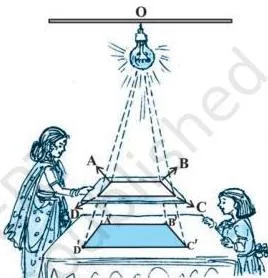
The whole chapter studies figures that have the same shape but different sizes, because similarity lets us measure things we cannot reach with a tape — the book’s own examples are the height of Mount Everest and the distance of the moon (NCERT, p. 73).
- Similar figures and the two polygon conditions (pp. 74–78): a precise rule for deciding similarity without judging by eye.
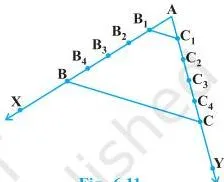
- The Basic Proportionality Theorem (Thales Theorem) and its converse (pp. 79–84): the first working tool, proved by comparing areas.
- The four similarity criteria (pp. 85–91): AAA, AA, SSS and SAS — the shortcuts every solution in this chapter uses.
- Applications (pp. 92–94): the lamp-post shadow and medians in similar triangles, which turn similarity into a measuring device.
- Closing material (pp. 97–98): the chapter summary, plus a Note to the Reader that adds the RHS similarity criterion.
The introduction also promises that the same ideas give a simple proof of the Pythagoras theorem you learnt in Class IX, and that similarity returns in the trigonometry chapters (Chapters 8 and 9) of this book (NCERT, p. 73).
Key Concepts: Similar Figures, Scale Factor and the Basic Proportionality Theorem
Everything in this chapter rests on one definition: two figures are similar when they have the same shape but not necessarily the same size (NCERT, p. 74). Everything below — the scale factor, the Basic Proportionality Theorem and the four criteria — is just a way to check that definition precisely.
Similar figures and the scale factor
All circles are similar, all squares are similar, and all equilateral triangles are similar, because shape alone decides similarity and size does not matter (NCERT, p. 74).
The photographer’s example makes the idea concrete: a 35 mm negative enlarged to a 55 mm print gives a bigger figure in which every line segment is \( \frac{55}{35} \) times the original, while the angles between corresponding segments stay exactly the same (NCERT, p. 75).
That common ratio of corresponding sides is called the scale factor, or the Representative Fraction, and it is the same ratio used in world maps and building blueprints (NCERT, p. 76).
The two conditions for similar polygons
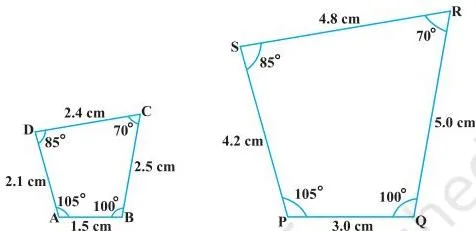
For polygons with the same number of sides, similarity needs two conditions at once: (i) their corresponding angles are equal, and (ii) their corresponding sides are in the same ratio (NCERT, p. 76). Neither condition alone is enough (NCERT, p. 78).
- A square and a rectangle have all angles equal, but their sides are not in the same ratio (NCERT, p. 77).
- A square and a rhombus have sides in the same ratio, but their angles are not equal (NCERT, pp. 77–78).
The Basic Proportionality Theorem, with a worked example
Theorem 6.1 (Basic Proportionality Theorem / Thales Theorem): if a line is drawn parallel to one side of a triangle so that it intersects the other two sides in distinct points, then the other two sides are divided in the same ratio (NCERT, p. 80).
The proof works by comparing areas. In the figure of the proof, triangles ADE and BDE share the same perpendicular from E to AB, so their areas are in the ratio AD : DB; triangles ADE and DEC share the perpendicular from D to AC, so their areas are in the ratio AE : EC (NCERT, p. 80).
Since triangles BDE and DEC stand on the same base DE between the same parallels BC and DE, their areas are equal — and that equality joins the two ratios into \( \frac{AD}{DB} = \frac{AE}{EC} \) (NCERT, p. 81).
Step 1: In \( \triangle ABC \), \( DE \parallel BC \) with D on AB and E on AC.
Given \( AD = 4\ \text{cm} \), \( DB = 6\ \text{cm} \), \( AE = 5\ \text{cm} \).
Find EC.
Step 2: Apply Theorem 6.1: \( \frac{AD}{DB} = \frac{AE}{EC} \).
\[ \frac{4}{6} = \frac{5}{EC} \;\Rightarrow\; EC = \frac{5 \times 6}{4} = 7.5\ \text{cm} \]
Step 3: Check with the AB-form: \( \frac{AD}{AB} = \frac{AE}{AC} \), that is \( \frac{4}{10} = \frac{5}{7.5 + 5} = \frac{5}{12.5} = 0.4 \) on both sides.
Final answer: \( EC = 7.5\ \text{cm} \) and \( AC = 12.5\ \text{cm} \).
The AB-form \( \frac{AD}{AB} = \frac{AE}{AC} \) is not what Theorem 6.1 states directly; you reach it from \( \frac{AD}{DB} = \frac{AE}{EC} \) by taking reciprocals and adding 1 to both sides, exactly as Example 1 shows (NCERT, pp. 82–83).
The converse of the Basic Proportionality Theorem
Theorem 6.2 (converse of BPT): if a line divides any two sides of a triangle in the same ratio, then the line is parallel to the third side (NCERT, p. 82).
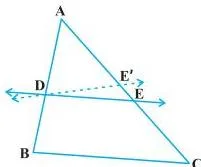
The proof is a contradiction argument: suppose the line through D is not parallel to BC, draw a line DE’ that is parallel to BC, and Theorem 6.1 forces the ratio \( \frac{AE}{EC} = \frac{AE’}{E’C} \). Adding 1 to both sides shows E and E’ must be the same point, so the supposed non-parallel line does not exist (NCERT, p. 82).
Choosing between the four similarity criteria
AAA (Theorem 6.3): if corresponding angles of two triangles are equal, their corresponding sides are in the same ratio, so the triangles are similar (NCERT, p. 87). AA (remark after Theorem 6.3): two equal angles are enough, because the angle-sum property forces the third angles to be equal too (NCERT, p. 88).
SSS (Theorem 6.4): if the sides of one triangle are proportional to the sides of another, the triangles are similar (NCERT, pp. 88–89). SAS (Theorem 6.5): if one angle of a triangle equals one angle of another and the sides including these angles are proportional, the triangles are similar (NCERT, pp. 90–91).
For triangles, one condition implies the other — so triangles need only three (in practice two) conditions, while polygons need all of them (NCERT, p. 89). Use this table to pick the criterion from the data your question gives you:
| What the question gives you | Criterion | Exact condition to check |
|---|---|---|
| Two angles of one triangle equal two angles of the other | AA | Match the angles at the correct corresponding vertices; the third angle follows |
| Three angles equal | AAA | Same check as AA in practice, since the third angle always follows |
| Three pairs of sides | SSS | Write all three ratios \( \frac{AB}{DE} = \frac{BC}{EF} = \frac{CA}{FD} \) and confirm they reduce to one value |
| Two sides and one angle | SAS | The equal angle must be the one included between the two proportional sides (NCERT, p. 90) |
| Right triangles with hypotenuse and one side proportional | RHS | Only for right triangles; the shorter route mentioned on page 98 |
Figure Walkthrough: Reading the Diagrams of Chapter 6
The figures in this chapter are not decoration — each one is a construction or a correspondence that the next theorem needs. Here is how to read the ones that matter most.
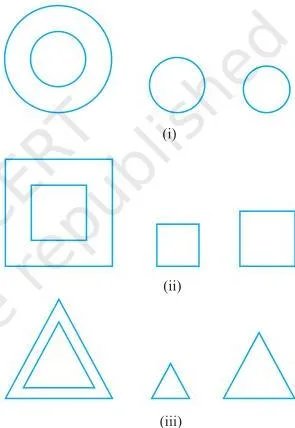
This is the very first figure of the chapter (NCERT, p. 74). It answers the question ‘can a triangle and a square be similar?’ by shape alone: no change of size can ever give a triangle a square’s shape, so the two can never be similar.
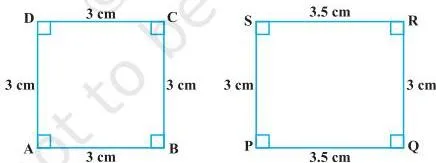
This is the chapter’s standing warning (NCERT, p. 77). Both quadrilaterals have four right angles, yet the square’s sides are all equal while the rectangle’s are not, so the side ratios differ. Equal angles alone never prove two polygons similar.
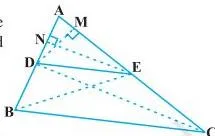
The two perpendiculars EN and DM are the whole trick of the proof (NCERT, p. 80).
Triangle ADE and BDE use the same height EN, and triangles ADE and DEC use the same height DM; then BDE and DEC have equal areas on the same base DE between the parallels, which joins the two ratios into \( \frac{AD}{DB} = \frac{AE}{EC} \).
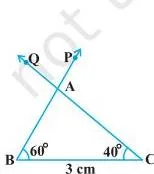
This construction draws the angles 60° and 40° at the ends of bases of two different lengths (NCERT, p. 86). The third angle is forced to be 80° in both triangles, and measuring the sides shows all corresponding ratios equal — this activity is the evidence behind the AAA criterion.
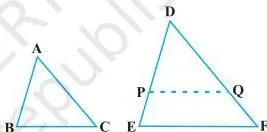
This is the proof figure for Theorem 6.3 (NCERT, p. 87). Cutting DP = AB and DQ = AC makes triangle DPQ congruent to ABC; then PQ ends up parallel to EF, and Theorem 6.1 delivers the proportionality of the remaining sides. The remark beside the figure gives the AA form.
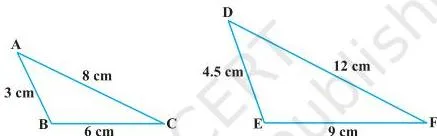
The two triangles are drawn with sides in the ratio \( \frac{2}{3} \), and measuring the angles gives \( \angle A = \angle D \), \( \angle B = \angle E \), \( \angle C = \angle F \) (NCERT, p. 88). This is the activity that justifies the SSS similarity criterion.
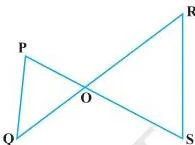
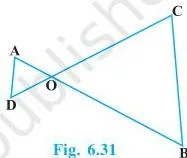
This figure shows why parallel lines plus crossing lines produce similarity for free (NCERT, p. 91). Alternate angles give \( \angle P = \angle S \) and \( \angle Q = \angle R \), and the vertically opposite angles \( \angle POQ = \angle SOR \) give the third; one AAA step finishes it.
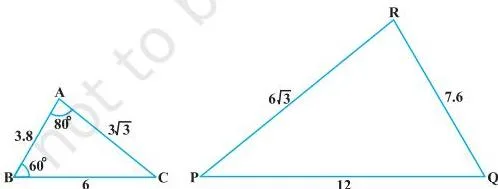
Misreading the correspondence is the trap here (NCERT, p. 91). The side ratios match in the order ABC to RQP, so \( \triangle ABC \sim \triangle RQP \), which makes \( \angle C \) correspond to \( \angle P \); the angle-sum property then gives \( \angle P = 40^\circ \).
In this figure AB is the lamp post, CD the girl, and DE her shadow on the ground (NCERT, p. 92).
Triangles ABE and CDE each contain a right angle (the vertical lamp post and the vertical girl) and they share the angle at E, so AA applies; the ratio of the two heights then equals the ratio of the two bases, and the shadow length follows.
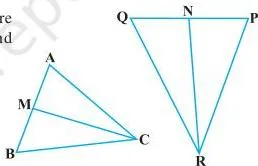
Since CM and RN are medians, AB = 2AM and PQ = 2PN (NCERT, p. 93). The known similarity of the big triangles gives \( \frac{AM}{PN} = \frac{CA}{RP} \) and \( \angle MAC = \angle NPR \), so SAS proves \( \triangle AMC \sim \triangle PNR \); a second SSS step on the remaining halves completes the pattern (NCERT, pp. 93–94).
Definitions and Theorems in Chapter 6, With Page Numbers
This table collects every definition and theorem the chapter names, so you can find any one of them without re-reading. Meanings are given in plain words, not the book’s phrasing.
| Term | Meaning in plain words | NCERT page |
|---|---|---|
| Similar figures | Figures of the same shape but not necessarily the same size | 74 |
| Scale factor (Representative Fraction) | The common ratio of every pair of corresponding sides of similar polygons; used in maps and blueprints | 76 |
| Equiangular triangles | Triangles whose corresponding angles are equal; Thales stated that the ratio of any two corresponding sides is then always the same | 79 |
| Basic Proportionality Theorem (Thales Theorem) | A line parallel to one side of a triangle cuts the other two sides at distinct points and divides them in the same ratio | 80 |
| Converse of BPT | If a line divides two sides of a triangle in the same ratio, the line is parallel to the third side | 82 |
| AAA similarity criterion | Equal corresponding angles force corresponding sides to be in the same ratio | 87 |
| AA similarity criterion | Two equal angles are enough; the third angle follows from the angle-sum property | 88 |
| SSS similarity criterion | Corresponding sides in the same ratio force the corresponding angles to be equal | 88–89 |
| SAS similarity criterion | One equal angle plus the two sides including it in proportion is enough | 90–91 |
| RHS similarity criterion | Right triangles are similar when the hypotenuse and one side of one are proportional to the hypotenuse and one side of the other | 98 |
The symbol \( \sim \) reads as ‘is similar to’, and the vertices must be written in matching order: \( \triangle ABC \sim \triangle DEF \) means A corresponds to D, B to E and C to F (NCERT, p. 86). Written as \( \triangle ABC \sim \triangle EDF \), the same statement is wrong.
Common Mistakes Students Make With Triangle Similarity
The mistakes in this chapter are not arithmetic — they are decisions about which condition to check and which order to write the answer in. Each row below names the mistake before you make it.
| Mistake | Correct rule | How to check your answer |
|---|---|---|
| Treating ‘similar’ as ‘congruent’ | All congruent figures are similar, but similar figures may differ in size (NCERT, p. 74) | Ask whether one figure could be an enlarged copy of the other — if yes, they are similar but not necessarily congruent |
| Judging polygons by looks | Polygons need both equal corresponding angles AND corresponding sides in the same ratio (NCERT, pp. 76–78) | Test both conditions: a square and a rectangle fail the side test; a square and a rhombus fail the angle test |
| Reading the scale factor backwards | The ratio direction depends on which figure you start from (NCERT, p. 75) | In a 35 mm to 55 mm enlargement, the bigger figure uses \( \frac{55}{35} \) and the smaller uses \( \frac{35}{55} \) |
| Writing the similarity symbol with mismatched vertex order | Written order must match the correspondence A to D, B to E, C to F (NCERT, p. 86) | Write the correspondence first, then copy that order into \( \triangle ABC \sim \triangle DEF \) |
| Using a criterion without its condition | SAS needs the equal angle included between the proportional sides (NCERT, p. 90); SSS needs all three side ratios equal; the triangle shortcut does not extend to polygons (NCERT, p. 89) | Name the criterion and point at the exact equal angle or the three equal ratios before writing \( \sim \) |
| Jumping straight to \( \frac{AD}{AB} = \frac{AE}{AC} \) | Theorem 6.1 gives \( \frac{AD}{DB} = \frac{AE}{EC} \); the AB-form needs the reciprocal-and-add-1 step of Example 1 (NCERT, pp. 82–83) | Check both numerators start at the same vertex A before you cross-multiply |
Exam Notes: How the Exercises Test Each Theorem
Every question in this chapter tests one of three things: the meaning of similarity, the Basic Proportionality Theorem, or the choice of a similarity criterion. Map the exercises to your weak spot.
| Exercise | Questions | What they test |
|---|---|---|
| Exercise 6.1 (pp. 78–79) | Q1 fill-in concept; Q2 examples of similar and non-similar figures; Q3 judging two quadrilaterals | The meaning of similarity and the two polygon conditions; the similar-versus-congruent distinction |
| Exercise 6.2 (pp. 84–86) | Q1 direct BPT ratio; Q2 converse check; Q3–Q6 chained BPT proofs; Q7–Q10 mid-point and trapezium results | Applying Theorem 6.1, reversing it with Theorem 6.2, and re-proving known Class IX results |
| Exercise 6.3 (pp. 94–97) | Q1 criterion identification; Q2–Q5 angle and ratio hunts; Q6–Q14 multi-step proofs; Q15 shadow application; Q16 median ratio | Choosing among AAA, AA, SSS and SAS, often chaining two criteria in one proof |
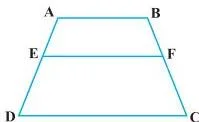
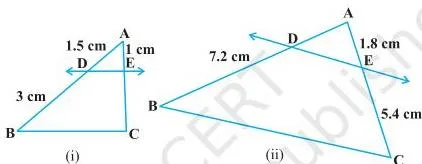
For Exercise 6.2 Q1, the figure you need is Fig 6.17: in each of its two triangles the segment DE is parallel to BC, so the three printed side lengths in part (i) give EC and the three in part (ii) give AD through one application of \( \frac{AD}{DB} = \frac{AE}{EC} \).
Exercise 6.2 Q2 checks the converse numerically by comparing \( \frac{PE}{EQ} \) with \( \frac{PF}{FR} \) in each case: (i) \( \frac{3.9}{3} \neq \frac{3.6}{2.4} \), so EF is not parallel to QR; (ii) \( \frac{4}{4.5} = \frac{8}{9} = \frac{8}{9} \), so EF is parallel to QR; (iii) using EQ = 1.28 − 0.18 = 1.10 and FR = 2.56 − 0.36 = 2.20, both ratios reduce to \( \frac{9}{55} \), so EF is parallel to QR.
Exercise 6.3 Q15 is the pure application of the chapter: a vertical pole of 6 m casts a 4 m shadow while a tower casts a 28 m shadow. The sun’s rays make the same angle with both, so the two right triangles are similar and \( \frac{6}{4} = \frac{h}{28} \), giving the tower height \( h = 42\ \text{m} \).
Here is a fresh shadow problem with different numbers, following the logic of Example 7 (NCERT, pp. 92–93).
Step 1: A person 1.6 m tall walks away from a 6.4 m lamp post at 1 m/s.
After 3 s the distance walked is \( 1 \times 3 = 3\ \text{m} \).
Step 2: Let the shadow be \( x \).
In \( \triangle ABE \) and \( \triangle CDE \), the right angles are equal and angle E is common, so the triangles are similar by AA.
\[ \frac{3 + x}{x} = \frac{6.4}{1.6} = 4 \]
Step 3: \( 3 + x = 4x \), so \( 3 = 3x \), giving \( x = 1 \).
Final answer: the shadow is \( 1\ \text{m} \) long after 3 seconds.
The RHS similarity criterion from the Note to the Reader (NCERT, p. 98) is a shorter route whenever the triangles are right-angled: check only the hypotenuse and one side in proportion. The chapter’s introduction also points out that similarity underlies a simple proof of Pythagoras theorem and returns in Chapters 8 and 9 (NCERT, p. 73).
Do not assume every part of the textbook is examinable this session — textbook contents and the examinable syllabus are not always identical, so check the current official syllabus.
The Chapter’s Own Summary in Plain Words
The chapter ends with a nine-point summary; this list restates each point so it can be revised in under a minute. The points follow the same order as the book’s summary (NCERT, pp. 97–98).
- Similar figures have the same shape but not necessarily the same size.
- All congruent figures are similar, but the converse is false.
- Two polygons are similar only if their corresponding angles are equal AND their corresponding sides are in the same ratio.
- Theorem 6.1: a line parallel to one side of a triangle divides the other two sides in the same ratio.
- Theorem 6.2: if a line divides two sides of a triangle in the same ratio, it is parallel to the third side.
- AAA criterion: equal corresponding angles force proportional sides.
- AA criterion: two equal angles are enough because the third follows.
- SSS criterion: proportional sides force equal corresponding angles.
- SAS criterion: one equal angle with the including sides proportional is enough.
- RHS criterion (from the Note to the Reader, p. 98): right triangles are similar when hypotenuse and one side are in proportion.
Related Chapters and Resources for Class 10 Maths
Similarity does not stop at Chapter 6. The introduction points forward to the trigonometry chapters — Chapter 8 Introduction to Trigonometry and Chapter 9 Some Applications of Trigonometry — where the same ideas return (NCERT, p. 73). In the meantime, these pages on the same site will help you revise the rest of the book:
- Class 10 Mathematics revision notes — the whole book chapter by chapter.
- The previous chapter: Arithmetic Progressions.
- The next chapter: Coordinate Geometry, which uses the similarity ideas again.
- The Class 10 hub for all subjects, and the main CBSE notes index.
Sources and Data Verification
This page describes the NCERT Class 10 Mathematics textbook (English medium), Chapter 6 Triangles — the official edition on ncert.nic.in, in the reprint named at the top of this page, with the chapter running on printed pages 73 to 98. The page covers the NCERT textbook only, not other publishers’ books and not the full CBSE scheme of studies.
- NCERT settles textbooks, their editions and the official PDFs; CBSE settles the curriculum, the syllabus and the examinations.
- The official NCERT portal (ncert.nic.in) is where current textbook editions are published.
- Textbook contents and the examinable syllabus are not always identical — check the current official syllabus before planning your revision.
FAQs on Class 10 Maths Chapter 6 Triangles
What is the Basic Proportionality Theorem in Class 10 Maths Chapter 6?
It is Theorem 6.1: if a line is drawn parallel to one side of a triangle so that it meets the other two sides at distinct points, those two sides are divided in the same ratio — \( \frac{AD}{DB} = \frac{AE}{EC} \) (NCERT, p. 80).
It is also called the Thales Theorem, and its converse (Theorem 6.2) says the line is parallel to the third side when the ratios are equal (NCERT, p. 82).
Are similar figures always congruent in Class 10 Chapter 6?
No. The chapter states it directly: all congruent figures are similar, but similar figures need not be congruent, because their sizes may differ (NCERT, p. 74). Congruence is similarity with the additional condition of equal size.
Why is a square not similar to a rectangle even though all angles are equal?
Because similarity of polygons needs both conditions — equal corresponding angles AND corresponding sides in the same ratio (NCERT, p. 76). A square and a rectangle have equal angles, but a square’s sides are all equal while a rectangle’s are not, so the side ratios differ and the polygons are not similar (NCERT, p. 77).
How do I choose between AAA, AA, SSS and SAS similarity criteria?
Look at what the question gives you: two equal angles → AA; three angles → AAA, which reduces to AA because the third angle follows; three pairs of sides → SSS; two sides plus one angle → SAS, provided the angle is the one included between the two proportional sides (NCERT, p. 90).
For right triangles, the RHS criterion on page 98 is often the shortest route.
Is the RHS similarity criterion included in the NCERT Class 10 Triangles chapter?
Yes, in the Note to the Reader on page 98: if the hypotenuse and one side of a right triangle are proportional to the hypotenuse and one side of another right triangle, the triangles are similar. It sits outside the summary list, which is why many revision pages miss it (NCERT, p. 98).
How does triangle similarity help measure the height of a tower?
At the same moment, the sun’s rays make equal angles with the ground, so the triangle formed by an object and its shadow is similar to the triangle formed by the tower and its shadow.
Then heights and shadows are in the same ratio: for a 6 m pole casting a 4 m shadow and a tower casting a 28 m shadow, \( \frac{6}{4} = \frac{h}{28} \), giving \( h = 42\ \text{m} \) (Exercise 6.3 Q15, NCERT, p. 97).
Reference: NCERT Class 10 Mathematics textbook, chapter 6, official edition on ncert.nic.in.
Explore Class 10 Mathematics Books
Class 10 Mathematics on LearnCBSE:
Related chapters: