
Quadratic Equations Class 10 is Chapter 4 of the NCERT Class 10 Mathematics textbook, in the 2026-27 reprint, and it opens on page 37.
The chapter starts with a prayer hall problem — a hall with a carpet area of 300 square metres whose length is one metre more than twice its breadth — and that situation becomes the equation \(2x^2 + x – 300 = 0\). The official chapter PDF is right below, and the rest of this page explains what the chapter contains and how its exercises are arranged.
Quadratic Equations Class 10 NCERT PDF Download
This is the complete official chapter as NCERT publishes it — the introduction with its historical note, the sections on quadratic equations, factorisation and the nature of roots, every worked example, all three exercises and the closing summary, exactly as printed.
Open the NCERT Class 10 Maths Chapter 4 Quadratic Equations PDF to read the full chapter from page 37 to page 47, including both figures and every exercise, in the official NCERT layout.
Reference: NCERT Class 10 Mathematics textbook, chapter 4, official edition on ncert.nic.in.
| What the chapter holds | Count | Where it is used |
|---|---|---|
| Printed pages | 11 | |
| Sections in the chapter | 5 | |
| Figures with NCERT captions | 2 | |
| Tables | 1 | |
| Worked examples | 2 | solved step by step in our NCERT Solutions |
| Exercise questions | 13 | answered in our NCERT Solutions |
| Official NCERT PDF | Download the chapter PDF | the chapter exactly as NCERT publishes it |
Chapter 4 at a Glance: Sections, Figures and Exercises
The table below lists what the chapter holds — its sections, figures, worked examples and exercise questions — so you can see the shape of the chapter before you start reading.
What Chapter 4 Covers: From a Prayer Hall to the Quadratic Formula
Chapter 4 picks up where Chapter 2 left off. There you met the quadratic polynomial \(ax^2 + bx + c\) with \(a \neq 0\); set that polynomial equal to zero and you have a quadratic equation (NCERT, p. 39).
The prayer hall problem at the very start shows why anyone needs this: with breadth \(x\) and length \(2x + 1\), the carpet area of 300 square metres becomes \(2x^2 + x = 300\), or \(2x^2 + x – 300 = 0\) (NCERT, p. 37-38).
A short historical note on page 38 explains that this equation has a long history. Babylonians solved such problems, Euclid approached them geometrically, Brahmagupta (C.E. 598-665) gave a formula for equations of the form \(ax^2 + bx = c\), and Sridharacharya (C.E. 1025) derived what we now call the quadratic formula by completing the square — a method Al-Khwarizmi (about C.E. 800) also studied.
The chapter then moves in three steps. Section 4.2 defines the standard form \(ax^2 + bx + c = 0\), \(a \neq 0\), and shows, through Examples 1 and 2, how real situations become equations and why you must simplify before classifying them.
Section 4.3 solves quadratic equations by factorisation, and Example 6 on page 44 finally answers the opening prayer hall problem with a breadth of 12 m and a length of 25 m. Section 4.4 introduces the quadratic formula and the discriminant, which tell you how many real roots an equation has before you solve it.
Key Concepts: Standard Form, Roots and the Quadratic Formula
One idea carries the whole chapter: a quadratic equation is a degree-2 polynomial set equal to zero, and solving it means finding the values of \(x\) that make the equation true. Everything below is a tool for that one job.
Standard Form and Why You Must Simplify First
A quadratic equation in the variable \(x\) is an equation of the form \(ax^2 + bx + c = 0\), where \(a, b, c\) are real numbers and \(a \neq 0\) (NCERT, p. 39). Written with powers in descending order, this is its standard form. The condition \(a \neq 0\) matters: if \(a\) were zero, the \(x^2\) term would vanish and the equation would become linear.
Before classifying any equation, simplify both sides completely. NCERT’s Example 2 makes the point twice over (NCERT, p. 40-41):
\[ x(x + 1) + 8 = (x + 2)(x – 2) \quad \Rightarrow \quad x^2 + x + 8 = x^2 – 4 \quad \Rightarrow \quad x + 12 = 0 \]
The \(x^2\) terms cancel, leaving a linear equation — so this one is not quadratic, even though it looks like one.
\[ (x + 2)^3 = x^3 – 4 \quad \Rightarrow \quad x^3 + 6x^2 + 12x + 8 = x^3 – 4 \quad \Rightarrow \quad 6x^2 + 12x + 12 = 0 \]
Here the equation looks cubic, but the \(x^3\) terms cancel exactly, leaving \(x^2 + 2x + 2 = 0\). So an equation that looks cubic can be quadratic after simplification — the highest power that survives decides (NCERT, p. 41).
Roots and the Factorisation Method
Once the equation is in standard form, solving it means finding its roots. A real number \(\alpha\) is a root of \(ax^2 + bx + c = 0\) if \(a\alpha^2 + b\alpha + c = 0\); we also say \(x = \alpha\) is a solution (NCERT, p. 42).
The roots of the equation are exactly the zeroes of the polynomial \(ax^2 + bx + c\). Since a quadratic polynomial has at most two zeroes, a quadratic equation has at most two roots (NCERT, p. 42).
The factorisation method splits the middle term into two parts. The check that keeps it error-free: the two numbers you split \(b\) into must multiply to \(a \times c\) and add to \(b\). Here is the full method on a fresh problem.
Problem: A rectangular garden is 5 m longer than twice its width, and its area is \(88\ \text{m}^2\).
Find its dimensions.
Step 1 — name the variable: Let the width be \(x\) m.
Then the length is \((2x + 5)\) m, and the area gives \(x(2x + 5) = 88\).
Step 2 — write in standard form: \(2x^2 + 5x – 88 = 0\), so \(a = 2\), \(b = 5\), \(c = -88\).
Step 3 — find the split numbers: they must multiply to \(a \times c = 2 \times (-88) = -176\) and add to \(b = 5\).
The pair is \(16\) and \(-11\).
Step 4 — split the middle term and factor:
\[ 2x^2 + 16x – 11x – 88 = 2x(x + 8) – 11(x + 8) = (2x – 11)(x + 8) \]
Step 5 — set each factor to zero: \(2x – 11 = 0\) gives \(x = \frac{11}{2} = 5.5\), and \(x + 8 = 0\) gives \(x = -8\).
Step 6 — reject the impossible value: \(x\) is a width, so \(-8\) is discarded.
Width = 5.5 m and length = \(2(5.5) + 5 = 16\) m.
Check: \(5.5 \times 16 = 88\) square metres, and both roots satisfy \(2x^2 + 5x – 88 = 0\).
The Quadratic Formula and the Discriminant
Factorisation only works when you can see the factors. The quadratic formula always works when real roots exist, and NCERT credits it to Sridharacharya, who derived it by completing the square (NCERT, p. 38):
\[ x = \frac{-b \pm \sqrt{b^2 – 4ac}}{2a}, \quad \text{provided } b^2 – 4ac \geq 0 \]
The quantity \(b^2 – 4ac\) is called the discriminant because it decides everything about the roots (NCERT, p. 45):
\[ D = b^2 – 4ac \]
| Discriminant \(D = b^2 – 4ac\) | Nature of roots | Example | Roots |
|---|---|---|---|
| \(D \gt 0\) | two distinct real roots | \(x^2 – 5x + 6 = 0\) | \(x = 2,\; x = 3\) |
| \(D = 0\) | two equal real roots | \(3x^2 + 6x + 3 = 0\) | \(x = -1,\; -1\) |
| \(D \lt 0\) | no real roots | \(x^2 + x + 1 = 0\) | none |
Why the three cases behave this way: the \(\pm\) in the formula adds and subtracts the same number, \(\sqrt{D}\). If \(D \gt 0\), that number is real and non-zero, so the two results are different.
If \(D = 0\), both results collapse to the same value, \(-b/2a\). If \(D \lt 0\), no real number has a negative square, so there are no real roots.
Here is the discriminant used end to end.
Example: Find the nature of the roots of \(3x^2 + 6x + 3 = 0\).
Step 1 — read off \(a, b, c\): \(a = 3\), \(b = 6\), \(c = 3\).
\[ D = b^2 – 4ac = 6^2 – 4(3)(3) = 36 – 36 = 0 \]
Step 2 — apply the case: \(D = 0\) means two equal real roots.
\[ x = \frac{-b}{2a} = \frac{-6}{2(3)} = -1 \]
Answer: the roots are \(-1\) and \(-1\). Check: \(3(-1)^2 + 6(-1) + 3 = 3 – 6 + 3 = 0\).
Figure Walkthrough: The Prayer Hall and the Circular Park
The chapter’s two figures do the same job: each turns a word problem into a picture, and the picture becomes an equation. The figures below are as printed in the book; here is how to read each one.
Fig. 4.1 — the prayer hall (NCERT, p. 38). The diagram is a rectangle with its breadth labelled \(x\) and its length labelled \(2x + 1\). That labelling is the whole translation of the problem: the length is one metre more than twice the breadth.
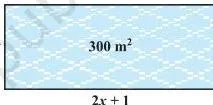
The picture makes the area step visible. Area is length times breadth, \((2x + 1) \cdot x = 2x^2 + x\), and since the carpet area is 300 square metres, the rectangle says \(2x^2 + x = 300\), i.e. \(2x^2 + x – 300 = 0\). Example 6 on page 44 solves this same equation and finds breadth 12 m and length 25 m.
Fig. 4.2 — the circular park (NCERT, p. 45). The diagram shows a circle with diameter \(AB = 13\) m and a point \(P\) on the boundary, with \(BP = x\) and \(AP = x + 7\). Because \(AB\) is a diameter, the angle \(APB\) is \(90^\circ\): any angle in a semicircle is a right angle.
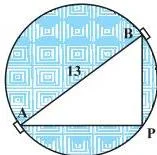
That makes triangle \(APB\) right-angled at \(P\), so Pythagoras gives \((x + 7)^2 + x^2 = 13^2\). Expanding and simplifying gives \(2x^2 + 14x – 120 = 0\), i.e. \(x^2 + 7x – 60 = 0\).
The discriminant is \(7^2 – 4(1)(-60) = 289\), which is \(17^2\) — positive, so the pole can be erected. The quadratic formula gives \(x = \frac{-7 \pm 17}{2}\), i.e. \(x = 5\) or \(x = -12\). The negative value is rejected because \(x\) is a distance; the pole stands 5 m from gate B and 12 m from gate A.
Definitions in Chapter 4: Quadratic Equation, Root and Discriminant
A quick glossary to check while you work. The full teaching for each term is in the Key Concepts section above.
| Term | Plain meaning | NCERT page |
|---|---|---|
| Standard form of a quadratic equation | \(ax^2 + bx + c = 0\) with \(a, b, c\) real numbers and \(a \neq 0\) | p. 39 |
| Root of a quadratic equation | A real number \(\alpha\) such that \(a\alpha^2 + b\alpha + c = 0\); then \(x = \alpha\) is a solution | p. 42 |
| Zero of the polynomial | The roots of the equation are exactly the zeroes of \(ax^2 + bx + c\) | p. 42 |
| Discriminant | \(D = b^2 – 4ac\), the quantity that fixes the number and type of roots | p. 45 |
| Nature of roots | \(D \gt 0\): two distinct real roots; \(D = 0\): two equal roots; \(D \lt 0\): no real roots | p. 45 |
Common Mistakes in Quadratic Equations and How to Avoid Them
These are the five errors this chapter invites. Each one is paired with the rule that stops it and a way to check your own work.
| Mistake | Correct rule | How to check your answer |
|---|---|---|
| Deciding whether an equation is quadratic without simplifying first | Expand both sides, collect all terms on one side, then look at the highest power (NCERT, p. 41) | The simplified result must be \(ax^2 + bx + c = 0\) with \(a \neq 0\); if the \(x^2\) terms cancel, the equation is linear |
| Not verifying the roots you found | Substitution is part of the method: \(\alpha\) is a root only if \(a\alpha^2 + b\alpha + c = 0\) (NCERT, p. 42) | Put each root back into the original equation and confirm both sides become equal (NCERT, p. 43) |
| Writing only one root when \(D = 0\) | Two equal roots are still two roots; both equal \(-b/2a\), so write both (NCERT, p. 45) | Factorise and check whether one linear factor appears twice, as in Example 5 (NCERT, p. 43) |
| Rejecting a negative root without a reason | Reject a negative root only when the variable measures a length, distance, age or count (NCERT, p. 44 and p. 46) | Ask what the variable measures: if it is a pure number, \(-12\) is a valid root; if it is a distance, it is not |
| Substituting the wrong sign for \(b\) | \(b\) carries its sign into the discriminant; \((-4)^2 = 16\) is positive (NCERT, p. 45) | Write \(a\), \(b\), \(c\) with their signs first, then substitute into \(D = b^2 – 4ac\) |
What the Exercises Ask and How to Practise Them
Each exercise trains one of the chapter’s three big skills, so the exercises also work as a revision plan: recognise, factorise, judge nature.
- Exercise 4.1 (p. 41) — recognise and form. Question 1 gives eight equations to classify, including \((x + 2)^3 = 2x(x^2 – 1)\), which simplifies to a cubic and is not quadratic; question 2 gives four situations — a plot, consecutive integers, ages and a train — to translate into equations.
- Exercise 4.2 (p. 44) — factorise. Five equations solved by splitting the middle term, including \(2x^2 – x + \frac{1}{8} = 0\) with a fractional coefficient and \(100x^2 – 20x + 1 = 0\) with a repeated root, then word problems on numbers, a right triangle and pottery articles.
- Exercise 4.3 (p. 47) — nature of roots. Find discriminants and classify; find \(k\) so that the roots are equal; and three “Is it possible” design questions, where a negative discriminant means the answer is no.
Word problems follow one template: name the variable, translate each condition into an expression, form \(ax^2 + bx + c = 0\), solve, and reject the values the situation forbids.
One caution: textbook contents and the examinable syllabus are not always identical, so check the current official CBSE syllabus before planning your exam preparation.
What to Remember From Chapter 4
The chapter closes with five summary points (NCERT, p. 47). Reworded for quick revision, they are:
- A quadratic equation in \(x\) has the standard form \(ax^2 + bx + c = 0\), with \(a, b, c\) real numbers and \(a \neq 0\).
- A real number \(\alpha\) is a root of \(ax^2 + bx + c = 0\) when \(a\alpha^2 + b\alpha + c = 0\). The roots of the equation are exactly the zeroes of the polynomial \(ax^2 + bx + c\), so a quadratic equation has at most two roots.
- If \(ax^2 + bx + c\) factorises into two linear factors, set each factor equal to zero and solve — each linear equation contributes one root.
- The quadratic formula \(x = \frac{-b \pm \sqrt{b^2 – 4ac}}{2a}\) gives the roots whenever \(b^2 – 4ac \geq 0\).
- The discriminant \(b^2 – 4ac\) decides the nature: two distinct real roots if \(D \gt 0\), two equal roots if \(D = 0\), no real roots if \(D \lt 0\).
Related Resources for Class 10 Maths
Quadratic Equations is the fourth chapter of Class 10 Maths, and it depends directly on the polynomials of Chapter 2. For the chapters around it, see the notes on Pair of Linear Equations in Two Variables (Chapter 3) and Arithmetic Progressions (Chapter 5).
The Class 10 Maths hub lists the chapters of the book; the Class 10 hub and the CBSE notes index are the places to go for the other subjects.
Sources and Data Verification
The details on this page describe the NCERT Class 10 Mathematics textbook, Chapter 4 (Quadratic Equations), official edition on ncert.nic.in, running from page 37 to page 47. This page is maintained for the current session using the NCERT information available to us.
NCERT settles textbooks, editions and PDFs; CBSE settles curriculum, syllabus and examinations. Textbook contents and the examinable syllabus are not always identical, so confirm the current official CBSE syllabus before planning revision.
Frequently Asked Questions About Quadratic Equations Class 10
How do I check whether a given equation is a quadratic equation?
Expand and simplify both sides fully, move every term to one side, and look at the highest power of the variable. If the result is \(ax^2 + bx + c = 0\) with \(a \neq 0\), it is quadratic. NCERT’s Example 2 shows both traps: an equation that looks quadratic but simplifies to \(x + 12 = 0\), and one that looks cubic but becomes quadratic (NCERT, p. 40-41).
Why does a quadratic equation have at most two roots?
Because the polynomial \(ax^2 + bx + c\) has at most two zeroes, a fact you met in Chapter 2, and the roots of the equation are exactly the zeroes of the polynomial (NCERT, p. 42).
When the discriminant is zero, why do we say the roots are equal?
Put \(D = 0\) into the quadratic formula: \(x = -b/2a \pm 0\), so the plus and minus results are the same number. The factorisation shows it too, because the same linear factor appears twice (NCERT, p. 43 and p. 45).
In word problems, should I always reject a negative root?
No. Reject a negative root only when the variable measures a quantity that cannot be negative — a length, distance, age or count. The pole problem rejects \(x = -12\) only because \(x\) is a distance; in a pure equation \(-12\) would be a valid root (NCERT, p. 46).
What is the difference between roots of an equation and zeroes of a polynomial?
None in this chapter. \(\alpha\) is a root of \(ax^2 + bx + c = 0\) exactly when \(a\alpha^2 + b\alpha + c = 0\), which is the same condition as \(\alpha\) being a zero of the polynomial \(ax^2 + bx + c\). The two words describe the same number from two directions (NCERT, p. 42).
Is the quadratic formula needed if I can factorise the equation?
No. If factorisation succeeds, set each factor to zero and you are done. The formula is the fallback that always works when \(b^2 – 4ac \geq 0\), even when the factors are not easy to see, as in Example 8 where \(x^2 + 7x – 60 = 0\) is solved by the formula (NCERT, p. 46).
Reference: NCERT Class 10 Mathematics textbook, chapter 4, official edition on ncert.nic.in.
Explore Class 10 Mathematics Books
Class 10 Mathematics on LearnCBSE:
Related chapters: