
Arithmetic Progressions Class 10 is Chapter 5 of the NCERT Mathematics book. It runs 24 printed pages (NCERT pages 48 to 72, in the official 2026-26 reprint) and builds the whole chapter around two formulas: the nth term of an AP and the sum of the first n terms.
The official NCERT PDF of the chapter is right below, followed by a walkthrough of the chapter — its definitions, formulas, figures, common mistakes and exercises — written so you can revise with the book open beside you. If you came for the book itself, take the PDF first; the rest of the page is what is inside it.
| What the chapter holds | Count | Where it is used |
|---|---|---|
| Printed pages | 24 | |
| Sections in the chapter | 5 | |
| Figures with NCERT captions | 6 | |
| Tables | 1 | |
| Worked examples | 2 | solved step by step in our NCERT Solutions |
| Exercise questions | 44 | answered in our NCERT Solutions |
| Official NCERT PDF | Download the chapter PDF | the chapter exactly as NCERT publishes it |
Arithmetic Progressions Class 10 NCERT Chapter 5 PDF
NCERT publishes the official NCERT Class 10 Maths Chapter 5 Arithmetic Progressions PDF on its own website at ncert.nic.in — the file below links straight to the chapter on the NCERT textbook site. Keep the file open while you read the sections below, because every explanation here gives you the NCERT page number to look at in your own book.
Chapter 5 at a glance: what is inside the file
The chapter opens with patterns found in nature — sunflower petals, honeycomb holes, the grains on a maize cob, the spirals on a pineapple and pine cone — and moves from these to number patterns in daily life such as salaries, ladder rungs and money boxes (NCERT p. 48).
Put together, the chapter has five sections, four exercise sets, and a one-point closing note that students often miss:
- 5.1 Introduction (pp. 48–50) — six real-life patterns, of which only some form APs.
- 5.2 Arithmetic Progressions (pp. 51–55) — the definition of an AP, the common difference, the general form, and Exercise 5.1. The definition of an AP is printed around NCERT p. 51–52.
- 5.3 nth Term of an AP (pp. 56–62) — the salary example leads to the nth term formula, worked as Examples 3–10, followed by Exercise 5.2. The formula itself appears on NCERT p. 58.
- 5.4 Sum of First n Terms of an AP (pp. 63–71) — the Gauss trick, the sum formula, Examples 11–16, and Exercises 5.3 and 5.4. The sum formula is proved on NCERT p. 64.
- 5.5 Summary and “A Note to the Reader” (p. 72) — the chapter’s own revision points, plus a closing point about the arithmetic mean.
Exercise 5.4 is printed in the book with an asterisk, marking it optional. The table below lists how much the chapter holds — its sections, figures, worked examples and exercise questions — so you know what you are opening.
What this chapter teaches: patterns, the nth term, and sums
The chapter exists because real life produces number patterns, and an AP is the simplest kind of pattern for which we can write formulas. Once you can recognise an AP, a single formula gives any term — the 15th, the 100th, even the 1000th — without writing out the list, and another formula adds the terms without adding them one by one.
The chapter moves in four steps, and every exercise belongs to one of them:
- Decide whether a list is an AP by checking that \(a_{k+1} – a_k\) comes out the same every time (NCERT p. 53). If the difference changes, the list is not an AP.
- Write the nth term using \(a_n = a + (n – 1)d\) (NCERT p. 58). The chapter’s salary example shows how this pattern emerges: year-wise salaries 8000, 8500, 9000, … grow by a fixed ₹500, so any year’s salary is first salary plus (year − 1) times the increment.
- Sum the first n terms by the reverse-and-add idea credited to Gauss, who found 1 + 2 + … + 100 = 5050 at age ten (NCERT p. 63–64). This gives the sum formula used for the rest of the chapter.
- Apply the formulas to word problems — salary increments, rose plants in a flower bed, simple interest year by year, a manufacturer’s production, money box savings. The chapter’s worked problems run from NCERT p. 56 to p. 68.
When a model of what you are checking: the pattern 10000, 12500, 15625, … grows by multiplying by \(\frac{5}{4}\); the square counts 1, 4, 9, 16 grow by squaring; the rabbit pairs 1, 1, 2, 3, 5, 8 grow like the Fibonacci sequence. None of these is an AP, because an AP grows by adding the same number every time.
The two formulas of the chapter: nth term and sum of first n terms
Both formulas of the chapter are collected here, with every symbol named, so you can substitute without guessing. A question that does not look like a formula question usually becomes one once you identify \(a\), \(d\) and \(n\).
- General form of an AP: \(a, a + d, a + 2d, a + 3d, \dots\) — \(a\) is the first term and \(d\) the common difference (NCERT p. 52).
- nth term (general term): \(a_n = a + (n – 1)d\), where \(a\) is the first term, \(d\) the common difference, and \(n\) the number of the term. Because the first term has \(n = 1\), the multiplier is \(n – 1\), not \(n\). If the AP has \(m\) terms, then \(a_m\) is the last term, also written \(l\) (NCERT p. 58).
- Sum of the first n terms: \(S_n = \frac{n}{2}[2a + (n – 1)d]\) (NCERT p. 64). The four quantities \(S_n, a, d, n\) are linked — if you know any three, the fourth can be found (NCERT p. 65).
- Sum using the last term: \(S_n = \frac{n}{2}(a + l)\), used when the first and last terms are given and \(d\) is not (NCERT p. 64). It works because \(l = a + (n – 1)d\), so the bracket \(2a + (n – 1)d\) equals \(a + l\).
- Sum of the first n positive integers: \(1 + 2 + 3 + \dots + n = \frac{n(n+1)}{2}\) (NCERT p. 67). This is the \(S_n = \frac{n}{2}(a + l)\) formula with \(a = 1, l = n\).
- Link between sum and term: \(a_n = S_n – S_{n-1}\) — the nth term is the sum up to n minus the sum up to n − 1 (NCERT p. 65, printed as a Remark).
Which sum form do I use? The question tells you. If it gives \(a\), \(d\) and \(n\), use \(S_n = \frac{n}{2}[2a + (n – 1)d]\). If it gives the first term, the last term \(l\) (and an n to find, or a number of terms), use \(S_n = \frac{n}{2}(a + l)\).
In both cases \(n\) is always a positive integer — it counts terms.
Worked example: the 15th term of the AP 4, 9, 14, …
Step 1: Write what the list gives.
First term \(a = 4\), common difference \(d = 9 – 4 = 5\), and \(n = 15\).
Step 2: Put the three values into \(a_n = a + (n – 1)d\), taking care with the bracket: \(n – 1 = 14\).
\[ a_{15} = 4 + (15 – 1) \times 5 = 4 + 14 \times 5 = 4 + 70 = 74 \]
Final answer: the 15th term is 74. Quick check: the list runs 4, 9, 14, 19, 24, … and 14 additions of 5 from 4 lands on 74.
Worked example: the sum of the first 8 terms of the AP 2, 12, 22, …
Step 1: Identify the values.
First term \(a = 2\), common difference \(d = 12 – 2 = 10\), number of terms \(n = 8\).
Step 2: Choose \(S_n = \frac{n}{2}[2a + (n – 1)d]\) because a, d and n are all known.
Substitute: \(2a = 4\), \((n – 1)d = 7 \times 10 = 70\).
\[ S_8 = \frac{8}{2}[4 + 70] = 4 \times 74 = 296 \]
Final answer: the sum of the first 8 terms is 296. Check by adding 2 + 12 + 22 + 32 + 42 + 52 + 62 + 72 = 296.
Figure walkthrough: which patterns in Chapter 5 are APs, and which are not

The opening figures of the chapter teach AP recognition by contrast. Reading them here makes the definition — “same number added every step” — concrete instead of abstract. Look at each pattern, work out what changes from one number to the next, and ask: is that change the same every time?
Figure 5.1 shows the maturity amounts 10000, 12500, 15625, 19531.25 from the savings scheme where a sum becomes \(\frac{5}{4}\) times itself every three years. The differences are 2500, then 3125, then 3906.25 — not constant. Multiplying by a fixed ratio is not an AP; only adding a fixed number is.

Figure 5.2 shows the number of unit squares in squares of side 1, 2, 3, … units: \(1^2, 2^2, 3^2, \dots\) gives 1, 4, 9, 16. The differences are 3, 5, 7 — they grow, so this is not an AP either. Growth by squaring is a different pattern.
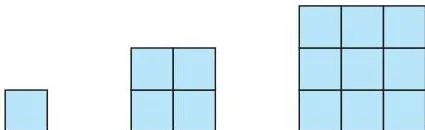
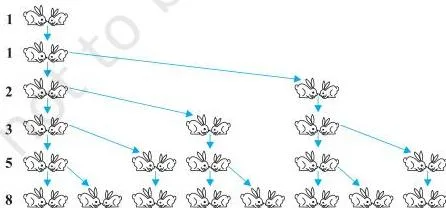
Figure 5.3 shows the rabbit pair counts 1, 1, 2, 3, 5, 8 described in the introduction. Each new term is the sum of the two before it — the Fibonacci pattern — and the differences 0, 1, 1, 2, 3 are not equal. Not an AP.
Now contrast those three with the chapter’s true APs from the same introduction: the salary list 8000, 8500, 9000, … grows by a fixed ₹500, and the ladder rung lengths 45, 43, 41, …, 31 drop by a fixed 2 cm each step. Those pass the fixed-difference test.
The figure that opens Section 5.4 returns to Shakila’s money box — ₹100 put in on the first birthday, ₹150 on the second, ₹200 on the third, and so on (NCERT p. 63). The amounts 100, 150, 200, 250, … form an AP with \(d = 50\).
The question this figure introduces is the one the Gauss method solves: total money collected by the 21st birthday, which the chapter computes as ₹12600 using the sum formula (NCERT p. 65).
Key terms defined in the chapter
Before reading examples or attempting exercises, fix the vocabulary. Each of these words appears repeatedly in the problems, and the chapter defines each one before using it.
- Term: each number in a listed sequence, denoted \(a_1, a_2, a_3, \dots, a_n\) (NCERT p. 52).
- Arithmetic Progression (AP): a list of numbers in which each term after the first is obtained by adding a fixed number to the preceding term (NCERT p. 51–52).
- Common difference (\(d\)): that fixed number. It may be positive, negative or zero — zero gives a constant list such as 3, 3, 3, … (NCERT p. 52). The formal test is \(d = a_{k+1} – a_k\) (NCERT p. 53).
- General form of an AP: \(a, a + d, a + 2d, a + 3d, \dots\), built from just two pieces of information, the first term \(a\) and the common difference \(d\) (NCERT p. 52).
- Finite AP and infinite AP: a finite AP has a fixed number of terms and therefore a last term; an infinite AP, such as 1, 2, 3, 4, …, goes on without a last term (NCERT p. 52).
- nth term (general term) and last term \(l\): \(a_n = a + (n – 1)d\) is called the general term of the AP; when the AP has \(m\) terms, \(a_m\) is its last term, often written \(l\) (NCERT p. 58).
- Arithmetic mean: the closing note to the reader says that if \(a, b, c\) are in AP, then \(b = \frac{a + c}{2}\), and \(b\) is called the arithmetic mean of \(a\) and \(c\) (NCERT p. 72).
Common mistakes in AP problems and how to avoid them
Every mistake below is one the chapter itself warns about, or one this topic reliably produces. Read the corrected rule before you start solving — you are more likely to commit these errors under exam pressure than to invent new ones.
- Subtracting in the wrong order when \(d\) is negative. For the AP 3, 1, −1, −3, …, the common difference is \(1 – 3 = -2\), not \(3 – 1 = 2\). NCERT states the rule on p. 54: subtract the kth term from the (k + 1)th term, even when the later term is smaller.
- Accepting a fractional \(n\). When you check whether a number is a term of an AP, the answer \(n\) must be a positive integer. The chapter’s Example 6 (NCERT p. 59) shows 301 is not a term of 5, 11, 17, 23, … precisely because \(n = \frac{151}{3}\) is not an integer.
- Miscounting a term from the end. For the 11th term from the last term of a 25-term AP, the required term is \(a_{15}\), not \(a_{14}\) (NCERT p. 60–61). A safer alternative the chapter offers: reverse the AP, so \(a = -62, d = 3\) in its example, and find the 11th term directly.
- Assuming a sum question has only one answer. When \(a\) is positive and \(d\) is negative, positive and negative terms cancel, so \(S_n\) can equal the same value for two different values of \(n\) (NCERT p. 66).
- Mixing up \(S_n\) with \(a_n\). The nth term is not the sum of n terms. Remember the chapter’s Remark: \(a_n = S_n – S_{n-1}\) (NCERT p. 65). Use it whenever a question gives you a sum and asks for a term.
Why a sum problem can have two answers
Take an AP the book does not use: 18, 15, 12, … with \(a = 18\), \(d = -3\), and suppose the sum is required to be 54.
- Step 1: Substitute into the sum formula: \(54 = \frac{n}{2}[2 \times 18 + (n – 1)(-3)]\).
- Step 2: Simplify: \(108 = n(39 – 3n)\), which rearranges to \(n^2 – 13n + 36 = 0\), factorising as \((n – 4)(n – 9) = 0\).
\[ n = 4 \quad \text{or} \quad n = 9 \]
Why both work: the first four terms sum to \(18 + 15 + 12 + 9 = 54\). The next five terms are 6, 3, 0, −3, −6 — their sum is 0 — so the first nine terms also sum to 54. Positive and negative terms cancelled exactly.
| Mistake | Correct rule | How to check your answer |
|---|---|---|
| Subtracting the earlier term from the later one to get \(d\) | \(d = a_{k+1} – a_k\), always later term minus earlier term (NCERT p. 53–54) | For 3, 1, −1, …, \(d\) must come out −2, and the list must fall by 2 each step |
| Accepting a fractional \(n\) when testing a number as a term | \(n\) must be a positive integer: \(n = 1, 2, 3, \dots\) (NCERT p. 59) | If \(n\) is a fraction, the number is not in the AP — say so and give the reason |
| Counting the 11th term from the end as \(a_{14}\) | Term k from the end of an m-term AP is \(a_{m – k + 1}\), here \(a_{25 – 11 + 1} = a_{15}\) (NCERT p. 60–61) | Reverse the AP and find \(a_{11}\) fresh — the two methods must agree |
| Reporting only one \(n\) when solving \(S_n\) = constant | A quadratic in \(n\) can give two positive integer values when \(a \gt 0\) and \(d \lt 0\) (NCERT p. 66) | Check both values: terms between the two answers may add to zero |
| Confusing the nth term with the sum of n terms | \(a_n = S_n – S_{n-1}\) (NCERT p. 65) | Test with small n: \(a_2 = S_2 – S_1\) should equal the second term |
How the chapter maps to exercise practice
Each exercise set practises one skill, so if a question is tripping you, you can go back to the exercise that teaches it. Note the printed page of the book for each exercise.
| Exercise | What it practises | Printed in the book at |
|---|---|---|
| Exercise 5.1 | Recognising which situations produce APs; writing the first term \(a\) and common difference \(d\) from a given list | around NCERT p. 55–56 |
| Exercise 5.2 | The nth term formula used in both directions — finding \(a_n\) from \(a, d, n\), and finding \(n, d\) or \(a\) when one term is given; includes a fill-in table and two multiple choice questions | around NCERT p. 62–63 |
| Exercise 5.3 | Sum formulas, including sums written term-by-term (such as \(7 + 10\frac{1}{2} + 14 + \dots + 84\)), word problems, and the relation between terms and sums | around NCERT p. 68–70 |
| Exercise 5.4 (Optional)* | Harder reasoning questions — finding the first negative term, rung lengths of a ladder, house numbering, concrete for a terrace | NCERT p. 71–72 |
NCERT prints the asterisk note “These exercises are not from the examination point of view” directly below Exercise 5.4 (NCERT p. 72). That is the book’s own marking, not a guess.
One caution applies to the whole chapter: textbook contents and the examinable syllabus are not always identical — the current official syllabus (CBSE Academic, cbseacademic.nic.in) settles what is examinable this session.
Two word problems in Exercise 5.3 are built on figures you can read as APs.
Fig. 5.5 (log pile) shows 200 logs stacked with 20 logs in the bottom row, 19 in the next, 18 in the row next to it, and so on — the rows form the AP 20, 19, 18, …, whose terms sum to 200, and the question asks how many rows are used and how many logs lie in the top row.
Fig. 5.6 (potato race) places a bucket at the start, 5 m from the first potato, with the potatoes 3 m apart; because the competitor runs out and back, the run distances are \(2 \times 5,\ 2 \times (5 + 3),\ 2 \times (5 + 2 \times 3), \dots\) — an AP with common difference 6.
The earlier spiral question (Question 18, with its figure printed in the NCERT PDF) works the same way using the book’s hint: the successive semicircle lengths form an AP because the centres alternate between A and B.


Key points to remember from Chapter 5
This is the night-before revision block, built from the chapter’s own printed Summary on NCERT p. 72 and written in plainer words.
- An AP is a list in which each term after the first is obtained by adding a fixed number \(d\) to the preceding term; the general form is \(a, a + d, a + 2d, \dots\) (NCERT p. 52).
- A list is an AP if \(a_{k+1} – a_k\) is the same for every k — the common difference test (NCERT p. 53).
- The nth term is \(a_n = a + (n – 1)d\), with \(a\) the first term and \(d\) the common difference (NCERT p. 58).
- The sum of the first n terms is \(S_n = \frac{n}{2}[2a + (n – 1)d]\) (NCERT p. 64).
- When the last term \(l\) is given, \(S_n = \frac{n}{2}(a + l)\) — the same sum when \(l = a + (n – 1)d\) (NCERT p. 64).
- If \(a, b, c\) are in AP, then \(b = \frac{a + c}{2}\); \(b\) is the arithmetic mean of \(a\) and \(c\) (NCERT p. 72).
Keep one caution in mind as you finish: textbook contents and the examinable syllabus are not always identical, so the official CBSE syllabus is the final word on what is testable.
Related books, chapters and PDF resources
This listing is maintained for the 2026-27 academic session using the NCERT textbook information available to us. NCERT remains the authority for confirming the latest edition.
Class 10 Mathematics is built as a sequence, and this chapter sits between two that use its tools. Before Chapter 5, Quadratic Equations (Chapter 4) gives you the factorisation practice that AP sum problems depend on — as seen in the quadratic you solve to find n. After Chapter 5, Triangles (Chapter 6) continues the same style of step-by-step reasoning with figures.
For the whole course in one place, the Class 10 Mathematics notes hub links every chapter, and the Class 10 study material page covers all subjects. The chapter PDF used on this page is the official one published by NCERT at ncert.nic.in, and the CBSE curriculum page linked above settles what is examinable each session.
Sources and data verification
- The page describes Chapter 5, Arithmetic Progressions, of the NCERT Class 10 Mathematics textbook, in its official NCERT edition.
- It covers that single chapter only — not the whole book and not the CBSE scheme of subjects; page numbers quoted are as printed in the book.
- The listing is maintained for the current academic session using the NCERT information available to us.
- NCERT settles textbooks, editions and official PDFs; CBSE settles curriculum, syllabus and examinations.
Frequently asked questions about Arithmetic Progressions Class 10
What is an arithmetic progression in Class 10?
An arithmetic progression (AP) is a list of numbers in which each term after the first is obtained by adding a fixed number to the term before it (NCERT p. 51–52). For example, 1, 4, 7, 10, … is an AP because 3 is added each time; the fixed number is its common difference.
What is the common difference of an AP and how do you find it?
The common difference \(d\) is the fixed number added to reach each next term, and it may be positive, negative or zero (NCERT p. 52). You find it from any two consecutive terms: \(d = a_{k+1} – a_k\), always subtracting the kth term from the (k + 1)th term — even when the later term is smaller (NCERT p. 53–54).
What is the formula for the nth term of an AP?
The nth term is \(a_n = a + (n – 1)d\), where \(a\) is the first term, \(d\) the common difference and \(n\) the number of the term (NCERT p. 58). Example: for 4, 9, 14, …, the 15th term is \(4 + 14 \times 5 = 74\). The formula is also called the general term of the AP.
What is the formula for the sum of the first n terms of an AP?
The sum of the first n terms is \(S_n = \frac{n}{2}[2a + (n – 1)d]\) (NCERT p. 64). When the first term \(a\) and the last term \(l\) are known and \(d\) is not, use \(S_n = \frac{n}{2}(a + l)\) (NCERT p. 64). For the first n positive integers this becomes \(\frac{n(n+1)}{2}\) (NCERT p. 67).
Why can an AP sum question sometimes have two answers?
Because terms can cancel. When the first term is positive and the common difference is negative, the AP eventually reaches negative terms, so the sum of the later terms can add to zero (NCERT p. 66). With the AP 18, 15, 12, …, a sum of 54 is obtained for both \(n = 4\) and \(n = 9\), since the terms from the 5th to the 9th sum to zero.
Is Exercise 5.4 of Class 10 Chapter 5 important for exams?
The book itself prints an asterisk and the note “These exercises are not from the examination point of view” below Exercise 5.4 (NCERT p. 72), meaning NCERT marks it optional. Still, textbook contents and the examinable syllabus are not always identical — the current official syllabus on cbseacademic.nic.in is the authority for what is testable this session.
Reference: NCERT Class 10 Mathematics textbook, Chapter 5, official edition on ncert.nic.in.
Explore Class 10 Mathematics Books
- Previous: Quadratic Equations
- Next: Triangles 6
Class 10 Mathematics on LearnCBSE:
Related chapters:
- Real Numbers
- Polynomials
- Pair of Linear Equations in Two Variables