
This page covers the Polynomials Class 10 chapter of the NCERT Mathematics book: Chapter 2, 14 printed pages on the zeroes of a polynomial, their geometrical meaning, and how zeroes are related to coefficients. The official PDF is right below, and the rest of this page explains the chapter section by section for the current session.
Download the Polynomials Class 10 NCERT Book PDF (Chapter 2, official edition) straight from NCERT’s own textbook server on ncert.nic.in — it is the exact file whose page numbers every section of this page follows.
| What the chapter holds | Count | Where it is used |
|---|---|---|
| Printed pages | 14 | |
| Sections in the chapter | 4 | |
| Figures with NCERT captions | 8 | |
| Tables | 3 | |
| Worked examples | 1 | solved step by step in our NCERT Solutions |
| Exercise questions | 3 | answered in our NCERT Solutions |
| Official NCERT PDF | Download the chapter PDF | the chapter exactly as NCERT publishes it |
Chapter 2 Polynomials at a glance
Use the table below to see how much Chapter 2 holds before you start. The mathematics itself is organised into four numbered sections, 2.1 to 2.4.
- 2.1 Introduction — recalls Class IX work on the degree of a polynomial, then defines the value \( p(k) \) and the zero of a polynomial (NCERT, p. 11).
- 2.2 Geometrical Meaning of the Zeroes of a Polynomial — the graph section. Tables 2.1 and 2.2 give values of \( y = x^2 – 3x – 4 \) and \( y = x^3 – 4x \), and most of the chapter’s figures sit here (pp. 12–17).
- 2.3 Relationship between Zeroes and Coefficients of a Polynomial — the algebraic core: factorise, read the zeroes, and connect them to the coefficients (pp. 18–22).
- 2.4 Summary — the chapter’s results collected for revision (p. 23).
Two exercises split the practice. Exercise 2.1 (after Section 2.2) is entirely graph-based: one question, six graphs, one skill — counting the zeroes. Exercise 2.2 (after Section 2.3) is algebra: two questions, each with six parts, on factorising quadratics and on building a quadratic from a given sum and product of zeroes.
What Chapter 2 actually teaches
If you have sixty seconds, here is the whole chapter in five lines. Each line is developed properly further down the page.
- A zero of a polynomial \( p(x) \) is a real number \( k \) with \( p(k) = 0 \) — put it in, get zero out (NCERT, p. 11).
- Geometrically, a zero is the \( x \)-coordinate of a point where the graph of \( y = p(x) \) meets the \( x \)-axis (NCERT, p. 12).
- A quadratic \( ax^2 + bx + c \) with \( a \neq 0 \) has at most 2 zeroes; a cubic has at most 3 (NCERT, p. 17).
- The coefficients remember the zeroes: for a quadratic, \( \alpha + \beta = -\frac{b}{a} \) and \( \alpha\beta = \frac{c}{a} \) (NCERT, p. 19).
- For a cubic, \( \alpha + \beta + \gamma = -\frac{b}{a} \), \( \alpha\beta + \beta\gamma + \gamma\alpha = \frac{c}{a} \), and \( \alpha\beta\gamma = -\frac{d}{a} \) (NCERT, p. 22).
How to use this page: read the key ideas below for the algebra, then walk through the figures with the book open. Definitions, common mistakes and the revision summary are the layers to re-read the night before an exam.
Key ideas explained: degree, zeroes and the coefficient relationships
Three ideas carry the whole chapter: what a polynomial is called, what a zero is, and how the zeroes are secretly stored inside the coefficients.
Degree first, then the family name
Every polynomial is named by its degree — the highest power of \( x \) in \( p(x) \) (NCERT, p. 11). Degree 1 is linear, degree 2 is quadratic, degree 3 is cubic. The name ‘quadratic’ comes from the word ‘quadrate’, meaning ‘square’, because the \( x^2 \) term is a square.
| Family name | Degree | General form (\( a \neq 0 \)) |
|---|---|---|
| Linear polynomial | 1 | \( ax + b \) |
| Quadratic polynomial | 2 | \( ax^2 + bx + c \) |
| Cubic polynomial | 3 | \( ax^3 + bx^2 + cx + d \) |
Expressions like \( \frac{1}{x – 1} \) or \( \sqrt{x} + 2 \) are not polynomials: dividing by \( x \) or taking a fractional power of \( x \) produces negative or fractional exponents, which the definition of a polynomial does not allow (NCERT, p. 11).
What a zero actually is
Take \( p(x) = x^2 – 3x – 4 \). At \( x = 2 \) the value is \( p(2) = -6 \); at \( x = -1 \) the value is \( p(-1) = 0 \). A real number \( k \) is a zero of a polynomial \( p(x) \) when \( p(k) = 0 \) (NCERT, p. 11). So the zeroes of \( x^2 – 3x – 4 \) are \( -1 \) and \( 4 \). A zero is a number, not a point — the point comes in the next section.
For a linear polynomial \( ax + b \), the zero is \( -\frac{b}{a} \). That is already a relationship between a zero and the coefficients: minus the constant term divided by the coefficient of \( x \) (NCERT, p. 11). The chapter’s driving question is whether quadratics and cubics hide their zeroes in their coefficients the same way. They do — that is Section 2.3.
The coefficient relationships
Suppose \( \alpha \) and \( \beta \) are the zeroes of \( ax^2 + bx + c \). Then \( x – \alpha \) and \( x – \beta \) are its factors, so \( ax^2 + bx + c = k(x – \alpha)(x – \beta) \) (NCERT, p. 19). Multiplying out gives \( k[x^2 – (\alpha + \beta)x + \alpha\beta] \). Comparing the \( x \)-term and the constant term with \( ax^2 + bx + c \) gives the two formulas:
\[ \alpha + \beta = -\frac{b}{a}, \qquad \alpha\beta = \frac{c}{a} \]
Why the minus sign? Expanding \( (x – \alpha)(x – \beta) \) produces \( -(\alpha + \beta)x \), so the coefficient of \( x \) is the negative of the sum. For a cubic, the same comparison yields three formulas (NCERT, p. 22):
\[ \alpha + \beta + \gamma = -\frac{b}{a}, \quad \alpha\beta + \beta\gamma + \gamma\alpha = \frac{c}{a}, \quad \alpha\beta\gamma = -\frac{d}{a} \]
Worked example: finding and verifying zeroes
The exam-standard sequence is factorise, then read the zeroes, then verify. The numbers below are fresh, not lifted from the book’s examples — work them yourself before reading the steps.
Step 1: Factorise \( 2x^2 – 7x + 3 \) by splitting the middle term.
We need two numbers whose product is \( 2 \times 3 = 6 \) and whose sum is \( -7 \): those are \( -1 \) and \( -6 \).
\[ 2x^2 – 7x + 3 = 2x^2 – x – 6x + 3 = x(2x – 1) – 3(2x – 1) = (x – 3)(2x – 1) \]
Step 2: Read the zeroes by setting each bracket to zero.
\( x – 3 = 0 \) gives \( x = 3 \); \( 2x – 1 = 0 \) gives \( x = \frac{1}{2} \).
Step 3: Verify the sum against \( -\frac{b}{a} \).
\[ \alpha + \beta = 3 + \frac{1}{2} = \frac{7}{2} = -\frac{b}{a} = -\frac{(-7)}{2} \]
Step 4: Verify the product against \( \frac{c}{a} \).
\[ \alpha\beta = 3 \times \frac{1}{2} = \frac{3}{2} = \frac{c}{a} = \frac{3}{2} \]
Final answer: the zeroes of \( 2x^2 – 7x + 3 \) are \( 3 \) and \( \frac{1}{2} \); sum \( \frac{7}{2} \), product \( \frac{3}{2} \), both matching the formulas.
A quick sign check: \( x^2 – 5x + 4 = (x – 1)(x – 4) \), so the zeroes are \( 1 \) and \( 4 \). Sum \( = 5 = -\frac{(-5)}{1} \), product \( = 4 = \frac{4}{1} \). The formulas behave — the minus sign in \( -\frac{b}{a} \) is the only trap, and it shows up precisely here.
What the graphs tell you: figures 2.1 to 2.10, read one by one
This is the part a text-only page cannot give you. Every figure below is the actual NCERT diagram — keep the book open and follow the shapes.
Linear polynomials: one zero, one crossing
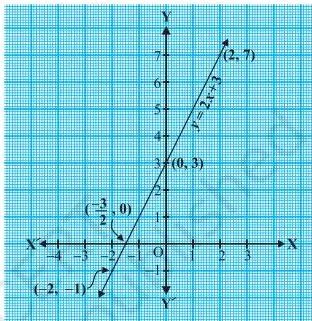
The graph of \( y = 2x + 3 \) is a straight line through \( (-2, -1) \) and \( (2, 7) \). It cuts the \( x \)-axis at exactly one point, \( \left(-\frac{3}{2}, 0\right) \) — and \( -\frac{3}{2} \) is precisely the zero of \( 2x + 3 \) (NCERT, p. 12). The \( x \)-coordinate of the crossing is the zero. A linear polynomial always has exactly one zero.
Quadratic: the parabola and its three cases
For any quadratic \( ax^2 + bx + c \), the graph of \( y = ax^2 + bx + c \) is a parabola — a U-shaped curve, opening upward when \( a \gt 0 \) and downward when \( a \lt 0 \) (NCERT, p. 13). The book does not ask you to plot these graphs; the footnote on p. 13 says plotting is not meant to be done by students.
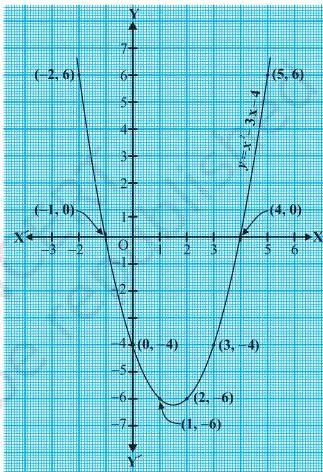
What the book does expect is that you read them. Its worked example is \( y = x^2 – 3x – 4 \), whose graph, drawn from the values in Table 2.1, crosses the \( x \)-axis at \( x = -1 \) and \( x = 4 \) — the two zeroes.
Three cases can happen (NCERT, pp. 14–15):
- Two distinct zeroes — the parabola cuts the \( x \)-axis at two separate points A and A’, and their \( x \)-coordinates are the two zeroes (Fig. 2.3).
- One zero — the parabola touches the \( x \)-axis at a single point A, where two points have coincided (Fig. 2.4).
- No zero — the parabola lies completely above, or completely below, the \( x \)-axis (Fig. 2.5).
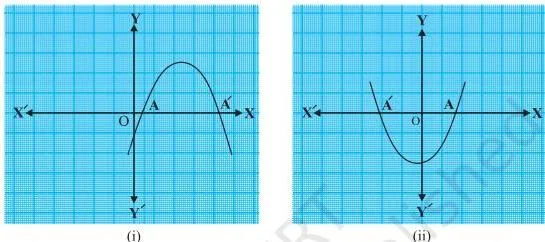
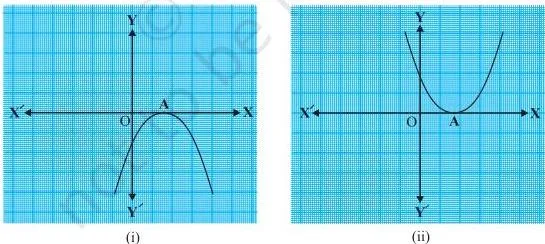
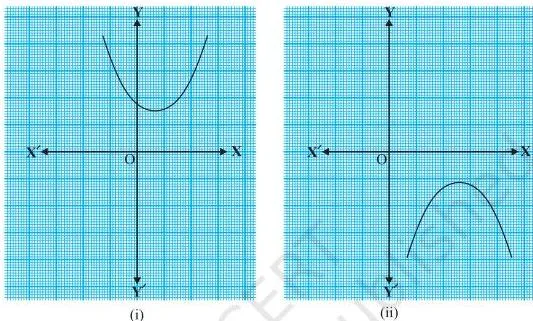
These three pictures are the entire graph syllabus for quadratics: cut gives two zeroes, touch gives one zero, miss gives no zero. More than two is impossible — that is the geometric form of the at-most rule.
Cubics: the at-most-three rule
Table 2.2 lists values of \( y = x^3 – 4x \), and the graph (Fig. 2.6) meets the \( x \)-axis at three points: \( x = -2 \), \( x = 0 \) and \( x = 2 \) — three zeroes (NCERT, p. 16).
The book then tries \( y = x^3 \), where only \( x = 0 \) works, and \( y = x^3 – x^2 = x^2(x – 1) \), with zeroes \( 0 \) and \( 1 \) — one zero and two zeroes respectively (NCERT, p. 17).
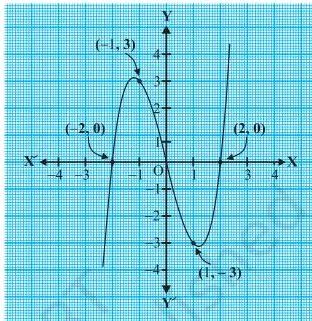
That leads to the chapter’s central remark (NCERT, p. 17): a polynomial of degree \( n \) has at most \( n \) zeroes. A cubic can show one, two or three zeroes — never four. Use this rule as a sanity check on any answer you compute.
Counting zeroes from any graph
NCERT’s Example 1 (p. 17) turns this into a routine: the number of zeroes of \( p(x) \) is simply the number of points where the graph of \( y = p(x) \) crosses or touches the \( x \)-axis. For the six graphs in Fig. 2.9, NCERT’s own solution counts 1, 2, 3, 1, 1 and 4 zeroes respectively.
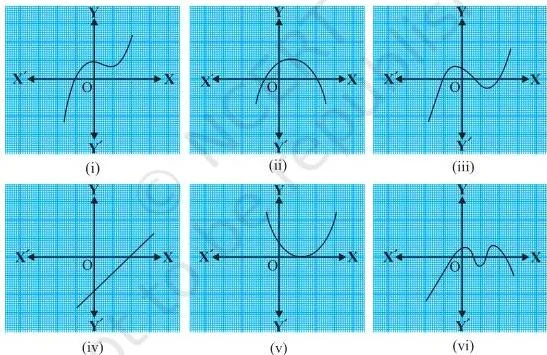
Notice graphs (iv) and (v): the curve touches the axis without crossing it, yet each still counts as one zero — at a touch, the two intersection points have coincided, exactly as in Fig. 2.4.
Definitions you need to write in board answers
Answers are marked for precise vocabulary, and this chapter’s terms are exact. Learn each term with its page so you can match the book’s own wording.
| Term | Meaning | NCERT page |
|---|---|---|
| Degree of a polynomial \( p(x) \) | The highest power of \( x \) in \( p(x) \) | p. 11 |
| Linear / quadratic / cubic polynomial | Polynomials of degree 1, 2, 3 | p. 11 |
| Value of \( p(x) \) at \( x = k \), written \( p(k) \) | Replace \( x \) by \( k \) and evaluate | p. 11 |
| Zero of a polynomial \( p(x) \) | A real number \( k \) such that \( p(k) = 0 \) | p. 11 |
| Parabola | The curve \( y = ax^2 + bx + c \); opens upward if \( a \gt 0 \), downward if \( a \lt 0 \) | p. 13 |
| Quadratic polynomial (general form) | \( ax^2 + bx + c \), where \( a \neq 0 \) | p. 11 |
| Cubic polynomial (general form) | \( ax^3 + bx^2 + cx + d \), where \( a \neq 0 \) | p. 11 |
One naming note: the book uses the Greek letters \( \alpha, \beta, \gamma \) — pronounced ‘alpha’, ‘beta’, ‘gamma’ — for the zeroes (NCERT, p. 19). Use the chapter’s notation in your answers.
Common mistakes, and the correction for each
Almost every mistake in this chapter is a sign error, a factor-versus-zero mix-up, or a graph misread. The table names each one before it costs you marks.
| Mistake | Correct rule | How to check your answer |
|---|---|---|
| Writing a zero as if it were a point: “the zero is at \( (-1, 0) \)” | A zero is the number \( k \) with \( p(k) = 0 \); the point \( (k, 0) \) has that number as its \( x \)-coordinate (pp. 11–12) | Substitute \( k \) into \( p(x) \) — you must get 0 |
| Losing the minus sign: writing \( \alpha + \beta = \frac{b}{a} \) | \( \alpha + \beta = -\frac{b}{a} \); for \( x^2 – 7x + 12 \) the zeroes are 3 and 4, sum 7, which is \( -\frac{(-7)}{1} \), not \( -\frac{7}{1} \) (p. 20) | Add your two zeroes and compare with \( -\frac{b}{a} \) |
| Reading \( (x – \alpha)(x – \beta) \) as giving zeroes \( -\alpha \) and \( -\beta \) | The zeroes are \( \alpha \) and \( \beta \) — the numbers that make each bracket zero (p. 19) | Solve each bracket equal to zero |
| Forgetting the leading coefficient: in \( 2x^2 – 8x + 6 = 2(x – 1)(x – 3) \), quoting the product of zeroes as 6 | \( \alpha\beta = \frac{c}{a} \) divides by \( a \): here \( \frac{6}{2} = 3 \) (pp. 18–19) | Factor out the common term first, then read the zeroes |
| Believing a quadratic always has two zeroes | It has at most two: cut gives two, touch gives one (two equal zeroes), miss gives none (Figs 2.4, 2.5) | Check whether the parabola cuts, touches, or misses the \( x \)-axis |
Exercise 2.1 asks you to apply the counting rule to six new graphs (NCERT, p. 18). Each curve in Fig. 2.10 is a graph of \( y = p(x) \); count the \( x \)-axis intersections, one per crossing and one per touch. The book deliberately includes touch-only graphs — that is exactly where weak students under-count.
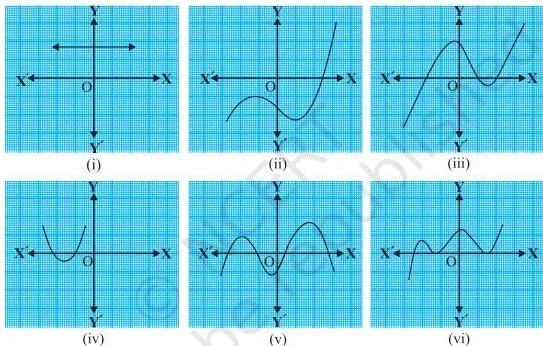
Exam notes for Chapter 2
One honest framing first: textbook contents and the examinable syllabus are not always identical — check the current official CBSE syllabus for what is examinable. With that in mind, the chapter itself expects five skills.
- Read the number of zeroes straight off a graph — count intersections, one per crossing or touch. Practice: NCERT Example 1 and Exercise 2.1. You are not expected to plot these graphs (footnote, NCERT p. 13).
- Factorise a quadratic by splitting the middle term and verify the sum and product of the zeroes against \( -\frac{b}{a} \) and \( \frac{c}{a} \). Practice: Exercise 2.2 Q1.
- Construct a quadratic from a given sum and product using \( k(x^2 – (\alpha + \beta)x + \alpha\beta) \). Practice: Exercise 2.2 Q2; NCERT Example 4 (p. 21) shows the pattern.
- Know the cubic relationships \( \alpha + \beta + \gamma = -\frac{b}{a} \), \( \alpha\beta + \beta\gamma + \gamma\alpha = \frac{c}{a} \), \( \alpha\beta\gamma = -\frac{d}{a} \). NCERT’s own worked cubic, Example 5 (p. 22), carries the footnote ‘Not from the examination point of view’ — an honest signal about how much time cubic verification deserves. Know the formulas; do not sink revision time into the full verification arithmetic.
- Use the at-most rule as a sanity check — a fourth answer to a quadratic question is wrong before you even check the arithmetic (p. 17).
Exercise 2.1 is the graph-reading question — all six parts test the same skill of counting intersections. Exercise 2.2 splits into two types: Q1 asks you to factorise and verify, Q2 asks you to build a polynomial from a given sum and product. A full-marks answer to any Q1-type part shows the factorisation, the zeroes, and both verifications written against the formulas.
One-page revision summary of Polynomials
Everything the chapter wants you to keep, compressed from its own Summary (NCERT, p. 23):
- Polynomials of degrees 1, 2 and 3 are called linear, quadratic and cubic respectively.
- General forms: quadratic \( ax^2 + bx + c \) and cubic \( ax^3 + bx^2 + cx + d \), all coefficients real, \( a \neq 0 \).
- The zeroes of \( p(x) \) are precisely the \( x \)-coordinates of the points where the graph of \( y = p(x) \) intersects the \( x \)-axis.
- A quadratic has at most 2 zeroes; a cubic has at most 3.
| Polynomial | Sum of zeroes | Sum of products, two at a time | Product of zeroes |
|---|---|---|---|
| Quadratic \( ax^2 + bx + c \) | \( \alpha + \beta = -\frac{b}{a} \) | — | \( \alpha\beta = \frac{c}{a} \) |
| Cubic \( ax^3 + bx^2 + cx + d \) | \( \alpha + \beta + \gamma = -\frac{b}{a} \) | \( \alpha\beta + \beta\gamma + \gamma\alpha = \frac{c}{a} \) | \( \alpha\beta\gamma = -\frac{d}{a} \) |
Learning order for the night before: do one factorise-and-verify problem end to end — factor, solve each bracket, check the sum, check the product — rather than memorising five. That one sequence is the mechanism the whole chapter grades.
Related resources and where this chapter sits
This listing is maintained for the 2026-27 academic session using the NCERT textbook information available to us. NCERT remains the authority for confirming the latest edition.
Chapter 1, Real Numbers, supplies the number system this chapter works inside. The factorising and sign logic you have just learned is exactly what Pair of Linear Equations in Two Variables (Chapter 3) and Chapter 4 on quadratic equations reuse — zeroes here are the skill those chapters assume.
For the rest of the book, browse the Class 10 Mathematics notes or the wider Class 10 study hub.
Sources and data verification
- The section names, page references, figures and exercise descriptions above come from the NCERT Class 10 Mathematics textbook, Chapter 2, official edition hosted on ncert.nic.in.
- This page covers the English-medium NCERT Class 10 Mathematics book only; it does not cover other language editions or the full CBSE subject scheme.
- It is maintained for the academic session of the NCERT Reprint edition named in the opening paragraph.
- NCERT settles the textbook, its editions and the official PDFs; CBSE settles the curriculum, syllabus and examinations — and the two are not always identical, so confirm examinable content against the current official CBSE syllabus.
Polynomials Class 10: common questions, answered
How do you find the number of zeroes of a polynomial from its graph?
Count the points where the graph of \( y = p(x) \) meets the \( x \)-axis — each crossing or touch counts as one zero. A curve that cuts the axis at two points has two zeroes; one that only touches has one; one that stays completely above or below has none.
NCERT’s Example 1 (Fig. 2.9, p. 17) does exactly this for six graphs, and Exercise 2.1 (Fig. 2.10) gives you six more to try.
How do I verify the relationship between zeroes and coefficients of a quadratic polynomial?
Factorise first, then check the two formulas. Take \( x^2 – 6x + 8 \): it factors as \( (x – 2)(x – 4) \), so the zeroes are 2 and 4. Sum: \( 2 + 4 = 6 \), and \( -\frac{b}{a} = -\frac{(-6)}{1} = 6 \). Product: \( 2 \times 4 = 8 \), and \( \frac{c}{a} = \frac{8}{1} = 8 \). Both match — write the factorisation, the zeroes, and both checks, and the verification is complete.
Can a quadratic polynomial have only one zero, or no zero at all?
Yes to both. A quadratic has at most two zeroes. It has two when the parabola cuts the \( x \)-axis at two distinct points (Fig. 2.3), one when it touches the axis at a single point — which the book describes as two coincident points (Fig. 2.4) — and none when the parabola stays wholly above or below the axis (Fig. 2.5).
Can a quadratic polynomial have no real zero?
Yes. If the parabola \( y = ax^2 + bx + c \) never touches the \( x \)-axis, the polynomial has no real zero — the chapter’s zeroes are real numbers \( k \) with \( p(k) = 0 \), and no such real \( k \) exists in that case (Fig. 2.5, NCERT p. 15).
What is the difference between factors and zeroes of a polynomial?
If \( \alpha \) is a zero of \( p(x) \), then \( (x – \alpha) \) is a factor of \( p(x) \), and the reverse is also true. Zeroes are the numbers; factors are the algebraic pieces. From \( (x – 3)(2x – 1) \), the zeroes are 3 (from \( x – 3 = 0 \)) and \( \frac{1}{2} \) (from \( 2x – 1 = 0 \)) — each bracket contributes one zero by being set equal to zero (NCERT, pp. 19–20).
Reference: NCERT Class 10 Mathematics textbook, chapter 2, official edition on ncert.nic.in.
Explore Class 10 Mathematics Books
- Previous: Real Numbers
- Next: Pair of Linear Equations in Two Variables
Class 10 Mathematics on LearnCBSE:
Related chapters:
- Quadratic Equations
- Arithmetic Progressions
- Triangles 6