
This is the official Coordinate Geometry Class 10 chapter — NCERT Mathematics, Chapter 7, Coordinate Geometry — a 14-page chapter that opens on printed page 98 of the Class 10 Mathematics book.
The official NCERT PDF is directly below, and the rest of this page maps what is inside the file: why the distance formula exists, how the section formula works, and which exercise question tests which idea.
Download the Coordinate Geometry Class 10 Chapter 7 PDF
The download below is the chapter itself, exactly as NCERT published it, from the official NCERT website — the same chapter this page explains, including every figure, both exercises, the Summary and the Note to the Reader.
Download the Coordinate Geometry Class 10 Chapter 7 NCERT PDF to open the official NCERT edition hosted on ncert.nic.in and read it the way the board’s textbook prints it. This is the original textbook file, so it matches your school copy page for page.
| What the chapter holds | Count | Where it is used |
|---|---|---|
| Printed pages | 14 | |
| Sections in the chapter | 4 | |
| Figures with NCERT captions | 6 | |
| Exercise questions | 20 | answered in our NCERT Solutions |
| Official NCERT PDF | Download the chapter PDF | the chapter exactly as NCERT publishes it |
Chapter 7 at a Glance: Sections, Figures and Exercises
The table below lists what this chapter holds — its sections, figures, worked examples and exercise questions — so you can see the size and shape of the file before you open it.
Opened in order, the chapter runs like this:
- 7.1 Introduction — printed pages 98–100: recap of coordinate axes and graphs, plus a point-plotting picture.
- 7.2 Distance Formula — pp. 100–105: the derivation, its remarks and solved examples.
- Exercise 7.1 — pp. 105–106: questions on the distance formula.
- 7.3 Section Formula — pp. 106–111: the derivation, solved examples and Exercise 7.2.
- Exercise 7.2 — pp. 111–112: questions on dividing a line segment.
- 7.4 Summary — p. 112: the chapter’s four key results.
- A Note to the Reader — p. 112: what the chapter deliberately leaves out.
The chapter is prose-and-figure based: there are no boxes, tables or separate activity blocks — the ideas move through the text and the diagrams.
What Coordinate Geometry Class 10 Covers: From Towns and Towers to Two Formulas
Read this section as a storyline: it is why the two formulas exist, so the formulas have a home before they appear.
The chapter opens by recalling Class 9: to locate a point on a plane you need a pair of coordinate axes. The distance of a point from the y-axis is its x-coordinate, or abscissa, and its distance from the x-axis is its y-coordinate, or ordinate (NCERT p. 99).
Coordinate geometry, the book notes, is an algebraic tool for studying geometry — and it is used in physics, engineering, navigation, seismology and art (p. 99).
The first task is a play, not a proof. You plot points such as A(4, 8), B(3, 9), C(3, 8) and D(1, 6) on graph paper, join them in the given order, then add three small triangles — and a picture appears (p. 99). It is a display of what coordinates can encode, and a warning to plot carefully.
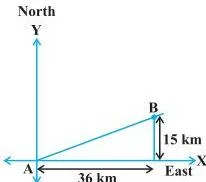
The measurement problem comes next. Town B lies 36 km east and 15 km north of town A — you cannot run a tape between them, but the two displacements are the legs of a right triangle, so Pythagoras gives the distance (p. 100). That triangle is the distance formula.
The section formula is born from a similar situation: a telephone company wants a relay tower at P on segment AB with its distance from B twice its distance from A, so P divides AB in the ratio 1 : 2 (p. 106). With A at the origin and B at (36, 15), the solution is P(12, 5). That triangle is the section formula.
The chapter closes with a Summary of its four results and a Note to the Reader that tells you exactly what is not covered: external division, which is deferred to higher classes (p. 112).
Key Concepts: Distance Formula, Section Formula and the Mid-point
The whole chapter is two formulas, and both come from right triangles — one from Pythagoras, one from similar triangles. Understand the triangles and the formulas stop being things to memorise.
The Distance Formula: Derived from a Right Triangle
The distance between two points is the hypotenuse of a right triangle whose legs are the horizontal gap and the vertical gap between the points.
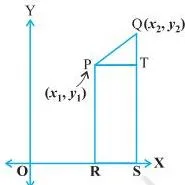
Take two points \( P(x_1, y_1) \) and \( Q(x_2, y_2) \). Drop perpendiculars from both to the x-axis, and draw a perpendicular from P to the line from Q to the axis. The horizontal leg is \( x_2 – x_1 \) and the vertical leg is \( y_2 – y_1 \) (NCERT p. 102). Pythagoras in that right triangle gives:
\[ PQ = \sqrt{(x_2 – x_1)^2 + (y_2 – y_1)^2} \]
This is the distance formula (NCERT p. 102). Two details matter. First, distance is never negative, so we take only the positive square root. Second, the order of subtraction does not matter: \( (x_1 – x_2)^2 = (x_2 – x_1)^2 \), because the differences are squared — that is why the book can write the formula with the coordinates either way round (p. 102).
A special case worth memorising: the distance of P(x, y) from the origin O(0, 0) is \( OP = \sqrt{x^2 + y^2} \) (p. 102). Exercise 7.1 Question 2 uses exactly this shortcut.
Worked example (new numbers): show that A(−1, 2), B(3, 2) and C(1, 6) form an isosceles triangle.
Step 1: Compute AB.
The y-coordinates are both 2, so AB is just the horizontal gap: \( AB = \sqrt{(3 – (-1))^2 + (2 – 2)^2} = \sqrt{4^2 + 0^2} = 4 \).
- Step 1: Compute AC, minding the sign of the negative x-coordinate: \( AC = \sqrt{(1 – (-1))^2 + (6 – 2)^2} = \sqrt{2^2 + 4^2} = \sqrt{20} \).
- Step 2: Compute BC: \( BC = \sqrt{(1 – 3)^2 + (6 – 2)^2} = \sqrt{(-2)^2 + 4^2} = \sqrt{20} \).
Final answer: \( AC = BC = \sqrt{20} \), so triangle ABC is isosceles, with base AB.
The Section Formula: Dividing a Segment in a Given Ratio
The section formula answers a new question: where is the point that splits a segment in a given ratio? The relay tower is the seed — it splits AB in the ratio 1 : 2 — and the derivation leans on AA similarity from Chapter 6 (NCERT p. 106).
If P divides the segment joining A(x₁, y₁) and B(x₂, y₂) internally in the ratio \( m_1 : m_2 \), meaning \( PA : PB = m_1 : m_2 \), then (NCERT p. 107):
\[ P = \left( \frac{m_1x_2 + m_2x_1}{m_1 + m_2}, \frac{m_1y_2 + m_2y_1}{m_1 + m_2} \right) \]
There is also a \( k : 1 \) version: if the ratio is written \( k : 1 \), the coordinates become \( \left( \frac{kx_2 + x_1}{k+1}, \frac{ky_2 + y_1}{k+1} \right) \) (p. 107). This form is handy when the question says “in what ratio” — you solve for k.
The classic trap is the cross-pairing. The part of the ratio that belongs to A multiplies the coordinates of B: \( m_1 \) travels with \( x_2 \) and \( y_2 \), never with \( x_1 \) and \( y_1 \). A memory hook: “A’s share pays for B’s coordinates.” Check it on the relay tower — the 1 (A’s part) multiplies B’s 36 and 15, giving x = 12 and y = 5.
Why the formula works: drawing perpendiculars and parallels creates similar triangles ΔPAQ and ΔBPC, and equality of corresponding sides gives \( \frac{x – x_1}{x_2 – x} = \frac{m_1}{m_2} \), which rearranges into the formula above (p. 107).
Worked example (new numbers): divide the segment from A(−2, 5) to B(7, −1) internally in the ratio 2 : 1.
Step 1: Identify \( m_1 = 2 \) (the part with A) and \( m_2 = 1 \) (the part with B).
The cross-pairing puts \( m_1 \) with B’s coordinates.
\[ x = \frac{2(7) + 1(-2)}{2 + 1} = \frac{14 – 2}{3} = 4 \]
Step 2: Same pairing for the y-coordinates, watching the sign of A’s y-coordinate: \( y = \frac{2(-1) + 1(5)}{2 + 1} = \frac{-2 + 5}{3} = 1 \).
Final answer: P(4, 1). Check: \( PA = \sqrt{(4+2)^2 + (1-5)^2} = \sqrt{52} \) and \( PB = \sqrt{(7-4)^2 + (-1-1)^2} = \sqrt{13} \), so \( PA : PB = \sqrt{52} : \sqrt{13} = 2 : 1 \). The ratio checks.
Mid-point, and the Formulas at a Glance
The mid-point is the section formula with the ratio 1 : 1 (NCERT p. 107). Putting \( m_1 = m_2 = 1 \) into the formula collapses it to the average of the coordinates:
\[ M = \left( \frac{x_1 + x_2}{2}, \frac{y_1 + y_2}{2} \right) \]
Worked example (new numbers): the mid-point of AB is M(2, −1) and B is (5, 3). Find A.
- Step 1: Rearrange the mid-point formula for an endpoint: \( x_1 = 2M_x – x_2 = 2(2) – 5 = -1 \), and \( y_1 = 2M_y – y_2 = 2(-1) – 3 = -5 \).
- Step 2: Verify by averaging: the mid-point of (−1, −5) and (5, 3) is \( \left( \frac{-1+5}{2}, \frac{-5+3}{2} \right) = (2, -1) \), which matches M.
Final answer: A(−1, −5).
Here is the whole chapter on one screen — the four formula results, with what each symbol means. This is the night-before formula sheet.
| Formula | What it gives | Meaning of symbols |
|---|---|---|
| \( PQ = \sqrt{(x_2 – x_1)^2 + (y_2 – y_1)^2} \) | Distance between two points P and Q | \( (x_1, y_1) \) and \( (x_2, y_2) \) are the two points; take the positive root only |
| \( OP = \sqrt{x^2 + y^2} \) | Distance of a point from the origin | \( (x, y) \) is the point; O is \( (0, 0) \) |
| \( \left( \frac{m_1x_2 + m_2x_1}{m_1 + m_2}, \frac{m_1y_2 + m_2y_1}{m_1 + m_2} \right) \) | Point dividing AB internally in \( m_1 : m_2 \) | \( m_1 \) belongs to A but multiplies B’s coordinates; \( m_2 \) belongs to B but multiplies A’s |
| \( \left( \frac{x_1 + x_2}{2}, \frac{y_1 + y_2}{2} \right) \) | Mid-point of a segment | The section formula with the ratio \( 1 : 1 \) |
The Chapter’s Figures, Explained
Every figure in this chapter carries a derivation — read the diagrams and the formulas stop being magic.
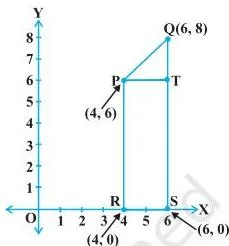
This is the distance formula’s seed. P(4, 6) and Q(6, 8) both sit in the first quadrant. Perpendiculars from P and Q to the x-axis meet it at (4, 0) and (6, 0), and a perpendicular from P to the line QS gives point T. The horizontal leg is 2 units and the vertical leg is 2 units (NCERT pp. 100–101). Pythagoras then gives \( PQ = \sqrt{2^2 + 2^2} = 2\sqrt{2} \).
Now P(6, 4) and Q(−5, −3) lie in different quadrants, so the gaps cross the axes. The horizontal gap is \( 6 – (-5) = 11 \) units and the vertical gap is \( 4 – (-3) = 7 \) units; the book asks you to work out why before it states the numbers (p. 101). Pythagoras gives \( PQ = \sqrt{11^2 + 7^2} = \sqrt{170} \). The point of the picture: the formula works unchanged even when coordinates are negative.
This figure belongs to the first full application of the distance formula. The three distances come out as 7.07, 7.21 and 1.41 (approx.). Because the sum of any two exceeds the third, the points form a triangle; and because \( PQ^2 + PR^2 = QR^2 \), the converse of Pythagoras shows the angle at P is \( 90^\circ \) (pp. 102–103).
Two tests in one picture: a triangle test and a right-angle test.
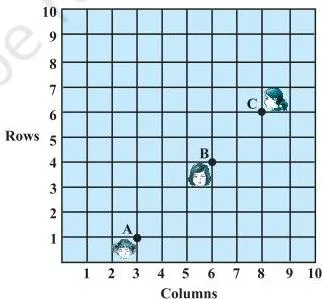
Three students sit at A(3, 1), B(6, 4) and C(8, 6). The distances are \( AB = 3\sqrt{2} \), \( BC = 2\sqrt{2} \) and \( AC = 5\sqrt{2} \), and \( AB + BC = AC \) — the largest distance is the sum of the other two, which is exactly the test for three points lying on one line (p. 104). The picture is of desks, but it is teaching collinearity.
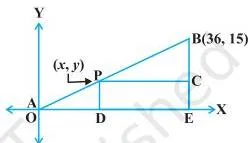
This is the whole motivation for the section formula. Town A sits at the origin, town B at (36, 15), and the tower P must satisfy PB = 2 × PA, so P divides AB in the ratio 1 : 2 (p. 106). The perpendiculars create similar triangles ΔPOD and ΔBPC, whose corresponding sides give \( \frac{x}{36 – x} = \frac{1}{2} \) and \( \frac{y}{15 – y} = \frac{1}{2} \), so x = 12 and y = 5.
The same similar-triangle argument returns in the general derivation on p. 107.
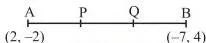
The trisection figure shows AB split into three equal parts, AP = PQ = QB (p. 109). With A(2, −2) and B(−7, 4), P divides AB in the ratio 1 : 2, giving \( \left( \frac{1(-7) + 2(2)}{1+2}, \frac{1(4) + 2(-2)}{1+2} \right) = (-1, 0) \), and Q divides AB in the ratio 2 : 1, giving (−4, 2). The book adds a quiet trick: Q is also the mid-point of PB, so you can reach it two different ways (p. 110).
Definitions You Need: Abscissa, Ordinate, Collinear and More
This chapter’s questions are worded with a few exact terms, and each has one precise meaning. These are the words that decide whether a question is easy or confusing.
- Abscissa — the x-coordinate of a point, its distance from the y-axis (p. 99).
- Ordinate — the y-coordinate of a point, its distance from the x-axis (p. 99).
- Point on the x-axis — always of the form (x, 0); a point on the y-axis is always of the form (0, y) (p. 99).
- Collinear — points lying on one straight line; checked with distances, because the largest distance must equal the sum of the other two (p. 104).
- Equidistant — at equal distances from two given points; you set AP = BP and solve (p. 104).
- Mid-point — the point that divides a segment in the ratio 1 : 1 (p. 107).
- Trisection — dividing a segment into three equal parts, using the ratios 1 : 2 and 2 : 1 (p. 109).
Common Mistakes Students Make in Coordinate Geometry Class 10
A handful of mistakes account for nearly every mark lost in this chapter, and all of them are avoidable. The table names each error, the correction, and a way to check yourself before you submit.
| Mistake | Correct rule | How to check your answer |
|---|---|---|
| Swapping \( m_1 \) and \( m_2 \) in the section formula | The part of the ratio belonging to A multiplies the coordinates of B; in \( x = \frac{m_1x_2 + m_2x_1}{m_1 + m_2} \), \( m_1 \) travels with \( x_2 \) (p. 107) | Ask which endpoint is nearer to P. That endpoint’s ratio part must multiply the far endpoint’s coordinates. Then verify \( PA : PB \) really equals \( m_1 : m_2 \). |
| Writing y = 0 for a point on the y-axis | A point on the x-axis is (x, 0); a point on the y-axis is (0, y) (p. 99) | Say it aloud: “on the x-axis means the height is zero” — the zero goes in the y position. |
| Sign errors when subtracting negative coordinates | Write the differences in brackets before squaring: \( (6 – (-5))^2 \) is \( 11^2 \), not \( 1^2 \) (p. 102) | Substitute both coordinates with brackets and read each bracket’s sign before you square. |
| Taking the negative square root | Distance is always non-negative — take only the positive root (p. 102) | A negative distance is impossible; if you get one, the sign error happened earlier. |
| Testing collinearity with the wrong pair | The largest of the three distances must equal the sum of the other two (p. 104) | Order the three distances, then check largest = sum of the smaller two. If no pair works, the points are not collinear. |
| Not verifying the answer | After finding an unknown coordinate, substitute it back (p. 105) | Compute AP and BP with your answer; if they are unequal, re-solve. |
How to Practise: A Question Map for Exercises 7.1 and 7.2
The two exercises are not a random mix — every question tests one specific idea, and knowing which is which makes practice faster.
| Question | What it tests | How to recognise it |
|---|---|---|
| Ex 7.1 Q1 | Direct distance formula | Two points are given; the question says “find the distance”. |
| Ex 7.1 Q2 | Distance from the origin | Points (0, 0) and (36, 15) — the town problem from Section 7.2. |
| Ex 7.1 Q3 | Collinearity test | Three points; compute three distances and check largest = sum. |
| Ex 7.1 Q4 | Isosceles triangle check | Three points; find two equal distances. |
| Ex 7.1 Q5 | Square check | Four points; equal sides and equal diagonals (Fig. 7.8). |
| Ex 7.1 Q6 | Naming a quadrilateral | Four points; distances and diagonals decide the name. |
| Ex 7.1 Q7 | Point on the x-axis equidistant from two points | “On the x-axis” — let the point be (x, 0), set AP = BP. |
| Ex 7.1 Q8 | Reverse distance formula | The distance is given (10 units); solve for an unknown y. |
| Ex 7.1 Q9 | Equidistant point plus two distances | Write QP = QR to find x, then find QR and PR. |
| Ex 7.1 Q10 | Relation between x and y from equal distances | Set AP = BP and simplify to a linear equation. |
| Ex 7.2 Q1 | Direct section formula | “Divides the join … in the ratio 2 : 3”. |
| Ex 7.2 Q2 | Points of trisection | Two points split 1 : 2 and 2 : 1. |
| Ex 7.2 Q3 | Real-life flags: distance then mid-point | Sports-day flags; distance first, halfway flag second. |
| Ex 7.2 Q4 | Finding the ratio from a given point | A point is given; let the ratio be k : 1 and solve. |
| Ex 7.2 Q5 | Division by the x-axis | On the x-axis, the y-coordinate is 0 — set it and solve. |
| Ex 7.2 Q6 | Parallelogram vertices | Diagonals bisect each other — equate the two mid-points. |
| Ex 7.2 Q7 | Diameter and centre | The centre is the mid-point of diameter AB. |
| Ex 7.2 Q8 | AP = 3/7 AB | This means P divides AB in the ratio 3 : 4. |
| Ex 7.2 Q9 | Four equal parts | Successive mid-points give the quarter points. |
| Ex 7.2 Q10 | Rhombus area | Find the diagonals, then area = half their product. |
Two observations tie the exercises together. Questions 7–10 of Exercise 7.1 are one family: all four are solved by writing AP = BP (or a given distance) and simplifying. And Question 10 of Exercise 7.2 is a distance-formula question in disguise — its hint hands you the rhombus-area formula, and the diagonal lengths come straight from the distance formula.
For a full-marks answer, show every substitution with brackets before simplifying, and for section-formula questions state the pairing (which ratio part belongs to which endpoint) before writing the formula. Both exercises are short-answer questions — there are no multiple-choice items — and several questions (the collinearity, square and quadrilateral ones) ask for a reason, so a bare coordinates answer loses marks.
One thing you can stop worrying about: the book itself says external division — the section formula for a point outside the segment — is not covered in this chapter; it comes in higher classes, so the Note to the Reader on p. 112 tells you it is safe to skip.
Coordinate Geometry Class 10: Night-Before Revision Summary
The book ends with a Summary; this section reworks those points into a faster read. This is revision, not teaching.
- Distance formula: \( PQ = \sqrt{(x_2 – x_1)^2 + (y_2 – y_1)^2} \), and distance is the positive square root only (p. 112).
- Distance from the origin: \( OP = \sqrt{x^2 + y^2} \).
- Section formula: P dividing AB internally in \( m_1 : m_2 \) has coordinates \( \left( \frac{m_1x_2 + m_2x_1}{m_1 + m_2}, \frac{m_1y_2 + m_2y_1}{m_1 + m_2} \right) \) — \( m_1 \) belongs to A and multiplies B’s coordinates.
- Mid-point: the special case \( m_1 = m_2 = 1 \), giving \( \left( \frac{x_1 + x_2}{2}, \frac{y_1 + y_2}{2} \right) \).
Both formulas are right-triangle results: the distance formula comes from Pythagoras, the section formula from similar triangles. If you blank on a formula, draw the perpendiculars and the triangles re-derive it — that is exactly the chapter’s own method.
Related NCERT Class 10 Maths Chapters
Coordinate geometry sits between two chapters you already know. The section formula’s derivation uses AA similarity from Chapter 6 Triangles (NCERT p. 106), and the right-triangle thinking behind the distance formula carries into Chapter 8 Introduction to Trigonometry. For the rest of the book, use the Class 10 Mathematics notes and the Class 10 hub.
Sources and Data Verification
- The figures, formulas and page references on this page describe the NCERT Class 10 Mathematics textbook, Chapter 7 Coordinate Geometry, official edition (Reprint 2026-27), printed pages 98–112.
- This page covers only this chapter of this one textbook; it does not attempt to cover the full CBSE scheme of subjects.
- The page is maintained for the current session using the NCERT information available to us.
- NCERT settles textbooks, editions and official PDFs; CBSE settles the curriculum, syllabus and examinations. Textbook contents and the examinable syllabus are not always identical, so check the current official syllabus.
Reference: NCERT Class 10 Mathematics textbook, chapter 7, official edition on ncert.nic.in.
Coordinate Geometry Class 10: Frequently Asked Questions
What is the distance formula in coordinate geometry class 10?
The distance formula is \( PQ = \sqrt{(x_2 – x_1)^2 + (y_2 – y_1)^2} \), where \( (x_1, y_1) \) and \( (x_2, y_2) \) are the two points (NCERT p. 102). It is the hypotenuse of the right triangle whose legs are the horizontal gap \( x_2 – x_1 \) and the vertical gap \( y_2 – y_1 \).
Why does the section formula become the midpoint formula when the ratio is 1 : 1?
Put \( m_1 = m_2 = 1 \) into the section formula. The coordinates become \( \left( \frac{x_1 + x_2}{2}, \frac{y_1 + y_2}{2} \right) \), which is the average of the two endpoints — that is the mid-point (NCERT p. 107).
How do you check whether three points are collinear using the distance formula?
Compute the three distances and compare them. If the largest distance equals the sum of the other two, the points are collinear — as in Example 3, where AB + BC = AC (NCERT p. 104). If no pair satisfies this, they are not on one line.
How do you find the ratio in which a point divides a line segment?
Write the ratio as \( m_1 : m_2 \) (or \( k : 1 \)), substitute the given point into the section formula, then equate the x-coordinates (and check the y-coordinates) and solve, exactly as Example 7 does (NCERT pp. 108–109).
Is the section formula for external division in the class 10 syllabus?
No. The book’s Note to the Reader states that external division is not covered in this chapter — the section formula for a point outside the segment is studied in higher classes (NCERT p. 112). Only internal division appears in Class 10.
How do you find a point on the x-axis or y-axis that is equidistant from two given points?
A point on the x-axis has the form (x, 0) and a point on the y-axis the form (0, y) (NCERT p. 99). Set its distance from the two given points equal (AP = BP), square both sides and solve — exactly how Example 5 finds the point (0, 9) (pp. 104–105).
Explore Class 10 Mathematics Books
Class 10 Mathematics on LearnCBSE:
Related chapters: