
Probability 14 Class 10 is the final chapter of the NCERT Class 10 Mathematics textbook. It runs about 16 printed pages — textbook pages 201 to 217 — and the official chapter PDF is offered right here, with an explanation of the chapter’s key ideas beneath it.
NCERT Probability 14 Class 10 PDF Download
The official file is exactly the chapter printed in the textbook, and keeping it open as a PDF makes the chapter easy to search, zoom and print while you study.
Download the NCERT Class 10 Maths Chapter 14 Probability PDF — the official chapter file from ncert.nic.in, identical to the printed textbook pages, and the copy to keep open while you work through this page.
| What the chapter holds | Count | Where it is used |
|---|---|---|
| Printed pages | 16 | |
| Sections in the chapter | 2 | |
| Figures with NCERT captions | 4 | |
| Tables | 2 | |
| Exercise questions | 24 | answered in our NCERT Solutions |
| Official NCERT PDF | Download the chapter PDF | the chapter exactly as NCERT publishes it |
Chapter 14 at a Glance: What the File Contains
The table below shows what the chapter file actually holds — its sections, figures and exercise questions — so you know the size and shape of the chapter before opening it.
The teaching sits almost entirely in section 14.1, Probability — A Theoretical Approach. Exercise 14.1 closes it, section 14.2 is the printed Summary, and a Note to the Reader ends the chapter on page 217.
What Chapter 14 Covers: From Class IX Trials to Theoretical Probability
This chapter replaces “run the experiment many times” with a formula that works from assumptions alone. The through-line of the chapter runs as follows.
- Class IX experimental (empirical) probability. You already know \(P(E) = \frac{\text{Number of trials in which the event happened}}{\text{Total number of trials}}\). That formula needs a repeatable experiment, which fails for a satellite launch or an earthquake — you cannot repeat either to count outcomes (NCERT, p. 203).
- The equally likely assumption. A fair coin’s head and tail, and a fair die’s six faces, have no reason to favour one outcome over another. The bag with 4 red balls and 1 blue ball does not give equally likely “red” and “blue” outcomes, even though every individual ball is equally likely to be drawn (NCERT, p. 203).
- The theoretical probability definition. Probability becomes \(\frac{\text{outcomes favourable to the event}}{\text{all possible outcomes}}\), a definition credited to Pierre Simon Laplace in 1795 (NCERT, p. 203).
- The example ladder. One coin, a bag of balls, one die, a deck of cards, real-life situations, two coins together, then two dice together (NCERT, pp. 204–214).
- Exercise 14.1 applies all of it (NCERT, pp. 214–217).
- Summary and Note to the Reader close the chapter (NCERT, p. 217).
Key Concepts in Section 14.1
The ideas below carry the whole section. Each one opens with what it is and why the chapter needs it, with the NCERT page beside it so you can follow along in your own book.
Equally Likely Outcomes: The Assumption Everything Depends On
A fair coin lands head or tail with no bias towards either side — NCERT calls this property being “unbiased”, and a “random toss” means the coin falls freely without bias or interference (NCERT, p. 203).
Two experiments show what equally likely means:
- A die rolled once: faces 1 to 6 have the same chance, so the six outcomes are equally likely.
- A bag with 4 red balls and 1 blue ball: “red” and “blue” are not equally likely, because four of the five balls are red — even though each individual ball has the same chance of being drawn.
From this point the chapter simply assumes every experiment has equally likely outcomes (NCERT, p. 203). That assumption is what makes the formula in the next subsection valid.
The Theoretical Probability Formula and Its 16th-Century Origin
This is the chapter’s definition of probability: the share of all possible outcomes that are favourable to the event, valid only when all outcomes are equally likely (NCERT, p. 203).
\[ P(E) = \frac{\text{Number of outcomes favourable to } E}{\text{Number of all possible outcomes of the experiment}} \]
The contrast with Class IX is the source of the numbers. Experimental probability counts trials that have actually happened; theoretical probability counts outcomes that are assumed equally likely, so no repetition is needed. That matters for experiments that cannot be repeated, like a satellite launch or an earthquake (NCERT, p. 203).
The chapter opens with history because probability began with games of chance: J. Cardan, an Italian physician and mathematician, wrote the first book on the subject, The Book on Games of Chance, in the 16th century, and Laplace gave the classical definition in 1795. That is why the examples are coins, dice and cards (NCERT, pp. 203–204).
Worked example with new numbers. A bag contains 6 red marbles and 4 blue marbles. One marble is drawn at random. Find P(red), P(blue) and P(not red).
Step 1: Confirm the equally likely assumption.
“At random” means every marble has the same chance of being drawn.
Step 2: Count the possible outcomes.
Total marbles = 6 + 4 = 10.
Step 3: Apply \(P(E) = \frac{\text{favourable}}{\text{total}}\) to each event.
\[ P(\text{red}) = \frac{6}{10} = \frac{3}{5} \]
\[ P(\text{blue}) = \frac{4}{10} = \frac{2}{5} \]
\[ P(\text{not red}) = \frac{4}{10} = \frac{2}{5} \]
Final answer: P(red) = \(\frac{3}{5}\), P(blue) = \(\frac{2}{5}\), P(not red) = \(\frac{2}{5}\). Notice P(red) + P(not red) = \(\frac{3}{5} + \frac{2}{5} = 1\) — the two events are complementary.
Complementary Events: The P(not E) = 1 – P(E) Shortcut
The complement is the most reused idea in the chapter. In the die experiment, \(P(\text{number greater than 4}) = \frac{2}{6} = \frac{1}{3}\) and \(P(\text{number less than or equal to 4}) = \frac{4}{6} = \frac{2}{3}\), and the two add to 1 because the second event is exactly “not the first” (NCERT, pp. 205–206).
Watch the wording trap: “not greater than 4” means “less than or equal to 4” — the book itself points this out when it builds the complement (NCERT, p. 206).
For any event E, \(\bar{E}\) is read “not E”. Then \(P(E) + P(\bar{E}) = 1\), which gives \(P(\bar{E}) = 1 – P(E)\) (NCERT, p. 206).
NCERT reuses this rule again and again:
- Example 4 — not an ace: \(1 – \frac{1}{13} = \frac{12}{13}\) (pp. 207–208);
- Example 5 — Reshma’s win: \(1 – 0.62 = 0.38\) (p. 208);
- Example 6 — same birthday: \(1 – \frac{364}{365}\) (p. 208);
- Example 7 — a boy representative: \(1 – \frac{5}{8} = \frac{3}{8}\) (p. 209);
- Example 9 — at least one head: \(1 – P(\text{no head}) = 1 – \frac{1}{4}\) (p. 210).
Mini worked example. If the probability of rain tomorrow is 0.35, what is the probability of no rain?
Step 1: Rain and no rain are complementary events, so their probabilities add to 1.
\[ P(\text{no rain}) = 1 – P(\text{rain}) = 1 – 0.35 = 0.65 \]
Final answer: P(no rain) = 0.65.
Elementary Events, Impossible Events and Sure Events: The Bounds of Probability
Three types of events mark the two ends of the probability scale. A probability can never go below 0 or above 1, and these events show why.
- Elementary event — an event with exactly one outcome, like “getting a head” in a single toss. The probabilities of all elementary events of an experiment add to 1 (NCERT, p. 205).
- Impossible event — an event with no favourable outcomes, so \(P = \frac{0}{6} = 0\). Example: getting 8 in one throw of a die (NCERT, p. 207).
- Sure or certain event — the event always happens, so \(P = \frac{6}{6} = 1\). Example: getting a number less than 7 in one throw of a die (NCERT, p. 207).
Because favourable outcomes can never exceed total outcomes, every probability obeys \(0 \leq P(E) \leq 1\) (NCERT, p. 207). This is the rule behind Question 4: -1.5 cannot be a probability because it is negative, while 15%, which is 0.15, can (NCERT, p. 215).
The Card Deck: 52 Cards, 4 Suits, 13 Each
Example 4 and Question 14 assume you know the structure of a deck of playing cards, stated once on NCERT page 207. Treat it as a fact sheet, not a set of questions to memorise.
| Suit | Colour | Cards in the suit |
|---|---|---|
| Spades | Black | 13 |
| Clubs | Black | 13 |
| Hearts | Red | 13 |
| Diamonds | Red | 13 |
Each suit runs ace, king, queen, jack, 10, 9, 8, 7, 6, 5, 4, 3, 2. Kings, queens and jacks are the face cards. Well-shuffling a deck is exactly what makes the outcomes equally likely (NCERT, p. 207).
| Deck fact | Count |
|---|---|
| Total cards | 52 |
| Red cards (hearts + diamonds) | 26 |
| Black cards (spades + clubs) | 26 |
| Face cards (3 per suit) | 12 |
| Aces | 4 |
These facts unlock the card questions. Example 4 gives \(P(\text{ace}) = \frac{4}{52} = \frac{1}{13}\), and \(P(\text{not ace}) = \frac{48}{52} = \frac{12}{13}\), which the book also reaches through the complement (NCERT, pp. 207–208). Question 14 asks for single-card probabilities such as a red king (\(\frac{2}{52}\)), a face card (\(\frac{12}{52}\)) and a spade (\(\frac{13}{52}\)).
Two Coins and Two Dice: Listing Outcomes Without Missing Any
Whenever two objects are involved, ordered pairs matter and every pair must be listed. This one rule prevents most of the chapter’s errors.
Two coins (Example 9). Toss a one-rupee coin and a two-rupee coin together. The possible outcomes are (H,H), (H,T), (T,H), (T,T), all equally likely. (H,T) is different from (T,H) because the two coins are distinct objects (NCERT, p. 210).
“At least one head” covers the first three outcomes, so \(P = \frac{3}{4}\); the book also reaches it as \(1 – P(\text{no head}) = 1 – \frac{1}{4}\).
Two dice (Example 13). A blue die and a grey die are thrown. Each outcome is an ordered pair (number on the blue die, number on the grey die), so there are \(6 \times 6 = 36\) outcomes, and the pair (1,4) is different from (4,1) (NCERT, p. 213). The full grid, printed as Fig. 14.3 in the book, is below.
| Blue / Grey | 1 | 2 | 3 | 4 | 5 | 6 |
|---|---|---|---|---|---|---|
| 1 | (1, 1) | (1, 2) | (1, 3) | (1, 4) | (1, 5) | (1, 6) |
| 2 | (2, 1) | (2, 2) | (2, 3) | (2, 4) | (2, 5) | (2, 6) |
| 3 | (3, 1) | (3, 2) | (3, 3) | (3, 4) | (3, 5) | (3, 6) |
| 4 | (4, 1) | (4, 2) | (4, 3) | (4, 4) | (4, 5) | (4, 6) |
| 5 | (5, 1) | (5, 2) | (5, 3) | (5, 4) | (5, 5) | (5, 6) |
| 6 | (6, 1) | (6, 2) | (6, 3) | (6, 4) | (6, 5) | (6, 6) |
Reading from the grid (NCERT, p. 213):
- Sum 8 — the pairs (2,6), (3,5), (4,4), (5,3), (6,2): five favourable outcomes, so \(P = \frac{5}{36}\).
- Sum 13 — no pair gives it, so \(P = \frac{0}{36} = 0\): an impossible event.
- Sum 12 or less — every pair qualifies, so \(P = \frac{36}{36} = 1\): a sure event.
Question 22 then traps a common argument: the 11 sums from 2 to 12 are not 11 equally likely outcomes. The 36 ordered pairs are the outcomes; sum 8 is produced by five of them while sum 2 is produced by only one, so the sums cannot each have probability \(\frac{1}{11}\) (NCERT, p. 216).
Figure Walkthrough: What the Chapter’s Diagrams Show
The figures worth pausing on are reproduced below, each captioned and explained so you can read the same diagram in your own book.
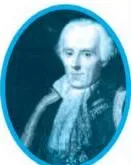
This illustration sits beside the historical note on page 204. Look at it while reading that paragraph: probability is rooted in games of chance, which is exactly why the chapter’s examples are coins, dice and cards. The same note traces the subject through James Bernoulli, A. de Moivre and Laplace’s Theorie Analytique des Probabilites of 1812.

Example 10 uses this number line. The music can stop at any instant between 0 and 2 minutes, so the total “distance” of outcomes is 2. The favourable distance — stopping within the first half-minute — runs from 0 to \(\frac{1}{2}\). That makes \(P = \frac{\frac{1}{2}}{2} = \frac{1}{4}\): probability as a ratio of lengths.
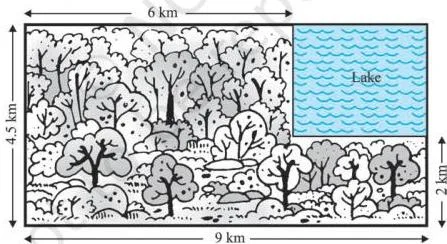
Example 11 extends the same idea to areas. The whole region has area \(4.5 \times 9 = 40.5\) km², and the lake has area \(2.5 \times 3 = 7.5\) km². Since the helicopter is equally likely to be anywhere in the rectangle, \(P(\text{crash in lake}) = \frac{7.5}{40.5} = \frac{5}{27}\).
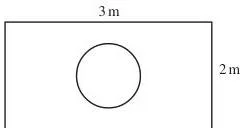
Question 20 turns the same area-ratio idea into an exercise: the die is equally likely to land anywhere in the rectangle, so the required probability is the circle’s area divided by the rectangle’s area.
NCERT flags Examples 10 and 11 and Question 20 with an asterisk — “Not from the examination point of view” (NCERT, pp. 210, 211, 216). The length-and-area idea is present in the book, but the book itself marks it outside the examination focus. Textbook contents and the examinable syllabus are not always identical — check the current official CBSE syllabus.
Definitions You Should Be Able to Write Correctly
These are the terms the chapter itself defines, and exam answers usually need the precise idea. Each meaning below is the chapter’s definition in plainer words, with the page where it appears.
| Term | Meaning | NCERT page |
|---|---|---|
| Theoretical (classical) probability | The fraction of outcomes favourable to the event out of all possible outcomes, assuming all outcomes are equally likely. | 203 |
| Equally likely outcomes | Outcomes with no reason for one to occur more often than another — like the two faces of a fair coin. | 203 |
| Elementary event | An event with exactly one outcome; the probabilities of all elementary events of an experiment add to 1. | 205 |
| Complement of E (written \(\bar{E}\)) | The event “not E”. E and \(\bar{E}\) are complementary, so \(P(E) + P(\bar{E}) = 1\). | 206 |
| Impossible event | An event with zero favourable outcomes, so its probability is 0. | 207 |
| Sure or certain event | An event that always occurs, so its probability is 1. | 207 |
| At random | A short way of saying every outcome is equally likely to be chosen. | 203, 209 |
| Face cards | Kings, queens and jacks in a deck of cards. | 207 |
Common Mistakes in Class 10 Probability (and the Correction)
Every mistake below is a place the chapter itself warns about. The table names the error, the rule that fixes it, and how to check your own answer.
| Mistake | Correct rule | How to check your answer |
|---|---|---|
| Two coins have only three outcomes — two heads, two tails, one of each — so each has probability 1/3. | (H,T) and (T,H) are different outcomes because the coins are distinct, so there are four equally likely outcomes. | List (H,H), (H,T), (T,H), (T,T): “one of each” fills two of the four positions (NCERT, Example 9, p. 210; Q25(i), p. 217). |
| The sums 2 to 12 are eleven outcomes, so each sum has probability 1/11. | The 36 ordered pairs are the outcomes; each sum collects a different number of pairs. | P(sum 8) = \(\frac{5}{36}\), not \(\frac{1}{11}\) — count its five pairs in the grid (NCERT, p. 213; Q22(ii), p. 216). |
| “Not greater than 4” is read as “5 or 6”. | “Not greater than 4” means “less than or equal to 4” — outcomes 1, 2, 3, 4 — the complement of “greater than 4”. | The two events must add to 1: \(\frac{2}{6} + \frac{4}{6} = 1\) (NCERT, p. 206). |
| A probability such as -1.5 is accepted as a number. | Every probability obeys \(0 \leq P(E) \leq 1\), because favourable outcomes cannot exceed total outcomes. | -1.5 lies below 0 — impossible; 15% = 0.15 lies inside the range and is fine (NCERT, p. 207; Q4, p. 215). |
| “At least one head” is found by counting the one-head cases and missing both heads. | Use the complement: \(1 – P(\text{no head}) = 1 – \frac{1}{4} = \frac{3}{4}\). | Of the four pairs, only (T,T) fails, so three of four contain a head (NCERT, Example 9, p. 210; Q24(ii), p. 217). |
| After a bulb is drawn, the total for the next draw stays 20. | When the drawn item is not replaced, the total drops by one — from 20 to 19. | In Q17(ii), 15 good bulbs remain out of 19, so \(P = \frac{15}{19}\) (NCERT, p. 216). |
| P(not ace) is always worked out by counting the 48 cards. | \(P(\bar{E}) = 1 – P(E)\) is faster and less error-prone. | \(\frac{1}{13} + \frac{12}{13} = 1\), so 48/52 and \(1 – \frac{1}{13}\) agree (NCERT, p. 208). |
Exam Notes: What the Textbook Flags and How to Approach the Exercises
Three honest observations grounded in the chapter itself. None of this is a promise about the exam: textbook contents and the examinable syllabus are not always identical, so check the current official CBSE syllabus.
1. NCERT flags its own boundary. Examples 10 and 11 and Question 20 carry the asterisk “Not from the examination point of view” (NCERT, pp. 210, 211, 216). They introduce probability as a ratio of lengths and areas — read them to understand the idea, but the book itself marks them outside the examination focus.
2. Exercise 14.1 repeats a small set of situations. The recurring question types are:
- coins — the fairness of a single toss, two coins together, one coin tossed three times;
- a die — thrown once, thrown twice;
- two dice thrown together;
- cards — a full 52-card deck and a reduced 5-card pack;
- everyday lots — balls, marbles, candies, coins in a piggy bank, pens, bulbs, shirts, fish, numbered discs, a spinning arrow, birthdays.
Every one is solved by the same two steps: count the total possible outcomes, count the favourable outcomes, then divide. Questions 1 to 5 are direct concept checks — definitions, the 0 to 1 bounds, and the complement rule. Question 22(ii) and Question 25 are reasoning questions: you must justify in words why the three-outcome or eleven-outcome arguments are wrong.
3. The complement trigger. When a question says “not”, “at least”, “same” or “less than / at most”, try \(1 – P(\text{the opposite})\) first — it is usually shorter. NCERT uses the move in Examples 4, 5, 6, 7 and 9, and the exercise asks for it in Questions 5, 7, 8, 10, 21 and 24. These groupings describe the chapter’s own exercise set; they are not a syllabus promise.
Chapter 14 Summary: The Six Points to Revise
This is the chapter’s own Summary (section 14.2, NCERT, p. 217), rewritten so it revises faster.
- \(P(E) = \frac{\text{outcomes favourable to } E}{\text{all possible outcomes}}\), assuming equally likely outcomes (NCERT, p. 203).
- A sure or certain event has probability 1 (NCERT, p. 207).
- An impossible event has probability 0 (NCERT, p. 207).
- For any event, \(0 \leq P(E) \leq 1\) (NCERT, p. 207).
- An elementary event has exactly one outcome, and the probabilities of all elementary events of an experiment add to 1 (NCERT, p. 205).
- \(P(E) + P(\text{not } E) = 1\), so \(P(\bar{E}) = 1 – P(E)\); E and not E are complementary events (NCERT, p. 206).
The printed Summary contains a misprint writing \(P(E) + P(E) = 1\); the rule used throughout the chapter is \(P(E) + P(\text{not } E) = 1\). Revise the corrected form.
Close with the Note to the Reader (p. 217): experimental probability is based on what has actually happened, theoretical probability predicts from assumptions, and as the number of trials grows the two draw closer together.
Related Chapters and Resources
This listing is maintained for the 2026-27 academic session using the NCERT textbook information available to us. NCERT remains the authority for confirming the latest edition.
Chapter 13 Statistics is the chapter just before this one — experimental data and frequency tables appear there, and probability formalises them here.
For a wider revision sweep, the Class 10 Mathematics notes page gathers the subject chapter by chapter, the Class 10 hub links every subject in the class, and the main notes index is the starting point for everything on this site.
The full official textbook is available from the NCERT Class 10 Mathematics textbook page at ncert.nic.in.
Sources and Data Verification
- The page numbers and NCERT page references on this page describe the NCERT Class 10 Mathematics textbook, Chapter 14 (Probability), official NCERT edition.
- This page covers this single chapter of that book — not other books or other classes.
- The listing is maintained for the current academic session using the NCERT materials published on ncert.nic.in.
- NCERT settles textbook editions, chapters and official PDFs; CBSE settles the examinable syllabus. A chapter appearing in the textbook does not by itself prove that every part of it is examinable this session.
Frequently Asked Questions About Probability Chapter 14
What is the difference between experimental probability and theoretical probability?
Experimental probability comes from counting what actually happened in repeated trials — the Class IX formula divides the number of trials in which the event happened by the total number of trials. Theoretical probability divides outcomes favourable to the event by all possible outcomes, assuming equally likely outcomes, so no experiment needs to be run (NCERT, p. 203).
The chapter’s Note to the Reader adds that as the number of trials increases, the experimental value draws close to the theoretical one (NCERT, p. 217).
Why are two coins tossed together not three equally likely outcomes?
Because the two coins are distinct objects, so (H,T) and (T,H) are different outcomes. The sample space is (H,H), (H,T), (T,H), (T,T) — four equally likely outcomes — and “one of each” is produced by two of them, not one (NCERT, p. 210). Question 25(i) calls the three-outcome argument incorrect (NCERT, p. 217).
When two dice are thrown, why is each sum from 2 to 12 not equally likely?
Because the 36 ordered pairs are the outcomes, not the sums. Different sums have different numbers of pairs: sum 8 has 5 pairs and sum 2 has only 1, so the sums cannot each have probability 1/11 (NCERT, pp. 213, 216).
What does “at least one head” mean and what is the fastest way to find its probability?
“At least one head” means one head or both heads — every outcome except no head. The fastest route is the complement: \(P(\text{at least one head}) = 1 – P(\text{no head}) = 1 – \frac{1}{4} = \frac{3}{4}\) (NCERT, p. 210).
What are face cards and how many are there in a deck of 52 cards?
Face cards are kings, queens and jacks. There are 3 in each of the 4 suits, so a standard 52-card deck has 12 face cards (NCERT, p. 207).
Which parts of Chapter 14 are marked “not from the examination point of view” in the textbook itself?
Example 10 (the musical chair number line), Example 11 (the helicopter and lake) and Question 20 (the die and circle) carry the asterisk “Not from the examination point of view” (NCERT, pp. 210, 211, 216). They are worth reading for the idea of probability as a ratio of lengths or areas.
As always, check the current official CBSE syllabus, since textbook contents and the examinable syllabus are not always identical.
Reference: NCERT Class 10 Mathematics textbook, chapter 14, official edition on ncert.nic.in.
Explore Class 10 Mathematics Books
Class 10 Mathematics on LearnCBSE:
Related chapters: